

Key Takeaways
- Solar pump inverters can reduce farming electricity costs by 70-90% while providing a reliable water supply even during power outages
- MPPT technology in modern inverters maximizes energy harvest even during cloudy conditions, ensuring consistent irrigation performance
- Precision irrigation control through variable flow rates helps farmers conserve up to 30% more water compared to conventional pumping systems
- Government incentives and rebates can offset up to 50% of initial installation costs, making solar irrigation financially accessible
Imagine never worrying about electricity bills for irrigation again.
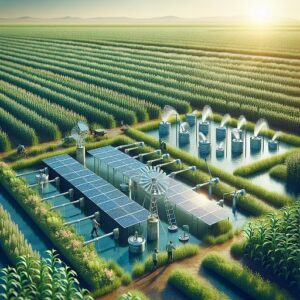
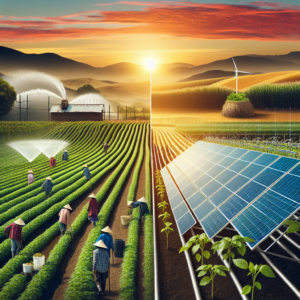
As climate change and rising energy costs continue to challenge agricultural operations worldwide, solar pump inverters are emerging as a transformative solution for modern farming. These sophisticated devices connect solar panels to water pumps, converting DC power from the sun into AC power that drives irrigation systems efficiently. By harnessing renewable energy from the sun, farmers can dramatically reduce operational costs while maintaining reliable water supply for crops.
The shift toward solar-powered irrigation represents more than just cost savings—it’s about building resilience into farming operations. Traditional irrigation methods often leave farmers vulnerable to grid outages and rising utility rates. Solar pump inverters eliminate these vulnerabilities by creating self-sufficient water delivery systems that operate independently from the grid. This technological advancement is particularly valuable for remote agricultural areas where grid connections are unreliable or nonexistent, opening new possibilities for productive farming in previously challenging locations.
Solar Pump Inverters: The Game-Changer for Modern Farming
Solar pump inverters have revolutionized irrigation by solving multiple challenges simultaneously. They address the high energy costs of traditional pumping, eliminate dependence on fossil fuels, and provide consistent water supply regardless of grid conditions. These systems convert solar energy directly into usable power for pumping operations, creating a seamless bridge between renewable energy and agricultural water needs. The technology has matured significantly in recent years, with modern inverters offering sophisticated features like automatic system protection, performance monitoring, and variable speed control.
What makes these systems truly remarkable is their scalability. From small family farms to large commercial operations, solar pump inverters can be sized appropriately to meet specific water requirements. Installation costs have decreased substantially over the past decade, while efficiency and reliability have dramatically improved. This favorable cost-to-performance ratio is driving rapid adoption across agricultural regions worldwide, with many farmers reporting complete return on investment within 3-5 years of installation.
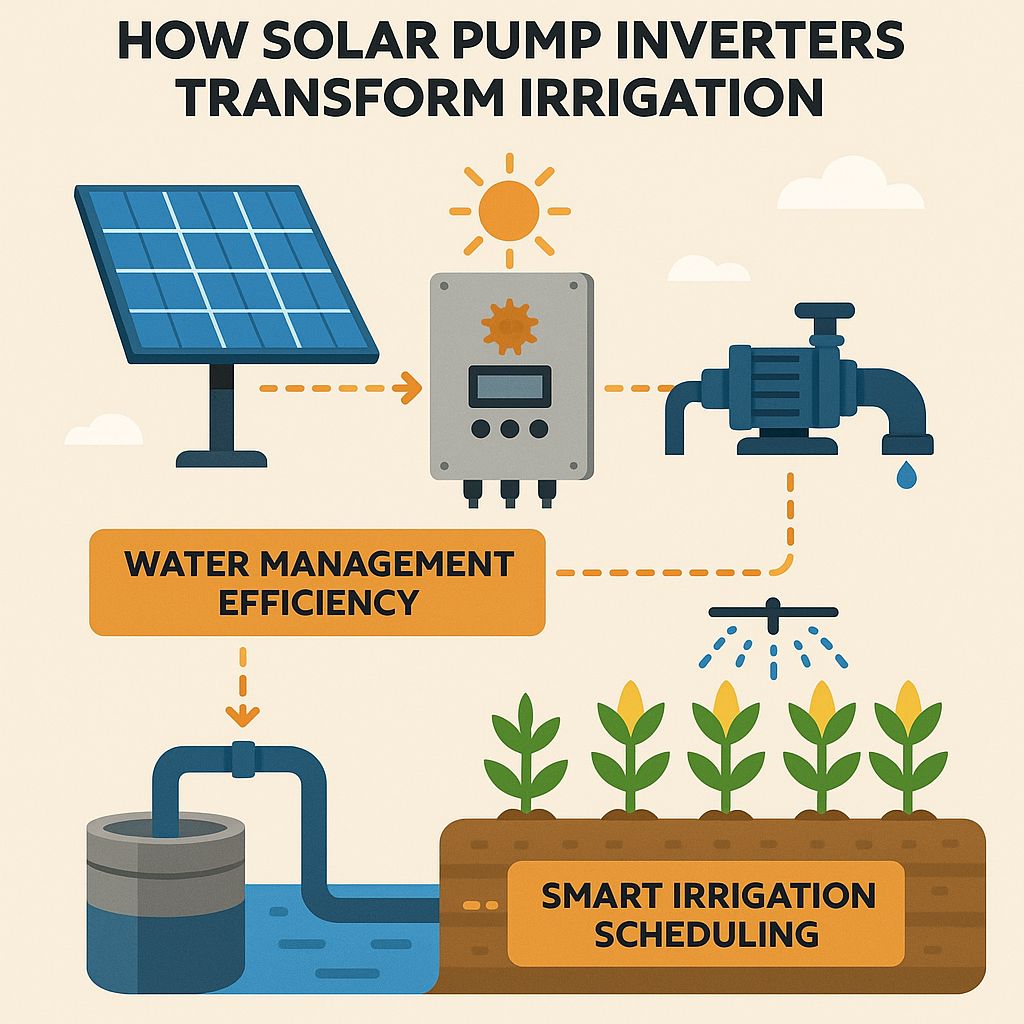
How Solar Pump Inverters Transform Irrigation
The fundamental transformation that solar pump inverters bring to farming operations lies in their ability to convert free solar energy into precisely controlled pumping power. Unlike traditional pumps that operate at fixed speeds regardless of demand, solar-powered systems can adjust their output based on available sunlight and actual irrigation needs. This flexibility translates to significant improvements in water management efficiency and reduced waste. Smart irrigation scheduling becomes possible, allowing farmers to deliver water when crops need it most rather than when electricity is available or affordable.
DC to AC Conversion: The Technical Magic
At the core of solar pump inverter functionality is the DC to AC conversion process. Solar panels naturally produce direct current (DC) electricity, but most irrigation pumps require alternating current (AC) to operate. The inverter bridges this gap by converting the DC output from solar panels into the AC power that pumps can utilize. This conversion process involves sophisticated power electronics that maintain stable voltage and frequency regardless of variations in solar intensity.
Modern solar pump inverters perform this conversion with remarkable efficiency, often exceeding 97% power conversion rates. This means nearly all the energy harvested from the sun reaches the pump with minimal losses. Additionally, advanced inverters incorporate power conditioning features that protect pumps from voltage spikes and irregular power flow, significantly extending equipment lifespan compared to pumps operating on inconsistent grid power.
The conversion technology also enables compatibility with various pump types and configurations, making solar irrigation adaptable to diverse farming operations. Whether a farm requires surface pumps for irrigation canals or submersible pumps for deep wells, solar inverters can be configured to provide the appropriate power characteristics for optimal performance.
Power Conversion Efficiency Comparison
Standard Grid Power: 85-90% efficiency with transmission losses
Diesel Generator Power: 25-35% energy conversion efficiency
Solar Pump Inverter: 95-98% DC to AC conversion efficiency
Overall System Efficiency: 85-92% from sunlight to water pumped
Maximum Power Point Tracking (MPPT) Technology
Perhaps the most significant technical innovation in solar pump inverters is Maximum Power Point Tracking (MPPT). This intelligent feature continuously analyzes and adjusts the electrical operating point of the solar array to extract the maximum possible power throughout the day as sunlight conditions change. MPPT technology ensures that the system operates at peak efficiency regardless of partial shading, cloud cover, or temperature variations that affect solar panel output.
Compatibility with Existing Farm Equipment
Solar pump inverters are designed with compatibility in mind, allowing farmers to integrate renewable energy without overhauling their entire irrigation infrastructure. Most quality inverters can connect to standard AC pumps that farmers already own, requiring minimal modifications to existing setups. This compatibility extends to various pump types including centrifugal, submersible, and surface pumps commonly used in agricultural applications.
The versatility doesn’t end with pump compatibility. Modern solar inverters feature adaptive input ranges that accommodate different solar panel configurations, giving farmers flexibility when designing their solar arrays. Many systems also include hybrid functionality, allowing automatic switching between solar power, grid electricity, and even generator backup depending on availability and demand. This flexibility ensures farmers can maximize their existing investments while gradually transitioning to renewable energy.
Installation interfaces have also been simplified, with plug-and-play connectors and intuitive control panels that don’t require specialized technical knowledge. Most systems can be installed and operational within days rather than weeks, minimizing disruption to farming operations during the transition period.
Solar pump inverters significantly transform irrigation for farmers by providing clean, affordable energy, improving water management, and enhancing overall farm productivity. This below table will go over how the Solar pump inverters are helping the farmer:
|
Benefit |
How it Transforms Irrigation |
Farmer Impact |
|---|---|---|
|
Cost Savings |
Converts solar power to run pumps, reducing need for grid electricity or diesel. |
Lower operating costs, greater financial stability. |
|
Energy Independence |
Enables off-grid irrigation and reduces reliance on unstable electricity. |
Reliable water access, especially in remote areas. |
|
Efficient Water Management |
Provides variable frequency control and automation for pump speed and scheduling. |
Precise water delivery improves yield, conserves water. |
|
Environmental Sustainability |
Uses renewable solar energy, cutting fossil fuel use and emissions. |
Greener farm operations, reduced carbon footprint. |
|
Operational Reliability |
MPPT technology ensures pumps run optimally even under fluctuating sunlight. |
Consistent irrigation regardless of weather or blackouts. |
|
Low Maintenance |
Few moving parts and system protection features extend pump life. |
Reduced repairs, less maintenance hassle. |
|
Remote Monitoring & Control |
Allows real-time monitoring of pump status, water flow, and energy usage. |
Faster response to issues; efficient resource use. |
sources for the table: 1, 2, 3, 4
5 Ways Solar Pump Inverters Cut Farming Costs
The financial benefits of solar pump inverters extend far beyond simple electricity savings. These systems create multiple avenues for cost reduction that compound over time, dramatically improving farm economics and sustainability. From operational savings to maintenance reductions and incentive opportunities, solar irrigation provides a comprehensive financial advantage over conventional pumping methods.
Slash Electricity Bills by 70-90%
The most immediate and noticeable benefit for farmers who switch to solar pump inverters is the dramatic reduction in electricity bills. Traditional irrigation often represents 20-30% of a farm’s total energy costs, making it a prime target for savings. By harnessing free solar energy, farmers typically reduce irrigation-related electricity expenses by 70-90%, depending on system size and local sunlight conditions.
For a mid-sized farm consuming 15,000 kWh annually for irrigation, this translates to potential savings of $1,800-$2,700 per year at average electricity rates. These savings increase proportionally with rising utility costs, creating an effective hedge against future energy price inflation. The ROI accelerates in regions with higher electricity rates or where time-of-use pricing penalizes daytime pumping – precisely when solar generation is at its peak.
Eliminate Diesel Fuel Expenses
For farms currently relying on diesel-powered pumps, the financial case for solar is even more compelling. Diesel generators not only consume expensive fuel but also require regular maintenance and eventual replacement. A typical diesel irrigation pump consumes 0.8-1.2 liters of fuel per hour of operation, with costs quickly accumulating during growing seasons.
Converting to solar eliminates these ongoing fuel expenses entirely while providing more consistent power quality for pumping operations. Farms previously spending $5,000-$10,000 annually on diesel for irrigation can redirect these funds to other operational needs or farm improvements. The environmental benefits are equally significant, with each converted diesel pump reducing carbon emissions by 10-15 tons annually. Learn more about solar-powered irrigation systems and their impact on farm efficiency.
Reduce Maintenance Requirements
Conventional electric and diesel pumps involve numerous moving parts and components that wear out over time, requiring regular maintenance and occasional emergency repairs. Solar pump systems, by contrast, have significantly fewer mechanical components and operate under less stress. The elimination of fuel combustion in particular removes many common failure points like filters, injectors, and exhaust systems that plague diesel setups.
Most solar pump inverters require only basic annual maintenance checks, with expected service intervals of 5-7 years for major components. This reduced maintenance burden translates to fewer operational interruptions and lower labor costs associated with pump system upkeep. Many farmers report maintenance cost reductions of 60-70% after switching to solar irrigation, with corresponding decreases in system downtime.
Maintenance Comparison: Solar vs. Traditional Pumping
Diesel Pump: 200-250 hours – Oil changes, filter replacements, injector cleaning
Grid-Connected Electric Pump: 500-1000 hours – Bearing replacements, pressure switch adjustments
Solar Pump System: 2000-3000 hours – Inverter inspection, panel cleaning
Available Government Incentives and Rebates
The transition to solar irrigation is further incentivized by numerous government programs designed to encourage renewable energy adoption in agriculture. These incentives can significantly reduce the initial investment required, improving project economics and accelerating payback periods. In the United States, programs like REAP (Rural Energy for America Program) can cover up to 25% of system costs through grants, while tax incentives may offset an additional 30% through investment tax credits.
Many states offer additional rebates and incentives specific to agricultural solar applications. These can include property tax exemptions for renewable energy equipment, sales tax exemptions on purchases, and performance-based incentives that provide ongoing payments for clean energy generation. Agricultural extension offices and renewable energy associations can help farmers identify and apply for these financial assistance programs, substantially reducing the net cost of solar pump installations.
Long-Term Return on Investment Analysis
When all factors are considered, solar pump inverters typically deliver complete return on investment within 3-7 years, depending on system size, local electricity costs, and available incentives. After this payback period, the systems continue generating essentially free irrigation power for 20+ years, creating substantial long-term value for farm operations.
A comprehensive ROI analysis should consider not just direct energy savings but also maintenance reductions, increased crop yields from improved irrigation reliability, and potential carbon credit opportunities. Many farmers discover that when properly sized and implemented, solar irrigation systems yield effective internal rates of return exceeding 15-20% – outperforming many traditional farm investments.
|
Investment Component |
Typical Cost Range |
Expected Lifespan |
|---|---|---|
|
Solar Panels |
$0.70-$1.00 per watt |
25-30 years |
|
Solar Pump Inverter |
$0.25-$0.40 per watt |
10-15 years |
|
Mounting & Installation |
$0.30-$0.50 per watt |
25+ years |
|
Water Storage (Optional) |
$500-$1,500 per 10,000 gallons |
20+ years |
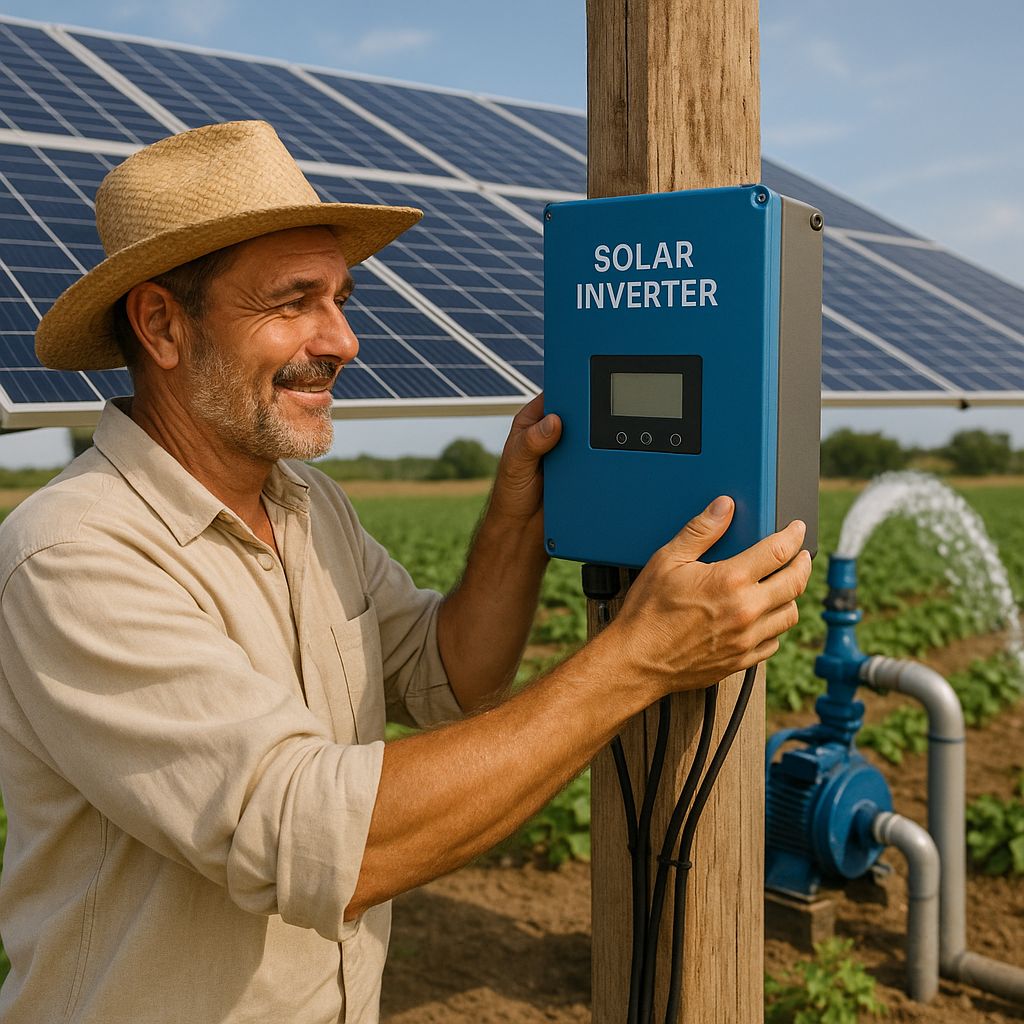
Boost Farm Productivity with Solar-Powered Irrigation
Solar pump inverters don’t just save money—they actively enhance farm productivity through several key mechanisms. The consistent availability of solar power during daylight hours (when irrigation is typically most beneficial) allows for optimized watering schedules that align perfectly with crop needs rather than electricity availability. This biological synchronization leads to improved crop health and yield increases of 15-30% in many documented cases. Learn more about solar-powered irrigation systems and their benefits.
The ability to distribute water precisely when and where it’s needed creates tremendous agricultural advantages. Plants receiving water at optimal times experience reduced stress, develop stronger root systems, and demonstrate improved resistance to pests and diseases. For high-value crops like fruits and vegetables, this optimization can significantly enhance quality metrics like size, color, and flavor that directly affect market value. Learn more about solar-powered drip irrigation systems and their benefits.
Consistent Water Supply During Peak Growing Seasons
Traditional grid-connected irrigation often suffers from voltage fluctuations and outages during summer months when electricity demand peaks—precisely when crops need water most. Solar pump inverters eliminate this vulnerability by generating maximum power during sunny summer days. This perfect alignment between energy availability and irrigation needs ensures crops receive consistent hydration during critical growth stages.
The reliability factor becomes especially important during heat waves and drought conditions when water timing is absolutely critical to crop survival. Many farmers report that the peace of mind from knowing their irrigation systems will operate reliably during these periods is worth the investment alone. This stability allows for more confident planting decisions and often enables expansion into crops that would be too risky with less reliable irrigation systems.
Smart Irrigation Scheduling Capabilities
Modern solar pump inverters incorporate sophisticated controls that enable precision irrigation scheduling based on multiple factors. Advanced systems can integrate with soil moisture sensors, weather forecasts, and crop-specific water requirement data to deliver highly optimized irrigation. This intelligent approach ensures water is applied only when genuinely beneficial, avoiding both under-watering and wasteful over-watering scenarios.
Scheduling capabilities typically include programmable timers, flow rate adjustments, and conditional operation parameters that can be customized to specific crop requirements. For instance, systems can be programmed to adjust water delivery based on growth stages, applying more water during fruit development and less during maturation. Some advanced inverters even incorporate machine learning algorithms that continuously improve irrigation efficiency based on observed results and changing conditions.
Remote Monitoring and Control Features
The connectivity features of modern solar pump inverters transform how farmers manage irrigation. Most systems now offer remote monitoring through smartphone apps or web interfaces, allowing farmers to check system performance, adjust settings, and troubleshoot issues from anywhere. This remote capability reduces the need for physical inspections and enables immediate responses to changing weather conditions or system alerts.
Advanced monitoring dashboards provide real-time data on energy production, water flow rates, pump pressure, and cumulative water delivery. Historical data collection creates valuable insights for long-term optimization, helping farmers identify patterns and refine their irrigation strategies season after season. Some systems even incorporate automated alerts that notify farmers of potential issues before they cause irrigation interruptions, enabling proactive maintenance that prevents crop stress.
Weather-Proof Your Water Supply
Resilience against weather events and power disruptions represents one of the most valuable benefits of solar pump inverters. Traditional irrigation methods leave farms vulnerable to grid outages caused by storms, equipment failures, or rolling blackouts. Solar-powered systems operate independently, continuing to provide water even when grid power is unavailable. This reliability ensures crops don’t suffer during critical growth periods due to infrastructure failures beyond the farmer’s control.
Energy Independence from the Grid
Grid independence brings both operational and financial advantages to farming operations. Beyond eliminating vulnerability to outages, solar irrigation frees farmers from the impact of rising electricity rates and demand charges that often spike during agricultural seasons. This independence creates predictable operating costs and stable irrigation capabilities regardless of utility company decisions or energy market fluctuations.
The value of energy autonomy extends beyond immediate financial considerations. Many farmers report that disconnecting from grid dependencies gives them greater control over their operations and planning confidence. In regions with unreliable grid infrastructure, this independence transforms agricultural possibilities, enabling consistent irrigation where it was previously impossible or prohibitively expensive.
Water Security During Power Outages
When severe weather or grid failures occur, solar pump systems can continue operating during daylight hours as long as the solar array remains functional. This resilience is particularly valuable during summer heat waves that often coincide with grid stress and power rationing. While conventional pumps sit idle during outages, solar systems continue delivering water to stressed crops precisely when they need it most.
For even greater resilience, many farmers incorporate water storage into their solar irrigation systems. By pumping excess water into tanks or reservoirs during peak solar production, they create buffers that enable irrigation during nighttime hours or cloudy periods. This storage approach maximizes the utility of available solar energy and further insulates farm operations from external disruptions.
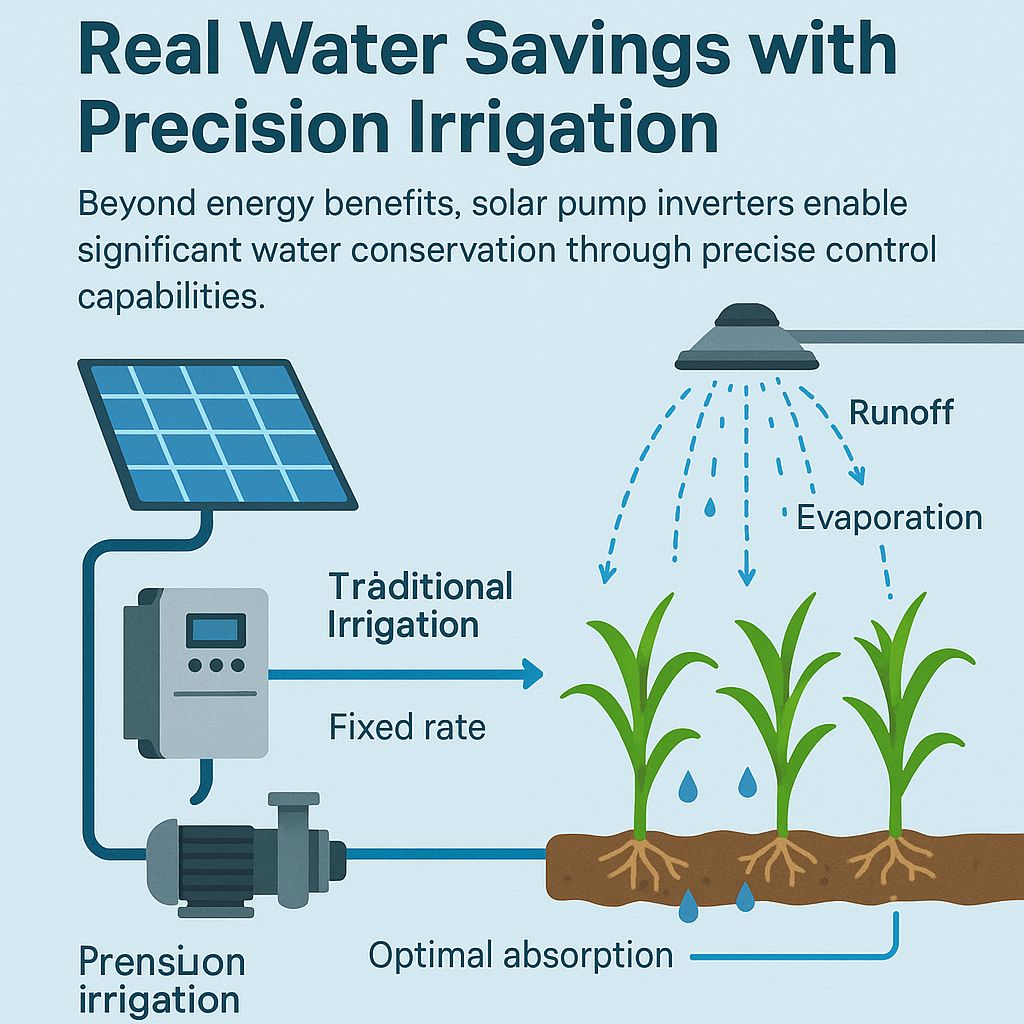
Real Water Savings with Precision Irrigation
Beyond energy benefits, solar pump inverters enable significant water conservation through precise control capabilities. Traditional irrigation often delivers water at fixed rates regardless of actual crop needs, leading to substantial waste through runoff, evaporation, and deep percolation below root zones. Variable frequency drives in solar inverters allow pumps to operate at exactly the flow rate and pressure needed for optimal absorption by plants and soil.
Variable Flow Rate Control
The ability to adjust water flow rates represents a transformative capability for irrigation management. Solar pump inverters with variable frequency drive (VFD) technology can modulate pump speeds to deliver water at rates matched precisely to soil absorption capabilities. This prevents the surface pooling and runoff common with fixed-speed pumps that often deliver water faster than soil can absorb it.
Flow control capabilities also enable tailored irrigation approaches for different crops and field sections with varying soil compositions. Farmers can program slower rates for heavy clay soils that absorb water gradually and faster rates for sandy soils that drain quickly. This customization ensures water reaches root zones efficiently across diverse growing conditions, optimizing both water usage and crop performance.
Pressure Regulation Benefits
Consistent water pressure is essential for efficient drip irrigation, sprinkler performance, and pivot system operation. Solar pump inverters maintain stable pressure regardless of varying solar conditions through intelligent electronic controls. This stability ensures even water distribution across fields and prevents the pressure fluctuations that cause inconsistent coverage with conventional pumping systems.
Pressure regulation also protects irrigation equipment from damage caused by pressure spikes and water hammer effects. By maintaining optimal pressure levels, solar systems extend the lifespan of drip tapes, sprinkler heads, and distribution lines while reducing maintenance requirements. Many farmers report significant reductions in irrigation component replacements after switching to pressure-regulated solar pumping.
Reduction in Water Waste and Runoff
The combination of flow control, pressure regulation, and intelligent scheduling leads to substantial water conservation benefits. Studies consistently show that well-designed solar irrigation systems reduce water consumption by 25-35% compared to conventional methods while maintaining or improving crop yields. This efficiency is increasingly valuable in regions facing water scarcity and usage restrictions.
Beyond quantity savings, optimized irrigation improves water quality in agricultural areas by reducing fertilizer and pesticide runoff into waterways. The precision delivery enabled by solar systems ensures more inputs remain in the root zone where they benefit crops rather than leaching into groundwater or surface water. This environmental benefit often helps farms comply with watershed protection regulations and sustainability certification requirements.
How to Choose the Right Solar Pump Inverter for Your Farm
Selecting the appropriate solar pump inverter requires careful matching of system capabilities to specific farm requirements. The process involves analyzing water needs, evaluating site conditions, and understanding the technical specifications that determine system performance. Getting this selection right ensures optimal performance and maximum return on investment.
Match Inverter to Your Water Requirements
The starting point for inverter selection is a detailed assessment of your farm’s water requirements. This includes calculating the daily water volume needed (measured in gallons or cubic meters), the pumping height (head) from source to distribution, and the distance water must travel horizontally. These factors collectively determine the pumping power required, measured in horsepower or kilowatts, which directly influences inverter sizing.
Seasonal variations must also be considered, as water requirements typically peak during summer months when crops experience maximum evapotranspiration. The inverter should be sized to handle these peak demands rather than average requirements. Many farmers find it helpful to work with agricultural extension services or irrigation specialists who can provide detailed water requirement calculations based on crop types, acreage, soil conditions, and local climate data.
Sizing Your Solar Array Correctly
The solar array must be properly sized to provide sufficient power to the inverter and pump throughout the day. This calculation considers local solar insolation (sunlight intensity), panel efficiency, system losses, and daily pumping duration requirements. As a general rule, solar arrays for irrigation typically require 1.5-2 kilowatts of panel capacity for each horsepower of pump size, though this ratio varies based on local conditions and system efficiency.
Key Features to Look For
Several critical features differentiate high-performance solar pump inverters from basic models. Priority should be given to inverters with true MPPT functionality, wide DC input voltage ranges that maximize daily pumping hours, automatic shut-off protection against dry running, and diagnostic capabilities that identify system issues. Communication features like Bluetooth, WiFi, or cellular connectivity enable remote monitoring and control, which is particularly valuable for distant well locations or dispersed irrigation zones. For more insights, explore how solar pump inverters can improve your farming efficiency.
Top Brands and Their Differences
The solar pump inverter market includes several established manufacturers with proven track records in agricultural applications. Leading brands like ONE-INVERTER, Lorentz, Grundfos, ABB, and SMA offer agricultural-specific inverters with varying specializations. ONE-INVERTER systems are known for their exceptional reliability in harsh environments and industry-leading efficiency ratings that maximize water output per watt of solar input.
When evaluating brands, consider not just the initial purchase price but also the availability of local technical support, warranty terms, and track record in similar agricultural applications. The most reputable manufacturers provide detailed specification sheets, performance curves specific to different pumping scenarios, and design assistance to ensure optimal system configuration. Many also offer monitoring platforms that provide valuable operational insights and enable remote troubleshooting if issues arise.
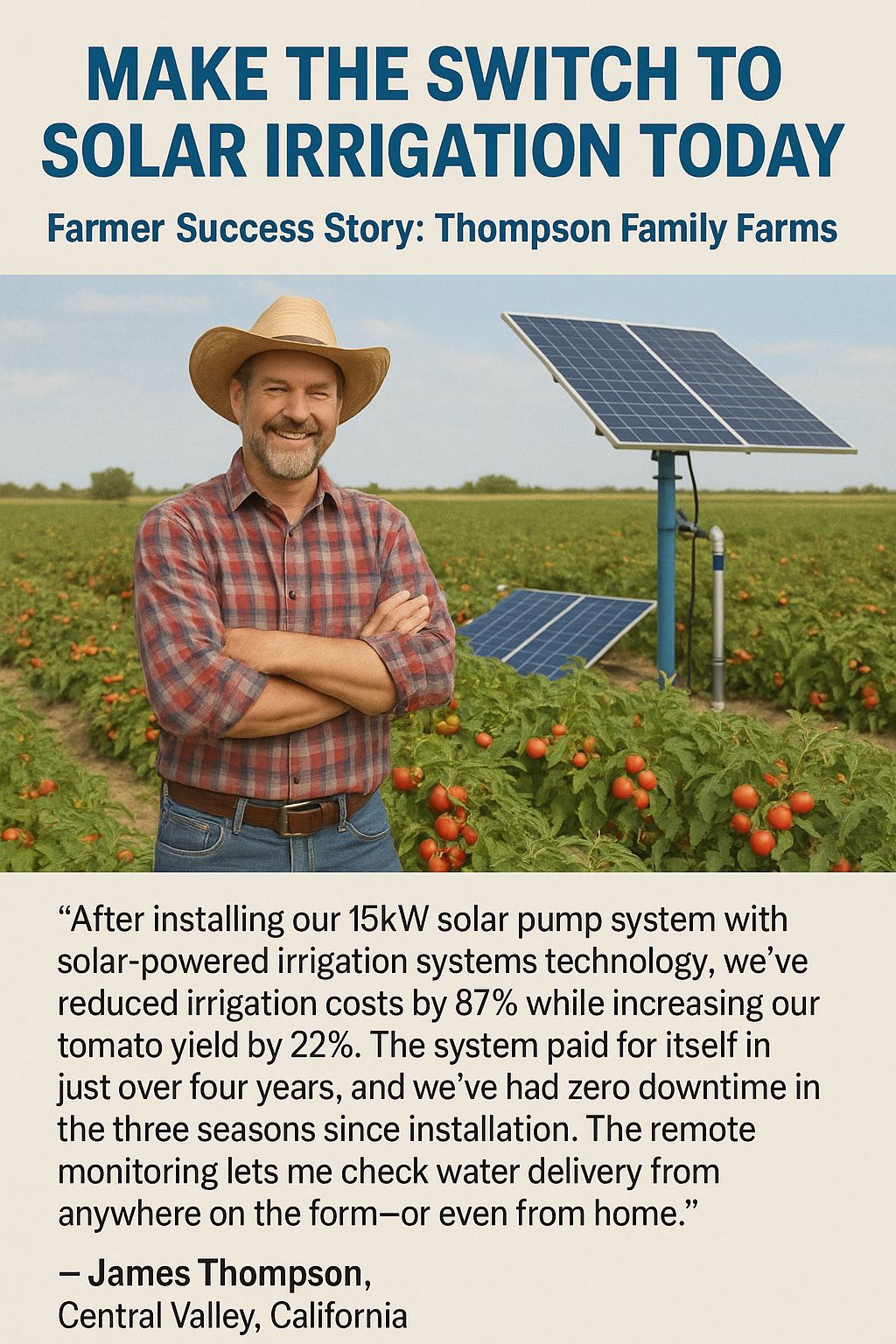
Make the Switch to Solar Irrigation Today
Farmer Success Story: Thompson Family Farms
“After installing our 15kW solar pump system with solar-powered irrigation systems technology, we’ve reduced irrigation costs by 87% while increasing our tomato yield by 22%. The system paid for itself in just over four years, and we’ve had zero downtime in the three seasons since installation. The remote monitoring lets me check water delivery from anywhere on the farm—or even from home.”
— James Thompson, Central Valley, California
The transition to solar-powered irrigation represents one of the most impactful investments modern farmers can make. The combination of operational cost savings, productivity improvements, and environmental benefits creates compelling economics that continue delivering returns for decades. With decreasing equipment costs and increasing incentive opportunities, there has never been a better time to harness the sun’s energy for agricultural water delivery.
Planning a solar irrigation project typically begins with a site assessment that evaluates solar exposure, water source characteristics, and existing irrigation infrastructure. Most agricultural solar providers offer free initial consultations to determine system feasibility and provide preliminary cost estimates. This planning phase should include discussions about seasonal water requirements, future farm expansion possibilities, and potential integration with other farm systems. For more information on how solar technology can enhance your farming efficiency, explore solar pump inverters.
The installation process itself is relatively straightforward, typically requiring 2-5 days depending on system size and complexity. Most installations can be scheduled during off-seasons or low irrigation periods to minimize disruption to farm operations. Many agricultural solar specialists offer financing options specifically designed for farm improvements, with payment structures aligned to harvest cycles and cash flow patterns.
Frequently Asked Questions
As solar irrigation technology continues gaining popularity among agricultural operations, many farmers have similar questions about implementation, performance, and economics. The following answers address the most common inquiries based on real-world installations and operational data.
These practical insights can help farmers move forward confidently with solar irrigation projects, understanding both the opportunities and considerations involved in this transformative agricultural technology.
How much can I save annually by switching to a solar pump inverter?
- Energy cost savings typically range from 70-90% of previous irrigation electricity expenses
- Maintenance savings add another 50-70% reduction in pump-related repair and service costs
- Water efficiency improvements can reduce water expenses by 20-30% in metered irrigation districts
- Total operational savings generally range from $1,500-$5,000 annually per 10HP pump equivalent
The exact savings depend significantly on your current energy source, local electricity rates, and irrigation patterns. Farms previously using diesel generators for pumping often see the most dramatic savings, frequently exceeding $4,000 annually per pump. Grid-connected operations typically save $1,500-$3,000 per 10HP pump equivalent, with higher savings in regions with premium daytime electricity rates. For more on solar-powered irrigation systems, explore different types and methods.
Beyond direct energy savings, many farmers report significant labor savings from reduced system monitoring and maintenance requirements. The automation capabilities of solar pump inverters often eliminate the need for manual pump activation and deactivation, saving 1-2 hours of labor weekly during irrigation seasons. For farms with multiple pumping locations, these time savings can translate to meaningful labor cost reductions.
It’s also worth noting that solar irrigation systems typically qualify for accelerated depreciation tax benefits that can significantly improve first-year economics. Consulting with an agricultural tax specialist can help identify all available tax advantages that apply to renewable energy investments in farming operations.
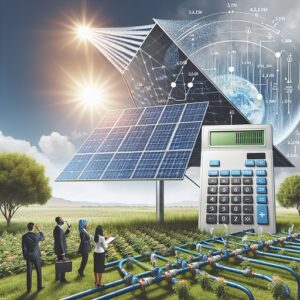
For comprehensive savings analysis, ONE-INVERTER offers a free solar pump savings calculator that incorporates local solar conditions, electricity rates, and water requirements to generate customized financial projections for your specific farm situation. For additional insights on integrating solar technology, check out our guide on solar panels powering a farm’s irrigation system.
Will a solar pump system work on cloudy days?
Yes, solar pump systems continue functioning during cloudy conditions, though at reduced capacity proportional to available sunlight. Modern inverters with MPPT technology are particularly effective at harvesting maximum power even in suboptimal conditions, typically delivering 30-50% of rated capacity during moderate cloud cover. This reduced output is often sufficient for maintaining critical irrigation, especially when combined with efficient low-pressure distribution systems like drip irrigation.
For applications requiring guaranteed water delivery regardless of weather, hybrid systems that incorporate battery storage or automatic switching to grid power offer complete reliability. These configurations ensure continuous operation during extended cloudy periods while still capturing substantial energy savings during normal sunny conditions. The economics of adding battery storage should be evaluated based on the criticality of uninterrupted water delivery for specific crops and operations.
What size solar pump inverter do I need for my farm?
Proper sizing depends primarily on three factors: daily water volume requirements, pumping head (vertical lift plus friction losses), and desired pumping hours. As a general guideline, determine your peak daily water requirement in gallons, the total dynamic head in feet, and then calculate the necessary flow rate based on available sunny hours. This information can be converted to required horsepower using standard pump engineering formulas, which then determines inverter sizing. For further insights on solar-powered irrigation systems, you might find this solar-powered drip irrigation system guide helpful.
For most applications, sizing the system to complete daily irrigation within 6-8 hours of peak sunlight creates the most cost-effective configuration. This approach minimizes battery storage requirements while ensuring complete water delivery during reliable sunny periods. Working with an experienced agricultural solar provider is recommended for precise sizing, as they can model system performance using local solar radiation data and specific pump efficiency curves to optimize the configuration.
Can I integrate batteries with my solar pump system?
Battery integration is entirely possible and increasingly common for farms requiring irrigation flexibility beyond daylight hours or during cloudy periods. Modern lithium-ion battery systems can be seamlessly connected to solar pump inverters, storing excess solar production for use when needed. This approach is particularly valuable for operations that benefit from nighttime irrigation (which can reduce evaporation losses) or farms in regions with frequent afternoon cloud patterns that interrupt solar production during otherwise sunny seasons.
What maintenance does a solar pump inverter require?
Solar pump inverters themselves require minimal maintenance compared to conventional pumping systems. The primary maintenance task is keeping the inverter clean, dry, and properly ventilated to prevent overheating. Annual inspection of electrical connections to ensure they remain tight and corrosion-free is recommended, along with verification that protection features like surge suppression components are functioning correctly. Most manufacturers suggest a professional inspection every 5 years to test critical safety functions and update firmware if available.
The broader solar pumping system does require some routine attention, primarily focused on the solar array rather than the inverter itself. Panel cleaning frequency depends on local conditions—dusty or pollen-heavy environments may require monthly cleaning, while areas with regular rainfall may need only quarterly attention. Ground-mounted arrays should have vegetation controlled to prevent shading, and mounting structures should be inspected annually for stability, particularly in regions with high wind exposure. For more information on maintaining solar systems, you can explore this guide for farmers.
Maintenance Schedule for Solar Pump Systems
Monthly: Visual inspection of panels for soiling, damage, or shading issues
Quarterly: Panel cleaning, verification of monitoring system accuracy
Annually: Electrical connection inspection, inverter filter cleaning (if applicable)
Every 5 Years: Professional system assessment, potential inverter servicing
The dramatic reduction in moving parts compared to diesel pumping systems translates directly to lower maintenance requirements and greater reliability. Most farmers report spending 70-80% less time on pump system maintenance after switching to solar, with correspondingly lower parts replacement costs. The typical solar pump inverter will operate for 10-15 years before requiring significant service or replacement—far longer than conventional pump controllers.
ONE-INVERTER’s advanced monitoring systems further simplify maintenance by providing automated alerts when performance metrics indicate potential issues requiring attention. This predictive approach helps prevent system failures by identifying problems before they impact irrigation operations, ensuring continuous water availability during critical growing periods.
Ready to transform your farm’s irrigation with solar technology? Contact ONE-INVERTER today to discover how our industry-leading solar pump inverters can reduce your operational costs while improving water delivery reliability and crop yields.
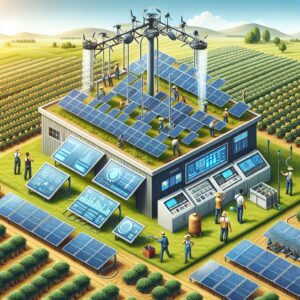
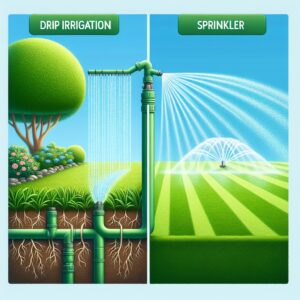
Solar pump inverters are revolutionizing the way farmers manage their irrigation systems. By converting DC power generated from solar panels into AC power, these inverters enable the use of solar energy to power irrigation pumps. This not only reduces dependency on traditional energy sources but also significantly cuts down on operational costs. For those interested in exploring the benefits of solar-powered irrigation, understanding the differences between solar drip irrigation and solar micro-sprinkler systems can be invaluable. These systems are highly efficient, providing a sustainable solution for water management on farms.

Leave a Reply