
Key Takeaways
- Monocrystalline solar panels offer the highest efficiency (17-22%) for farms with limited space, making them ideal for barn roofs and compact installations.
- Polycrystalline panels provide a more budget-friendly option (15-20% cheaper) while still delivering good efficiency (13-17%) for larger farm installations.
- Solar panel systems can reduce farm electricity bills by 70-90%, creating significant long-term savings while providing protection against rising energy costs.
- Agricultural operations can benefit from specialized mounting options including agrivoltaics systems that allow for dual land use – growing crops while generating clean energy.
Solar energy is revolutionizing the agricultural sector by offering farmers a reliable, sustainable alternative to traditional power sources. Farms require significant electricity to power equipment, lighting, irrigation systems, and climate control—making them perfect candidates for solar adoption. The right solar panel system can dramatically reduce operational costs while contributing to environmental sustainability.
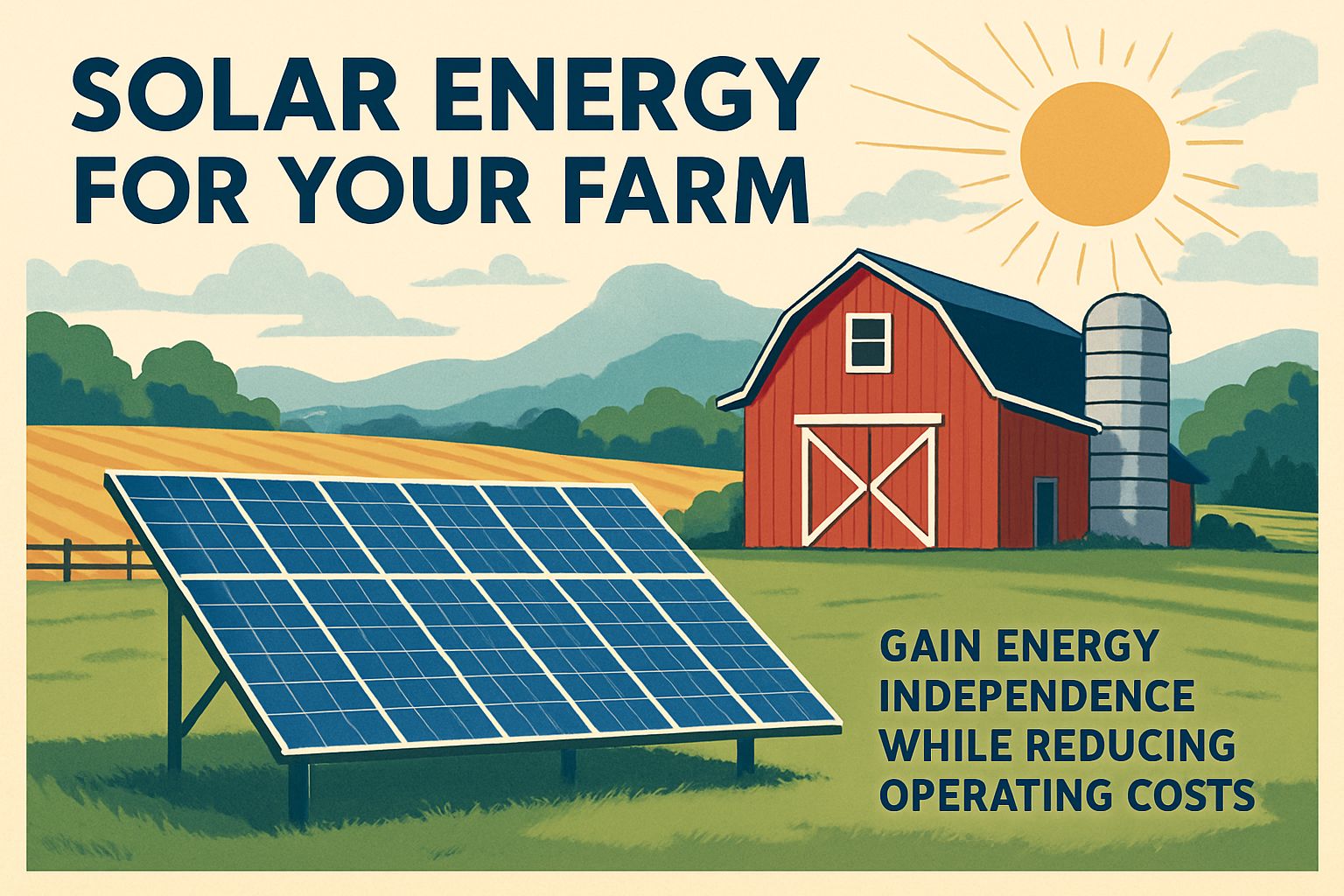
Solar Panels Can Transform Your Farm’s Energy Future
Modern farming operations face mounting pressure from rising energy costs, unpredictable weather patterns, and increasing demands for sustainable practices. Solar power offers an elegant solution to these challenges by providing clean, renewable energy that can be generated right on your property. With payback periods typically ranging from 5-10 years and systems lasting 25-30 years, the long-term economics make solar an increasingly attractive investment for agricultural operations of all sizes. GrowingSolarMist is helping farmers identify the most effective solar solutions tailored to their specific operational needs.
Why Farmers Are Switching to Solar Power
The agricultural sector’s shift toward solar energy is driven by multiple compelling factors that directly impact a farm’s bottom line and sustainability profile.
Slash Your Electricity Bills by 70-90%
Agricultural operations typically have high energy demands for irrigation pumps, refrigeration, ventilation systems, and processing equipment. By generating electricity on-site, farmers can dramatically reduce or even eliminate their monthly utility bills. A properly sized solar array can offset 70-90% of a farm’s electricity consumption, creating immediate cash flow improvements and long-term operational savings. These savings can be redirected into farm improvements, equipment upgrades, or expansion efforts.
Protect Against Rising Energy Costs
Energy costs have historically increased at rates exceeding inflation, creating unpredictable operating expenses for farms. By installing solar panels, farmers effectively lock in their electricity costs for decades. This cost certainty provides valuable protection against future utility rate hikes and allows for more accurate long-term financial planning. Some systems even generate excess power that can be sold back to the grid, creating an additional revenue stream.
- Energy independence reduces vulnerability to power outages
- Protection from volatile energy market fluctuations
- Predictable energy costs improve financial planning
- Reduced dependency on fossil fuels and external suppliers
Tap Into Agricultural Solar Incentives
The economics of farm solar installations are enhanced by numerous financial incentives specifically designed for agricultural applications. These include the federal Investment Tax Credit (ITC), which allows farmers to deduct a significant percentage of solar system costs from their taxes. Additionally, USDA’s Rural Energy for America Program (REAP) offers grants covering up to 25% of system costs and loan guarantees for renewable energy projects. Many states also offer performance-based incentives, property tax exemptions, and accelerated depreciation benefits that can dramatically improve return on investment.
Generate Revenue from Unused Land
Farmers with available land can generate supplemental income by installing ground-mounted solar arrays. These systems can be strategically placed on less productive areas, along field perimeters, or integrated with existing operations through innovative agrivoltaic approaches. Modern dual-use systems even allow continued agricultural production beneath and between solar panels, maximizing land productivity. This approach creates two revenue streams from the same acreage – energy generation and crop production.

The 4 Best Solar Panel Types for Agricultural Applications
Selecting the right type of solar panel is critical for maximizing both energy production and financial returns on your farm. Each technology offers distinct advantages depending on your specific agricultural needs, budget constraints, and installation location. Let’s explore the four most effective solar panel options for agricultural applications.
1. Monocrystalline Panels: High-Efficiency Option for Limited Space
Monocrystalline panels represent the premium tier of solar technology, offering exceptional performance in a compact footprint. These panels are manufactured from single-crystal silicon, giving them their characteristic uniform black appearance and high efficiency ratings.
For farms with limited roof space or land constraints, monocrystalline panels deliver maximum power output per square foot. Their superior efficiency means fewer panels are needed to achieve target energy production, reducing both installation complexity and mounting hardware requirements.
While the upfront investment is higher compared to other panel types, monocrystalline systems typically provide better long-term value through increased energy generation and system longevity. They’re particularly well-suited for dairy operations, poultry farms, and other agricultural facilities with high continuous power demands. For more insights on optimizing energy solutions, explore best power solutions for farmers.
2. Polycrystalline Panels: Budget-Friendly for Large Farm Installations
Polycrystalline panels strike an excellent balance between affordability and performance, making them the most widely deployed solar technology in agricultural settings. Their distinctive blue color comes from multiple silicon fragments melted together during manufacturing, resulting in a more cost-effective production process.
These panels typically cost 15-20% less than monocrystalline options while still delivering solid efficiency ratings between 13-17%. For farms with ample space for ground-mounted installations, polycrystalline arrays offer compelling economics by maximizing return on investment through lower initial capital expenditure.
Many large-scale agricultural operations find polycrystalline systems ideal for powering irrigation systems, processing facilities, and general farm operations. Their excellent price-to-performance ratio makes them particularly suitable for expansive ground-mounted arrays where installation area isn’t a significant constraint. Additionally, these systems can significantly improve farm water efficiency, which is crucial for sustainable agricultural practices.
3. Thin-Film Panels: Flexible Solution for Greenhouse Integration
Thin-film solar technology offers unique advantages for specialized agricultural applications. These panels are manufactured by depositing photovoltaic material onto a substrate, resulting in panels that are significantly lighter and more flexible than traditional crystalline silicon options. Learn more about which solar panel is best for agriculture.
The lightweight nature of thin-film panels makes them ideal for integration with greenhouses and high-tunnel structures without requiring reinforced support systems. Their flexibility allows for installation on curved surfaces and non-traditional mounting locations that would be impractical for rigid panels. Discover how solar panels improve farm resilience by adapting to various agricultural environments.
While thin-film panels have lower efficiency ratings (typically 10-13%) than crystalline options, they perform better in high-temperature environments and maintain more consistent output during extremely hot days. This characteristic makes them particularly valuable for greenhouse applications where heat management is already a concern.
These panels also show superior performance in low-light and diffuse light conditions, generating electricity earlier in the morning and later in the evening than conventional panels. This extended production window can be advantageous for operations requiring consistent power throughout the day.
- Minimal weight load on existing structures
- Flexible installation options for unconventional surfaces
- Better temperature coefficient (less output loss in heat)
- Superior performance in diffuse light conditions
- Lower profile aesthetics for visually sensitive applications
4. Bifacial Panels: Maximize Energy Harvest with Dual-Sided Production
Bifacial solar panels represent cutting-edge technology for agricultural applications, featuring photovoltaic cells on both the front and back surfaces. This dual-sided design allows these panels to capture direct sunlight on the front while simultaneously harvesting reflected light from the ground or surrounding surfaces on the rear side.
The innovative design can increase energy production by 10-30% compared to traditional monofacial panels of equivalent size, significantly enhancing the overall system yield and improving economic returns. Bifacial technology is particularly effective when installed above reflective surfaces such as light-colored soil, concrete pads, or even certain crops with high albedo (reflectivity).
Here is a comparison table of the four best solar panel types for agricultural use — focusing on features, efficiency, and suitability for farms.
|
Solar Panel Type |
Efficiency Range |
Cost per Watt (Approx.) |
Key Advantages for Agriculture |
Limitations |
Best Farm Applications |
|---|---|---|---|---|---|
|
Monocrystalline Panels |
17–22% 1 |
$0.90–$1.50 2 |
High efficiency, compact design, long lifespan, performs well in all climates |
Higher upfront cost |
Space-limited farms, rooftops, and irrigation systems 1 |
|
Polycrystalline Panels |
13–17% 3 |
$0.70–$1.00 3 |
Lower cost, durable, long lifespan, strong in direct sunlight |
Requires more space, less efficient in cloudy conditions | |
|
Thin-Film Panels |
10–13% 5 |
$0.50–$0.90 2 |
Lightweight, flexible, better low-light/shaded performance |
Lower efficiency, shorter lifespan |
Greenhouses, barns, shaded or irregular terrain 5 |
|
Bifacial Panels |
18–22% 6 |
$1.00–$1.60 6 |
Captures light from both sides, high energy yield, great for reflective surfaces like grass or soil |
Higher cost, more complex installation |
Agrivoltaics (dual-use with crops), open-field installations 6 |
These four types of solar panels represent the most effective options for agricultural operations, allowing farmers to select between high efficiency (monocrystalline, bifacial) and lower-cost scalability (polycrystalline, thin-film) depending on land availability, sunlight exposure, and budget.
Monocrystalline Panels: Perfect for Space-Limited Farms
Monocrystalline solar panels excel in situations where maximizing energy production within limited space is crucial. Their space efficiency makes them ideal for roof-mounted installations on barns, equipment sheds, and processing facilities. These premium panels deliver exceptional performance that can justify their higher initial investment through superior long-term energy production.
The manufacturing process for monocrystalline panels involves growing single crystal silicon ingots, which are then sliced into wafers. This process creates the distinctive uniform black cells with rounded corners that characterize monocrystalline panels. The single-crystal structure allows electrons greater freedom of movement, resulting in superior efficiency compared to other technologies.
Highest Efficiency Ratings (17-22%)
Modern monocrystalline panels routinely achieve efficiency ratings between 17-22%, with premium models from top manufacturers pushing even higher. This exceptional efficiency means these panels convert more of the available sunlight into usable electricity, generating more power per square foot than any other commercially available technology. For farms with substantial energy requirements but limited installation space, this efficiency premium can be the deciding factor.
Longest Lifespan (25-30 Years)
Monocrystalline panels typically offer the most robust performance warranties in the industry, with most manufacturers guaranteeing at least 25 years of production at 80% or better of original capacity. The actual operational lifespan often extends well beyond 30 years, though with gradual efficiency decreases in later years. For more on how solar panels can enhance farm operations, check out the benefits and savings of solar panels.
This exceptional longevity makes monocrystalline panels an excellent long-term investment, particularly for established agricultural operations planning for generational continuity. The extended productive lifespan significantly enhances lifetime return on investment calculations despite higher initial costs.
“We installed monocrystalline panels on our dairy barn roof five years ago, and they’ve already paid for themselves through energy savings. The system produces enough electricity to power our entire milking operation, refrigeration equipment, and most of our processing facility. The high efficiency meant we could generate all the power we needed without expanding beyond our existing roof space.” – James Harrington, Clearview Dairy Farm
Better Performance in Partial Shade
Monocrystalline panels generally demonstrate superior performance in partially shaded conditions compared to other panel types. When portions of a solar array experience shading from nearby trees, buildings, or equipment, monocrystalline panels maintain better overall system production. This shade tolerance is particularly valuable for farm installations where complete shade avoidance isn’t always possible due to existing structures or operational requirements.
Best for Barn Roofs and Limited Land Area
The space efficiency of monocrystalline panels makes them the preferred choice for roof-mounted farm installations. Their higher power density means fewer panels and mounting hardware are needed to achieve production targets, reducing both installation complexity and structural load requirements. For farms where preserving productive land is a priority, roof-mounted monocrystalline arrays offer maximum energy generation while maintaining full use of valuable ground space for agricultural activities.
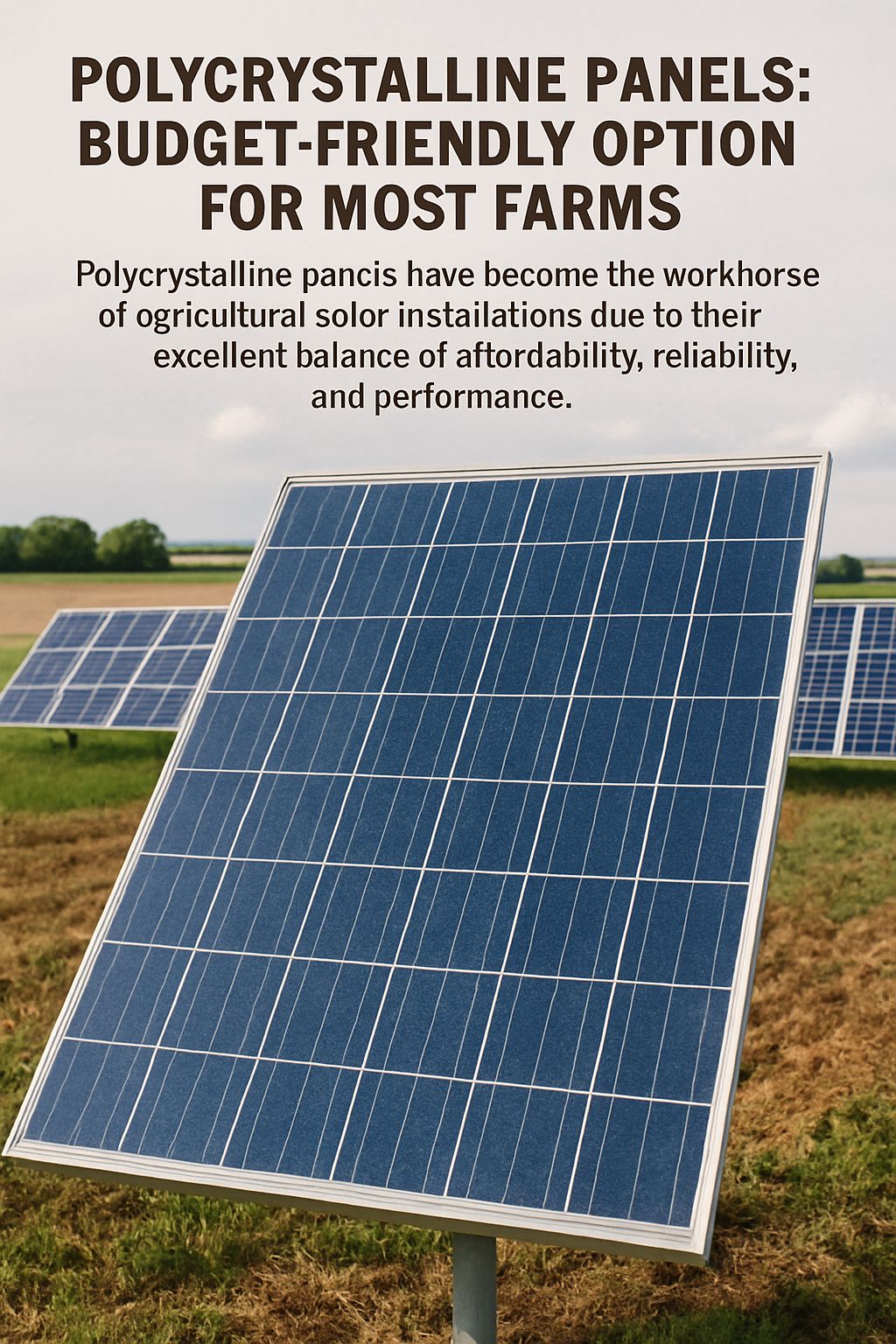
Polycrystalline Panels: Budget-Friendly Option for Most Farms
Polycrystalline panels have become the workhorse of agricultural solar installations due to their excellent balance of affordability, reliability, and performance. These panels account for a significant portion of agricultural solar deployments worldwide, offering farmers a cost-effective entry point into renewable energy without compromising on quality or longevity.
Low Upfront Cost (15-20% Cheaper)
Polycrystalline panels typically cost 15-20% less than equivalent monocrystalline options, making them an attractive choice for budget-conscious farm installations. This cost advantage allows farmers to install larger systems for the same initial investment, potentially generating more total energy despite the slightly lower efficiency rating per panel.
The manufacturing process for polycrystalline panels—which involves melting multiple silicon fragments together rather than growing single crystals—results in significant production cost savings that are passed on to end users. For large agricultural installations where hundreds of panels may be required, these savings can amount to tens of thousands of dollars in reduced upfront costs.
Good Efficiency (13-17%) for Ground Mounts
Modern polycrystalline panels achieve respectable efficiency ratings between 13-17%, making them entirely suitable for most agricultural applications where space constraints are less critical. While this is lower than premium monocrystalline options, the difference becomes less significant in ground-mounted installations where additional panels can be added to achieve desired energy output targets.
Ideal for Large Open Spaces
Farms with adequate unused land or non-productive areas can maximize their return on investment by deploying larger polycrystalline arrays. These installations work particularly well along field perimeters, in fallow areas, or on marginal lands less suitable for cultivation. The lower cost-per-watt enables farmers to install more total capacity, potentially generating more overall energy despite the slightly lower efficiency rating.
Thin-Film Solar: Flexible Installation for Agricultural Buildings
Thin-film solar technology offers unique advantages for specific agricultural applications, particularly where weight considerations, installation flexibility, and performance in extreme conditions are important factors. Unlike rigid crystalline panels, thin-film modules are manufactured by depositing photovoltaic material onto a substrate, creating ultra-lightweight and sometimes flexible panels.
Lightweight and Bendable Design
The most compelling feature of thin-film panels for agricultural applications is their remarkably light weight—often weighing 50-80% less than conventional crystalline panels. This dramatic weight reduction makes thin-film technology ideal for installation on structures that cannot support the additional load of traditional panels, such as older barns, equipment sheds, or lightweight greenhouses. Some flexible thin-film products can be installed on curved surfaces, opening up installation possibilities that would be impossible with rigid panels. For more information on how solar panels can offer benefits for farm structures, explore this resource.
Perfect for Greenhouse Integration
Thin-film technology has found a specialized niche in agricultural greenhouse applications where partial transparency is desirable. Certain thin-film products allow a controlled percentage of light to pass through while converting another portion to electricity, creating dual-purpose greenhouse roofing that generates power while maintaining suitable growing conditions below. This integration can improve the economics of both greenhouse operations and solar generation by sharing structural costs and space requirements.
Better Performance in Extreme Heat
One significant advantage of thin-film technology in agricultural settings is its superior temperature coefficient compared to crystalline silicon. In practical terms, thin-film panels experience less performance degradation during extremely hot weather conditions that often coincide with peak growing seasons and irrigation demands. While a conventional silicon panel might lose 0.4-0.5% of its output for every degree above standard test conditions, thin-film modules typically lose only 0.2-0.3%, maintaining better performance during summer heat waves when farm energy demands may be highest. For more information on choosing the right solar panel for agricultural use, you can explore which solar panel is best for agriculture.
This heat tolerance makes thin-film technology particularly valuable in southern regions where summer temperatures regularly exceed 90°F (32°C) during critical growing periods. The more stable output helps ensure irrigation systems, cooling equipment, and refrigeration units receive consistent power when they’re needed most.
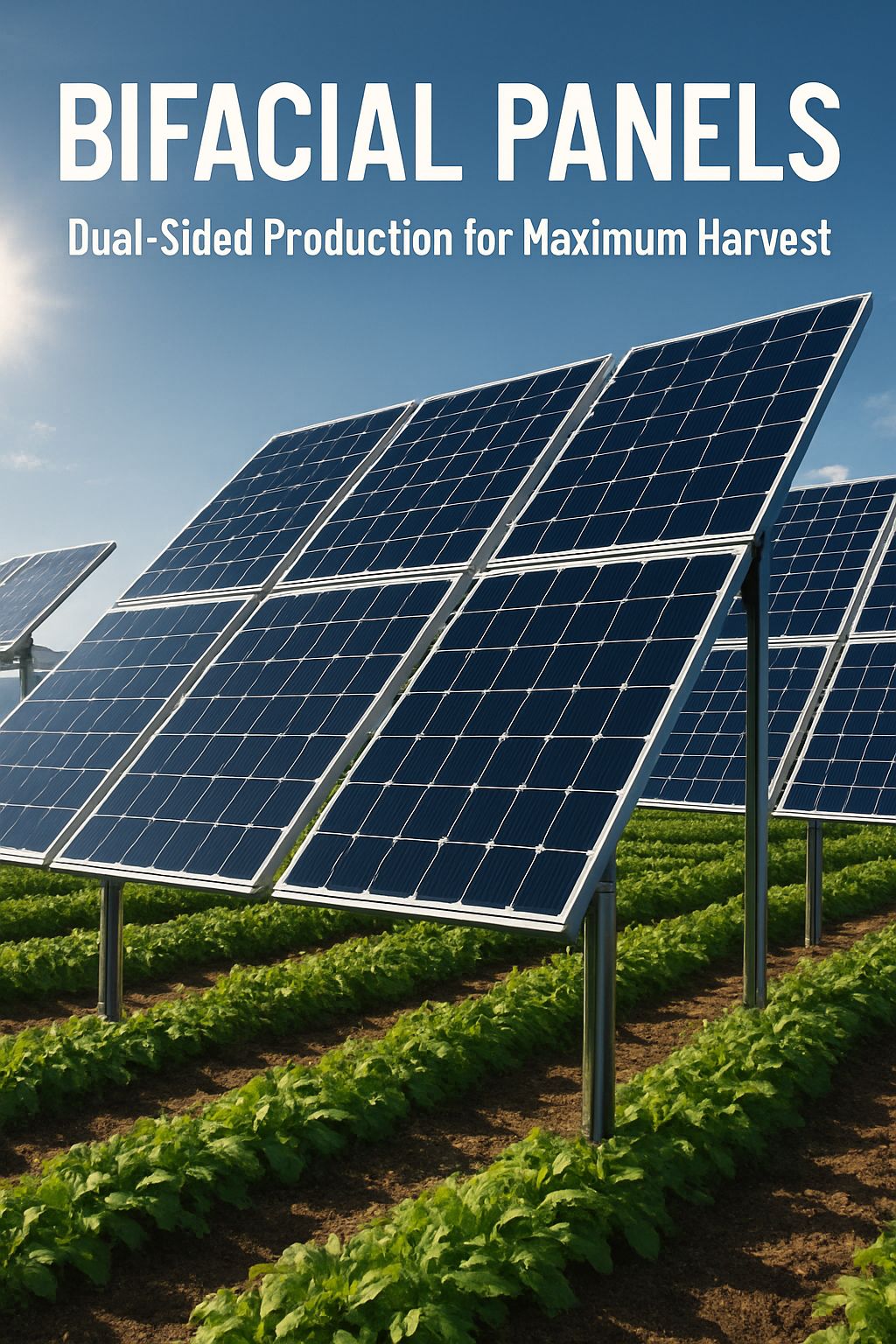
Bifacial Panels: Dual-Sided Production for Maximum Harvest
Bifacial solar technology represents a significant innovation for agricultural applications, particularly for installations where maximizing energy yield per acre is essential. These specialized panels feature photovoltaic cells on both front and back surfaces, allowing them to capture reflected light from the ground or surrounding surfaces in addition to direct sunlight.
Captures Sunlight from Both Sides
The defining feature of bifacial panels is their ability to generate electricity from both sides simultaneously. While the front surface captures direct sunlight like conventional panels, the rear surface harnesses reflected light (albedo) from surrounding surfaces including soil, vegetation, snow, or light-colored ground covers. This dual-collection capability significantly increases overall energy harvest without requiring additional land area, making bifacial technology increasingly attractive for agricultural installations where land value and productivity are critical considerations.
10-30% More Energy Than Traditional Panels
Field studies and commercial installations have consistently demonstrated that bifacial panels deliver 10-30% greater energy production compared to equivalent monofacial panels, with the exact boost depending on installation height, ground reflectivity, and system design. This performance enhancement improves project economics by generating more kilowatt-hours from the same number of panels, accelerating payback periods and increasing lifetime returns.
“The bifacial system we installed last year has consistently outperformed our projections by nearly 25%. The panels are mounted eight feet off the ground over a light-colored gravel base, which maximizes reflection to the back side. We’re now able to run our entire irrigation system and cold storage facility purely on solar power, even during peak summer demand.” – Miguel Rodriguez, Fresh Valley Produce Farm
Ideal for Agrivoltaics (Growing Crops Under Panels)
Bifacial technology is particularly well-suited for innovative agrivoltaic systems that combine solar energy production with active farming operations on the same land. When mounted at sufficient height (typically 8-12 feet), bifacial panels allow enough light penetration for many crops to grow successfully underneath while simultaneously generating electricity above. This dual land use dramatically improves the economics of both farming and solar production by sharing land costs across two revenue streams.
Crops that perform well in partial shade conditions—including many leafy greens, herbs, berries, and some root vegetables—have shown promising results in agrivoltaic systems using bifacial panels. The elevated mounting creates a beneficial microclimate underneath, reducing water evaporation and providing protection from extreme weather events like hail or intense sun. Some farmers report water savings of 15-30% for crops grown beneath bifacial arrays due to reduced evaporation.
Best Mounting Systems for Farm Solar
The mounting system you choose for your farm solar installation is just as important as the panels themselves. Different agricultural operations require different approaches to solar mounting, depending on available space, land use priorities, and operational requirements.
Fixed Ground Mounts for Permanent Installations
Fixed ground-mounted systems remain the most common choice for large agricultural solar installations, offering excellent stability, optimal orientation, and relatively straightforward installation. These systems typically consist of rows of panels mounted on metal frames anchored to the ground via concrete foundations or driven piles. The angle and orientation can be precisely optimized for your specific location to maximize annual energy production, with most installations in the northern hemisphere facing due south at a tilt equal to the site’s latitude. Learn more about how solar panels improve farm resilience.
|
Mounting System |
Best For |
Relative Cost |
Space Efficiency |
Installation Complexity |
|---|---|---|---|---|
|
Fixed Ground Mount |
Large installations, fallow land |
Medium |
Medium |
Low |
|
Pole Mount |
Dual land use, smaller systems |
High |
Low |
Medium |
|
Single-Axis Tracking |
Maximizing daily production |
High |
Medium |
High |
|
Roof Mount |
Preserving all ground space |
Low |
High |
Medium |
Ground-mounted systems allow for optimal panel spacing to minimize shading between rows, and their ground-level installation simplifies maintenance access. They’re particularly well-suited for installations on marginal or unused land that isn’t needed for cultivation or livestock. Modern agricultural ground mounts can be designed with sufficient clearance to allow small equipment access underneath for vegetation management.
For farms concerned about land use, these systems can be strategically placed on less productive areas, field edges, or land with poor soil quality to minimize impact on agricultural operations. Some farms successfully integrate ground-mounted solar with grazing operations, using the arrays for sheep or other small livestock that benefit from the partial shade while keeping vegetation naturally managed.
Pole Mounts for Elevated Access
Pole-mounted solar systems elevate panels on single or multiple poles, typically raising them 10-20 feet above ground level. This elevated design creates valuable multi-purpose space underneath that remains available for equipment storage, livestock shelter, or even continued crop production. While more expensive per watt than ground mounts due to increased structural requirements, pole mounts enable true dual land use that can justify the additional investment in areas where land value is high.
Tracking Systems to Follow the Sun
Solar tracking systems automatically adjust panel orientation throughout the day to follow the sun’s path across the sky, significantly increasing daily energy production compared to fixed installations. Single-axis trackers (which rotate east to west) can increase annual energy yield by 15-25%, while more complex dual-axis trackers (which adjust both east-west and seasonally) can boost production by 30-45% in ideal conditions.
For agricultural operations with high daytime power demands that closely match peak sunlight hours—such as irrigation systems, packing facilities, or cold storage—tracking systems can deliver electricity precisely when it’s most needed. This improved alignment between generation and consumption can reduce or eliminate the need for battery storage in some farm applications, improving overall system economics. Discover more about reducing farm energy costs with solar panels.
“We installed a single-axis tracking system for our orchard irrigation, and the performance difference is remarkable. The system starts producing usable power much earlier in the morning and continues later into the evening than our neighbor’s fixed array. This extended production window perfectly matches our irrigation schedule, allowing us to run pumps throughout the day without drawing from the grid.” – Sarah Johnson, Sunny Hill Orchards
While tracking systems involve higher initial costs and more moving parts that may require maintenance, they often deliver superior economics for larger agricultural installations where the increased energy production justifies the additional investment. Modern tracking systems are engineered for reliability, with many manufacturers offering 10+ year warranties on mechanical components.
Building-Integrated Options for Barn Roofs
Building-integrated photovoltaic (BIPV) systems incorporate solar generation directly into agricultural structures, either as the primary roofing material or as an addition to existing roofs. These installations maximize space efficiency by utilizing structures that already exist or need to be built, eliminating the need to dedicate additional land to solar generation. Modern barn designs can incorporate solar from the beginning, optimizing roof pitch and orientation for maximum energy production while fulfilling all structural and functional requirements.
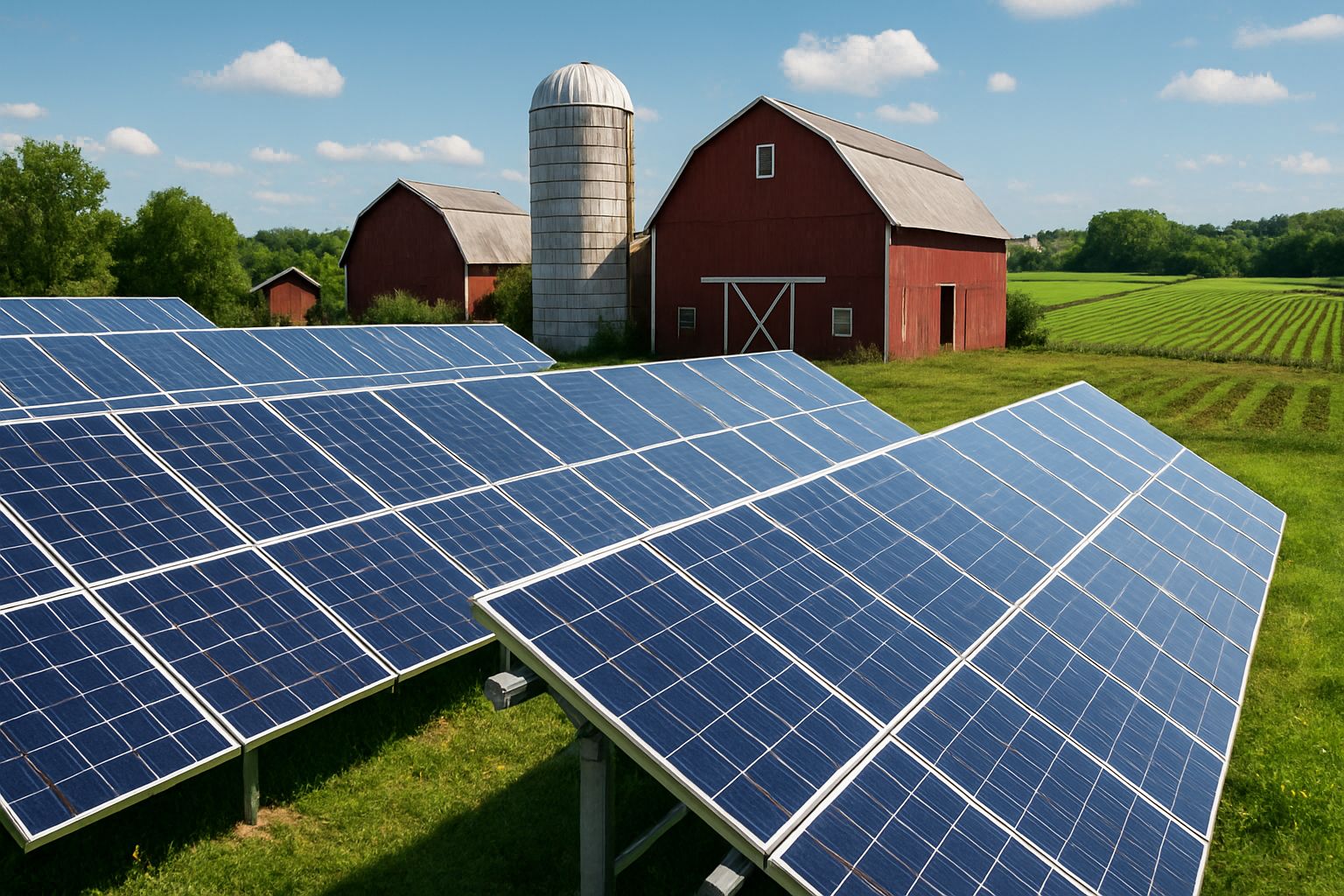
Real Farm Solar Success Stories
Agricultural solar installations across the country are demonstrating the practical benefits of renewable energy for farms of all types and sizes. These real-world examples illustrate how thoughtfully designed solar systems can address specific farm energy needs while delivering compelling financial returns.
The economics of farm solar have improved dramatically in recent years, with system costs declining while efficiency and reliability have increased. Many agricultural operations now see payback periods as short as 4-7 years, followed by decades of virtually free electricity that significantly improves operational margins and resilience. For more information on how solar panels can be a smart investment for agriculture, check out this solar panel system for farms.
These case studies highlight different approaches to agricultural solar adoption, from roof-mounted systems that preserve all productive land to innovative agrivoltaic installations that create new production opportunities. Each represents a successful adaptation of solar technology to specific farm requirements and conditions.
- Reduced operational costs through dramatic cuts in electricity expenses
- Protection against future energy price increases
- Improved sustainability profile and environmental stewardship
- Enhanced farm resilience through energy independence
- New revenue streams from excess power production
The following examples demonstrate how different types of farms have successfully integrated solar energy into their operations, addressing specific challenges while capitalizing on their unique resources and opportunities.
Dairy Farm Cuts $45,000 in Annual Energy Costs
Hillcrest Dairy in Vermont installed a 200kW rooftop solar array across their main barn complex to offset the substantial electricity demands of their milking parlor, refrigeration equipment, and processing facility. The system, comprised of 615 high-efficiency monocrystalline panels, now generates approximately 230,000 kWh annually—offsetting nearly 85% of the operation’s total electricity consumption. For more information on how solar panels can be a smart investment for agriculture, visit this solar panel system guide.
With previous utility bills averaging $53,000 annually, the solar installation now saves the operation approximately $45,000 each year in energy costs. After applying available agricultural solar incentives, the system achieved payback in just 5.3 years and is projected to save more than $1.3 million over its 30-year lifespan. The dairy also reports more stable operations during grid outages thanks to a battery backup system that keeps essential refrigeration running even when utility power is unavailable.
Poultry Operation Achieves Energy Independence
Circle M Farms, a poultry operation in North Carolina, installed a comprehensive solar solution to address their substantial electricity needs for ventilation, lighting, and climate control across six large poultry houses. Their ground-mounted 275kW system utilizes polycrystalline panels on single-axis trackers to maximize daily production and closely match the farm’s daytime-heavy consumption pattern. For more information on how solar systems can be a smart investment for agriculture, visit Solar Republic.
The tracking system produces approximately 30% more energy than a comparable fixed installation would generate, creating sufficient surplus during peak production hours to earn net metering credits that offset nighttime consumption. The operation now enjoys virtually complete energy independence, with annual savings exceeding $38,000 compared to previous utility expenses. Perhaps more importantly, the stable power supply has improved poultry health outcomes and reduced mortality rates by ensuring uninterrupted ventilation and climate control. For more insights on how solar panels benefit farm livestock, visit solar panels benefits for farm livestock.
Vegetable Grower Powers Irrigation with Solar
Fresh Valley Produce, a 120-acre vegetable operation in California’s Central Valley, faced escalating pumping costs for their essential irrigation systems. They installed a specialized solar solution featuring 310 bifacial panels mounted on elevated racks that allow continued cultivation underneath. This innovative agrivoltaic approach generates 175 kW of power while maintaining productive use of the land below for shade-tolerant crops like lettuce and spinach that benefit from the filtered light conditions.
How to Choose the Right Solar Panel for Your Farm
Selecting the optimal solar technology for your agricultural operation requires balancing multiple factors including your specific energy needs, available installation space, budget constraints, and operational priorities. A systematic approach to this decision-making process will help ensure your investment delivers maximum returns in both energy production and financial benefits.
The most successful farm solar installations begin with thorough planning that considers both immediate energy requirements and future expansion possibilities. Taking time to assess these factors before committing to specific equipment will result in a system that better serves your operational needs while maximizing financial returns.
Assess Your Energy Needs First
Begin by analyzing your farm’s electricity consumption patterns using at least 12 months of utility bills to capture seasonal variations. Pay particular attention to when energy is consumed throughout the day and year, as this timing will influence system design decisions. Operations with high daytime consumption that aligns with peak solar production hours will generally see better economics than those with primarily nighttime usage patterns that require storage solutions or grid interaction.
Consider Your Available Space
The amount and type of space available for solar installation will significantly impact your panel selection. Farms with limited suitable roof area or valuable productive land may benefit from high-efficiency monocrystalline panels that maximize generation per square foot. Conversely, operations with ample unused land might find better overall economics with more affordable polycrystalline panels deployed over a larger area.
Also consider the orientation and shading conditions of potential installation sites. South-facing roof areas (in the northern hemisphere) with minimal shading are ideal for maximum production. If your available space has suboptimal orientation or partial shading issues, higher-efficiency panels with better shade tolerance may justify their premium cost through improved performance under these conditions.
Evaluate Your Budget and Financing Options
Solar installations represent significant long-term investments that can be approached with various financing strategies. If upfront capital is limited, consider solar loans, leases, or power purchase agreements (PPAs) specifically designed for agricultural applications. Many systems can be cash-flow positive from the first year when financed appropriately, with monthly savings exceeding finance payments. Discover how solar panels can contribute to energy cost reduction for farms.
Match Panel Type to Your Specific Farm Operations
Different agricultural activities have unique energy requirements and physical constraints that may favor particular solar technologies. Dairy operations with high continuous loads for refrigeration and milking equipment often benefit from high-efficiency monocrystalline installations that maximize production from available roof space. Poultry or hog operations with substantial ventilation and climate control needs might find tracking systems most advantageous to extend daily production hours.
Greenhouse operations should explore specialized thin-film or semi-transparent panel options that allow strategic light penetration while generating electricity. Irrigated crop production might benefit most from systems designed to maximize output during pumping hours, potentially including tracking technology to extend daily production.
For operations with high seasonal variations in energy consumption, system sizing becomes particularly important. A solar array sized for peak summer irrigation demands might produce substantial excess energy during off-seasons unless storage solutions or favorable net metering arrangements are in place.
Consider how your agricultural activities might change or expand in coming years, as most solar systems will operate for 25+ years. Designing with future flexibility in mind—including potential for expansion or battery addition—can prevent limitations as your operation evolves.
- Dairy farms: High-efficiency roof systems for continuous loads
- Poultry/livestock: Tracking systems for climate control alignment
- Irrigated crops: Production timed to pumping schedules
- Greenhouses: Specialized semi-transparent or thin-film options
- Diversified farms: Hybrid approaches combining multiple technologies
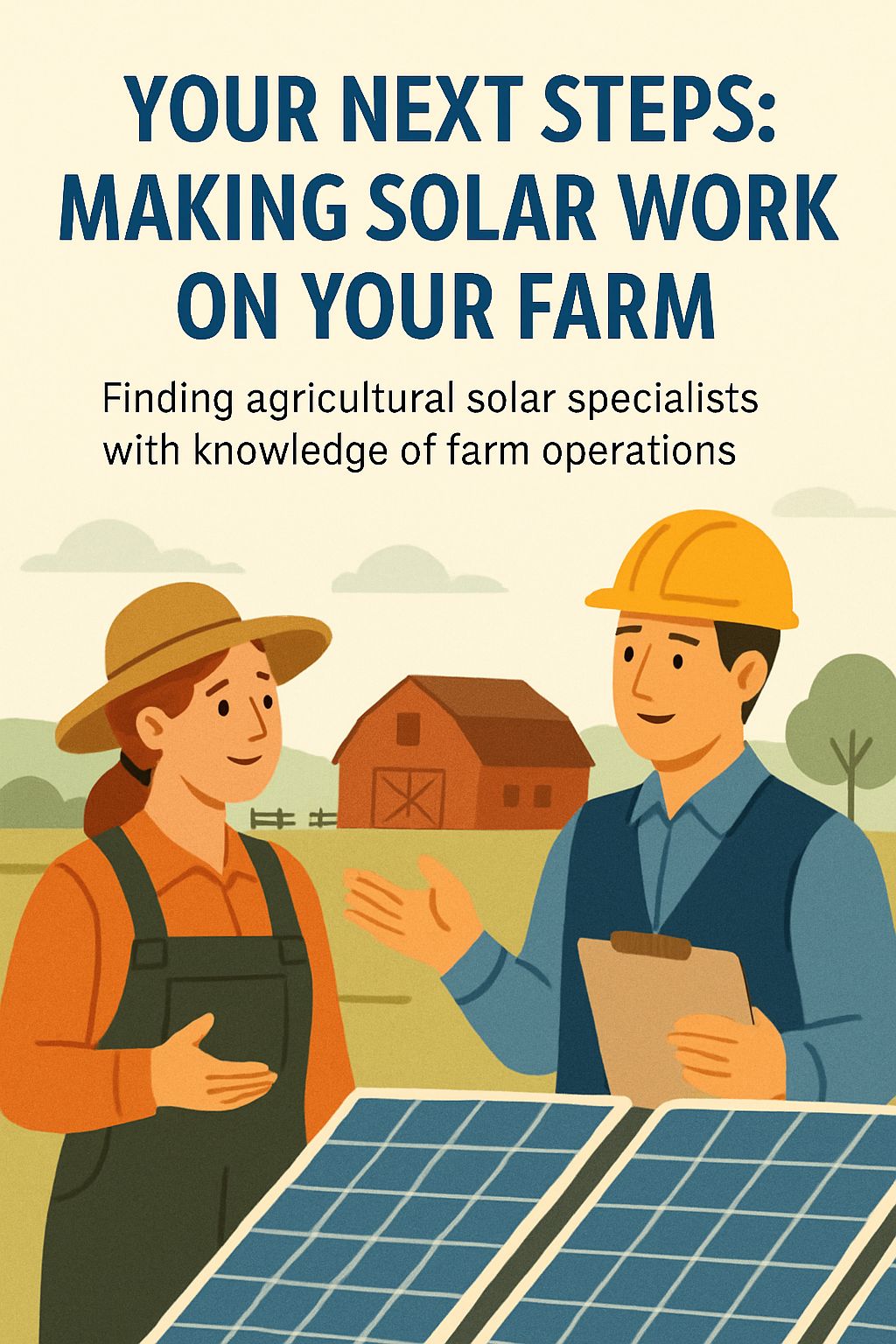
Your Next Steps: Making Solar Work on Your Farm
Implementing solar energy on your farm begins with finding qualified agricultural solar specialists who understand both renewable energy technology and the specific requirements of farming operations. Look for providers with demonstrated experience in agricultural installations, as they’ll better understand the unique challenges and opportunities presented by farm environments. Request site-specific assessments that evaluate your energy consumption patterns, available installation areas, and potential system configurations tailored to your operation. Additionally, explore how solar panels can create income streams for farmers to further benefit from renewable energy investments.
Most importantly, view solar as a long-term strategic investment in your farm’s future viability and sustainability. The right system will not only reduce operating costs but also provide protection against energy price volatility, enhance your environmental profile, and potentially create new production opportunities through innovative approaches like agrivoltaics. With proper planning and implementation, agricultural solar installations can deliver reliable returns for decades while supporting the continued success of your farming operation.
Frequently Asked Questions
Farm operators considering solar installations typically have several common questions about implementation, costs, and benefits. Here are answers to the most frequently asked questions about agricultural solar systems.
How much does a farm solar system typically cost?
Agricultural solar installation costs typically range from $1.80 to $3.50 per watt before incentives, with larger systems generally achieving lower per-watt pricing. This translates to approximately $180,000 to $350,000 for a 100kW system before applying tax credits, grants, and other incentives that can reduce net costs by 30-60%. After available incentives, most farm installations achieve payback periods between 4-10 years, followed by decades of minimal-cost electricity production. For more information on how solar panels can help reduce farm energy costs, check out solar panels benefits & savings.
What farm operations can solar panels power?
Solar panels can power virtually any electrical equipment used in modern farming operations, including irrigation pumps, ventilation systems, refrigeration, milking equipment, grain drying, lighting, and processing machinery. The modularity of solar systems allows them to be sized appropriately for operations ranging from small specialty farms to large commercial agricultural enterprises.
For operations with critical loads that cannot tolerate interruptions, solar systems can be paired with battery storage to provide backup power during grid outages. This energy resilience can be particularly valuable for livestock operations with ventilation requirements or farms with essential refrigeration needs.
Do agricultural solar panels need special maintenance?
Solar panels designed for agricultural applications are engineered for durability in farm environments, typically requiring minimal maintenance. Most systems benefit from occasional cleaning to remove dust, pollen, or bird droppings that might reduce efficiency, particularly in drier regions. Panel cleaning can often be incorporated into existing maintenance routines, with many farms performing this task 1-4 times annually depending on local conditions.
Can I still farm land with ground-mounted solar panels?
Modern agricultural solar installations increasingly incorporate dual-use strategies that maintain productive farming activities alongside energy generation. Elevated mounting systems with panels installed 8-12 feet above ground level allow for continued cultivation of shade-tolerant crops, grazing of small livestock like sheep, or operation of certain equipment underneath. These agrivoltaic approaches maximize land productivity by generating both agricultural products and renewable energy from the same acreage.
What financing options are available for farm solar installations?
Agricultural operations have access to several specialized financing options for solar installations. The USDA’s Rural Energy for America Program (REAP) offers both grants covering up to 25% of project costs and loan guarantees that can secure favorable terms from commercial lenders. Many states offer additional agricultural energy programs, tax incentives, and specialized loan products. Commercial solar loans, leases, and Power Purchase Agreements (PPAs) are also widely available for qualified agricultural businesses, often structured to be cash-flow positive from the first year.
When evaluating financing options, consider both short-term cash flow impacts and long-term ownership benefits. While third-party ownership models like leases or PPAs require less upfront investment, direct ownership typically delivers greater total financial benefits over the system’s multi-decade lifespan.

Leave a Reply