
Article-At-A-Glance
- Polycrystalline solar panels offer farmers a cost-effective renewable energy solution with 15-17% efficiency rates and distinctive blue appearance due to their multiple silicon crystal structure
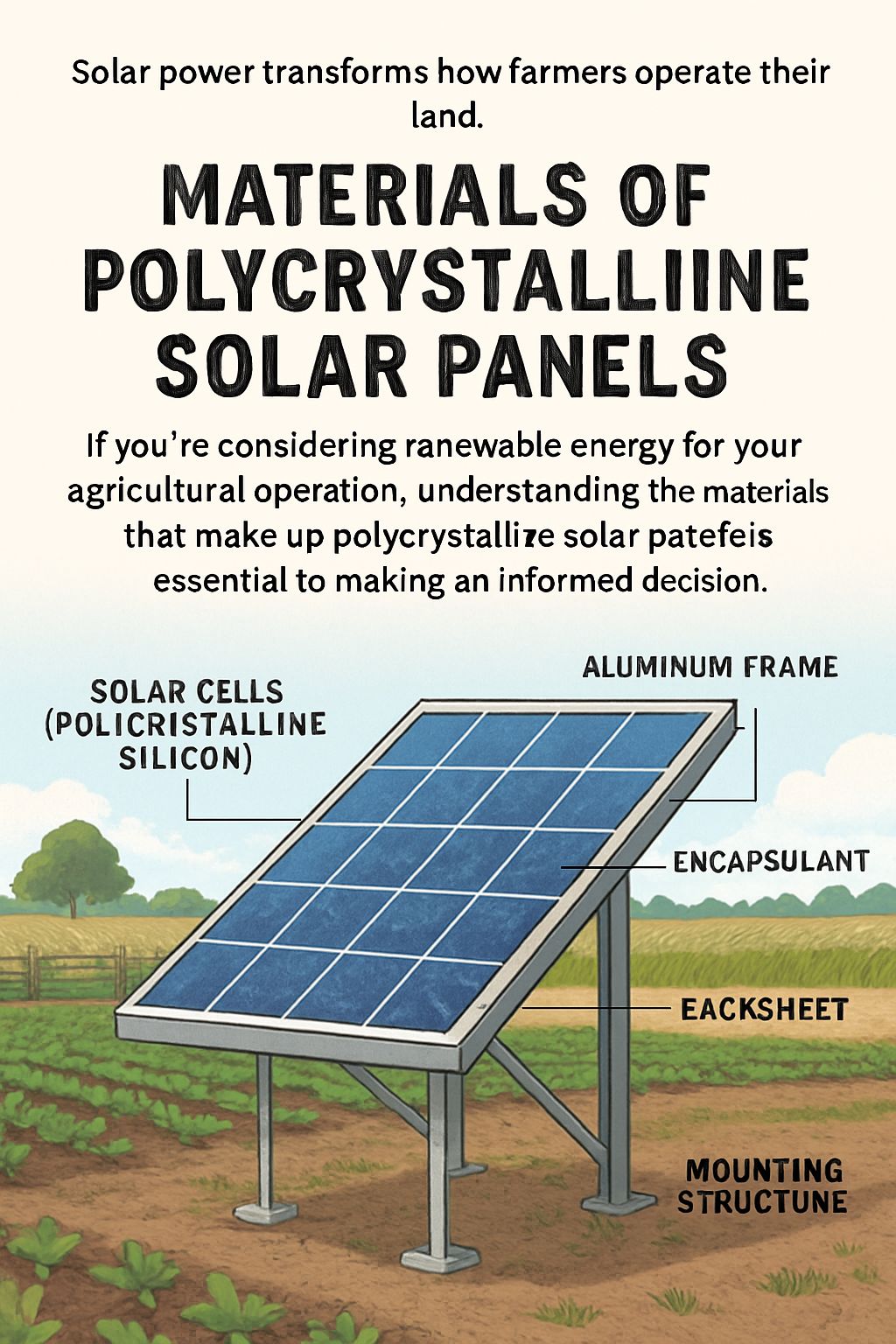
- The core materials include silicon wafers, tempered glass, EVA encapsulant, aluminum frames, and specialized junction boxes designed to withstand agricultural environments
- While less efficient than monocrystalline alternatives, polycrystalline panels perform reliably in farm settings with a lower initial investment cost and good performance in varied weather conditions
- Growing Solar Mist provides specialized guidance for farmers transitioning to solar energy with customized agricultural solutions
- Properly installed polycrystalline panels can last 25+ years on farms with minimal maintenance, offering excellent long-term return on investment for agricultural operations
Solar power transforms how farmers operate their land. If you’re considering renewable energy for your agricultural operation, understanding the materials that make up polycrystalline solar panels is essential to making an informed decision.
As farm energy costs continue rising, more agricultural professionals are turning to solar solutions that balance affordability and performance. Growing Solar Mist has been helping farmers navigate these renewable energy options, with polycrystalline panels often emerging as an excellent middle-ground solution. These panels offer substantial energy generation capabilities without the premium price tag of some alternatives.
Understanding the composition, benefits, and limitations of polycrystalline solar panels can help you determine if they’re the right fit for powering your irrigation systems, barn operations, or other farm electrical needs. Let’s explore what makes these blue-hued panels work and why they might be perfect for your agricultural energy needs.
The Power of Polycrystalline Solar Panels for Your Farm
Polycrystalline solar technology has evolved significantly over the past decade, making these panels increasingly attractive for agricultural applications. These panels convert sunlight into electricity through silicon cells made from multiple silicon fragments melted together, creating a distinctive structure that influences both their appearance and performance characteristics.
For farmers, the appeal lies in the balance of affordability and reliability. Unlike more expensive monocrystalline options, polycrystalline panels offer a lower initial investment while still providing dependable energy generation for decades. This makes them particularly suitable for agricultural operations with substantial energy needs but budget constraints.
The durability of polycrystalline panels also makes them well-suited to farm environments. Their robust construction withstands dust, rain, snow, and wind – common challenges in agricultural settings. Many farmers report excellent performance even in partially shaded areas like near windbreaks or scattered trees, though direct sunlight naturally yields optimal results.

What Makes Polycrystalline Solar Panels Different
The fundamental difference between polycrystalline panels and other solar technologies lies in their material composition and manufacturing process. This difference affects everything from appearance to performance to cost – factors that directly impact their suitability for your farm’s energy needs.
Silicon Crystal Structure: Multi vs. Mono
The most significant difference between polycrystalline and monocrystalline panels is in their silicon crystal structure. While monocrystalline panels use silicon ingots grown from a single crystal, polycrystalline (sometimes called multi-crystalline) panels are made from multiple silicon fragments melted together. This multi-crystal structure creates boundaries between the silicon crystals, which affects how electrons move through the material. For a more detailed explanation, check out this polycrystalline solar panel composition guide.
These crystal boundaries slightly reduce efficiency compared to monocrystalline panels, typically resulting in efficiency ratings of 15-17% versus the 18-22% of mono panels. However, the manufacturing process is less resource-intensive and more cost-effective, making poly panels more affordable for large farm installations. For many agricultural applications where space isn’t severely limited, this efficiency difference is easily offset by installing a slightly larger array at a lower cost.
The Distinctive Blue Color Explained
The distinctive blue color of polycrystalline panels isn’t just an aesthetic choice – it’s a direct result of how light interacts with the multi-crystal silicon structure. When sunlight hits the surface of polycrystalline cells, it reflects differently off the varied crystal formations, creating that characteristic blue appearance with visible crystal flakes.
This blue coloration contrasts with the uniform black appearance of monocrystalline panels. For farmers concerned about visual impact on their property, this blue hue sometimes blends more naturally with the sky when viewed from a distance. The color has no impact on the panel’s durability or longevity, though the surface is typically covered with anti-reflective coating to maximize light absorption rather than reflection.
Manufacturing Process: From Silicon to Solar Cell
The manufacturing process for polycrystalline panels begins with melting raw silicon fragments together in a square mold. Unlike the more complex Czochralski process used for monocrystalline cells (which pulls a single crystal ingot from molten silicon), polycrystalline production simply allows the silicon to cool in the mold, forming multiple crystals. This cooled block is then sliced into thin wafers, doped with boron and phosphorus to create the positive and negative layers needed for electricity production, and assembled into cells.
This simpler manufacturing process translates directly to lower costs, which is particularly advantageous for farm installations where multiple panels are needed to power irrigation systems, barn operations, or other agricultural equipment. The square mold also means less silicon waste during production compared to the rounded edges of mono cells, furthering the cost advantage. For budget-conscious farm operations, this production efficiency often makes polycrystalline panels the practical choice without significantly compromising performance.
Core Materials in Polycrystalline Solar Panels
Understanding the materials that make up polycrystalline solar panels helps farmers make informed decisions about their durability and performance in agricultural settings. Each component serves a specific purpose in the panel’s operation, protection, and longevity.
Silicon Wafers: The Heart of the Panel
The fundamental component of polycrystalline solar panels is the silicon wafer. These wafers are thin slices cut from blocks of silicon that have been melted and cooled to form multiple crystals. The typical thickness ranges from 200 to 350 micrometers – about the thickness of a few human hairs. This multi-crystal structure is what gives polycrystalline panels their characteristic blue color and slightly lower efficiency compared to single-crystal alternatives.
Silicon remains the dominant material for solar cells because of its semiconductor properties and abundance (it’s the second most common element in Earth’s crust). For farm installations, this means reliable panels made from readily available materials, reducing concerns about supply chain disruptions or material shortages that might affect more exotic solar technologies.
Glass, Aluminum, and EVA: The Protective Components
The silicon solar cells are sandwiched between protective layers that shield them from the elements while allowing sunlight to pass through. The front cover typically consists of low-iron tempered glass, chosen for its excellent transparency and mechanical strength. This glass layer is critical for farm installations where panels may face impacts from hail, falling branches, or other debris.
Behind the silicon cells, you’ll find ethylene-vinyl acetate (EVA) encapsulant sheets that seal the cells and prevent moisture intrusion. This transparent polymer adheres well to both glass and silicon, creating a protective envelope around the delicate cell structure. The aluminum frame surrounding the panel provides structural integrity and mounting points, while being lightweight and corrosion-resistant – properties that make it ideal for long-term outdoor use in agricultural environments.
Junction Box and Wiring Materials
The junction box on the back of polycrystalline panels houses the electrical connections and diodes that control current flow. These components are typically made from weather-resistant plastics and metals designed to withstand temperature fluctuations and moisture. For farm installations, these junction boxes are particularly important as they must endure dust, rain, and potentially chemical exposure from agricultural sprays.
The internal wiring uses copper conductors with specialized coatings to maximize conductivity while preventing oxidation. Connectors are designed for tool-free, weatherproof connections that remain secure through years of thermal cycling and vibration – common challenges in agricultural settings. Some manufacturers now use special agricultural-grade junction boxes with enhanced seals specifically designed for farm environments where dust and moisture concerns are heightened.
Backsheet Composition and Function
The backsheet serves as the final protective layer on the rear side of the panel. Typically made from weatherproof polymers like polyvinyl fluoride (PVF) or polyethylene terephthalate (PET), these sheets prevent moisture ingress while providing electrical insulation. The white color of most back sheets reflects internal heat, helping to keep panel temperatures down and maintaining efficiency during hot summer days in open farm fields.
Modern polycrystalline panels increasingly use multi-layer back sheets that combine different materials to enhance durability in harsh environments. These composite structures provide better protection against UV degradation, moisture penetration, and physical damage – all crucial considerations for panels installed in agricultural settings where exposure to the elements is constant and maintenance may be less frequent than in residential applications.
Here is a table discussing the core materials in polycrystalline solar panels, summarizing their roles and characteristics:
|
Core Material |
Description |
Role in Polycrystalline Solar Panels |
Notes |
|---|---|---|---|
|
Silicon Fragments/Wafers |
Multiple silicon crystals fused together, sliced into wafers that make the solar cells |
Primary semiconductor material that absorbs sunlight and generates electricity |
Lower purity silicon than monocrystalline, less efficient but more cost-effective and sustainable |
|
Glass |
Typically tempered glass layer covering the solar cells |
Protects cells from environmental damage while allowing sunlight to pass |
Durable and impact-resistant |
|
Aluminum |
Frame material that encloses and supports the panel |
Provides structural support and stability; lightweight and strong |
Ensures panel durability and weather resistance |
|
Metal Contacts |
Usually made of conductive metals like silver or copper |
Collects and conducts electricity generated by the cells |
Enables efficient energy transfer |
|
Encapsulation Layers |
Protective layers including Ethylene Vinyl Acetate (EVA) or similar encapsulants |
Bonds and protects solar cells from moisture and UV damage |
Enhances longevity and panel safety |
|
Protective Backsheet |
Layer made from materials such as polyethylene terephthalate (PET) or TPT |
Provides electrical insulation and protects the back of the panel |
Adds mechanical strength and weather resistance |
Polycrystalline solar panels are composed mainly of multiple silicon crystals, giving the characteristic bluish, speckled appearance. The use of lower purity silicon reduces manufacturing costs and energy consumption but slightly lowers efficiency compared to monocrystalline panels. Glass and aluminum are critical for protection and structural integrity, while encapsulation materials safeguard the cells from environmental factors, ensuring durability and performance over time (1, 2, 3, 4).
Performance Characteristics for Agricultural Applications
When evaluating polycrystalline solar panels for your farm, understanding their performance characteristics in agricultural environments is essential. How these panels perform under varying farm conditions directly impacts your return on investment and energy production reliability. For more insights, consider exploring how solar panels improve farm resilience.
Efficiency Rates in Farm Environments
Polycrystalline solar panels typically achieve efficiency rates between 15-17% in converting sunlight to electricity. While this is lower than monocrystalline panels (18-22%), the difference becomes less significant in agricultural settings where space constraints are often minimal compared to residential installations. Most farms have ample roof space on barns or open land that can accommodate slightly larger arrays to compensate for the efficiency difference. For more details on the various types of solar panels, check out this comprehensive guide to solar panel types.
The multi-crystalline structure affects performance particularly in low-light conditions, with slightly lower output during early morning, late afternoon, or overcast days compared to monocrystalline alternatives. However, for most farming operations that run equipment primarily during daylight hours, this limitation aligns well with typical usage patterns. Many farmers find that polycrystalline panels produce more than enough power during peak sunlight hours when irrigation pumps and other equipment are most active.
Temperature Tolerance on Open Fields
Polycrystalline panels generally have a temperature coefficient between -0.4% to -0.5% per degree Celsius above standard test conditions. This means for every degree over 25°C (77°F), the panel loses roughly half a percent of its power output. In open farm fields where panels can reach high temperatures during summer months, this characteristic becomes particularly relevant. For more insights on how solar panels can improve your farm’s resilience, check out our guide on solar panels in agriculture.
The performance advantage of polycrystalline panels becomes apparent in real-world farm conditions, as they typically perform slightly better than monocrystalline alternatives in high-temperature environments. The crystal boundaries in polycrystalline panels can actually help mitigate efficiency losses at high temperatures, making them well-suited for installations in hot, sunny agricultural regions where panels may routinely operate at temperatures exceeding 65°C (149°F). Learn more about solar panel materials and their suitability for different climates.
Weather Resistance for Year-Round Operation
Modern polycrystalline panels are designed to withstand harsh weather conditions common to agricultural environments. They’re typically rated to resist wind loads up to 2,400 Pascal and snow loads up to 5,400 Pascal – sufficient for most farming regions. The tempered glass covering can withstand moderate hail impact, while the aluminum frames resist corrosion from rain, humidity, and agricultural chemicals that might be present in the atmosphere around farms.
Cost vs. Performance: Making the Right Choice for Your Farm
For most farmers, the decision to invest in solar energy comes down to economics. Polycrystalline panels offer a compelling balance of upfront cost and long-term performance that often makes them ideal for agricultural applications where initial budget constraints must be balanced against decades of energy production.
The typical cost of polycrystalline panels runs 10-15% less than comparable monocrystalline options, representing significant savings on large farm installations. For a typical 30kW system suitable for a medium-sized farm operation, this can translate to savings of $3,000-$5,000 on panel costs alone. These savings help farmers achieve faster payback periods, typically reducing the time to break even by 6-12 months compared to monocrystalline systems.
When evaluating the total cost of ownership, consider these key factors that impact the economics of polycrystalline panels for agricultural applications:
- Lower upfront cost allows for larger system size within the same budget
- Slightly lower efficiency means more roof or ground space required
- Excellent heat tolerance provides consistent performance in hot farm environments
- Typical warranty periods of 25+ years ensure long-term reliability
- Performance degradation averages 0.7% annually, maintaining good output over decades
Initial Investment Comparison
The initial cost advantage of polycrystalline panels makes them particularly attractive for cash-flow conscious farm operations. While prices vary by manufacturer and installation specifics, polycrystalline panels typically cost $0.70-$0.90 per watt compared to $0.90-$1.20 per watt for monocrystalline options. For agricultural installations that may require dozens or even hundreds of panels, these per-watt savings compound significantly, freeing up capital for other farm investments or allowing for larger system capacity within budget constraints.
Energy Output per Dollar Spent
When analyzing the lifetime energy production per dollar invested, polycrystalline panels often provide better overall value for agricultural applications. Although they produce approximately 5-7% less energy per square foot than monocrystalline panels, their lower cost more than compensates for this difference in most farm settings where space isn’t at a premium.
For example, a 10kW polycrystalline system might cost $3,000 less than an equivalent monocrystalline system while producing only 5-7% less energy annually. Over a 25-year lifespan, the slightly lower efficiency is often more than offset by the initial savings, especially when considering the time value of money for farm businesses with competing capital needs.
Maintenance Requirements and Costs
Maintenance considerations favor polycrystalline panels in agricultural settings due to their durability and simple design. Both poly and monocrystalline panels require similar maintenance – primarily occasional cleaning to remove dust, pollen, bird droppings, or agricultural residue that might reduce light transmission. In most farming regions, natural rainfall provides adequate cleaning, though supplemental cleaning may be needed during dry seasons or in areas with heavy pollen or dust.
The robust construction of polycrystalline panels, with their multi-crystal structure, sometimes provides slightly better resistance to microcracks from thermal cycling or mechanical stress. This can translate to marginally lower failure rates in farm environments where panels experience extreme temperature variations and potential physical impacts. For more information on solar panel materials, you can refer to this solar panel materials construction guide.
Farmer Case Study: Davidson Family Farms
The Davidson family installed a 40kW polycrystalline system on their dairy operation in 2018. Initial cost: $78,000 after incentives
Annual electricity production: 52,000 kWh
Annual savings: $7,280
Simple payback period: 10.7 years
25-year ROI: 268%
“The polycrystalline system has been completely reliable through three seasons of extreme weather, and the blue panels actually blend better with our farm aesthetic than black panels would have.” – James Davidson
Many agricultural solar installers report that polycrystalline panels require fewer warranty claims in farm environments compared to thin-film alternatives, though they perform similarly to monocrystalline options in terms of reliability. The primary maintenance consideration is ensuring junction boxes and connections remain sealed against moisture and agricultural chemicals, which is standard practice regardless of panel type. For more information on solar panel materials, you can refer to this solar panel materials construction guide.
For farms with dusty operations like grain handling or fields that require frequent chemical application, the smooth glass surface of polycrystalline panels allows for easier cleaning compared to some textured panel designs. This practical consideration can reduce maintenance time and costs over the system’s lifespan.
“Best Solar Panels for Farms …” from growingsolarmist.com and used with no modifications.
6 Ways Polycrystalline Panels Can Power Your Farm Operations
Polycrystalline solar panels offer versatile power solutions for diverse farm activities. Their reliability, cost-effectiveness, and performance characteristics make them suitable for powering virtually any agricultural operation that requires electricity. Understanding specific applications helps farmers envision how these panels can integrate into their existing operations.
- Direct power for daytime operations with high energy demands
- Battery-coupled systems for 24/7 power availability
- Grid-tied systems that reduce utility bills through net metering
- Mobile solar arrays for rotational grazing or remote field operations
- Hybrid systems that combine with existing generators or wind power
Most farming operations see immediate benefits from solar adoption through reduced operating costs and increased energy independence. Polycrystalline panels provide the reliability needed for critical farm functions while offering the cost advantages that make implementation financially viable even for small to medium-sized farms. Learn more about how solar panels improve farms’ resilience.
The modular nature of solar systems allows farmers to start with powering critical operations and expand as budget permits. This scalability makes polycrystalline panels particularly suited to growing agricultural businesses that may want to incrementally increase their renewable energy capacity.
1. Irrigation Systems and Water Pumping
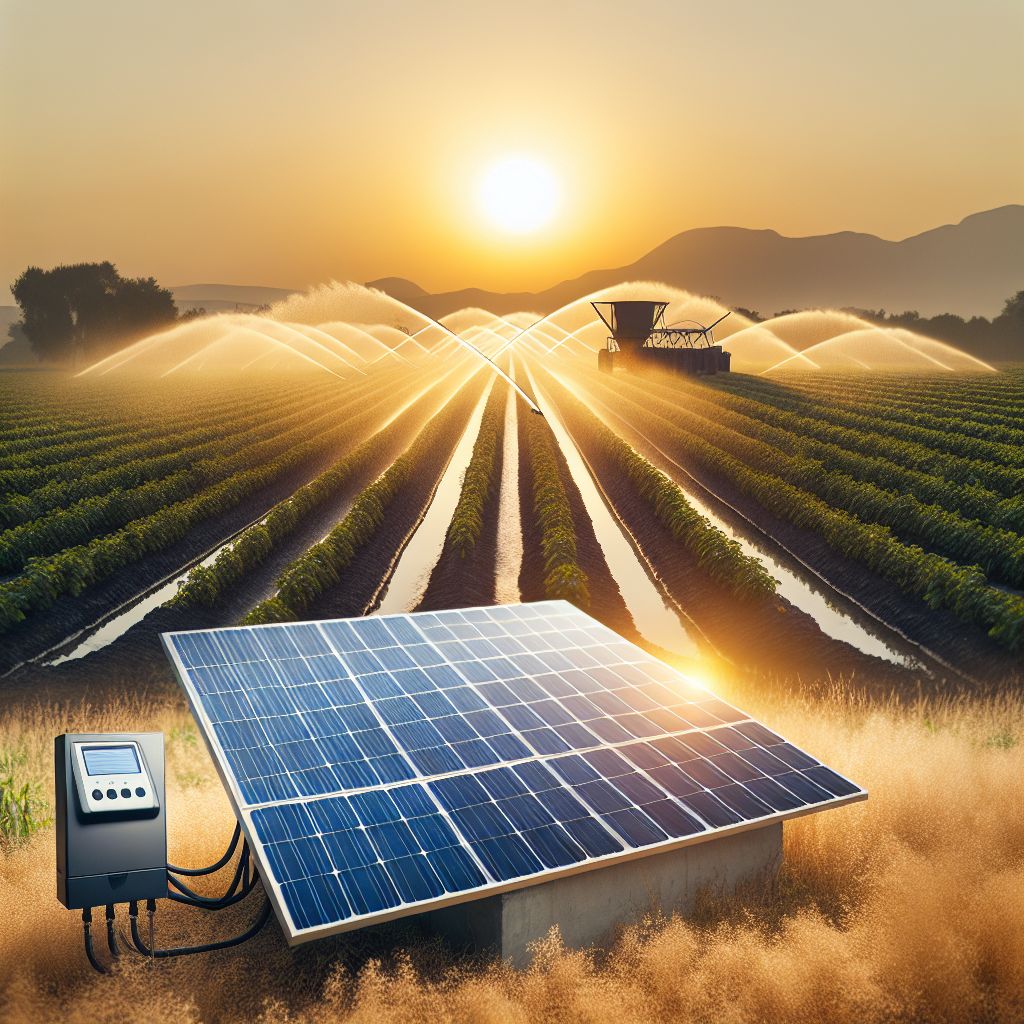
Irrigation represents one of the most energy-intensive aspects of many farming operations, making it an ideal application for polycrystalline solar panels. The peak power demand for irrigation typically aligns perfectly with peak solar production during sunny summer days. Solar-powered irrigation systems can be designed as direct-drive (pumping when the sun shines) or battery-backed (providing consistent pressure regardless of sunlight conditions). Many farmers find that eliminating fuel costs or electric bills for irrigation pumping alone justifies their entire solar investment, with polycrystalline panels providing the optimal balance of cost and performance for these high-load applications.
2. Barn and Outbuilding Electrification
Agricultural buildings present excellent opportunities for both rooftop and ground-mounted polycrystalline solar installations. The large, unobstructed roof areas of most barns and equipment sheds provide ideal mounting surfaces with minimal shading concerns. These installations can power lighting, ventilation, automated feeding systems, refrigeration, and other electrical equipment essential to modern farm operations.
- Lighting systems for extended work hours or livestock management
- Ventilation fans for livestock comfort and crop drying
- Refrigeration for milk, produce, or other perishable farm products
- Security systems and electric fencing
- Workshop power tools and equipment
The versatility of polycrystalline panels allows for various mounting configurations, including roof-parallel installations that maximize available space or tilted arrays that optimize seasonal production. For agricultural buildings, the slightly larger footprint of polycrystalline panels compared to monocrystalline rarely poses space constraints given the extensive roof areas typically available. To explore more about solar panel efficiency and performance factors, visit our guide.
In livestock operations, solar power provides critical backup during grid outages that might otherwise compromise animal welfare. Battery-backed systems using polycrystalline panels ensure ventilation, watering systems, and critical monitoring equipment remain operational even during extended power outages – a significant advantage for operations where animal health depends on continuous electrical service.
The durability of polycrystalline panels makes them well-suited to the challenging environment of agricultural buildings, where dust, humidity, and temperature fluctuations can stress electrical equipment. The robust construction and simple design hold up well in these conditions, providing reliable power with minimal maintenance requirements.
3. Greenhouse Temperature Regulation
Greenhouses require consistent climate control that can consume significant energy for heating, cooling, ventilation, and irrigation. Polycrystalline solar panels can power these systems directly or supplement grid power to reduce operational costs. The energy demand pattern of many greenhouse operations aligns well with solar production curves, with peak cooling needs occurring during maximum sunlight hours. Some innovative farmers are now integrating semi-transparent solar panels directly into greenhouse designs, though standard polycrystalline panels mounted on adjacent land or support structures remain the most cost-effective approach for most agricultural greenhouse operations.
4. Equipment Charging Stations
As farm equipment increasingly transitions to electric power, charging infrastructure becomes essential. Polycrystalline solar arrays provide an ideal power source for charging electric tractors, utility vehicles, and other battery-operated equipment. The consistent daytime production of these panels allows for opportunistic charging during field breaks or overnight charging when paired with battery storage systems.
The economics of solar-powered equipment charging become particularly compelling when compared to the alternative of running new utility lines to remote areas of large farms. For operations with fields distant from existing electrical infrastructure, self-contained solar charging stations eliminate the substantial cost of trenching and running new service lines while providing renewable energy at the point of use.
5. Crop Drying and Processing
Post-harvest processing represents another energy-intensive aspect of many farming operations that polycrystalline solar panels can effectively power. From grain drying to nut processing to fruit packing, these activities require substantial electricity that solar can provide. The seasonal nature of many processing operations often aligns well with peak solar production months, creating a natural match between energy supply and demand. For operations with significant seasonal processing needs, polycrystalline panels offer the cost advantages that make large system sizes economically viable, providing sufficient power for energy-intensive drying fans, conveyor systems, sorting equipment, and cold storage facilities. For more information on solar panel efficiency, check out our guide on solar panel efficiency.
6. Farmers Residence and Workers Living Quarters
Beyond agricultural operations, polycrystalline solar panels provide an excellent solution for powering farm residences and worker housing. These panels can significantly reduce or eliminate utility bills for farmhouses, bunkhouses, and other residential structures on the property. For many farming families, this represents a direct improvement in quality of life and reduction in living expenses.
With net metering available in many agricultural regions, excess production during daylight hours offsets evening consumption, effectively using the grid as battery storage. This arrangement works particularly well with polycrystalline panels, as their lower cost allows for installation of larger arrays that can produce sufficient energy to cover both operational and residential needs. Some forward-thinking farm operations are now including solar-ready designs in new worker housing, recognizing that energy independence benefits both the business and the people who make it function.
Lifespan and Degradation: What Farmers Need to Know About Polycrystalline Panels
- Polycrystalline panels typically degrade at 0.5-0.7% per year
- Most manufacturers guarantee at least 80% production after 25 years
- Actual field studies often show better-than-guaranteed performance
- Farm environments present specific degradation challenges
- Proper installation significantly impacts long-term performance
When investing in solar infrastructure for your farm, understanding the longevity of polycrystalline panels becomes crucial for accurate financial planning. These panels represent a multi-decade investment, and their performance over time directly impacts your return on investment and energy production capacity.
Most quality polycrystalline panels come with 25-year performance warranties, but their actual useful lifespan often extends well beyond this timeframe. Numerous studies of early solar installations have found panels continuing to produce at acceptable levels even after 30-35 years. This longevity makes them particularly suitable for farm operations with long planning horizons and multi-generational ownership structures.
The degradation process is gradual and predictable, allowing farmers to account for it in their energy planning. Initial degradation may be slightly faster in the first year (sometimes called “light-induced degradation”), but then stabilizes to the more gradual 0.5-0.7% annual rate that continues throughout the panel’s life. For agricultural planning, this means a 100kW system will still produce approximately 82-87% of its original output after 25 years of operation.
Expected Performance Over 25+ Years
Polycrystalline panels follow a relatively predictable degradation curve that farmers can factor into their long-term energy planning. In the first year, panels typically experience light-induced degradation of about 2-3%, followed by a more gradual decline of 0.5-0.7% annually. This means that after 25 years, a polycrystalline panel system will still produce approximately 80-85% of its original rated output. For farming operations with consistent energy needs, this predictable performance trajectory allows for accurate forecasting of supplemental energy requirements or system expansion timing. Many farmers find that the guaranteed 80% minimum production after 25 years aligns well with the typical finance period for solar investments, ensuring the system produces at or above expectations throughout the loan term.
Factors Affecting Degradation on Farms
Agricultural environments present unique challenges that can influence solar panel degradation rates. Dust from field operations, pollen during growing seasons, and potential chemical drift from spraying activities can all accumulate on panel surfaces, temporarily reducing output and potentially causing micro-abrasions over time. Temperature fluctuations in farm settings, particularly in metal-roofed agricultural buildings where panels may be mounted, can accelerate thermal cycling stress. Additionally, farms with livestock operations may experience ammonia exposure from animal waste, which can potentially affect junction box seals and frame materials over decades of exposure. Proactive maintenance practices, including seasonal cleaning, regular inspection of mounting hardware, and monitoring system output, can mitigate these farm-specific degradation factors and extend the effective lifespan of polycrystalline panels well beyond their warranty period.
Warranty Considerations for Agricultural Use
- Product warranties typically cover manufacturing defects for 10-12 years
- Performance warranties guarantee minimum output levels for 25-30 years
- Agricultural installations may require specific warranty validation requirements
- Documenting maintenance practices helps protect warranty coverage
- Some manufacturers offer enhanced warranties for commercial agricultural applications
When selecting polycrystalline panels for farm use, understanding the nuances of warranty coverage becomes particularly important. Most manufacturers offer two distinct warranty types: a product warranty covering physical defects (typically 10-12 years) and a performance warranty guaranteeing minimum power output over time (typically 25-30 years). For agricultural installations, the product warranty merits special attention, as farm environments may present more physical stress than residential settings.
Always verify that the intended installation method and mounting location comply with warranty requirements. Some manufacturers specify maximum wind and snow load ratings that must not be exceeded, or particular mounting hardware that must be used to maintain warranty coverage. These considerations become especially relevant for barn roofs or open field installations where environmental exposure exceeds typical residential conditions.
For larger agricultural installations, some manufacturers offer enhanced commercial warranties or extended coverage options that may provide additional value. These enhanced warranties sometimes include more favorable degradation guarantees or longer product warranty periods, reflecting the manufacturer’s confidence in their panels’ performance in demanding settings. When evaluating these options, consider the manufacturer’s longevity and financial stability, as warranty coverage is only valuable if the company remains in business to honor it.
Maintaining proper documentation of your system from installation through its operational life protects your warranty coverage and facilitates claims if needed. Keep records of installation details, maintenance activities, and system performance to demonstrate proper care and help identify any warranty-eligible performance issues that might arise during your polycrystalline panels’ decades-long service life.
When would Polycrystalline Solar Panel be Better for Farmers to Use Other Solar Panels
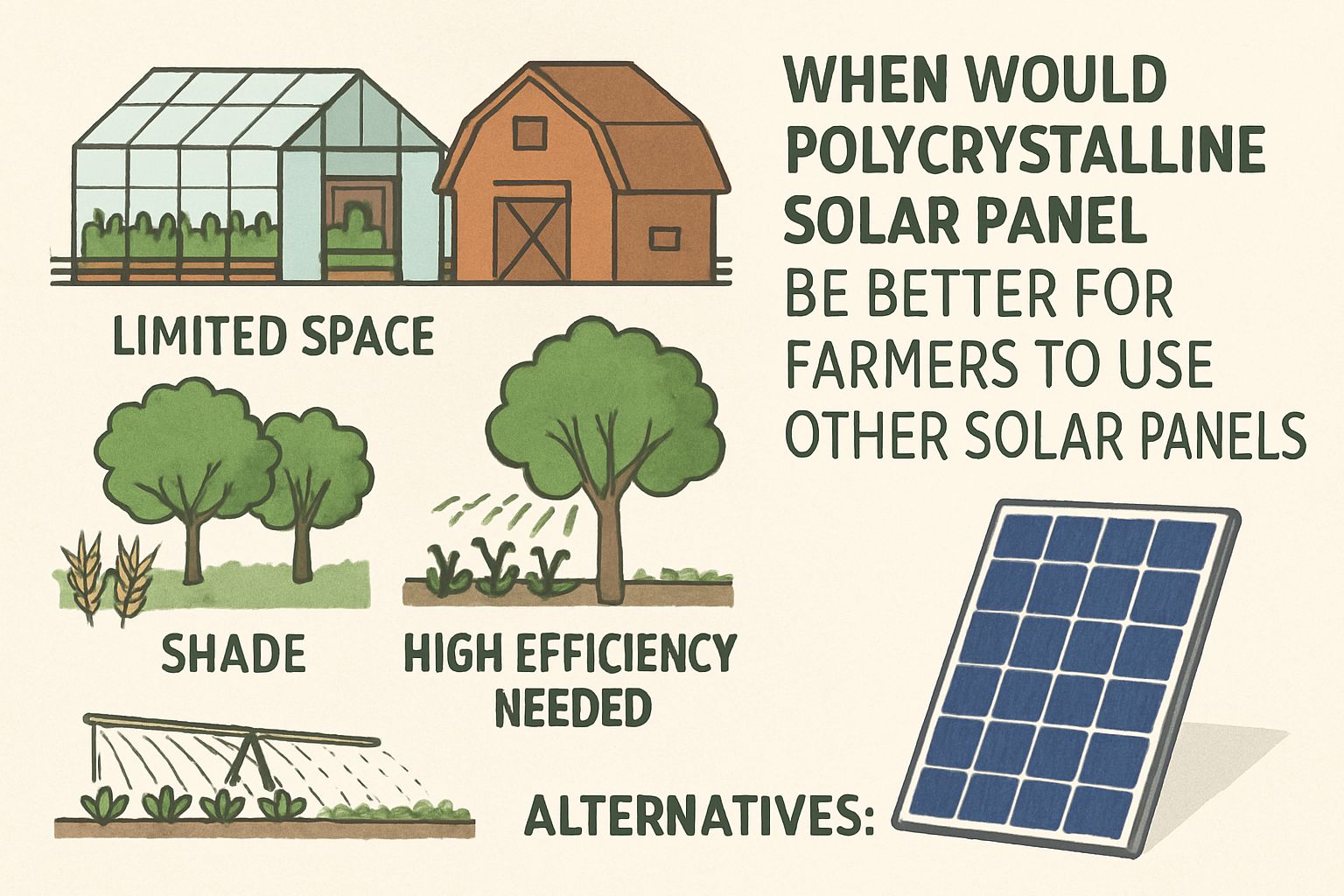
While polycrystalline panels offer numerous advantages for agricultural applications, certain farm situations might benefit from alternative solar technologies. Farms with extremely limited space for panel installation may achieve better results with higher-efficiency monocrystalline panels, despite their higher cost. Similarly, operations in regions with predominantly diffuse light conditions (consistently cloudy or foggy areas) might see better performance from thin-film technologies that handle low-light conditions more effectively. For specialized applications like solar-integrated structures or flexible mounting needs, technologies like bifacial panels or thin-film options could provide advantages that outweigh the cost benefits of standard polycrystalline panels. The decision should always be based on your specific farm’s energy requirements, space constraints, budget limitations, and local environmental conditions. Working with a solar provider experienced in agricultural installations helps ensure you select the optimal technology for your particular farming operation.
Frequently Asked Questions
When considering polycrystalline solar panels for your farm, you likely have specific questions about their performance, maintenance, and value. The following questions address common concerns from farmers evaluating solar energy options for their agricultural operations.
These answers reflect real-world experience from agricultural installations rather than theoretical specifications, providing practical insights relevant to farm applications. Remember that specific performance will vary based on your location, installation configuration, and energy usage patterns.
How do polycrystalline solar panels perform in high-temperature farm environments?
Polycrystalline panels typically lose 0.4-0.5% efficiency for each degree Celsius above 25°C (77°F), which means on hot summer days when panel temperatures may reach 65-70°C (149-158°F), overall performance might decrease by 16-22% from rated capacity. However, this temperature-related efficiency loss is slightly better than monocrystalline alternatives in most cases. For farm installations in hot climates, ensuring adequate airflow behind panels becomes crucial – raised mounting systems that allow air circulation can reduce operating temperatures by 5-10°C, significantly improving performance during hot weather periods.
Many farmers in high-temperature regions report that the actual annual production from polycrystalline panels exceeds initial estimates despite summer efficiency losses, as these panels continue producing substantial power even during extreme heat events that might trigger shutdown in more sensitive electronics. The robust design and tolerance for temperature variations make polycrystalline technology particularly well-suited to the environmental extremes common in agricultural settings.
What maintenance do polycrystalline panels require for agricultural installations?
Maintenance requirements for farm-based polycrystalline panels are minimal but important. Regular visual inspections (2-4 times yearly) to check for physical damage, loose connections, or excessive soiling are recommended. Cleaning is generally only necessary when visible dirt, pollen, or bird droppings accumulate – in most locations, natural rainfall provides sufficient cleaning, though dusty environments near tilled fields may require occasional manual cleaning using water and a soft brush or specialized solar panel cleaning tools. Avoid high-pressure washing or abrasive materials that might damage the panel surface. Electrical connections and mounting hardware should be inspected annually to ensure everything remains tight and corrosion-free, particularly important in agricultural settings where vibration from equipment and exposure to chemicals might accelerate wear on components.
How do polycrystalline panels compare to monocrystalline for irrigation systems?
For irrigation applications specifically, polycrystalline panels often provide better overall value despite their slightly lower efficiency. The cost advantage (typically 10-15% less expensive) allows farmers to install larger systems within the same budget, often more than offsetting the 5-7% efficiency difference. Irrigation demands typically peak during summer months when solar production is highest, creating natural alignment between energy generation and consumption patterns. Many farmers report that polycrystalline panels perform particularly well for direct-drive irrigation systems (where pumps operate when the sun shines) because their performance curve throughout the day matches irrigation needs well, with gradual morning startup and afternoon wind-down periods that help maintain consistent water pressure. For battery-backed irrigation systems, the slightly lower efficiency is easily compensated by adding a few additional panels at minimal cost increase, while still maintaining the economic advantages over monocrystalline alternatives.
Are polycrystalline panels durable enough for harsh farm conditions?
Polycrystalline panels have demonstrated excellent durability in agricultural environments, with robust construction that withstands dust, vibration, temperature fluctuations, and moderate hail impacts. The tempered glass covering resists damage from small projectiles, while the aluminum framing provides structural integrity against wind and snow loads. Most quality polycrystalline panels are certified to withstand wind speeds up to 140 mph and snow loads of 5,400 Pascal – sufficient for all but the most extreme agricultural environments.
Field experience shows that properly installed polycrystalline panels frequently outlast their 25-year warranty periods even in challenging farm conditions. The multi-crystal structure sometimes provides additional resistance to microcracks compared to monocrystalline alternatives, as the crystal boundaries can help limit crack propagation. For installations near livestock operations, specialized junction box seals resistant to ammonia exposure may be worth considering, as standard seals can degrade prematurely in these environments. Overall, farmers consistently report that polycrystalline panel durability exceeds expectations, with systems installed in the early 2000s still performing reliably after two decades in agricultural service.
What’s the typical ROI timeframe for polycrystalline systems on farms?
Return on investment for farm-based polycrystalline systems typically ranges from 5-9 years, depending on local electricity rates, available incentives, and system size. Agricultural operations benefit particularly from solar investments due to their high daytime energy consumption patterns and available space for optimal panel placement. Many farmers report that actual ROI exceeds initial projections due to rising utility rates over time, which increases the value of self-generated electricity beyond original calculations.
The economics become even more favorable when considering USDA REAP grants (which can cover up to 25% of system costs for agricultural businesses), accelerated depreciation benefits, and state-specific agricultural solar incentives. For farms with irrigation as their primary electricity expense, ROI timeframes often shorten to 4-6 years as these systems directly offset high-demand pump operations that would otherwise incur premium utility rates during summer months.
Growing Solar Mist specializes in helping farmers calculate accurate ROI projections based on their specific operation type, energy consumption patterns, and available incentives. Our agricultural energy experts can develop customized solar solutions that maximize financial returns while meeting your farm’s specific power requirements. Contact us today to discover how polycrystalline solar technology can transform your farm’s energy economics while contributing to a more sustainable agricultural future.







Leave a Reply