

Key Takeaways
- Solar-powered irrigation systems can reduce farm operating costs by 40-80% compared to grid-powered systems, with typical payback periods of 3-7 years.
- Modern solar irrigation setups can effectively power both low and high-pressure sprinkler systems, handling most commercial agricultural water demands.
- Battery storage integration with solar irrigation provides consistent performance during cloudy periods and enables night watering for optimal crop health.
- Solar panels designed for irrigation systems typically last 25-30 years, offering decades of reliable power with minimal maintenance.
The cost of watering crops keeps climbing. For farmers facing rising utility bills and unpredictable energy markets, solar-powered irrigation systems aren’t just environmentally friendly – they’re becoming an economic necessity. These systems transform free sunshine into reliable power that keeps crops hydrated without the monthly electric bill shock.
As weather patterns become more erratic and energy prices continue their upward trajectory, many agricultural operations are discovering that traditional grid-powered irrigation is increasingly unsustainable for their bottom line. Growing Solar Mist has been at the forefront of helping farmers transition to renewable irrigation solutions that offer both immediate operational benefits and long-term financial stability. Their agricultural solar specialists provide custom system designs that address specific farm requirements while maximizing available incentives.
The question isn’t whether solar can power irrigation systems effectively – that’s been conclusively proven across thousands of installations worldwide. The real questions center around specific implementation: Is it financially viable for your particular operation? How quickly will you recoup the investment? And will it reliably deliver the performance your crops demand? Let’s explore these questions in detail.
Solar-Powered Irrigation: A Game-Changer for Modern Farms
The marriage between solar technology and irrigation systems represents one of the most significant agricultural innovations in recent decades. By converting sunlight directly into electricity, these systems eliminate the ongoing costs associated with powering pumps and controllers. This approach transforms what was once a continual expense into a one-time investment that delivers returns for decades.
Unlike many agricultural innovations that promise efficiency at the cost of increased complexity, solar irrigation systems actually simplify farm operations once installed. They reduce dependence on external infrastructure, minimize vulnerability to grid outages or fuel shortages, and provide predictable performance without the fluctuations in operating costs that plague conventional systems.
The technology has matured significantly over the past decade, with dramatic improvements in panel efficiency, pump technology, and system integration. Today’s solar irrigation systems can effectively handle everything from small market garden operations to commercial-scale center pivot systems spanning hundreds of acres. This scalability makes them relevant to virtually any agricultural enterprise.
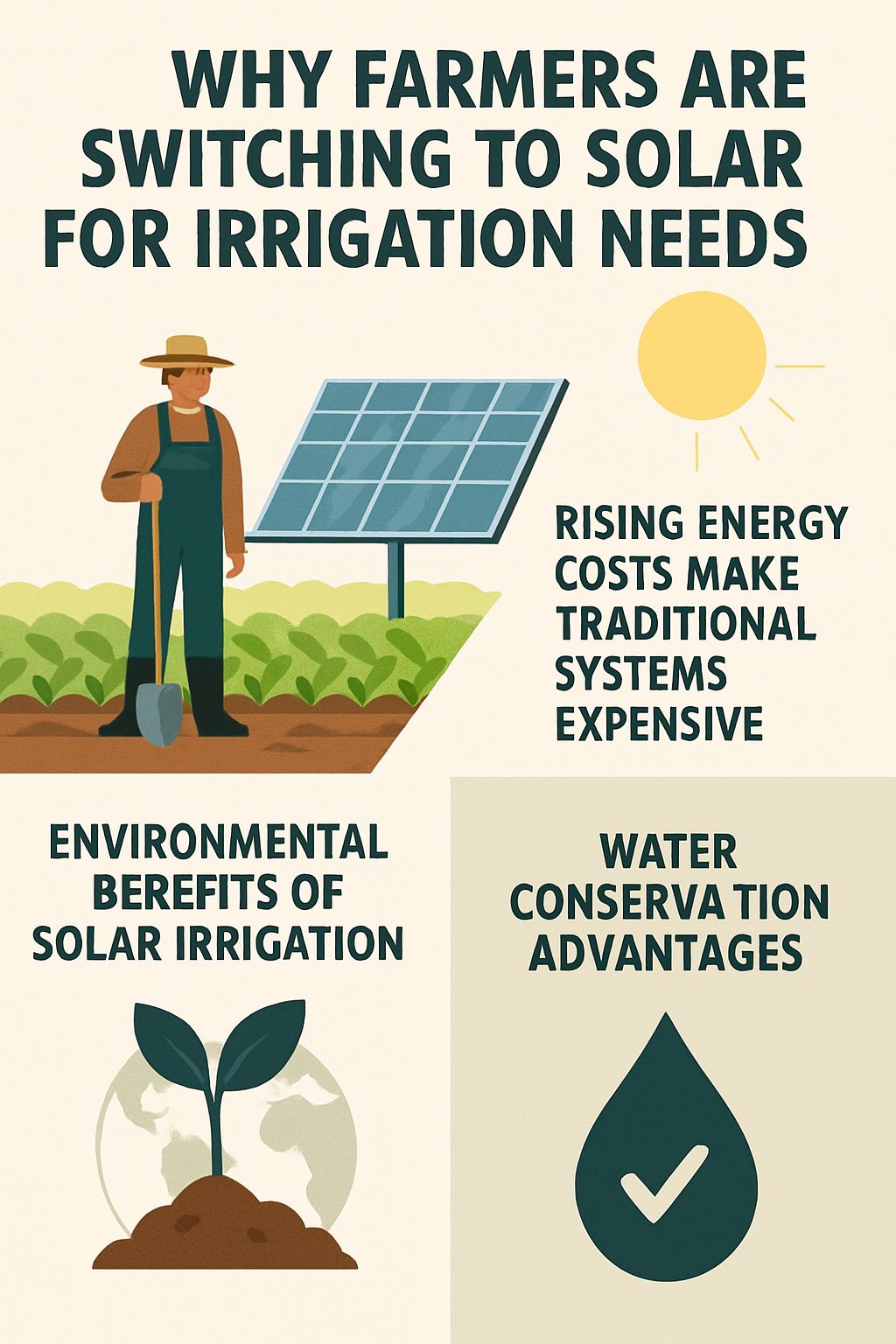
Why Farmers Are Switching to Solar for Irrigation Needs
The transition to solar-powered irrigation isn’t happening by accident. Specific economic and practical factors are driving this shift across diverse agricultural regions. Understanding these motivations helps clarify why solar irrigation represents more than just an environmental choice – it’s increasingly the most practical option available.
Rising Energy Costs Make Traditional Systems Expensive
Electricity rates for agricultural operations have increased by an average of 4-6% annually in many regions, significantly outpacing inflation. For irrigation-intensive farms, this translates to thousands of dollars in additional operating costs each growing season. Solar irrigation systems create a hedge against these escalating expenses by locking in energy costs upfront.
The unpredictability of energy markets creates additional financial stress for farm operations already dealing with thin margins. Solar power eliminates this uncertainty, allowing for more accurate financial planning and reduced exposure to market volatility. Many farmers report that simply having predictable energy costs has been as valuable as the actual savings they’ve realized.
Environmental Benefits of Solar Irrigation
Beyond the financial advantages, solar-powered irrigation dramatically reduces the carbon footprint of agricultural operations. A typical 10-hectare farm converting from grid electricity to solar for irrigation can prevent approximately 15-20 tons of CO₂ emissions annually – equivalent to taking 3-4 cars off the road. This reduction becomes especially significant considering that agriculture accounts for approximately 10% of total U.S. greenhouse gas emissions.
The environmental benefits extend beyond carbon reduction. Solar systems eliminate local air pollution from diesel-powered pumps, reduce noise pollution that can disturb livestock, and decrease the risk of soil and water contamination from fuel spills. These improvements support healthier farm ecosystems and can contribute to organic or sustainable certification requirements.
Water Conservation Advantages
Modern solar irrigation systems often incorporate smart controllers that optimize water delivery based on real-time soil conditions, weather forecasts, and crop requirements. These systems can reduce water usage by 15-30% compared to conventional timer-based approaches, preserving a precious resource while simultaneously decreasing pumping requirements. The result is a virtuous cycle where energy efficiency and water conservation mutually reinforce each other.
The integration of variable frequency drives (VFDs) with solar-powered pumps allows for precise pressure control that minimizes water waste through evaporation and runoff. Unlike conventional pumps that operate at fixed speeds regardless of actual requirements, solar VFD systems can maintain optimal pressure for different irrigation zones and applications. This precision extends system life while maximizing the effectiveness of every gallon pumped.
- Reduced dependency on unreliable grid infrastructure in rural areas
- Elimination of fuel transportation and storage challenges associated with diesel pumps
- Potential for additional income through net metering when irrigation isn’t required
- Tax benefits and depreciation advantages that improve overall farm financial position
- Enhanced property values associated with permanent renewable infrastructure improvements
How Solar-Powered Fixed Sprinkler Systems Actually Work
Solar irrigation systems operate on a surprisingly simple principle: photovoltaic panels convert sunlight into direct current (DC) electricity, which is then either used directly or converted to alternating current (AC) to power pumps and control systems. Unlike many renewable technologies that require complex implementation, the basic functionality is straightforward and relies on proven components with decades of field testing.
The true engineering achievement lies in how these systems are calibrated to meet specific agricultural requirements while accommodating the variable nature of solar energy production. Modern systems use maximum power point tracking (MPPT) controllers that continuously adjust electrical parameters to extract the optimal amount of power from panels regardless of temperature or light conditions.
Core Components of a Solar Irrigation Setup
Every solar irrigation system includes four primary elements: the solar array, the controller/inverter, the pump system, and the water distribution network. The solar array consists of interconnected photovoltaic panels mounted on ground structures or tracking systems that follow the sun. These panels generate the DC electricity that powers the entire operation.
The controller and inverter components serve as the system’s brain, converting DC electricity to AC when needed and regulating power flow to protect equipment from voltage fluctuations. Advanced controllers incorporate programmable logic that can integrate with soil moisture sensors, weather data, and automated scheduling to optimize irrigation timing and duration.
The pump system, typically submersible or surface-mounted depending on water source and required pressure, converts electrical energy into hydraulic power. Modern solar pumps are specifically designed to function efficiently with variable power input, operating at reduced capacity during lower light conditions rather than shutting down entirely. This adaptability maintains at least some water flow even during sub-optimal conditions.
Direct Solar vs. Battery Storage Options
Solar irrigation systems come in two primary configurations: direct-drive and battery-coupled. Direct-drive systems operate only when sufficient sunlight is available, making them simpler and less expensive but limiting operation to daylight hours. This configuration works well for operations where daytime irrigation aligns with crop needs and where water storage is available through tanks or reservoirs. For more information on the different types of solar-powered irrigation systems, check out this detailed guide.
Battery-coupled systems include energy storage that captures excess solar production for use during cloudy periods or nighttime operation. While adding approximately 20-30% to system cost, batteries dramatically increase reliability and enable strategic irrigation timing based on crop requirements rather than sunlight availability. Most commercial operations find that the flexibility provided by batteries justifies their additional investment, particularly for high-value crops.
System Sizing Requirements for Different Farm Needs
Proper sizing represents the most critical factor in solar irrigation success. Undersized systems fail to deliver sufficient water during peak demand periods, while oversized systems unnecessarily inflate initial costs. Accurate sizing requires detailed analysis of water requirements throughout the growing season, hydraulic calculations for pressure and flow rates, and solar radiation data specific to the installation location.
For small vegetable operations of 1-5 acres using drip irrigation, systems typically range from 2-5 kilowatts and can cost $5,000-$15,000 installed. Medium-sized operations of 5-20 acres using mixed irrigation methods generally require 5-15 kilowatt systems costing $15,000-$45,000. Large commercial operations with high-pressure sprinkler systems covering 20+ acres may need 15-50 kilowatt arrays costing $45,000-$150,000, though economies of scale improve cost-effectiveness as system size increases.
Integration with Existing Irrigation Infrastructure
Most farms already have significant investments in irrigation equipment, making the ability to integrate solar power with existing infrastructure essential. Fortunately, modern solar systems can be designed to work with virtually any existing sprinkler, drip, or flood irrigation setup with minimal modifications. This compatibility dramatically reduces transition costs while preserving previous investments.
When retrofitting conventional systems, the electrical components (pumps, controllers, and valves) are typically replaced or modified while keeping the water distribution infrastructure intact. This approach minimizes disruption to established fields while still capturing the operational benefits of solar power. For many operations, this phased implementation provides the most practical path toward renewable irrigation.

Real Financial Numbers: Is Solar Irrigation Worth It?
Beyond environmental benefits, the decision to invest in solar irrigation ultimately comes down to financial performance. The good news: detailed financial analysis consistently demonstrates strong returns across diverse agricultural operations. However, these returns vary significantly based on specific circumstances, making individualized assessment essential.
The most common financial metric for evaluating solar irrigation is simple payback period—the time required for energy savings to equal the initial investment. This straightforward calculation provides a clear benchmark for comparing solar against other potential farm improvements. Most properly designed systems achieve payback in 3-7 years while delivering benefits for 25+ years, creating decades of essentially free operation.
Available Tax Incentives and Agricultural Subsidies
The economics of solar irrigation improve dramatically when available incentives are properly leveraged. The federal Investment Tax Credit currently allows farmers to deduct 30% of the system cost from their taxes, instantly reducing the effective investment. This credit works alongside accelerated depreciation allowances that provide additional tax benefits in the early years after installation.
Beyond federal incentives, many states and utilities offer agricultural solar programs with rebates ranging from $0.10 to $1.50 per watt installed. The USDA’s Rural Energy for America Program (REAP) provides both grants covering up to 25% of project costs and loan guarantees that facilitate financing at favorable rates. When combined, these incentives can reduce out-of-pocket costs by 40-60%, transforming the economics of even marginally viable projects.
Typical Payback Periods Based on Farm Size
Financial performance varies predictably based on farm size and irrigation requirements. Small operations typically see payback periods of 4-7 years, medium operations 3.5-5 years, and large commercial farms often achieve payback in just 3-4 years due to economies of scale and higher energy displacement. These figures assume moderate utility rates of $0.12-0.15/kWh; in regions with higher electricity costs or demand charges, payback accelerates significantly.
Long-Term Savings Calculator
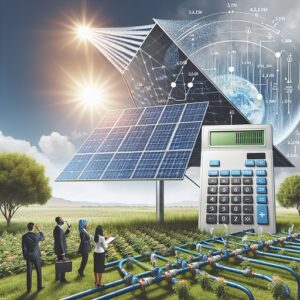
While payback period provides a useful metric, it fails to capture the impressive lifetime returns of solar irrigation. A more comprehensive financial assessment looks at 25-year returns, which typically range from 300-800% of the initial investment. For a 10-kilowatt system costing $30,000 after incentives, lifetime operational savings typically exceed $100,000 when accounting for avoided electricity costs, reduced maintenance, and increased system lifespan.
Maintenance Costs Compared to Traditional Systems
Solar irrigation dramatically reduces maintenance requirements compared to conventional alternatives. With no fuel to purchase, store, or transport and few moving parts, solar systems typically require only annual inspections and occasional panel cleaning. Electrical components like inverters may need replacement after 10-15 years, but this cost remains minimal compared to the ongoing maintenance of diesel pumps or the steady electricity bills of grid-powered systems.
Comparative 10-Year Operating Costs (20-acre farm)
Grid Electricity: $68,000 (assuming 5% annual rate increases)
Diesel Generator: $83,000 (fuel, maintenance, replacements)
Solar Irrigation: $8,000 (maintenance only after initial investment)
The maintenance advantage extends beyond direct costs. Solar systems eliminate the operational disruptions associated with fuel deliveries, power outages, and mechanical failures of conventional pumps. This increased reliability translates to reduced crop stress and more consistent yields, providing additional value that often exceeds the direct energy savings.
For farms operating in remote locations, the logistics of maintaining conventional systems create additional challenges. Fuel deliveries require accessible roads and consistent supply chains, while grid connections may require expensive infrastructure extensions. Solar systems eliminate these dependencies, functioning autonomously even in the most isolated locations.
Over the typical 25-30 year lifespan of a solar irrigation system, the cumulative maintenance savings alone often justify the initial investment. When combined with eliminated energy costs, the financial case becomes compelling for virtually any irrigation-dependent operation with suitable solar exposure.
Practical Limitations You Need to Know
While the benefits of solar irrigation are substantial, realistic implementation requires acknowledging certain limitations. Understanding these constraints upfront allows for proper planning that mitigates their impact and sets realistic expectations for system performance.
Most limitations aren’t deal-breakers but rather factors that influence system design and operational procedures. With proper planning and sizing, solar irrigation can reliably meet agricultural requirements in almost any environment. The key is addressing these considerations during the planning phase rather than discovering them after installation.
The good news is that ongoing technological improvements continue to reduce these limitations each year. Panel efficiency increases, battery costs decline, and control systems become more sophisticated – all contributing to solar irrigation systems that deliver increasingly robust performance under challenging conditions.
Weather Dependency Challenges
The most obvious limitation is the dependency on favorable weather conditions. Cloud cover reduces system output, potentially limiting irrigation capacity during overcast periods. This variability can create challenges for crops that require precisely timed or constant irrigation regardless of weather conditions.
Modern system designs address this limitation through several approaches. Battery storage provides power during cloudy periods or nighttime, water storage tanks maintain reserves for low-production days, and oversized solar arrays ensure sufficient power even in suboptimal conditions. These solutions effectively manage weather variability but do increase system costs and complexity.
Seasonal variations in sunlight also affect system performance, with winter months typically producing 30-60% less power than summer peak. For year-round operations, this requires either seasonal adjustments to irrigation scheduling or system sizing based on worst-case scenarios, which creates excess capacity during optimal conditions.
Land Requirements for Solar Arrays
Solar installations require physical space that could otherwise be used for cultivation. A typical 10-kilowatt ground-mounted system occupies approximately 800-1,000 square feet, which represents a non-trivial footprint for smaller operations. This land requirement creates opportunity costs that must be factored into the overall economic analysis.
Creative mounting solutions can mitigate land use concerns. Elevated mounting systems allow for continued use of the land underneath panels for grazing or certain crops, pole-mounted systems minimize footprint, and tracking systems increase efficiency while requiring less total panel area. Some operations successfully integrate panels with structures like equipment sheds or packing facilities, eliminating additional land requirements entirely.
Technical Expertise Needed
Solar irrigation systems introduce technical complexity beyond conventional irrigation equipment. This complexity requires either developing in-house expertise or establishing relationships with qualified service providers who understand both agricultural requirements and renewable energy systems. The learning curve can be steep for operations accustomed to simpler mechanical systems.
While day-to-day operation remains straightforward, troubleshooting and maintenance require specialized knowledge. Most manufacturers offer remote monitoring capabilities that allow for professional oversight without on-site visits, but local technical support remains important for timely resolution of any issues that arise. For more information on these systems, you can explore irrigation systems and solar panels.
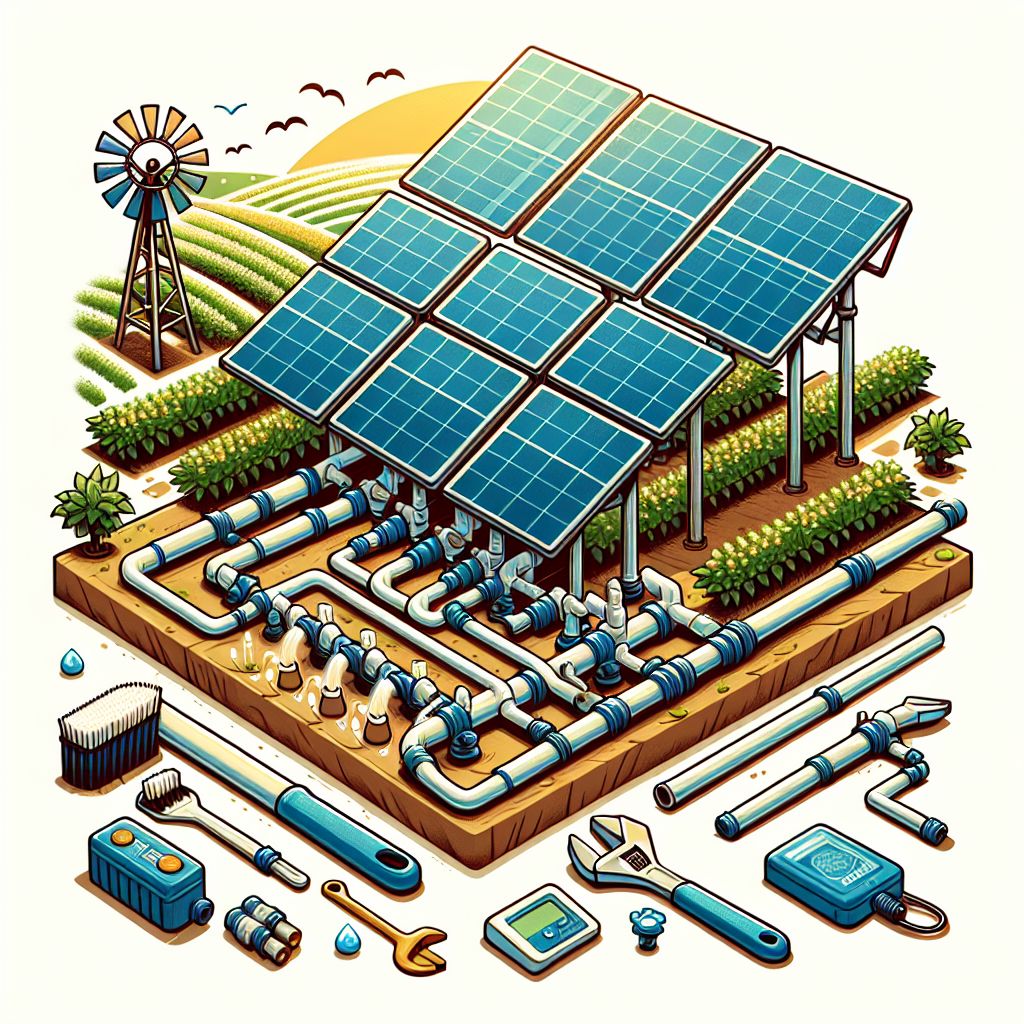
“Solar Panels for an Irrigation System …” from growingsolarmist.com and used with no modifications.
5 Critical Factors for a Successful Solar Irrigation Installation
The difference between disappointing and exceptional solar irrigation performance often comes down to five key decisions made during the planning and implementation process. Getting these elements right virtually guarantees satisfactory results, while overlooking any one of them can compromise the entire investment.
1. Proper System Sizing
Accurate system sizing begins with detailed water requirements analysis. This process involves calculating peak daily water needs based on crop type, climate conditions, soil characteristics, and irrigation method. These requirements are then translated into pumping power needs, accounting for pressure requirements, elevation changes, and pipeline friction losses.
Once water and power requirements are established, solar production calculations determine the necessary array size. This calculation must account for seasonal variations, typical weather patterns, and system efficiency losses. Undersizing at this stage creates frustrating performance limitations, while oversizing unnecessarily increases costs without proportional benefit.
The most successful installations typically include a 10-20% capacity buffer beyond calculated requirements. This margin accommodates unexpected demand increases, accounts for gradual panel degradation over time, and provides operational flexibility during suboptimal conditions. For more insights on maximizing efficiency, explore the integration of solar panels with sprinkler irrigation systems.
2. Strategic Panel Placement
Panel placement dramatically impacts system output, with poorly positioned arrays potentially producing 30-40% less energy than optimal installations. Ideal placement includes unobstructed southern exposure (in the northern hemisphere), proper tilt angle based on latitude, and sufficient elevation to avoid shading from nearby trees, structures, or crops as they grow.
For maximum production, single or dual-axis tracking systems that follow the sun throughout the day can increase energy harvest by 25-45% compared to fixed installations. While these systems add cost and complexity, they often provide the best solution for space-constrained operations or locations with expensive land value.
3. Water Demand Analysis
Beyond simple volume calculations, sophisticated water demand analysis examines timing requirements throughout the growing season. This analysis identifies peak demand periods that drive system sizing requirements and highlights opportunities for strategic irrigation scheduling that maximizes solar utilization.
The most efficient systems match irrigation timing to solar production when possible. This approach minimizes storage requirements and maximizes direct utilization of available power. For crops that benefit from early morning or evening irrigation, battery storage becomes essential despite the additional cost.
4. Battery Storage Considerations
Battery storage decisions balance cost against operational flexibility. Larger battery systems provide greater independence from solar production variations but significantly increase initial investment. The optimal configuration depends on specific operational requirements, crop sensitivity to irrigation interruptions, and local weather patterns.
Lithium-ion batteries have become the dominant technology for new installations due to their longer life cycles, higher efficiency, and declining costs. For a typical 10-kilowatt system, 10-20 kilowatt-hours of storage provides sufficient capacity for most agricultural applications while maintaining reasonable economics. Learn more about solar-powered irrigation systems and their integration with battery storage.
When evaluating battery options, lifetime cost analysis provides more accurate comparison than initial price. Higher-quality systems with 3,000+ cycle ratings and 10+ year warranties typically deliver better long-term value despite higher upfront costs, particularly for daily-use agricultural applications.
5. Professional Installation vs. DIY
While the DIY approach appears tempting for cost-conscious farmers, professional installation typically provides better long-term value for solar irrigation systems. Proper installation ensures compliance with electrical codes, optimal system performance, and warranty protection. Professional installers also navigate permitting requirements, utility interconnection, and incentive applications – complex processes that often confound first-time solar adopters.
The expertise gap becomes particularly significant when integrating solar with existing irrigation infrastructure or implementing control systems that optimize water use. These integrations require specialized knowledge that spans multiple technical domains and can create costly problems when improperly executed. For more insights, explore the integration of irrigation systems and solar panels.
The middle ground approach that often works best involves educating yourself thoroughly on system requirements and options, then partnering with qualified professionals for implementation. This collaboration ensures you make informed decisions while benefiting from specialized expertise for technical aspects.
Success Stories: Farmers Who Made the Switch
The theoretical benefits of solar irrigation become tangible through the experiences of farmers who have successfully implemented these systems. Their real-world results provide valuable insights into both the potential and the practical considerations of renewable irrigation.
These case studies represent diverse agricultural operations across different regions and scales. While specific results vary based on local conditions, the consistent theme is that properly designed solar irrigation systems deliver or exceed expected performance while creating operational advantages beyond simple energy savings.
Most successful implementations share common elements: thorough planning, appropriate technology selection, professional installation, and systematic monitoring after deployment. These elements create a foundation for success regardless of farm type or size. For more insights on integrating technology, check out this guide on irrigation systems and solar panels.
Comparative Results Across Farm Types
Small Farms (1-5 acres): 60-80% reduction in irrigation costs, 2-5 year payback
Medium Farms (5-30 acres): 70-90% reduction in irrigation costs, 3-6 year payback
Large Farms (30+ acres): 40-70% reduction in irrigation costs, 4-7 year payback
Small Vegetable Farm Case Study
River Valley Organics, a 4.5-acre diversified vegetable operation in California’s Central Valley, installed a 7.2-kilowatt system with 10 kilowatt-hours of battery storage in 2019. The system powers both drip and micro-sprinkler irrigation for 23 different crop varieties. Their $21,000 investment (after incentives) achieved payback in just 2.8 years, primarily due to high local electricity rates and year-round growing conditions. Beyond the 94% reduction in irrigation energy costs, owner Maria Gonzalez reports significant improvements in crop quality and yield due to more consistent irrigation made possible by the system’s reliability.
Large-Scale Crop Operation Results
Heartland Grains, a 640-acre corn and soybean operation in Nebraska, implemented a 48-kilowatt solar array to power a center pivot irrigation system covering 130 acres. Their 2018 installation cost $112,000 after incentives and achieved payback within 4.5 years despite relatively low rural electricity rates. The system displaced approximately 75% of their previous grid electricity usage, reducing annual operating costs by $24,800. Farm manager Jason Williams notes that beyond direct savings, the solar system provided critical resilience during two regional power outages that would have otherwise threatened crops during crucial growth stages.
Orchard Implementation Success
Sunnyslope Orchards, a 22-acre apple and pear operation in Washington state, installed a 15-kilowatt system with 30 kilowatt-hours of battery storage to power their frost protection sprinklers and regular irrigation. The $42,000 system (after incentives) achieved payback in 3.7 years while virtually eliminating irrigation-related energy costs. Owner David Chen reports that the ability to run frost protection systems independent of grid power has prevented crop losses during critical spring periods when grid outages coincided with freeze threats, essentially paying for the entire system in a single season by saving a vulnerable crop.

“Farms Irrigation Solar Panels System …” from growingsolarmist.com and used with no modifications.
Future-Proof Your Farm with Solar Irrigation
The agricultural landscape faces unprecedented challenges in the coming decades. Climate variability, water restrictions, rising energy costs, and increasing environmental regulations all threaten traditional farming operations. Solar irrigation represents a proactive response to these challenges, creating resilience against multiple threat vectors simultaneously.
Beyond addressing current challenges, solar irrigation positions farms to capitalize on emerging opportunities. Carbon credit markets increasingly reward renewable energy adoption, while consumers and supply chains place growing value on sustainably produced foods. Early adopters gain both operational advantages and market positioning that will become increasingly valuable as these trends accelerate.
The technology continues to improve rapidly, with each generation of equipment offering better performance at lower cost. Today’s investments deliver immediate benefits while establishing infrastructure that can be enhanced over time with modular upgrades to storage capacity, control systems, and monitoring capabilities. Growing Solar Mist’s agricultural specialists can help design systems that meet current needs while accommodating future expansion and technological evolution.
Frequently Asked Questions
The decision to implement solar irrigation naturally raises questions about performance, economics, and practical considerations. Addressing these common concerns provides clarity and confidence when evaluating renewable options for your specific agricultural operation.
While each farm presents unique circumstances that influence system design and performance, these general responses apply to most agricultural implementations. For situation-specific guidance, consultation with agricultural solar specialists provides the most accurate assessment based on your particular requirements and conditions.
How long do solar panels for irrigation systems typically last?
Modern solar panels used in agricultural applications typically carry 25-year manufacturer warranties and have expected lifespans of 30+ years. Throughout this period, panels experience minimal degradation, typically losing only 0.5-0.7% of their production capacity annually. This means that after 25 years, most quality panels still produce 80-85% of their original output – maintaining sufficient capacity for most irrigation applications throughout their entire lifespan. The electronic components like inverters and controllers generally require replacement after 10-15 years, but these represent a small percentage of the overall system cost.
Can solar-powered systems handle the water pressure needed for sprinklers?
Modern solar irrigation systems can effectively power both low and high-pressure applications, including impact sprinklers that require 40+ PSI for proper operation. The key lies in proper system sizing and component selection. High-pressure requirements simply mean larger solar arrays and appropriately specified pumps. For very high pressure applications like center pivot end guns or overhead frost protection, additional solar capacity ensures sufficient power is available. Some systems incorporate pressure regulation and accumulator tanks to maintain consistent pressure despite variations in solar production.
What happens to my irrigation system on cloudy days?
System performance during cloudy conditions depends entirely on the design approach chosen. Direct-drive systems without batteries will experience reduced output proportional to the decrease in solar radiation, potentially limiting irrigation capacity during heavily overcast periods. Battery-coupled systems maintain full operational capacity during cloud cover until the stored energy is depleted. The most robust configurations include both battery storage and grid connectivity as backup, ensuring uninterrupted operation regardless of weather conditions.
Are there specific crops that benefit more from solar irrigation?
- High-value specialty crops with strict irrigation requirements benefit from the precise control and reliability solar systems provide
- Drought-sensitive crops that require consistent moisture levels throughout the growing season
- Organic operations where sustainable practices contribute to certification and marketing advantages
- Crops grown in remote locations where grid infrastructure is unreliable or unavailable
- Perennial crops where long-term infrastructure investments can be amortized over multiple growing seasons
The economic equation proves most favorable for water-intensive, high-value crops where irrigation directly impacts quality and yield. For these operations, the improved control and reliability of solar irrigation often creates value beyond simple energy savings, improving crop outcomes and marketability.
Interestingly, certain crops align naturally with solar production patterns. Summer vegetables that require peak irrigation during maximum solar production periods create perfect synchronization between energy availability and water requirements. This natural alignment maximizes direct utilization of solar energy without storage, improving system economics.
Conversely, crops with critical irrigation requirements during low-light periods (early spring or late fall) may require larger storage capacity or hybrid systems. This doesn’t preclude solar adoption but does influence system design and economic calculations.
How difficult is it to maintain a solar-powered irrigation system?
Maintenance requirements for solar irrigation systems are remarkably minimal compared to conventional alternatives. The typical maintenance schedule includes seasonal panel cleaning to remove dust and debris (2-4 times annually), annual inspection of electrical connections and mounting hardware, and monitoring system performance through provided software interfaces. Most components have no moving parts and require no regular service beyond visual inspection.
The most common maintenance issues involve pump systems rather than the solar components themselves. Proper filtration upstream of pumps prevents most problems, while modern monitoring systems provide early warning of developing issues before they cause operational disruptions. Many installations include remote monitoring capabilities that alert both the owner and service provider to performance anomalies requiring attention.
- Panel cleaning: 2-4 times annually (more in dusty regions)
- Electrical inspection: Annually
- Battery maintenance: Varies by type (minimal for lithium, quarterly for lead-acid)
- Pump servicing: Same as conventional systems, typically annually
- Inverter check: Annually
Most farmers find they can handle routine maintenance themselves after initial training, with professional support required only for specific electrical components or troubleshooting unusual issues. The simplicity of maintenance represents a significant advantage over diesel or propane alternatives that require frequent attention to mechanical components. For more insights on integrating solar panels with irrigation systems, check out this article on efficient farm operations.
For operations transitioning from fossil fuel pumps to solar, the reduction in maintenance requirements alone often justifies the investment. The elimination of fuel deliveries, oil changes, filter replacements, and exhaust system maintenance creates both direct cost savings and operational simplicity that many farmers find surprisingly valuable.
Growing Solar Mist offers comprehensive maintenance packages that provide regular professional oversight while training farm personnel in basic maintenance procedures. Their agricultural specialists understand both solar technology and farming operations, ensuring your system delivers optimal performance throughout its multi-decade lifespan.
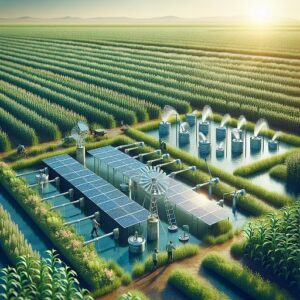
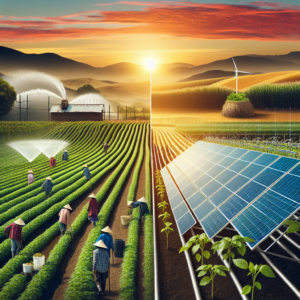
Solar panels are increasingly being used to power fixed sprinkler irrigation systems on farms. This sustainable energy solution not only reduces electricity costs but also minimizes the carbon footprint of agricultural operations. By harnessing the power of the sun, farmers can ensure a reliable and eco-friendly water supply for their crops. For more detailed insights on how solar panels can be integrated with irrigation systems, check out this guide on irrigation systems and solar panels.

Leave a Reply