

Key Takeaways
- Solar-powered furrow irrigation systems can reduce farm energy costs by up to 90% compared to traditional power sources
- Farmers typically see a return on investment within 3-7 years when installing solar panels for irrigation
- Solar panels integrate seamlessly with existing furrow irrigation infrastructure without requiring complete system overhauls
- Beyond cost savings, solar-powered systems provide energy independence and reliability for remote farming operations
- Growing Solar Mist offers specialized solar solutions specifically designed for agricultural irrigation needs
Farmers across the country are discovering that solar power isn’t just for rooftops anymore. The marriage between ancient furrow irrigation techniques and modern solar technology is revolutionizing how we grow food while cutting costs dramatically.
The shift to solar-powered irrigation isn’t just a trend—it’s a practical solution to rising energy costs and environmental concerns. By harnessing sunlight to power water pumps and irrigation systems, Growing Solar Mist’s agricultural solutions help farmers create sustainable operations that remain profitable for decades. The technology has matured to the point where reliability meets affordability, making now the perfect time to consider this upgrade for your farm.
90% Energy Cost Reduction: Solar Panels Transform Furrow Irrigation
Traditional irrigation systems typically rely on grid electricity or diesel generators, both of which come with fluctuating prices and environmental concerns. Solar panels eliminate this uncertainty by providing a consistent, renewable energy source that can reduce operational costs by up to 90% compared to conventional power. This dramatic reduction stems from eliminating monthly utility bills and fuel costs that typically make up a significant portion of irrigation expenses.
The math is compelling: a medium-sized farm spending $10,000 annually on irrigation power can potentially reduce that figure to just $1,000 or less with properly sized solar installations. These savings accumulate year after year, providing budget predictability that helps farmers plan for other investments and improvements.
Even more impressive is that modern solar systems can be tailored specifically to the irrigation demands of different crops and field sizes. This customization ensures you’re not paying for more capacity than needed while still meeting peak water requirements during critical growing periods.
How Farmers Save $8,000+ Annually on Irrigation Energy
The economics of solar-powered irrigation become clear when examining real-world numbers. A typical 30-acre farm using conventional furrow irrigation might require a 10-15 horsepower pump operating for 1,500 hours during the growing season. With standard electricity rates averaging $0.12/kWh, annual power costs often exceed $10,000. Converting this system to solar can reduce these expenses to just the maintenance costs—typically under $2,000 annually—resulting in $8,000+ in savings each year.
Additionally, many farmers report that these solar systems maintain consistent pressure and flow rates better than grid-connected alternatives, which can experience voltage fluctuations. This consistency translates to more uniform water distribution and potentially better crop yields.
- Elimination of monthly utility bills for pump operation
- Protection from rising energy costs and price volatility
- Reduced maintenance expenses compared to diesel generators
- Potential tax incentives and depreciation benefits
- Lower operational costs during peak irrigation seasons
Water Conservation Benefits Beyond Cost Savings
The integration of solar technology with furrow irrigation doesn’t just save money—it often leads to improved water management practices. Because solar-powered systems encourage farmers to maximize efficiency (to match available power), many users report becoming more conscious of water usage patterns. This awareness typically results in water conservation improvements of 15-30% compared to conventional approaches.
Solar-powered pumps also allow for more precise control over water delivery, which helps reduce runoff and evaporation. When paired with soil moisture sensors and automated controls, these systems can apply exactly the right amount of water exactly when crops need it most. This precision reduces waste while improving crop health and yield potential.
“After installing our solar-powered furrow irrigation system, we reduced water usage by 22% while increasing tomato yields by 15%. The system paid for itself faster than expected because of both energy and water savings.” — Maria Rodriguez, Sunshine Valley Farms

Perfect Match: Why Solar Power Works with Traditional Furrow Systems
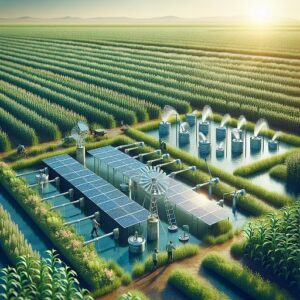
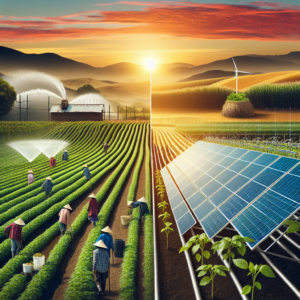
Furrow irrigation has endured for thousands of years because of its simplicity and effectiveness. Unlike newer irrigation technologies that might require completely new infrastructure, solar panels integrate surprisingly well with existing furrow systems. The basic mechanics remain unchanged—gravity still moves water down the furrows—but the energy source that powers the water delivery becomes clean and renewable.
This compatibility stems from the fact that solar panels generate DC electricity that can be either converted to AC for conventional pumps or used directly with DC pumps. The flexibility allows farmers to either retrofit existing systems or design new installations that maximize efficiency based on their specific needs and conditions. For more insights, explore the advantages of polycrystalline solar panels for agriculture.
- Compatible with both new installations and retrofits of existing systems
- Scalable designs that can grow with farm expansion
- Works with both surface water and groundwater sources
- Can power additional farm operations during non-irrigation periods
- Adapts to seasonal variations in water requirements
What is a Furrow Irrigation System
Furrow irrigation represents one of agriculture’s oldest and most widely used water delivery methods. The approach involves creating parallel channels (furrows) between crop rows, allowing water to flow downslope while gradually infiltrating the soil to reach plant roots. This gravitational system requires minimal technology but does need energy to pump water to field entrances or elevated positions to initiate flow. For more information on the benefits and cost-efficiency of using solar panels with furrow irrigation, you can explore this detailed guide.
Technical Compatibility Factors
The technical marriage between solar power and furrow irrigation hinges on several key compatibility factors. Most importantly, solar panels generate direct current (DC) electricity, which can power specialized DC pumps directly or be converted to alternating current (AC) for conventional pumps. This flexibility allows farmers to either utilize existing pump infrastructure or optimize with DC pumps that operate at 30-40% higher efficiency than their AC counterparts.
Water flow requirements in furrow irrigation also align well with solar power generation patterns. Since furrow irrigation typically requires moderate but consistent pressure rather than high-pressure bursts, the steady power output from solar panels matches this demand profile effectively. Additionally, peak sunlight hours generally coincide with peak evapotranspiration periods when crops need water most, creating a natural synchronization between energy production and irrigation needs.
System sizing becomes critical when designing a solar-powered furrow setup. A properly sized system accounts for factors like pumping depth, distance, flow rates, and seasonal variations. Most agricultural operations find that 5-15 kW systems provide sufficient power for small to medium farms, while larger operations might require 20-50 kW installations to meet their irrigation demands. For more detailed guidance, check out this investment guide for farmers considering solar panels for furrow irrigation.
Easy Integration with Existing Infrastructure
One of the most compelling aspects of solar-powered furrow irrigation is how seamlessly it integrates with existing farm infrastructure. Unlike drip or pivot systems that might require complete field restructuring, solar panels can be connected to existing pump stations with minimal modifications. The primary components—panels, mounting structures, controllers, and possibly inverters—can be installed without disrupting established furrow layouts or water delivery channels.
This retrofit capability means farmers can implement solar power in phases, starting with a single field or pump station before expanding. The modular nature of solar arrays allows for gradual scaling as budget allows or as farmers become comfortable with the technology. Many agriculturists begin with hybrid systems that maintain grid connections as backup while primarily operating on solar power.
Modern solar systems also incorporate smart controllers that can interface with existing irrigation timers and automation systems. These controllers optimize power usage based on available sunlight and can be programmed to prioritize critical irrigation zones during limited energy periods, ensuring the most efficient use of generated power.
Operational Improvements Over Conventional Power Sources
Beyond simple energy replacement, solar-powered systems offer distinct operational advantages over conventional power sources. Unlike diesel generators that require regular maintenance, fuel deliveries, and produce noise pollution, solar systems operate silently with minimal maintenance requirements—typically just annual inspections and occasional panel cleaning. For farmers looking to optimize their operations, exploring the cost benefits of solar panels can be a worthwhile investment.
Grid-tied farms often face voltage fluctuations that can damage pump motors or cause inconsistent water delivery. Solar systems deliver clean, consistent power that protects equipment and extends motor lifespan. Additionally, many farmers report that their solar-powered systems continue operating during grid outages, providing irrigation continuity during critical growing periods when traditional power might fail.
“We used to lose at least three pumping days each season due to power outages or generator problems. Since installing solar five years ago, we haven’t missed a single scheduled irrigation day. The reliability alone justified the investment.” — James Wilson, Heartland Produce Farm
Real Farm Results: Solar-Powered Furrow Irrigation Success Stories
Across diverse agricultural regions, farmers are reporting remarkable results after converting to solar-powered furrow irrigation. These success stories provide tangible evidence of the technology’s real-world benefits beyond theoretical projections. From small family farms to large commercial operations, the pattern of improved economics and reduced environmental impact emerges consistently.
The transition stories typically highlight not just cost savings but unexpected benefits like water conservation, reduced soil erosion, and even improved crop quality. Many farmers report that the forced efficiency of matching irrigation to available solar power led them to develop better water management practices overall. This optimization often translates to healthier soil biology and more resilient crops.
Perhaps most telling is that early adopters are now expanding their solar capacity beyond irrigation to power other farm operations. This expansion demonstrates that the initial experience with solar-powered irrigation provides confidence to further reduce dependence on conventional energy sources across all farm activities.
Southwest Farm Cuts Costs 87% While Boosting Crop Yields
Desert Sun Farms in Arizona presents a compelling case study in solar transformation. This 120-acre vegetable operation previously spent over $42,000 annually on electricity and diesel for furrow irrigation pumping. After installing a 75kW solar array to power their irrigation system, their energy costs plummeted to approximately $5,400 per year—an 87% reduction that paid for the initial investment in just 4.2 years.
More surprisingly, the farm reported a 12% increase in tomato yields and a 9% improvement in pepper production after the solar conversion. The farm manager attributes these gains to more consistent irrigation schedules made possible by energy independence. Rather than limiting irrigation during peak electricity rate periods, they now optimize watering based solely on crop needs. The elimination of diesel generators also reduced plant stress from exhaust emissions that previously affected crops nearest to pumping stations.
|
Metric |
Before Solar |
After Solar |
Improvement |
|---|---|---|---|
|
Annual Energy Cost |
$42,000 |
$5,400 |
87% reduction |
|
Tomato Yield |
32 tons/acre |
35.8 tons/acre |
12% increase |
|
Water Usage |
4.2 acre-feet |
3.7 acre-feet |
12% reduction |
|
System Downtime |
8-12 days/season |
0-1 days/season |
~95% reduction |
Small-Scale Implementation Shows Big Returns
Not all success stories come from large operations. Green Valley Family Farm, a 15-acre diversified vegetable farm in the Midwest, demonstrates how even small installations can yield significant benefits. The farm invested $18,000 (after incentives) in a 12kW solar system to power their furrow irrigation pump drawing from a nearby creek. Within three growing seasons, the system had completely paid for itself through eliminated electricity costs of approximately $6,000 annually.
The owners report that beyond financial savings, the system provided unexpected marketing advantages. Their “solar-grown produce” created a distinctive selling point at farmers’ markets, allowing them to command premium prices from environmentally conscious consumers. Additionally, the farm qualified for preferential selection in a farm-to-school program specifically seeking suppliers with sustainable practices, opening a valuable institutional market that increased their revenue by 22%. For more insights on how solar panels can benefit agricultural operations, you can explore the cost benefits and tips for farmers.

5 Major Benefits of Solar-Powered Furrow Irrigation
Converting furrow irrigation systems to solar power delivers multiple advantages that extend far beyond simple energy cost reduction. While the financial benefits are immediately apparent, the operational improvements and environmental advantages create a compelling case for agricultural sustainability. These benefits compound over time, making solar power increasingly valuable as traditional energy costs continue to rise.
Let’s examine the five most significant benefits that farmers experience after switching to solar-powered furrow irrigation systems.
1. Predictable Energy Costs for Decades
Unlike conventional energy sources with volatile pricing, solar power provides cost certainty that can transform farm financial planning. Once installed, solar panels deliver electricity at a fixed cost for 25+ years, effectively locking in irrigation energy expenses for decades. This predictability allows farmers to accurately forecast operating costs and make confident long-term planting decisions without worrying about energy price spikes.
Most solar systems for irrigation come with production guarantees, ensuring that panels will maintain at least 80% efficiency even after 25 years of operation. This longevity creates an exceptional return on investment compared to continuously rising grid electricity rates or fluctuating fossil fuel prices that have historically increased 3-5% annually. The elimination of this financial uncertainty represents a significant competitive advantage for solar-equipped farms.
2. Reduced Environmental Impact
The environmental benefits of solar-powered irrigation extend well beyond carbon reduction. A typical 20kW solar system for irrigation offsets approximately 30 tons of CO2 emissions annually—equivalent to planting over 500 trees each year. This significant carbon reduction helps farms meet sustainability goals while potentially qualifying for environmental incentives or premium market access.
Solar systems eliminate the risk of fuel spills that can contaminate soil and water sources, protecting valuable farmland and avoiding potential remediation costs. Additionally, by replacing noisy diesel generators, solar creates a healthier work environment for farm workers and a more hospitable habitat for beneficial insects and wildlife. These environmental improvements often translate into tangible marketing advantages when selling to eco-conscious consumers or supply chains with sustainability requirements. For more insights on this topic, you can explore our guide on solar panel benefits for farms.
3. Improved Water Management
Solar-powered furrow irrigation naturally encourages more efficient water usage. Because system operation aligns with daylight hours when solar generation is strongest, farmers typically optimize irrigation scheduling to maximize water delivery when power is most abundant. This scheduling discipline frequently results in more effective soil moisture management compared to traditional systems that might run whenever electricity is cheapest, regardless of optimal watering times.
Many solar irrigation systems include monitoring technology that provides detailed data on water application rates, soil moisture levels, and system performance. These insights help farmers fine-tune their irrigation practices, often reducing water consumption by 15-30% while maintaining or improving crop yields. The combination of energy independence and data-driven decision-making creates a powerful platform for sustainable water management that becomes increasingly valuable as water resources grow scarcer.
Farmers who upgrade to solar-powered systems frequently report that the technology has transformed their relationship with water resources, making them more conscious stewards of this precious input. The result is not just cost savings but a fundamental improvement in agricultural sustainability.
4. Energy Independence for Remote Farms
For farms located in areas with unreliable grid service or no electrical infrastructure, solar power creates unprecedented irrigation opportunities. These remote operations can establish consistent water delivery without the expense of extending power lines (which can cost $15,000-$50,000 per mile) or the ongoing maintenance and refueling requirements of diesel generators.
This energy independence eliminates irrigation disruptions caused by power outages or fuel delivery delays that can be devastating during critical growing periods. Solar-powered systems continue functioning regardless of utility company issues or regional fuel shortages, providing peace of mind during extreme weather events or supply chain disruptions. For many remote farms, solar represents the only economically viable option for implementing modern irrigation controls and automation that can dramatically improve productivity.
5. Enhanced System Reliability
Solar-powered irrigation systems typically demonstrate exceptional reliability compared to conventional alternatives. With no moving parts except for tracking systems (if installed), solar arrays require minimal maintenance while delivering consistent performance for decades. This reliability contrasts sharply with diesel generators that require regular maintenance, face parts obsolescence, and typically need replacement after 10,000-15,000 operating hours.
Modern solar systems include sophisticated monitoring that alerts farmers to any performance issues before they affect irrigation schedules. This preventative approach minimizes downtime compared to conventional systems that might fail without warning during critical irrigation periods. Many farmers report that after switching to solar, unexpected irrigation interruptions virtually disappear, removing a significant source of crop stress and potential yield loss.
“We used to keep two backup generators because our grid connection was so unreliable. Since installing solar, we haven’t had a single missed irrigation cycle in three years. The peace of mind alone is worth the investment.” — Carlos Mendez, Valley Vista Farms
ROI Calculator: When Solar Panels Pay for Themselves
Understanding the return on investment timeline is crucial when evaluating solar power for furrow irrigation. While upfront costs remain significant, dramatic reductions in operating expenses typically deliver complete payback within 3-7 years, depending on farm size, location, and existing energy costs. After this payback period, the system essentially provides free irrigation power for the remaining 20+ years of its operational life.
The ROI calculation must consider multiple factors beyond simple energy replacement costs. These include available tax incentives, depreciation benefits, potential carbon credits, water savings, yield improvements, and maintenance reductions. When all these factors are properly accounted for, most farms discover that solar power represents one of their highest-return capital investments.
Typical Payback Period Based on Farm Size
|
Farm Size |
Typical System Size |
Average Installation Cost |
Annual Savings |
Payback Period |
|---|---|---|---|---|
|
Small (5-20 acres) |
10-15kW |
$20,000-$30,000 |
$4,000-$6,000 |
4-6 years |
|
Medium (20-100 acres) |
15-50kW |
$30,000-$100,000 |
$6,000-$20,000 |
3.5-5 years |
|
Large (100+ acres) |
50-200kW |
$100,000-$400,000 |
$20,000-$80,000 |
3-7 years |
Long-Term Financial Benefits
The true financial power of solar-powered irrigation emerges in long-term analysis. Over a 25-year period, the typical operational life of quality solar panels, farmers can expect cumulative energy savings that exceed the initial investment by 300-500%. This exceptional return stems from the compounding effect of avoiding annually increasing energy costs while maintaining consistent production with minimal additional investment.
Beyond direct energy savings, many farmers report secondary financial benefits including reduced water costs, lower maintenance expenses, decreased downtime, and potentially higher crop values through improved quality or sustainability certification. These combined advantages frequently transform farm economics, improving profit margins and creating resilience against input cost volatility. Some operations leverage their solar investments into marketing advantages, commanding premium prices for “solar-grown” products in certain markets.
When calculating long-term benefits, it’s important to consider the salvage value of solar equipment. Even after 25+ years, solar panels retain significant value, with recycling programs and secondary markets offering additional returns at end-of-life. The mounting structures, wiring infrastructure, and some electronic components can often be reused with replacement panels, extending the system’s useful life with minimal reinvestment.
Tax Incentives That Cut Initial Costs By 30%
The economics of solar-powered irrigation improve substantially through available tax incentives and agricultural programs. The federal Investment Tax Credit (ITC) currently allows farmers to deduct 30% of the solar system cost from their taxes, dramatically reducing effective installation expenses. This credit applies to both new installations and retrofits, making solar viable for farms of all sizes.
Beyond the ITC, farmers can utilize USDA REAP (Rural Energy for America Program) grants that can cover up to 25% of project costs. Many states offer additional incentives including property tax exemptions, sales tax exemptions, and performance-based incentives that further enhance returns. Agricultural operations can also take advantage of accelerated depreciation options like bonus depreciation or MACRS (Modified Accelerated Cost Recovery System), allowing them to depreciate the entire system within 5-7 years for additional tax benefits.
- Federal Investment Tax Credit: 30% of system cost
- USDA REAP grants: Up to 25% of eligible costs
- Accelerated depreciation: 5-7 year schedule
- State-specific incentives: Vary by location
- Utility rebates: Available in some service territories
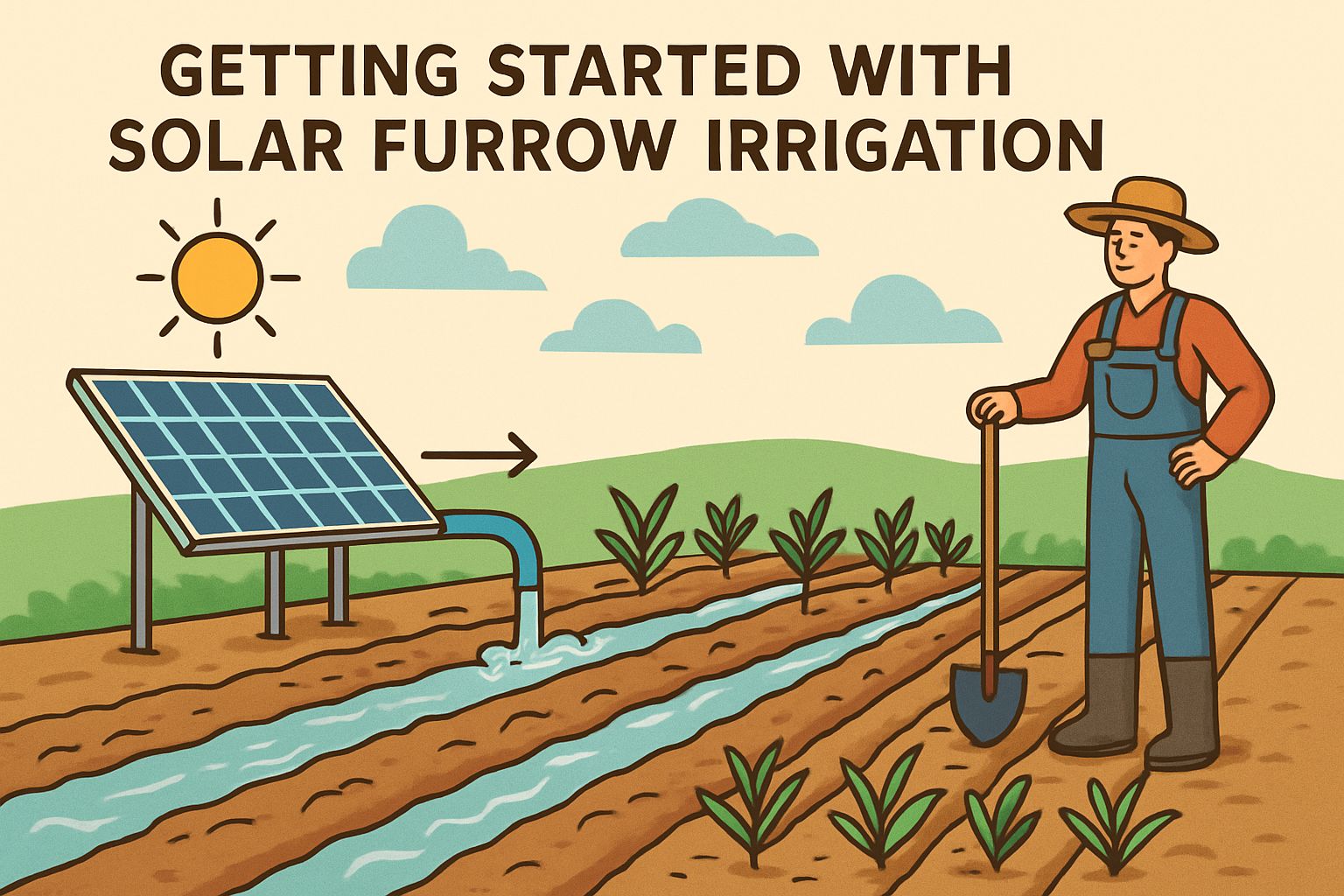
Implementation: Getting Started with Solar Furrow Irrigation
Site Assessment and System Design
The path to successful solar-powered furrow irrigation begins with a comprehensive site assessment that evaluates several critical factors. Solar exposure analysis identifies optimal panel placement by measuring sunlight hours throughout the year and accounting for potential shading from trees, buildings, or topographical features. Water source evaluation determines pumping requirements based on depth, distance, pressure needs, and seasonal flow variations that will dictate system sizing.
During design, energy modeling matches solar generation capacity with irrigation demand patterns by analyzing historical water usage and crop requirements. This modeling ensures the system delivers sufficient power during peak irrigation periods while avoiding unnecessary overcapacity. Site-specific variables including soil type, field gradient, crop rotation plans, and future expansion possibilities all influence the final system configuration. Working with an agricultural solar specialist rather than a residential installer is crucial, as they understand the unique demands of irrigation systems and can optimize for farming applications.
Installation Timeline and Process
Most agricultural solar installations follow a predictable timeline that minimizes disruption to farming operations. Initial site assessment and design typically requires 2-4 weeks, followed by permitting and utility interconnection applications that may take 4-8 weeks depending on location. The physical installation process is surprisingly quick—most systems can be installed in 3-10 days depending on size, with minimal impact on field access or irrigation schedules. Commissioning and testing usually requires 1-2 days, making the total active implementation period relatively brief compared to many farm infrastructure projects. For more insights, explore the cost benefits of solar panels for farmers.
Maintenance Requirements (Much Lower Than You Think)
One of solar power’s most significant advantages is its minimal maintenance requirements compared to conventional energy sources. Most systems require only annual inspection and panel cleaning to maintain peak performance, with cleaning frequencies varying by local dust and pollen conditions. Modern monitoring systems automatically alert owners to any performance issues, eliminating the need for regular manual checks while ensuring optimal operation.
|
Maintenance Task |
Frequency |
Typical Cost |
Skills Required |
|---|---|---|---|
|
Panel Cleaning |
1-4 times annually |
$200-$600 or DIY |
Basic, can be done by farm staff |
|
System Inspection |
Annually |
$300-$500 |
Professional technician |
|
Inverter Servicing |
Every 10-15 years |
$1,000-$3,000 |
Professional technician |
|
Battery Replacement |
Every 7-10 years (if applicable) |
Varies by capacity |
Professional technician |
Unlike diesel generators that require regular oil changes, filter replacements, and eventual engine rebuilds, solar systems have no moving parts except for optional tracking mechanisms. This fundamental difference eliminates most routine maintenance costs and associated downtime. The simplicity also removes the need for specialized mechanical knowledge, allowing farm staff to handle basic maintenance tasks like panel cleaning without extensive training.
Most quality solar installations include monitoring systems that track performance down to the individual panel level, automatically alerting owners to any issues before they impact irrigation capacity. This preventative approach contrasts sharply with conventional systems that often fail without warning during critical irrigation periods. Many agricultural solar providers include maintenance plans with their installations, further reducing management requirements and ensuring optimal performance.
Future-Proof Your Farm with Solar Irrigation Today
As agriculture faces increasing pressure from rising input costs, climate variability, and market volatility, solar-powered irrigation offers a rare opportunity to establish long-term cost stability while improving sustainability. By converting sunlight—a free, abundant resource—into irrigation power, farmers can effectively lock in one of their most significant operating expenses for decades while reducing their environmental footprint. This dual benefit positions solar-adopting farms for success regardless of how energy markets or environmental regulations evolve in coming years.

Conclusion: Do Farmers Save Enough Money to Justify Using Solar Panels with a Furrow Irrigation Systems.
The evidence is compelling: solar-powered furrow irrigation systems deliver exceptional returns on investment through dramatic energy cost reductions, improved reliability, and multiple secondary benefits. With payback periods typically ranging from 3-7 years and operational lifespans exceeding 25 years, these systems create decades of essentially free irrigation power after the initial investment is recovered. When combined with available tax incentives, grants, and financing options, the economic case becomes nearly irrefutable for most farming operations.
Beyond pure economics, solar-powered irrigation provides significant operational advantages including energy independence, reduced environmental impact, improved water management, and enhanced system reliability. These benefits compound over time, potentially transforming overall farm sustainability and resilience. As agricultural producers face increasing challenges from climate variability, resource constraints, and market pressures, solar power represents a proven strategy for establishing long-term viability while reducing operational uncertainty. Growing Solar Mist’s specialized agricultural solar solutions are helping farmers across the country realize these benefits while providing expert guidance throughout the transition process.
Frequently Asked Questions
As farmers consider transitioning to solar-powered furrow irrigation, several common questions arise about implementation, performance, and economics. The following answers address the most frequent concerns based on real-world experience across diverse agricultural operations.
How much land is needed for solar panels to power a typical furrow irrigation system?
Land requirements for solar arrays depend primarily on system capacity and local solar conditions. As a general guideline, each kilowatt of solar capacity requires approximately 100-200 square feet of space, including access areas between rows. For a typical 20kW system sufficient to power irrigation for 20-40 acres of cropland, farmers should allocate roughly 2,000-4,000 square feet (less than 0.1 acre). Many installations utilize non-productive areas like equipment yards, building rooftops, or field edges to minimize impact on plantable acreage. In some cases, elevated mounting systems allow for continued use of the land underneath panels for equipment storage or even limited crop production.
Can solar-powered irrigation systems work at night or on cloudy days?
Solar irrigation systems can accommodate nighttime or cloudy-day operation through several approaches. The most common solution involves grid connection with net metering, allowing excess daytime generation to offset nighttime usage through energy credits. For off-grid locations, battery storage systems can capture daytime solar production for use during non-sunlight hours, though this adds significant cost. Many farmers optimize irrigation scheduling to match daylight hours, installing larger water storage tanks or reservoirs that fill during solar production peaks and provide consistent water pressure throughout irrigation cycles. Hybrid systems that combine solar with backup generators or grid connections provide the most flexibility while still delivering substantial energy savings.
Do I need to replace my entire irrigation system when adding solar power?
Solar power integration typically requires minimal changes to existing furrow irrigation infrastructure. In most cases, only the energy source changes—the solar system simply replaces or supplements conventional electricity or diesel power while utilizing the same pumps, pipes, and distribution systems. Some operations benefit from upgrading to more efficient DC pumps that can be powered directly by solar panels without inverters, but this remains optional rather than necessary.
The compatibility with existing systems makes solar power particularly attractive for furrow irrigation compared to other methods. Unlike pressurized systems that might require completely new infrastructure, furrow irrigation’s relatively modest power requirements and simple mechanics facilitate straightforward solar integration. Most installations require only minor electrical modifications to connect the solar array to existing pump controls.
For systems previously powered by diesel generators, the transition typically eliminates not just the generator but also fuel storage facilities, resulting in simplified maintenance and reduced environmental compliance requirements. This streamlining can provide additional operational benefits beyond energy savings, especially when utilizing solar panels for cost benefits.
What happens if my solar panels produce more energy than my irrigation system needs?
Excess energy production creates several valuable opportunities for farm operations. Grid-connected systems with net metering arrangements can feed surplus electricity back to the utility, earning credits that offset other farm power costs or generating additional revenue. Some utilities offer feed-in tariffs that pay for excess production, creating a secondary income stream. Alternatively, farms can utilize excess capacity to power other operations including workshops, cold storage, office buildings, or equipment charging, reducing overall energy costs beyond irrigation alone.
Are there financing options specifically for agricultural solar projects?
Agricultural solar projects benefit from numerous specialized financing options designed to minimize upfront costs while maximizing returns. USDA programs including REAP grants and guaranteed loan programs specifically target renewable energy for agricultural producers, offering favorable terms unavailable to other industries. Many solar providers offer agricultural-specific lease arrangements or power purchase agreements (PPAs) that eliminate upfront costs entirely, allowing farmers to pay for the system through energy savings over time.
Farm credit institutions increasingly offer “green lending” programs with preferential rates for solar and other sustainability projects. These loans typically feature longer terms (10-20 years) aligned with system lifespan and may include flexible payment scheduling that matches farm cash flow patterns. Some states provide additional financing through green banks, property assessed clean energy (PACE) programs, or specialized agricultural loan funds designed specifically for sustainable farming initiatives.


Leave a Reply