
Key Takeaways
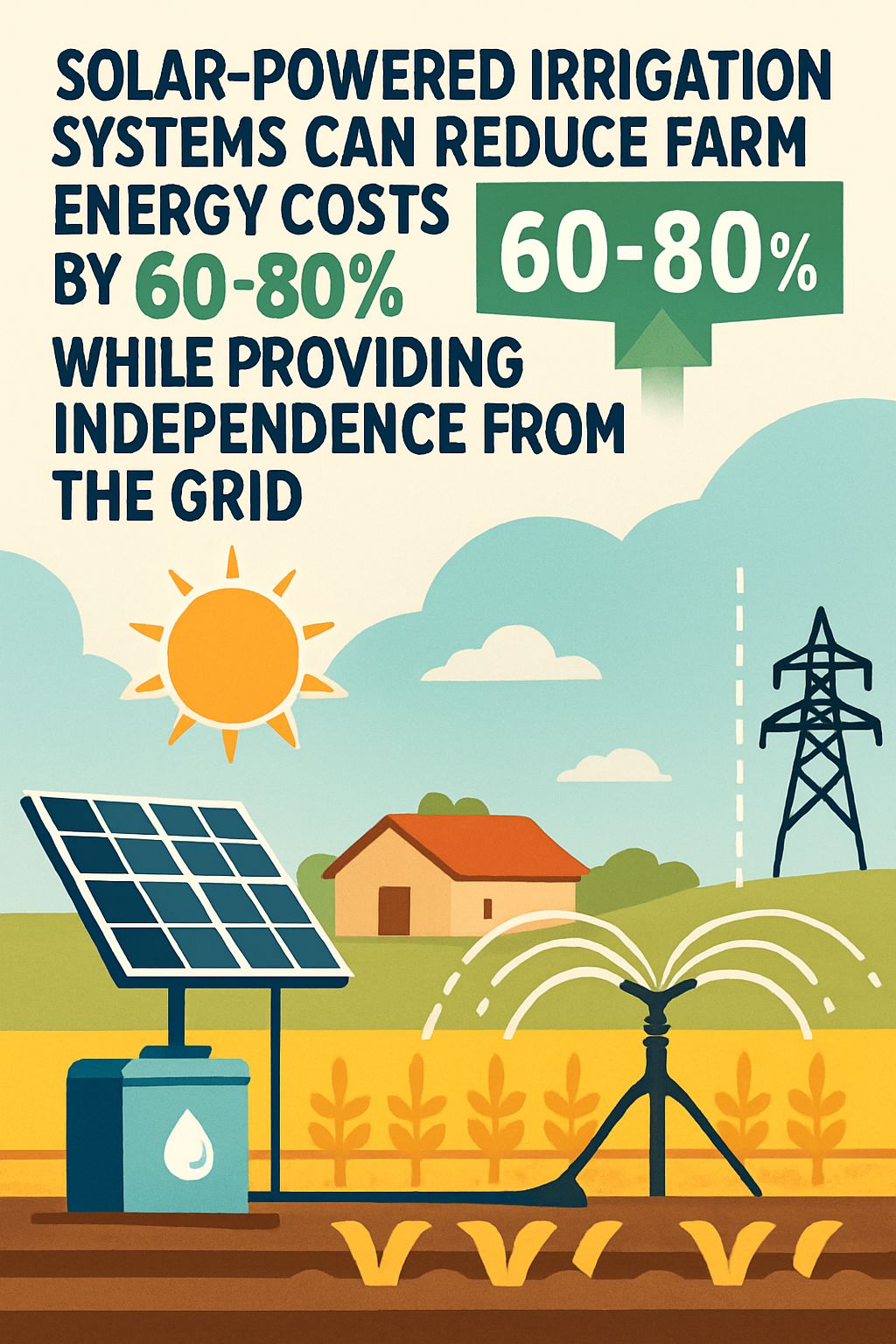
- Solar-powered irrigation systems can reduce farm energy costs by 60-80% while providing independence from the grid
- The natural alignment between peak solar production and irrigation needs creates perfect synergy for maximum efficiency
- Modern solar sprinkler systems improve water efficiency by up to 75% compared to traditional irrigation methods
- Growing Solarmist provides expert guidance on implementing solar solutions that transform agricultural operations
- Integration of solar panels with irrigation systems typically pays for itself within 3-7 years while lasting 25+ years
Solar-Powered Sprinkler Irrigation: The Perfect Farm Partnership
The farming landscape is evolving rapidly, with solar-powered irrigation leading the charge toward sustainability. By combining solar energy with sprinkler systems, farmers are discovering a powerful synergy that addresses both energy costs and water management challenges simultaneously. Growing Solarmist has been at the forefront of helping farmers implement these integrated systems, revolutionizing how agricultural operations manage resources while boosting productivity.
This partnership between solar panels and sprinkler irrigation represents more than just an alternative energy application—it’s a complete rethinking of farm infrastructure that aligns perfectly with the rhythms of nature and modern agricultural needs.
What is Solar-Powered Sprinkler Irrigation
Solar-powered sprinkler irrigation combines photovoltaic technology with water distribution systems to create a self-sustaining farm operation. At its core, this integration uses solar panels to generate electricity that powers water pumps, control systems, and sprinkler mechanisms. Unlike traditional setups that rely on grid electricity or fossil fuels, these systems harness renewable energy directly at the point of use. The complete system typically includes solar panels, inverters, pumps, water storage facilities, and distribution networks designed to work in harmony. What makes these systems truly remarkable is their ability to operate independently in remote locations where power infrastructure is unreliable or absent.
Natural Energy Alignment with Peak Irrigation Needs
One of the most elegant aspects of solar irrigation is the natural alignment between solar energy availability and plant water requirements. Solar energy production peaks during summer months and daylight hours—precisely when crops need the most water. This synchronization means the system produces maximum power when irrigation demands are highest, creating a perfect match between energy supply and water needs. During hot summer days when evapotranspiration rates increase, solar panels capture more energy to power increased irrigation demands. This natural rhythm eliminates the need for extensive energy storage in many applications, making the system more efficient and cost-effective.
The alignment extends beyond seasonal patterns to daily cycles as well. Morning and afternoon sun provides power for crucial watering periods, allowing farmers to optimize irrigation schedules without worrying about peak electricity rates or fuel costs.
60-80% Reduction in Irrigation Energy Costs
The financial impact of switching to solar-powered irrigation is substantial and immediate. Farmers implementing these systems typically report energy cost reductions between 60-80% compared to conventional grid-powered or diesel pump systems. For a mid-sized farm operation that might spend $10,000-$15,000 annually on irrigation energy, this translates to savings of $6,000-$12,000 each year. These savings begin accumulating from day one, though the full system typically pays for itself within 3-7 years depending on local conditions and incentives available.
Beyond direct energy savings, these systems eliminate vulnerability to rising utility rates and fuel price fluctuations, providing budget predictability that’s invaluable for farm financial planning. The economic benefits extend even further when considering reduced maintenance costs compared to diesel pumps and the elimination of fuel transportation and storage expenses. For farmers looking to maximize savings, exploring solar panels cost benefits can be an essential step.
Improved Water Efficiency Up to 75% Compared to Traditional Methods
Solar-powered sprinkler systems don’t just save energy—they dramatically improve water utilization efficiency. By integrating solar technology with modern irrigation controls, these systems enable precision watering that can reduce water usage by up to 75% compared to conventional flood irrigation techniques. This efficiency comes from the ability to deliver water precisely when and where crops need it, minimizing runoff, evaporation, and deep percolation losses. Advanced solar systems often incorporate soil moisture sensors, weather monitoring, and programmable controls that optimize water application based on actual plant needs rather than rigid schedules.
The water conservation benefits are particularly significant in regions facing drought conditions or depleting aquifers. For many farmers, the improved water efficiency alone justifies the investment in solar irrigation technology, especially as water becomes an increasingly precious and regulated resource.
Why Solar Panels and Sprinkler Systems Work Better Together
The integration of solar panels with sprinkler irrigation creates a system greater than the sum of its parts. While each technology offers distinct benefits on its own, their combination addresses multiple farm challenges simultaneously with remarkable efficiency. The modular nature of both technologies also allows farmers to scale systems precisely to their needs, adding capacity as operations grow or resources permit. This scalability provides an accessible entry point for farms of all sizes, from small specialty crop operations to large commercial enterprises.
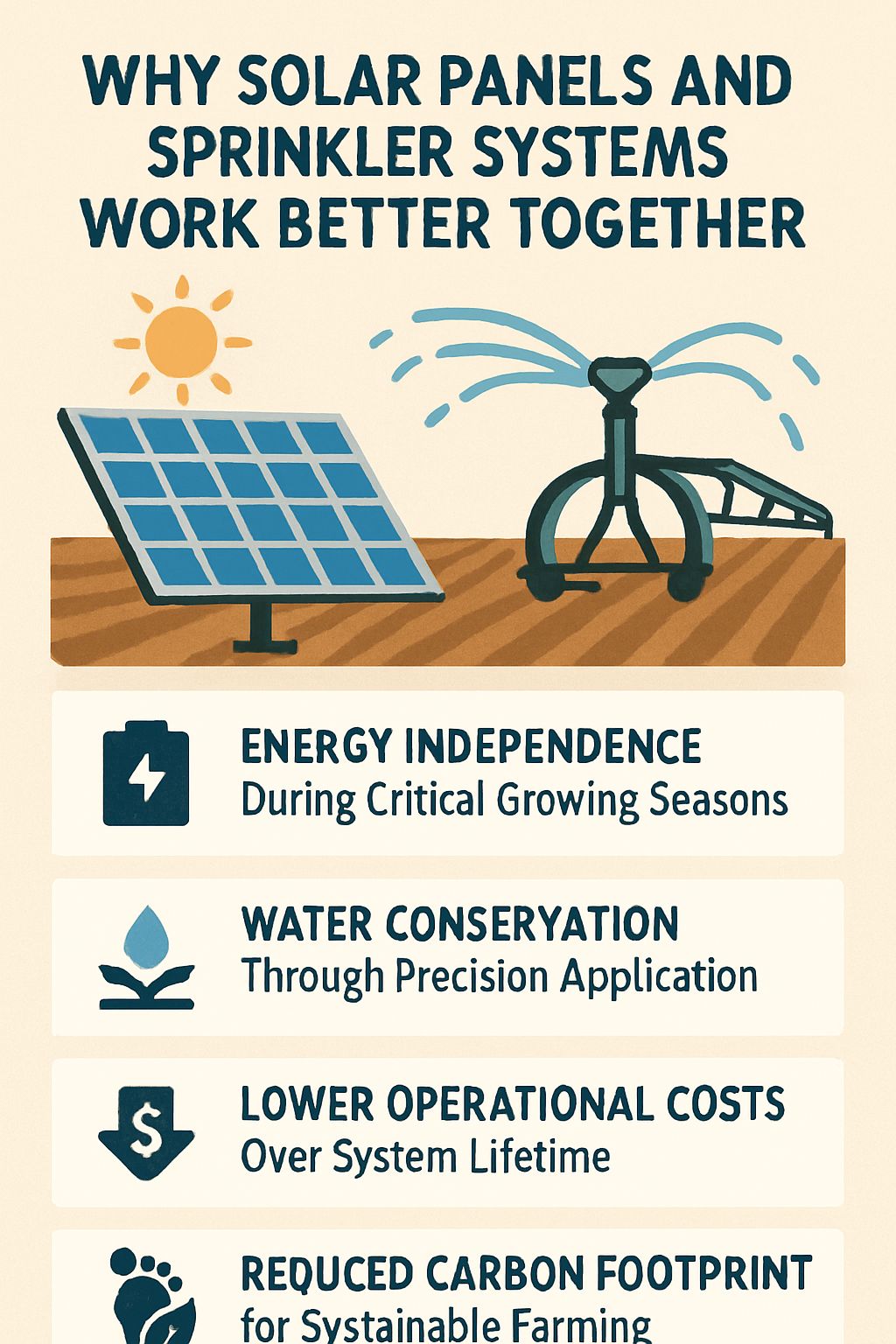
Energy Independence During Critical Growing Seasons
Solar-powered irrigation systems deliver crucial energy independence exactly when farmers need it most. During peak growing seasons when grid demand is highest and outages most common, solar systems continue operating reliably, ensuring crops receive consistent irrigation regardless of external power conditions. This independence protects harvests from potential losses due to power interruptions during critical growth stages. For many rural operations where power infrastructure is already stretched thin during summer months, this self-sufficiency represents a significant competitive advantage.
The system’s reliability extends to remote field operations where running power lines would be prohibitively expensive. Solar arrays can be positioned directly adjacent to water sources and irrigation zones, eliminating transmission losses and infrastructure costs while providing power exactly where needed.
Water Conservation Through Precision Application
The marriage of solar power and modern sprinkler technology creates unprecedented opportunities for water conservation. By powering precision sprinklers with consistent, clean energy, farmers can implement zone-specific watering schedules that deliver exactly the right amount of moisture based on crop type, growth stage, and soil conditions. These systems can reduce water usage by 30-50% compared to conventional methods while simultaneously improving crop yields through optimized moisture management.
Advanced solar-powered systems often incorporate soil moisture sensors, weather monitoring stations, and automated controls that adjust watering in real-time. This level of precision was previously impractical due to energy limitations or prohibitive operational costs. The water savings become increasingly valuable as climate change impacts water availability and regulatory pressures on agricultural water use continue to intensify.
Lower Operational Costs Over System Lifetime
When evaluating total operational expenses over the 25+ year lifespan of a solar irrigation system, the economic advantages become strikingly clear. After the initial investment, solar-powered systems operate at a fraction of the cost of conventional alternatives. Traditional irrigation systems require ongoing fuel purchases, regular maintenance of combustion engines, and replacement of worn components – costs that increase annually with inflation and rising fuel prices. Solar systems, by contrast, have minimal moving parts, require limited maintenance, and operate on free solar energy for decades after installation.
The reliability factor further enhances the economic equation. Solar irrigation systems experience significantly fewer operational disruptions than their fossil-fuel counterparts, reducing costly emergency repairs and minimizing crop stress during system downtime. This operational consistency translates directly to improved crop quality and yield reliability, factors that strengthen a farm’s market position and profitability.
Additionally, these systems typically retain substantial value even after their primary operational life, with panels maintaining 80%+ efficiency even after 25 years – creating residual asset value that conventional systems can’t match.
Reduced Carbon Footprint for Sustainable Farming
Beyond the operational and financial benefits, solar-powered irrigation significantly reduces a farm’s environmental impact. Each kilowatt-hour of solar energy used for irrigation instead of grid electricity or diesel fuel prevents approximately 0.85-1.5 pounds of carbon dioxide emissions. For a moderate-sized farm operation, this can translate to 20-40 tons of emissions prevented annually – equivalent to taking 4-8 cars off the road each year.
This reduced carbon footprint positions farms advantageously in increasingly environmentally-conscious markets. As consumers and corporate buyers place greater emphasis on sustainable production practices, solar-powered operations gain competitive differentiation and access to premium market segments. Many regional and national sustainability certification programs now award additional points for renewable energy utilization, further enhancing market positioning for farms using solar irrigation technology.
Setting Up Your Solar-Powered Sprinkler Irrigation System
Implementing a solar-powered sprinkler system requires thoughtful planning and design to maximize benefits. The integration process involves several key components that must work seamlessly together, from energy generation to water delivery. While system complexity varies based on farm size and requirements, understanding these fundamental elements ensures successful implementation regardless of scale.
1. Sizing Your System Based on Water Requirements
The first and most crucial step in designing a solar irrigation system is accurately calculating your water requirements. Begin by documenting water needs for each crop area, considering factors like plant type, soil composition, and local climate conditions. A common calculation involves multiplying the irrigated acreage by the water requirement per acre (typically 0.25-0.5 inch per application) and the frequency of irrigation needed. This total water volume requirement then determines the pumping capacity needed, typically measured in gallons per minute (GPM) or gallons per hour (GPH). For more insights on solar irrigation, consider exploring solar panels as a good investment for farmers.
Once you’ve established your water flow requirements, the next step involves calculating the total dynamic head (TDH) – the combination of vertical lift and friction loss your pump must overcome. This measurement, typically in feet, accounts for elevating water from its source plus the resistance through pipes, fittings, and sprinklers. Every 2.31 feet of head requires approximately 1 PSI of pressure, which directly impacts the pump power requirements.
With water flow and pressure requirements established, you can calculate the wattage of solar panels needed. As a general guideline, each horsepower of pump capacity requires approximately 1,000 watts of solar panels, though this varies based on system efficiency and local solar conditions. For example, a 2HP pump operating 6 hours daily might require a 3-4kW solar array to ensure consistent operation during peak irrigation periods.
2. Panel Placement Options for Maximum Sunlight Capture
Optimal panel placement dramatically impacts system performance and return on investment. The ideal orientation faces true south in the northern hemisphere (true north in the southern hemisphere) at an angle approximately equal to your latitude. This positioning maximizes annual energy production by optimizing the solar collection angle throughout the year. For irrigation-specific applications that primarily operate during growing seasons, slightly adjusting the tilt angle 10-15° more vertical than your latitude can boost summer production when water demands are highest.
When selecting installation locations, prioritize areas with unobstructed sunlight exposure from at least 9am to 3pm daily. Avoid even partial shading, as it can disproportionately reduce system output – a 10% shaded array might lose 25-40% of its production capacity. Consider ground-mounted systems for agricultural applications, as they offer easier maintenance access, better cooling (which improves efficiency), and flexibility in positioning compared to roof installations. Advanced tracking systems that follow the sun’s path can increase daily energy production by 25-45%, though they add complexity and maintenance requirements that must be weighed against the production gains.
3. Connecting Solar Arrays to Irrigation Pumps
The connection between solar panels and irrigation pumps requires careful component selection to ensure compatibility and efficiency. Most agricultural systems use either direct DC coupling or AC conversion depending on pump type and distance. DC pumps connected directly to solar arrays offer the highest efficiency for smaller systems, eliminating inverter losses and simplifying the installation. For larger systems or when using existing AC pumps, a solar inverter converts the DC electricity from panels into grid-compatible AC power, though this conversion typically loses 3-5% of energy in the process.
4. Battery Storage Solutions for 24/7 Operation
Battery storage systems transform solar irrigation from a daylight-only operation to a 24/7 capable system, providing crucial flexibility for optimal water management. Modern lithium-ion batteries offer the most efficient storage option, maintaining 80-90% round-trip efficiency and lasting 10+ years under typical agricultural cycling conditions. Sizing battery capacity requires balancing overnight irrigation needs against system cost – a common approach allocates sufficient storage for 1-2 complete irrigation cycles outside daylight hours, providing operational flexibility without excessive capacity. For systems prioritizing cost-efficiency, hybrid approaches that incorporate minimal battery storage solely for critical operation periods often deliver the optimal balance between capability and investment.
5. Control Systems and Smart Technology Integration
Modern control systems transform solar irrigation from a simple pumping operation into a precision agriculture tool. Automated controllers allow farmers to program complex irrigation schedules based on time, soil conditions, weather forecasts, and crop growth stages. These systems typically include user-friendly interfaces accessible via smartphone apps or web portals, enabling remote monitoring and adjustment from anywhere with internet connectivity.
Smart sensors dramatically enhance irrigation precision by providing real-time feedback on soil moisture levels, weather conditions, and system performance. These sensors communicate wirelessly with the control hub, automatically adjusting water delivery based on actual field conditions rather than rigid schedules. Advanced systems can create irrigation zones with independent watering parameters, allowing farmers to customize water delivery based on micro-climate variations, soil differences, and crop-specific needs within the same field.
The integration of weather forecasting data further optimizes water management by anticipating rainfall and adjusting irrigation schedules accordingly. This predictive capability prevents wasteful watering before natural precipitation events and allows the system to compensate during extended dry periods, maximizing both water efficiency and crop health outcomes.
Financial Benefits of Solar Sprinkler Integration
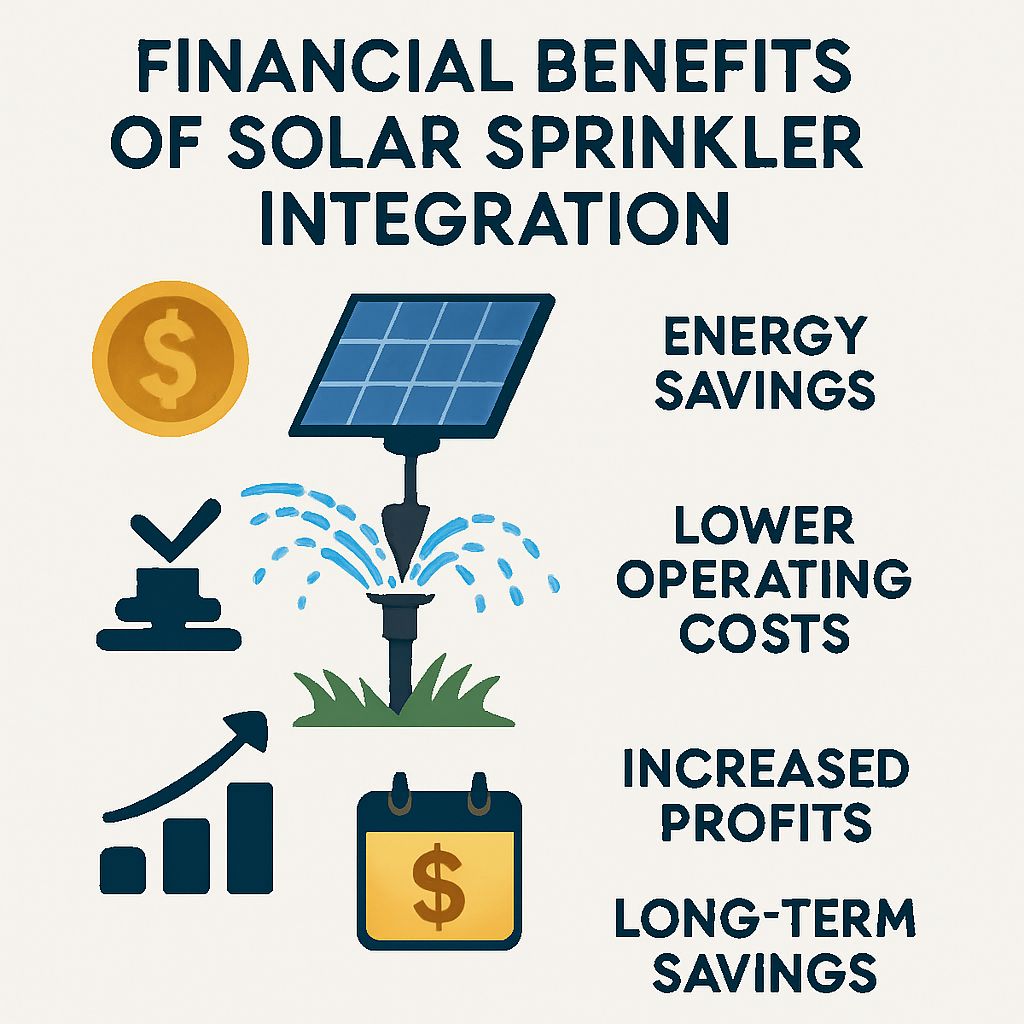
The financial analysis of solar sprinkler integration reveals compelling economics that extend far beyond simple energy savings. When evaluating the investment, farmers must consider the comprehensive financial picture that includes initial costs, ongoing savings, available incentives, and long-term return on investment. The current market conditions create a particularly favorable environment for adoption, with component costs continuing to decrease while incentive programs remain robust.
Current Tax Credits and Agricultural Incentives
The financial landscape for solar irrigation adoption has never been more favorable, with multiple incentive programs substantially reducing upfront costs. Federal tax credits currently allow farmers to deduct 30% of the total system cost directly from their tax liability—not just as a deduction but as a dollar-for-dollar reduction in taxes owed. This single incentive effectively reduces system costs by nearly one-third before considering any additional benefits. Beyond federal incentives, many states offer additional tax credits, rebates, and performance-based incentives that can reduce costs by an additional 10-25% depending on location.
Agricultural-specific grant programs through USDA’s Rural Energy for America Program (REAP) provide both grants covering up to 25% of project costs and loan guarantees for the remaining amount, dramatically improving project financing options. These specialized programs recognize the unique position of agricultural operations to benefit from renewable energy. Additionally, accelerated depreciation schedules allow farmers to recover their investment costs more quickly for tax purposes, further enhancing early-year cash flows and reducing the effective payback period by 1-2 years in many cases.
Typical Return-on-Investment Timeframes
Solar irrigation systems typically achieve financial payback within 3-7 years, depending on local electricity rates, available incentives, and system utilization. For farms in high-cost electricity regions paying $0.15-0.25 per kWh, payback periods often fall closer to the 3-4 year mark, representing an exceptional return on investment exceeding 20% annually. Even in lower-cost energy regions, the combination of incentives, depreciation benefits, and rising utility rates generally ensures payback periods under 7 years. When compared against the 25+ year operational lifespan of quality solar components, this creates an exceptional long-term value proposition with 18-22 years of essentially free operation after the payback period.
The financial equation improves even further for farms facing expensive grid connection costs for remote irrigation sites. In these cases, the avoided cost of running power lines—which can exceed $15,000-$30,000 per mile—makes solar the economically superior option from day one, often eliminating payback calculations entirely as the solar solution becomes immediately less expensive than grid connection alternatives.
Long-Term Savings Projection Models
Comprehensive financial modeling reveals that a typical 10kW solar irrigation system saving $2,000-$3,000 annually in direct energy costs will generate $50,000-$75,000 in cumulative savings over its 25-year operational life. These calculations become even more favorable when factoring in projected utility rate increases of 3-5% annually, which can push total lifetime savings into the $85,000-$110,000 range for the same system. The inflation-protected nature of these savings provides an important hedge against rising operational costs in other areas of farm operations.
More sophisticated financial analyses that include the time value of money still show impressive internal rates of return (IRR) of 12-18% for most agricultural solar installations—far exceeding returns available from most conventional farm investments or financial instruments. When incorporating the increased property value that solar installations typically provide—generally estimated at $3-4 per watt of installed capacity—the complete financial picture becomes even more compelling for farm owners looking at both operational benefits and long-term asset appreciation.
Future-Proofing Your Farm with Integrated Solar Irrigation
Implementing solar-powered irrigation represents more than an operational improvement—it’s a strategic positioning for agriculture’s evolving future. As climate patterns become less predictable, energy costs continue rising, and water resources face increasing pressure, farms with integrated solar irrigation gain significant adaptability advantages. These systems provide resilience against utility rate increases, weather volatility, and potential energy supply disruptions while simultaneously reducing environmental impact. As markets increasingly value sustainable production methods, solar-irrigated farms also gain marketing advantages and potential premium pricing opportunities that further enhance return on investment. By combining immediate operational benefits with long-term strategic positioning, solar irrigation systems represent one of the most complete farm infrastructure investments available today, offering both immediate returns and decades of competitive advantage in an agricultural landscape undergoing rapid transformation.

Conclusion:
The integration of solar panels with sprinkler irrigation systems creates a powerful synergy that transforms farm operations across multiple dimensions. This combination delivers immediate benefits through reduced energy costs, improved water efficiency, and enhanced crop production while simultaneously positioning farms for long-term sustainability and resilience. The technology has matured to the point where reliable implementation is accessible to operations of all sizes, with modular approaches allowing farms to start small and expand as experience and confidence grow. For more insights on the financial advantages, check out solar panels cost benefits.
The financial case for solar irrigation has never been stronger, with declining component costs, robust incentive programs, and rising conventional energy prices creating favorable economics across nearly all agricultural contexts. When considering the complete picture—including operational improvements, environmental benefits, and long-term sustainability—solar-powered irrigation emerges as one of the most impactful investments available to modern farm operations.
- Reduced operating costs through elimination of fuel or electricity expenses
- Enhanced water efficiency with precision application capabilities
- Environmental benefits including carbon footprint reduction
- Operational resilience against grid outages and energy price fluctuations
- Improved crop quality and yield through consistent irrigation availability
As agriculture faces increasing challenges from climate change, resource constraints, and economic pressures, integrated solar irrigation provides a proven pathway to more sustainable and profitable farm operations. The technology continues evolving rapidly, with each generation offering improved efficiency, enhanced capabilities, and stronger economic returns. For forward-thinking farmers looking to position their operations for long-term success, solar-powered sprinkler irrigation represents not just a smart current investment, but a foundational system for farming’s future.
Is it a Good Idea for Farmer to Add Solar Panels to an Existing Sprinkler Irrigation Systems
Converting existing sprinkler irrigation systems to solar power typically represents an excellent investment for most farm operations. The retrofit process is straightforward for most pump configurations, requiring minimal modifications to the existing water infrastructure while eliminating ongoing energy costs. For systems currently powered by grid electricity, the conversion essentially replaces the utility connection with solar generation, maintaining identical irrigation performance while dramatically reducing operational expenses. Diesel-powered systems gain even greater benefits from conversion, eliminating not just fuel costs but also the maintenance requirements, noise, and emissions associated with combustion engines.
The ideal retrofit candidates are systems with consistent daytime irrigation requirements, unshaded installation areas within 500 feet of the pump location, and current annual energy costs exceeding $1,500. For these operations, solar conversion typically delivers payback periods under 5 years while providing 20+ years of nearly free operation afterward. Even for less ideal scenarios, the combination of available incentives, rising conventional energy costs, and improved system reliability makes solar conversion worth serious consideration for virtually any established irrigation system.
Does Solar Panels & Sprinkler Irrigation Systems Integration Make the Farm Operations More Efficient
The efficiency improvements from solar-powered sprinkler systems extend far beyond simple energy cost reduction. When properly implemented, these integrated systems enhance operational efficiency across multiple dimensions of farm management. Water utilization improves through pressure consistency and timing flexibility, allowing irrigation to occur during optimal plant uptake periods rather than being constrained by time-of-use electricity rates or labor availability. This optimization alone can improve water efficiency by 15-25% while simultaneously enhancing crop response to applied irrigation.
Labor efficiency represents another significant operational improvement. Automated solar irrigation systems dramatically reduce the time required for manual irrigation management, often saving 5-10 hours weekly for small to medium operations. This labor can be redirected to higher-value activities while ensuring more consistent irrigation execution. The elimination of fuel management, engine maintenance, and related tasks further streamlines farm operations, creating more focused and productive workflows.
Perhaps most importantly, solar irrigation creates planning efficiency through predictable operational costs and reliable performance. By eliminating the variability of fuel prices and utility rate fluctuations, farmers can develop more accurate budgets and long-term plans. This predictability extends to irrigation scheduling, with solar-powered systems providing consistent performance that enables precise crop management protocols and reliable harvest timing—factors that significantly impact market positioning and price realization for many agricultural products.
The cumulative impact of these efficiency improvements typically extends well beyond the direct energy savings, creating operational advantages that enhance overall farm profitability and sustainability. For many operations, these secondary benefits ultimately deliver greater long-term value than the immediate energy cost reductions, though both contribute to the compelling case for solar irrigation adoption.
- Improved water utilization efficiency through consistent pressure and optimal timing
- Reduced labor requirements for irrigation management and monitoring
- Eliminated fuel management and engine maintenance activities
- Enhanced planning capability through predictable operational costs
- Improved crop performance through optimized irrigation scheduling
Frequently Asked Questions
As solar irrigation technology continues gaining adoption across diverse agricultural settings, farmers naturally have questions about implementation details, performance expectations, and practical considerations. The following responses address the most common inquiries, providing clear guidance based on real-world implementation experience across hundreds of agricultural installations.
These insights help farmers move beyond general understanding to practical implementation planning, addressing the specific concerns that influence adoption decisions and system design choices.
How much does a solar-powered sprinkler irrigation system cost for an average farm?
Solar irrigation costs vary based on system capacity, but typically range from $2.50-$4.00 per watt of installed capacity before incentives. For a modest 5kW system capable of powering a 2HP pump for 6-8 hours daily, this translates to approximately $12,500-$20,000 in initial investment. After applying the 30% federal tax credit and potential state/utility incentives, the net cost typically reduces to $8,000-$14,000. Larger commercial systems benefit from economies of scale, with 25kW+ installations often dropping below $2.25 per watt before incentives. These price ranges include complete system installation with panels, mounting, inverters, controls, and electrical integration to existing pump infrastructure.
When evaluating costs, it’s crucial to consider not just the upfront investment but the lifetime operational savings and system lifespan. With minimal maintenance costs averaging just $150-$300 annually and operational lifespans exceeding 25 years, the levelized cost of energy from solar irrigation typically ranges from $0.04-$0.08 per kWh over the system lifetime—significantly below retail electricity rates in most agricultural regions and dramatically lower than diesel generator costs which often exceed $0.30-$0.40 per kWh when including all operational and maintenance expenses.
Can solar irrigation systems work in regions with less consistent sunlight?
Solar irrigation systems function effectively even in regions with moderate solar resources, though system sizing and storage requirements may differ from sunnier locations. In areas with less consistent sunlight, successful implementation typically involves slightly larger solar arrays—generally 20-30% more capacity than would be required in optimal conditions—combined with strategic battery storage sized for specific operational requirements. Modern system design software incorporates detailed regional solar radiation data to precisely calculate necessary capacity adjustments for specific locations, ensuring reliable operation despite regional variations in solar resource availability.
The practical effectiveness of these systems in cloudy regions has been demonstrated across diverse geographic areas, including the Pacific Northwest, Northeast, and Midwest United States, where successful installations routinely deliver 90%+ of irrigation needs despite less-than-ideal solar conditions. The key to success in these regions lies in proper system sizing, appropriate storage configuration, and intelligent controls that optimize water delivery around available solar production. With these adaptations, farms in virtually any agricultural region can successfully implement solar irrigation, though payback periods may extend slightly compared to sunnier locations with equivalent electricity costs.
What maintenance is required for solar panels used in agricultural settings?
Agricultural solar installations require minimal but consistent maintenance to ensure optimal performance in farm environments. Panel cleaning represents the primary ongoing task, with most installations benefiting from quarterly cleaning to remove dust, pollen, and bird droppings. This process typically involves simple water rinsing with soft brushes or specialized extension tools, requiring approximately 1-2 hours for a 10kW system. In extremely dusty environments or during pollen season, more frequent cleaning may be beneficial, while installations in areas with regular rainfall may require less manual intervention.
Beyond cleaning, annual electrical inspections help ensure connection integrity and system performance. These inspections should include checking for loose connections, examining weather seals around junction boxes, verifying proper inverter operation, and inspecting mounting hardware for any loosening due to wind or thermal cycling. For systems with batteries, quarterly maintenance checks are recommended to ensure proper function and maximize component lifespan. This maintenance routine typically requires just 4-8 hours annually for complete system care, making it one of the lowest-maintenance power sources available for agricultural operations.
With this basic care regimen, agricultural solar systems routinely deliver 25+ years of reliable operation with panel degradation rates averaging just 0.5% annually—meaning systems still produce 80-85% of their original capacity even after 25 years of continuous service. This exceptional longevity and minimal maintenance requirement contributes significantly to the favorable lifetime economics of solar irrigation compared to alternatives requiring more frequent intervention.
Maintenance Schedule for Agricultural Solar Irrigation Systems
Timeframe
Maintenance Task
Estimated Time Required
Special Equipment Needed
Quarterly
Panel cleaning and visual inspection
1-2 hours per 10kW
Soft brushes, extension poles, non-abrasive cleaner
Bi-annually
Check mounting hardware and connections
1 hour per 10kW
Basic hand tools
Annually
Complete electrical inspection and performance verification
2-3 hours
Multimeter, irradiance meter (optional)
Every 5 years
Inverter preventative maintenance
1-2 hours
Manufacturer maintenance kit
Every 7-10 years
Battery replacement (if applicable)
4-8 hours
Replacement batteries, lifting equipment
How do I know if my current irrigation system can be converted to solar power?
Most existing irrigation systems can be successfully converted to solar power with minimal modifications to the water infrastructure. The primary technical consideration involves matching the electrical characteristics of the pump motor with appropriate solar generation and control equipment. AC pump motors—the most common type in existing installations—typically require solar systems with grid-tie inverters that convert DC power from the panels to AC power matching the pump’s voltage and phase requirements. These conversions are straightforward for most single-phase 240V systems common on small to medium farms, while three-phase systems used in larger operations may require specialized inverters or phase converters depending on specific motor characteristics.
The feasibility assessment process begins with documenting three key parameters: pump horsepower rating, average daily runtime hours, and seasonal operation period. This information allows system designers to calculate the required solar capacity and determine appropriate configuration options. Ideal candidates for conversion include systems with motors under 25HP, daytime irrigation schedules, and seasonal operation aligning with periods of high solar availability. Systems currently relying on diesel generators typically see the fastest payback periods when converted to solar, often achieving complete return on investment in just 3-4 years due to the high operational costs they replace.
Are there specific crops that benefit more from solar-powered sprinkler systems?
High-value specialty crops often realize the greatest benefits from solar-powered irrigation due to their precise water requirements and direct quality response to optimal irrigation management. Fruits, vegetables, herbs, and nursery crops frequently show measurable quality improvements when irrigation timing and volume precisely match plant needs—capabilities enhanced by the operational flexibility of solar systems. For these crops, the improved irrigation precision often translates directly to premium pricing opportunities, accelerating system payback through both reduced costs and enhanced revenue. Specific examples include wine grapes, where controlled irrigation stress at precise developmental stages significantly impacts flavor development, and leafy greens, where consistent moisture levels directly affect texture, appearance, and shelf-life.
Water-sensitive field crops also demonstrate substantial benefits, with corn, soybeans, and cotton showing yield improvements of 7-12% when irrigation timing precisely matches developmental needs rather than following rigid schedules dictated by energy costs or labor availability. Even drought-tolerant crops benefit from the precision timing that solar irrigation facilitates, allowing farmers to maximize the efficiency of limited water applications during critical growth stages. The elimination of engine noise and exhaust from solar systems provides additional advantages for specialty operations hosting agritourism activities or located near residential areas, where the silent operation enhances visitor experiences and maintains positive community relations.
For organic and regenerative farming operations, solar irrigation aligns perfectly with sustainability principles while providing practical operational advantages. The elimination of fossil fuels from irrigation processes supports certification requirements and marketing narratives, while the precision water management capabilities support soil health objectives through optimized moisture management. This alignment of operational benefits with certification requirements and marketing advantages makes solar irrigation particularly valuable for farms pursuing premium market positioning based on sustainable production practices.







Leave a Reply