

Key Takeaways
- Bifacial solar panels can increase energy production by 10-30% compared to traditional panels by capturing sunlight from both sides.
- Farmers can maximize land use by installing bifacial panels that allow for continued crop growth underneath, creating dual-purpose agricultural land.
- The durability and weather resistance of bifacial panels make them particularly suited for farm environments with varying weather conditions.
- Despite higher initial costs, bifacial panels offer greater long-term returns through increased efficiency and longer lifespans.
- Agricultural solar incentives and tax credits can significantly reduce payback periods, making bifacial panels an economically viable option for farm operations.
Boost Farm Profits with Bifacial Solar Panels
Modern farming operations face increasingly tight profit margins with rising input costs. Energy expenses represent one of the most significant operational costs for farms, from running irrigation systems to powering equipment and climate-controlled buildings. Bifacial solar panels offer a compelling solution by generating more power from the same footprint as traditional panels, potentially cutting energy costs by up to 40% while creating new income opportunities. For agricultural operations looking to remain competitive while embracing sustainability, bifacial solar technology from AG Solar Solutions presents a pathway to both immediate savings and long-term profitability.
These innovative panels work differently than the conventional solar technology many farmers may have previously considered. By capturing light from both sides, they transform underutilized farm spaces into dual-purpose energy and agricultural production zones. This approach aligns perfectly with the practical needs of modern farming—maximizing return from every acre while reducing operating expenses.
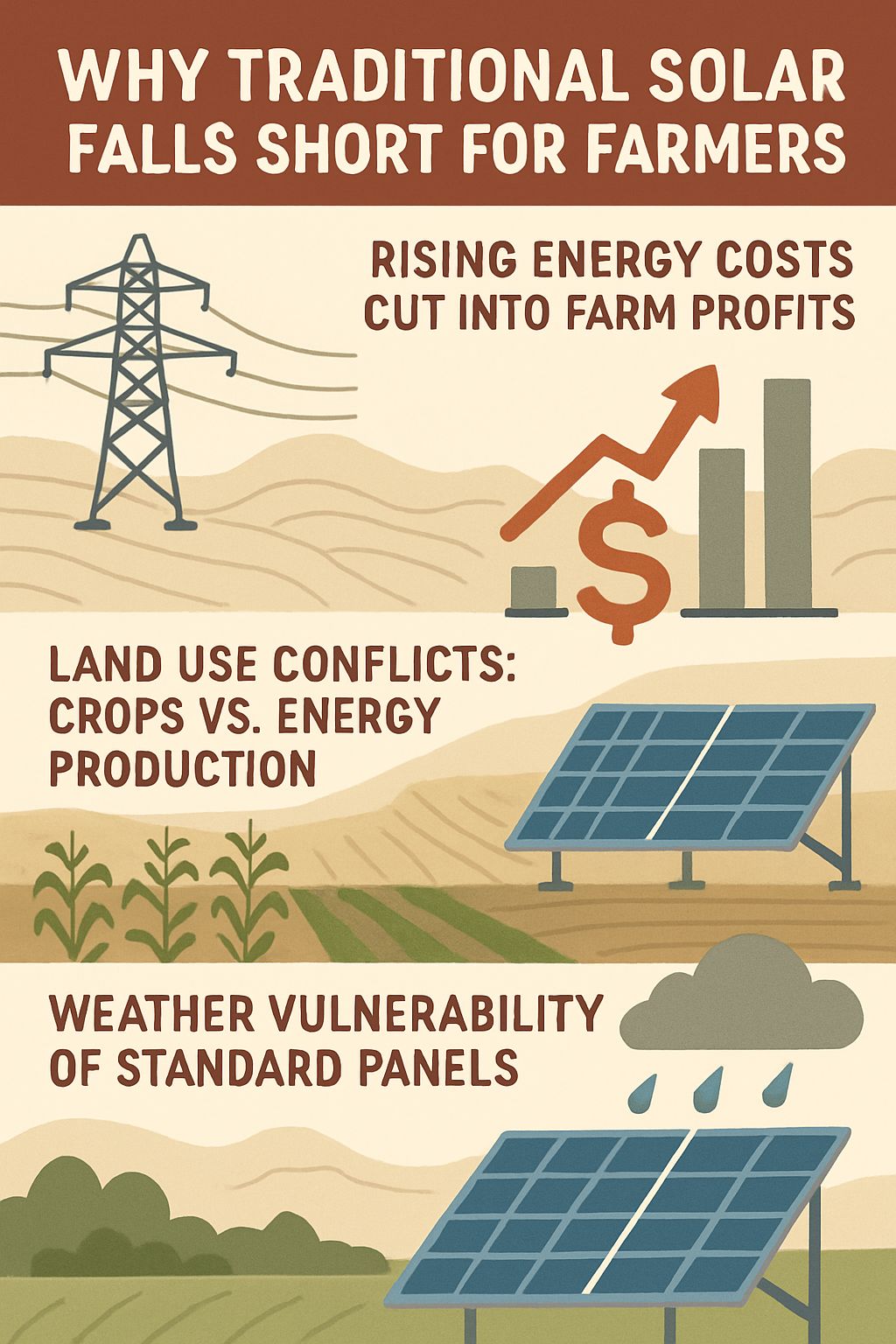
Why Traditional Solar Falls Short for Farmers
Conventional monofacial solar installations have historically presented farmers with challenging tradeoffs. These systems typically require dedicated land that could otherwise be used for crop production or livestock grazing. For many farm operations working with finite acreage, this either/or proposition has made solar adoption difficult to justify, despite the potential energy savings.
Rising Energy Costs Cut into Farm Profits
Agricultural operations face steadily increasing energy expenses that directly impact bottom-line profitability. Irrigation pumps, climate control systems for livestock buildings, refrigeration, and equipment all contribute to substantial electricity demands. Traditional solar panels often fail to generate sufficient power density to offset these costs effectively, especially on farms with limited installation space. When energy represents 7-15% of production costs for many farming operations, inefficient solar solutions simply don’t deliver the necessary financial returns to justify their implementation.
Land Use Conflicts: Crops vs. Energy Production
The fundamental challenge with conventional solar arrays has been their exclusive land use requirement. Traditional ground-mounted systems typically preclude agricultural activities on the same land, forcing farmers to choose between growing crops or generating energy. This creates an economic tension that has limited solar adoption in agriculture. Many farms operate on carefully balanced production systems where removing acreage from production directly impacts revenue and operational viability. Exploring solar vs. wind power can help farmers make informed decisions about energy sources that minimize land use conflicts.
Additionally, standard installations often require extensive racking systems that disturb soil, create erosion risks, and permanently alter farmland. For operations with premium agricultural soil or limited acreage, sacrificing productive land for energy production rarely makes economic sense with conventional solar technology.
“We couldn’t justify taking five acres out of production for traditional solar panels, but with bifacial technology installed above our berry crops, we’re actually seeing improved yields from the partial shading while generating enough power to run our entire operation.” – California berry farmer testimonial from AG Solar Solutions case study
Weather Vulnerability of Standard Panels
Traditional solar panels face significant performance challenges in agricultural settings where weather conditions can be particularly harsh. Heavy snow accumulation can completely block light absorption for weeks in northern climates, while dust and pollen from nearby fields regularly coat panel surfaces, reducing efficiency by up to 25% without frequent cleaning. Single-sided panels also prove particularly vulnerable to hail damage, with impact-related failures representing one of the most common warranty claims.
Farm environments present unique challenges that conventional solar technology wasn’t specifically designed to handle. From tractor-generated dust to irrigation overspray and seasonal weather extremes, the demanding conditions of agricultural settings often lead to underperformance in traditional solar installations. For a comprehensive understanding of how new technologies can better adapt to these conditions, explore bifacial solar panels and their benefits.
What Makes Bifacial Solar Panels Different
Bifacial solar technology represents a fundamental redesign rather than an incremental improvement over conventional panels. Unlike traditional panels that only capture direct sunlight on their front surface, bifacial panels harness energy from both sides, creating a transformative efficiency advantage. This dual-sided approach perfectly addresses the unique challenges and opportunities present in agricultural settings.
Two-Sided Design Captures More Sunlight
The defining feature of bifacial panels is their ability to generate electricity from both the front and rear surfaces. The front side works conventionally, converting direct sunlight to electricity, while the rear side captures reflected and diffuse light that would be wasted with traditional panels. This design utilizes transparent backing materials instead of the opaque backsheets found in conventional panels, allowing light to penetrate through the module and reach the photovoltaic cells from both directions.
This dual-capture approach proves particularly advantageous in farm settings where reflective surfaces like snow, water, light-colored soil, or even certain crops can significantly boost energy production. Farm environments often provide ideal conditions for maximizing the bifacial advantage, with open spaces and natural reflectors enhancing the panels’ performance beyond what would be possible in more urban installations.
How Light Reflection Increases Energy Output by 25%
Bifacial solar panels harness reflected light—a previously untapped energy source that traditional panels ignore. In agricultural settings, natural reflective surfaces like snow (which can reflect up to 90% of sunlight), light-colored soil (20-30% reflection), and even certain crops with glossy leaves significantly boost energy production. This reflective phenomenon, known as the albedo effect, creates a substantial secondary energy source that can increase overall production by 20-30% annually in optimized installations.
The reflection capture becomes particularly valuable during morning and evening hours when the sun sits at lower angles. During these periods, bifacial panels continue generating significant power while conventional panels experience steep production declines. For farms with early morning or evening operational demands, this extended production window provides electricity precisely when it’s most needed for tasks like milking, irrigation, or produce cooling.
Material Construction and Durability Benefits
The structural design of bifacial panels inherently creates superior durability compared to traditional panels. Most bifacial models utilize dual-glass construction, with tempered glass on both front and back surfaces, eliminating the polymer backsheet that commonly deteriorates in conventional panels. This glass-on-glass construction provides enhanced mechanical strength and superior resistance to environmental stressors common in agricultural environments.
The material advantages translate directly to longer warranties, typically 30 years versus the 25-year standard for conventional panels. Many manufacturers report that their bifacial products show degradation rates of only 0.3% annually compared to the 0.5-0.7% commonly seen in traditional panels. For farmers making long-term infrastructure investments, this durability difference can mean 5-10 additional years of productive operation before replacement becomes necessary.

Top 5 Benefits for Farm Operations
1. Increased Energy Production on Limited Space
Farm operations often face space constraints when considering solar installations. Bifacial technology addresses this challenge by dramatically increasing energy density—producing up to 30% more electricity from the same physical footprint as traditional panels. This amplified production means farmers can generate sufficient power for operations while using less land area. For a typical 100-acre farm requiring 50kW of solar capacity, a bifacial system might require only 2,500 square feet of installation space versus 3,250 for conventional panels—preserving an additional 750 square feet for agricultural production.
2. Lower Cost Per Kilowatt-Hour Over Panel Lifetime
While bifacial panels typically carry a 10-15% price premium over conventional models, their substantially higher energy production creates a lower lifetime cost per kilowatt-hour. The economic advantage becomes particularly clear when calculating the levelized cost of electricity (LCOE)—a metric that factors in all lifetime costs divided by total expected energy production. Analyses consistently show bifacial systems deliver electricity at $0.04-0.06 per kilowatt-hour over their lifespan, compared to $0.07-0.09 for conventional panels in agricultural applications. For a mid-sized dairy operation consuming 150,000 kWh annually, this difference can translate to over $100,000 in additional savings over 25 years.
3. Reduced Snow and Dirt Accumulation
The elevated mounting systems typically used with bifacial installations provide substantial practical advantages in farm environments. With greater ground clearance, these systems experience significantly less snow accumulation in winter months—snow slides off more easily and melts faster due to reflected light warming the panel undersides. This self-clearing effect ensures power production continues even during winter months when traditional ground-mounted systems might remain covered and non-productive for weeks.
Similarly, the elevated design dramatically reduces dirt and dust accumulation from field operations. While conventional panels installed near agricultural activities often require regular cleaning due to dust from plowing, harvesting, and other field work, bifacial installations positioned higher above these activities maintain cleaner surfaces and higher efficiency. This reduced maintenance requirement translates directly to labor savings and more consistent energy production throughout the growing season.
4. Better Performance in Cloudy Conditions
Bifacial panels demonstrate significantly better performance during overcast weather thanks to their ability to capture diffuse light from multiple angles. While direct sunlight decreases during cloudy conditions, the proportion of diffuse light actually increases—light that conventional panels largely waste but bifacial panels effectively harvest through their rear surfaces. Testing shows bifacial installations typically maintain 60-70% of their rated production during moderate cloud cover, compared to only 40-50% for traditional panels. For farms in regions with frequent cloudy weather, this advantage can increase annual energy yield by 15-25% beyond the standard bifacial premium. Learn more about solar panel efficiency performance factors.
5. Compatible with Crop Growth Underneath
Perhaps the most transformative advantage for agricultural operations is the compatibility of bifacial installations with continued crop production underneath the panels. When installed on elevated racking systems with optimized spacing, these “agrivoltaic” configurations create partially shaded microclimates that benefit many crop varieties. Research demonstrates that crops like lettuce, spinach, tomatoes, and certain berries actually achieve higher yields under the dappled shade of properly designed solar arrays, while simultaneously reducing irrigation requirements by 20-30% through decreased evaporation. This dual-use approach essentially eliminates the land-use conflict that has historically limited solar adoption in agriculture, allowing farmers to harvest both sunlight and crops from the same acreage.
Bifacial vs. Monofacial Panel Comparison
Understanding the practical differences between bifacial and conventional monofacial technology helps farmers evaluate which solution best fits their specific operation. While both systems convert sunlight to electricity using similar photovoltaic cells, their fundamental design approaches create significant performance differences in real-world agricultural applications.
Monofacial panels represent the traditional solar technology that has dominated the market for decades. These panels feature an opaque backsheet that blocks light from reaching the photovoltaic cells from the rear. In contrast, bifacial models utilize transparent materials on both sides, allowing cells to capture light from front and back simultaneously.
The structural differences extend beyond just light capture capability. Most bifacial panels utilize frameless designs with dual-glass construction, creating superior mechanical strength and resistance to torque forces from wind. Conventional panels typically rely on aluminum frames which, while lightweight, provide less structural integrity in extreme weather conditions common in agricultural settings.
Energy Output Differences (10-30% More Production)
Field testing consistently demonstrates that bifacial installations outperform traditional panels by margins ranging from 10% in minimal reflection environments to over 30% in optimized installations with highly reflective surroundings. This production advantage increases proportionally with installation height, panel spacing, and ground reflectivity—all factors that can be optimized in agricultural settings. A comprehensive three-year study across multiple climate zones found that properly designed bifacial systems in agricultural environments achieved an average production advantage of 24.3% compared to identically sized monofacial installations, with the advantage reaching 32% during winter months in northern regions where snow reflection significantly boosted rear-side production.
Lifespan and Durability Comparison
The durability differences between bifacial and monofacial technologies become particularly relevant in agricultural environments where panels face harsher conditions than in residential installations. Bifacial panels’ glass-on-glass construction eliminates the polymer backsheet degradation that causes many conventional panel failures, especially in environments with high UV exposure, temperature fluctuations, and moisture—all common in farm settings.
|
Feature |
Monofacial Panels |
Bifacial Panels |
|---|---|---|
|
Production Degradation Rate |
0.5-0.7% annually |
0.3-0.4% annually |
|
Standard Warranty |
25 years |
30 years |
|
Hail Impact Resistance |
25mm hailstone at 23 m/s |
35mm hailstone at 30 m/s |
|
UV Degradation Resistance |
Moderate (backsheet vulnerable) |
Excellent (glass both sides) |
|
Expected Service Life |
25-30 years |
35-40 years |
The superior durability metrics translate directly to longer productive lifespans for bifacial installations. While conventional panels typically reach their economic end-of-life after 25-30 years, properly installed bifacial systems often remain economically productive for 35-40 years. This extended service life significantly improves lifetime return on investment and reduces the amortized cost of solar electricity for farm operations.
Maintenance requirements also differ substantially between the technologies. Conventional panels with polymer backsheets require more frequent inspection for microcracks, delamination, and hotspots—issues largely eliminated in dual-glass bifacial construction. Field data shows bifacial systems typically require 30-40% less maintenance intervention over their lifetime, a significant consideration for busy farm operations where maintenance simplicity carries real economic value.
Installation Cost vs. Long-Term Return
When evaluating bifacial versus monofacial technologies, the initial cost differential must be weighed against lifetime performance advantages. Bifacial installations typically carry a 10-15% premium in upfront costs due to their advanced construction, specialized mounting requirements, and higher-quality components. For a typical 50kW farm installation, this might represent an additional investment of $15,000-25,000 compared to conventional technology.
However, this cost difference is quickly offset by performance advantages. The 20-30% higher energy production translates directly to increased savings or revenue, depending on whether the system primarily offsets farm usage or exports to the grid. Financial modeling shows the crossover point where bifacial systems become more economical typically occurs between years 5-7 of operation. Beyond this point, the bifacial advantage compounds annually, creating substantially higher lifetime returns.
The net present value (NPV) calculation, which accounts for the time value of money, consistently shows bifacial systems outperforming conventional installations by 25-40% over their operational life when installed in suitable agricultural settings. This superior return profile makes bifacial technology the financially prudent choice despite higher initial costs, particularly for farmers planning long-term operational sustainability.
Space Efficiency Metrics
The land-use efficiency of solar installations holds particular importance for agricultural operations. Bifacial systems excel in this metric, producing significantly more energy per acre than conventional arrays. When comparing standard ground-mounted configurations, bifacial arrays typically generate 650-750 MWh per acre annually versus 500-550 MWh for monofacial systems of identical capacity. This 30% space efficiency advantage translates directly to more preserved agricultural land or higher energy production from the same footprint.
The space efficiency advantage grows even more pronounced when considering agrivoltaic installations that maintain crop production beneath elevated panels. These dual-use configurations effectively achieve land use efficiency of 160-180% compared to separate farming and energy production, creating an unmatched economic advantage for operations with limited acreage. This land use optimization represents perhaps the most compelling advantage for farm operations considering solar adoption, effectively eliminating the traditional tradeoff between energy and crop production.
Real Farm Success Stories of Farmers Using Bifacial Solar Panels
Case Study: Dairy Farm Cuts Energy Costs by 40% with Bifacial Solar Panels
Wilson Family Dairy in Vermont installed a 75kW bifacial solar array in 2019 to address rising electricity costs that were eroding their operational profitability. The farm’s 120-cow operation consumed substantial energy for milk cooling, pasteurization, and barn climate control. After evaluating several solar options, they selected a bifacial system specifically designed to maximize winter production when their energy demands peaked for barn heating.
The results exceeded projections, with the system achieving 28% higher annual production than an equivalent monofacial installation would have delivered. During winter months, snow reflection boosted production by 35-40% above baseline expectations. The farm reports that their electricity bills decreased by 40% in the first year, representing annual savings of $12,600. With their financing structure, the system will be fully paid off in year 8, after which the farm will enjoy essentially free electricity for the remainder of the system’s 35+ year expected lifespan. Beyond the financial benefits, the elevated mounting system preserved all usable pasture area, allowing grazing directly beneath the panels with no reduction in livestock capacity.
“We looked at traditional solar first, but the bifacial system made more financial sense for our operation, especially with our winter energy demands. The production boost from snow reflection has been remarkable—on sunny winter days after a snowfall, we sometimes produce more power than in summer. The system will have paid for itself several years earlier than a traditional array would have.” – James Wilson, Owner
Vegetable Farmer’s Dual Harvest Experience
Green Valley Produce, a 35-acre vegetable operation in California, implemented a 110kW bifacial agrivoltaic system in 2020. Their innovative installation places bifacial panels 12 feet above active growing fields, creating partial shade that benefits their lettuce, spinach, and herb production while generating renewable energy. The farm specifically selected crops that would benefit from reduced solar stress during the intense summer months.
After two growing seasons, they report multiple benefits beyond energy production. Water usage for the crops grown beneath panels decreased by 28% due to reduced evaporation, while summer lettuce yields increased by 14-20% compared to similar varieties grown in full sun. Heat-sensitive crops experienced fewer cases of tip-burn and bolting, reducing waste and improving marketability. The energy production has eliminated their $27,000 annual electricity bill while generating an additional $9,000 in annual revenue through their net metering agreement.
Perhaps most significantly, the farm expanded their growing season by nearly six weeks for certain crops by utilizing the microclimate beneath the panels. The partial shading delays soil temperature increases in spring and slows cooling in fall, effectively extending favorable growing conditions. This season extension allows them to command premium prices by reaching markets earlier and later than competitors, substantially improving profit margins.
Financial Analysis: Making the Numbers Work
Understanding the complete financial picture of bifacial solar adoption requires looking beyond simple payback calculations to evaluate comprehensive project economics. For farm operations, the combination of production advantages, tax benefits, and potential crop integration creates a uniquely favorable investment profile that often outperforms many traditional farm capital improvements.
Upfront Costs vs. Lifetime Savings
Current market pricing places bifacial solar installations at $2.20-2.60 per watt for agricultural applications, compared to $1.90-2.20 for comparable monofacial systems. This premium primarily stems from the advanced materials, specialized mounting requirements, and more sophisticated inverter configurations needed to maximize bifacial advantages. For a typical 50kW farm installation, this represents an initial investment of $110,000-130,000 for bifacial technology versus $95,000-110,000 for conventional panels.
The lifetime economic advantage becomes clear when calculating total energy production over the system lifespan. A well-designed bifacial system will typically generate 25% more electricity annually while degrading more slowly than conventional alternatives. Over a 30-year operation period, this production advantage compounds to deliver approximately 30-35% more total energy, creating proportionally higher savings or revenue depending on the farm’s utilization model. When calculated on a per-dollar invested basis, bifacial systems typically deliver $3.40-3.80 in energy value per dollar spent, compared to $2.80-3.10 for monofacial alternatives—a substantial economic advantage that justifies the higher initial investment.
Available Tax Credits and Incentives for Farmers
Agricultural solar installations qualify for substantial federal incentives, including the 30% Investment Tax Credit (ITC) recently extended through 2032 for commercial installations. This credit applies to the total system cost, effectively reducing the net investment by nearly one-third. Additionally, systems qualify for accelerated depreciation through the Modified Accelerated Cost Recovery System (MACRS), allowing the remaining cost to be depreciated over just five years, creating significant tax benefits for profitable farm operations.
Many states offer additional incentives specifically targeting agricultural solar adoption. These range from property tax exemptions for solar improvements to production-based incentives that pay performance bonuses for solar electricity. Several states have implemented specialized “farm-to-solar” grant programs providing direct funding for agricultural solar projects, particularly those incorporating agrivoltaic elements that maintain crop production. These layered incentives can reduce the effective cost of bifacial installations by 50-70% in optimal jurisdictions, dramatically improving investment returns and shortening payback periods.
Payback Period Calculations
Actual payback periods for bifacial agricultural installations vary based on local electricity rates, available incentives, and specific farm energy usage patterns, but typically range from 5-9 years—notably shorter than the 8-12 years common with conventional systems. This accelerated return results directly from the production advantages of bifacial technology combined with their optimal fit for agricultural settings. Operations with high daytime energy usage patterns, such as dairy farms with significant refrigeration loads or operations with substantial irrigation demands, often achieve payback in the shorter end of this range due to the high value of directly offset electricity costs.
Financing Options for Agricultural Solar
Several specialized financing structures have emerged to help farmers implement solar with minimal initial capital requirements. Power Purchase Agreements (PPAs) allow third-party ownership of systems installed on farm property, with the farm purchasing electricity at predetermined rates typically 15-25% below utility prices. These arrangements require no upfront investment while immediately reducing operating costs, though they provide lower lifetime returns than direct ownership.
- USDA Rural Energy for America Program (REAP) grants covering up to 25% of project costs
- Farm-specialized solar loans with terms up to 25 years matching system lifespan
- Agricultural equipment leasing structures with purchase options
- Community solar participation for farms with unsuitable installation sites
- State-specific agricultural clean energy revolving loan programs
Many agricultural lenders now offer specialized solar financing products with terms designed specifically for farm operations. These typically feature longer amortization periods (15-25 years) aligned with system lifespan, seasonal payment adjustments that align with farm cash flow cycles, and structures that help maximize available tax incentives. When properly structured, these financing arrangements can create positive cash flow from the first year of operation, with the energy savings exceeding the financing payments.
For farmers seeking to minimize complexity, several turnkey providers now offer complete design, permitting, construction, and financing packages specifically tailored to agricultural applications. These comprehensive solutions simplify the adoption process while still allowing farms to capture the significant economic benefits of bifacial technology.
“Solar Panels Off-Grid Farming Guide …” from growingsolarmist.com and used with no modifications.
Start Your Farm’s Solar Transformation Today with Bifacial Solar Panels
Every day your farm operates without harvesting the abundant solar resources falling on your property represents lost opportunity for savings and sustainability. Bifacial solar technology has matured to the point where it now offers compelling economics for nearly all agricultural operations, combining superior energy yield with farm-friendly installation options that preserve or even enhance agricultural productivity. By generating clean, renewable energy while maintaining full productive capacity of your land, bifacial solar represents the ideal energy solution for forward-thinking farm operations.
AG Solar Solutions specializes in custom-designed agricultural solar installations that optimize both energy and crop production, delivering systems that enhance farm profitability while reducing environmental impact. Contact their farm energy specialists today for a free assessment of your operation’s solar potential and discover how bifacial technology can transform your energy economics.
Frequently Asked Questions
As bifacial solar technology gains popularity in agricultural applications, farmers typically have specific questions about implementation, performance, and compatibility with farm operations. Below are answers to the most common inquiries based on real-world installations and performance data.
How much more efficient are bifacial solar panels compared to traditional panels?
- In optimal agricultural installations, bifacial panels typically produce 20-30% more energy annually than equivalent monofacial panels
- Winter performance advantages can reach 35-40% in snowy conditions due to reflected light
- Performance advantages increase with mounting height, row spacing, and ground reflectivity
- Agrivoltaic configurations with crops underneath typically achieve 15-25% production gains compared to conventional installations
- Cumulative lifetime production advantage reaches 30-35% due to slower degradation rates
The efficiency advantage varies significantly based on installation specifics and environmental factors. The reflectivity of surrounding surfaces (known as albedo) plays a crucial role in determining actual performance gains. Light-colored agricultural soils typically have albedo values of 0.2-0.3, providing moderate reflection benefits, while snow cover can temporarily boost albedo to 0.8-0.9, creating dramatic production increases during winter months.
System design decisions significantly impact performance advantages. Installations with greater elevation (minimum 3-4 feet clearance) and wider row spacing capture more reflected light on rear surfaces. Similarly, north-south oriented arrays typically maximize bifacial advantages compared to east-west configurations in most agricultural settings. Working with designers experienced in agricultural bifacial installations ensures optimal configuration for specific farm conditions.
Beyond simple efficiency metrics, bifacial panels demonstrate superior performance consistency throughout daily and seasonal cycles. Their ability to capture diffuse light results in earlier morning production start and later evening generation compared to conventional panels, better aligning with many farm operational needs like morning milking or evening irrigation cycles. For more on how these panels function, explore the efficiency performance factors impacting farmers.
Can I still use my tractor and farm equipment around bifacial solar installations?
Yes, properly designed agricultural bifacial installations specifically accommodate continued equipment access and operation. Most agrivoltaic configurations elevate panels a minimum of 8-12 feet above ground level, providing ample clearance for standard tractors, sprayers, and even combine harvesters depending on the specific design. The structural supports are typically arranged in patterns that create clear “lanes” aligned with equipment working widths, minimizing any operational adjustments while maintaining necessary structural integrity.
Many installations incorporate reinforced bases and protective elements around support columns to prevent accidental equipment damage during field operations. The elevated design also eliminates concerns about dust from field operations reducing panel efficiency—a common issue with lower traditional installations. Electrical conduits are buried at depths exceeding normal tillage operations, allowing for continued soil management without risking infrastructure damage. Working with designers familiar with agricultural equipment requirements ensures systems that integrate seamlessly with existing farm operational patterns rather than forcing adaptation around solar constraints.
What types of crops grow best beneath bifacial solar panels?
Research and field experience have identified several categories of crops that perform exceptionally well in the modified microclimate beneath bifacial panels. Leafy greens like spinach, lettuce, kale, and arugula typically show yield increases of 10-20% under optimal partial shading, with notably improved quality due to reduced heat stress. Other successful crops include many berries (particularly strawberries and blackberries), herbs, brassicas, and shade-tolerant vegetables like certain pepper varieties. The reduced direct sunlight and lower soil temperatures can also substantially extend growing seasons in hot climates, allowing production to continue through periods when open-field cultivation becomes challenging due to heat stress.
How do bifacial panels handle extreme weather conditions like hail or high winds?
- Dual-glass construction provides superior impact resistance compared to conventional panels with plastic backsheets
- Most bifacial panels are certified to withstand 1-inch hailstones at terminal velocity with no damage
- Frameless designs reduce wind-catch potential and minimize torque stress on mounting systems
- Higher mounting configurations increase wind-shedding capability compared to standard ground-mounted systems
- Snow sheds more effectively from elevated bifacial installations, reducing load stress concerns
Bifacial panels demonstrate excellent resilience in agricultural environments where weather extremes are common. Their dual-glass construction inherently creates superior impact resistance, with most models tested to withstand significantly larger hailstones than required by standard certification. Field data shows damage rates from hail are approximately 60-70% lower than conventional panels in identical storm conditions, a crucial advantage in hail-prone agricultural regions.
The elevated mounting systems typically used with agricultural bifacial installations provide additional weather resilience benefits. Higher mounting allows wind to flow more freely around panels, reducing potential uplift forces during high wind events. Many agricultural configurations incorporate additional structural reinforcement compared to conventional installations, recognizing the need for decades of reliable operation in exposed rural settings with minimal maintenance intervention.
Temperature tolerance also exceeds conventional panels due to superior heat dissipation from both surfaces. This reduces thermal stress during extreme heat events and helps maintain higher efficiency during hot summer periods when many conventional panels experience significant temperature-related performance decreases.
Are there special maintenance requirements for bifacial panels on farms?
Bifacial panels generally require less maintenance than conventional systems in agricultural settings. Their elevated mounting significantly reduces dirt and debris accumulation, while the smooth glass surfaces on both sides shed dust more effectively than the textured backsheets of traditional panels. Most agricultural installations are designed for “self-cleaning” through natural rainfall, eliminating the need for regular washing that conventional ground-mounted systems often require. For those interested in exploring different solar options, check out the best solar panel types for farms.
The primary maintenance consideration involves vegetation management beneath elevated arrays. Depending on the specific agrivoltaic strategy implemented, this might involve standard cropping operations if actively farming beneath panels, or simplified mowing if maintaining basic ground cover. The panels themselves typically require only annual visual inspection for any potential issues, plus periodic electrical testing (usually every 3-5 years) to ensure optimal performance.
Monitoring systems included with most modern installations provide automated performance tracking that identifies potential issues without physical inspection. These systems detect production anomalies that might indicate maintenance needs, allowing for targeted intervention rather than scheduled maintenance regardless of system condition. This approach proves particularly valuable for busy farm operations where maintenance simplicity represents a significant practical advantage.







Leave a Reply