
Key Takeaways
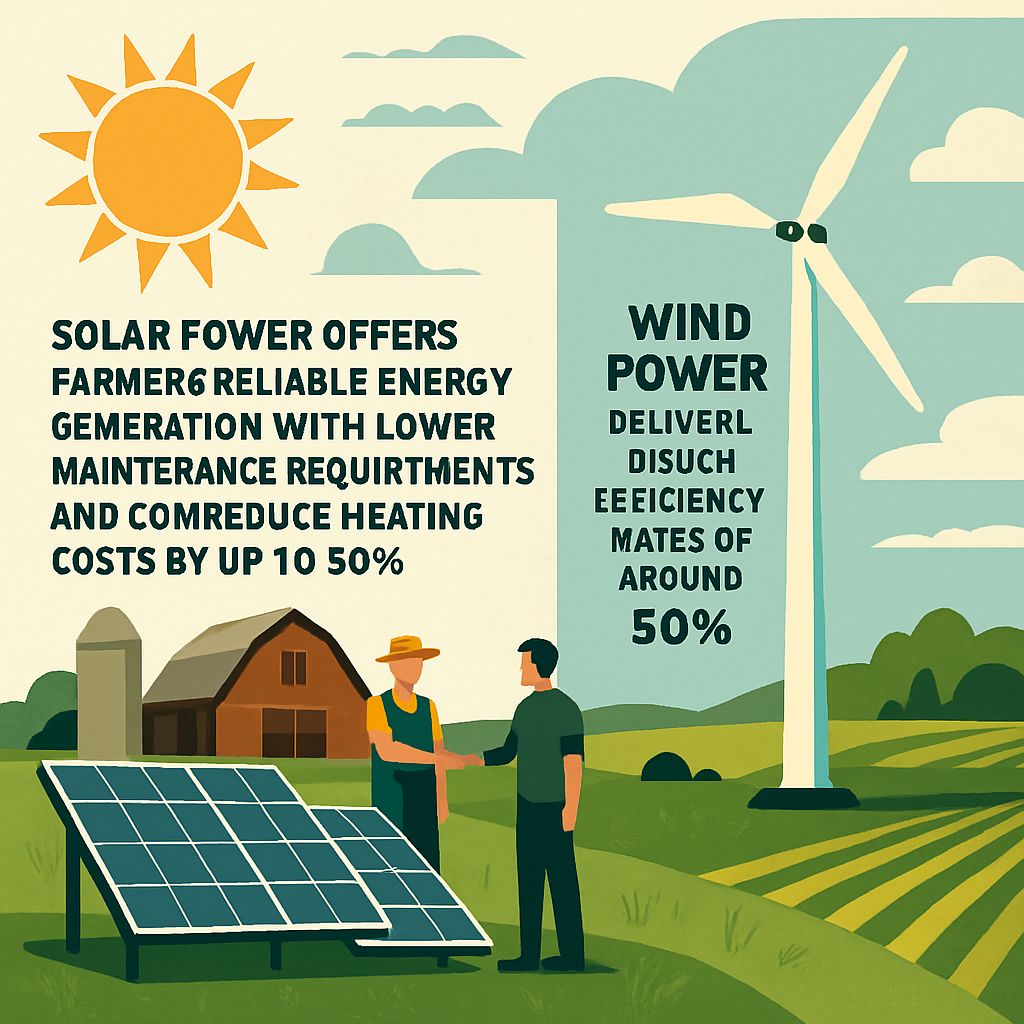
- Solar power systems offer farmers consistent energy production with 20% efficiency rates and can reduce heating costs by up to 85%, while requiring minimal maintenance.
- Wind turbines deliver superior efficiency rates of approximately 50% but require specific wind patterns and more extensive maintenance to operate effectively.
- The USDA’s Renewable Energy for Agriculture Program (REAP) can cover up to 75% of installation costs for both solar and wind systems on farms.
- Dual-use farming practices like agrivoltaics allow crops to grow beneath solar panels, maximizing land efficiency while generating power.
- Your farm’s geographical location and weather patterns should be the primary factors when choosing between solar and wind energy systems.
Why Farmers Are Switching to Renewable Energy
As energy costs continue to rise, farmers across the country are turning to renewable power sources to maintain profitability and sustainability. The agricultural industry consumes approximately 1.7 quadrillion BTUs of energy annually for everything from irrigation and crop drying to climate control in livestock facilities. This energy dependence creates both vulnerability and opportunity for modern farming operations. By generating their own electricity through renewable sources, farmers can stabilize operational costs while reducing their carbon footprint.
The economics of farm energy have shifted dramatically in the past decade. Solar panel prices have dropped by over 70% since 2010, while wind turbine technology has become increasingly efficient and accessible for agricultural applications. Beyond cost savings, renewable energy systems can create new revenue streams through net metering programs that allow farmers to sell excess electricity back to the grid. Additionally, many agricultural producers are finding that clean energy investments align with consumer preferences for sustainably produced food, potentially commanding premium prices in the marketplace.
Government incentives have transformed the financial equation for farm-based renewable energy. The USDA’s Renewable Energy for Agriculture Program (REAP) provides grants covering up to 25% of project costs and loan guarantees for an additional 50%, making these systems attainable for operations of all sizes. When combined with federal tax incentives and accelerated depreciation benefits, many farmers see return on investment periods as short as 3-7 years. This convergence of economic, environmental, and policy factors explains why renewable energy adoption on farms increased by 132% between 2012 and 2022.

Solar Power: The Steady Worker for Your Farm
Solar energy offers predictable performance for agricultural operations, functioning whenever the sun shines without moving parts that require frequent maintenance. A typical farm solar array continues producing electricity for 25-30 years with minimal degradation, typically losing only 0.5% efficiency annually. This reliability makes solar particularly valuable for operations that need consistent power for irrigation systems, dairy equipment, or climate control in livestock buildings.
Unlike wind systems that require specific conditions to operate effectively, solar installations perform adequately in most agricultural regions across the United States. Even in northern states with fewer sunny days, modern photovoltaic technology can generate sufficient power to offset significant portions of farm energy costs. The modular nature of solar systems also allows for gradual expansion as farm operations grow or energy needs increase, providing flexibility that wind installations typically cannot match.
How Solar Panels Generate Farm Electricity
Solar panels work through what’s known as the photovoltaic effect, converting sunlight directly into electricity without requiring mechanical components or fuel. When photons from sunlight strike the silicon semiconductors in solar cells, they knock electrons loose, creating direct current (DC) electricity. An inverter then converts this DC power into alternating current (AC) that can power farm equipment or feed into the electrical grid. This simple conversion process happens instantaneously whenever light hits the panels, though production peaks during midday hours when the sun is most intense.
Modern agricultural solar installations come in multiple configurations to accommodate different farm layouts and needs. Roof-mounted systems utilize existing barn or equipment shed structures, preserving valuable ground space for cultivation or livestock. Ground-mounted arrays can be installed with sufficient clearance to allow for continued grazing beneath the panels, maximizing land use efficiency. The latest innovation, floating solar panels on irrigation ponds or water retention basins, provides the dual benefit of power generation while reducing water evaporation by up to 70%.
Farm Solar Production By Region (Average Annual kWh per kW installed)
Southwest: 1,800-2,100 kWh
Southeast: 1,500-1,700 kWh
Midwest: 1,300-1,500 kWh
Northeast: 1,200-1,400 kWh
Northwest: 1,100-1,300 kWh
Source: USDA Rural Development Energy Programs, 2023
Installation Costs: What You’ll Really Pay
The current cost of agricultural solar installations ranges from $2.00 to $3.50 per watt of capacity, with economies of scale making larger systems more cost-effective. For a typical 25kW farm system capable of offsetting significant energy usage, the pre-incentive investment falls between $50,000-$87,500. However, after applying the 30% federal Investment Tax Credit and accelerated depreciation benefits, the actual out-of-pocket cost drops considerably. REAP grants can further reduce this figure, bringing the net investment to as little as $15,000-$30,000 for qualifying agricultural producers. Most systems reach payback within 5-8 years, after which they provide essentially free electricity for decades.
Dual-Use Benefits: Growing Crops Under Solar Panels
Agrivoltaics—the practice of producing crops beneath solar panels—is revolutionizing how farmers think about land use efficiency. Research from the University of Massachusetts found that certain crops actually perform better under the partial shade provided by solar installations. Leafy greens showed yield increases of up to 60% when grown under panels, compared to conventional full-sun cultivation. The modified microclimate beneath solar arrays reduces water requirements by 20-30% and protects sensitive crops from extreme weather events. To learn more about the benefits of solar energy in agriculture, check out this article on the best energy source for a farm.
- Shade-tolerant crops that thrive under solar panels: lettuce, spinach, broccoli, chard, and many herbs
- Fruit crops showing improved quality under partial shade: blueberries, raspberries, and certain apple varieties
- Grazing operations benefit from cooler pastures and shelter for livestock
- Interplanted pollinator habitats enhance crop pollination while supporting solar electricity generation
Maintenance Requirements and Lifespan
Solar systems require minimal maintenance compared to other renewable energy solutions, with most arrays needing only occasional cleaning and annual electrical inspections. In agricultural settings, the primary maintenance task involves removing dust or bird droppings that can reduce efficiency, typically requiring just 2-3 cleanings annually in most regions. The lack of moving parts means fewer components that can fail, making solar particularly attractive for farmers with limited technical support in rural areas. Most quality solar panels come with 25-year power production warranties, though systems commonly function for 30+ years with only gradual efficiency declines. For more on how solar panels can benefit farmers’ operations, explore additional resources.
Component replacement needs are predictable and manageable with solar installations. Inverters, the most likely component to require replacement, typically last 10-15 years and cost between $1,000-$2,000 to replace for farm-scale systems. Annual maintenance costs average just $300-$500 for a typical 25kW agricultural installation. This predictable maintenance schedule allows farmers to plan expenses with confidence, unlike diesel generators or even wind turbines that can require emergency repairs during critical growing periods.
85% Heating Cost Reduction with Solar Technology
Beyond electricity production, solar thermal systems can dramatically reduce heating costs for agricultural operations like greenhouses, poultry barns, and dairy facilities. A properly designed solar thermal system typically cuts heating expenses by 65-85% compared to propane or natural gas systems. These savings are particularly significant for livestock operations, where maintaining optimal temperatures directly impacts animal health and productivity. One Wisconsin dairy operation documented savings exceeding $42,000 annually after installing a combination of solar thermal and photovoltaic systems to manage their heating and electrical needs.
Wind Power: Harnessing the Breeze for Maximum Output
Wind energy presents a compelling option for farms located in regions with consistent air movement patterns. The primary advantage of wind turbines lies in their exceptional capacity factor—many agricultural wind installations achieve 30-50% efficiency rates compared to solar’s typical 15-20%. This means a 50kW wind turbine in a suitable location can generate significantly more electricity over time than a 50kW solar array. For farming operations with high energy demands for grain drying, refrigeration, or irrigation pumping, this production advantage can translate into substantial cost savings.
Wind power’s production profile often aligns well with seasonal agricultural needs. In many regions, wind resources increase during fall and winter months when solar production decreases, providing more consistent year-round energy generation. Additionally, wind turbines continue producing power 24 hours a day when wind conditions permit, unlike solar systems limited to daylight hours. This continuous generation capability makes wind particularly valuable for operations requiring constant power like dairy farms or poultry facilities with critical ventilation needs.
How Wind Turbines Convert Farm Winds to Power
Agricultural wind systems capture kinetic energy from moving air and convert it to rotational mechanical energy via propeller-like blades. As wind passes over the specially shaped blades, it creates lift (similar to an airplane wing) that causes the rotor to spin. This spinning motion drives a generator that produces electricity, with output increasing exponentially as wind speeds rise. Modern farm-scale turbines typically begin generating usable power at wind speeds of 7-9 mph, reach rated capacity around 25-30 mph, and automatically shut down for safety at approximately 55 mph.
The height of wind turbines significantly impacts their performance on farm properties. Because wind speed increases with elevation above ground level, taller towers access stronger, more consistent air movement. Agricultural installations typically use towers ranging from 80-140 feet tall to maximize energy capture while avoiding excessive installation costs. Each additional 20 feet of tower height generally increases energy production by 10-15%, making proper tower sizing crucial for optimizing return on investment. Most farm turbines use horizontal-axis designs with three blades, though specialized vertical-axis models are available for sites with highly turbulent wind patterns.
Installation Costs: What You’ll Really Pay
Farm-scale wind turbines require significant upfront investment, with complete installed costs ranging from $3,000-$8,000 per kilowatt of capacity depending on size, tower height, and location. A 50kW system—appropriate for medium-sized agricultural operations—typically costs $150,000-$400,000 before incentives. This price includes the turbine, tower, foundation, inverter, installation labor, and grid interconnection equipment. Permitting and engineering costs vary widely by location, adding $5,000-$15,000 to typical projects.
Farm Wind Turbine Costs By Size
10kW (Small Farm): $50,000-$80,000
50kW (Medium Farm): $150,000-$400,000
100kW (Large Farm): $300,000-$800,000
250kW+ (Commercial Farm): $750,000-$2,000,000
Source: American Wind Energy Association, Farm Energy Cost Analysis 2023
The 50% Efficiency Advantage of Wind Energy
Wind turbines convert kinetic energy to electricity with remarkable efficiency compared to other renewable technologies. In optimal conditions, modern wind systems achieve conversion efficiencies up to 45-50%, approaching the theoretical Betz Limit of 59.3% that governs wind energy physics. This efficiency advantage means a properly sited wind turbine can generate 2-3 times more electricity per rated kilowatt than equivalent solar capacity. For a 100-acre farm with annual electricity costs of $24,000, a properly sized wind system can often offset 80-100% of electricity usage, compared to 40-60% typical of similarly priced solar installations.
The productivity gap between wind and solar grows even wider in agricultural regions with Class 4 or higher wind resources. In these areas, annual capacity factors for wind can reach 40-45%, meaning a 50kW turbine effectively delivers the same annual energy as a 100-125kW solar array. This production differential makes wind particularly attractive for energy-intensive operations like dairy farms, which typically consume 800-1,200 kWh per cow annually. Several case studies of Wisconsin dairy operations demonstrate complete energy self-sufficiency achieved through single-turbine installations, eliminating utility bills entirely while occasionally generating surplus power that creates new revenue streams.
Space Requirements and Farm Layout Considerations
Wind turbines have a remarkably small physical footprint relative to their energy production capacity. A typical farm-scale 50kW turbine requires only about 100 square feet for its foundation and access area, allowing agricultural activities to continue virtually unimpeded across the surrounding land. The compact ground footprint makes wind an excellent option for farms where maximizing productive acreage is essential. However, proper siting requires careful consideration of setbacks from property lines, buildings, and overhead utilities.
Turbine placement must account for both energy production and operational factors. Most agricultural installations require minimum setbacks of 1.1-1.5 times the total turbine height from property lines and at least twice the height from inhabited structures. Access roads must support heavy construction equipment during installation and occasional crane access for maintenance. Ideal placement typically occurs along field edges, at high points on the property, or near existing farm infrastructure where electrical interconnection is simplified. Many successful farm installations position turbines at field corners where they have minimal impact on equipment operation while accessing unobstructed wind.
Maintenance Challenges in Agricultural Settings
Wind turbines require more intensive maintenance than solar systems due to their mechanical complexity and moving parts. A typical agricultural wind installation requires scheduled maintenance 2-3 times annually, with costs averaging $0.01-$0.015 per kWh produced. For a 50kW system generating 120,000 kWh annually, this represents approximately $1,200-$1,800 in yearly maintenance expenses. These maintenance activities include gearbox oil changes, bearing inspections, bolt torque checks, and control system diagnostics.
The rural location of most farms creates additional maintenance considerations. Service technicians may need to travel significant distances, increasing response times for repairs. Many agricultural wind turbine owners opt for maintenance contracts that include emergency service provisions to minimize downtime during critical periods. Some manufacturers now offer remote monitoring systems that can predict potential failures before they occur, allowing for scheduled preventive maintenance rather than emergency repairs. These predictive systems typically add $1,000-$2,500 to initial installation costs but can save significantly on long-term maintenance expenses.
Direct Comparison: Solar vs. Wind for Your Farm
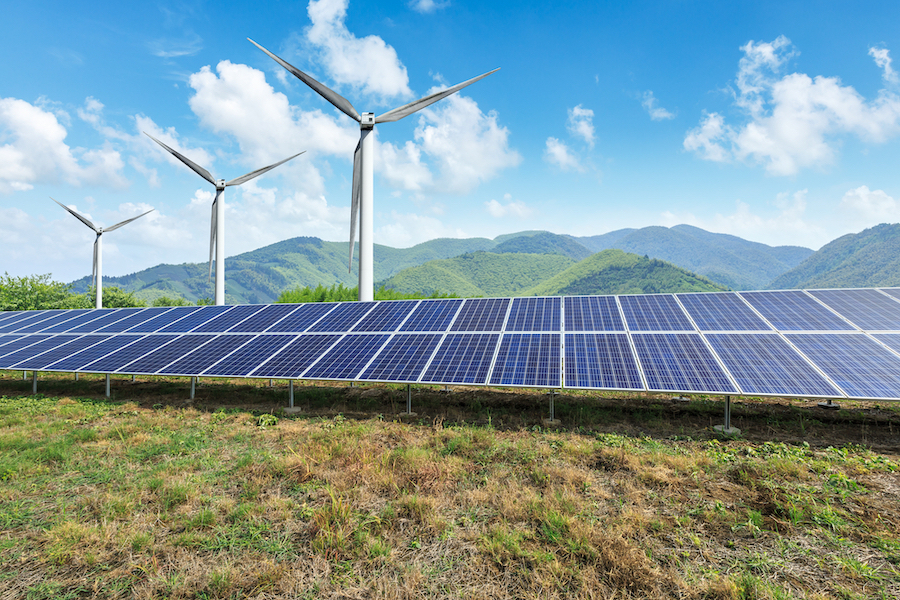
When evaluating renewable energy options for your agricultural operation, the decision between solar and wind depends on several critical factors unique to your farm. While wind systems typically generate more electricity per dollar invested in suitable locations, they require specific wind resources that aren’t available everywhere. Solar installations offer greater versatility and reliability across most agricultural regions, but produce less energy per installed kilowatt. The ideal choice depends on your farm’s specific energy needs, physical characteristics, and financial considerations.
Upfront Cost Breakdown
Solar systems generally require lower initial investment than comparable wind installations, with agricultural solar costing $2.00-$3.50 per watt compared to $3.00-$8.00 per watt for farm-scale wind. For equivalent energy production, however, this price difference often diminishes since properly sited wind turbines generate more electricity per rated kilowatt. A 25kW solar array producing approximately 35,000 kWh annually might cost $50,000-$87,500 before incentives, while a 10kW wind turbine generating similar output in a Class 4 wind area would cost $50,000-$80,000.
Maintenance costs create another significant financial distinction between these technologies. Solar systems typically require just $300-$500 annually in maintenance for a 25kW system, representing less than 1% of initial cost per year. Wind maintenance averages 2-3% of system cost annually, meaning a $150,000 wind turbine might require $3,000-$4,500 yearly in maintenance expenses. Over a 25-year operating period, this maintenance differential can add $60,000-$100,000 to the lifetime cost of a wind system compared to solar of equivalent capacity.
|
Factor |
Solar Power |
Wind Power |
|---|---|---|
|
Initial Investment (per kW) |
$2,000-$3,500 |
$3,000-$8,000 |
|
Annual Maintenance |
0.5-1% of system cost |
2-3% of system cost |
|
Energy Production Efficiency |
15-20% |
30-50% |
|
System Lifespan |
25-30+ years |
20-25 years |
|
Land Use Impact |
Moderate (dual-use possible) |
Minimal ground footprint |
Energy Output Expectations
Wind turbines deliver superior energy production in locations with consistent wind resources. In Class 3 or better wind areas (average speeds above 11.5 mph at hub height), a wind turbine typically generates 2-3 times more electricity per rated kilowatt than solar panels. This production advantage makes wind particularly attractive for energy-intensive agricultural operations like dairy farms, irrigated crop production, or on-farm processing facilities. A 50kW wind turbine in an excellent wind resource area might generate 150,000-200,000 kWh annually, enough to power multiple farm buildings and equipment.
Solar energy provides more predictable and consistent production patterns across different regions. A 50kW solar array generates approximately 65,000-90,000 kWh annually depending on location, with higher production in southern states and lower output in northern regions. While this represents less total energy than a properly sited wind turbine of the same capacity rating, solar systems offer generation profiles that often align better with daytime agricultural activities like irrigation, ventilation, and equipment operation. Solar production also tends to peak during summer months when many farms have their highest energy demands for cooling and irrigation.
Weather Dependency Factors
Both solar and wind energy systems depend on weather conditions, but they respond differently to seasonal variations. Solar production follows predictable daily and seasonal patterns, generating maximum power during summer months and midday hours when sunlight is most intense. This production profile aligns well with cooling and irrigation needs but may not match winter energy demands for heating and lighting. Solar systems also produce no power at night and reduced output during cloudy conditions, necessitating either energy storage solutions or continued grid connectivity.
Wind turbines operate whenever sufficient wind is available, day or night and throughout all seasons. Many agricultural regions experience stronger and more consistent winds during fall, winter, and spring months, creating complementary production patterns when paired with solar installations. Wind production can be less predictable than solar on a day-to-day basis, but seasonal wind patterns tend to be reliable in most regions. This seasonal reliability makes wind particularly valuable for maintaining consistent renewable energy production throughout the year.
Environmental Impact on Your Land
Solar installations have larger physical footprints but offer opportunities for dual-use land management strategies. A ground-mounted 50kW solar array typically requires 4,000-6,000 square feet of land area, though modern agrivoltaic approaches allow continued agricultural production beneath and between panel rows. Research has demonstrated successful cultivation of shade-tolerant crops, grazing of small livestock, and establishment of pollinator habitat within solar arrays. These dual-use strategies maintain agricultural productivity while generating clean energy, maximizing the value derived from each acre.
Wind turbines occupy minimal ground space relative to their energy production capacity. A typical farm-scale wind turbine has a foundation footprint of only 100-400 square feet, allowing agricultural operations to continue virtually unimpeded across surrounding lands. The vertical nature of wind turbines preserves valuable farm acreage for continued production. However, wind installations do create visual impacts on the landscape and may face more significant permitting challenges in some communities due to concerns about viewshed changes, noise, or wildlife impacts. For those considering alternative solutions, exploring solar panels for energy cost reduction could be beneficial.
Making the Right Choice Based on Your Farm’s Location
Your farm’s geographic location and site-specific characteristics ultimately determine which renewable energy technology will perform best. Solar energy offers viable production levels across most agricultural regions in the United States, with systems in the Southwest generating 40-50% more electricity than identical installations in the Northeast or Northwest. Wind energy viability depends much more on local wind resources, with sites in Class 3 or higher wind zones (average speeds above 11.5 mph) typically needed for cost-effective production. The National Renewable Energy Laboratory’s wind resource maps provide county-level data to help determine if your location has sufficient wind resources.
Best Options for Flat, Open Farmland
Flat, unobstructed agricultural land presents ideal conditions for either solar or wind installations, making your decision primarily dependent on local climate patterns. In America’s heartland—particularly across Iowa, Nebraska, Kansas, and the Dakotas—Class 4 and 5 wind resources combine with minimal topographical interference to create optimal conditions for wind energy production. These regions typically see capacity factors exceeding 40% for properly sited wind turbines, meaning they deliver electricity at less than half the cost per kilowatt-hour compared to regions with poor wind resources. For more insights on choosing between these energy sources, check out this comparison of solar energy and wind power.
For flat farmland in southern regions like California, Arizona, Texas, and Florida, solar installations often provide better returns despite adequate wind resources. The exceptional solar radiation in these areas—often exceeding 5.5 kWh/m²/day—creates capacity factors of 20-25% for fixed solar arrays and up to 30% for tracking systems. The reliability of solar production in these regions typically outweighs the theoretical advantages of wind energy, particularly when considering the lower maintenance requirements of photovoltaic systems.
Solutions for Hilly or Partially Shaded Properties
Farms with varied topography present unique challenges and opportunities for renewable energy development. Hilly properties often create accelerated wind flows over ridgelines and hilltops, potentially creating microclimate advantages for strategically placed wind turbines. These elevation changes can increase local wind speeds by 20-30% compared to surrounding areas, dramatically improving turbine performance. A professional site assessment using temporary meteorological towers can identify these optimal locations on properties with complex terrain.
For partially shaded properties or farms with significant tree lines, solar installations require careful placement to avoid production losses. Modern solar design software can model shading impacts throughout the year, identifying optimal array locations that minimize interference from trees, buildings, and topographical features. Distributed solar installations—placing multiple smaller arrays in different locations rather than one large system—often provide the best solution for farms with limited contiguous open space. These distributed approaches might include roof-mounted systems on multiple farm buildings combined with strategic ground installations in available open areas.
Regional Wind Class Ratings: What They Mean for You
Wind resource classifications directly determine the economic viability of agricultural wind installations. The U.S. Department of Energy classifies wind resources on a scale from Class 1 (poor) to Class 7 (superb), based on average wind speeds at typical turbine heights. Most agricultural wind installations require minimum Class 3 resources (11.5-12.5 mph average speed at 80 feet) to achieve reasonable payback periods. Class 4 areas (12.5-13.4 mph) typically deliver excellent economic returns, while Class 5 and above locations can produce electricity at costs competitive with any other generation technology.
Localized wind patterns often differ significantly from regional classifications. Specific farm features like ridgelines, open plains, or proximity to large bodies of water can create microclimate advantages that improve wind resources beyond regional averages. Professional wind assessment using temporary meteorological towers provides the most accurate picture of your specific site potential. These assessments typically cost $5,000-$15,000 but are essential before committing to major wind investments since even small differences in average wind speed create exponential changes in energy production potential.
Financial Incentives That Make Renewable Energy Affordable
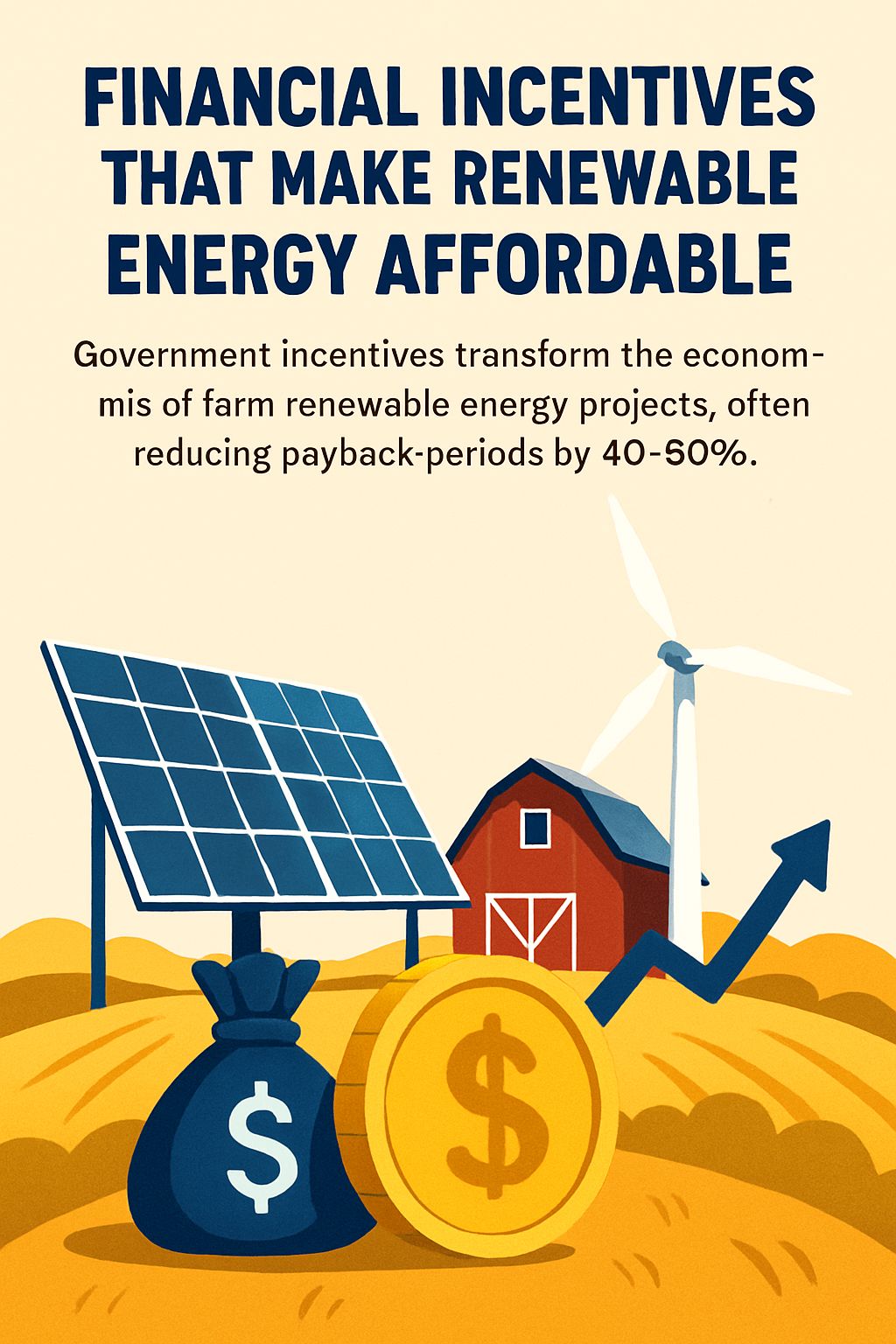
Government incentives transform the economics of farm renewable energy projects, often reducing payback periods by 40-60%. These programs exist at federal, state, and local levels, with agricultural producers frequently qualifying for specialized incentives not available to other sectors. Understanding and fully leveraging these programs can make the difference between marginal and excellent returns on renewable energy investments.
REAP Grants: Covering Up to 75% of Installation Costs
The USDA’s Rural Energy for America Program (REAP) provides the most significant financial support for agricultural renewable energy projects. This program offers grants covering up to 25% of project costs and loan guarantees for an additional 50%, potentially addressing 75% of total installation expenses. Grant amounts range from $2,500 to $500,000 for renewable energy systems, with smaller projects often receiving higher percentage awards. The competitive application process evaluates projects based on technical merit, energy generation relative to farm needs, and financial viability. Applications demonstrating innovative approaches or serving underrepresented agricultural sectors typically receive priority consideration. For farmers looking to enhance their operations with renewable energy, understanding the benefits of solar panels can be crucial.
Tax Credits and Depreciation Benefits
The federal Investment Tax Credit (ITC) allows agricultural businesses to deduct 30% of renewable energy system costs directly from tax liability in the installation year. Unlike tax deductions that merely reduce taxable income, this credit provides dollar-for-dollar tax reduction. For profitable farm operations with sufficient tax liability, this incentive alone can reduce effective system cost by nearly one-third. The credit applies equally to both solar and wind installations, though different phase-down schedules exist for each technology.
Accelerated depreciation provides another significant tax advantage for farm renewable energy systems. Agricultural businesses can depreciate 100% of remaining system costs (after the 30% ITC) in the first year through bonus depreciation provisions. For farm operations in the 24% federal tax bracket, this accelerated depreciation typically reduces effective system cost by an additional 16-17%. Combined with the ITC, these federal tax incentives can decrease net system costs by approximately 47%, cutting payback periods nearly in half.
|
Incentive Type |
Potential Value |
Eligibility Requirements |
|---|---|---|
|
REAP Grant |
Up to 25% of project cost |
Rural small business or agricultural producer |
|
REAP Loan Guarantee |
Up to 50% of project cost |
Rural small business or agricultural producer |
|
Federal Investment Tax Credit |
30% of system cost |
Taxable business with sufficient tax liability |
|
Accelerated Depreciation |
16-17% of system cost (tax benefit) |
For-profit business ownership structure |
|
Net Metering |
Retail rate for excess generation |
Varies by state and utility |
Utility Company Programs for Farmers
Many rural electric cooperatives and agricultural region utilities offer specialized renewable energy incentives for farm customers. These programs include production-based incentives that pay fixed rates for each kilowatt-hour generated, capacity rebates that provide upfront payments based on system size, and net metering arrangements that credit excess generation at retail rates. Some utilities have developed agricultural-specific programs recognizing the unique energy needs and contribution potential of farm operations. These programs often include higher compensation rates for systems that help manage peak demand periods or provide grid support services.
- Production-based incentives: Additional payments of $0.02-$0.06 per kWh generated for 5-15 years
- Capacity rebates: Upfront payments of $200-$500 per installed kilowatt
- Net metering: Credit for excess generation, usually at retail rates
- Demand response programs: Payments for reducing load during peak periods
- Specialized agricultural rates: Discounted electricity pricing for farms with renewable systems
Some utilities have established virtual net metering programs specifically beneficial for farms with multiple meters. These arrangements allow renewable energy generation at one location to offset consumption at other meters under the same farm ownership. For operations with scattered facilities like irrigation pumps, outbuildings, or processing facilities, these programs eliminate the need for multiple smaller renewable systems. Instead, one optimally located larger system can efficiently serve the entire operation’s energy needs while simplifying maintenance and maximizing economies of scale.
Innovative financing options through utility partnerships have emerged in many agricultural regions. These include on-bill financing programs where system costs are repaid through monthly utility bills, often structured so that energy savings exceed monthly payments. Other utilities offer leasing arrangements or power purchase agreements (PPAs) that eliminate upfront costs entirely. Under these arrangements, the utility or third-party investor owns the system installed on farm property, selling the generated electricity to the farm at predetermined rates typically 10-20% below standard retail prices.
Community solar programs provide another pathway for farms to benefit from solar energy without direct system ownership. Many rural electric cooperatives have developed agricultural-focused community solar initiatives where farms can purchase or subscribe to portions of larger solar installations. These programs eliminate concerns about system maintenance while still providing predictable energy costs. Some innovative models even allow farms to host community solar installations, receiving lease payments for the land while also benefiting from discounted electricity. For more information on energy sources for farms, you can read about the best energy source for a farm.
Hybrid Systems: When Combining Solar and Wind Makes Sense
The complementary production profiles of wind and solar technologies create compelling opportunities for hybrid renewable systems on agricultural properties. Wind turbines typically generate more electricity during winter months and overnight hours, while solar systems produce maximum output during summer days—precisely when many farms have peak cooling and irrigation demands. This natural complementarity means hybrid systems often achieve higher net energy production with less variability than either technology alone. For farms seeking to maximize self-generation or achieve net-zero energy status, these hybrid approaches frequently provide the most effective solution.
Modern hybrid systems utilize integrated control technologies that optimize the interplay between wind and solar production. Smart inverters can balance output from both sources to maintain stable power quality despite fluctuations in either resource. Energy management systems can direct surplus production to priority uses like water pumping or heating during times of excess generation. Some advanced systems incorporate battery storage to capture production that would otherwise be exported to the grid, making it available during peak demand periods or utility outages. These storage-enabled hybrid systems can provide critical resilience during power interruptions that might otherwise disrupt essential farm operations.
The economics of hybrid systems often surpass those of single-technology installations when evaluated on a whole-farm energy basis. While initial investment is higher, the improved capacity utilization of grid connections, inverters, and electrical infrastructure creates economies of scale that reduce overall costs per kilowatt-hour produced. Many hybrid installations qualify for additional incentives focused on grid resilience or dispatchable renewable generation. The distributed nature of hybrid systems—combining technologies with different generation profiles—also reduces weather-related risk, ensuring more consistent renewable production regardless of seasonal conditions.
Conclusion: The Best Energy Source for Your Farm
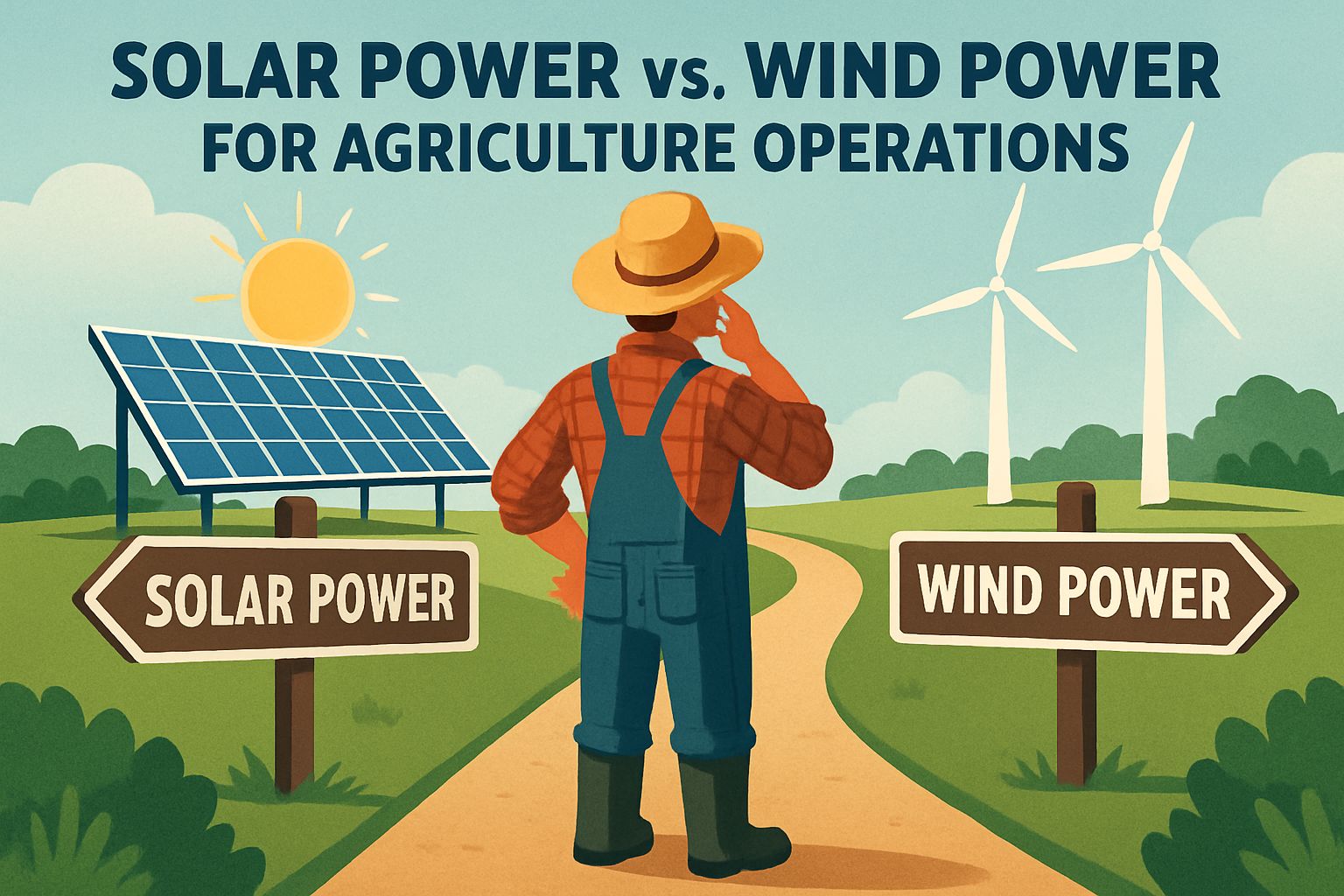
The optimal renewable energy solution for your agricultural operation depends primarily on your specific location, energy needs, and financial situation. Farms with excellent wind resources (Class 4 or higher) and significant annual electricity consumption typically benefit most from wind turbines, which provide superior energy production per dollar invested in these locations. Operations in regions with marginal wind resources or those prioritizing low maintenance and operational simplicity generally find solar installations more appropriate. Many larger farms with diverse energy needs discover that hybrid systems combining both technologies deliver the best overall performance, particularly when resilience during utility outages is a priority.
Frequently Asked Questions
When considering renewable energy for your farm operation, these commonly asked questions address the most important practical concerns. Understanding these fundamental aspects will help guide your decision-making process and ensure you select the most appropriate system for your specific agricultural needs.
The economics, technical considerations, and operational impacts of renewable energy systems vary significantly across different agricultural contexts. These questions highlight key issues that every farm owner should evaluate before investing in either solar or wind technology.
- What permits will I need for my renewable energy installation?
- How do renewable energy systems affect property values and property taxes?
- Can I install the system myself or do I need certified contractors?
- What happens during power outages with grid-tied systems?
Working with qualified renewable energy consultants who understand agricultural operations can help address these and other questions specific to your situation. Many state agricultural extension services offer free or low-cost renewable energy assessments for farmers, providing objective guidance tailored to local conditions and regulations. For more information on how renewable energy systems can generate income and revenue streams for farmers, consider exploring available resources.
How long does it take to recoup my investment in farm solar panels?
Most agricultural solar installations achieve payback periods of 5-8 years depending on local electricity rates, available incentives, and system design. Operations with high daytime electricity usage typically see faster returns, as do farms in states with favorable net metering policies or additional solar incentives. After this payback period, systems continue producing essentially free electricity for 20+ additional years, generating substantial long-term savings. Farms that structure their renewable energy investments to maximize available tax incentives and accelerated depreciation benefits often achieve payback periods of 4 years or less, particularly when combining federal incentives with state-specific agricultural renewable energy programs.
What wind speed is needed for a turbine to be effective on my farm?
Agricultural wind turbines require minimum average wind speeds of 10-12 mph at hub height (typically 80-140 feet) to achieve reasonable economic performance. At these minimum speeds, expect capacity factors of 20-25%, meaning your turbine will produce 20-25% of its theoretical maximum output. For truly excellent performance with capacity factors exceeding 35%, average wind speeds of 13+ mph are necessary. Modern farm-scale turbines begin generating usable power at wind speeds of 7-9 mph (cut-in speed), reach rated capacity around 25-30 mph, and automatically shut down for safety when winds exceed approximately 55 mph (cut-out speed).
Critically, these required wind speeds must be measured at turbine hub height, not ground level. Wind speed typically increases significantly with elevation—a site with 8 mph average winds at 10 feet might have 11-12 mph winds at 100 feet, potentially transforming a marginal location into a viable one. Professional wind site assessments using meteorological towers or SODAR (Sonic Detection and Ranging) technology provide the most accurate prediction of actual turbine performance at your specific location.
Can I still farm underneath solar panels?
Modern agrivoltaic installations specifically design solar arrays to accommodate continued agricultural production underneath and between panel rows. Research from the National Renewable Energy Laboratory shows that many crops actually benefit from the partial shade provided by solar panels, particularly in hot or arid regions. Leafy greens, cool-weather crops, and many berries have demonstrated yield increases of 20-60% when grown under appropriately designed solar arrays compared to conventional full-sun cultivation. The microclimate created beneath panels reduces water requirements by 20-30% while protecting sensitive crops from extreme heat events and harsh weather.
Livestock integration represents another successful approach to farming beneath solar installations. Sheep grazing provides effective vegetation management around solar arrays while offering additional farm revenue. Research from American Solar Grazing Association documents that a properly designed 1MW solar installation can support approximately 100 sheep while eliminating most mechanical vegetation maintenance. Chicken and turkey operations have also successfully incorporated solar arrays into pasture rotation systems, with the panels providing valuable shade and predator protection for poultry while generating electricity.
Specialized mounting systems for “elevated agrivoltaics” now enable tractor and equipment access beneath higher clearance solar arrays. These systems typically position panels 12-15 feet above ground level with wider spacing between rows, allowing standard farm equipment to operate underneath. While these elevated systems cost approximately 20-25% more than conventional ground-mounted arrays, the ability to maintain full mechanical cultivation capabilities while generating solar electricity often justifies this premium for commercial farming operations.
Will installing renewable energy affect my crop insurance?
Renewable energy installations generally do not impact traditional crop insurance coverage provided appropriate documentation and design considerations are implemented. The USDA’s Risk Management Agency has clarified that land utilized for both agricultural production and renewable energy generation maintains its eligibility for federal crop insurance programs. To ensure continued coverage, maintain clear documentation showing the percentage of land remaining in production and notify your crop insurance agent before installation. Most modern agrivoltaic designs specifically maintain insurability by ensuring adequate space between panel rows for equipment access and sufficient light transmission for crop production.
How do I connect my renewable energy system to the grid?
Grid interconnection for agricultural renewable energy systems requires coordination with your electric utility and compliance with local regulations. The process typically begins with an interconnection application submitted to your utility, including system specifications, site plans, and electrical diagrams. Most utilities require a professional interconnection study for systems exceeding 25kW to evaluate potential grid impacts. This study, costing $1,000-$5,000 depending on system size and utility requirements, identifies any necessary grid upgrades or protective equipment needed to ensure safe operation.
Modern agricultural renewable energy systems require specialized interconnection equipment including grid-interactive inverters, protective relaying, and revenue-grade metering. These components ensure your system automatically disconnects during grid outages (preventing dangerous backfeeding) and accurately tracks energy production for net metering credits. Larger farm installations typically require three-phase interconnections compatible with agricultural power distribution systems, adding complexity compared to residential installations. Working with contractors experienced in agricultural renewable energy projects helps navigate these technical requirements efficiently.
Interconnection timelines vary significantly by utility and system size, typically ranging from 2-6 months from application to approval. Some rural electric cooperatives and municipal utilities have streamlined processes specifically for agricultural customers, while investor-owned utilities often have more standardized but lengthy procedures. Planning your renewable energy installation during off-peak agricultural seasons allows time for this interconnection process without disrupting critical farm operations. For more information on how renewable energy can benefit your farm, explore the benefits of solar panels for farmers.
To maximize the value of your grid connection, understand your utility’s net metering or feed-in tariff policies before finalizing system design. Some utilities offer favorable annual net metering that allows summer production surplus to offset winter consumption, while others settle accounts monthly, potentially reducing the value of excess generation. Agricultural operations with multiple utility services or meters should investigate meter aggregation policies that allow renewable production at one location to offset consumption at other meters under the same farm ownership.
For Paradise Solar Energy’s complete guide to agricultural renewable energy systems including case studies, financing calculators, and regional incentive information, visit our website. Our agricultural energy specialists can provide personalized assessments to determine whether solar, wind, or hybrid systems will deliver the best return for your specific farming operation. Additionally, you can explore how solar panels benefit farm energy cost reduction to further understand the advantages of renewable energy solutions for your farm.
When considering renewable energy sources for agriculture operations, it’s important to weigh the benefits of solar versus wind power. Solar energy is often praised for its reliability and ease of installation, making it a popular choice for farms. However, wind power can be more efficient in areas with consistent wind patterns. To explore which energy source might be best for your farm, you can read more about the best energy source for a farm.



Leave a Reply