

Key Takeaways
- Solar panels can reduce farm energy costs by 50-80%, with payback periods typically ranging from 5-10 years depending on system size and energy usage.
- Agricultural solar installations qualify for numerous financial incentives including the 30% federal tax credit, USDA REAP grants, and state-specific programs.
- Modern agrivoltaic systems allow farmers to simultaneously grow crops and generate electricity on the same land, increasing overall farm productivity.
- Solar power enables farms to maintain critical operations during grid outages and power remote facilities without expensive utility line extensions.
- SunPal Solar helps farmers design custom renewable energy solutions that address specific agricultural needs while maximizing financial returns.
The traditional image of a farm powered by diesel generators and utility electricity is rapidly transforming. As agricultural operations face rising energy costs and increasing pressure to reduce their environmental footprint, solar energy has emerged as a game-changing solution for modern farming.
Farms consume substantial amounts of electricity for irrigation, climate control, and equipment operation – often ranking among the highest energy users in rural communities. With energy costs representing 7-15% of farm production expenses, the financial strain can significantly impact a farm’s bottom line. SunPal Solar helps agricultural businesses address these challenges through customized renewable energy solutions that reduce operational costs while promoting sustainability.
Farm Energy Crisis: Why Solar Power Is the Answer
Agriculture faces a perfect storm of energy challenges. Utility rates continue climbing at 3-5% annually, while farms require increasingly more electricity to power advanced equipment and automation systems. Add to this the rural grid’s vulnerability to outages and the remote location of many agricultural operations, and you have a scenario where traditional energy sources are becoming both unreliable and financially burdensome.
Solar power directly addresses these pain points by providing farms with energy independence. Unlike fossil fuels with volatile pricing, solar delivers predictable energy costs for 25+ years. The technology has matured substantially over the past decade, with panel efficiency increasing by over 60% while costs have dropped by more than 70%, making now the optimal time for agricultural adoption.
What makes solar particularly suitable for farms is the natural alignment between agricultural operations and solar energy production. Farms typically have abundant unused roof space on barns, equipment sheds, and other outbuildings, plus open land that can accommodate ground-mounted systems. Additionally, peak solar production coincides with many farms’ highest energy demands, such as irrigation needs during summer months.
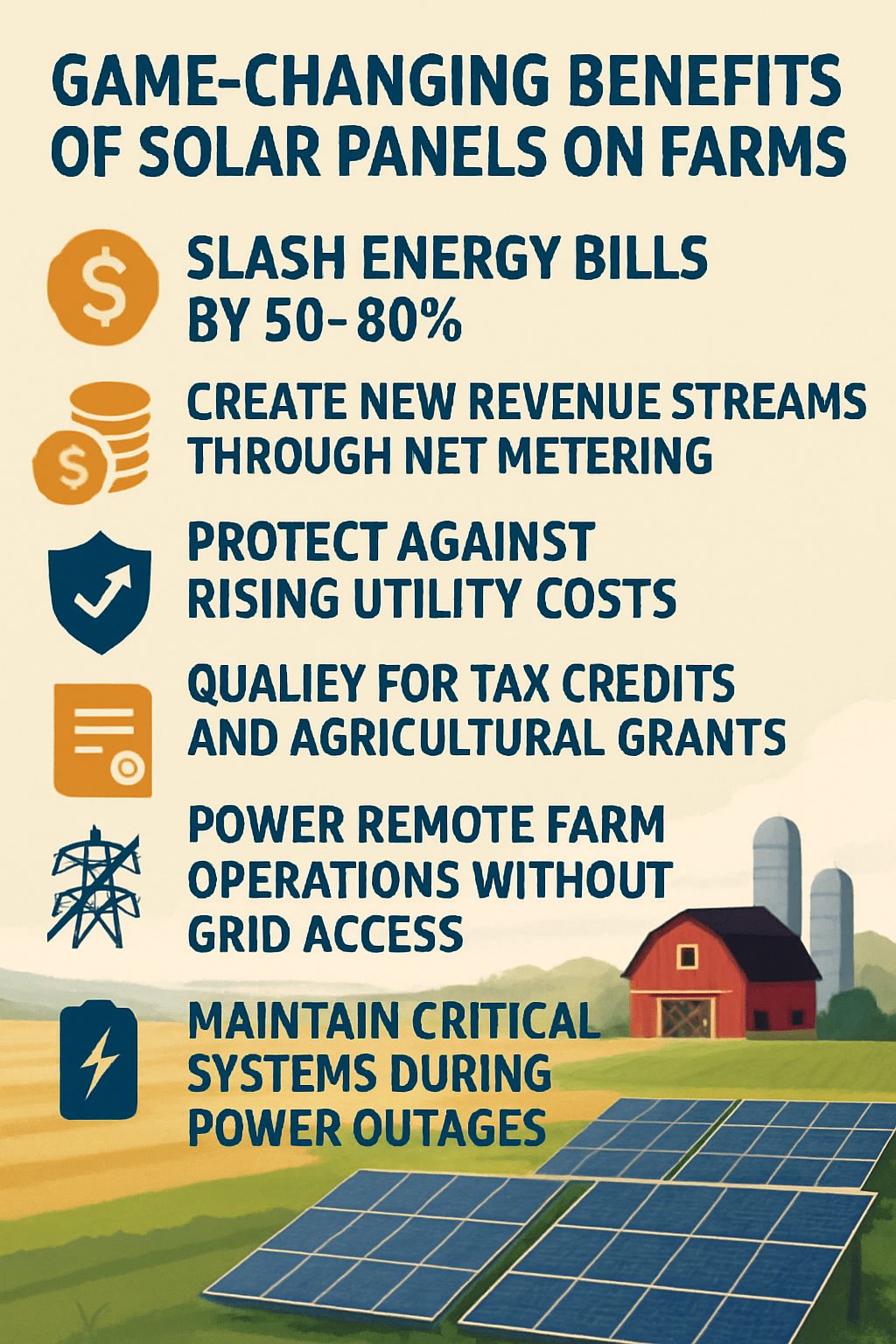
6 Game-Changing Benefits of Solar Panels on Farms
The agricultural sector stands to gain multiple advantages from solar adoption beyond simple electricity generation. When properly implemented, solar technology becomes a strategic asset that enhances overall farm operations.
1. Slash Energy Bills by 50-80%
The most immediate benefit of farm solar installations is dramatic cost reduction. A properly sized system can offset between 50-80% of a farm’s electricity consumption, with many operations achieving complete energy independence. For large operations with monthly electric bills exceeding $1,500, these savings quickly accumulate to tens of thousands of dollars annually, directly improving profit margins without changing crop yields or production methods.
Energy-intensive operations like dairy farms, which use substantial electricity for milk cooling, pumping, and ventilation, often see the most dramatic financial benefits. Case studies show dairy operations reducing their annual energy expenditure by $15,000-$25,000 through strategic solar implementation.
2. Create New Revenue Streams Through Net Metering
Many states offer net metering programs that allow farmers to sell excess solar electricity back to the utility grid. This effectively turns unused roof and land space into revenue-generating assets. During periods of lower farm activity or optimal solar production, the excess energy creates credits that offset costs during high-usage periods, essentially using the grid as a battery while generating income.
3. Protect Against Rising Utility Costs
Solar panels function as a hedge against future energy price increases. While conventional electricity rates have historically risen 2-5% annually, a solar installation locks in energy costs for its 25-30 year lifespan. This cost certainty allows farmers to plan long-term investments with greater confidence, knowing their operational expenses won’t be subject to unpredictable utility rate hikes.
4. Qualify for Tax Credits and Agricultural Grants
The financial case for agricultural solar is significantly strengthened by available incentives. The federal Investment Tax Credit currently offers a 30% tax credit on installed system costs, while USDA’s Rural Energy for America Program (REAP) provides grants covering up to 25% of project costs. Combined with accelerated depreciation benefits, these incentives can reduce total system costs by 50-60%.
- Federal Investment Tax Credit: 30% of system cost
- USDA REAP Grants: Up to 25% of project costs
- Accelerated Depreciation: 5-year MACRS schedule
- State-Specific Incentives: Varies by location
- Property Tax Exemptions: Available in many agricultural zones
5. Power Remote Farm Operations Without Grid Access
Solar power with battery storage eliminates the need for expensive utility line extensions to remote locations. For operations like irrigation pumps in distant fields, livestock watering stations, or monitoring systems, solar provides reliable power without the $15,000-$50,000 per mile cost of extending grid lines. These standalone systems deliver immediate ROI by eliminating both the infrastructure expense and ongoing utility costs.
6. Maintain Critical Systems During Power Outages
Grid reliability in rural areas remains a significant challenge, with many farming regions experiencing frequent outages due to weather events, equipment failures, and limited infrastructure investment. Solar arrays paired with battery storage systems ensure critical farm operations continue uninterrupted during power failures. For livestock operations where ventilation, heating, or cooling systems are essential for animal welfare, this reliability can prevent catastrophic losses during extended outages.
Modern battery storage systems have evolved significantly, now offering 10+ year lifespans with minimal maintenance requirements. These systems automatically detect grid outages and seamlessly transition to stored solar energy within milliseconds, maintaining power to designated critical circuits.
Real-World Success: Farms Transformed by Solar Energy
The impact of solar adoption on agricultural operations is best illustrated through real-world examples that demonstrate both the financial and operational benefits realized by different types of farms.
Small Family Farm Cuts $12,000 in Annual Energy Costs
The Wilson family operates a 140-acre diversified farm in the Midwest, growing vegetables and raising free-range poultry. After installing a 30kW solar array on their equipment barn, they reduced their annual electricity expenses from $15,000 to approximately $3,000—an 80% reduction. The system’s total cost of $75,000 was offset by $22,500 in federal tax credits and a $15,000 USDA grant, resulting in a net investment of $37,500. At their current savings rate, the system will fully pay for itself within 4 years while continuing to generate clean energy for decades.
Dairy Operation Achieves Energy Independence
Meadowview Dairy installed a 200kW ground-mounted solar system to power their 300-cow operation, including milk cooling, vacuum pumps, and automated feeding systems. The installation generates approximately 260,000 kWh annually, meeting 95% of the farm’s electricity needs. Beyond the direct energy savings of $32,000 per year, Meadowview’s owner notes that the consistent power quality from their solar system has extended the lifespan of sensitive electronic equipment and reduced maintenance costs on their milking systems. Learn more about boosting agribusiness with solar energy.
Greenhouse Facility Extends Growing Season Year-Round
Green Harvest Organics operates 15,000 square feet of greenhouse space in a northern climate with high heating costs. Their 75kW solar system combined with ground-source heat pumps allowed them to reduce propane consumption by 85% while extending their growing season to year-round production. This transition increased annual revenue by $95,000 through winter crop availability while simultaneously reducing energy costs by $22,000 annually.
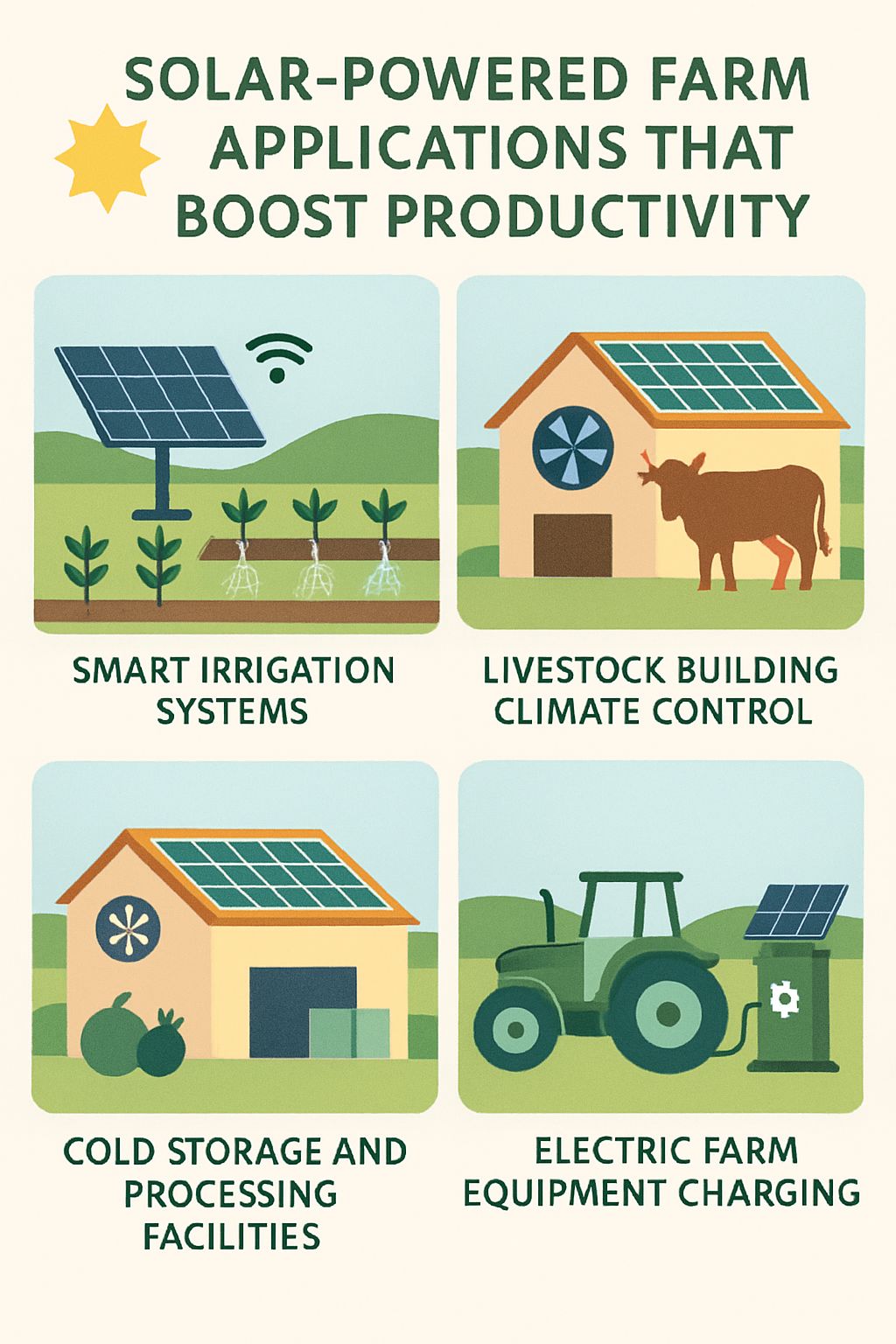
Solar-Powered Farm Applications That Boost Productivity
The versatility of solar power extends far beyond simple electricity generation. When strategically implemented, solar can enhance numerous agricultural operations while simultaneously reducing costs and improving sustainability metrics. From precision agriculture to automated processing, solar power enables technological adoption that would otherwise be cost-prohibitive due to high energy requirements.
Smart Irrigation Systems
Solar-powered irrigation represents one of the most impactful applications for agricultural operations. These systems combine solar panels, efficient pumps, and smart controllers to deliver precise water amounts exactly when crops need it. By eliminating fuel costs for diesel pumps and avoiding peak-rate electricity charges, solar irrigation can reduce water-related expenses by 70-80% while improving crop yields through more consistent moisture management.
Livestock Building Climate Control
Maintaining optimal temperature and ventilation in livestock facilities is crucial for animal health and productivity. Solar-powered ventilation systems ensure continuous air exchange regardless of grid status, preventing dangerous heat buildup during summer months.
Temperature stability directly impacts animal productivity, with research showing that dairy operations can lose 10-20% milk production during heat stress events. Solar-powered cooling systems maintain consistent temperatures throughout the day, protecting this production value while reducing utility costs.
Cold Storage and Processing Facilities
Post-harvest handling represents a significant energy demand for many farming operations. Solar power combined with thermal storage technologies can dramatically reduce refrigeration costs, which often account for 15-30% of a farm’s total energy consumption.
By generating electricity during peak sun hours and storing cooling capacity in thermal batteries or phase-change materials, solar-powered cold storage systems can operate efficiently through the night. This approach not only reduces energy costs but also increases product shelf life by maintaining more consistent temperatures.
- Walk-in coolers and freezers for direct-market farms
- Dairy milk cooling systems with pre-cooling technology
- Controlled atmosphere storage for tree fruits
- Wine and beverage climate control systems
- Flash cooling systems for leafy greens and berries
The return on investment for solar-powered cooling is particularly compelling because refrigeration loads typically align well with peak solar production hours. As harvesting often occurs during daylight hours when solar generation is highest, the energy can be used immediately for cooling without requiring battery storage.
Electric Farm Equipment Charging
As agricultural equipment manufacturers increasingly develop electric versions of tractors, utility vehicles, and specialized machinery, on-farm solar charging stations create a truly sustainable operation cycle. Several major equipment manufacturers now offer electric tractors in the 30-100hp range that can complete a full day’s work on a single charge. By powering this equipment with on-site solar generation, farmers eliminate both fuel costs and maintenance expenses associated with internal combustion engines while reducing their carbon footprint.
Agrivoltaics: Growing Crops Under Solar Panels
One of the most innovative developments in agricultural solar is the rise of agrivoltaic systems—a farming approach that intentionally combines solar energy production with crop cultivation on the same land. Rather than viewing solar panels and agriculture as competing land uses, agrivoltaics creates a symbiotic relationship that can increase overall land productivity by 60-70%.
Research conducted by the University of Arizona has demonstrated that certain crops grown beneath solar panels outperform those grown in full sun, particularly in hot, dry climates. The partial shade created by panels reduces water evaporation, protects plants from extreme heat stress, and creates microclimate effects that benefit many crop varieties.
Modern agrivoltaic installations feature adjustable panel heights and spacing specifically designed to accommodate farm equipment passage and optimize light distribution for plant growth. Some advanced systems even incorporate tracking technology that adjusts panel angles throughout the day to balance electricity generation with optimal light levels for specific crop needs. Learn more about solar panels for farms and how they boost productivity and cut costs with sustainable energy.
Dual-Use Land Benefits
The financial case for agrivoltaics is compelling when considering the combined revenue streams from both electricity generation and crop production. While conventional solar installations might generate $800-$1,200 per acre annually in electricity value, adding compatible crop production can contribute an additional $500-$5,000 per acre depending on crop selection. This dual revenue approach often results in per-acre returns significantly higher than either farming or solar generation alone would produce.
Ideal Crops for Solar Panel Shade
- Leafy greens (lettuce, spinach, kale) which benefit from reduced heat stress
- Shade-tolerant berries including blackberries and raspberries
- Herbs such as mint, oregano, and thyme that thrive in partial sun
- Mushroom cultivation in specially designed growing containers
- Native pollinator plantings that enhance biodiversity and support nearby crops
Increased Water Efficiency in Partial Shade
One of the most significant benefits of agrivoltaic systems is the dramatic improvement in water efficiency. Research conducted across multiple climate zones shows that crops grown under solar panels can require 20-50% less irrigation compared to those in full sun. This water conservation occurs because the partial shade reduces soil surface temperature and decreases evaporation rates, allowing more moisture to remain available for plant uptake.
In drought-prone regions, this water efficiency benefit can be the difference between crop failure and successful harvest. Farmers implementing agrivoltaic systems consistently report that their water-use efficiency improves dramatically, which translates to lower irrigation costs and reduced strain on limited water resources. Some operations have documented water savings exceeding 1.5 million gallons per growing season on 10-acre installations.
“After implementing our agrivoltaic system, we reduced irrigation needs by 47% while maintaining comparable yields for our leafy green production. The water savings alone justified the investment, even before calculating the electricity generation value.” – James Harrington, Sunnyvale Farm
The microclimate created beneath solar panels also extends growing seasons in many regions by protecting crops from early frosts and late spring temperature fluctuations. This season extension creates additional marketing windows and revenue opportunities without requiring heated greenhouse structures or row covers.
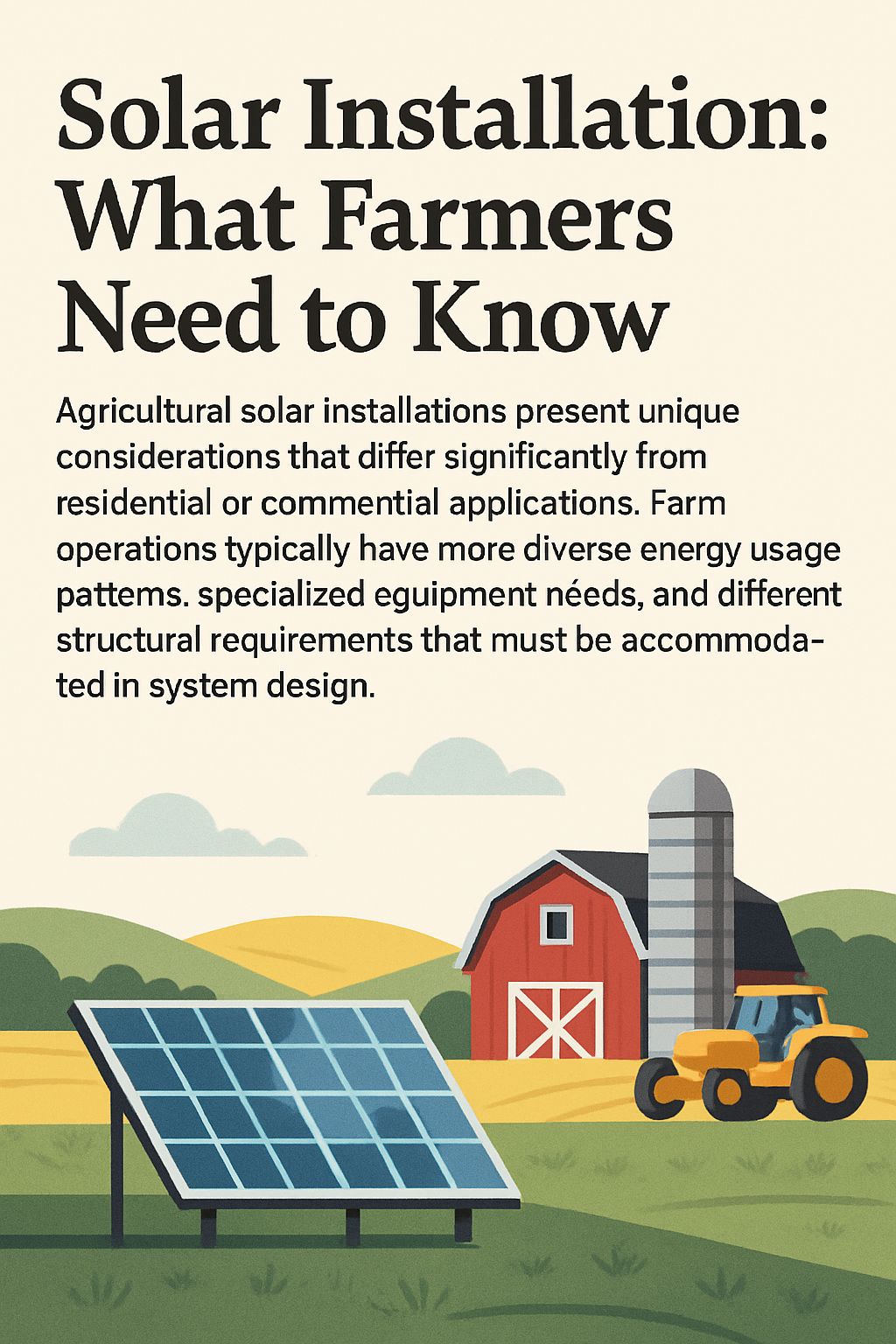
Solar Installation: What Farmers Need to Know
Agricultural solar installations present unique considerations that differ significantly from residential or commercial applications. Farm operations typically have more diverse energy usage patterns, specialized equipment needs, and different structural requirements that must be accommodated in system design. Working with installers experienced in agricultural applications ensures these nuances are properly addressed during planning and implementation phases.
Roof vs. Ground-Mount Systems for Agricultural Settings
The decision between roof-mounted and ground-mounted solar arrays depends on several farm-specific factors. Roof mounting on existing structures like barns, equipment sheds, and processing facilities maximizes land-use efficiency by generating power without consuming additional space. These installations typically cost 10-15% less than ground-mounted alternatives since they don’t require extensive land preparation or structural supports.
Ground-mounted systems offer several advantages for agricultural applications, including optimal panel orientation regardless of existing building alignment, easier maintenance access, and the ability to implement agrivoltaic approaches. These installations can also be designed with sufficient clearance to allow grazing animals to utilize the land beneath panels, further maximizing productivity. For remote applications like irrigation pumps or livestock watering stations, small ground-mounted systems can provide power directly where it’s needed without expensive wire runs.
Size Requirements Based on Farm Energy Needs
Accurate system sizing begins with a comprehensive energy audit that analyzes 12-24 months of electricity consumption data. This analysis reveals seasonal usage patterns and helps identify opportunities for efficiency improvements that might reduce the required solar capacity. Most agricultural operations benefit from systems sized to offset 70-100% of their annual electricity consumption, depending on available incentives and net metering policies.
Connecting to the Grid vs. Off-Grid Solutions
Grid-connected systems remain the most cost-effective option for farms with existing utility service, as they eliminate the need for expensive battery storage while still providing reliable power. These systems use the grid as a virtual battery, feeding excess electricity to the utility during peak production periods and drawing from the grid when solar generation is insufficient. Through net metering arrangements, this exchange is typically credited at retail or near-retail rates, maximizing the financial benefits.
Off-grid solar solutions are increasingly viable for remote agricultural applications where utility connection costs would exceed $15,000-$50,000. Modern battery technologies, particularly lithium iron phosphate (LiFePO4) systems, provide reliable storage with 10+ year lifespans and minimal maintenance requirements. These standalone systems can power irrigation pumps, livestock watering systems, security lighting, and monitoring equipment in locations where traditional utility service would be prohibitively expensive.
Weather Resistance Features for Rural Environments
Agricultural solar installations must withstand harsh environmental conditions including high winds, hail, snow loads, and temperature extremes. Modern agricultural solar systems incorporate multiple protection features designed specifically for rural exposures and extreme weather events. Reinforced mounting systems with wind ratings exceeding 120 mph ensure stability during severe storms, while tempered glass panels with impact resistance ratings can withstand most hailstorms without damage.
Lightning protection systems are particularly important for rural installations where solar arrays are often the highest structures in open areas. Comprehensive grounding networks and surge protection devices shield sensitive electronic components from both direct strikes and induced voltage events. These protection systems typically add only 2-3% to total installation costs while significantly reducing the risk of weather-related damage.
|
Weather Threat |
Protection Feature |
Performance Rating |
|---|---|---|
|
High Winds |
Reinforced mounting systems |
120-150 mph wind resistance |
|
Hail |
Impact-resistant tempered glass |
1″ hail at 50+ mph |
|
Snow Load |
Engineered racking systems |
30-50 lbs/sq ft capacity |
|
Lightning |
Comprehensive grounding network |
UL 1449 surge protection |
|
Temperature Extremes |
Temperature coefficient optimization |
-40°F to +185°F operating range |
Maintenance requirements for agricultural solar systems have been significantly reduced with technological improvements. Most installations now utilize self-cleaning panel coatings that allow rainfall to effectively remove dust and debris, minimizing manual cleaning needs. Remote monitoring systems track system performance in real-time, alerting owners to any performance issues before they impact energy production significantly.
The Economics of Farm Solar: Breaking Down the Numbers
The financial case for agricultural solar installations has never been stronger due to declining equipment costs, improved technology efficiency, and substantial government incentives. When properly designed, these systems deliver reliable returns on investment that outperform many traditional farm capital improvements while simultaneously reducing operational costs and environmental impact.
Initial Investment Range for Different Farm Types
Investment requirements vary significantly based on farm size, energy consumption patterns, and system design specifications. Small diversified farms typically invest $20,000-$60,000 for systems in the 15-45kW range, while larger operations like dairies or processing facilities might require 100-500kW systems costing $125,000-$600,000 before incentives. When evaluating these costs, it’s essential to consider that solar installations typically reduce monthly operating expenses immediately while qualifying for substantial tax benefits and depreciation advantages that dramatically improve cash flow during the first five years of operation.
Payback Period Calculations
The payback period for agricultural solar installations has decreased dramatically in recent years, with most systems now achieving full return on investment within 5-10 years depending on electricity rates, available incentives, and system design. This calculation typically includes the 30% federal investment tax credit, accelerated depreciation benefits, any available state incentives, and direct energy savings. USDA REAP grants, when secured, can reduce payback periods by an additional 1-3 years by covering up to 25% of eligible project costs.
- High electricity cost regions (15¢+ per kWh): 4-6 year payback
- Moderate electricity cost regions (10-15¢ per kWh): 6-8 year payback
- Lower electricity cost regions (under 10¢ per kWh): 8-10 year payback
- Systems with USDA REAP grants: 1-3 years faster payback
- Operations with high daytime electricity usage: 15-25% faster payback
These calculations become even more favorable when considering the protection solar provides against future utility rate increases, which have historically risen 2-5% annually in most agricultural regions. Each year of rate increases accelerates the payback timeline while increasing the lifetime savings generated by the system.
Unlike many farm investments that depreciate over time, solar installations typically include performance warranties guaranteeing 85%+ of original power output after 25 years. This long-term production assurance makes solar uniquely valuable as both an immediate cost-saving measure and a long-term asset that continues delivering financial benefits for decades.
Long-Term ROI and Maintenance Costs
After the initial payback period, solar installations continue generating substantial returns through energy savings for their 25-30 year expected lifespan. When calculating lifetime returns, most agricultural installations deliver 15-20% annual ROI over their operational life, with total returns often exceeding 300-400% of the original investment. These returns come primarily through avoided utility costs, though revenue from renewable energy credit sales can provide additional income in certain markets.
Maintenance requirements and costs have decreased significantly as solar technology has matured. Modern systems typically require only annual inspections costing $200-$500 and inverter replacement after 12-15 years (approximately 10% of original system cost). This minimal maintenance makes solar one of the lowest-maintenance farm investments available while still delivering consistent financial returns year after year.
Future-Proof Your Farm with Sustainable Energy
Implementing solar technology does more than simply reduce current operating costs—it positions agricultural operations to thrive amid changing energy landscapes, regulatory environments, and market demands. As consumers increasingly prefer products from sustainable operations and retailers establish carbon footprint requirements for suppliers, solar-powered farms gain competitive advantages in the marketplace. Beyond the immediate financial benefits, solar installations help agricultural businesses build resilience against energy price volatility, reduce environmental impact, and align with emerging sustainability certification programs that can open premium market opportunities.
Frequently Asked Questions
As you consider solar energy for your agricultural operation, you likely have specific questions about how these systems will integrate with your existing farm infrastructure and operations. The following answers address the most common concerns raised by farmers evaluating solar technology.
How many solar panels does a typical farm need?
The number of panels required depends on your farm’s annual electricity consumption and available installation space. As a general guideline, small diversified operations typically require 40-120 panels (15-45kW), mid-sized farms need 120-300 panels (45-100kW), and large operations like dairies or processing facilities might install 300-1,500 panels (100-500kW). A comprehensive energy audit is essential for accurate sizing, as factors like seasonal usage patterns, future expansion plans, and equipment efficiency upgrades significantly impact system design requirements.
Can solar panels withstand extreme weather common in agricultural areas?
Modern agricultural solar installations are engineered specifically for rural environments and extreme weather conditions. Quality systems utilize reinforced mounting structures rated for 120+ mph winds, impact-resistant panels that withstand 1-inch hail, and snow load capabilities exceeding 50 pounds per square foot. Lightning protection systems and temperature management features ensure reliable operation even in challenging environments. These protective measures typically add only 2-3% to project costs while substantially reducing weather-related risks and insurance concerns.
Do solar panels interfere with farm equipment or operations?
Properly designed agricultural solar installations actually enhance farm operations rather than interfering with them. Roof-mounted systems utilize otherwise unproductive space with zero operational impact, while ground-mounted arrays can be designed with sufficient clearance for equipment passage or livestock grazing beneath panels. Strategic placement ensures systems don’t interfere with field operations, equipment storage, or future expansion plans. For more information on how solar panels are powering farm operations, visit this article on on-grid solar panels.
Many farmers report that solar installations create beneficial microclimates that improve working conditions during summer months by providing shaded areas for equipment maintenance, livestock, or worker breaks. Additionally, the distributed power generation can improve electrical stability for sensitive equipment by reducing voltage fluctuations common in rural utility service.
How long do agricultural solar systems typically last?
Quality agricultural solar installations are designed for 25-30 years of productive operation, with manufacturers providing performance warranties guaranteeing at least 85% of original power output after 25 years. The actual physical lifespan often exceeds 35 years, though gradual efficiency declines of approximately 0.5% annually are normal. Inverters typically require replacement after 12-15 years, representing the only major maintenance expense during the system’s operational life.
What happens to excess energy my farm solar system produces?
In grid-connected systems, excess electricity automatically flows to the utility grid, typically earning credits through net metering programs that offset future electricity costs. These arrangements effectively use the grid as a virtual battery, allowing farms to bank excess production during sunny periods and draw from accumulated credits during higher usage or lower production times. Most agricultural operations design systems to approximately match their annual consumption, maximizing these net metering benefits.
For farms in areas without favorable net metering policies, battery storage systems can capture excess production for later use, though this adds 20-30% to project costs. These storage solutions are becoming increasingly cost-effective, with prices dropping approximately 15% annually while performance and lifespan improve.
Some larger agricultural operations are exploring additional uses for excess electricity production, including electric vehicle charging stations, hydrogen production for equipment fuel, or powering value-added processing that creates new revenue streams. These innovative applications can significantly enhance the overall return on solar investments beyond direct electricity savings.
“Our solar array produces about 35% more electricity than we need during summer months. We’ve converted our fleet to electric vehicles that charge during peak production times, effectively eliminating both our electricity and fuel costs simultaneously.” – Maria Rodriguez, Green Valley Organics
Implementing solar energy on your farm represents a strategic investment in both immediate cost reduction and long-term operational resilience. As agricultural energy demands continue rising while solar technology costs decline, the financial case for farm solar adoption becomes increasingly compelling for operations of all sizes.







Leave a Reply