

Key Takeaways
- Lithium Iron Phosphate (LiFePO4) batteries offer the best long-term value for farmers with their 10+ year lifespan and minimal maintenance requirements.
- Farm size directly impacts battery selection, with small operations often needing 5-10kWh of storage while large farms may require 50kWh+ systems.
- Deep-cycle lead-acid batteries remain the most budget-friendly option for farmers starting their solar journey, though they require more maintenance.
- Battery backup systems can reduce a farm’s operating costs by 30-70% while providing critical power security during grid outages.
- BlueSun Solar specializes in agricultural energy solutions that can be customized to the unique needs of any farming operation.
Why Farmers Need Reliable Battery Backup for Solar Systems
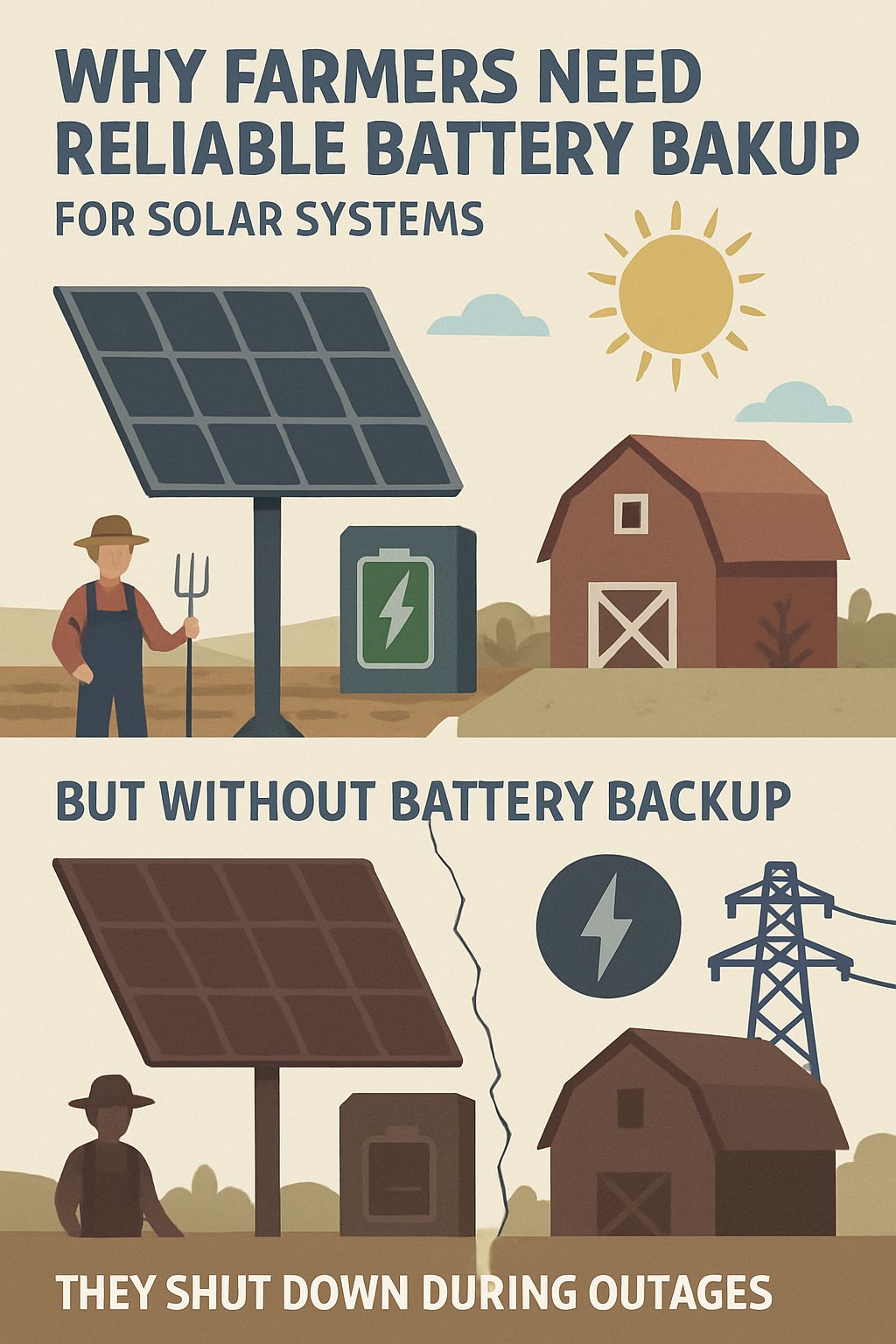
Farming operations can’t afford downtime, especially when irrigation, climate controls, or dairy equipment rely on consistent power. When the grid fails during critical growing or harvesting periods, the financial impact can be devastating – potentially resulting in crop loss, livestock stress, or spoiled products. Solar panel systems provide excellent daytime power, but without battery backup, they shut down during outages.
Battery backup solutions from BlueSun Solar transform a standard grid-tied solar system into a resilient power source that keeps essential farm equipment running regardless of utility status. Modern agricultural operations increasingly depend on technology that requires uninterrupted electricity – from automated feeding systems to data monitoring and smart irrigation controls. The stability provided by quality battery storage means farmers can focus on production instead of worrying about power reliability.
Beyond emergency backup, solar batteries enable farms to store excess daytime energy for use during evening hours or peak rate periods. This load-shifting capability can significantly reduce energy costs by minimizing grid consumption when utility rates are highest. Additionally, battery systems allow farmers to maximize self-consumption of their solar production rather than selling surplus energy back to the grid at wholesale rates, improving overall return on investment for solar installations.

Top Battery Options for Farm Solar Backup Systems
The ideal battery for agricultural applications balances initial cost with longevity, maintenance requirements, and performance under varying conditions. With multiple technologies available, farmers should evaluate options based on their specific operational needs rather than simply choosing the cheapest solution. Let’s examine the top contenders for farm solar backup.
Here is a concise comparison table of common battery options for farm solar backup systems
|
Battery type |
Typical cycle life |
Usable depth of discharge |
Maintenance needs |
Upfront cost |
Best farm use case |
|---|---|---|---|---|---|
|
Lithium Iron Phosphate (LiFePO4) |
About 3,000–6,000+ cycles, often 10–15 years of daily use before major capacity loss. |
Commonly 80–100% usable without serious damage. |
Maintenance‑free; no watering or equalization needed. |
High initial cost, often 2–3× comparable lead‑acid for same kWh. |
Primary storage for off‑grid or grid‑tied with frequent cycling where reliability and lifetime matter more than lowest price. |
|
Deep‑cycle flooded lead‑acid |
Roughly 300–1,000 cycles depending on depth of discharge and care. |
About 50% recommended for best life; deeper discharge shortens life. |
High: needs watering, terminal cleaning, equalization, and ventilation for gas. |
Lowest upfront cost per kWh. |
Budget farm backup where labor for regular checks is available and outages are occasional, not daily cycling. |
|
Sealed AGM lead‑acid |
Typically similar or slightly better than flooded deep‑cycle, often a few hundred to around 1,000 cycles with proper use. |
Usually about 50–60% recommended usable capacity. |
Low: sealed design, no watering; still needs basic inspection but no venting of liquid acid. |
Moderate: more expensive than flooded but cheaper than LiFePO4. |
Remote pump houses or outbuildings where maintenance access is limited but budget cannot stretch to lithium. |
|
Gel lead‑acid |
Often in the same general range as AGM, roughly several hundred to about 1,000 cycles under solar use. |
Typically around 50% recommended for best longevity. |
Low: sealed, no watering; must be charged correctly to avoid damage. |
Moderate: similar to or slightly higher than AGM in many markets. |
Smaller backup banks for control systems, lighting, and electronics where gentle cycling and low maintenance are priorities. |
|
Flow batteries |
Commonly around 10,000–15,000 cycles with minimal capacity fade. |
Up to 100% depth of discharge without significant wear. |
Moderate: pumps and electrolyte tanks require monitoring; usually installed as engineered systems. |
Very high upfront cost and more complex balance‑of‑system. |
Large commercial or multi‑building farm microgrids needing long‑duration storage and very high cycle life. |
1. Lithium Iron Phosphate (LiFePO4) Batteries
LiFePO4 batteries represent the gold standard for agricultural solar storage due to their exceptional safety profile and impressive lifespan. Unlike other lithium chemistries, these batteries resist thermal runaway, making them ideal for barn installations where fire safety is paramount. They deliver 3,000-7,000 cycles at 80% depth of discharge, translating to 10+ years of reliable service. While their upfront cost exceeds lead-acid alternatives, their superior efficiency (95%+) and minimal voltage drop during heavy loads make them perfect for powering well pumps and other high-demand farm equipment.
Farm operations benefit significantly from LiFePO4’s minimal maintenance requirements – no watering, no special ventilation needs, and no regular equalization charges. Their compact footprint saves valuable space in equipment rooms, and their weight (roughly 50% that of equivalent lead-acid banks) simplifies installation. Many agricultural users report that despite higher initial investment, LiFePO4 batteries deliver the lowest lifetime cost when maintenance labor and replacement frequency are factored into calculations.
2. Deep-Cycle Lead-Acid Batteries
Traditional flooded lead-acid batteries continue to serve farmers with tight budgets who can manage regular maintenance routines. These workhorses cost 50-70% less than lithium alternatives initially, though they typically deliver only 500-1,500 cycles. For seasonal operations or farms with minimal daily storage needs, this technology provides acceptable performance at an accessible price point. The key downside is maintenance – batteries require regular watering, terminal cleaning, and specific charging parameters to prevent premature failure. Discover how solar power cuts farmers’ maintenance costs and expenses.
Ventilation represents another consideration for flooded lead-acid installations, as hydrogen gas emissions during charging necessitate adequate airflow. Despite these drawbacks, many small farms successfully operate with properly maintained lead-acid banks that deliver 3-7 years of service before replacement becomes necessary. For farmers comfortable with traditional technology and willing to perform regular maintenance, these batteries remain a viable entry point into solar storage.
3. Sealed AGM Batteries
Absorbed Glass Mat (AGM) technology offers a middle ground between traditional flooded batteries and premium lithium options. These maintenance-free lead-acid variants eliminate watering requirements and hydrogen venting concerns, making them suitable for installation in enclosed farm buildings. Their sealed design prevents acid leaks and allows mounting in various orientations, increasing installation flexibility. AGM batteries typically deliver 600-1,800 cycles – a modest improvement over flooded variants – while costing approximately 20-30% more upfront.
4. Gel Batteries
Gel batteries utilize a silica additive that transforms the electrolyte into a gel-like substance, preventing spillage and allowing for maintenance-free operation. This technology excels in extreme temperature environments common on farms, maintaining better performance in cold conditions compared to traditional flooded lead-acid options. Their self-discharge rate is significantly lower, making them ideal for seasonal farming operations with extended periods of minimal use.
While gel batteries command a premium price over AGM alternatives, they compensate with better cycling performance and increased tolerance to deep discharges. Many agricultural operations in regions with temperature extremes find gel batteries strike an effective balance between acquisition cost and long-term performance. Their 800-2,000 cycle life translates to approximately 5-8 years of service when properly maintained.
5. Flow Batteries for Larger Agricultural Operations
Large-scale farming operations with substantial power requirements should consider flow battery technology for its exceptional longevity and scalability. Unlike conventional batteries, flow systems store energy in liquid electrolyte solutions contained in separate tanks, which can be sized independently from the power-generating component. This architecture allows for virtually unlimited cycling (10,000+ cycles) with minimal degradation, making them suitable for operations planning decades-long use.
Though flow batteries represent the highest initial investment among current technologies, their 20+ year lifespan and ability to undergo complete discharge without damage offer compelling advantages for extensive agricultural installations. For farms with irrigation pumps, cold storage facilities, or processing equipment requiring consistent high-capacity backup, flow batteries can deliver the lowest cost per kilowatt-hour over their operational lifetime despite higher acquisition costs.
How Farm Size Affects Your Battery Backup Needs
Battery capacity requirements scale dramatically based on operation size, making proper system sizing critical to achieving both reliability and cost-effectiveness. Understanding typical needs for different farm classifications helps establish realistic expectations for system scope and investment level.
Small Farm Requirements (Under 50 Acres)
Small-scale farming operations typically require modest battery capacity ranging from 5-15kWh to power essential equipment during outages. This size category often focuses on backing up critical systems rather than attempting whole-farm power independence. A carefully selected battery bank can support well pumps, refrigeration for harvested produce, and basic lighting for 1-3 days without recharging. For more insights on improving farm efficiency, explore how solar power boosts farm efficiency.
For hobby farms and small market gardens, scalable lithium systems starting with 5kWh capacity provide an excellent entry point, with the ability to expand incrementally as budget allows. Small operations benefit particularly from modular systems that can grow alongside the farm’s development without requiring complete replacement as energy needs increase.
Medium Farm Solutions (50-500 Acres)
Mid-sized agricultural operations typically require 15-40kWh of battery storage to maintain critical functions during extended outages. These farms often support more significant infrastructure including multiple irrigation zones, climate-controlled storage, and modest processing equipment. Battery configurations at this scale must balance depth of discharge limitations with sufficient capacity to sustain 2-4 days of essential operations. For more insights on how solar power can enhance farm efficiency, check out this article on solar power boosting farm efficiency.
Medium-scale farms benefit particularly from hybrid battery approaches that combine premium lithium batteries for daily cycling with more affordable lead-acid components for extended backup scenarios. This strategy optimizes the cost-performance ratio by utilizing each technology’s strengths. The diversified production common on medium farms also necessitates careful load prioritization to ensure critical systems receive uninterrupted power during extended outages. For more insights, explore how solar power benefits farmers by improving operations efficiency.
Large Agricultural Operations (500+ Acres)
Commercial-scale farming enterprises typically require 50kWh to several hundred kWh of storage capacity integrated with substantial solar arrays. These operations often implement sophisticated energy management systems that automatically prioritize loads based on operational importance and available battery capacity. For dairy operations, processing facilities, or farms with substantial cold storage, battery systems must be engineered for continuous heavy-duty cycling rather than occasional backup.
Large operations increasingly implement multi-technology storage solutions that combine short-duration, high-power batteries with long-duration storage optimized for extended outages. The substantial investment required at this scale necessitates thorough financial analysis, including detailed return-on-investment calculations that account for avoided production losses during outages alongside routine energy cost savings.
Critical Battery Specifications for Agricultural Applications
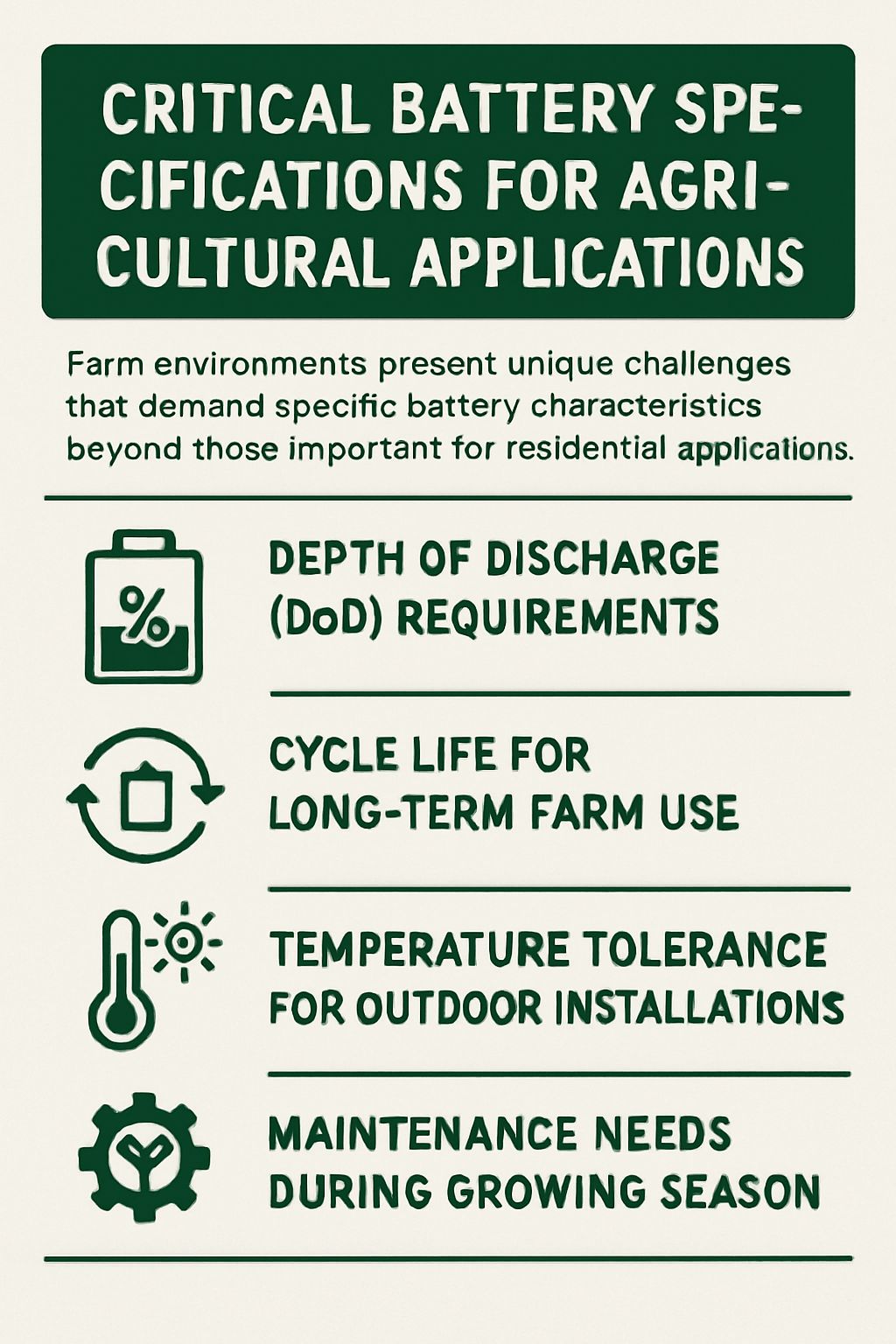
Farm environments present unique challenges that demand specific battery characteristics beyond those important for residential applications. Understanding these critical specifications ensures your investment delivers reliable performance throughout demanding agricultural cycles.
Depth of Discharge (DoD) Requirements
- Lead-acid batteries typically limited to 50% DoD for acceptable lifespan
- Lithium batteries safely accommodate 80-100% DoD without significant degradation
- Flow batteries allow complete discharge without damage
- Higher allowable DoD means more usable capacity from the same battery bank size
- Critical for applications with unpredictable or high-demand periods typical in farming operations
The usable capacity of any battery system depends largely on its recommended depth of discharge limit. For agricultural applications with unpredictable loads and potentially extended outage periods, this specification takes on particular importance. Lead-acid technologies (flooded, AGM, and gel) deliver optimal lifespan when discharge remains between 30-50% of rated capacity, effectively doubling the required battery bank size compared to nominal ratings.
Lithium technologies dramatically outperform in this category, safely allowing 80-100% depth of discharge without significant capacity degradation. This advantage translates to substantially smaller battery banks for equivalent usable capacity – particularly valuable in space-constrained farm installations. For seasonal operations with potential for extended storage periods at partial charge states, lithium systems also demonstrate superior capacity retention and less susceptibility to sulfation damage that plagues lead-acid batteries under similar conditions.
When calculating necessary capacity for critical farm loads, always apply appropriate DoD limitations to battery bank sizing. A 10kWh lead-acid bank effectively provides only 5kWh of usable energy when operated within recommended parameters, while an equivalent lithium system delivers 8-10kWh of usable capacity. This fundamental difference significantly impacts both initial system cost and physical space requirements. For more insights on enhancing farm efficiency, explore how solar power boosts farm efficiency.
Cycle Life for Long-Term Farm Use
Agricultural battery systems typically undergo more frequent and deeper cycling than residential installations, making cycle life a critical economic consideration. Premium lithium iron phosphate batteries rated for 4,000-7,000 cycles deliver 10-15 years of daily use, justifying their higher initial cost through extended service life and reduced replacement frequency. By contrast, even high-quality flooded lead-acid batteries typically provide only 1,000-1,500 cycles, necessitating replacement every 3-5 years under similar usage patterns.
Temperature Tolerance for Outdoor Installations
Farm environments frequently expose equipment to temperature extremes that can dramatically impact battery performance and lifespan. Most battery chemistries experience reduced capacity in cold conditions (typically 1-2% per degree below 77°F/25°C) and accelerated degradation in high heat. For installations in uncontrolled environments, temperature-compensated charging systems are essential, as are robust battery enclosures that moderate temperature swings while providing adequate ventilation to prevent overheating during summer operation.
Maintenance Needs During Growing Season
Maintenance requirements vary dramatically between battery technologies, with significant implications for farm operations during busy growing seasons. Lead-acid batteries demand regular attention including water level checks, terminal cleaning, and equalization charges – maintenance tasks that compete with critical farm activities during peak seasons. By contrast, lithium batteries require virtually no routine maintenance, eliminating these competing priorities during crucial production periods.
Farms with seasonal labor constraints should strongly consider maintenance-free options despite higher acquisition costs. The time savings over a battery system’s lifespan often outweigh initial price differences, particularly when maintenance would otherwise fall during harvest or planting periods. For operations with limited technical staff, maintenance-free technologies also reduce dependency on outside service providers, improving system reliability through simplified ownership.
Real Cost Analysis: Battery Options for Farm Budgets
Initial acquisition cost represents only one component of the total ownership expense for agricultural battery systems. A comprehensive analysis must consider lifespan, maintenance requirements, and performance factors that impact real-world value. While premium batteries command higher upfront prices, their extended service life and improved efficiency often deliver superior returns over the system lifecycle.
Initial Investment Comparison
Battery Type Comparison for 20kWh System (2022 Pricing)
Flooded Lead-Acid: $5,000-$7,500
AGM/Gel: $7,500-$10,000
Lithium Iron Phosphate: $12,000-$16,000
Flow Battery: $20,000-$30,000
Initial investment varies significantly between technology types, with traditional flooded lead-acid batteries representing the most affordable entry point at approximately $250-$375 per kilowatt-hour of nominal capacity. AGM and gel variants typically command a 30-50% premium over flooded counterparts while eliminating maintenance requirements. Lithium iron phosphate systems represent a substantial initial investment at $600-$800 per kilowatt-hour but deliver dramatically improved cycle life and usable capacity.
For farms with limited capital but available maintenance capacity, flooded lead-acid batteries continue to offer a viable entry point to solar storage. However, operations prioritizing long-term value should consider the substantial advantages of lithium technologies despite higher acquisition costs. Flow batteries, while representing the highest initial investment, can deliver the lowest lifetime cost for large installations with 20+ year planning horizons.
Lifespan and Replacement Costs
Replacement frequency dramatically impacts lifetime battery system costs, particularly when installation labor is considered alongside equipment expenses. Lead-acid technologies typically require replacement every 3-7 years depending on usage patterns and maintenance quality. By contrast, premium lithium batteries routinely deliver 10-15 years of service before significant capacity degradation occurs, reducing replacement frequency by 50-75% compared to lead-acid alternatives.
When evaluating total ownership costs, farmers should calculate replacement expenses over a 15-20 year horizon rather than focusing exclusively on initial acquisition. A system requiring three replacement cycles within this timeframe may ultimately cost significantly more than a premium option with longer service life, particularly when future price increases and installation labor are considered. For operations with difficult battery access locations or complex integration requirements, minimizing replacement frequency through higher-quality initial components often delivers substantial long-term savings.
Maintenance Expenses Over Time
Maintenance costs vary dramatically between battery technologies, significantly impacting total ownership expense. Flooded lead-acid batteries require regular watering, terminal cleaning, and specific charging protocols that translate to approximately 1-2 hours of maintenance monthly plus periodic professional service. These activities represent both direct labor costs and opportunity costs as farm personnel divert attention from production activities.
Sealed lead-acid variants eliminate watering requirements but still benefit from professional inspection and maintenance annually. Lithium and flow technologies require minimal maintenance beyond occasional electronic system checks, dramatically reducing ongoing expenses. When calculating true ownership costs, the cumulative value of maintenance hours over a system’s lifespan can equal or exceed the price difference between economy and premium battery options, particularly for farms with high labor costs or limited maintenance personnel.
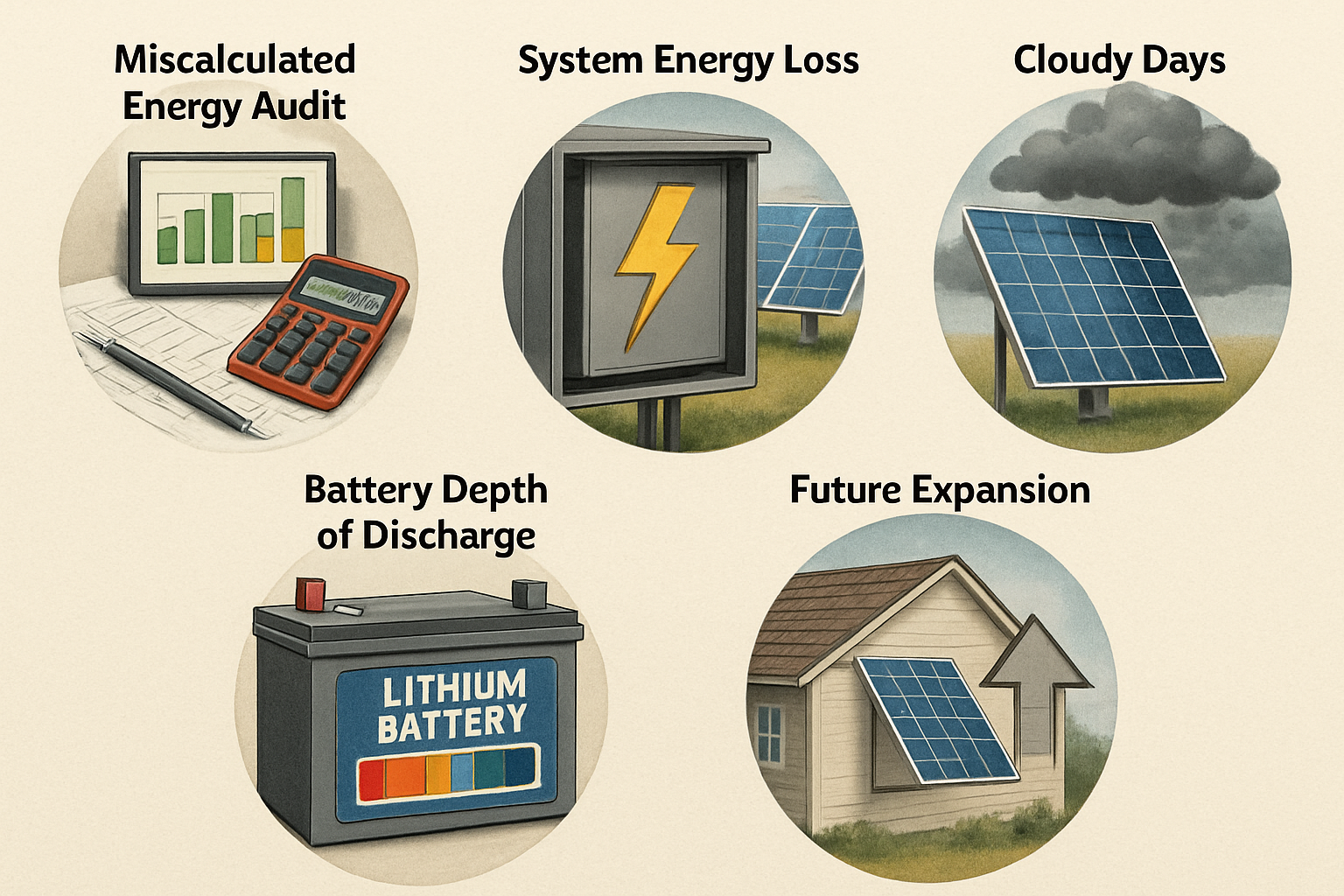
“Sizing Your Lithium Battery Storage” from www.anernstore.com and used with no modifications.
Sizing Your Battery Bank for Critical Farm Operations
Proper battery sizing requires balancing sufficient capacity against budget constraints while accounting for the specific characteristics of chosen battery technology. Undersized systems fail to provide adequate backup during critical periods, while oversized banks unnecessarily increase initial investment and ongoing maintenance requirements. A methodical approach to load calculation ensures appropriate capacity for reliable operation.
Calculating Essential Power Loads
Begin battery sizing by identifying and quantifying truly essential loads that must operate during grid outages. Rather than attempting to power an entire farm, focus on critical systems that prevent crop or livestock loss. For many operations, this includes irrigation pumps, ventilation systems, refrigeration for perishable products, and minimal lighting for safety operations. Categorize loads by criticality to enable selective backup during extended outages when conservation becomes necessary.
For each essential device, document both power draw (watts or kilowatts) and typical daily runtime hours. Multiply these values to calculate daily energy consumption (kilowatt-hours), then sum all essential loads to determine minimum daily backup requirements. For irrigation systems or other equipment with varying seasonal usage, calculate requirements based on peak season needs to ensure sufficient capacity during critical growth periods. This consumption figure forms the foundation for battery capacity calculations, though several adjustment factors must be applied before finalizing system specifications.
Accounting for Seasonal Energy Variations
Agricultural energy requirements often vary dramatically throughout the growing cycle, necessitating flexible battery configurations that accommodate changing demands. Irrigation needs typically peak during summer months when solar production is highest, creating natural synergy between generation and consumption. However, processing equipment, greenhouse heating, or livestock support systems may require substantial energy during lower-production winter periods, creating seasonal imbalances that affect battery sizing.
When designing systems for operations with significant seasonal variations, consider modular battery configurations that allow capacity adjustments throughout the year. Some farms implement portable battery components that can be relocated between operational areas based on seasonal priorities. Others design systems with excess capacity during low-demand periods, utilizing this surplus for non-critical operations or grid services that generate additional revenue during off-peak agricultural seasons.
Planning for Multi-Day Backup Requirements
Agricultural operations often require more extended backup capabilities than residential applications due to rural locations with potentially longer utility outage durations. While single-day backup may suffice in areas with reliable grid service, many farms benefit from 2-5 day autonomy to maintain essential functions during extended weather events or infrastructure failures. Calculating multi-day capacity requires multiplying daily essential load requirements by the desired backup duration, then adjusting for battery-specific factors including depth of discharge limitations and temperature effects.
For critical operations where extended outages would cause significant losses, consider implementing tiered backup strategies that maintain full operation initially, then automatically shed non-essential loads as battery capacity diminishes. Advanced energy management systems can prioritize critical equipment while temporarily disabling lower-priority systems, extending effective backup duration during emergencies. This approach maximizes protection for crucial farm functions while balancing practical limitations on battery capacity and cost.
Installation Considerations for Farm Environments
Agricultural battery installations face unique environmental challenges compared to residential or commercial applications. Farm environments frequently expose equipment to dust, moisture, temperature extremes, and occasionally corrosive atmospheres from livestock operations. Specialized installation techniques and equipment configurations help ensure reliable performance despite these challenging conditions.
Weather-Resistant Enclosure Options
Battery enclosures for agricultural applications require robust environmental protection while maintaining appropriate operating temperatures. NEMA-rated cabinets designed specifically for farm environments provide dust and moisture resistance crucial for preserving battery connections and control systems. For outdoor installations, UV-resistant enclosures with proper ventilation prevent heat buildup during summer operation while providing sufficient insulation for winter temperature management.
Beyond environmental protection, proper enclosure selection addresses safety concerns unique to farm environments. Lockable cabinets prevent unauthorized access, particularly important in operations with multiple workers or visiting contractors. For batteries installed in livestock areas, enclosures should withstand potential physical impact from animals while preventing any possible contact with potentially harmful battery components.
Custom enclosure designs often prove valuable for agricultural applications with specific requirements. Some farms integrate battery storage within existing structure walls but separate from main spaces using dedicated compartments with independent ventilation systems. Others utilize repurposed shipping containers modified with insulation, climate control, and appropriate electrical safety features to create stand-alone battery houses positioned strategically throughout the property.
- NEMA 3R or higher rating for most farm installations
- Temperature-regulated enclosures for batteries in uninsulated buildings
- Elevated mounting in flood-prone areas
- Dust filtration for installations near field operations
- Corrosion-resistant materials for livestock area installations
Temperature Management Systems
Battery performance and longevity depend significantly on maintaining appropriate operating temperatures, presenting challenges in agricultural settings with minimal climate control. Lead-acid batteries perform optimally between 70-75°F (21-24°C), losing capacity in cold conditions and experiencing accelerated degradation at high temperatures. Lithium systems offer broader temperature tolerance but still benefit from moderation of extreme conditions. Effective temperature management strategies include insulated enclosures, thermostatically controlled ventilation, heating elements for cold weather operation, and strategic placement away from direct sun exposure.
Strategic Placement to Minimize Cable Runs
Battery placement significantly impacts both installation cost and system efficiency, with voltage drop across long cable runs reducing effective power delivery to critical equipment. Positioning batteries centrally among major loads minimizes wiring requirements while improving system performance. For operations with distributed power needs, multiple smaller battery banks strategically placed throughout the property may prove more effective than a single centralized system, despite higher equipment costs. For more insights, explore how off-grid solar power systems can enhance farm efficiency.
When evaluating placement options, consider both current needs and future expansion possibilities. Positioning battery systems with space for additional capacity simplifies future upgrades as energy requirements grow. Additionally, selecting locations with good accessibility for maintenance and eventual replacement prevents complicated service procedures that might otherwise delay crucial repairs during critical farming periods. For more information on selecting the right battery, visit this guide on choosing the right battery.
Your Farm’s Energy Independence Starts with the Right Battery Choice
The journey toward energy independence and resilience begins with selecting battery technology aligned with your specific agricultural needs and operational patterns. Rather than focusing exclusively on initial cost, consider the complete picture including performance characteristics, maintenance requirements, lifespan, and compatibility with future expansion. The ideal system balances adequate capacity for critical functions with reasonable acquisition and maintenance costs while providing pathways for growth as farm operations evolve.
Frequently Asked Questions
Below are answers to common questions about solar battery systems for agricultural applications. These responses address typical concerns faced by farmers considering energy storage investments.
How long will a solar battery backup system power my farm during outages?
Backup duration depends on three factors: battery capacity, load requirements, and available solar recharging during the outage. A properly sized system typically provides 1-5 days of essential operations power, with specific duration determined during the design process based on critical load analysis. Systems with load management capabilities can extend effective backup by automatically prioritizing crucial equipment while temporarily disabling non-essential functions as capacity diminishes.
What’s the typical payback period for a farm battery system?
Agricultural battery systems typically achieve financial payback within 5-10 years depending on utility rates, available incentives, and specific usage patterns. Operations with high peak demand charges or time-of-use rates that allow effective load-shifting often experience faster returns. However, the complete value proposition extends beyond direct energy savings to include production loss prevention during outages and potential revenue from grid services in some markets.
When calculating payback, include both energy cost reduction and avoided losses from power interruptions. For operations where outages would cause significant crop damage or livestock stress, the risk mitigation value alone can justify battery investment even before considering routine energy savings. Many farmers find that while energy cost reduction provides steady returns, the true value emerges during the first major outage when production continues uninterrupted while neighboring operations experience losses.
Can I add batteries to my existing farm solar setup?
Most grid-tied solar installations can be retrofitted with battery storage, though the process complexity varies based on your current inverter type and system configuration. Modern systems with hybrid inverters simplify battery addition, while older installations may require additional equipment to enable storage capabilities. A qualified solar professional can evaluate your existing system and recommend appropriate battery integration options based on your specific equipment and backup needs.
Do agricultural solar batteries qualify for tax incentives?
Yes, agricultural battery systems typically qualify for the federal Investment Tax Credit when installed with new solar panels or added to existing solar within specific timeframes. This incentive can reduce effective system cost by 26-30% depending on installation timing. Additionally, many states offer supplemental incentives for farm energy storage, and USDA programs including REAP (Rural Energy for America Program) provide both grants and loan guarantees for qualifying agricultural energy projects. Consult with a tax professional familiar with agricultural operations to maximize available incentives for your specific situation.
How do extreme temperatures affect farm battery performance?
Temperature significantly impacts both capacity and lifespan for all battery technologies, though specific effects vary by chemistry. Cold temperatures temporarily reduce available capacity (typically 1-2% per degree below 77°F/25°C), while heat accelerates chemical degradation that permanently diminishes battery lifespan. Lead-acid batteries are particularly vulnerable to temperature effects, while lithium iron phosphate offers better tolerance of both hot and cold conditions.
For optimal performance in agricultural settings with minimal climate control, implement temperature management strategies including insulated enclosures, ventilation systems, or dedicated battery rooms with basic climate regulation. These measures protect your investment while ensuring reliable performance during critical periods regardless of ambient conditions. When selecting battery technology for uncontrolled environments, prioritize products specifically rated for wide temperature operation rather than general-purpose alternatives designed for climate-controlled settings.




Leave a Reply