

Key Takeaways
- Solar panel efficiency on farms is significantly impacted by proper placement, with optimal angles varying based on geographical location and seasonal changes
- Temperature management is crucial as solar panels actually lose efficiency when they get too hot, with output decreasing by approximately 0.4-0.5% for every degree Celsius above optimal operating temperature
- Agricultural environments present unique challenges including dust, pollen, and crop debris that can reduce panel efficiency by up to 25% if not regularly cleaned
- Strategic panel placement that considers shade patterns throughout the day and seasons can prevent the “domino effect” where shading on even 10% of a panel can reduce output by up to 50%
As a farmer, you’re a master of working with the elements. You read the sky, you know the soil, and you plan your life around the rhythm of the seasons. But one element you’ve likely been paying for, instead of profiting from, is the sun itself. Imagine harvesting more than just crops from your fields—imagine harvesting energy. Turning those wide-open, sun-soaked spaces into a power-generating asset is one of the smartest moves you can make to secure your farm’s future. It’s about taking control of your costs, insulating your operation from volatile energy prices, and building a more resilient legacy.
Solar Panels Can Boost Your Farm’s Bottom Line – Here’s How
The modern farm is a business of margins, efficiency, and long-term strategy. You invest in better equipment, more efficient irrigation, and data-driven crop management—all to maximize your yield and minimize your expenses. But there’s one high-impact asset that many producers are overlooking: their roof. Solar energy has rapidly become a critical tool for agricultural operations looking to future-proof their business. It’s not just an environmental play; it’s a calculated move to hedge against rising electricity costs, generate a powerful return on investment, and add a significant, stable asset to your balance sheet. Ready to see how solar can give your farm the competitive edge it needs? Let’s break down the numbers.
Agricultural solar is rapidly emerging as a smart, sustainable, and incredibly profitable investment for farms of all sizes. It’s not just about being “green”; it’s about smart business.
Here’s how bringing solar panels to your farm can significantly boost your bottom line:
- Slash Your Operating Costs with Renewable Power
- Capitalize on Generous Incentives and Grants
- Turn Your Roof (or Land) into a Revenue Stream
- Fortify Your Farm with Energy Independence
Solar power for agriculture is no longer a futuristic concept; it’s a proven, economically sound investment that addresses critical farming challenges. It’s about reducing costs, generating income, securing energy independence, and positioning your farm for long-term success in a changing world.
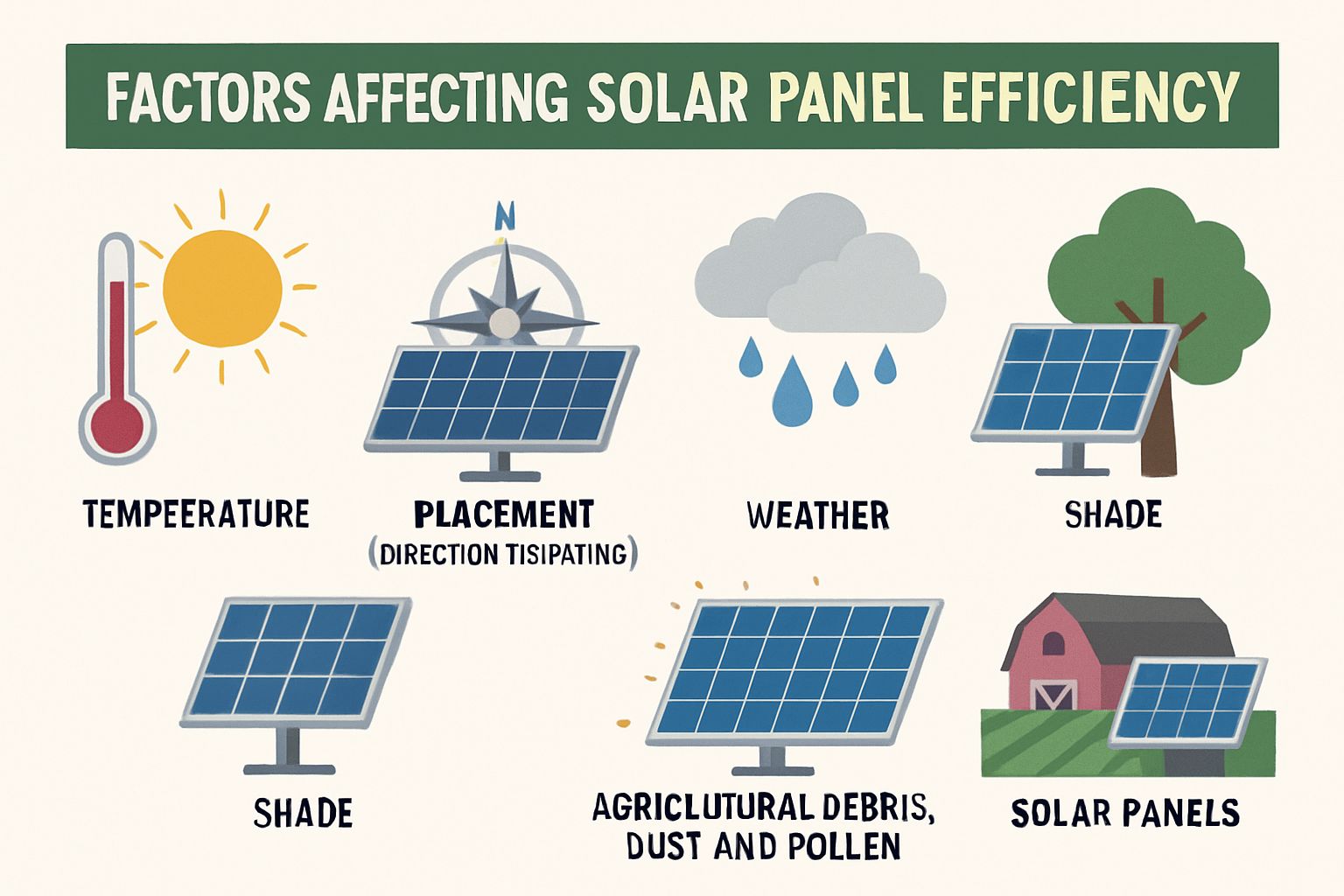
Factors Affecting Solar Panels Efficiency
Solar panel efficiency in farm settings is influenced by several critical factors that can dramatically impact your return on investment. Understanding these variables is essential for making informed decisions about your solar installation and maintenance practices. The combination of these factors determines whether your system performs at peak capacity or struggles to generate the expected output.
Temperature
Contrary to what many assume, solar panels actually perform better in cooler conditions than in extreme heat. When panels exceed their optimal operating temperature (typically around 25°C/77°F), their efficiency begins to decline noticeably. For every degree Celsius rise above the optimal temperature, panel efficiency typically drops by 0.4-0.5%. This temperature effect is particularly relevant for farm installations where panels may be mounted close to reflective surfaces or in areas without natural cooling from air circulation.
Placement – Direction its Facing
The orientation of your solar panels is perhaps the single most important factor affecting their energy production capacity. In the Northern Hemisphere, south-facing installations generally capture the most sunlight throughout the year, but this simplistic approach doesn’t always yield optimal results for farm operations with unique energy usage patterns. The ideal tilt angle varies based on your geographical latitude, with the general rule being that your panel tilt should approximately match your latitude degree to maximize annual production. Learn more about how solar power benefits farmers in improving operations efficiency.
However, farms with seasonal operations might benefit from adjustable mounting systems that can be optimized for different times of year. For instance, a more vertical tilt in winter can capture more of the lower-angle sunlight, while a flatter position in summer takes advantage of the higher sun position and longer days.
Weather
Weather patterns directly impact daily and seasonal energy production from your solar array. While panels will still generate electricity on cloudy days, output typically drops to 10-25% of their rated capacity. Frequent rain can actually benefit panel performance by naturally cleaning dust and debris, but regions with prolonged cloudy seasons may require additional panels to meet energy needs during these periods.
Farms in regions with significant snowfall face additional challenges, as snow coverage can completely block light from reaching panels. However, most panels are installed at angles that promote natural snow shedding, and their dark surfaces help accelerate melting when exposed to even minimal sunlight.
Case Study: Wisconsin Dairy Farm
A 200-acre dairy operation in Wisconsin installed a 75kW system with adjustable mounts, allowing for a 50° winter tilt and 20° summer tilt. This seasonal adjustment increased annual energy production by 18% compared to fixed mounting, resulting in approximately $3,200 in additional savings annually.
Shade
Even partial shading can dramatically reduce solar panel output in ways that might not be immediately obvious. When a portion of a panel is shaded, it doesn’t just reduce output proportionally – it can create a “bottleneck” effect that impacts the entire string of connected panels. Modern panels with bypass diodes help mitigate this issue, but proper site planning remains essential.
Agricultural Debris, Dust and Pollen
Farm environments create unique challenges for solar panel maintenance due to the constant presence of dust, pollen, and crop debris. During harvesting seasons, airborne particles can accumulate rapidly on panel surfaces, creating a layer that blocks sunlight and reduces efficiency by up to 25% in severe cases. Regular cleaning becomes even more critical in agricultural settings than in residential installations.
Proximity to dirt roads, tilled fields, and livestock areas significantly increases the rate of soiling on solar panels. Many farmers report efficiency drops of 5-10% within just weeks of cleaning during high-activity periods. This accumulation not only reduces immediate performance but, if left unaddressed, can lead to permanent “hot spots” that damage panels over time. For more insights on optimizing solar power, explore how solar power boosts farm efficiency.
Solar Panels
Not all solar panels are created equal, especially when it comes to farm applications. Panel technology choices significantly impact both initial performance and long-term reliability in agricultural settings. Monocrystalline panels typically offer the highest efficiency rates (18-22%) but come at a premium price, while polycrystalline options provide a balance of performance (15-17% efficiency) and affordability that many farmers find attractive.
For farm buildings with limited roof space, high-efficiency panels may justify their higher cost by generating more power per square foot. Alternatively, thin-film panels, while less efficient (10-12%), can be more cost-effective for ground-mount installations where space isn’t a limitation and offer better performance in high-temperature conditions typical of summer months. To explore more about the benefits of solar power in agriculture, check out solar power benefits for farmers.
Why Temperature Makes or Breaks Your Solar Panel Performance
The relationship between temperature and solar panel output is often misunderstood by new solar adopters. While panels need sunlight to generate electricity, they actually perform better when they’re cool. This counterintuitive reality means that bright, cool spring days can deliver more energy than hotter summer days with the same sunlight intensity. Learn how solar power boosts farm efficiency by optimizing these conditions.
Most solar panels are rated for peak performance at 25°C (77°F), but panel surfaces can reach 65°C (149°F) or higher on sunny days. For every degree above the rated temperature, efficiency typically decreases by 0.4-0.5%, meaning a very hot panel might produce 15-20% less power than its rating suggests.
How Heat Actually Decreases Efficiency
The physics behind temperature-related efficiency loss is related to the semiconductor properties of the silicon in solar cells. As silicon heats up, the difference between its energy states decreases, causing voltage drops across the panel. This voltage reduction directly translates to lower power output, even while current remains relatively stable.
Farm installations are particularly vulnerable to heat-related losses due to their open exposure and lack of surrounding structures that might provide shade or cooling effects. Ground-mounted systems often experience higher temperatures than roof-mounted systems due to reduced air circulation underneath and reflected heat from the ground.
Regional variations also play a significant role in temperature management. In the humid Southeast, panels might experience less efficient cooling than in drier Western regions where evaporation helps dissipate heat more effectively. This regional factor should influence both system design and production expectations.
Cooling Strategies That Keep Panels Working Optimally
Elevating panels at least 4-6 inches above mounting surfaces promotes better airflow and can reduce operating temperatures by 5-10°C. This simple design consideration can improve annual energy yield by 2-5% with minimal additional cost during installation. For ground-mounted systems, allowing vegetation to grow beneath panels (while maintaining clearance) can reduce ground temperature and reflected heat. Additionally, solar power benefits for farmers include enhanced operational efficiency, which can be further optimized with proper cooling strategies.
Some innovative farms have implemented dual-use systems where panels are mounted high enough to allow grazing animals beneath them. The animals naturally keep vegetation trimmed while benefiting from the shade, and their presence reduces ground temperature and reflected heat to the panels above. These agrivoltaic approaches create mutually beneficial relationships between energy production and traditional farming activities.
Temperature Impact Calculator
For every 10°C (18°F) increase above 25°C (77°F):
– Monocrystalline panels: 4-5% efficiency loss
– Polycrystalline panels: 4-5% efficiency loss
– Thin-film panels: 1-2% efficiency loss
A 10kW system operating at 65°C instead of 25°C might produce 16-20% less power (400-500 fewer kilowatt-hours annually per kW of capacity). Learn how to cut your farm’s electricity costs with solar power.
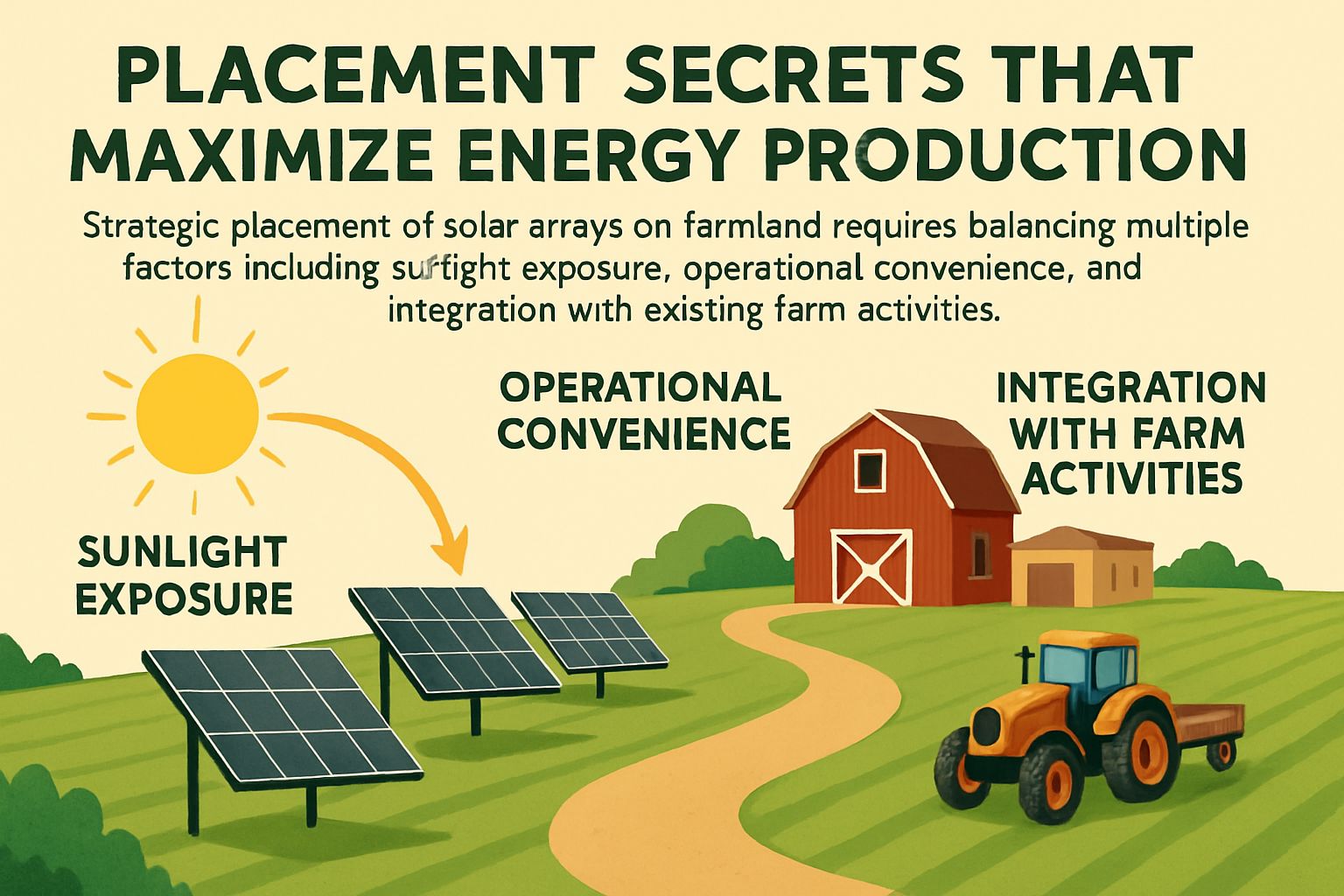
Placement Secrets That Maximize Energy Production
Strategic placement of solar arrays on farmland requires balancing multiple factors including sunlight exposure, operational convenience, and integration with existing farm activities. The ideal location varies based on geographical location, farm layout, and specific energy usage patterns. For operations with significant seasonal variation in energy needs, optimizing for peak demand periods may be more valuable than maximizing annual production. To learn more about optimizing solar panel efficiency, consider exploring key factors that influence efficiency.
Large farm operations often benefit from distributed solar installations rather than a single large array. This approach allows for strategic placement near points of high energy consumption, reducing transmission losses and potentially eliminating the need for expensive electrical infrastructure upgrades. It also provides redundancy in case one section requires maintenance or experiences issues.
South-Facing Is Not Always Best for Every Farm
While south-facing installations (in the Northern Hemisphere) generally capture the most total sunlight throughout the year, this orientation primarily maximizes midday production. For farms with operations that run heavily in morning or afternoon hours, east or west-facing installations might better align energy production with actual usage patterns. East-facing arrays produce more morning electricity, while west-facing systems generate more power in the afternoon and early evening.
Some agricultural operations are implementing dual-orientation systems, with some panels facing east and others west, to create a more balanced daily production curve. This configuration sacrifices some total annual production but can reduce reliance on battery storage or grid electricity during morning and evening usage peaks.
Farms with time-of-use utility rates should consider this factor in orientation decisions, potentially favoring west-facing installations that produce more during high-rate afternoon periods. This rate optimization can improve financial returns even with slightly lower total energy production. For more insights, explore key factors that influence solar panel efficiency.
Optimal Angles for Different Seasons
The ideal tilt angle for your solar array should align with your farm’s geographical latitude for maximum year-round production. However, seasonal adjustments can significantly boost efficiency during critical farming periods. For winter optimization, increase your tilt angle by 10-15 degrees above your latitude to capture more of the low-hanging winter sun. During summer months, reducing the angle by 10-15 degrees below your latitude maximizes exposure during longer daylight hours.
Adjustable mounting systems offer flexibility for farms with distinct seasonal energy needs, though they require manual adjustments 2-4 times annually. The additional 15-25% seasonal production gain often justifies this small maintenance commitment, especially for operations with specific high-energy seasons like dairy farms with summer cooling demands or grain operations with fall drying requirements. For more information on how to optimize your solar panel efficiency, consider exploring key factors that influence solar panels.
Distance From Farm Operations for Dust Management
Strategic positioning of solar arrays relative to dusty farm activities can dramatically reduce maintenance requirements and improve overall system performance. Maintaining at least 100-150 feet distance from frequently tilled fields, gravel roads, or livestock areas significantly reduces particulate accumulation on panel surfaces. For areas where close proximity to dust-generating activities is unavoidable, consider windbreak plantings or installing panels at greater heights to reduce dust impact.
Some farmers have found success with placing arrays downwind of their most dust-producing operations, using natural wind patterns to their advantage. This simple positioning consideration can extend the intervals between necessary cleanings from weekly to monthly or even quarterly depending on your specific environment.
Weather Impacts Beyond Your Control (And What to Do About Them)
Weather conditions create both challenges and opportunities for solar energy production on farms. While these environmental factors aren’t directly controllable, understanding their impacts allows farmers to design more resilient systems and establish realistic performance expectations throughout the year. The key to successful agricultural solar implementation is not eliminating weather impacts but adapting your system to work with them.
Cloudy Day Performance Reality Check
Modern solar panels typically generate 10-25% of their rated capacity during overcast conditions. This reduced output is still valuable, especially in regions where cloudy periods coincide with lower energy demands. For farms in frequently overcast regions, oversizing your system by 10-20% compared to sunnier locations can help maintain adequate production during these challenging periods.
Diffuse light conditions, common on partly cloudy days, can sometimes create a “lens effect” where momentary production exceeds clear-day performance. While these spikes are temporary, they highlight how variable weather creates a more complex production profile than many farmers initially expect. Monitoring systems help quantify these patterns and adjust operations accordingly.
Rain: Natural Cleaning vs. Production Drops
Rainfall provides a valuable natural cleaning service for solar panels, especially important in agricultural settings where dust accumulation occurs rapidly. A moderate rainfall of at least 0.5 inches typically removes 70-90% of surface debris, potentially restoring 5-10% of lost efficiency without manual intervention. Farms in regions with regular rainfall patterns may require significantly less manual panel cleaning than those in drier climates.
However, the productivity loss during rainy periods must be factored into overall system design and production estimates. Sophisticated solar design software accounts for historical precipitation patterns in your region when projecting annual energy production, helping create realistic expectations for seasonal variations. For farmers looking to cut costs and raise yields, solar-powered irrigation systems can be an effective solution.
Snow Removal Techniques That Won’t Damage Panels
Snow accumulation presents a temporary but significant efficiency challenge for farm solar installations in northern regions. Most ground-mounted agricultural systems are installed at angles that promote natural snow shedding once temperatures rise slightly or sun hits portions of the panel. This passive clearing approach works well for intermittent snow events but may be insufficient during extended winter periods.
When manual removal becomes necessary, use only soft-bristled brooms or specialized rubber-edged snow rakes designed specifically for solar panels. Avoid metal tools, standard shovels, or pressure washers that can scratch panel surfaces or damage seals. Many farmers report success with simply removing snow from the bottom row of panels, allowing sunshine to create a melting effect that gradually clears upper rows.
Annual Weather Impact on 100kW Farm System
– Cloudy days: 15-25% production reduction (40-60 days/year in Midwest)
– Snow cover: 50-90% production loss (15-30 days/year depending on region)
– Heavy rain: 80-95% production loss during rainfall, followed by 5-10% efficiency boost from cleaning
– Seasonal variation: Winter production typically 30-60% lower than summer in northern states
Wind Protection Measures for Rural Installations
Open farm environments expose solar installations to higher wind forces than residential settings, requiring robust mounting systems designed for agricultural applications. Systems rated for 90+ mph wind loads are essential for most farm installations, with areas prone to tornadoes or hurricanes requiring even higher ratings. Additional anchoring and reinforcement add relatively little to overall project costs while providing significant protection against catastrophic failures.
Wind can benefit panel performance by providing natural cooling effects that increase efficiency during hot weather. However, consistent strong winds also accelerate dust accumulation and may require more frequent cleaning schedules. Some farms install partial windbreaks on prevailing dust-carrying wind sides while leaving cooling breezes unobstructed. For those looking to cut your farm’s electricity costs with solar power, considering wind effects is crucial.
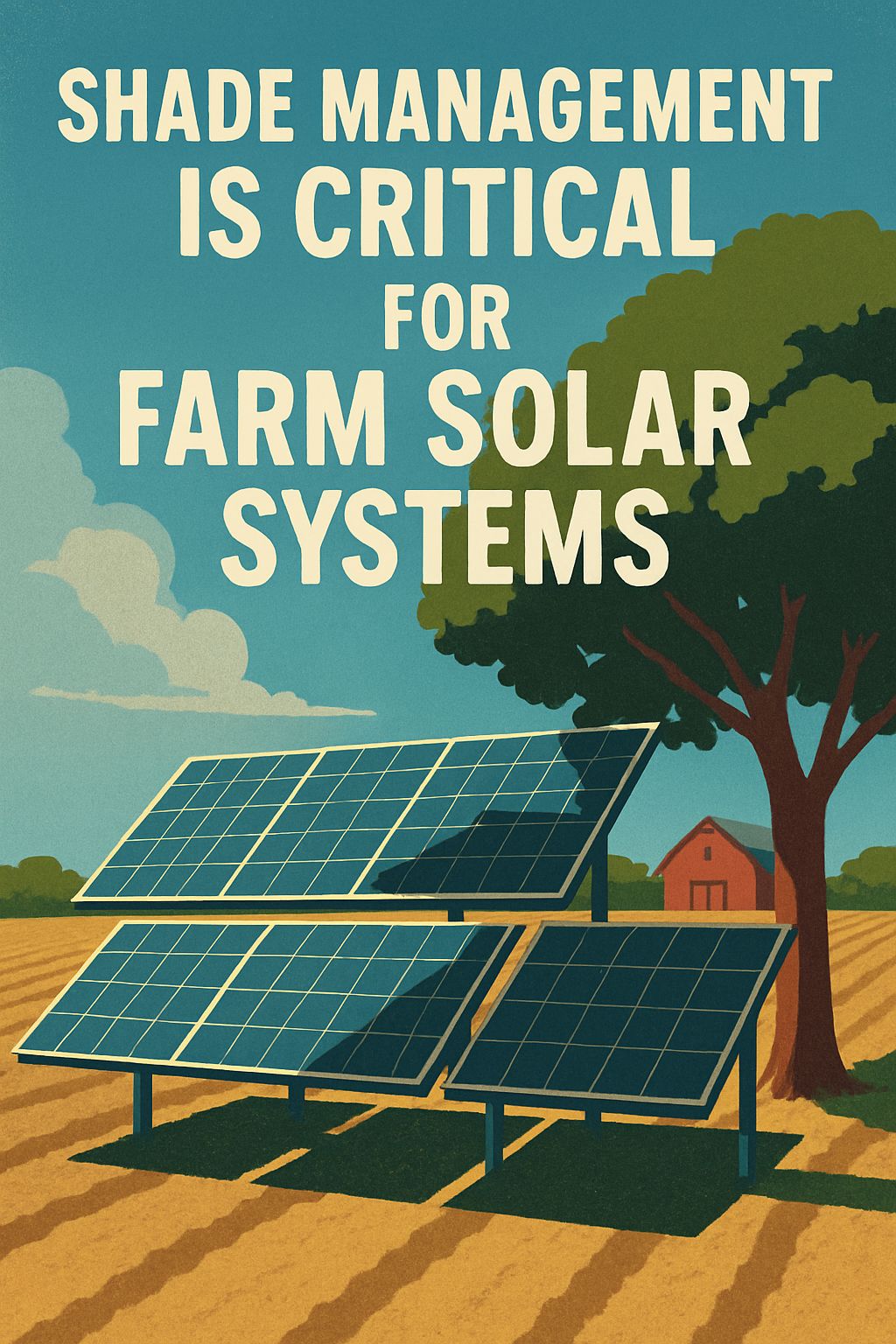
Shade Management Is Critical for Farm Solar Systems
Shade represents one of the most significant yet often overlooked efficiency factors in farm solar installations. Even partial shading can trigger disproportionate production losses due to the interconnected nature of solar cells and panels. Understanding and managing shade patterns throughout the day and across seasons is essential for maximizing system performance and longevity.
Tree Growth Planning Around Solar Arrays
Existing and future vegetation requires careful consideration when planning farm solar installations. Trees that currently pose no shade issue may become significant obstructions as they grow over your system’s 25-30 year lifespan. When planning new array locations, consider not just current shade patterns but projected growth of surrounding trees, accounting for species-specific mature heights and spreads.
For necessary tree management, prioritize selective pruning over complete removal when possible. Many farms maintain north-side windbreaks while removing or trimming trees on the southern exposure. This approach maintains beneficial windbreaks and wildlife habitat while eliminating problematic shade sources.
Seasonal Shade Pattern Analysis
Shade patterns change dramatically between summer and winter months, with winter sun casting much longer shadows from the same objects. Professional solar assessments should include seasonal shade analysis using tools like Solar Pathfinder or digital modeling software that predicts shade impacts throughout the year. These assessments often reveal that objects seemingly far enough away from summer installations become significant winter obstructions.
Farm buildings present particular challenges, as their relatively tall profiles can cast extensive shadows. Roof-mounted systems eliminate this concern but introduce other considerations like structural capacity and orientation limitations. The ideal solution varies by operation, but comprehensive shade analysis should inform this decision.
How Even Partial Shade Dramatically Cuts Output
The impact of partial shading extends far beyond the shaded area due to the series connection of cells within panels. When even 10% of a standard panel is shaded, output may drop by 30-50% as the shaded cells create resistance that affects the entire circuit. Modern panels incorporate bypass diodes that mitigate this effect somewhat, but cannot eliminate it entirely.
String inverter systems are particularly vulnerable to partial shading issues, as a single shaded panel can reduce output from all panels in that string. Microinverters or power optimizers, while adding 10-15% to system costs, can pay for themselves quickly on farms with unavoidable intermittent shading by allowing each panel to operate independently at its maximum potential regardless of conditions affecting other panels.
Dust, Pollen, And Agricultural Debris: The Invisible Efficiency Killers
Agricultural environments create unique soiling challenges for solar arrays that can significantly impact performance. Dust accumulation reduces light transmission to solar cells, with each millimeter of dust potentially reducing efficiency by 4-7%. Combined with pollen, crop debris, and other farm-specific particulates, unmanaged panels can experience efficiency drops of 20-30% within a single growing season. To combat these issues, farmers are increasingly turning to solar power solutions to enhance farm efficiency and maintain optimal panel performance.
Cleaning Schedule Based on Your Farm Activities
Effective cleaning schedules should align with your farm’s operational calendar, increasing frequency during high dust-generating periods like tilling, harvesting, or hay cutting. Most agricultural operations benefit from inspecting panels monthly and cleaning quarterly at minimum, with additional cleanings scheduled immediately following major dust-generating activities. The productivity gains from proper cleaning typically deliver returns of 10-15 times the labor cost involved. For more insights on improving your solar panel efficiency, check out these key factors.
Many farmers incorporate panel cleaning into existing equipment maintenance routines, creating efficiency in labor allocation. Simple visual inspections can identify when cleaning becomes necessary, with notable dust accumulation or visible “water spots” from previous rainfall serving as indicators that performance is being compromised.
Equipment And Methods for Safe Panel Cleaning
Proper cleaning techniques preserve both panel efficiency and longevity. Use only soft brushes, microfiber cloths, and squeegees designed for solar applications. Avoid high-pressure washers that can damage seals and potentially void warranties. For most agricultural settings, a simple combination of deionized water (to prevent mineral deposits) and a soft brush on an extension pole is sufficient for routine maintenance.
For installations accessible by farm equipment, some operations have adapted existing spraying equipment with appropriate nozzles and reduced pressure settings to efficiently clean ground-mounted arrays. This approach can dramatically reduce the time required for cleaning large installations while ensuring consistent maintenance.
- Morning or evening cleaning prevents thermal shock from cold water on hot panels
- Never use abrasive materials, detergents with additives, or high-mineral content water
- Document cleaning in maintenance logs to correlate with performance data
- Consider professional cleaning services for annual deep cleaning or hard-to-reach installations
- Anti-soiling coatings can extend periods between necessary cleanings by 30-50%
Some innovative farms have installed simple rainwater collection systems that provide ideal cleaning water while demonstrating commitment to resource conservation. These systems typically pay for themselves within 2-3 years through reduced water costs and labor efficiency.

“Best Solar Panel Types for Farms …” from growingsolarmist.com and used with no modifications.
Panel Quality and Technology Differences That Matter for Farms
The solar panel market offers diverse technologies with significant implications for agricultural applications. Your specific farming operation, budget constraints, and performance expectations should guide technology selection rather than simply choosing the cheapest option or the one with the highest rated output. The right panel technology can mean the difference between a system that struggles to meet expectations and one that consistently exceeds performance projections.
Monocrystalline vs. Polycrystalline vs. Thin-film vs. Bifacial Panels for Agricultural Settings
Solar Panel Technology Comparison for Agricultural Use
Monocrystalline: 18-22% efficiency, excellent performance in limited space, higher cost, better high-temperature performance
Polycrystalline: 15-17% efficiency, good value option, slightly larger footprint needed, moderate temperature sensitivity
Thin-Film: 10-13% efficiency, lowest cost per watt, flexible installation options, best high-temperature performance
Bifacial: 20-30% production boost over standard panels when properly installed with reflective surroundings, ideal for elevated agricultural applications
Monocrystalline panels typically offer the highest efficiency and space-saving benefits, making them ideal for roof-mounted systems on barns, equipment sheds, or processing facilities where available space constrains system size. Their superior heat tolerance also provides more consistent performance during summer temperature spikes common in agricultural regions.
Polycrystalline panels offer an excellent middle-ground option that many farmers find provides the best balance of performance and affordability. Their slightly lower efficiency is often offset by their lower cost, potentially delivering better financial returns despite requiring approximately 15-20% more space for equivalent power production.
Thin-film technology, while less space-efficient, offers several advantages in specific agricultural applications. Their superior high-temperature performance makes them well-suited to hot climates, and their lighter weight allows for installation on structures that might not support heavier conventional panels. Some thin-film technologies also perform better in diffuse light conditions common during early morning hours when many farm operations begin.
Bifacial panels represent the newest mainstream technology with particular relevance for elevated agricultural installations. By capturing reflected light from the ground on their undersides, these panels can produce 10-30% more energy than conventional panels in the same footprint. This technology is especially effective when installed over reflective surfaces like light-colored gravel or certain crop types, creating opportunities for dual-use installations that maintain agricultural production beneath the panels.
Here is a comparison table of the four best solar panel types for agricultural use — focusing on features, efficiency, and suitability for farms.
|
Solar Panel Type |
Efficiency Range |
Cost per Watt (Approx.) |
Key Advantages for Agriculture |
Limitations |
Best Farm Applications |
|---|---|---|---|---|---|
|
Monocrystalline Panels |
17–22% 1 |
$0.90–$1.50 2 |
High efficiency, compact design, long lifespan, performs well in all climates |
Higher upfront cost |
Space-limited farms, rooftops, and irrigation systems 1 |
|
Polycrystalline Panels |
13–17% 3 |
$0.70–$1.00 3 |
Lower cost, durable, long lifespan, strong in direct sunlight |
Requires more space, less efficient in cloudy conditions | |
|
Thin-Film Panels |
10–13% 5 |
$0.50–$0.90 2 |
Lightweight, flexible, better low-light/shaded performance |
Lower efficiency, shorter lifespan |
Greenhouses, barns, shaded or irregular terrain 5 |
|
Bifacial Panels |
18–22% 6 |
$1.00–$1.60 6 |
Captures light from both sides, high energy yield, great for reflective surfaces like grass or soil |
Higher cost, more complex installation |
Agrivoltaics (dual-use with crops), open-field installations 6 |
These four types of solar panels represent the most effective options for agricultural operations, allowing farmers to select between high efficiency (monocrystalline, bifacial) and lower-cost scalability (polycrystalline, thin-film) depending on land availability, sunlight exposure, and budget.
Degradation Rates and Warranty Considerations
Panel degradation rates significantly impact long-term return on investment and should be carefully evaluated when selecting technology for farm installations expected to operate for 25+ years. Quality panels typically degrade at 0.5-0.7% annually, meaning they’ll still produce 80-85% of their original output after 25 years. Budget panels with higher degradation rates (0.8-1.2% annually) may offer lower initial costs but potentially deliver significantly less energy over their lifetime, compromising long-term financial returns. For more information on factors that influence the efficiency of your solar panels, check out this comprehensive guide.
Tracking Systems: Are They Worth It for Your Operation?
Solar tracking systems automatically adjust panel orientation throughout the day to maximize sunlight exposure, potentially increasing energy production by 20-45% compared to fixed installations. This production boost must be weighed against higher initial costs, increased maintenance requirements, and greater system complexity when determining if tracking is right for your farm operation. The economics vary significantly based on your specific agricultural setting, energy usage patterns, and available incentives.
Tracking systems require more land area than fixed installations due to necessary spacing that prevents adjacent arrays from shading each other as they rotate. This increased land requirement should be factored into decisions for farms where available space for solar is limited or where land has high agricultural production value. The ideal scenario combines marginal land with high solar potential where the tracking advantage can be maximized without sacrificing valuable cropland.
Power consumption of the tracking mechanisms themselves reduces net energy gain, though modern systems typically use less than 0.5% of the energy they help produce. More significant considerations include the additional maintenance requirements and potential points of failure introduced by mechanical tracking components, particularly in harsh agricultural environments with dust, temperature extremes, and potential impact from farm equipment.
Single-Axis vs. Dual-Axis Economics
Single-axis tracking systems, which rotate panels east to west throughout the day, typically increase production by 20-30% while adding 30-40% to system costs. Dual-axis systems, which adjust both east-west and seasonal angle, boost production by 30-45% but increase costs by 45-55% and require significantly more maintenance. For most agricultural applications, single-axis tracking delivers the better balance of increased production and manageable complexity, with payback periods typically 1-3 years longer than fixed systems but better lifetime returns in suitable locations.
Maintenance Requirements in Farm Environments
Farm environments present unique challenges for tracking system maintenance due to dust, pollen, and airborne debris that can affect moving parts and sensors. Establish quarterly inspection schedules for tracking components, with particular attention to drive motors, bearings, and control systems. Most manufacturers recommend professional servicing annually, which adds approximately $500-1,500 per year to operational costs for typical farm-scale systems – a significant consideration when calculating lifetime return on investment.
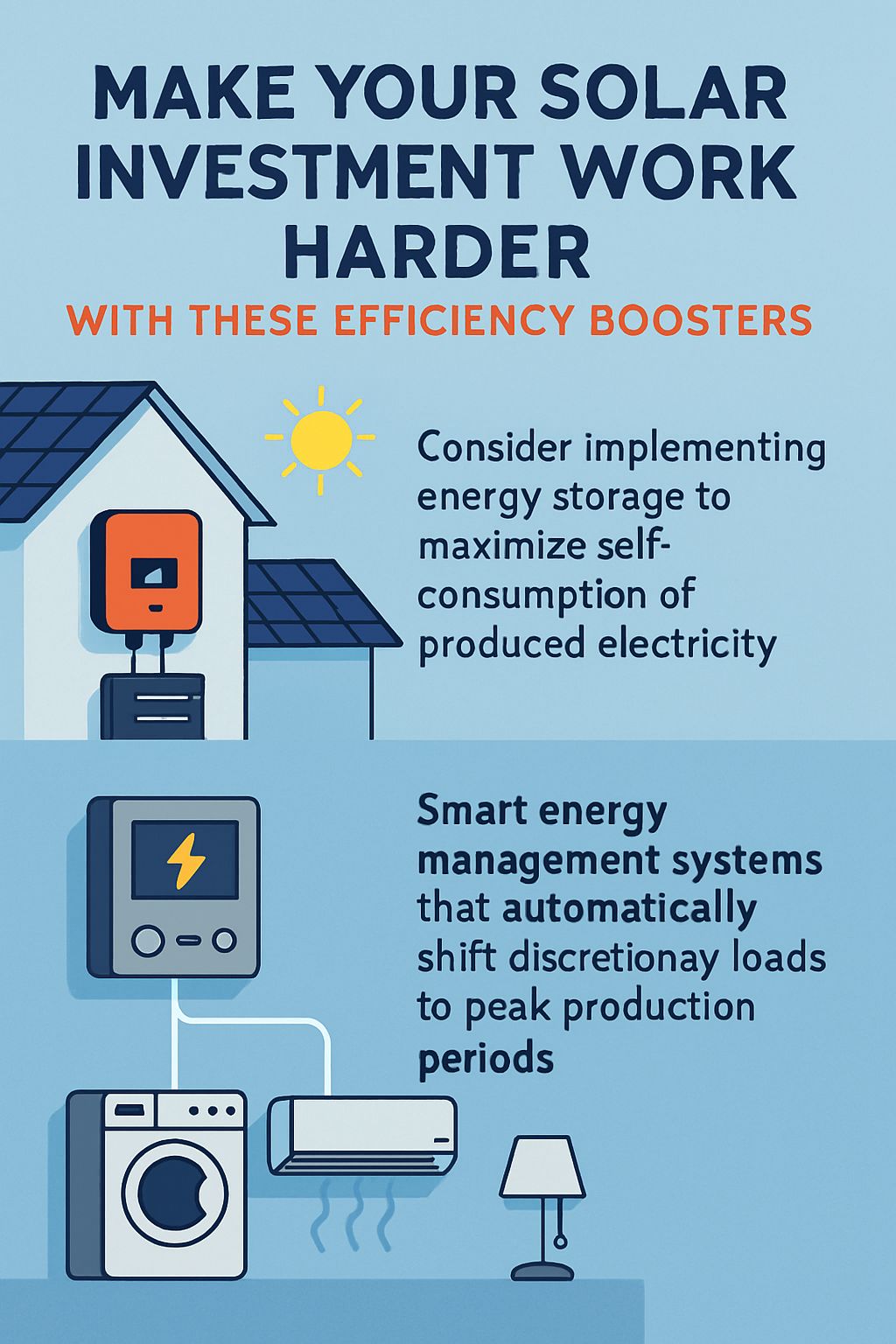
Make Your Solar Investment Work Harder with These Efficiency Boosters
Beyond the fundamental factors affecting solar performance, several advanced strategies can further enhance energy capture and system value. Consider implementing energy storage to maximize self-consumption of produced electricity, especially valuable for operations with significant evening energy needs or time-of-use utility rates. Smart energy management systems that automatically shift discretionary loads (water pumping, grain drying, etc.) to peak production periods can increase self-consumption by 15-30% without requiring battery storage, improving financial returns without significant additional investment. For more insights, explore the key factors that influence solar panel efficiency.
Frequently Asked Questions
Farm owners consistently raise specific questions when evaluating solar options for their operations. The following answers address the most common concerns with practical information tailored to agricultural applications rather than generic solar information. These insights come from working directly with hundreds of farm operations across diverse agricultural settings and climates.
How much maintenance do solar panels need on a working farm?
Agricultural solar installations typically require 2-4 cleaning sessions annually plus visual inspections after extreme weather events or major dust-generating farm activities. This minimal maintenance schedule translates to approximately 4-8 hours of labor per year for a typical 25-50kW system. The cleaning process involves primarily water application with soft brushes, ideally scheduled during early morning or evening hours to avoid thermal shock to panels from cold water applied to hot surfaces.
Can I install solar panels on existing farm buildings?
Most agricultural buildings constructed in the past 30 years can support solar panel installations with minimal structural modifications. The additional weight (2-4 lbs per square foot) typically falls within existing design tolerances, particularly for engineered structures. Older barns may require structural assessment and potential reinforcement, though the cost is usually modest compared to the overall system investment. Metal roofs common in agricultural settings offer ideal mounting conditions that minimize roof penetrations while providing excellent long-term durability.
What’s the payback period for a typical farm solar system?
Farm solar installations typically achieve payback periods of 5-9 years depending on local utility rates, available incentives, and specific farm energy usage patterns. Operations with high daytime electricity consumption generally see faster returns than those with primarily evening usage. The consistent, predictable nature of solar production provides valuable hedging against future utility rate increases, with each 1% annual utility rate increase accelerating payback by approximately 3-4 months. For more insights, explore how solar power can cut your farm’s electricity costs.
Many agricultural operations qualify for specialized USDA Rural Energy for America Program (REAP) grants covering up to 25% of project costs in addition to standard federal tax incentives, potentially reducing payback periods to 3-5 years in optimal scenarios. These agricultural-specific incentives significantly improve financial returns compared to residential or commercial installations.
Will solar panels work effectively in areas with frequent cloudy weather?
Modern solar technology performs surprisingly well in variable weather conditions, typically producing 10-25% of rated capacity even on heavily overcast days. Many farms in traditionally “cloudy” regions like the Pacific Northwest, Upper Midwest, and Northeast have successfully implemented solar with adjusted system sizing to compensate for reduced peak sunlight hours. The key is accurate system design based on location-specific solar resource data rather than generalized assumptions about regional weather patterns. For more insights, discover how solar power boosts farm efficiency.
Can I grow crops underneath ground-mounted solar panels?
Agrivoltaic systems that combine solar production with continued agricultural use underneath panels represent one of the most promising innovations in farm solar applications. Research consistently shows certain crops – particularly shade-tolerant vegetables, berries, and some forage crops – thrive in the partial shade created by elevated panel arrays. These dual-use systems maintain 70-95% of original agricultural productivity while adding energy production, effectively increasing per-acre revenue by 30-70%.
Livestock grazing, particularly with sheep, works exceptionally well with ground-mounted solar, as the animals naturally maintain vegetation while benefiting from partial shade during hot weather. This symbiotic relationship reduces or eliminates mechanical vegetation management costs while providing additional farm income, improving overall project economics.
For optimal compatibility, panels should be mounted at least 7-10 feet high with adequate spacing between rows to allow for sufficient light penetration and equipment access. While this configuration increases initial installation costs by 15-25%, the maintained agricultural productivity often justifies this premium through continued land productivity.
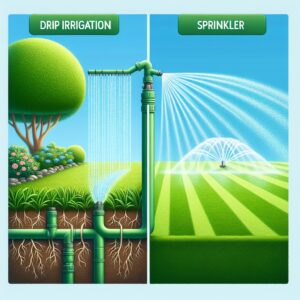
Solar panels have become an essential component for modern farmers looking to reduce energy costs and promote sustainability. By utilizing solar power, farmers can efficiently run various irrigation systems, including drip and sprinkler setups. In fact, cutting your farm’s electricity costs with solar power is one of the significant benefits that attract farmers to this renewable energy source. This technology not only helps in conserving energy but also in ensuring that farms remain productive and environmentally friendly.

Leave a Reply