
Key Takeaways
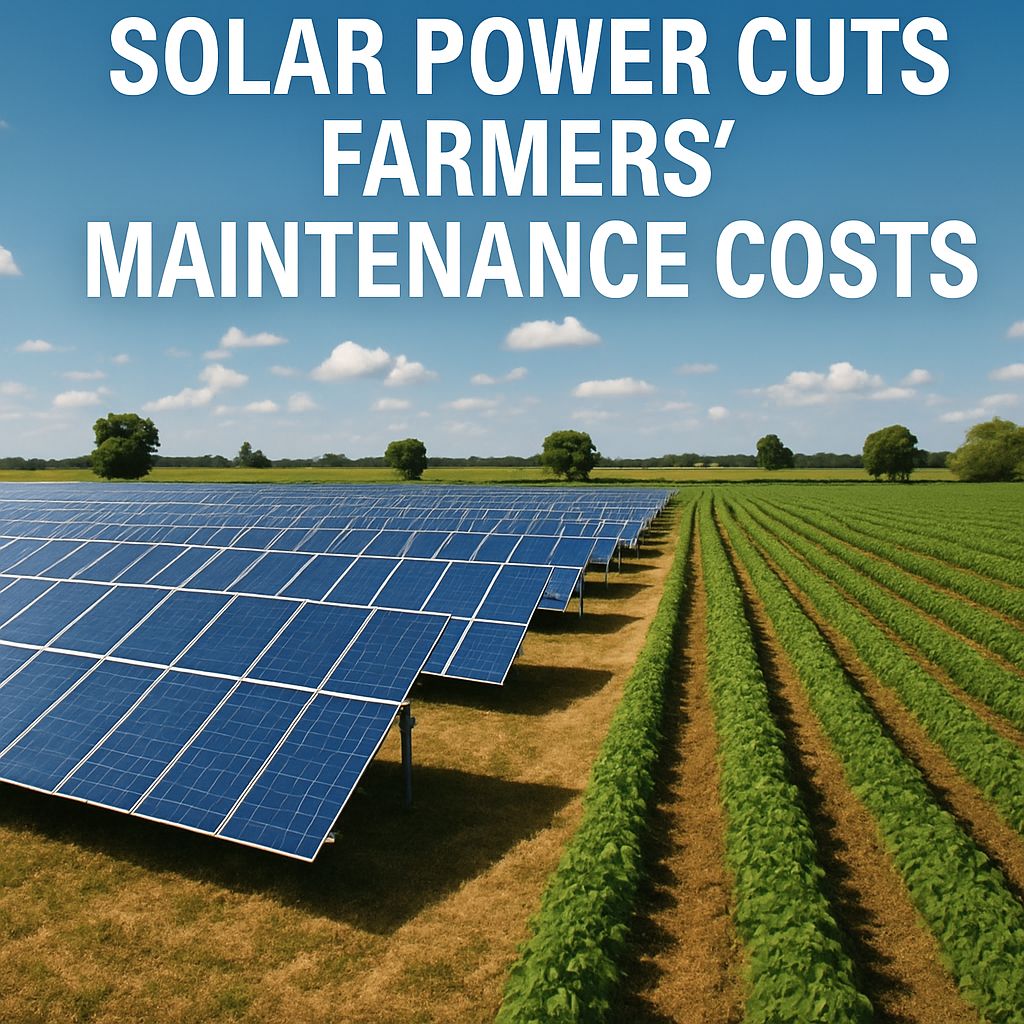
- Solar power systems can reduce farm maintenance costs by up to 70% compared to conventional energy sources
- Solar-powered equipment has fewer moving parts, resulting in significantly lower repair costs and less downtime
- Modern solar installations have decreased 82% in cost since 2010, making them increasingly affordable for agricultural operations
- Federal tax credits currently cover 30% of solar installation costs, with additional USDA grants available for farmers
- Properly maintained solar systems can operate efficiently for 25+ years, providing decades of predictable energy costs
Farming has always been a battle of margins. Today’s agricultural operations face unprecedented pressure from rising energy costs, unpredictable fuel prices, and the constant maintenance demands of conventional equipment. For many farmers, these expenses are eating away at already thin profits.
Solar power is transforming this financial landscape by dramatically reducing both immediate operating costs and long-term maintenance expenses. With installation costs dropping by over 80% in the last decade, solar has become a practical solution rather than a luxury alternative. Renewables Inc has found that farmers implementing solar solutions typically reduce their overall maintenance expenses by 60-70% within the first five years of operation.
Farmers Are Drowning in Rising Energy and Maintenance Costs
The traditional farming model relies heavily on fossil fuels and grid electricity—both increasingly expensive and volatile resources. Diesel-powered equipment requires frequent maintenance, with repair costs typically ranging from $2,000-$5,000 annually for mid-sized operations. Grid electricity rates continue to climb at approximately 2.5% per year, creating unpredictable operating budgets that make financial planning nearly impossible.
Maintenance schedules for conventional farm equipment are relentless and costly. Tractors need oil changes every 100-150 hours of operation. Irrigation pumps powered by diesel or grid electricity require professional servicing at least twice per growing season. When equipment inevitably breaks down, replacement parts and specialized technicians command premium prices—often when farmers can least afford delays.
Labor costs compound these challenges, as skilled maintenance workers become harder to find and more expensive to retain. Many farmers report spending 15-20 hours per week solely on equipment maintenance during peak seasons—time that could otherwise be devoted to productive farm management.
“I was spending over $8,000 yearly just maintaining my diesel irrigation pumps. After switching to solar, my maintenance costs dropped to less than $1,200 annually—mostly just routine panel cleaning and occasional system checks.” — James Harrington, 300-acre vegetable farm, California

How Solar Power Systems Slash Operating Expenses
The economics of solar power for agricultural applications creates multiple pathways to cost savings. Unlike conventional energy sources that require constant input costs (fuel, parts, labor), solar systems front-load expenses into the initial investment, then deliver decades of low-maintenance operation. This fundamental difference transforms how farms manage their operating budgets and maintenance schedules.
Zero Fuel Costs: The End of Diesel Dependencies
The most immediate benefit comes from eliminating fuel costs entirely. Diesel-powered irrigation pumps typically consume 2.5-4 gallons per hour, costing $10-$16 hourly at current prices. By contrast, solar-powered pumps harvest free energy from the sun, removing this expense completely from farm operating budgets. For operations running irrigation 8-12 hours daily during growing seasons, this represents savings between $20,000-$40,000 annually for mid-sized farms.
Fewer Moving Parts = Less Frequent Breakdowns
|
Equipment Type |
Moving Parts |
Annual Maintenance Hours |
Average Repair Costs |
|---|---|---|---|
|
Diesel Irrigation Pump |
200+ |
75-100 |
$2,500-$4,000 |
|
Solar Irrigation System |
3-5 |
10-15 |
$300-$600 |
|
Diesel Generator |
150+ |
60-80 |
$1,800-$3,200 |
|
Solar + Battery Storage |
0-2 |
5-10 |
$200-$400 |
Solar-powered equipment fundamentally changes the maintenance equation by dramatically reducing mechanical complexity. Conventional diesel engines contain hundreds of moving parts that wear, break, and require regular replacement. By contrast, solar-powered systems rely on solid-state electronics and simpler motors with minimal friction points. This structural advantage translates directly to fewer breakdowns, less frequent service intervals, and lower overall maintenance costs throughout the equipment lifecycle.
Predictable Energy Expenses for Better Financial Planning
Perhaps the most underrated benefit of solar for farm operations is cost predictability. With conventional energy, farmers face constantly fluctuating fuel prices and rising utility rates that make budgeting difficult. Solar power eliminates this uncertainty by providing consistent, predictable energy costs for 25+ years. This predictability allows for more accurate long-term financial planning, improved cash flow management, and better investment decisions across the entire operation.
The initial investment in solar pays dividends through maintenance savings that compound over time. While fossil fuel systems require increasing maintenance as they age, solar systems actually become more economically efficient with each passing year as the initial investment is spread across more operating hours. The result is a steadily decreasing cost-per-kilowatt-hour that conventional energy sources simply cannot match.
Real Savings Numbers: What Farmers Are Actually Keeping in Their Pockets
The financial impact of switching to solar power becomes most evident when examining real-world data from working farms. Across different agricultural sectors and farm sizes, the maintenance savings follow consistent patterns that make a compelling case for solar conversion. Let’s look at what farmers are actually experiencing in terms of maintenance cost reductions.
Average Annual Maintenance Costs: Traditional vs. Solar
|
Farm Type |
Size (Acres) |
Traditional Energy Maintenance |
Solar System Maintenance |
Annual Savings |
|---|---|---|---|---|
|
Dairy |
150-300 |
$12,500 |
$2,800 |
$9,700 |
|
Row Crops |
500-1,000 |
$18,200 |
$3,400 |
$14,800 |
|
Orchard |
75-150 |
$9,800 |
$1,900 |
$7,900 |
|
Livestock |
200-400 |
$15,300 |
$2,600 |
$12,700 |
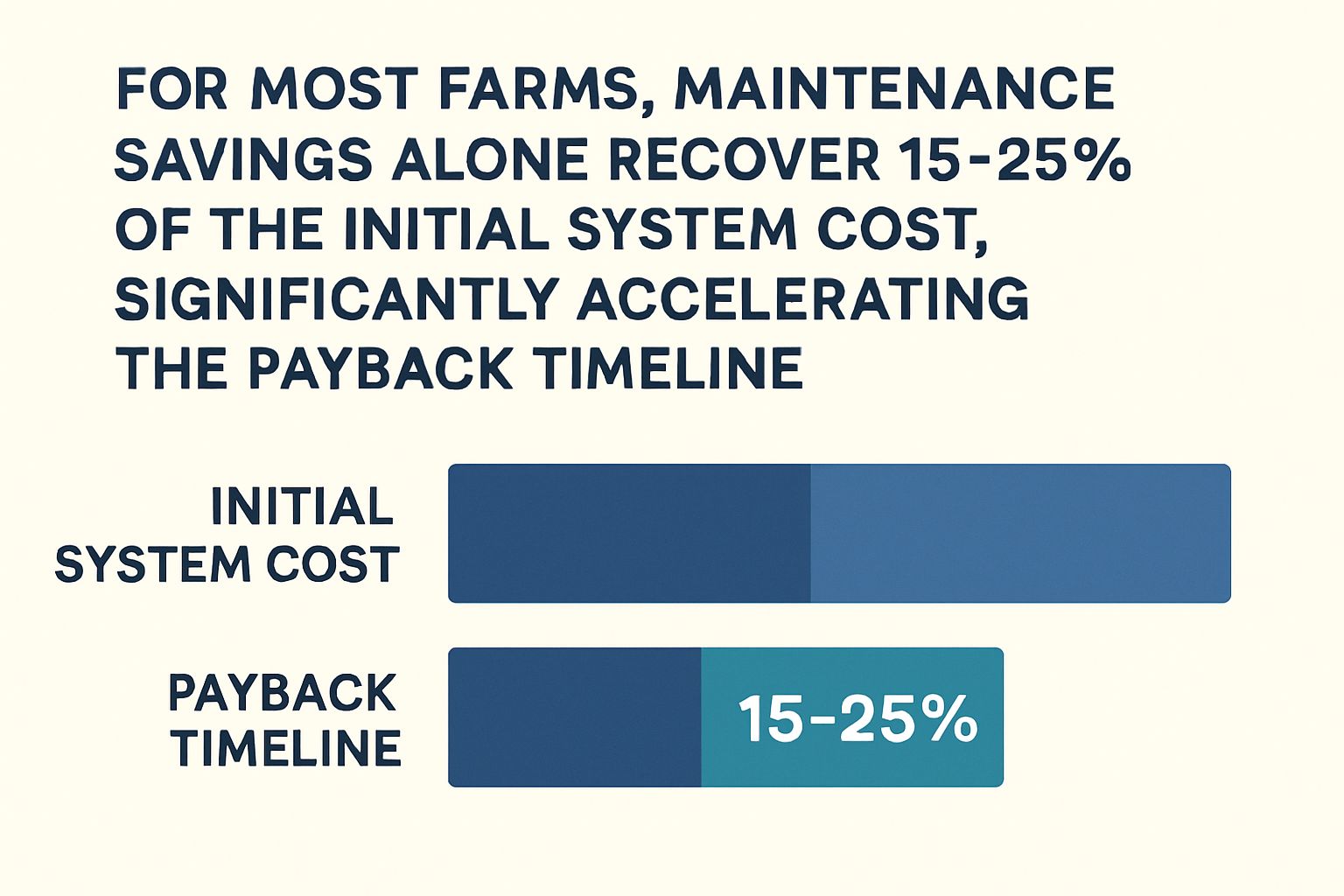
These figures represent typical maintenance expenses only, not including the actual energy costs, which provide additional savings. For most farms, maintenance savings alone can recover 15-25% of the initial solar investment, significantly accelerating the payback period.
Return on Investment Timeline for Different Farm Sizes
When factoring in both energy and maintenance savings, most agricultural solar installations reach complete return on investment in 5-8 years, with smaller operations typically falling at the longer end of that range. However, the maintenance savings component remains remarkably consistent across farm sizes, typically accounting for 30-40% of the total financial benefit.
For a mid-sized row crop operation of approximately 750 acres, the combined savings often reach $25,000-$35,000 annually. At this rate, even a substantial $180,000 solar installation reaches breakeven within 6 years, followed by decades of significantly reduced operating costs. What’s particularly compelling is that these systems continue to function at 80%+ efficiency even after 25 years, creating an extremely long-tail return on the initial investment.
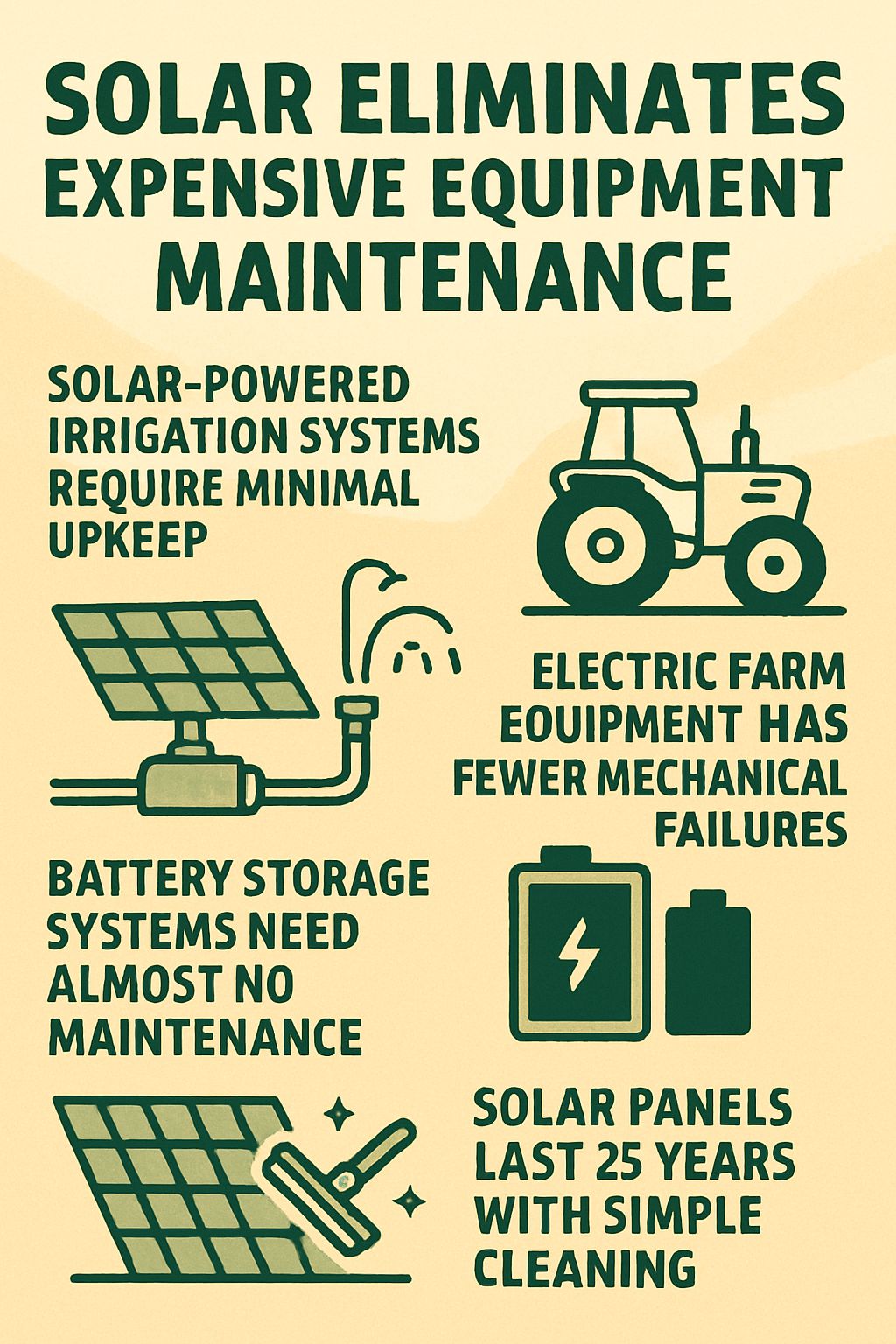
4 Ways Solar Eliminates Expensive Equipment Maintenance
The dramatic reduction in maintenance costs stems from the fundamental differences in how solar-powered agricultural equipment operates compared to conventional alternatives. These differences create multiple pathways to savings that compound over time.
1. Solar-Powered Irrigation Systems Require Minimal Upkeep
Conventional irrigation pumps powered by diesel engines require oil changes every 250 hours of operation, filter replacements every 500 hours, and major overhauls approximately every 2,000 hours. The annual maintenance cost typically ranges from $3,000-$5,000 for a medium-duty pump, not including emergency repairs or parts replacement.
By contrast, solar-powered irrigation systems eliminate the combustion engine entirely, replacing it with simple electric motors that have just one moving part. Annual maintenance typically involves checking electrical connections, occasional bearing lubrication, and ensuring solar panels remain clean. Total annual maintenance costs average just $300-$700, regardless of how many hours the system operates.
2. Electric Farm Equipment Has Fewer Mechanical Failures
“We switched our primary handling equipment to electric models charged by our solar array. In the first year alone, our repair costs dropped by 78%. There’s simply less that can go wrong without all those moving parts.” — Maria Rodriguez, 250-acre specialty vegetable farm, Arizona
The maintenance advantage extends beyond just irrigation to all types of farm equipment. Electric tractors and utility vehicles powered by solar-charged batteries eliminate countless failure points: no oil changes, no transmission fluid, no fuel filters, no exhaust systems, and dramatically simpler cooling systems. Electric motors typically have just one moving part compared to hundreds in internal combustion engines.
This simplicity translates directly to fewer breakdowns and less frequent service intervals. Most electric farm equipment requires only quarterly maintenance checks rather than the biweekly or monthly service schedule typical of diesel equipment. For many farms, this means reducing annual maintenance hours from 200+ to less than 40 across their equipment fleet. Discover how solar power benefits farmers by improving operations and efficiency.
The labor savings alone can be substantial, especially during critical planting and harvest seasons when equipment downtime is most damaging. Many farmers report that their solar-electric equipment fleets operate with 95%+ uptime compared to 80-85% for conventional equipment.
3. Battery Storage Systems Need Almost No Maintenance
Modern lithium-ion battery storage systems paired with solar installations require virtually no regular maintenance beyond occasional monitoring. Unlike diesel generators that demand constant attention, battery systems can operate for 10+ years with only annual professional inspections. This represents another significant area of maintenance cost reduction, especially for farms in areas with unreliable grid power that previously relied on backup generators.
4. Solar Panels Last 25+ Years with Simple Cleaning
The solar panels themselves are remarkably durable and maintenance-free. Quality solar installations can operate efficiently for 25+ years with only basic cleaning 2-4 times annually to remove dust and debris. This cleaning can often be accomplished by farm staff using simple equipment rather than requiring specialized technicians. Learn more about solar power benefits for farmers and how it can improve operations efficiency.
In agricultural settings, this cleaning typically costs $200-$400 annually for a medium-sized system—a fraction of what farms spend maintaining conventional power equipment. The panels have no moving parts to wear out, and modern systems include monitoring technology that automatically alerts owners to any performance issues, eliminating the need for regular manual inspections.
Government Incentives That Make Solar Even More Affordable
The already compelling maintenance savings from solar power become even more attractive when combined with substantial government incentives designed specifically for agricultural applications. These programs dramatically reduce the initial investment required, accelerating the timeline to profitability.
The financial assistance available comes through multiple channels, with federal, state, and local programs often stackable to maximize savings. Smart farmers leverage these opportunities to transform their energy infrastructure while minimizing out-of-pocket expenses.
Federal Tax Credits Cut Installation Costs by 30%
The federal Investment Tax Credit (ITC) remains one of the most significant incentives, currently offering a 30% tax credit on the total cost of solar installations. For a $100,000 farm solar system, this translates to $30,000 in direct tax savings—not a deduction, but a dollar-for-dollar reduction in tax liability. This credit can be carried forward for up to 20 years if it exceeds your tax liability in the year of installation.
For farms operating as pass-through entities like LLCs or S-corporations, this credit flows directly to owners’ personal tax returns. C-corporations can claim the credit directly on corporate returns. The current 30% rate is guaranteed through 2032, after which it will gradually step down, creating a compelling case for earlier adoption. For farmers interested in sustainable practices, center pivot irrigation powered by solar panels can also be a cost-effective solution.
Beyond the ITC, accelerated depreciation options like bonus depreciation and Modified Accelerated Cost Recovery System (MACRS) allow for rapid write-off of the remaining system cost, further enhancing tax benefits in early years of ownership. These combined tax incentives typically recover 45-55% of the total system cost within the first five years. For more insights on how solar power can benefit your operations, explore the solar power benefits for farmers.
USDA REAP Grants Can Cover Up to 25% of System Costs
The USDA’s Rural Energy for America Program (REAP) offers both grants and loan guarantees specifically designed for agricultural producers. These grants can cover up to 25% of total project costs, with maximum awards reaching $500,000 for renewable energy systems. Unlike tax credits that require tax liability to utilize, REAP grants provide direct cash assistance that reduces your initial out-of-pocket expense immediately.
Competition for REAP grants is strong, but farms with well-planned solar projects demonstrating clear energy savings and maintenance cost reductions typically score well in the selection process. Applications require detailed energy audits and financial projections, but this preparation pays dividends through substantially reduced project costs. Working with an experienced agricultural solar provider familiar with the REAP application process significantly increases approval chances.
State-Specific Agricultural Solar Programs
Beyond federal incentives, many states offer additional programs targeting agricultural solar adoption. These range from property tax exemptions for solar equipment to specialized rebate programs and performance-based incentives. In agricultural powerhouse states like California, Iowa, and Minnesota, these programs can reduce costs by an additional 10-20%, compounding the federal incentives.
Some state programs specifically target maintenance cost reduction through equipment modernization initiatives. For example, California’s Dairy Digester Research and Development Program provides grants for converting manure management systems to renewable energy production, directly addressing one of the highest maintenance cost centers on dairy farms.
Choosing the Right Solar System for Your Farm
Maximizing maintenance savings requires selecting the appropriate solar configuration for your specific agricultural operation. The right system matches your energy needs, physical farm layout, and long-term operational goals. Making informed choices at the design stage pays dividends through decades of reduced maintenance and operating costs. For more information on improving operational efficiency, explore the benefits of solar power for farmers.
Calculate Your Farm’s Energy Needs
The foundation of an effective farm solar system is accurate energy assessment. Most agricultural operations have highly seasonal energy demands, with irrigation, cooling, and processing equipment creating significant peaks during growing and harvest seasons. A properly sized system must balance these peak demands against annual production averages to avoid both underproduction and expensive overbuilding.
Start by collecting 12-24 months of utility bills to establish your consumption baseline. Next, inventory all major equipment with its power requirements and typical operating hours. This data allows for precise system sizing that matches your actual needs rather than relying on generic formulas. Right-sizing eliminates both wasted capacity and undersized systems that fail to deliver expected savings. For instance, integrating solar panels with sprinkler irrigation systems can enhance efficiency and reduce costs.
“Our initial solar quote was for a system twice the size we actually needed. By carefully analyzing our operation’s true energy consumption patterns, we cut our installation costs nearly in half while still meeting 95% of our electricity needs.” — Thomas Wilson, 180-acre diversified farm, Oregon
Ground-Mount vs. Rooftop: Which Works Better for Farms?
The physical mounting system significantly impacts both initial installation costs and long-term maintenance requirements. For most agricultural operations, ground-mounted systems offer superior maintenance economics despite slightly higher initial costs. Ground mounts provide easier access for cleaning and inspection, better airflow for cooling (which improves efficiency and lifespan), and simpler expansion options as energy needs grow.
Rooftop installations on existing agricultural buildings can make sense when land constraints exist or when buildings have ideal sun exposure and structural capacity. However, they typically have higher maintenance costs due to access challenges and reduced cooling efficiency. For maintenance cost optimization, ground-mounted systems typically reduce annual maintenance expenses by 15-25% compared to roof mounts.
Grid-Tied vs. Off-Grid Solutions
The decision between remaining connected to the utility grid or going completely independent has major implications for both system design and maintenance requirements. Grid-tied systems generally offer the best combination of lower initial investment and reduced maintenance costs for most farm operations. They eliminate the need for extensive battery storage, reducing both upfront costs and ongoing maintenance while still providing substantial energy independence.
What Solar Panels to Use Farmers Should Use to power the Farm
Panel selection significantly impacts both performance and long-term maintenance requirements. Agricultural applications face unique challenges including dust exposure, potential equipment impact, and exposure to agricultural chemicals. The right panel technology balances initial cost, efficiency, durability, and maintenance requirements.
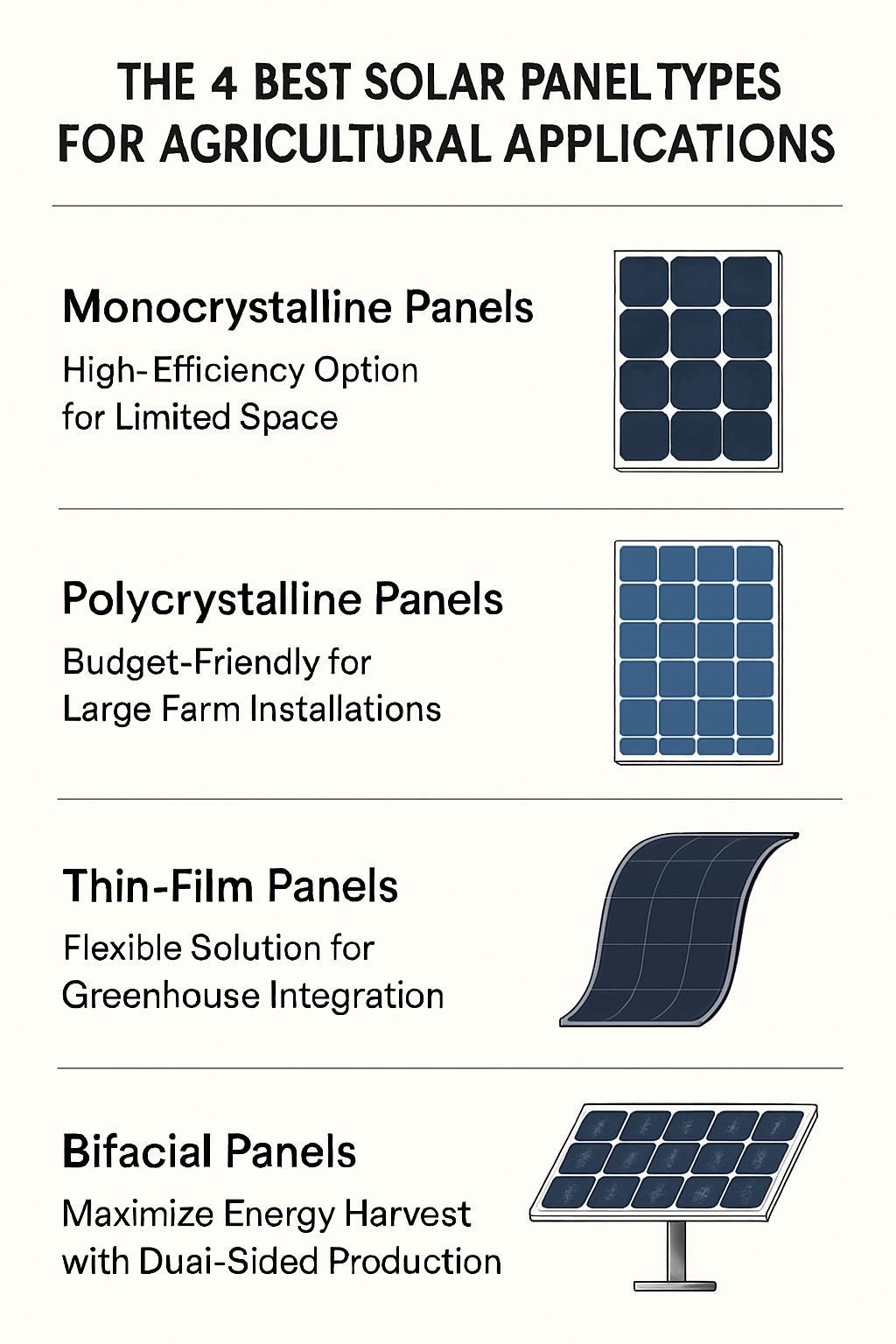
Here is a comparison table of the four best solar panel types for agricultural use — focusing on features, efficiency, and suitability for farms.
|
Solar Panel Type |
Efficiency Range |
Cost per Watt (Approx.) |
Key Advantages for Agriculture |
Limitations |
Best Farm Applications |
|---|---|---|---|---|---|
|
Monocrystalline Panels |
17–22% 1 |
$0.90–$1.50 2 |
High efficiency, compact design, long lifespan, performs well in all climates |
Higher upfront cost |
Space-limited farms, rooftops, and irrigation systems 1 |
|
Polycrystalline Panels |
13–17% 3 |
$0.70–$1.00 3 |
Lower cost, durable, long lifespan, strong in direct sunlight |
Requires more space, less efficient in cloudy conditions | |
|
Thin-Film Panels |
10–13% 5 |
$0.50–$0.90 2 |
Lightweight, flexible, better low-light/shaded performance |
Lower efficiency, shorter lifespan |
Greenhouses, barns, shaded or irregular terrain 5 |
|
Bifacial Panels |
18–22% 6 |
$1.00–$1.60 6 |
Captures light from both sides, high energy yield, great for reflective surfaces like grass or soil |
Higher cost, more complex installation |
Agrivoltaics (dual-use with crops), open-field installations 6 |
These four types of solar panels represent the most effective options for agricultural operations, allowing farmers to select between high efficiency (monocrystalline, bifacial) and lower-cost scalability (polycrystalline, thin-film) depending on land availability, sunlight exposure, and budget.
Farms in high-dust environments like grain or livestock operations should prioritize panels with self-cleaning glass technologies and durable construction. These features may increase initial costs slightly but substantially reduce the frequency and expense of cleaning maintenance over the system lifetime.
Panel warranties have significant implications for lifetime maintenance costs. Premium panels typically offer 25-30 year production guarantees with degradation rates below 0.5% annually, ensuring predictable output with minimal maintenance intervention. The additional upfront cost for higher-quality panels typically pays for itself through reduced maintenance and replacement expenses within 7-10 years.
Mounting hardware quality also substantially impacts maintenance costs. Agricultural environments expose solar equipment to wind, dust, and sometimes chemical drift from spraying operations. Industrial-grade mounting systems with galvanized or stainless steel components might cost 15-20% more initially but can reduce maintenance costs by 30-40% over the system lifetime.
• Monocrystalline Panels: High-Efficiency Option for Limited Space
Monocrystalline panels offer the highest efficiency ratings commercially available, converting up to 22% of solar energy into electricity. This efficiency comes with a higher price tag but requires less physical space to generate the same amount of power as lower-efficiency options. For farms with limited installation area or high energy demands, these panels maximize production per square foot.
From a maintenance perspective, monocrystalline panels typically feature high-quality construction and materials that resist degradation from environmental exposure. This translates to less frequent replacement and consistent performance throughout their 25+ year lifespan. The higher initial investment typically results in lower lifetime maintenance costs per kilowatt-hour produced. For more insights on how solar energy reduces operational costs in farming, visit this resource.
• Polycrystalline Panels: Budget-Friendly for Large Farm Installations
Polycrystalline technology offers a more economical entry point for farms with adequate installation space. While slightly less efficient than monocrystalline (typically 13-17%), these panels provide excellent value for large ground-mounted installations where space constraints are minimal. The 10-15% cost savings on initial installation allows for faster payback and greater total capacity within the same budget. For farmers interested in integrating solar solutions with irrigation, center pivot irrigation powered by solar panels can further enhance efficiency and reduce costs.
Modern polycrystalline panels now match monocrystalline options in durability and degradation rates, closing the historical gap in long-term performance. For maintenance considerations, these panels require the same basic cleaning regimen but generally cost less to replace if damaged, making them ideal for installations in working farm environments where equipment traffic or activities might occasionally impact the array.
• Thin-Film Panels: Flexible Solution for Greenhouse Integration
Thin-film technology shines in specialized agricultural applications like greenhouse integration, barn roofing, or situations requiring flexible or lightweight mounting. While less efficient per square foot, these panels excel in partial shading conditions and maintain better output during high-temperature operations. Their flexibility also allows for creative installations that conventional rigid panels cannot accommodate.
• Bifacial Panels: Maximize Energy Harvest with Dual-Sided Production
Bifacial panels represent the cutting edge for farm solar applications with high production requirements. By capturing reflected light from the ground on their undersides, these panels can generate 5-30% more electricity than traditional one-sided models, depending on ground reflectivity and mounting height. This dual-production capability makes them particularly effective in snowy regions (where winter ground reflection is high) and when mounted above light-colored surfaces or even productive cropland.
Smart Ways to Finance Your Solar Transition
The dramatic maintenance savings from solar power become even more compelling when paired with intelligent financing strategies that minimize initial cash outlay. Most agricultural operations can leverage several financing options simultaneously to optimize both short-term cash flow and long-term ownership benefits.
The key financing principle for maximum benefit is matching the financing term to the expected system lifespan. Unlike tractors or other equipment that depreciate rapidly, solar installations maintain their value and production capacity for decades, justifying longer financing terms with lower monthly payments. This approach often allows the energy and maintenance savings to exceed the monthly financing costs from the first month of operation. For more information on how solar energy reduces operational costs in farming, visit this resource.
For multi-generational family farms, solar investments represent particularly good value. The 25+ year production lifespan means the system continues generating savings long after the financing term ends, creating lasting economic benefits for future farm operators.
“We financed our 75kW system through a combination of USDA-backed loans and on-bill utility financing. Our monthly payment is $320 less than what we were spending on electricity and diesel maintenance combined. After the 12-year loan term, we’ll essentially have free power for another 15+ years.” — Robert Johnson, 220-acre dairy farm, Wisconsin
Agricultural Loans with Favorable Terms
Farm-specific lending programs often offer the most favorable terms for solar investments. USDA-guaranteed loan programs provide interest rate reductions of 1-2% compared to conventional financing, along with extended terms of up to 30 years for renewable energy projects. These programs typically require detailed business plans demonstrating how maintenance and energy savings will support the loan payments, but this preparation ultimately strengthens project outcomes.
Power Purchase Agreements: No Upfront Costs
For farms prioritizing immediate cash flow benefits without capital investment, Power Purchase Agreements (PPAs) offer an attractive alternative. Under this model, a third-party company installs, owns, and maintains the solar system on your property at no cost to you. You simply purchase the electricity produced at a predetermined rate typically 10-25% below your current utility rates.
The maintenance advantage is particularly compelling with PPAs since the system owner assumes all responsibility for repairs, monitoring, and optimization. This arrangement eliminates maintenance costs entirely while still delivering substantial energy savings. After a typical term of 15-25 years, many PPAs include options to purchase the system at significantly reduced cost or extend the agreement with updated terms. For more information on how solar energy reduces operational costs, check out this article on solar energy in farming.
|
Financing Method |
Initial Cost |
Maintenance Responsibility |
Long-Term Ownership |
Typical Savings |
|---|---|---|---|---|
|
Cash Purchase |
High |
Farm |
Immediate |
30-40% |
|
Agricultural Loan |
Low-Moderate |
Farm |
After term |
20-35% |
|
Power Purchase Agreement |
None |
Provider |
Optional purchase |
10-25% |
|
Equipment Lease |
Very Low |
Varies |
Optional purchase |
15-30% |
The ideal financing approach often combines multiple methods. Many successful installations use USDA grants to reduce initial costs, tax incentives to generate early-year cash flow, and favorable agricultural loans to finance the remaining balance. This hybrid approach maximizes both immediate benefits and long-term ownership value.
Equipment Leasing Options
- Operating Leases: Treat solar as an off-balance-sheet expense with fixed monthly payments, often lower than current utility bills.
- Capital Leases: Function similarly to loans but may offer tax advantages for certain farm operations.
- Lease-to-Own: Start with lower payments that build equity toward eventual ownership.
- Performance-Based Leasing: Payments tied directly to system production, aligning costs with benefits.
Leasing arrangements vary widely in their maintenance provisions. Some include comprehensive maintenance packages that eliminate all service responsibilities for the farm operation. Others place basic maintenance like panel cleaning with the farm while covering major repairs and system monitoring. These differences significantly impact the total cost of ownership and should be carefully evaluated during the decision process.
The economic advantage of solar adoption increases substantially when maintenance savings are properly factored into financial projections. While energy cost reduction often receives more attention, the elimination of ongoing maintenance expenses frequently represents 30-40% of the total financial benefit over the system lifetime.
When comparing financing options, request comprehensive projections that include both energy and maintenance savings. The most attractive option isn’t always the one with the lowest monthly payment, but rather the one that maximizes total lifetime savings while matching your farm’s cash flow requirements and tax situation.
Conclusion: Does the Savings in Maintenance Costs Make Solar Panels a Good Investment for Farmers
The financial case for solar power in agricultural settings becomes compelling when maintenance savings are properly accounted for. While energy cost reduction typically drives initial interest, the elimination of ongoing maintenance expenses often represents the difference between a good investment and an exceptional one. For most farms, maintenance savings alone recover 15-25% of the initial system cost, significantly accelerating the payback timeline.
Beyond the direct financial benefits, solar power delivers operational advantages that further strengthen its value proposition. Reduced downtime during critical seasons, simplified maintenance scheduling, and decreased reliance on specialized repair technicians all contribute to smoother farm operations. These benefits often prove as valuable as the direct cost savings, particularly during high-demand periods when equipment reliability is paramount.
“We used to budget $15,000 annually just for equipment maintenance. After converting to solar for irrigation, grain drying, and barn operations, we’ve reduced that to under $4,000. The system paid for itself in just over 5 years, and we’re looking at another 20+ years of these savings.” — Michael Anderson, 850-acre grain farm, Illinois
The solar revolution in agriculture represents more than just an alternative energy source—it fundamentally transforms the economics of farm operations by eliminating unpredictable and escalating maintenance costs. As equipment reliability increases and maintenance requirements decrease, farms gain both financial stability and operational flexibility that enhance overall profitability. For example, center pivot irrigation powered by solar panels can significantly cut costs and raise yields.
For forward-thinking agricultural operations, the question is no longer whether solar makes financial sense, but rather how to optimize system design and financing to maximize both short-term cash flow and long-term value. With proper planning and implementation, solar power delivers decades of reduced operating costs, simplified maintenance requirements, and enhanced farm resilience.
Frequently Asked Questions
As farmers consider transitioning to solar power, several common questions arise about the practical implications for farm operations and maintenance requirements. These answers reflect real-world experience from agricultural operations that have successfully implemented solar solutions.
Understanding these practical considerations helps farms develop realistic expectations and proper planning for their solar transitions. While each agricultural operation faces unique circumstances, these general guidelines apply across most farming contexts. For more insights on how solar energy can enhance farming, explore the benefits of solar power for farmers.
How much can I really save on maintenance with solar power?
Most farms experience maintenance cost reductions between 60-80% after transitioning to solar power. For a typical 500-acre operation, this translates to annual savings of $8,000-$15,000 depending on previous equipment types and operating patterns. These savings remain relatively consistent regardless of farm size, as maintenance requirements scale proportionally with system capacity.
Will solar panels work during cloudy weather or winter months?
Modern solar panels continue producing electricity during cloudy weather, typically generating 10-25% of their rated capacity depending on cloud density. Winter production varies by location but generally reaches 40-60% of summer output in northern regions and 70-80% in southern areas. Properly designed agricultural systems account for these seasonal variations by slightly oversizing capacity or incorporating minimal storage to ensure consistent operation year-round.
How long does a typical farm solar system take to pay for itself?
When accounting for both energy and maintenance savings, most agricultural solar installations reach breakeven in 5-8 years. Factors influencing this timeline include state incentives, farm energy usage patterns, and previous maintenance expenses. Larger operations with high energy demands typically see faster payback periods, often reaching breakeven in 4-6 years due to economies of scale in both installation and ongoing maintenance.
Can I power my entire farm operation with solar energy?
Most farms can achieve 70-100% energy independence through appropriately sized solar systems. Operations with consistent energy demands like dairy farms or those with cold storage facilities typically require larger systems or battery storage to reach full independence. Row crop operations with seasonal irrigation demands often achieve complete independence during growing seasons with properly designed systems.
The economic sweet spot for most agricultural operations is 80-90% energy offset, which minimizes system size while still eliminating the vast majority of utility costs. This approach typically delivers the optimal balance between initial investment and long-term savings for both energy and maintenance expenses.
What kind of maintenance do solar systems require?
Solar systems require minimal maintenance compared to conventional farm equipment. Routine maintenance typically includes panel cleaning 2-4 times annually (more in very dusty operations), visual inspection of wiring and mounting hardware once or twice yearly, and monitoring system production through automated software. Most farms handle basic maintenance in-house with existing staff, contracting only for specialized electrical work when needed. For more information on integrating solar panels with farm systems, you can explore efficient farm operations.
For optimal performance, professional inspection every 3-5 years is recommended to check electrical connections, inverter function, and mounting stability. These inspections typically cost $300-$600 depending on system size and complexity—a fraction of the maintenance costs for conventional power equipment. Many solar installers offer maintenance packages that include these services along with production monitoring and performance guarantees.
By dramatically reducing maintenance requirements and associated costs, solar power transforms farm economics while contributing to agricultural sustainability. Renewables Inc helps farmers implement custom solar solutions that maximize both energy production and maintenance savings for decades of reliable, low-cost operation.







Leave a Reply