
Key Takeaways
- Solar-powered linear move irrigation systems can reduce operational costs by up to 70% compared to conventional fossil fuel-powered systems while providing reliable water distribution.
- These systems are ideal for rectangular fields, specialty crops, and farms in areas with high electricity costs or limited grid access.
- Initial investment ranges from $50,000-150,000 depending on field size, but can achieve payback periods of 3-7 years through energy savings.
- Modern solar irrigation systems integrate smart technology for precision agriculture, maximizing water efficiency and improving crop yields.
- Battery storage solutions have solved the historical limitations of solar power, enabling reliable irrigation during cloudy periods and nighttime hours.
The agricultural landscape is evolving rapidly, and with climate change intensifying water scarcity and energy costs climbing, farmers are seeking smarter irrigation solutions. Solar-powered linear move irrigation systems represent one of the most significant advancements in modern farming technology, offering a sustainable approach to one of agriculture’s most resource-intensive necessities.
Traditional irrigation methods have sustained farming for generations, but today’s agricultural challenges demand innovation that addresses multiple pain points simultaneously. The perfect balance of efficiency, sustainability, and cost-effectiveness has proven elusive—until now. Solar-powered linear move systems are changing the game for forward-thinking farmers.
Why Traditional Irrigation Falls Short for Modern Farmers
Conventional irrigation systems have served agriculture well, but their limitations become increasingly apparent in our changing world. Traditional diesel or electric-powered irrigation systems create significant operational costs that eat into farm profitability. Many farmers report spending 15-30% of their operational budget on energy costs alone, with irrigation representing the largest portion of that expense.
Grid-dependent irrigation systems leave farmers vulnerable to power outages and price fluctuations. During peak growing seasons, when irrigation is most crucial, power grids in agricultural areas often experience strain, leading to unreliable service exactly when farmers need it most. Weather patterns have become less predictable, creating additional challenges for scheduling efficient watering cycles with conventional systems.
- Energy costs for conventional irrigation systems typically range from $70-$150 per acre annually
- Traditional systems often waste 30-50% of water through evaporation, runoff, or improper distribution
- Maintenance costs for fuel-powered pumps average $3,000-5,000 annually for a mid-sized operation
- Carbon emissions from diesel-powered irrigation contribute significantly to a farm’s environmental footprint
Environmental considerations have moved from peripheral concerns to central decision factors for many agricultural operations. With consumers and regulations increasingly focused on sustainability metrics, irrigation systems that rely heavily on fossil fuels create both environmental and market disadvantages for modern farms. The limitations of traditional approaches have created a perfect opportunity for solar innovation to transform irrigation practices.
Solar-Powered Linear Move Systems: The Game-Changer for Farm Irrigation
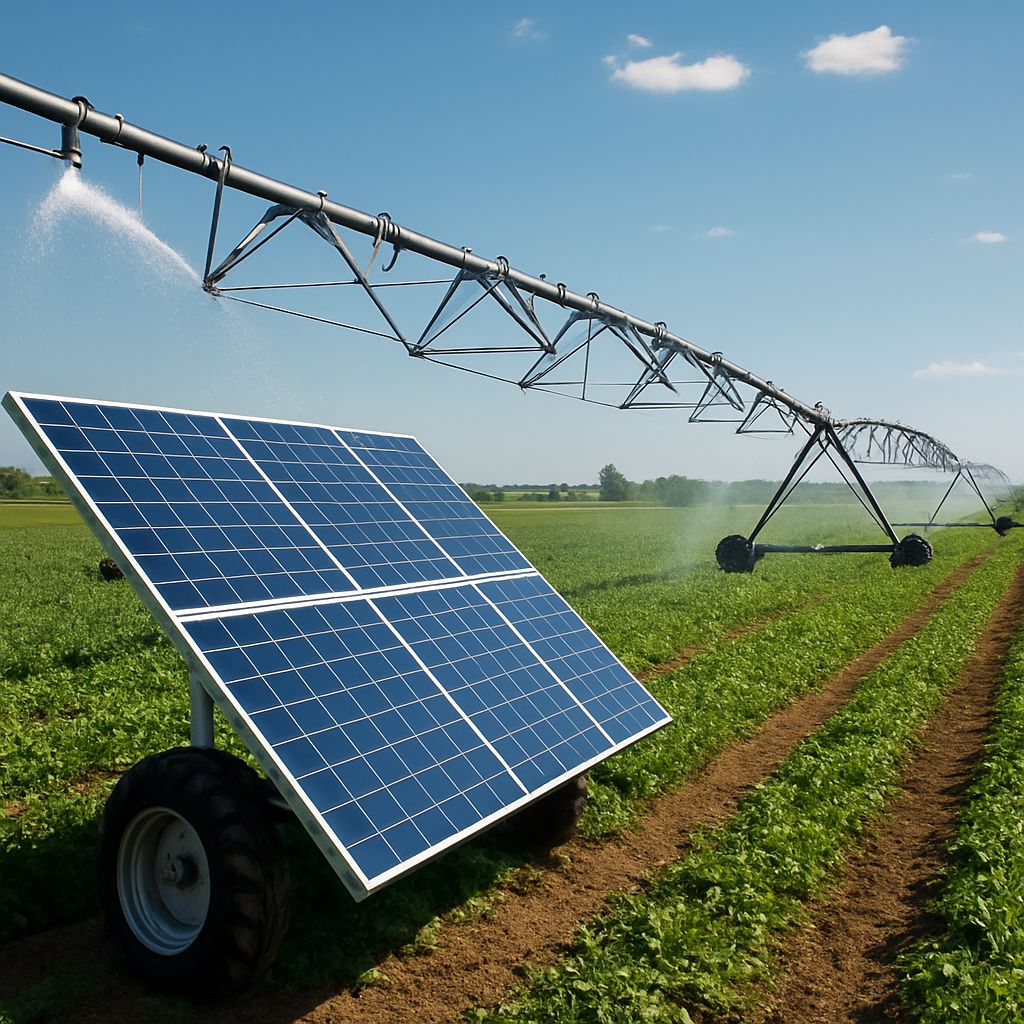
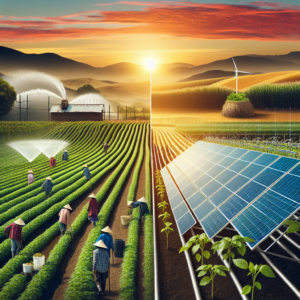
Solar-powered linear move irrigation systems represent a fundamental shift in agricultural water management. By harnessing the sun’s energy to power precision water distribution equipment, these systems address multiple challenges simultaneously: reducing operational costs, increasing water efficiency, minimizing environmental impact, and improving reliability. The technology combines proven irrigation mechanics with clean energy innovation to create a solution tailored to contemporary farming needs.
What is a Linear Move Irrigation System
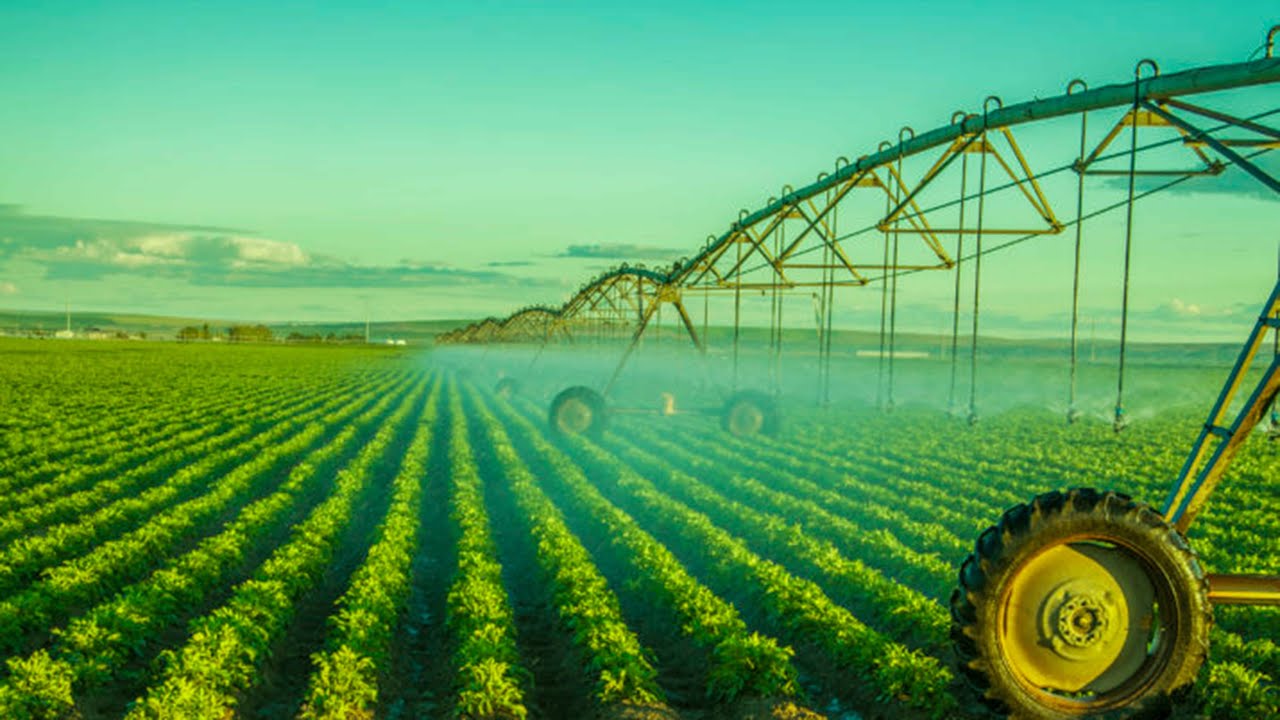
A linear move irrigation system, sometimes called a lateral move system, consists of a series of sprinklers mounted on wheeled towers that move in a straight line across rectangular or square fields. Unlike center pivot systems that rotate around a fixed point, linear systems travel from one end of a field to the other, providing exceptionally uniform water distribution. This design makes them ideal for rectangular fields where center pivot systems would leave corners unirrigated. The system typically includes a central control panel, drive mechanisms, sprinkler packages, and guidance systems to ensure straight movement across the field. For more information on different solar-powered irrigation systems, check out this detailed guide.
How Does Solar Power Work on a Farm
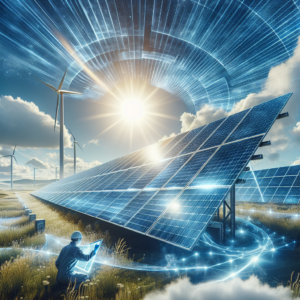
Agricultural solar power systems convert sunlight into electricity through photovoltaic (PV) panels that generate direct current (DC) electricity when exposed to sunlight. This electricity is then converted to alternating current (AC) through inverters if needed for certain equipment, or used directly as DC power for compatible irrigation components. Modern agricultural solar systems include battery storage that captures excess energy during peak sunlight hours and releases it during cloudy periods or nighttime, ensuring consistent power availability. The entire system is managed by smart controllers that optimize energy production, storage, and consumption based on irrigation schedules and weather conditions.
How These Systems Work Together in the Field
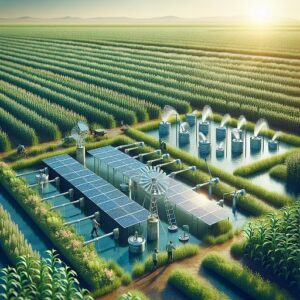
The integration of solar power with linear move irrigation creates a self-contained system that operates independently from the power grid. Solar panels are typically mounted directly on the irrigation equipment or installed nearby in a dedicated array, depending on the system size and power requirements. The electricity generated powers the drive motors that move the system across the field, the pumps that maintain proper water pressure, and the control systems that manage precise application rates. Advanced systems include weather monitoring stations and soil moisture sensors that automatically adjust watering schedules based on real-time conditions, maximizing both energy and water efficiency.
Key Components That Make the System Efficient
The efficiency of solar-powered linear move irrigation systems stems from several critical components working in harmony. High-efficiency solar panels, typically monocrystalline or polycrystalline, convert sunlight with 20-25% efficiency rates. Modern lithium-ion or flow batteries store excess power for continuous operation. Variable frequency drives adjust power consumption based on actual needs, while precision sprinkler packages with pressure regulators ensure uniform water application regardless of field topography. For more details, you can explore this guide on solar-powered linear move irrigation systems.
Smart controllers serve as the system’s brain, integrating weather data, soil moisture readings, and crop water requirements to optimize irrigation scheduling. These controllers can reduce water usage by 30-40% compared to timer-based systems by delivering water only when and where crops need it. The entire system is designed for durability in agricultural environments, with components rated for exposure to dust, moisture, and temperature fluctuations typical in farming operations.
Comparing to Center Pivot and Other Irrigation Methods
When evaluating irrigation options, linear move systems offer distinct advantages over other methods for certain field configurations. Unlike center pivot systems that leave corner areas unirrigated in square fields, linear systems can achieve nearly 100% field coverage on rectangular plots. This maximizes productive acreage and provides more uniform crop development. The even water distribution of linear systems results in 15-25% greater water use efficiency compared to flood irrigation and 5-10% better than poorly maintained center pivots.
Irrigation Method Comparison
Linear Move Systems: 85-95% water application efficiency, 100% field coverage for rectangular fields, medium-high initial cost
Center Pivot: 80-90% water application efficiency, 78-80% field coverage for square fields (without corner arms), medium initial cost
Drip Irrigation: 90-95% water application efficiency, excellent for row crops, high initial cost, high maintenance
Flood Irrigation: 40-65% water application efficiency, low initial cost, high labor requirements, poor uniformity
The operational flexibility of solar-powered linear systems exceeds that of conventional irrigation. With independent power sources, farmers can irrigate during optimal biological windows rather than scheduling around off-peak electricity rates. This capability can improve crop response to irrigation by timing water application to coincide with critical growth stages, potentially increasing yields by 7-12% compared to less precisely timed irrigation schedules.
5 Best Applications for Solar Linear Move Systems
While solar-powered linear move systems offer numerous benefits, they shine particularly bright in specific agricultural scenarios. Understanding where these systems deliver maximum value helps farmers make informed investment decisions based on their unique circumstances and constraints. The following applications represent ideal use cases where the return on investment is typically strongest.
1. Row Crops in Rectangular Fields
Linear move systems achieve their highest efficiency in rectangular fields where traditional center pivots would leave significant acreage unirrigated. For high-value row crops like corn, soybeans, wheat, cotton, and sugar beets, maximizing irrigated acreage directly impacts revenue potential. A typical 160-acre square field irrigated with a center pivot covers approximately 126 acres, while a linear system can irrigate nearly the entire field, potentially adding 20-30 acres of productive land. For crops yielding $500-1,000 per acre, this difference represents $10,000-30,000 in additional annual revenue potential. Learn more about solar-powered irrigation systems and their benefits for farming.
2. Water-Sensitive Specialty Crops
Specialty crops with precise moisture requirements benefit tremendously from the uniform water distribution of linear move systems. Crops like potatoes, onions, carrots, and leafy greens develop more consistently when watering is precise, resulting in higher percentages of marketable yield. The precision application capabilities of modern linear systems can reduce culls by 10-15% in sensitive crops, translating to significantly higher marketable yields. When powered by solar, these systems can also support multiple light irrigation cycles during hot periods rather than less frequent, heavier applications, further supporting crop quality.
3. Regions with High Electricity Costs
Areas with electricity rates exceeding $0.15/kWh see particularly compelling economic benefits from solar-powered irrigation. California, Hawaii, Alaska, New England states, and parts of the Midwest face electricity costs that significantly impact irrigation economics. Solar-powered systems eliminate these ongoing energy expenses, offering payback periods as short as 3-5 years in high-cost electricity regions. As utility rates continue to climb at 3-5% annually in many agricultural areas, the economic advantage of solar power increases proportionally each year.
4. Areas with Limited Grid Access
Many productive agricultural regions suffer from inadequate electrical infrastructure, making conventional irrigation systems impractical or prohibitively expensive. Farms located more than a quarter-mile from existing power lines typically face extension costs of $15,000-50,000 per mile, plus ongoing maintenance expenses. Remote operations in developing regions often rely on diesel generators with fuel costs of $15-30 per hour during irrigation season. Solar-powered linear systems eliminate these challenges entirely by creating energy independence, enabling irrigation in locations previously considered non-viable for modern mechanized agriculture.
5. Farms Focused on Sustainability Goals
Agricultural operations with sustainability targets—whether for certification programs, consumer marketing, or corporate responsibility initiatives—gain measurable environmental benefits from solar irrigation. A solar-powered linear system typically reduces carbon emissions by 20-30 metric tons annually compared to grid power (depending on local energy mix) and 40-60 metric tons compared to diesel-powered alternatives. These systems also support water conservation goals through precision application technology, typically reducing water consumption by 15-30% compared to less efficient methods. For farms pursuing organic or sustainability certifications, these documented environmental benefits can contribute significantly to program requirements.
Real Cost Breakdown: Initial Investment vs. Long-Term Savings
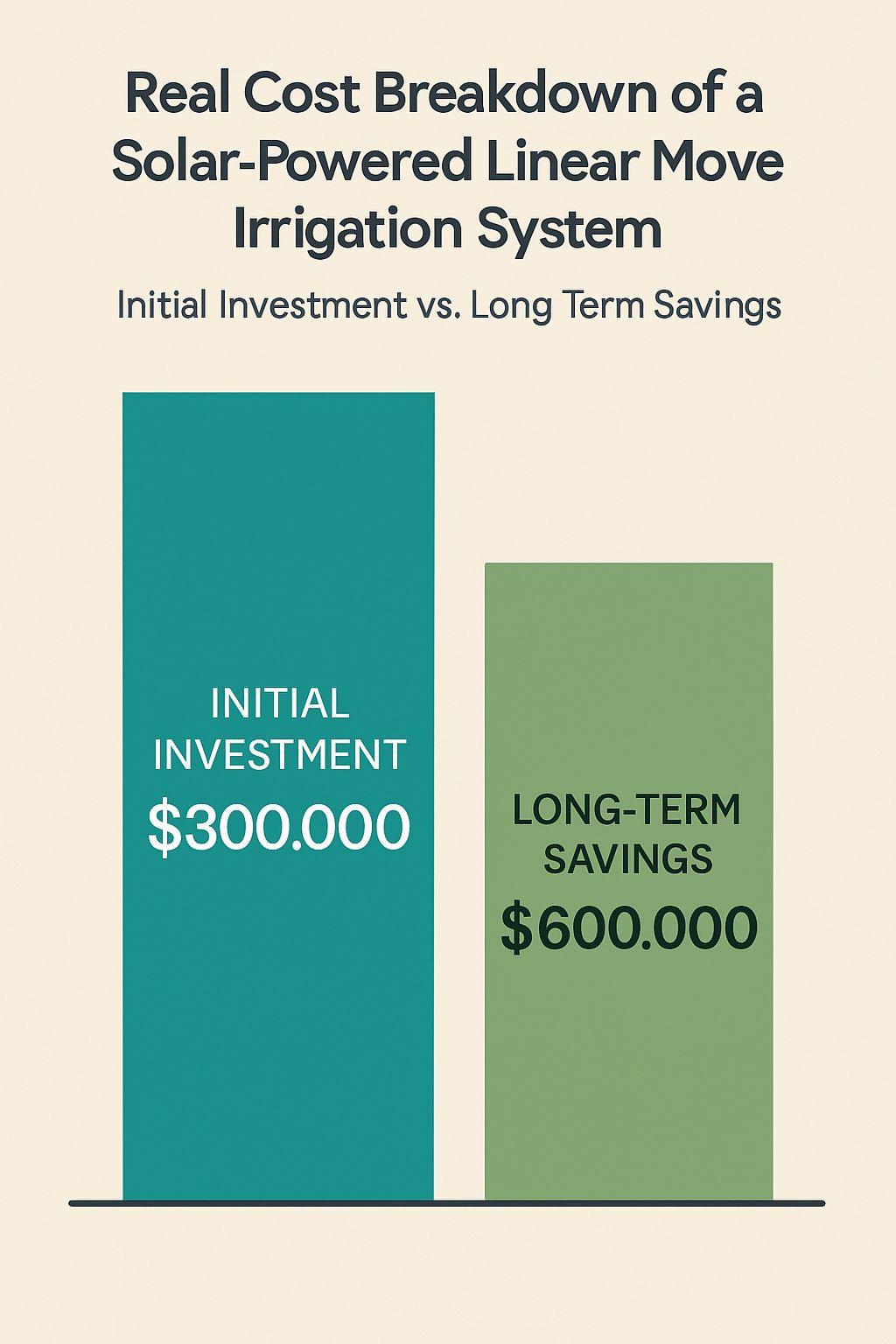
Understanding the complete financial picture of solar-powered linear move irrigation requires examining both the initial capital outlay and the long-term operational economics. The investment analysis reveals why these systems, despite higher upfront costs, frequently represent the most economically advantageous option over the system lifespan.
Upfront Costs to Expect
Initial investment for solar-powered linear move irrigation systems typically ranges from $1,800-2,500 per acre for complete installations, depending on field size, system complexity, and local conditions. For a standard 160-acre field, total costs generally fall between $50,000-150,000 higher than conventional electric systems. Solar components represent approximately 30-40% of this premium, with power storage solutions accounting for another 20-30%. The remainder covers specialized controllers, variable frequency drives, and installation requirements specific to solar integration.
Energy Savings Calculation
The energy savings from solar-powered irrigation systems provide the primary financial benefit over their operational life. A typical linear move system for a 160-acre field consumes approximately 40,000-60,000 kWh annually when powered by grid electricity. At average agricultural electric rates of $0.12-0.18/kWh, this represents $4,800-10,800 in annual energy costs. Solar-powered systems eliminate this recurring expense entirely, generating cumulative savings of $48,000-108,000 over a 10-year period, not accounting for likely utility rate increases that would make the savings even more substantial.
Maintenance Requirements and Expenses
Maintenance costs for solar-powered systems typically run 20-30% lower than conventional electric systems due to fewer mechanical components and reduced strain on drive motors. Annual maintenance for solar components averages $500-1,200 for a standard 160-acre system, primarily for panel cleaning and periodic battery maintenance. The DC motors commonly used in solar-powered systems have fewer points of failure than their AC counterparts, typically reducing repair costs by $800-1,500 annually compared to conventional systems. Many solar components carry 25-year warranties, significantly longer than the 5-10 year warranties typical for conventional irrigation equipment.
Replacement parts for solar components have become increasingly standardized and affordable as the industry has matured, with costs dropping approximately 60% over the past decade. Most farmers report spending 30-45% less time troubleshooting solar systems compared to conventional electric systems, representing valuable labor savings during critical growing periods. The simplified electrical systems in solar-powered units also reduce the need for specialized technicians, allowing more maintenance to be performed by farm staff.
Payback Period Case Studies
Real-world implementations demonstrate compelling payback periods for solar-powered linear move systems across various agricultural contexts. A 120-acre alfalfa operation in California’s Central Valley converted to solar power in 2018 with a total premium investment of $72,000 above conventional system costs. With annual energy savings of $14,500 and water efficiency improvements valued at $3,200 annually, the system achieved complete payback in 4.1 years. The operation now reports approximately $18,000 in annual operational savings compared to previous irrigation methods.
In the corn belt, a 160-acre operation in Nebraska invested in a solar-powered linear system in 2019, paying a $96,000 premium over conventional options. Despite lower electricity rates than California, the system’s payback period is projected at 6.8 years, primarily through energy savings of $11,200 annually and yield improvements of 7% from more consistent irrigation timing. The farmer also secured a USDA REAP grant covering 25% of the solar component costs, improving project economics substantially. These real-world examples demonstrate that when properly sized and implemented, solar-powered systems typically achieve full financial payback well within their operational lifespan.
Performance Across Different Climates and Seasons
The adaptability of solar-powered irrigation systems across varying climatic conditions represents one of their most significant advancements in recent years. Modern systems are designed to perform reliably from Arizona deserts to Minnesota farmland, with engineering modifications that address specific regional challenges. Understanding these climate-specific performance characteristics helps farmers evaluate system viability for their particular growing environment.
Low-Sun Winter Operations
In northern latitudes with shorter winter days, solar-powered systems have overcome historical limitations through improved panel efficiency and innovative storage solutions. Modern high-efficiency solar panels produce 20-30% more power per square foot than models from just five years ago, capturing more energy during limited daylight hours. For winter crop operations, systems now incorporate oversized solar arrays that generate sufficient power even during low-light conditions, with capacity typically increased 30-40% above peak summer requirements.
Cold-weather performance has improved dramatically with panels specifically designed for agricultural applications, featuring enhanced cold-tolerance and snow-shedding capabilities. Many systems now include automated panel-tilting mechanisms that can adjust seasonally to optimize sun exposure, increasing winter energy capture by up to 25% compared to fixed-angle installations. These advancements have extended the viable range of solar irrigation into regions previously considered impractical due to seasonal light limitations.
Battery Storage Solutions for Overnight Watering
The development of advanced energy storage technology has fundamentally transformed the capabilities of solar irrigation by enabling consistent operation regardless of immediate sunlight conditions. Modern systems typically incorporate lithium-ion battery banks sized to provide 12-36 hours of operational power without solar input, ensuring uninterrupted irrigation during cloudy periods or nighttime operations. For crops that benefit from nighttime watering to reduce evaporative losses, this capability delivers both water conservation and improved growing conditions.
Battery systems are now designed specifically for agricultural applications, with ruggedized components that withstand field conditions and temperature fluctuations. Energy management systems dynamically allocate stored power based on irrigation priorities and weather forecasts, ensuring critical watering cycles are never compromised. The substantial drop in battery costs—approximately 85% reduction over the past decade—has made these storage solutions economically viable even for mid-sized farming operations, eliminating what was previously the primary limitation of solar-powered irrigation.
Weather Monitoring Integration
Advanced solar irrigation systems now incorporate comprehensive weather monitoring capabilities that optimize both energy management and irrigation efficiency. On-site weather stations measure solar radiation, precipitation, wind speed, temperature, and humidity, feeding this data to intelligent control systems that adjust watering schedules accordingly. This integration enables the system to automatically increase irrigation before expected hot periods or pause operations when natural precipitation provides sufficient moisture, maximizing both water conservation and energy utilization.
Predictive algorithms analyze local weather patterns and forecasts to optimize solar energy capture, automatically adjusting panel angles or preemptively storing extra energy before expected cloudy periods. Some systems now include micro-weather radar integration that can detect approaching rain events up to 30 miles away, allowing for real-time irrigation adjustments that prevent wasteful watering immediately before natural rainfall. These weather-responsive capabilities typically improve system efficiency by 15-20% compared to standard timer-based approaches, while significantly reducing unnecessary irrigation cycles.
Smart Technology Integration for Precision Agriculture
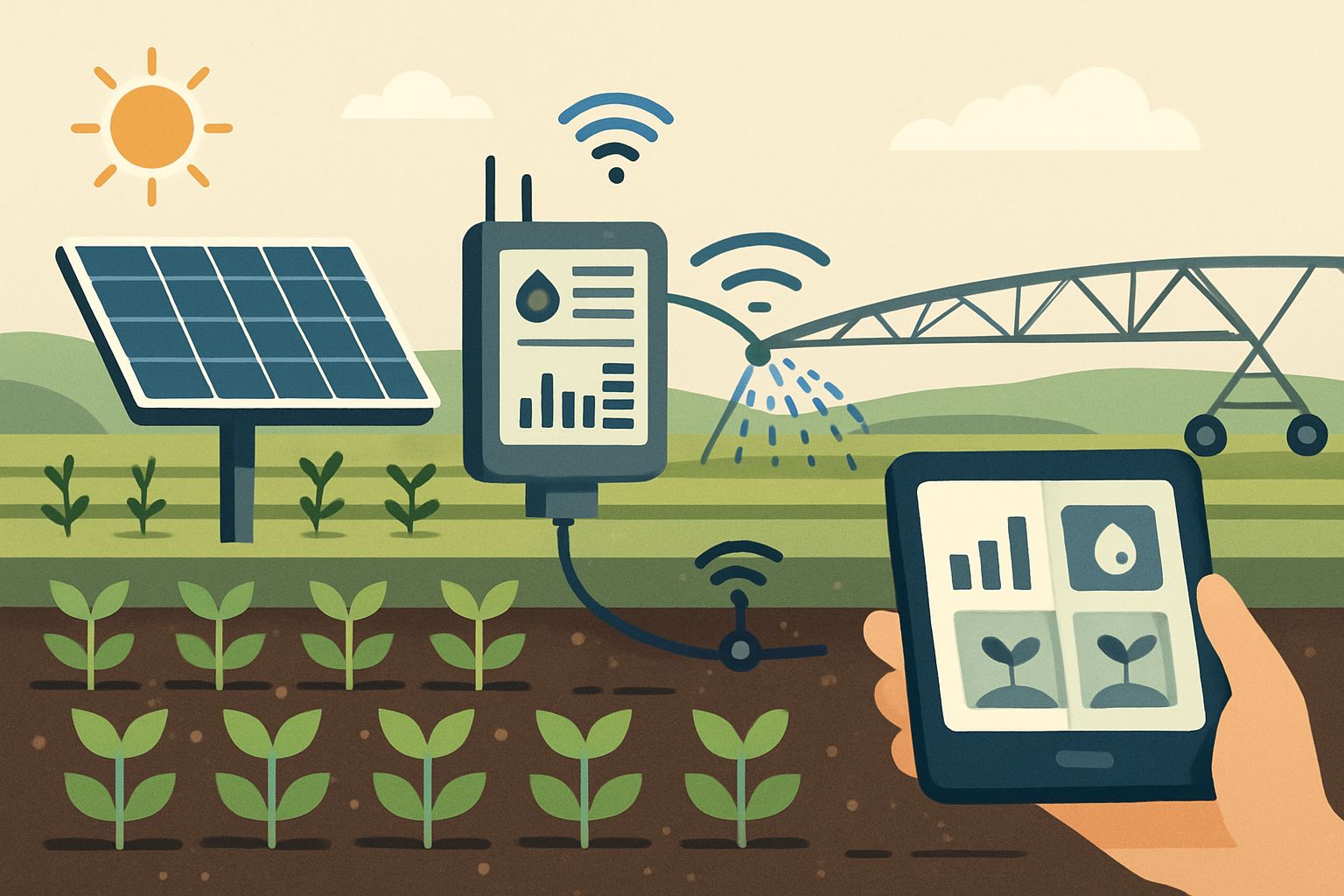
The marriage of solar-powered irrigation with precision agriculture technologies creates synergistic benefits that extend far beyond simple water delivery. Today’s systems incorporate sophisticated monitoring and control capabilities that transform irrigation from a basic input to a precision-managed component of the growing system. This technological integration delivers quantifiable improvements in resource efficiency, crop performance, and operational intelligence.
Soil Moisture Sensors and Automated Scheduling
Modern solar irrigation systems typically incorporate networks of soil moisture sensors that provide real-time data on water availability at multiple depths throughout the field. These sensors communicate wirelessly with the central control system, creating dynamic irrigation maps that identify specific zones requiring more or less water based on actual soil conditions rather than estimates or averages. Advanced systems place sensors at 12-inch, 24-inch, and 36-inch depths to monitor moisture throughout the root zone, ensuring water reaches critical root areas without wasteful deep percolation.
Automated scheduling algorithms use this moisture data alongside crop water requirements, growth stage information, and weather forecasts to create optimal irrigation programs that maintain ideal soil moisture levels with minimal water input. Research shows this precision approach typically reduces water usage by 20-30% while improving crop response through more consistent moisture availability. For operations in water-restricted regions, these moisture-based systems can extend limited water allocations substantially, potentially increasing irrigated acreage or extending the growing season with the same water resources. Learn more about solar-powered irrigation systems and their benefits for efficient water management.
Remote Monitoring and Control Systems
The integration of cellular and satellite connectivity has transformed how farmers interact with irrigation systems, enabling comprehensive monitoring and control from anywhere with internet access. Mobile applications provide real-time system status, power generation metrics, water application rates, and alert notifications directly to operators’ smartphones or tablets. Farmers can adjust watering schedules, flow rates, and system movement remotely, reducing the need for field visits and allowing immediate response to changing conditions.
Advanced diagnostic capabilities continuously monitor system performance, detecting potential issues before they cause operational failures. Pressure sensors, flow meters, drive system monitors, and electrical systems all report to central control systems that can identify deviations from normal parameters. Many systems now include GPS precision guidance that maintains alignment accuracy within inches, preventing the drift problems that plagued earlier linear move systems. This remote management capability typically reduces labor requirements by 40-60% compared to manually controlled irrigation while improving response time to critical issues from hours to minutes.
Real Results: Water Savings and Yield Improvements with a Solar-Powered Linear Move Irrigation Systems
The ultimate measure of any agricultural technology lies in its measurable impact on production efficiency and crop performance. Field data from solar-powered linear move systems across diverse growing regions demonstrates consistent improvements in key performance indicators. These documented results provide compelling evidence for the technology’s contribution to both farm profitability and environmental sustainability.
Water Use Efficiency Metrics
Comprehensive studies across multiple crop types show solar-powered linear systems with precision application technology typically achieve water use efficiency improvements of 25-40% compared to conventional irrigation methods. In corn production, documented cases show reductions from 24 acre-inches to 16-18 acre-inches per season while maintaining or improving yields. The uniform application pattern of linear systems eliminates the over/under-watering common in other methods, ensuring each plant receives optimal moisture regardless of field position.
The precision control capabilities enable more frequent, lighter applications that keep soil moisture in the ideal range for plant uptake while minimizing runoff and deep percolation losses. Evaporative losses are reduced by 15-30% through strategic timing of irrigation during lower evaporation periods, a flexibility made possible by independent solar power that isn’t constrained by time-of-use electricity rates. For water-limited operations, these efficiency improvements often translate directly to expanded production capacity or improved drought resilience, providing both economic and risk management benefits.
Crop Quality and Yield Data
Beyond simple water conservation, solar-powered linear systems demonstrate significant impacts on crop performance metrics that directly affect farm revenue. Field trials in potato production show grade improvements of 8-15% when irrigated with precision linear systems, substantially increasing the percentage of premium-quality tubers. Vegetable crop uniformity typically improves by 12-20%, reducing sorting costs and increasing the marketable percentage of total yield.
Row crop yield improvements of 7-12% are common when converting from less precise irrigation methods, primarily due to elimination of stress periods and maintenance of optimal soil moisture throughout the growing season. The flexible operation made possible by solar power allows irrigation timing to align perfectly with critical growth stages rather than being constrained by power availability or cost considerations. This precision timing is particularly valuable during flowering, pollination, and fruit development stages when even brief moisture stress can significantly impact final yield and quality.
Environmental Impact Reduction
The environmental benefits of solar-powered linear irrigation extend well beyond simple carbon reduction, creating multiple sustainability advantages that increasingly translate to market premiums and regulatory compliance. Water conservation reduces strain on aquifers and surface water sources, with documented projects demonstrating 1.5-2.5 million gallon reductions per 160 acres annually. Fertilizer efficiency typically improves 10-15% with precise water management, reducing both input costs and potential groundwater contamination from leaching.
Energy-related emissions elimination represents perhaps the most significant environmental benefit, with each solar-powered system preventing 40-60 tons of CO₂ emissions annually compared to fossil-fuel alternatives. For farms participating in sustainability certification programs or carbon markets, these quantifiable emissions reductions can generate additional revenue through carbon credits or sustainability premiums. As environmental considerations become increasingly important in agricultural markets, these documented sustainability improvements provide both immediate environmental benefits and long-term market positioning advantages. To explore more about these systems, check out solar-powered irrigation systems and their types.
Conclusion: Is the Solar-Powered Linear Move Irrigation Systems Good Way for the Farmer to Save on the Bottom Line
The evidence demonstrates that solar-powered linear move irrigation systems represent a financially sound investment for many agricultural operations, particularly those facing high energy costs, water limitations, or sustainability requirements. The economics are most compelling when evaluating total lifecycle costs rather than focusing exclusively on initial investment. For operations with 15+ year planning horizons, these systems typically deliver substantial net positive returns through reduced operational expenses, improved crop performance, and extended equipment lifespan.
The technology has matured beyond its experimental phase, with thousands of successful implementations across diverse agricultural regions proving both reliability and performance. As component costs continue to decline and efficiency improves, the economic case strengthens annually, expanding the range of viable applications. For farmers navigating increasing environmental regulations, water restrictions, and energy volatility, these systems offer a proactive solution that addresses multiple challenges simultaneously. Learn more about solar-powered irrigation systems and their benefits.
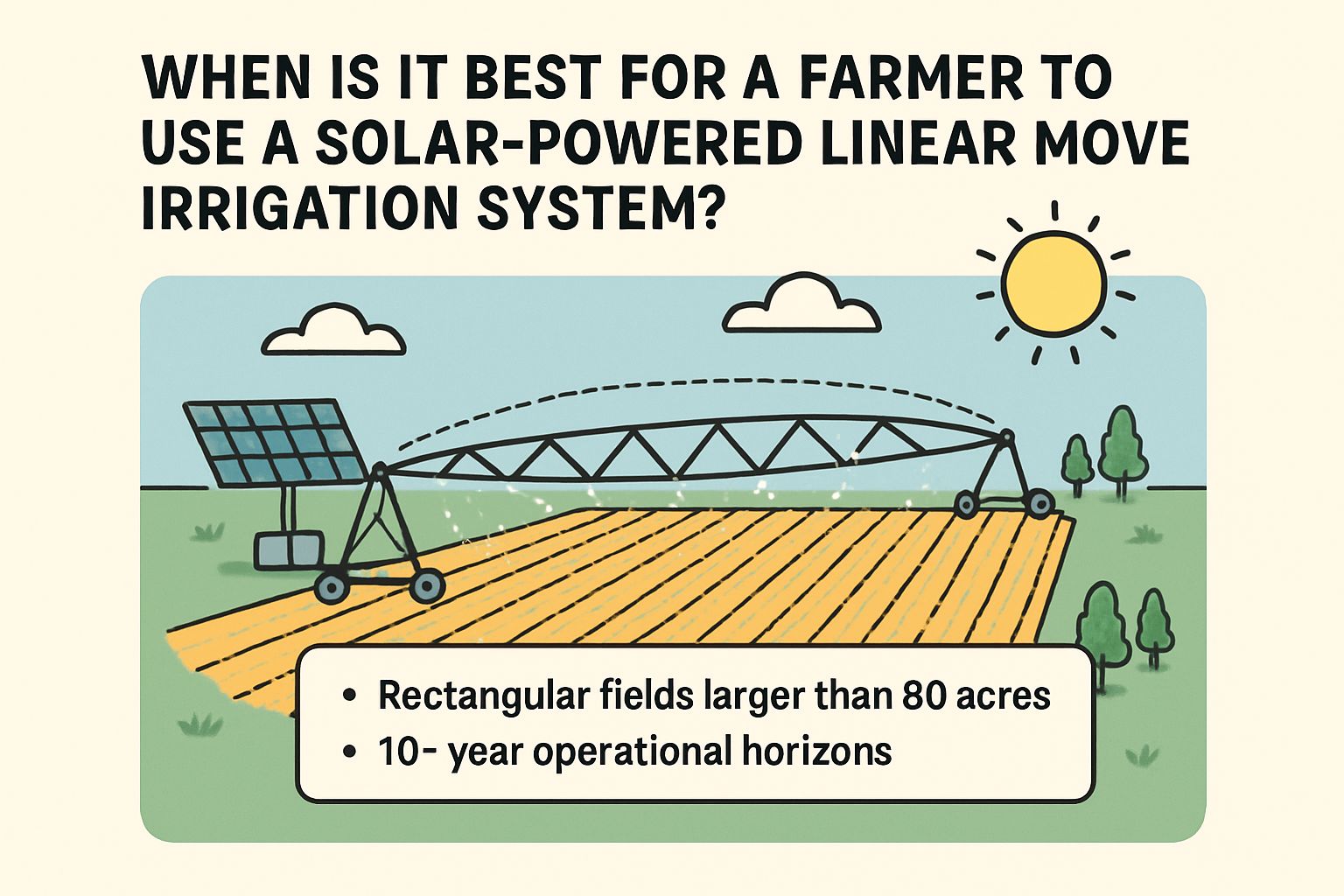
When is it Best for a Farmer to Use a Solar-Powered Linear Move Irrigation Systems
Solar-powered linear systems deliver maximum benefit in specific scenarios that align with their particular strengths. Rectangular fields larger than 80 acres with 10+ year operational horizons typically provide ideal economics, allowing sufficient scale to optimize the solar investment. Operations facing electricity costs above $0.12/kWh or unreliable grid service gain particularly compelling advantages, as do those located more than a quarter-mile from existing power infrastructure. For more insights, explore whether solar panels are a good investment for a farmer.
Water-limited regions with allocation restrictions or high pumping costs receive exceptional value through the improved efficiency these systems deliver. Specialty crop producers focused on quality metrics benefit from the precision application capabilities that support consistent crop development. Ultimately, farms incorporating sustainability into their business strategy—whether for market positioning, regulatory compliance, or personal values—find these systems align perfectly with both environmental and economic objectives. For those interested in solar energy solutions, exploring the best thin-film solar panels for farmers can provide additional insights.
Frequently Asked Questions (FAQ)
As farmers consider implementing solar-powered linear move irrigation systems, several common questions arise about performance, economics, and practical considerations. The following responses address the most frequently asked questions based on field experience and documented installations.
How long do solar-powered linear move irrigation systems typically last?
Solar panels in agricultural applications typically maintain 80%+ efficiency for 25-30 years, significantly exceeding the 15-20 year lifespan of most irrigation equipment. The mechanical components of linear move systems generally last 15-20 years with proper maintenance, comparable to conventional systems. Battery systems represent the most variable component, with modern lithium-ion installations typically providing 10-15 years of service before requiring replacement, though this continues to improve with advancing technology.
The extended lifespan of solar components often means they retain significant value when the mechanical irrigation system requires replacement, allowing continued use with new equipment or potential resale value. Most manufacturers now offer modular designs that facilitate component replacement without requiring complete system overhauls, extending practical service life substantially.
Can these systems work at night or during cloudy days?
Modern solar-powered irrigation systems are specifically designed to operate regardless of immediate sunlight conditions through integrated energy storage solutions. Standard installations include battery capacity sufficient for 12-36 hours of operation without solar input, easily spanning overnight periods or brief cloudy conditions. For regions with extended low-light seasons, expanded battery capacity or hybrid power options can provide reliable operation through virtually any conditions.
- Standard battery systems provide 12-36 hours of continuous operation without solar charging
- Expanded storage options can extend this capacity to 48-72 hours for regions with frequent cloudy conditions
- Intelligent energy management systems prioritize critical irrigation needs during extended low-light periods
- Optional backup generators can provide supplemental power during extreme conditions, though these are rarely needed in properly sized systems
The system’s energy management software optimizes power usage based on irrigation priorities and weather forecasts, ensuring critical watering cycles are maintained even during suboptimal solar conditions. For most agricultural regions, properly sized systems provide 98%+ uptime reliability, comparable to or exceeding grid-powered alternatives when power outages are considered.
What maintenance is required for solar panels in dusty farm environments?
Solar panels in agricultural settings typically require cleaning 2-4 times annually depending on local dust conditions, pollen levels, and rainfall patterns that naturally clean panels. Most installations use simple water cleaning with soft brushes, though automated cleaning systems are available for larger installations. Panel efficiency typically declines 3-5% due to dust accumulation between cleanings, with performance immediately restored after maintenance. Regular visual inspections for physical damage, connector integrity, and mounting security are recommended quarterly, typically requiring less than an hour for a standard system.
Is it possible to convert an existing linear move system to solar power?
Most linear move irrigation systems manufactured in the past 10-15 years can be successfully converted to solar power, though conversion economics vary based on the specific equipment model and age. Conversion typically involves installing solar arrays, battery storage, charge controllers, and often replacing AC motors with more efficient DC alternatives. The conversion cost typically ranges from 60-75% of a new solar-powered system, making it economically viable for relatively new equipment but less attractive for systems approaching end-of-life.
Many manufacturers now offer conversion kits specifically designed for popular irrigation models, simplifying the retrofit process significantly. These conversions typically require 3-7 days of system downtime, with most farmers scheduling work during off-season periods to avoid disrupting irrigation cycles. For operations considering conversion, professional assessment is recommended to evaluate compatibility and develop accurate cost projections based on existing equipment specifications.
How does water pressure compare to traditional electric-powered systems?
Modern solar-powered pumping systems can achieve identical pressure and flow rates to conventional electric systems when properly sized and configured. Variable frequency drives allow precise pressure management regardless of solar input fluctuations, maintaining consistent sprinkler performance throughout the day. Systems are typically designed to operate at 35-50 PSI at the sprinkler head, identical to conventional specifications, ensuring compatible performance with standard sprinkler packages.
For systems requiring higher pressure applications, multiple solar arrays can be configured to provide sufficient power, though energy efficiency generally favors moderate pressure designs. Water hammer and pressure fluctuation issues common in some conventional systems are actually reduced in solar-powered configurations due to the gradual startup and shutdown capabilities of variable frequency drives. The pressure consistency from modern solar systems typically results in more uniform water application than conventional alternatives that may experience voltage fluctuations during high grid demand periods.

Leave a Reply