

“Bifacial Solar Panels …” from growingsolarmist.com and used with no modifications.
Key Takeaways
- Monocrystalline panels (17–22% efficiency) are the strongest choice for barn rooftops and equipment sheds where space is limited and weight matters.
- Bifacial panels can boost energy output by 10–30% when ground-mounted over reflective surfaces — making them ideal for open crop land.
- The right panel type depends entirely on your farm’s layout, not just the technology specs — a dairy operation and a grain farm have completely different solar needs.
- Growing Solar Mist provides farm-focused solar guidance to help agricultural operations find the right fit between technology, land use, and long-term ROI.
- Agrivoltaic systems — where solar panels and crops share the same land — are changing how farmers think about ground-mounted bifacial arrays, and the numbers are worth knowing.
Choosing the wrong solar panel type for your farm can cost you thousands in lost energy production over a 25-year system life — so getting this decision right from the start matters more than most farmers realize.
The two technologies dominating agricultural solar right now are monocrystalline and bifacial panels, and while both can dramatically cut farm energy costs, they work best in very different situations. A dairy farmer with a south-facing barn roof has completely different needs than a grain farmer with 20 acres of open, unshaded land. Understanding the technical differences — not just the marketing claims — is what separates a smart farm solar investment from an expensive mistake. Growing Solar Mist breaks down exactly these kinds of farm-specific decisions to help agricultural operations get the most from every panel installed.
Monocrystalline vs. Bifacial: Here’s What Farmers Actually Need to Know
These two panel types are not competing products in the traditional sense — monocrystalline refers to the cell construction material, while bifacial refers to the panel’s physical design. In fact, most bifacial panels on the market today use monocrystalline cells. The real question farmers need to ask is: where will my panels be mounted, and what surfaces surround them? That single question determines which technology delivers the better return on your investment.
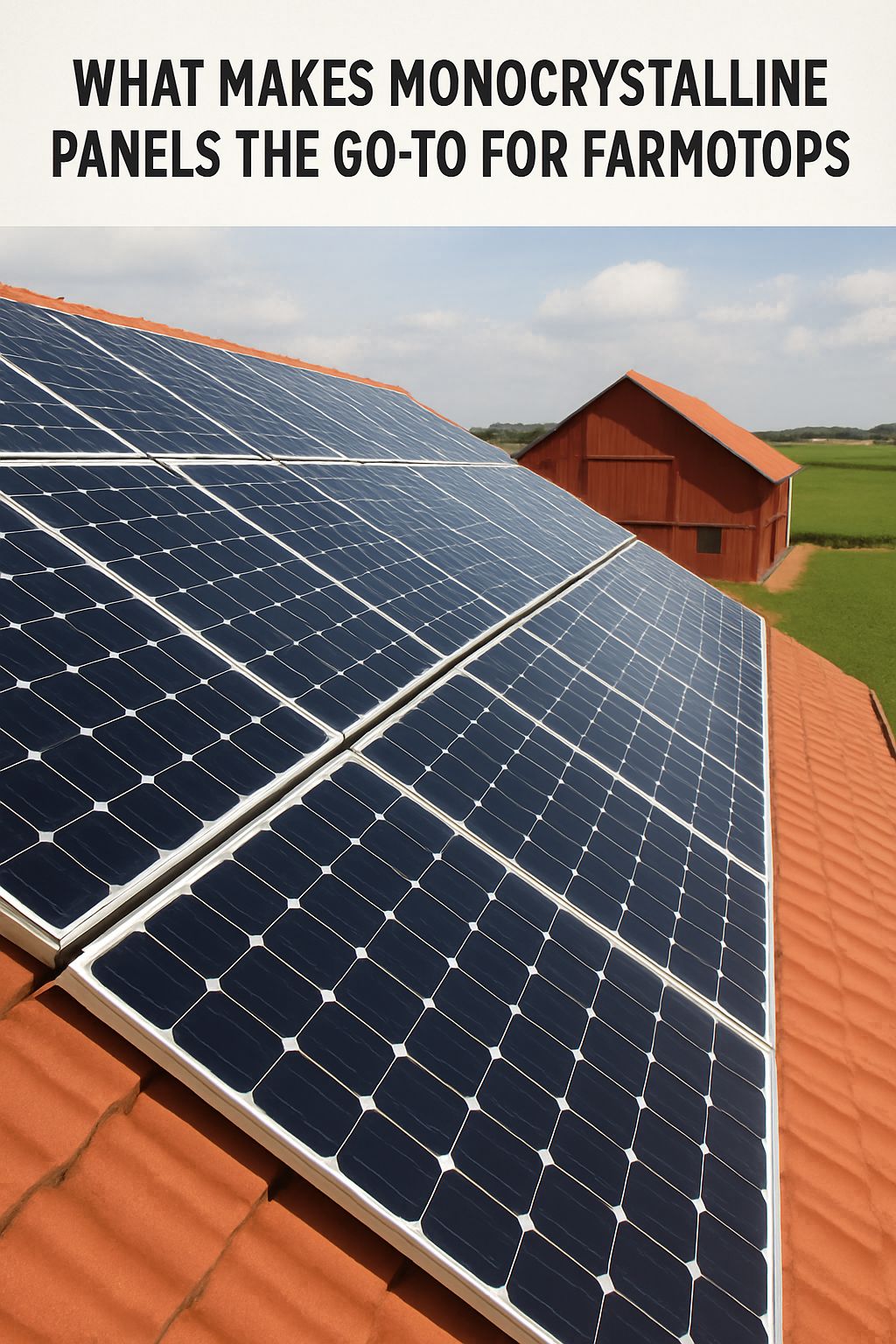
What Makes Monocrystalline Panels the Go-To for Farm Rooftops
Monocrystalline solar panels are built from a single continuous silicon crystal, which gives electrons a cleaner, less obstructed path to flow — and that translates directly into higher efficiency. These panels have been the gold standard in agricultural rooftop installations for good reason. They pack more power into less space, they perform consistently in partial shade, and they carry a track record that spans decades of farm deployments across diverse climates.
For farmers evaluating rooftop systems, monocrystalline panels represent the most predictable, lowest-risk technology available — and predictability matters enormously when you’re financing a system over 10 to 20 years.
How Single-Crystal Silicon Drives Higher Efficiency (17–22%)
Standard monocrystalline panels operate at 17% to 22% efficiency, meaning they convert that percentage of incoming sunlight into usable electricity. That might sound modest, but compared to older polycrystalline panels that max out around 13–17%, it’s a meaningful difference when you’re working with a fixed roof area. Premium monocrystalline products from manufacturers like SunPower (Maxeon series) and LG NeON have pushed efficiency past 22%, though most farm-grade installations sit comfortably in the 19–21% range for cost-effective deployments.
The single-crystal structure also means better temperature coefficients — these panels lose less efficiency as temperatures rise, which is a practical advantage during peak summer months when farm energy demand from cooling, irrigation pumps, and processing equipment is highest.
- Typical efficiency range: 17–22% for standard farm-grade monocrystalline panels
- Temperature performance: Lower power loss per degree Celsius compared to polycrystalline alternatives
- Space efficiency: Fewer panels needed to hit target energy output on limited roof areas
- Lifespan: 25–30 years with most manufacturers offering linear performance warranties
- Shade tolerance: Better per-cell performance under partial shading common near tree lines or adjacent structures
What this means practically: a 10,000 sq ft dairy barn roof outfitted with 400W monocrystalline panels can generate significantly more annual kilowatt-hours than the same roof covered with lower-efficiency alternatives — without adding a single extra mounting point or structural modification.
Why Barn Roofs and Equipment Sheds Suit Monocrystalline Best
Most working farm buildings weren’t designed with solar in mind, which means available roof space is almost always the limiting factor. Monocrystalline panels solve this problem directly — their higher power density means you’re generating more watts per square foot than any other standard panel type. A south-facing barn roof that might fit 40 panels can produce substantially more energy with premium monocrystalline units than with lower-efficiency alternatives, without any changes to the mounting system or roof structure.
Equipment sheds present a similar case. These buildings often have metal roofing in excellent structural condition, ideal southern exposure, and no shading obstructions — exactly the environment where monocrystalline panels perform at their rated efficiency consistently throughout the day.
Structural Load Considerations for Older Farm Buildings
One factor that rarely gets enough attention in farm solar discussions is roof load capacity. Standard monocrystalline panels weigh approximately 40–50 lbs each, and a full rooftop array on a large barn can add several tons of distributed load to an aging structure. Before any installation, a structural assessment of the roof framing, purlins, and rafters is essential — particularly for timber-framed barns built before modern load standards. Many older farm buildings can be reinforced cost-effectively to support a full array, but that cost needs to factor into your total system budget upfront rather than surfacing as a surprise after contracts are signed.
Working with installers who have specific agricultural experience — not just residential solar contractors — makes a significant difference here. Agricultural solar specialists understand how to assess working farm structures and design mounting systems that distribute load appropriately across existing framing.
Bifacial Panels: How Capturing Reflected Light Changes the Math
Bifacial solar panels generate electricity from both sides of the panel — the front face captures direct sunlight just like any standard panel, while the rear face collects light that bounces up from the ground or surrounding surfaces. On a farm with open land, this dual-capture design can meaningfully increase total energy output without adding a single extra panel to your system. The key variable is what’s underneath and around the panels, and agricultural environments often have exactly the right conditions to make bifacial technology perform at its best.
The energy gain from the rear side is measured as bifacial gain — typically expressed as a percentage increase over what the front face alone would produce. In the right farm conditions, this isn’t a marginal improvement. It’s a legitimate bump in production that directly improves your system’s long-term payback period.
How Bifacial Technology Produces 10–30% More Energy
The 10–30% production gain from bifacial panels isn’t a guaranteed figure — it’s a range that depends almost entirely on installation conditions. Ground-mounted systems elevated well above highly reflective surfaces sit at the top of that range, while poorly planned installations over dark, absorptive soil might deliver closer to 2–5% rear-side gain. Understanding what drives that number is what separates a well-designed bifacial system from one that underperforms against its projections. For more insights, check out this comparison of bifacial vs. monofacial solar panels.
Three factors drive bifacial gain on farm installations:
- Albedo (surface reflectivity): The percentage of sunlight a surface reflects back upward. Light-colored gravel, concrete, and snow-covered ground score high. Dark, wet soil scores low.
- Panel elevation: Higher ground clearance allows more reflected light to reach the rear cells. Industry data suggests a minimum of 18–24 inches of clearance is needed to begin seeing meaningful rear-side gains.
- Row spacing: Wider spacing between panel rows reduces shading of the ground surface and allows more diffuse light to bounce upward toward rear cells.
When these three conditions align — reflective ground, adequate elevation, and proper row spacing — bifacial panels installed on open farmland consistently hit the upper end of that production range. For a 100kW ground-mounted system, a 20% bifacial gain translates to the equivalent of adding 20kW of generation capacity at essentially no additional hardware cost. Learn more about how to maximize energy on farms with bifacial solar panels.
Which Ground Surfaces Reflect the Most Light on a Farm
Not all farmland surfaces reflect light equally, and this is where site-specific assessment becomes critical. Light-colored pea gravel has an albedo rating of approximately 0.25–0.35, making it one of the most cost-effective ground treatments for bifacial installations. White concrete performs even better at 0.40–0.55, though it’s rarely practical to lay concrete across large agricultural areas. Naturally occurring farm surfaces like dry sandy soil (0.25–0.45) and dormant winter grass (0.20–0.35) can also deliver solid rear-side performance without any ground modification.
The surfaces that actively hurt bifacial performance are worth knowing too. Freshly tilled dark soil drops to an albedo of just 0.05–0.15, waterlogged fields perform similarly poorly, and dense green crop cover — while visually bright — reflects less usable solar spectrum than most farmers expect. For crop farms planning a bifacial ground-mount, working with a solar designer who incorporates seasonal albedo variation into production modeling is essential for accurate ROI projections.
Minimum Panel Elevation Requirements for Rear-Side Energy Gain
Rear-side energy capture in bifacial panels depends directly on how high off the ground the panel is mounted. At very low elevations — under 12 inches — the rear face is essentially looking at its own shadow, and bifacial gain collapses to near zero. The practical industry benchmark for meaningful rear-side production is a minimum ground clearance of 18 to 24 inches at the panel’s lowest point, with optimal performance typically achieved at 36 inches or higher for large ground-mounted agricultural arrays.
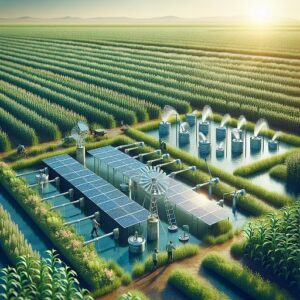
For agrivoltaic systems — where panels are mounted high enough to allow crops or livestock to coexist beneath them — clearance heights of 8 to 14 feet are common. At these elevations, bifacial panels capture excellent rear-side light while simultaneously enabling continued agricultural use of the land below. This dual-use design is one of the most compelling economic arguments for bifacial technology on working farms.

“Bifacial Solar Panels …” from growingsolarmist.com and used with no modifications.
Monocrystalline vs. Bifacial: Side-by-Side Comparison for Farmers
Comparing these two technologies side by side reveals something important: they aren’t direct substitutes. Each technology has a specific set of conditions where it clearly outperforms the other. Forcing a bifacial system onto a barn roof, or installing standard monocrystalline panels on open reflective land, both represent missed optimization opportunities that show up as lower lifetime energy production and longer payback periods.
Efficiency, Cost, and Space Requirements at a Glance
|
Feature |
Monocrystalline Panels |
Bifacial Panels |
|---|---|---|
|
Typical Efficiency |
17–22% |
19–23% (front face) + rear gain |
|
Energy Gain vs. Standard |
Baseline |
+10–30% in optimal ground-mount conditions |
|
Best Mounting Location |
Rooftop (barns, sheds) |
Ground-mount with reflective surface |
|
Cost Premium |
10–15% over polycrystalline |
Typically 10–20% over standard mono |
|
Space Requirements |
Compact, high power density |
Requires wider row spacing for full gain |
|
Installation Complexity |
Standard, compatible with most farm structures |
Requires specific elevation and spacing design |
|
Lifespan |
25–30 years |
25–30 years |
|
Best Farm Application |
Dairy, livestock, equipment facilities |
Open cropland, agrivoltaic systems |
Long-Term ROI Differences Between Both Panel Types
The cost premium for bifacial panels is real — typically 10–20% higher upfront than standard monocrystalline units — but the ROI calculation only makes sense when you factor in their production environment. A bifacial system achieving consistent 20% rear-side gain on open farmland with light-colored gravel underneath can recover that cost premium within 2–3 years of the payback difference, then continue generating bonus production for the remaining 20+ years of system life. That’s a compelling long-term argument for operations with available open land and suitable ground conditions.
On the rooftop side, monocrystalline panels installed on a well-oriented barn roof in most U.S. agricultural regions achieve payback periods of 6–10 years — and with federal Investment Tax Credit (ITC) incentives currently at 30% for agricultural solar under the Inflation Reduction Act, the financial case has never been stronger. After payback, the remaining 15–20 years of system life represents near-pure energy cost savings that directly improve farm operating margins.
Which Farm Types Benefit Most from Each Panel
Farm solar isn’t one-size-fits-all — the layout of your operation, your primary energy loads, and the physical characteristics of your land all determine which technology delivers the best return. A 500-cow dairy operation running continuous refrigeration, ventilation, and milking equipment has fundamentally different solar priorities than a 2,000-acre grain farm with seasonal energy peaks around harvest. Matching panel technology to farm type is where the real optimization happens. For more insights, consider reading about the best choice for farmers.
It’s also worth noting that many larger farm operations benefit from a hybrid approach — monocrystalline panels on available barn and shed rooftops handling base electrical loads, combined with a bifacial ground-mount array on less productive land to capture additional generation. This layered strategy can maximize total farm energy offset without requiring a farmer to choose one technology over the other.
Dairy and Livestock Farms: Why Monocrystalline Wins on Rooftops
- Continuous high energy loads from milking equipment, refrigeration, and ventilation systems make consistent daily production critical
- Large south-facing barn roofs provide ideal monocrystalline installation surfaces
- High power density means maximum output from existing roof area without structural modifications
- Predictable, warranty-backed performance aligns with long-term farm financing structures
- No land area is taken out of grazing or production use
Dairy operations are among the highest energy consumers in all of agriculture — a single 500-cow dairy can consume 15,000 to 25,000 kWh per month, making energy cost reduction an immediate operational priority. Monocrystalline panels on barn rooftops directly attack that monthly utility bill without disrupting any aspect of farm operations.
The compact, roof-mounted design also protects the panels from the ground-level hazards inherent to working livestock facilities — animal contact, equipment movement, and feed storage activity that could damage low-mounted or ground-level installations. Keeping the solar array elevated and out of the working area of a livestock operation is a practical safety and maintenance advantage that often gets overlooked in purely financial comparisons.
Premium monocrystalline products like the SunPower Maxeon 6 Series and REC Alpha Pure-R panels are specifically well-suited to agricultural rooftop applications — both deliver efficiency ratings above 21% with robust performance warranties that align with the long operational timelines farms require from any capital investment.
Crop Farms with Open Land: Where Bifacial Delivers Better Returns
Crop farms with substantial open acreage — particularly land that’s less productive, located in flood-prone areas, or sitting at field edges that are difficult to farm efficiently — represent the ideal deployment environment for bifacial ground-mount systems. When panels are elevated over light-colored stubble, dry sandy soil, or installed gravel beds, rear-side albedo gain consistently pushes total system output to the upper range of bifacial performance projections. For a 250kW system on a grain operation, the difference between 10% and 25% bifacial gain represents tens of thousands of additional kilowatt-hours annually — energy that directly offsets irrigation pump costs, grain drying fuel expenses, and general farm utility bills.
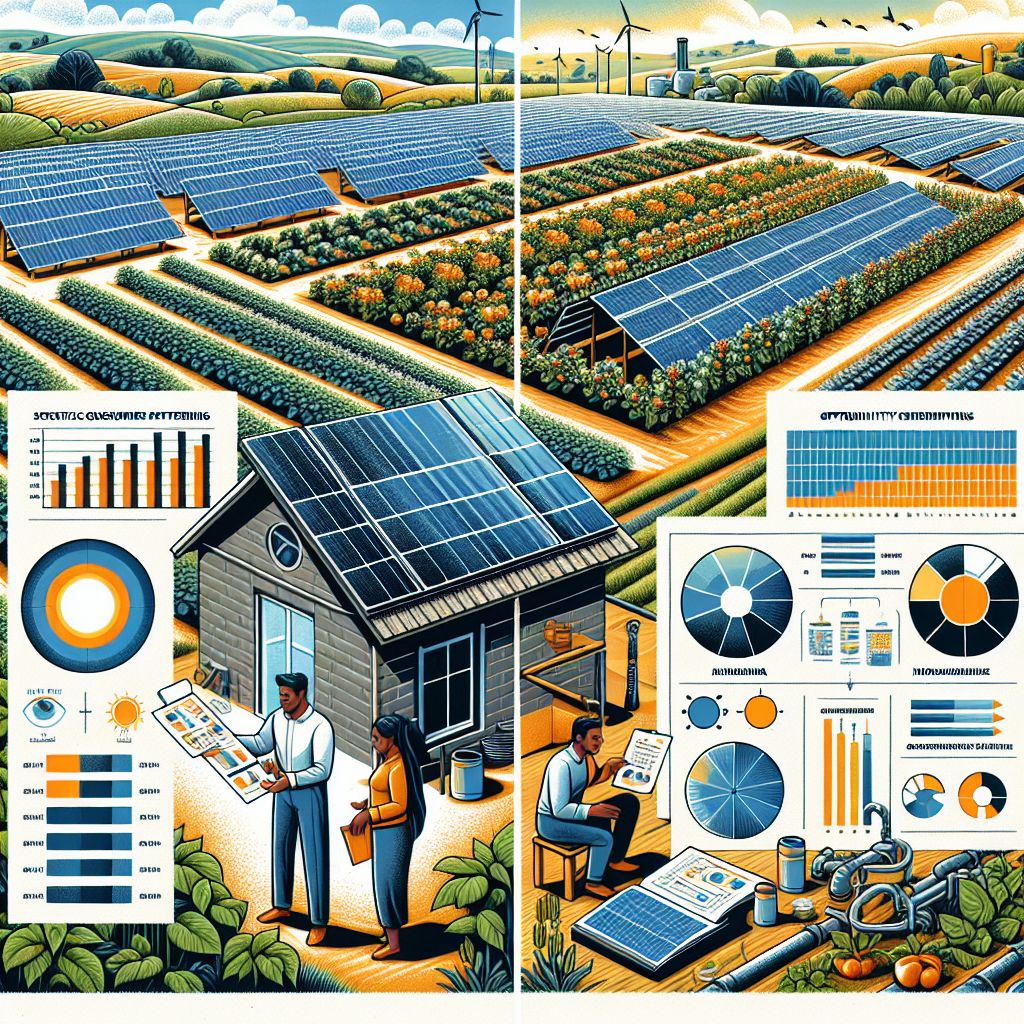
How Agrivoltaic Systems Let Farmers Harvest Crops and Energy Simultaneously
- Panels mounted at 8–14 feet allow standard farm equipment to pass underneath during planting and harvest
- Partial shading from elevated panels can reduce crop water stress in hot climates, improving yields on heat-sensitive crops
- Sheep and cattle can graze beneath agrivoltaic arrays, adding livestock revenue to the same land footprint
- Ground-mounted bifacial panels in agrivoltaic configurations capture rear-side light from both soil albedo and reflected crop canopy light
- Studies from the National Renewable Energy Laboratory (NREL) have documented successful dual-use agrivoltaic deployments across multiple U.S. agricultural regions
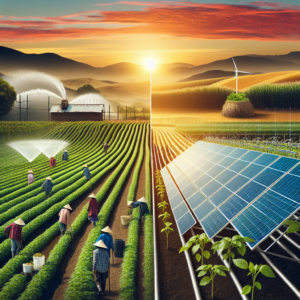
Agrivoltaic systems are one of the most significant developments in farm solar in the last decade — and bifacial panels are at the center of why they work so well economically. By mounting panels high enough to allow continued crop production or livestock grazing underneath, farmers effectively generate two revenue streams from the same acre of land. The solar array produces energy income or direct utility cost offsets, while the land below continues producing agricultural output. For operations where land is the primary constraint, this dual-use model fundamentally changes the return-on-investment calculation.
The practical design of an agrivoltaic bifacial system requires careful coordination between the solar array layout and the farm’s existing equipment and crop rotation practices. Row spacing needs to match tractor widths, panel height must clear standard combines or sprayers, and the overall array orientation should minimize shading during critical crop growth periods. These aren’t insurmountable engineering challenges, but they do require an installer with genuine agricultural experience — not just a residential solar contractor who has never worked around a planter or grain cart.
From an energy production standpoint, the elevated mounting heights common in agrivoltaic systems are actually ideal for bifacial panel performance. At 10–14 feet of ground clearance, rear-side cells receive light from a wide reflected angle, and the open row spacing allows diffuse light to bounce upward from the crop canopy or soil surface throughout the day. This combination of agricultural compatibility and bifacial performance optimization makes agrivoltaic ground-mount systems one of the strongest long-term investments available to crop farmers today.
Bifacial panels used in agrivoltaic installations should be specified with durable tempered glass on both faces rather than a rear plastic backsheet — the dual-glass construction provides better protection against humidity, fertilizer exposure, and the mechanical stress that comes with operating heavy equipment nearby over decades of farm use. Manufacturers like Longi Solar (Hi-MO 6 series) and Trina Solar (Vertex bifacial series) offer dual-glass bifacial products specifically rated for demanding outdoor commercial and agricultural environments.
“Monocrystalline Panels: Premium …” from growingsolarmist.com and used with no modifications.
Monocrystalline Panels Win on Rooftops, Bifacial Wins on the Ground — Here’s the Bottom Line
The answer to which solar panel is best for farmers isn’t a single technology — it’s a decision that starts with your farm’s physical layout and energy needs. Monocrystalline panels are the clear winner for barn rooftops, equipment sheds, and any structure with south-facing roof space, delivering 17–22% efficiency in a compact footprint that doesn’t compete with your working land. Bifacial panels earn their premium on open ground — mounted over reflective surfaces at adequate elevation, they add 10–30% more energy output than a front-face-only system, making them the better long-term investment for crop farms and agrivoltaic operations. For larger farm operations, the smartest approach is often both: monocrystalline on the rooftops, bifacial on the ground, each technology deployed exactly where it performs best.
Frequently Asked Questions
These are the questions farm operators most commonly ask when comparing monocrystalline and bifacial panels for agricultural solar installations.
How Much More Electricity Do Bifacial Panels Produce Compared to Monocrystalline?
Bifacial panels produce more electricity than standard single-face monocrystalline panels when ground-mounted over reflective surfaces — typically 10–30% more total output depending on albedo conditions, panel elevation, and row spacing. In rooftop applications, that advantage largely disappears, with bifacial panels delivering only 2–5% improvement over standard monocrystalline in most roof-mounted configurations. For a deeper understanding of the differences and benefits between these solar panel types, check out our detailed comparison.
The important distinction is that most bifacial panels use monocrystalline cells — so you’re not comparing two entirely different materials, but rather a standard single-face panel against a dual-face design that captures additional reflected light from its rear surface. The production gain from bifacial technology is real, but it’s entirely dependent on the installation environment delivering adequate reflected light to the rear cells.
Can I Install Both Panel Types in a Single Farm Solar System?
Yes — and for many mid-to-large farm operations, a hybrid installation is actually the optimal strategy. Monocrystalline panels can be deployed on available barn and shed rooftops to handle base electrical loads, while a separate bifacial ground-mount array on open or marginal land captures additional generation with the rear-side albedo advantage. Both arrays can feed into a single inverter system or operate through separate inverters depending on the scale and design of your overall farm energy setup.
The main considerations for a hybrid system are ensuring your inverter capacity is sized correctly for total combined array output, and that your utility interconnection agreement accommodates the full system size. Working with an agricultural solar designer — rather than a standard residential installer — ensures both arrays are optimized independently while functioning as a coordinated farm energy system.
Which Panel Type Handles Snow and Dust Accumulation Better on a Farm?
Monocrystalline panels installed at a standard rooftop pitch of 20–30 degrees shed snow more readily than flat or low-angle ground-mounted bifacial arrays, simply because gravity does more of the work. Bifacial ground-mount systems in agricultural areas can accumulate dust, crop debris, and pollen on both faces, making periodic rear-side cleaning an additional maintenance consideration that doesn’t exist for rooftop monocrystalline installations. That said, bifacial panels with dual-tempered glass construction are actually more resistant to abrasive cleaning and environmental weathering than backsheet-based panels — so when cleaning is performed, the panels handle it better over the long term.
Do Bifacial Panels Work on Rooftops or Only on the Ground?
Bifacial panels can technically be installed on rooftops, but the rear-side energy gain in that configuration is minimal — typically only 2–5% above standard mono performance — because the rear face is looking directly at the roof surface rather than a reflective open ground. For rooftop installations, the additional cost of bifacial panels rarely justifies the marginal production increase. The bifacial advantage is a ground-mount phenomenon, and the technology should be specified and budgeted accordingly.
How Long Do Monocrystalline and Bifacial Panels Last on a Working Farm?
Both monocrystalline and bifacial panels carry standard manufacturer warranties of 25 to 30 years, with most tier-one manufacturers guaranteeing that panels will still produce at least 80–87% of their original rated output at the end of that warranty period. In agricultural environments, the actual degradation rate — typically 0.5% per year for premium monocrystalline panels — is the more useful planning figure than the warranty endpoint alone.
Bifacial panels with dual-tempered glass construction often outperform backsheet-based panels in harsh farm environments over time. The glass-glass sandwich design provides superior protection against humidity ingress, UV degradation, and mechanical stress from nearby farm activities — all common stressors in working agricultural settings that accelerate degradation in lower-quality panel constructions.



Leave a Reply