

Key Takeaways
- Monocrystalline solar panels offer the highest efficiency (17-22%) for farms with limited space, making them ideal for barn roofs and compact installations.
- Bifacial panels can boost energy production by 10-30% by capturing reflected sunlight, particularly valuable for ground-mounted systems with reflective surfaces common in agricultural settings.
- The best solar panel choice depends on your specific farming operation – dairy and livestock farms often benefit from monocrystalline, while crop farms with available land may see better ROI from bifacial technology.
- While monocrystalline panels have a higher upfront cost, they typically deliver better long-term value for space-constrained operations through increased energy generation and system longevity.
- Modern agricultural solar installations can provide both energy production and land-use benefits through agrivoltaic systems that allow continued farming beneath properly mounted panels.
Choosing the right solar technology could be the difference between moderate savings and transformative energy independence for your farm. The decision between monocrystalline and bifacial panels isn’t just about efficiency numbers—it’s about matching technology to your specific agricultural operation. Growing Solar Mist has been helping farmers navigate these choices to maximize both energy production and financial returns.
The Solar Panel Decision That Could Make or Break Your Farm’s Energy Future
Farms face unique energy challenges—from seasonal demand fluctuations to remote locations with unreliable grid connections. Solar power offers a solution, but the panel technology you select will significantly impact your system’s performance, cost, and ultimate ROI. Today’s agricultural operations must balance immediate budget constraints against long-term energy needs while considering available space and mounting options.
Your farm’s energy profile is unlike any other. Dairy operations typically have consistent, high electricity demand for milk cooling and processing. Row crop farms might need seasonal power for irrigation pumps. Livestock facilities require year-round climate control systems. These varied needs demand thoughtful solar panel selection rather than a one-size-fits-all approach.
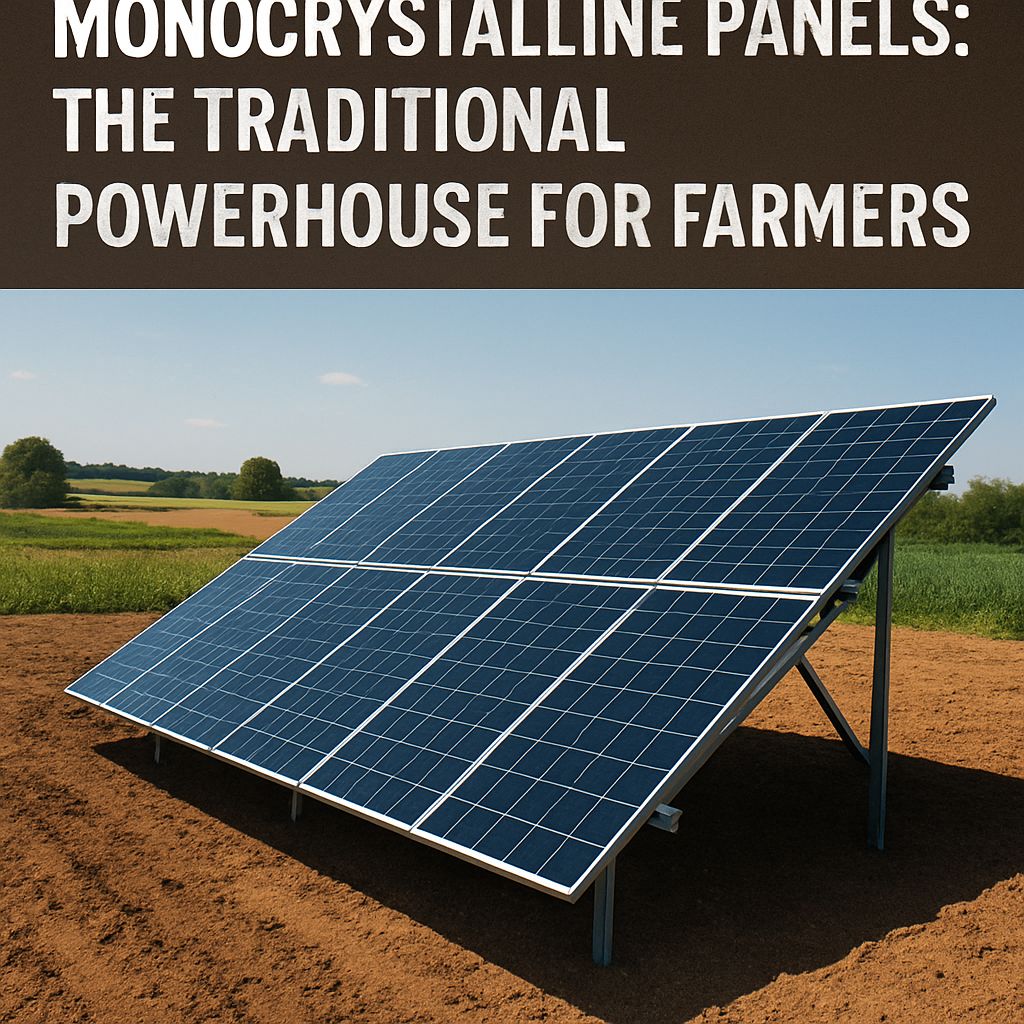
Monocrystalline Panels: The Traditional Powerhouse for Farmers
Monocrystalline panels have earned their reputation as the premium choice in agricultural solar installations. These panels are manufactured from single-crystal silicon, giving them that distinctive uniform black appearance. This construction method results in higher purity silicon and better electron flow, translating to superior efficiency in converting sunlight to electricity.
For farms with limited roof space or land constraints, monocrystalline panels deliver maximum power output per square foot. Their superior efficiency means fewer panels are needed to achieve target energy production, reducing both installation footprint and associated mounting hardware costs. This compact design makes them particularly valuable for dairy barns, equipment sheds, and other agricultural buildings with suitable roof orientation. To explore more about these panels, consider reading about monocrystalline vs bifacial solar panels.
Farm Case Study: Wilson Family Dairy in Wisconsin installed 64 monocrystalline panels on their main barn roof, generating 28,500 kWh annually—covering 85% of their milk house electricity needs while using less than 1,200 square feet of roof space. The system paid for itself in 6.3 years and is expected to save over $175,000 during its 25-year warranty period.
How These Single-Crystal Panels Work
Monocrystalline panels achieve their efficiency through silicon ingots grown from a single crystal structure. This uniform arrangement allows electrons knocked loose by photons to flow more freely, creating higher electrical output. The manufacturing process is more intensive, contributing to higher costs, but results in panels with fewer internal defects and resistance points that could otherwise reduce efficiency.
The black coloration of monocrystalline cells isn’t just aesthetic—it’s functional. The darker surface absorbs more light across the spectrum, further boosting energy capture. This characteristic is particularly valuable in northern farming regions with fewer peak sun hours, where maximizing every bit of available solar energy is crucial for system economics. For more information on the benefits and drawbacks of different solar panel types, you can explore this article on bifacial vs. monofacial solar panels.
17-22% Efficiency Ratings: What This Means for Your Farm
When a solar panel boasts 20% efficiency, it means one-fifth of the sunlight hitting its surface is converted to usable electricity. While that might not sound impressive at first, it represents decades of technological advancement. For your farm, this higher efficiency translates to more kilowatt-hours generated from the same square footage compared to other panel types.
This efficiency advantage becomes critical when evaluating farm buildings for solar potential. A typical 2,400 square foot dairy barn roof with 20% efficient monocrystalline panels can generate approximately 45,000 kWh annually in suitable locations—often enough to power the entire milking operation. The same roof with 15% efficient panels would produce significantly less energy, potentially requiring ground-mounted system additions to meet the same demand.
25-30 Year Lifespan: Long-Term Investment Benefits
Quality monocrystalline solar panels typically carry 25-year production warranties, though their actual operational lifespan often extends to 30+ years with minimal degradation. For farmers making generational decisions about infrastructure, this longevity represents significant value. Most manufacturers guarantee that their monocrystalline panels will still produce at least 80-85% of their original rated output after 25 years of continuous operation.
This exceptional durability stems from the inherent stability of single-crystal silicon cells and advanced manufacturing techniques that protect against moisture intrusion and micro-cracking. The panels’ robust construction withstands decades of exposure to agricultural environments where dust, ammonia from livestock operations, and varying humidity levels would challenge lesser technologies.
Space Requirements and Installation Considerations
When evaluating your farm’s solar potential, roof orientation and structural integrity become critical factors for monocrystalline installations. South-facing roof sections (or north-facing in the Southern Hemisphere) with pitches between 15-40 degrees typically yield optimal annual production. Many agricultural buildings offer ideal mounting surfaces without consuming valuable productive land.
For barn roof installations, structural engineering assessment is essential. While monocrystalline panels are relatively lightweight (typically 40-50 pounds per panel), the cumulative load and wind uplift considerations must be evaluated, particularly for older structures. The compact nature of high-efficiency monocrystalline arrays often allows farmers to achieve significant energy production without structural reinforcement costs that might be required for larger, less efficient array footprints.
Here’s a detailed table comparing monocrystalline and bifacial solar panels for farmers, focusing on efficiency, costs, installation, space requirements, and suitability for agricultural applications:
|
Feature |
Monocrystalline Panels |
Bifacial Panels |
|---|---|---|
|
Efficiency |
Front-side: 17-22%; total output can be 20–30% higher in ideal setups. 3, 4, 6, | |
|
Cost |
Lower upfront cost. 1 | |
|
Space Efficiency |
Moderate — best with reflective surfaces and ample open space. 1, 3 | |
|
Installation Complexity |
Simple, flexible for barn roofs, rooftops, and varied farm structures. 1, 3 |
Requires careful optimization (tilt, elevation, ground reflectivity). 1, 3 |
|
Durability/Lifespan |
Long, robust two-sided build, may be more resistant to environment. 1, 3 | |
|
Performance in Shade/Clouds |
Variable; best output in clear, reflective environments. 1, 3 | |
|
Ideal Applications (Farms) |
Barn roofs, limited space, standard farm installations. 2, 5 |
Ground-mounted arrays, solar carports, open fields, innovative layouts. 1, 3 |
|
Return on Investment |
Reliable with lower investment, slower long-term savings. 1, 2, |
Potentially higher returns if farm setup optimizes dual-sided output. 1, 3 |
Bifacial Panels: Harvesting Sunlight from Both Sides
Bifacial solar technology represents the cutting edge of agricultural solar solutions, offering farmers a compelling alternative to traditional one-sided panels. These innovative modules capture direct sunlight on the front face while simultaneously collecting reflected light on the rear surface. The dual-collection design can boost total energy production by 10-30% in optimal conditions, significantly improving return on investment for ground-mounted systems.
Unlike standard panels, bifacial modules feature transparent backing materials (typically glass or clear polymer) that allow light to reach the photovoltaic cells from both directions. This design is particularly advantageous in agricultural settings where naturally reflective surfaces like snow, light-colored soil, or even limestone gravel access roads can redirect substantial light to the panel undersides.
The Technology Behind Two-Sided Energy Collection
Bifacial panels employ specialized cell structures that can generate electricity when light strikes either surface. Most use either n-type monocrystalline or PERC (Passivated Emitter and Rear Cell) technology that functions efficiently regardless of which side receives illumination. The transparency between cells allows light to pass through gaps and reach the rear surface, while reflective internal components maximize energy capture from both direct and ambient light sources.
This dual-collection capability makes bifacial technology especially valuable for farm installations with variable light conditions throughout the day and seasonal changes in sun angle. The panels can harvest more energy during early morning and late afternoon hours when the sun is at lower angles, extending productive generation time beyond what traditional panels achieve.
10-30% Production Boost on Reflective Farm Surfaces
The “bifacial gain” – additional energy harvested from the rear side – varies significantly based on installation specifics. Ground-mounted systems elevated over light-colored surfaces generally see the highest performance improvements. Research from the National Renewable Energy Laboratory (NREL) shows bifacial systems installed over white gravel can achieve 30% production increases, while installations over typical farm soil might see 10-15% gains.
Seasonal conditions can amplify these advantages. In northern farming regions, winter snow cover creates nearly perfect reflectance conditions, sometimes pushing bifacial gain to 50% during clear winter days. This increased winter production can be especially valuable for livestock operations with consistent year-round energy demands.
The reflectivity of the underlying surface, technically called “albedo,” directly impacts bifacial performance. Common agricultural surfaces offer varying albedo values: fresh snow (80-90%), white gravel (30-50%), light soil (15-25%), and vegetation (10-25%). Strategic ground cover management – including light-colored gravel installation beneath arrays – can significantly enhance bifacial performance at relatively low cost.
Installation Height and Ground Cover Requirements
Maximizing bifacial gain requires proper elevation – typically 3-5 feet minimum above ground level – to allow adequate light reflection to reach the rear surface. This elevation requirement creates opportunities for continued agricultural use beneath panels, known as agrivoltaics. Shade-tolerant crops, grazing livestock, or beekeeping can utilize the same land area, effectively doubling productivity per acre.
The optimal installation height balances multiple factors: higher elevations increase bifacial gain but also raise structural costs and wind load concerns. Agricultural equipment clearance requirements may dictate minimum heights in row crop applications. Most successful farm installations position panels 6-8 feet above grade, creating sufficient clearance for both light reflection and continued agricultural activities. For more insights on the best solar panel types for farms, check out this comprehensive guide.
Weather Resistance and Durability in Farm Environments
Bifacial panels demonstrate exceptional durability in agricultural settings due to their dual-glass construction. Unlike traditional panels with polymer backsheets that can degrade over time when exposed to ammonia from livestock operations, the glass-on-glass design creates superior resistance to chemical exposure. This construction also eliminates the potential for moisture ingress from the rear, a common failure point in conventional panels.
The symmetrical design of bifacial panels provides enhanced mechanical strength, making them less susceptible to microcracks from thermal cycling or handling during installation. Many manufacturers offer extended warranties for bifacial products—often 30 years compared to the standard 25 years for conventional panels—reflecting their confidence in the technology’s longevity in demanding farm environments.
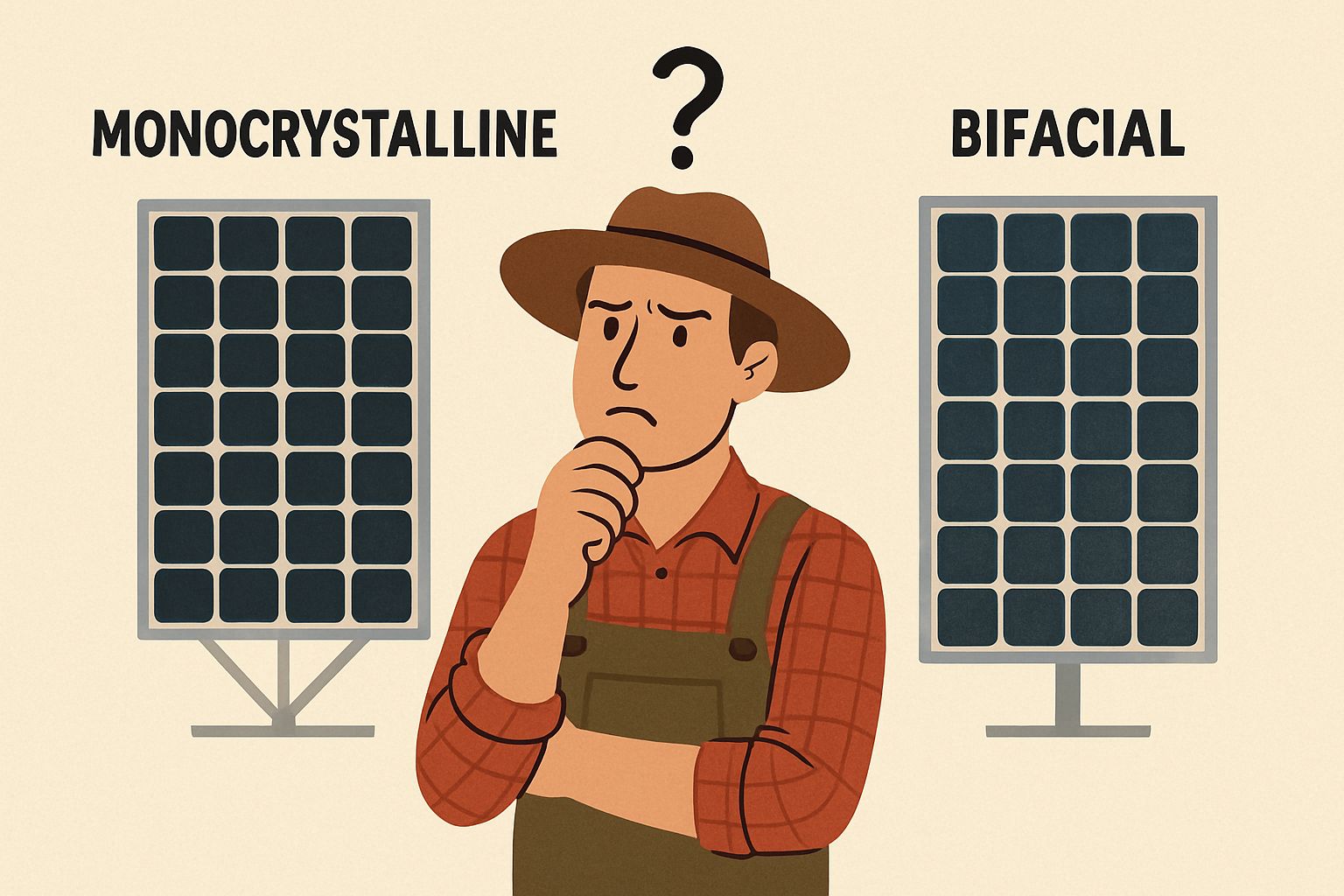
Cost Comparison: Initial Investment vs. Lifetime Returns
The financial equation for farm solar installations must balance initial capital outlay against decades of energy generation. Monocrystalline panels typically command a 10-15% premium over standard polycrystalline options, while bifacial technology adds another 5-10% to system costs. However, these price differentials continue to narrow as manufacturing scale increases for these advanced technologies.
When calculating lifetime returns, the increased production from high-efficiency monocrystalline or bifacial panels often justifies their higher upfront costs. A properly designed bifacial system generating 20% more energy might cost only 10% more initially, creating a net financial advantage over the system lifetime. This advantage becomes particularly significant when factoring in fixed costs like inverters, mounting hardware, and installation labor that remain relatively constant regardless of panel efficiency.
|
Panel Type |
Typical Efficiency |
Relative Cost |
25-Year Production* |
Best Farm Application |
|---|---|---|---|---|
|
Standard Monocrystalline |
17-20% |
$$ |
Baseline |
Roof-mounted, space-constrained |
|
Premium Monocrystalline |
20-22% |
$$$ |
+5-10% |
High-value roof space, premium systems |
|
Bifacial |
17-22% (front) + rear gain |
$$$ |
+10-30% |
Ground-mounted, agrivoltaic systems |
Calculating Your Farm’s Payback Period
Payback periods for agricultural solar installations vary widely based on electricity rates, available incentives, and system design. In areas with high electricity costs ($0.15+/kWh), modern solar installations typically achieve payback in 5-8 years. Farms with consistent daytime energy usage patterns—like dairy operations or cold storage facilities—see faster returns as they directly offset retail electricity rates rather than relying on net metering or lower-value grid exports.
The economic analysis must account for panel degradation over time. Quality monocrystalline panels typically lose 0.3-0.5% of production capacity annually, while many bifacial panels advertise even lower degradation rates of 0.25-0.4% per year. This seemingly small difference compounds significantly over decades, potentially adding thousands of kilowatt-hours of lifetime production and associated financial returns.
Available Agricultural Solar Incentives and Tax Credits
Agricultural solar installations benefit from multiple incentive programs that dramatically improve financial returns. The federal Investment Tax Credit (ITC) provides a substantial tax credit worth 30% of the system cost through 2032, while accelerated depreciation allows farms to deduct the system value over just 5 years. Combined, these tax benefits can recover 45-60% of system costs for profitable farming operations.
Many states offer additional incentives specifically targeting agricultural solar adoption, including production-based incentives, property tax exemptions, and grant programs. The USDA’s Rural Energy for America Program (REAP) provides grants covering up to 25% of project costs and guaranteed loan financing for the remainder, making comprehensive solar investments accessible even for farms with limited capital reserves.
Real-World Performance: What Actually Works on Farms
The theoretical advantages of different panel technologies matter less than real-world performance in actual agricultural settings. Field data consistently shows that system design and installation quality frequently impact performance more than panel type selection. Proper system sizing, orientation, and maintenance protocols often make larger differences than marginal efficiency gains between premium panel technologies.
Dairy Farm Case Study: How Monocrystalline Panels Reduced Energy Bills by 85%
A 150-cow dairy operation in Wisconsin installed 75kW of premium monocrystalline panels on south-facing barn roofs, specifically targeting the significant electricity demand from milk cooling, vacuum pumps, and water heating. The rooftop installation avoided using productive land while positioning generation directly above primary energy consumption points, minimizing transmission losses. Despite the northern location with fewer sun hours, the high-efficiency panels generate approximately 95,000 kWh annually, offsetting 85% of the operation’s electricity consumption.
The project economics were compelling: $150,000 total investment, reduced to effectively $67,500 after applying the 30% federal tax credit and accelerated depreciation benefits. With electricity savings of approximately $14,250 annually, the system achieved payback in under 5 years while significantly reducing the operation’s exposure to rising electricity rates. The system’s 25-year warranty provides long-term cost certainty for a major operational expense category.
Row Crop Farm Results: Bifacial Panels in Agrivoltaic Systems
A diversified 500-acre row crop operation in Illinois installed a 200kW bifacial solar array elevated 10 feet above a 1-acre section previously used for conventional crop production. The elevated mounting system permits continued agricultural use beneath the panels, with the farmer successfully cultivating shade-tolerant specialty crops generating $4,000-$6,000 per acre annually—nearly matching the revenue from conventional crops on neighboring fields.
The bifacial system generates approximately 280,000 kWh annually, approximately 15-20% more than an equivalent monocrystalline installation would produce at the same location. This additional production, combined with the continued agricultural revenue, creates a compelling financial case despite the higher initial installation cost. The system powers irrigation pumps, grain drying equipment, and other seasonal loads directly while exporting excess production to the grid during less intensive farming periods.
Performance in Extreme Weather Conditions
Agricultural solar installations face harsher environmental conditions than residential or commercial systems, making resilience crucial. Field data shows bifacial panels particularly excel during winter months in northern farming regions, where snow cover significantly increases rear-side reflection while simultaneously clearing snow more quickly due to their elevated mounting and dual-sided warming. This winter performance advantage can partially offset seasonal production variations that impact farm cash flow.
Heat tolerance increasingly matters as climate patterns shift. Both premium monocrystalline and bifacial panels typically offer better high-temperature performance coefficients than standard panels, losing less production capacity during extreme heat events. The elevated mounting required for bifacial panels provides additional airflow that reduces operating temperatures, sometimes yielding 2-3% higher summer production compared to roof-mounted systems that trap heat against building surfaces.
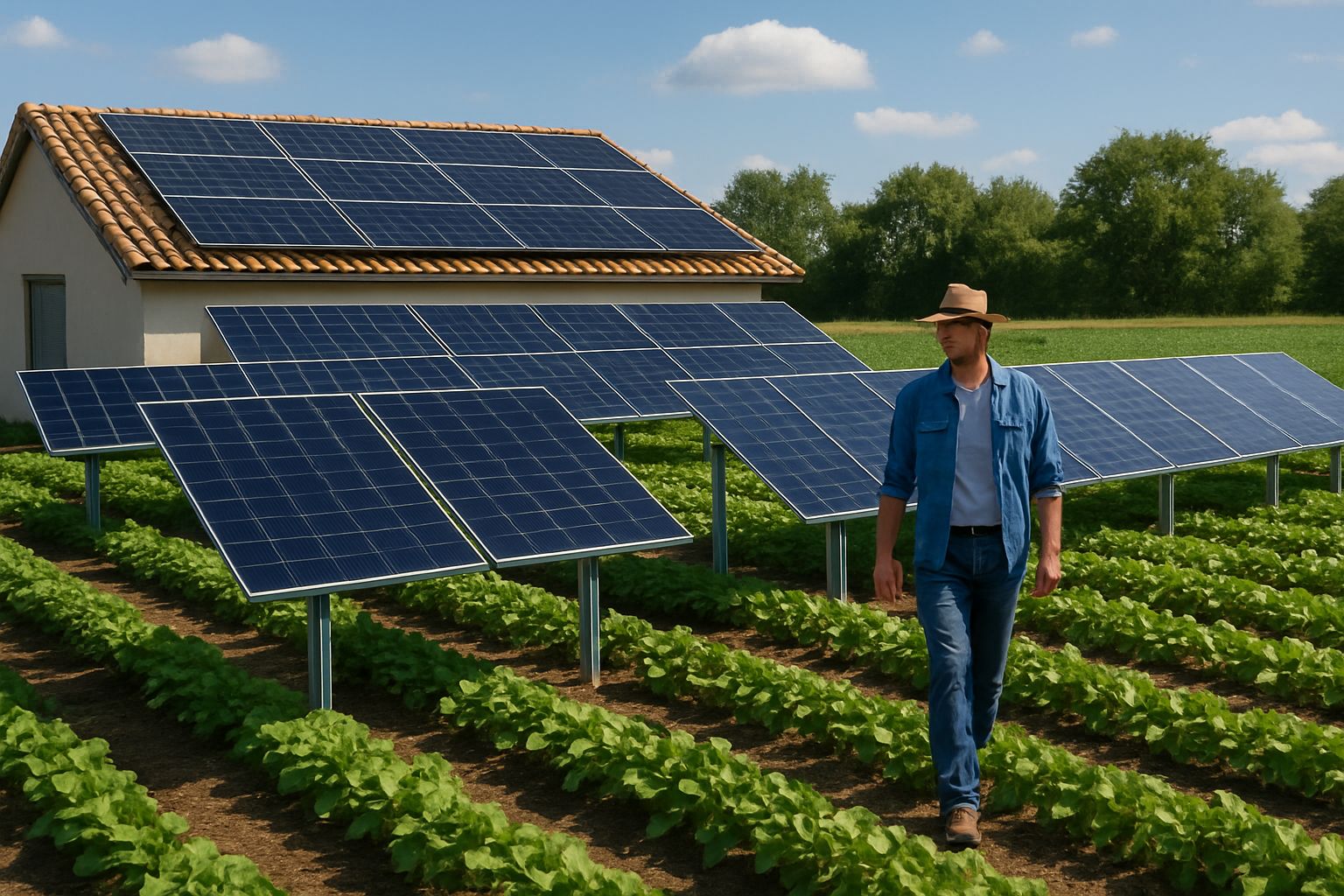
Decision Matrix: Matching Panel Type to Your Specific Farm
Best Choice for Dairy and Livestock Operations
Dairy and livestock facilities typically offer extensive roof areas with steady, year-round electricity demands for ventilation, cooling, and processing equipment. These operations generally benefit most from high-efficiency monocrystalline panels mounted on south-facing barn roofs. The compact footprint maximizes energy density on available roof space, while the premium efficiency ensures maximum production during both peak summer cooling periods and shorter winter days when lighting demands increase.
Ideal Panel Selection for Crop Farms
Row crop operations with available land often see superior returns from bifacial ground-mounted systems implemented as agrivoltaic installations. The dual-use approach maintains agricultural productivity while generating electricity, effectively doubling land-use efficiency. Elevated bifacial arrays can be strategically positioned along field margins, over irrigation ponds, or integrated with precision irrigation systems to maximize overall farm productivity while creating beneficial partial shade for certain crop varieties.
Solutions for Mixed Farming Operations
Diversified farms typically benefit from hybrid approaches combining both technologies. Roof-mounted monocrystalline panels can serve base electrical loads, while ground-mounted bifacial arrays positioned over less productive land areas provide additional capacity for seasonal demands like grain drying or irrigation. This hybrid strategy often delivers the optimal combination of space efficiency, energy production, and financial returns.
When analyzing mixed operations, prioritize placing generation capacity nearest to consumption points to minimize transmission losses and electrical infrastructure costs. For remote pumping stations or outbuildings not easily connected to main electrical systems, small dedicated solar arrays with battery storage often prove more economical than extending utility lines or main system connections.
Future-Proof Your Farm with the Right Solar Technology
- Scalable system design that allows for future expansion as farm energy needs grow
- Battery storage compatibility to capture excess production for evening use or emergency backup
- Smart energy management systems that prioritize on-farm consumption over grid export
- Monitoring technology that identifies maintenance needs before production losses occur
- Robust mounting systems designed for agricultural environments and potential equipment contact
Forward-thinking farm solar installations should anticipate future energy requirements as operations expand or electrify additional processes. Selecting inverter systems with excess capacity allows for panel additions without replacing core system components. Similarly, choosing battery-ready inverters provides flexibility to add storage capacity as prices continue to decline or if grid reliability becomes problematic.
The regulatory landscape continues evolving, with many utilities shifting toward time-of-use rates and reduced net metering compensation. These changes typically favor high-efficiency monocrystalline panels for systems focused on immediate self-consumption, while bifacial systems with east-west orientations may better capture morning and afternoon production to match extended daily farm operations.
Agricultural carbon credit programs increasingly recognize solar adoption as a qualifying carbon-reduction strategy, creating additional revenue streams beyond direct energy savings. Documenting baseline energy consumption before installation establishes verification metrics that maximize potential carbon credit values, which can contribute thousands of dollars annually to large farm operations.
Conclusion:
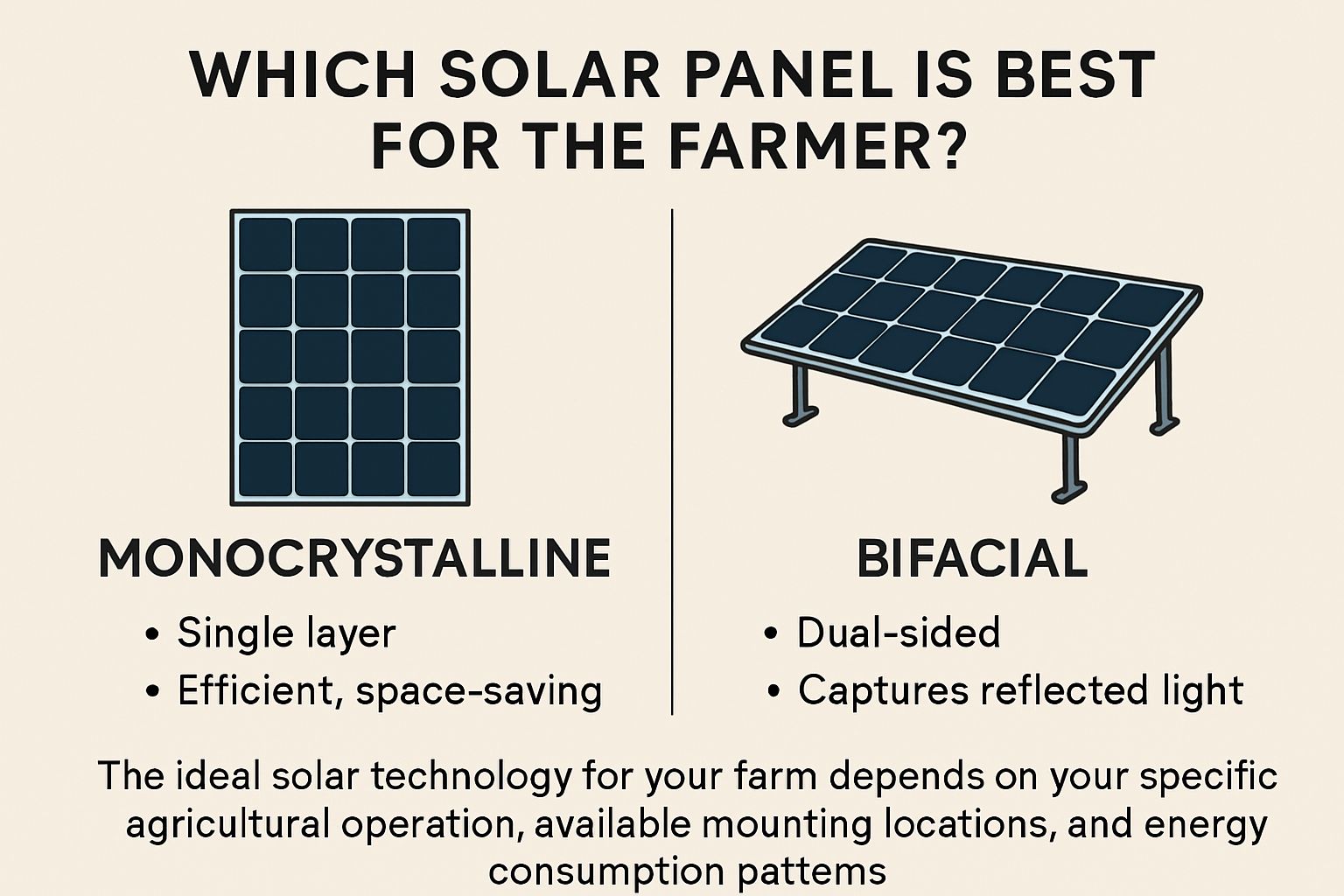
Which Solar Panel is best for the Farmer, Monocrystalline or Bifacial
The ideal solar technology for your farm depends on your specific agricultural operation, available mounting locations, and energy consumption patterns. Monocrystalline panels excel in space-constrained applications where maximum production per square foot justifies their premium price, making them ideal for most roof installations. Bifacial technology delivers superior returns for ground-mounted systems with appropriate elevation and surface reflectivity, particularly when combined with continued agricultural use beneath the arrays. The best approach often combines both technologies to maximize the unique advantages each offers for different aspects of farm operations. Whatever your choice, properly designed agricultural solar systems represent one of the most reliable long-term investments available to modern farming operations, delivering decades of clean energy with minimal maintenance requirements.
Frequently Asked Questions
Agricultural solar installations come with unique considerations that differ from residential or commercial applications. Below are answers to the most common questions farmers ask when evaluating solar panel options for their operations.
These questions address specific agricultural concerns about system performance, installation requirements, and financial considerations that impact technology selection decisions.
How much more electricity do bifacial panels really produce compared to monocrystalline panels?
In typical agricultural installations, properly mounted bifacial panels generate 10-20% more electricity than equivalent monocrystalline panels. This “bifacial gain” varies significantly based on mounting height, ground reflectivity, and system design. The highest gains (25-30%) occur in systems elevated 3+ feet over highly reflective surfaces like white gravel or snow cover, while more modest improvements (8-15%) are typical over natural vegetation or soil. This production advantage must be weighed against the 5-10% higher system cost when calculating overall return on investment.
Can I mix both panel types in a single farm solar system?
Yes, hybrid systems often deliver optimal results for diverse farm operations. Roof-mounted monocrystalline arrays can provide base power production while strategically positioned ground-mounted bifacial panels handle peak seasonal demands or maximize production during specific seasonal needs. The key consideration is string design—panels with different electrical characteristics should be connected to separate inverter inputs to prevent performance limitations.
Many successful farm installations use premium monocrystalline panels on building roofs while deploying bifacial panels on trackers in field margins or over water features where reflection potential is highest. This approach maximizes the unique advantages of each technology based on specific installation conditions.
System designers must ensure compatible inverter technology when mixing panel types. Modern string inverters with multiple MPP trackers or microinverter-based systems provide the necessary flexibility to optimize performance across diverse panel technologies within a single interconnected system.
Which panel type handles snow and dust accumulation better?
Bifacial panels typically shed snow more quickly than traditional panels due to their elevated mounting position and dual-sided warming effect. The glass-on-glass construction heats more uniformly, helping melt snow from both sides simultaneously. For dust accumulation, bifacial panels with proper elevation experience better natural cleaning from rainfall and wind circulation compared to roof-mounted systems, though seasonal manual cleaning may still be necessary in especially dusty agricultural environments.
Are there specific mounting requirements for bifacial panels on farms?
Bifacial panels require elevated mounting—typically minimum 3 feet clearance, with 4-6 feet optimal for most agricultural applications—to maximize rear-side light capture. The mounting structure must avoid creating shadows on the panel rear and should incorporate open-frame designs that minimize light obstruction. Cable management becomes more critical with bifacial installations to prevent rear-side shading from wiring harnesses.
Agricultural installations often use specialized agrivoltaic mounting systems that provide sufficient clearance for equipment passage or livestock grazing beneath the arrays. These systems typically feature wider row spacing between panel groups compared to conventional installations, sacrificing some land-use efficiency to maintain agricultural productivity of the underlying acreage.
How do these panel types affect my eligibility for USDA REAP grants?
Both monocrystalline and bifacial solar panels qualify for USDA Rural Energy for America Program (REAP) grants and guaranteed loans, provided the installation serves a rural small business or agricultural producer. REAP scoring criteria particularly favor innovative approaches like bifacial agrivoltaic systems that maintain agricultural productivity while generating renewable energy. Applications demonstrating multiple agricultural benefits—like providing animal shelter, reducing irrigation needs through partial shading, or enabling new crop varieties—typically receive higher scores in the competitive grant evaluation process.
The program provides grants for up to 25% of total eligible project costs and loan guarantees for up to 75% of total eligible project costs. While panel technology doesn’t directly impact eligibility, systems demonstrating higher efficiency and productivity per acre often score better in the evaluation process, potentially giving premium technologies a slight advantage in the highly competitive grant program.
For maximum REAP success, work with an agricultural solar specialist familiar with the program requirements to develop a comprehensive application highlighting the specific ways your selected panel technology addresses unique farm energy challenges while supporting broader rural development goals. Growing Solar Mist specializes in helping farmers navigate these complex funding opportunities to maximize financial support for sustainable energy transitions that strengthen the economic resilience of rural agricultural operations.



Leave a Reply