

Article At a Glance
- PERC panels convert more sunlight into electricity by using a passivation layer that recaptures light that would otherwise be lost — giving them a 5-6% efficiency edge over standard solar panels.
- Bifacial panels can generate 20-30% more energy annually than equivalent monofacial panels by capturing reflected light from the ground on their rear side — making panel placement and ground surface critical factors.
- For most farm rooftop installations, PERC panels are the more practical and cost-effective choice, while bifacial panels shine in open ground-mounted systems with high-albedo surfaces beneath them.
- Bifacial PERC hybrid panels are an emerging technology combining both advantages — keep reading to find out why they are gaining traction in agricultural settings.
- Growing Solar Mist breaks down complex solar decisions for farmers, helping agricultural operations find the right technology match for their specific land and energy needs.
PERC vs Bifacial Solar Panels: Here Is What Farmers Need to Know First
Choosing the wrong solar panel technology for your farm can mean leaving thousands of dollars in energy savings on the table over a 25-year system lifespan.
The debate between PERC and bifacial solar panels is not just a technical one — it is a financial decision that depends heavily on your specific farm setup, geography, and energy goals. Both technologies outperform standard conventional panels, but they do it differently and they each have a clear home turf where they dominate. Understanding that difference is what separates a good solar investment from a great one.
For farmers navigating these decisions, Growing Solar Mist provides deep-dive agricultural solar guidance tailored specifically to farm operations — not generic homeowner advice. Whether you are powering a poultry barn, an irrigation system, or an entire grain operation, the panel type you choose matters more than most installers will tell you.
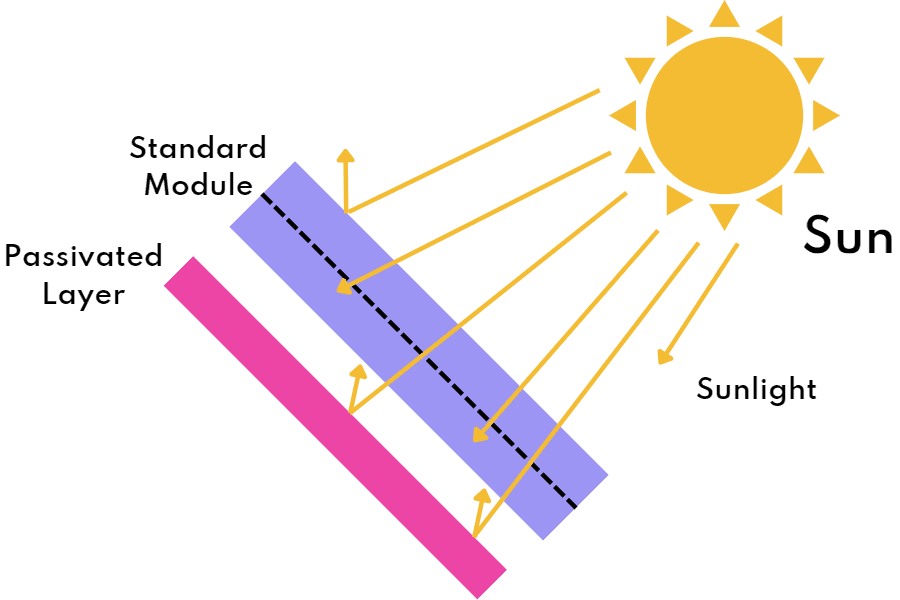
“PERC Cell Technology: Everything You …” from voltanic.solar and used with no modifications.
What Is a PERC Solar Panel?
PERC stands for Passivated Emitter and Rear Cell. It is a refinement of the standard monocrystalline solar cell design, and it has become the dominant solar panel technology in commercial agriculture over the past decade. The core idea is straightforward: standard solar cells waste a significant portion of incoming sunlight because photons that pass through the cell without being absorbed are simply lost. PERC panels fix that problem.
How the Passivation Layer Boosts Efficiency
At the rear of a PERC cell sits a specially engineered passivation layer — a dielectric coating that serves two critical functions. First, it reflects unabsorbed photons back into the silicon cell for a second absorption attempt, recovering light that a standard cell would waste. Second, it reduces electron recombination at the rear surface, which is a process where electrons lose their energy before they can be converted into usable electricity. Less recombination means more electrons complete the circuit and contribute to power output.
The result is a measurable and consistent efficiency gain. In real-world farm applications, PERC panels deliver efficiency improvements typically in the range of 5-6% over conventional panels, and commercial PERC modules now commonly achieve cell efficiencies between 20% and 23%. That might sound modest, but across a large agricultural installation covering barn rooftops or open land, the cumulative energy gain is substantial.
Why PERC Panels Perform Better in Heat and Low Light
One of the most practical advantages of PERC technology for farm environments is its performance stability across variable conditions. Farms are not climate-controlled environments — panels bake in summer heat and work through overcast winter days. PERC panels handle both scenarios better than standard panels because the passivation layer maintains higher electron flow efficiency even as temperatures rise. Conventional panels lose a meaningful percentage of output on hot days, while PERC panels show a lower temperature coefficient, meaning less efficiency loss per degree of heat.
Low-light performance is equally important for agricultural solar systems, particularly in regions with significant cloud cover or morning fog. The passivation layer’s ability to capture more of the available photons means PERC panels start generating useful power earlier in the day and continue generating longer into the evening than standard alternatives. For farms running irrigation pumps or refrigeration equipment on solar power, this extended daily generation window directly translates to operational reliability.
Current PERC Efficiency Ranges in Commercial Panels
Commercial PERC panels available today typically fall in the 20% to 23% efficiency range at the module level. Leading manufacturers have pushed laboratory results beyond this, but real-world agricultural deployments consistently land in this window. For a mid-sized farm installation, this efficiency range allows meaningful energy generation from limited rooftop space — a critical factor when barn roof geometry restricts how many panels can be mounted.
What Is a Bifacial Solar Panel?
Bifacial solar panels do exactly what the name suggests — they generate electricity from both the front and the rear of the panel. While a standard panel has an opaque back sheet that blocks light, a bifacial panel uses a transparent or semi-transparent rear surface, typically glass-on-glass or a transparent polymer backsheet, allowing the rear solar cells to capture light reflected up from the ground and surrounding surfaces. For more details on their material composition and agricultural uses, you can explore further resources.
How Bifacial Panels Generate Power From Both Sides
The front face of a bifacial panel works identically to any high-quality monocrystalline panel, capturing direct and diffuse sunlight. The rear face captures albedo light — sunlight that has bounced off the ground surface beneath the array. This reflected light contribution varies significantly based on what sits beneath the panels. Light-colored gravel, white sand, concrete, or snow-covered ground reflects substantially more light than dark soil or green grass. In optimal agricultural installations with high-albedo surfaces, bifacial panels can draw meaningful additional power from the rear face throughout the day as the sun angle shifts.
How Much Extra Energy Bifacial Panels Can Realistically Produce
The energy gain from bifacial panels is real, but it is highly site-dependent. In optimal agricultural installations, bifacial panels typically produce 20-30% more energy annually than equivalent monofacial panels. In snowy conditions, winter performance advantages can reach 35-40% due to the highly reflective snow surface beneath ground-mounted arrays. However, on a dark-soil farm field with panels mounted close to the ground, that rear-side contribution can drop considerably — sometimes to less than 5-10% additional output. Elevation above the ground surface, row spacing, and ground cover type are all variables that bifacial system design must account for carefully.

PERC vs Bifacial: Side-by-Side Performance on Farms
When comparing PERC and bifacial panels head-to-head in an agricultural context, the performance story depends almost entirely on where and how the panels are installed. There is no single winner across every farm scenario — but there are clear patterns that make the decision straightforward once you know your setup.
Energy Output Per Square Foot of Farm Space
When farm space is limited, efficiency per square foot becomes the deciding metric. PERC panels, with their 20-23% module efficiency, consistently deliver strong output from compact rooftop footprints. A typical 400W PERC panel produces that rated output from roughly 21-22 square feet of surface area. Bifacial panels of similar dimensions may produce equivalent front-side output, but their real advantage only materializes when the installation design actively maximizes rear-side light capture — which requires specific mounting height, row spacing, and ground surface planning that rooftop installations simply cannot accommodate.
Performance in Partial Shade and Cloudy Conditions
Partial shading is a genuine challenge on working farms. Trees, grain bins, water towers, and adjacent structures can all cast shadows across panel arrays at different times of day. PERC panels handle partial shading reasonably well, particularly when paired with microinverters or DC power optimizers that allow each panel to operate independently rather than dragging down the output of an entire string.
Bifacial panels under partial shade conditions present a more complex picture. While their front-side shading response is similar to PERC panels, shading on a bifacial panel can affect rear-side performance differently depending on mounting configuration. In diffuse light conditions — overcast skies typical of Midwest winters or Pacific Northwest farm operations — both panel types perform competitively, though PERC panels tend to show more predictable and stable output curves that make energy budgeting easier for farm managers.
Temperature Tolerance Across Seasons
Temperature coefficient is a specification that deserves far more attention from farmers than it typically gets. This figure tells you how much output a panel loses for every degree Celsius the panel temperature rises above 25°C (77°F). Standard panels typically have temperature coefficients around -0.45% to -0.50% per °C. Quality PERC panels improve on this, often coming in at -0.35% to -0.40% per °C, which translates to meaningfully better summer performance in hot agricultural climates across the American South and Southwest.
Bifacial panels generally share similar temperature coefficients to PERC panels since most bifacial products are also built on PERC cell technology. The bifacial advantage in cold weather comes from a different mechanism entirely — snow on the ground beneath a raised ground-mounted bifacial array acts as a highly reflective surface, boosting rear-side generation precisely when front-side output is reduced by low winter sun angles. For farms in northern states with significant snowfall, this seasonal dynamic can meaningfully tilt the annual energy calculation in favor of bifacial ground-mounted systems.
Real Cost Comparison for Farm Installations
Cost comparisons between PERC and bifacial systems need to go beyond the panel price tag. Installation configuration, mounting hardware, inverter selection, and ground preparation all factor into the true system cost — and bifacial installations carry additional requirements that affect the final number.
Upfront Cost Difference Between PERC and Bifacial Systems
At the panel level, bifacial modules typically carry a 10-20% price premium over comparable PERC monofacial panels. On a 100kW farm installation, that premium can represent a meaningful upfront difference. Beyond the panels themselves, bifacial systems require elevated racking structures to maximize rear-side light capture, which adds mounting hardware costs. Ground preparation to establish a high-albedo surface — white gravel, reflective sheeting, or concrete — adds further to the upfront investment. PERC rooftop installations on existing barn structures avoid most of these additional costs, using the existing roof as the mounting surface with standard racking hardware.
Payback Period: Which Technology Pays Off Faster
For rooftop farm installations, PERC panels typically deliver payback periods in the 4-7 year range — a significant improvement over the 6-9 years common with conventional panels. Bifacial ground-mounted systems, while generating more total energy over their lifetime when properly installed, carry higher upfront costs that can push the initial payback period slightly longer unless energy production gains are substantial. The break-even math shifts in bifacial’s favor on large open-land installations where the higher production volumes offset the added system costs within a competitive timeframe. Agricultural tax incentives, including the federal Investment Tax Credit (ITC), apply equally to both technologies and significantly compress payback timelines for qualifying farm operations.
Long-Term ROI Over a 25-Year System Lifespan
Over a full 25-year system lifespan, the ROI comparison between PERC and bifacial systems becomes a function of cumulative energy production versus total installed cost. A well-designed bifacial ground-mounted system on a farm with favorable albedo conditions will generate more total kilowatt-hours over 25 years than an equivalent-capacity PERC rooftop system. However, both technologies deliver strong long-term returns for agricultural operations, with the bulk of the economic value coming after the payback period — essentially free electricity for the remaining 18+ years of system life.
Degradation rates matter significantly in a 25-year calculation. Quality PERC panels degrade at approximately 0.5% per year, meaning a panel rated at 400W today will still produce around 88% of its original output at year 25. Bifacial panels built on PERC cell technology show comparable degradation profiles. Both significantly outperform older thin-film and polycrystalline technologies in long-term output retention, making either choice a durable investment for farm energy infrastructure.
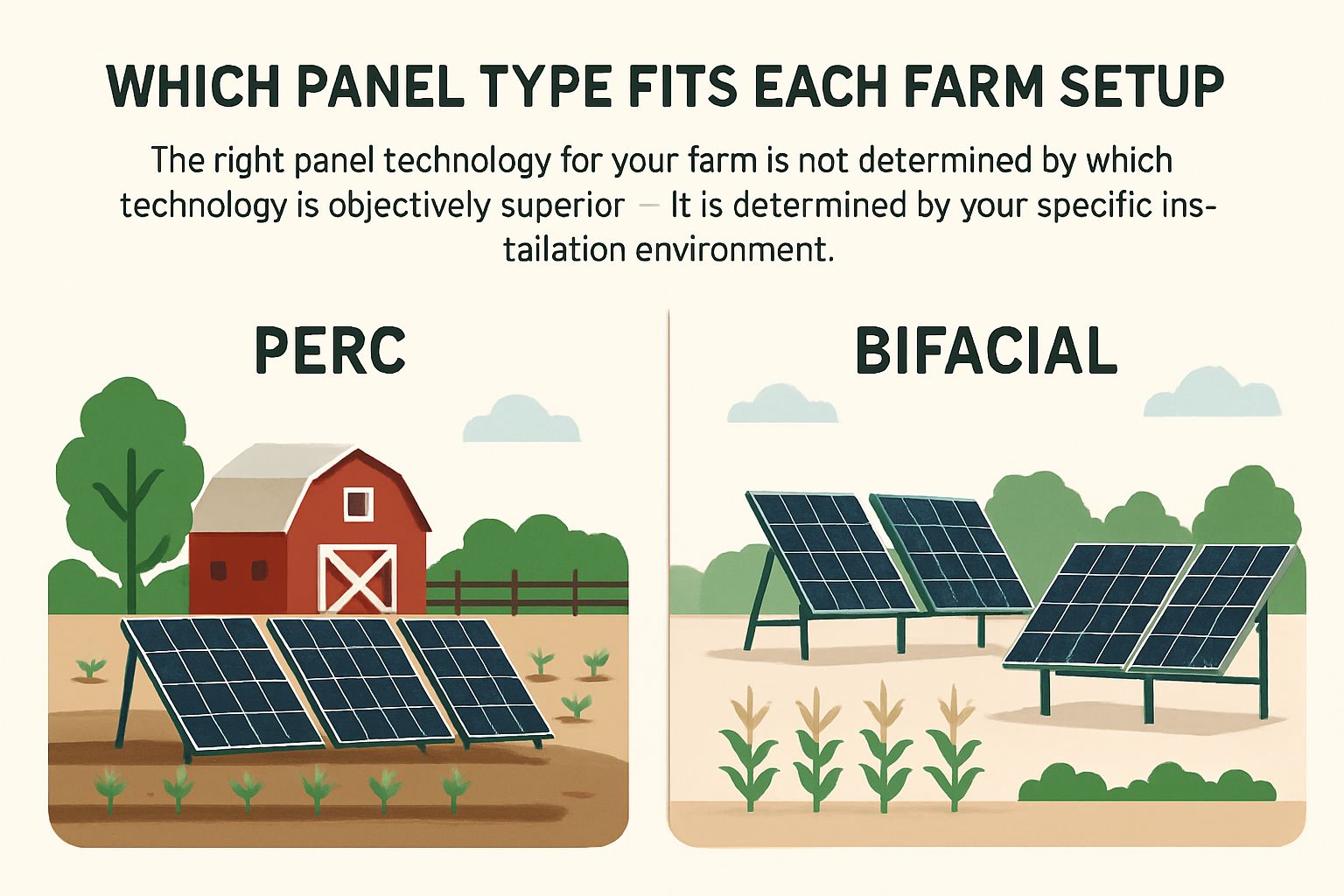
Which Panel Type Fits Each Farm Setup
The right panel technology for your farm is not determined by which technology is objectively superior — it is determined by your specific installation environment. Here is how the decision breaks down across the most common agricultural solar scenarios.
Ground-Mounted Systems on Open Agricultural Land
Open farmland with available acreage that is not actively needed for crops or grazing is the natural home territory for bifacial panels. When a ground-mounted system is designed with elevated racking — typically 1.5 to 2 feet minimum clearance above the ground surface — and a high-albedo material beneath the array, bifacial panels deliver their full energy advantage. Row spacing in ground-mounted bifacial systems is also deliberately wider than in standard ground-mount designs, allowing more light to reach the ground between rows and bounce back to the rear cells.
For farms with darker soil or native ground cover that cannot be modified, the bifacial advantage narrows considerably. In these cases, the additional cost of the bifacial system may not be justified by the actual rear-side production gains at that specific site. A qualified solar installer should conduct an albedo assessment and site-specific energy modeling before recommending bifacial over PERC for any ground-mounted farm installation.
Rooftop Installations on Barns and Farm Buildings
Rooftop installations are where PERC panels have a clear and consistent advantage over bifacial alternatives. A rooftop-mounted bifacial panel simply cannot access meaningful rear-side light — the roof surface beneath blocks any reflected light from reaching the rear cells. Installing a premium bifacial panel flat against a barn roof means paying the bifacial price premium while only receiving monofacial performance. For barn rooftops, equipment sheds, poultry houses, and any other agricultural building installation, PERC monofacial panels deliver the best combination of performance and cost efficiency. Their proven efficiency, excellent temperature tolerance, and strong low-light performance make them the go-to choice for agricultural rooftop solar across every farm type and size.
Agrivoltaic Systems Where Panels and Crops Share Space
Agrivoltaic farming — where solar panels and active crop production share the same land — is one of the fastest-growing applications in agricultural solar, and panel selection here requires careful thinking. In a well-designed agrivoltaic system, panels are mounted significantly higher than standard ground-mount configurations, often 8 to 14 feet above ground level, to allow farm equipment to operate beneath them and to ensure crops receive adequate direct sunlight. This elevated mounting geometry is naturally favorable for bifacial panels, as the increased height above the ground surface maximizes rear-side light capture from the soil and crop canopy below.
However, the crop type matters enormously in the panel selection decision. Shade-tolerant crops like leafy greens, herbs, and certain berry varieties actually benefit from the partial shading that solar panels provide, reducing water stress and heat damage during peak summer periods. In these systems, bifacial panels mounted at optimal height deliver strong energy production while the crops below benefit from modified light conditions. For row crops that require maximum sunlight — corn, soybeans, wheat — the agrivoltaic design must prioritize wider panel spacing and higher mounting to minimize crop yield impact, which simultaneously improves bifacial rear-side production conditions.
PERC monofacial panels also have a legitimate place in agrivoltaic designs, particularly where budget constraints make the bifacial premium difficult to justify or where ground surface albedo is low due to dense crop cover. The decision ultimately comes down to a site-specific energy model that weighs panel cost, mounting system cost, expected rear-side gain from the actual crop canopy albedo, and the value of the agricultural output from the land below. Either technology can anchor a productive agrivoltaic system — the key is matching the panel choice to the actual conditions of the specific installation rather than defaulting to one technology across every farm scenario. For more information on maximizing energy with bifacial solar panels, check out this article on bifacial solar panels.
Bifacial PERC Panels: The Emerging Hybrid Option
Most bifacial panels on the market today are already built on PERC cell technology — meaning they combine the passivation layer efficiency gains of PERC with the dual-sided light capture of bifacial design. This bifacial PERC combination represents the current leading edge of mainstream agricultural solar technology. A bifacial PERC panel captures more photons on the front face through the passivation layer’s recycling mechanism, and simultaneously harvests reflected albedo light on the rear face — delivering both efficiency advantages in a single module. In the right installation environment, these panels represent the highest energy yield per panel available in commercial agricultural solar today.
The practical consideration for farmers evaluating bifacial PERC modules is that they require the installation conditions that allow bifacial rear-side gains to materialize — primarily elevated mounting, wide row spacing, and favorable ground albedo. Without those conditions, a bifacial PERC panel performs essentially as a high-quality PERC monofacial panel at a higher price point. As manufacturing scale increases and the price premium for bifacial PERC modules narrows, they are becoming the default choice for new ground-mounted agricultural installations where the site conditions support rear-side generation. For rooftop applications, standard PERC monofacial panels remain the more economical and equally effective choice.
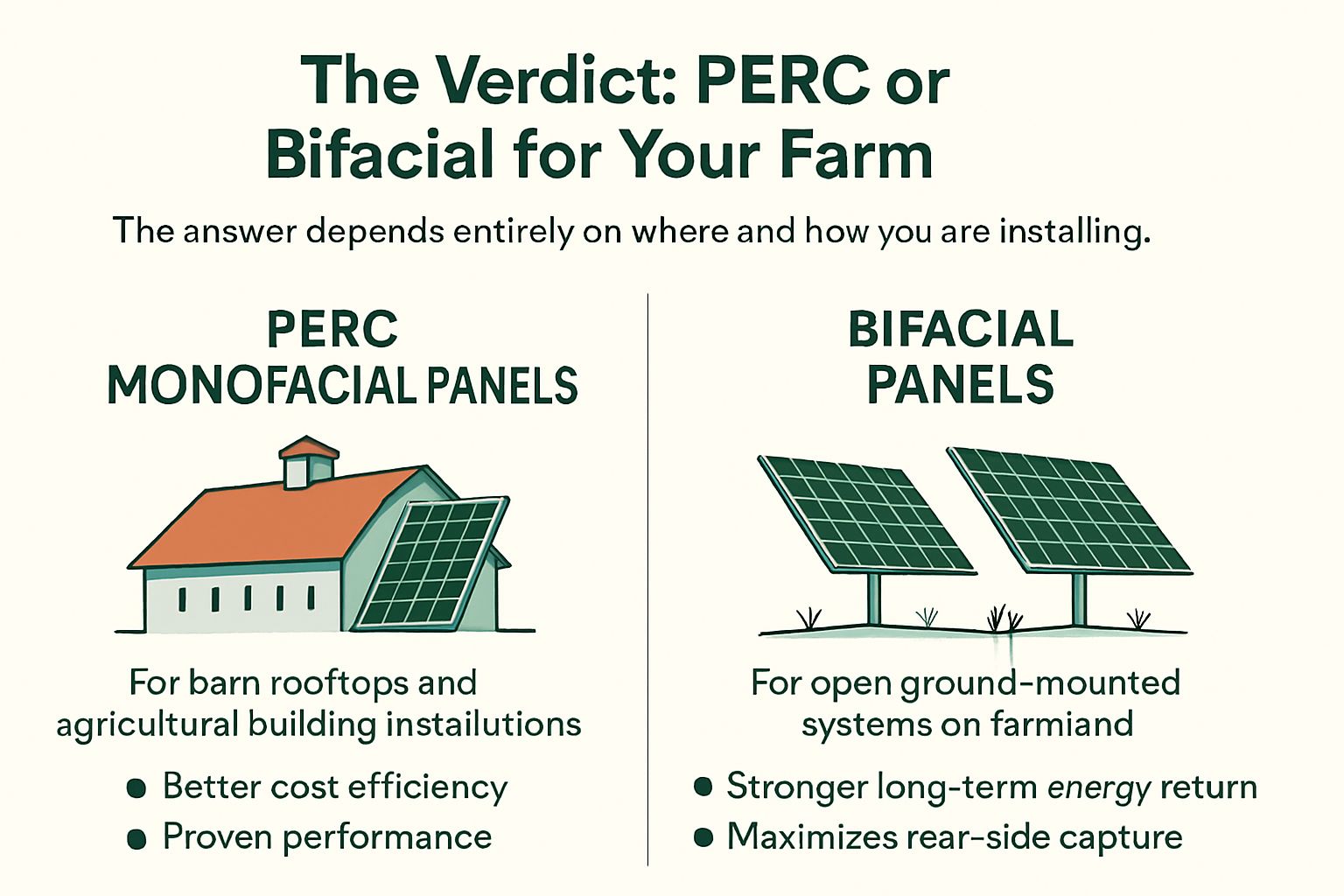
The Verdict: PERC or Bifacial for Your Farm
The answer depends entirely on where and how you are installing. For barn rooftops and agricultural building installations, PERC monofacial panels are the clear choice — better cost efficiency, proven performance, and no wasted bifacial premium on a mounting surface that blocks rear-side light. For open ground-mounted systems on farmland with favorable albedo conditions, bifacial panels — ideally bifacial PERC modules — deliver the stronger long-term energy return when the system is designed to maximize rear-side capture. For agrivoltaic systems, bifacial panels gain the edge when mounting height and crop type support meaningful rear-side production. Either way, both technologies outperform conventional panels significantly, and the payback periods and 25-year ROI for agricultural solar make a compelling financial case regardless of which direction your farm’s specific setup points.
Frequently Asked Questions
These are the questions farmers most commonly ask when evaluating PERC versus bifacial solar panels for agricultural installations.
Are Bifacial Solar Panels Worth the Extra Cost for Small Farms?
For small farms, the answer depends heavily on the installation type. If a small farm is mounting panels on an existing barn or equipment shed roof, bifacial panels are generally not worth the price premium — the rooftop blocks rear-side light, so the bifacial advantage simply does not exist in that configuration. A quality PERC monofacial panel delivers equivalent performance at lower cost. If a small farm has open land suitable for a ground-mounted system with elevated racking and good ground albedo, bifacial panels become more justifiable — but the smaller the system, the more the upfront cost premium weighs against the long-term energy gain. Small farm operators should run a site-specific energy model with actual albedo data before paying the bifacial premium.
Can PERC Panels Handle the Harsh Outdoor Conditions on a Farm?
PERC panels are built for exactly the kind of demanding outdoor environments that farms present. Quality commercial PERC panels are rated to IEC 61215 and IEC 61730 standards, which cover mechanical load resistance (including snow and wind), hail impact resistance, humidity and temperature cycling, and UV exposure degradation. Standard commercial PERC panels are rated to withstand hail up to 25mm diameter at 23 m/s impact velocity — sufficient for most agricultural hail events. For farm regions with extreme hail risk, glass-on-glass bifacial PERC panels actually offer superior physical durability compared to standard backsheet PERC panels due to the tempered glass rear surface replacing the more vulnerable polymer backsheet.
Dust, bird droppings, and agricultural chemical residue are practical maintenance considerations for any farm solar installation. PERC panels with anti-reflective coated tempered glass fronts shed rain-driven debris reasonably well, but farms with heavy dust exposure — particularly near grain handling operations — benefit from a periodic cleaning schedule to maintain optimal output. A surface soiling loss of even 5-7% on uncleaned panels in dusty agricultural environments is not uncommon, and that loss applies equally to PERC and bifacial panels. The front surface maintenance requirements are identical between the two technologies.
What Efficiency Should Farmers Expect From PERC Panels in Real Conditions?
Condition
Standard Panel Efficiency
PERC Panel Efficiency
Bifacial PERC Efficiency
Standard Test Conditions (STC)
15–17%
20–23%
20–23% (front) + rear gain
High Temp (45°C panel temp)
Significant loss (~‑0.45%/°C)
Lower loss (~‑0.35%/°C)
~‑0.35%/°C
Low Light / Overcast
Noticeable drop
Better retention
Better retention
Ground-Mount with Snow Below
Standard output
Standard output
Up to 35–40% boost from rear
Rooftop Barn Installation
Baseline
5–6% above baseline
Same as PERC (no rear gain)
Real-world efficiency for PERC panels on operating farms consistently lands in the 19-21% range when accounting for installation losses, wiring losses, inverter efficiency, and real-world temperature conditions — slightly below the lab-rated STC efficiency, which is measured under ideal controlled conditions. This gap between rated and real-world efficiency is normal and expected across all panel technologies.
The more useful figure for farm energy planning is the Performance Ratio (PR) — the ratio of actual energy output to theoretical maximum output given the solar irradiance at the site. Well-designed agricultural PERC installations typically achieve PR values of 75-85%, with the losses accounted for by temperature, soiling, wiring, and inverter conversion. Bifacial systems can show higher effective PR values when rear-side gains are factored into the calculation against the rated front-side capacity.
Farmers should always request energy production estimates in annual kilowatt-hours (kWh) from their installer rather than focusing solely on panel efficiency percentages. A 20% efficient panel on a well-oriented barn roof in a high-irradiance location will outperform a 22% efficient panel on a poorly oriented, partially shaded rooftop every single year. Orientation, tilt angle, shading analysis, and local solar irradiance data matter more to actual farm energy production than the efficiency percentage printed on the panel specification sheet.
Do Bifacial Panels Need Special Mounting Equipment on Farms?
Yes — and this is a cost factor that is frequently underestimated in initial bifacial system quotes. To capture meaningful rear-side energy, bifacial panels need to be mounted with sufficient clearance above the ground surface, typically a minimum of 1.5 feet and ideally 2 feet or more for optimal rear-side irradiance. This requires taller racking structures than standard ground-mount hardware, which adds material and labor costs. The racking must also avoid blocking rear-side light, so mounting rail placement and support structure design need to minimize rear-surface shading from the mounting hardware itself. Standard rooftop racking hardware used for barn installations does not create this issue since rear-side gain is not a factor in rooftop bifacial configurations.
Row spacing in bifacial ground-mount systems is also deliberately wider than standard ground-mount designs — typically 10-15% wider rows — to maximize the amount of light reaching the ground between rows and bouncing back to the rear cells. This wider spacing means a bifacial ground-mount system requires more land area per kilowatt of installed capacity compared to a tightly packed standard ground-mount design, which is a relevant consideration for farms where land is actively productive and space opportunity cost is real.
Can Farmers Combine PERC or Bifacial Panels With Battery Storage Systems?
Both PERC and bifacial panels integrate seamlessly with battery storage systems — the panel technology has no impact on battery compatibility. What matters for battery integration is the inverter type selected and the overall system design. String inverters, microinverters, and hybrid inverters that include built-in battery charge controllers all work equally well with either panel technology. The most common battery storage systems paired with agricultural solar installations include the Tesla Powerwall 3, SolarEdge Home Battery, and larger commercial-scale lithium iron phosphate (LFP) battery banks from manufacturers like BYD and CATL for operations requiring significant storage capacity.
For farm operations with time-of-use utility rates or frequent grid outages, battery storage paired with either PERC or bifacial solar can dramatically improve the economics and reliability of the system. The ability to store midday solar generation and deploy it during evening peak demand periods — when irrigation systems, grain dryers, and livestock climate control systems often run simultaneously — can significantly reduce demand charges that represent a disproportionate share of large agricultural utility bills. Battery storage also provides operational continuity during grid outages, which is critical for farms running sensitive livestock operations where climate control or water supply interruptions create immediate animal welfare and economic consequences.
The sizing of battery storage relative to the solar array and farm load profile is the most important design decision in a storage-integrated agricultural solar system. A storage system that is undersized for the farm’s evening and overnight loads provides limited grid independence, while an oversized battery bank relative to available solar generation results in chronically undercharged storage with poor cycle economics. Working with an installer who performs detailed load profile analysis — mapping actual farm energy consumption hour by hour across different seasons — is the only way to size a storage system that genuinely delivers on its economic and operational promise for a specific agricultural operation.
Solar panels are a great investment for farmers looking to reduce energy costs and increase sustainability. There are different types of solar panels available, and choosing the right one can be crucial for maximizing efficiency. For instance, bifacial solar panels offer unique benefits by capturing sunlight from both sides, making them an attractive option for agricultural settings.







Leave a Reply