
Key Takeaways
- TOPCon panels consistently outperform standard bifacial panels in real farm conditions — delivering higher front-side efficiency, better heat tolerance, and lower long-term degradation rates.
- Bifacial panels only deliver their advertised rear-side gains under specific conditions — elevated ground mounts, high-albedo surfaces like gravel or snow, and wide panel spacing are all required to see meaningful energy gains.
- TOPCon solar cells use a tunnel oxide passivation layer that dramatically reduces electron recombination, which is why they convert more sunlight into usable electricity than older PERC-based bifacial panels.
- The best setup for many large farms is actually bifacial TOPCon — a hybrid technology that combines rear-side light capture with TOPCon’s superior cell efficiency, covered later in this article.
- Australian Premium Solar manufactures both bifacial and TOPCon panels and provides detailed guidance on matching panel technology to specific farm configurations.
TOPCon Wins for Most Farms — Here’s Why
Choosing the wrong solar panel technology for your farm is an expensive mistake that plays out slowly over 25 years — and most buyers don’t realize it until it’s too late.
The bifacial vs TOPCon debate comes down to one core question: does your property actually support the conditions bifacial panels need to deliver their rear-side energy gains? For the majority of Australian farms, the honest answer is no. Rooftop installations on sheds and barns, properties with vegetation or dark soil underneath panels, and systems where budget constraints limit mounting height — all of these scenarios favor TOPCon technology. Australian Premium Solar works directly with farm operators to assess exactly this kind of site-specific fit before any panel recommendation is made.
That said, bifacial panels are genuinely powerful when deployed correctly. Ground-mounted agrivoltaic systems over gravel or dried grass, large open paddock arrays, and snow-prone regions are all environments where bifacial rear-side capture becomes a real advantage. The technology is not flawed — it’s just misapplied more often than it should be.
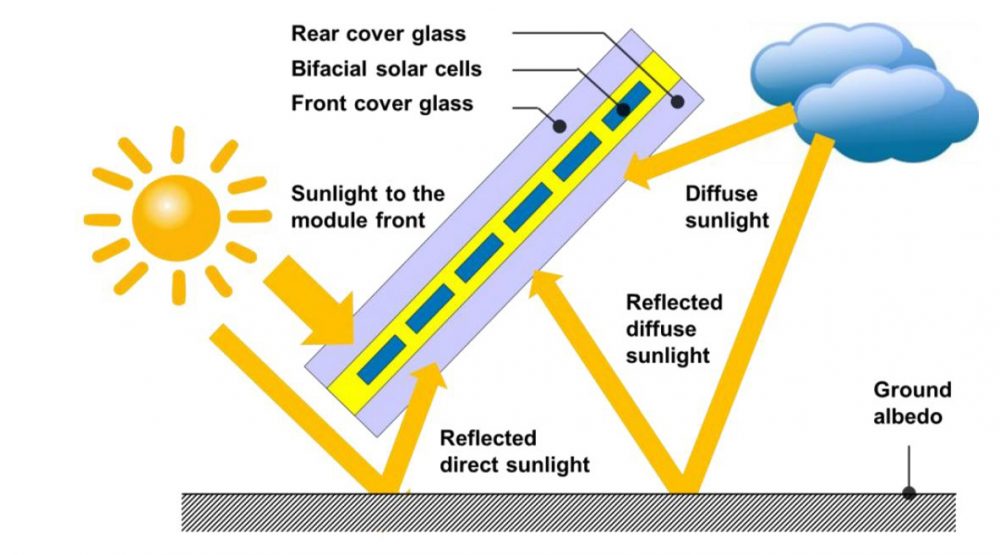
“What are Bifacial Solar panels …” from ontario-solar-installers.ca and used with no modifications.
What Is a Bifacial Solar Panel?
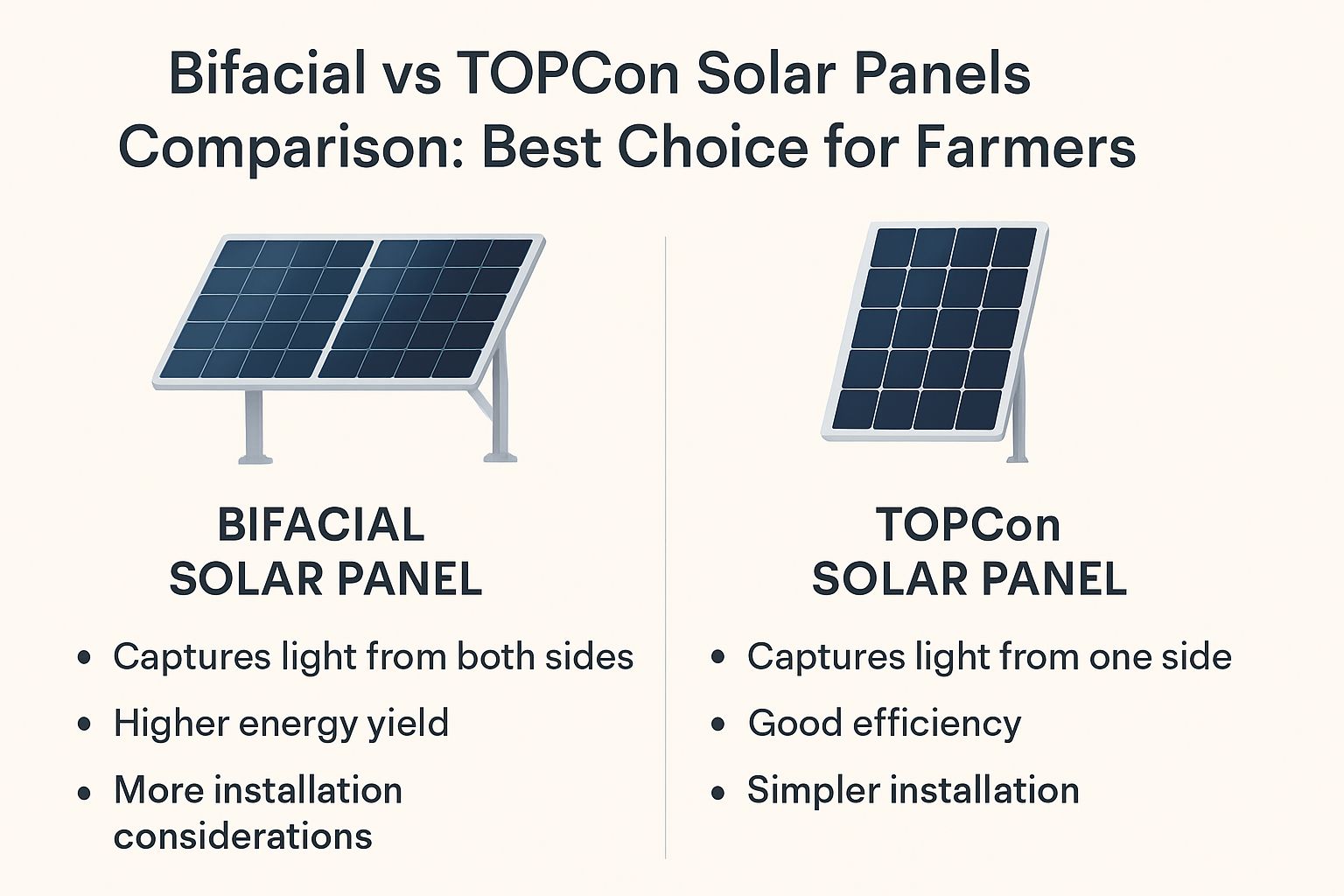
A bifacial solar panel is a panel that generates electricity from both its front face and its rear face. Unlike a standard monofacial panel, which only captures light hitting the top surface, a bifacial panel uses a transparent backsheet or dual glass construction to allow sunlight reflected off the ground or surrounding surfaces to enter from behind and contribute to total energy output.
How Rear-Side Energy Generation Works
The rear side of a bifacial panel does not generate electricity independently — it captures albedo light, which is sunlight that has already hit the ground and bounced back upward. That reflected light passes through the transparent rear surface and strikes the solar cells from below. The same photovoltaic process occurs regardless of which side the light enters from, so both contributions add up to a combined output figure.
Rear-side contribution is measured as a percentage of front-side output and is called the bifaciality factor. Most commercial bifacial panels carry a bifaciality factor between 65% and 80%, meaning the rear side can theoretically contribute up to 80% of whatever the front side is generating — but only under ideal reflective conditions.
What Albedo Means and Why It Matters on Your Farm
Albedo is the measure of how much light a surface reflects. It’s expressed as a value between 0 and 1, where 0 is a perfectly absorbing black surface and 1 is a perfectly reflective white surface. Fresh snow has an albedo of around 0.8. White gravel or sand sits around 0.25 to 0.4. Green grass comes in at roughly 0.2 to 0.25, and dark wet soil can drop as low as 0.05.
Why does this matter on your farm? Because the rear-side gain from a bifacial panel is directly tied to what’s sitting underneath it. A solar array installed over dry, pale gravel will generate meaningfully more rear-side energy than the same array installed over a lush green paddock or irrigated crop rows. Most farm surfaces don’t provide the high-albedo conditions needed to unlock bifacial panel potential, and that gap between manufacturer specifications and real-world output is where a lot of farmer disappointment originates.
When Bifacial Panels Actually Deliver Their Promised Gains
Bifacial panels perform as advertised when three conditions are met simultaneously: the panels are mounted high enough off the ground to allow diffuse reflected light to reach the rear surface (typically 1 meter or more), the surface underneath has a high albedo rating, and the panels are spaced with enough row-to-row distance that they aren’t shadowing their own rear faces. For more insights, you can read about TOPCon vs Bifacial solar panels and their performance differences.
In utility-scale solar farms built over white gravel with tracker systems and 1.5-meter ground clearance, bifacial rear-side gains of 10–15% above standard output are well-documented. For a rooftop installation on a corrugated iron farm shed sitting 10cm above the roof surface, that rear-side contribution is effectively zero. For more information on the differences between these technologies, you can read this comparison of bifacial and TOPCon solar panels.
What Is a TOPCon Solar Panel?
TOPCon stands for Tunnel Oxide Passivated Contact. It refers to a specific cell architecture used in the manufacturing of high-efficiency monocrystalline solar panels. The technology was developed to solve a fundamental limitation in older PERC (Passivated Emitter and Rear Cell) panels: electron recombination at the rear contact surface, which wastes converted energy before it can be used.
TOPCon panels are currently the dominant high-efficiency technology in commercial solar manufacturing, with leading manufacturers achieving front-side cell efficiencies above 24% in laboratory conditions and 22–23% in commercial production. For farmers, this means more watts generated per square meter of panel surface — which translates directly into either fewer panels needed for a target output or higher total generation from a fixed roof or land area.
How TOPCon Cell Technology Differs From Standard Panels
In a standard PERC solar cell, the rear contact metal sits directly against the silicon wafer. Where they touch, electrons that have been excited by sunlight can recombine and lose their energy as heat rather than flowing through the circuit as usable electricity. TOPCon inserts an ultra-thin layer of tunnel oxide — just 1 to 2 nanometers thick — between the silicon and the rear contact, along with a doped polysilicon layer on top of that. This passivation stack dramatically reduces recombination losses.
The result is a measurably higher open-circuit voltage and a better fill factor — the two cell-level metrics that determine how efficiently a panel converts sunlight into electrical output. Where a standard PERC panel might achieve a module efficiency of 20–21%, a TOPCon panel of the same physical size regularly reaches 22–23%, with premium units pushing past that threshold.
Why TOPCon Performs Better in Heat and Low Light
Two real-world conditions separate good solar panel specs from actual farm performance: heat and cloud cover. TOPCon panels carry a lower temperature coefficient than PERC panels — typically around -0.30% per °C compared to -0.35% to -0.40% per °C for standard PERC. On a hot Australian summer day where panel surface temperatures can easily hit 65–70°C, that difference compounds into measurably more electricity generated during the hottest and sunniest parts of the day.
In low-light conditions — early morning, overcast days, or the diffuse light common in high-humidity coastal farm regions — TOPCon’s superior passivation means the cells can still respond effectively to lower-intensity light. PERC panels lose a proportionally higher share of their rated output as light intensity drops, while TOPCon panels maintain a flatter performance curve across the day.
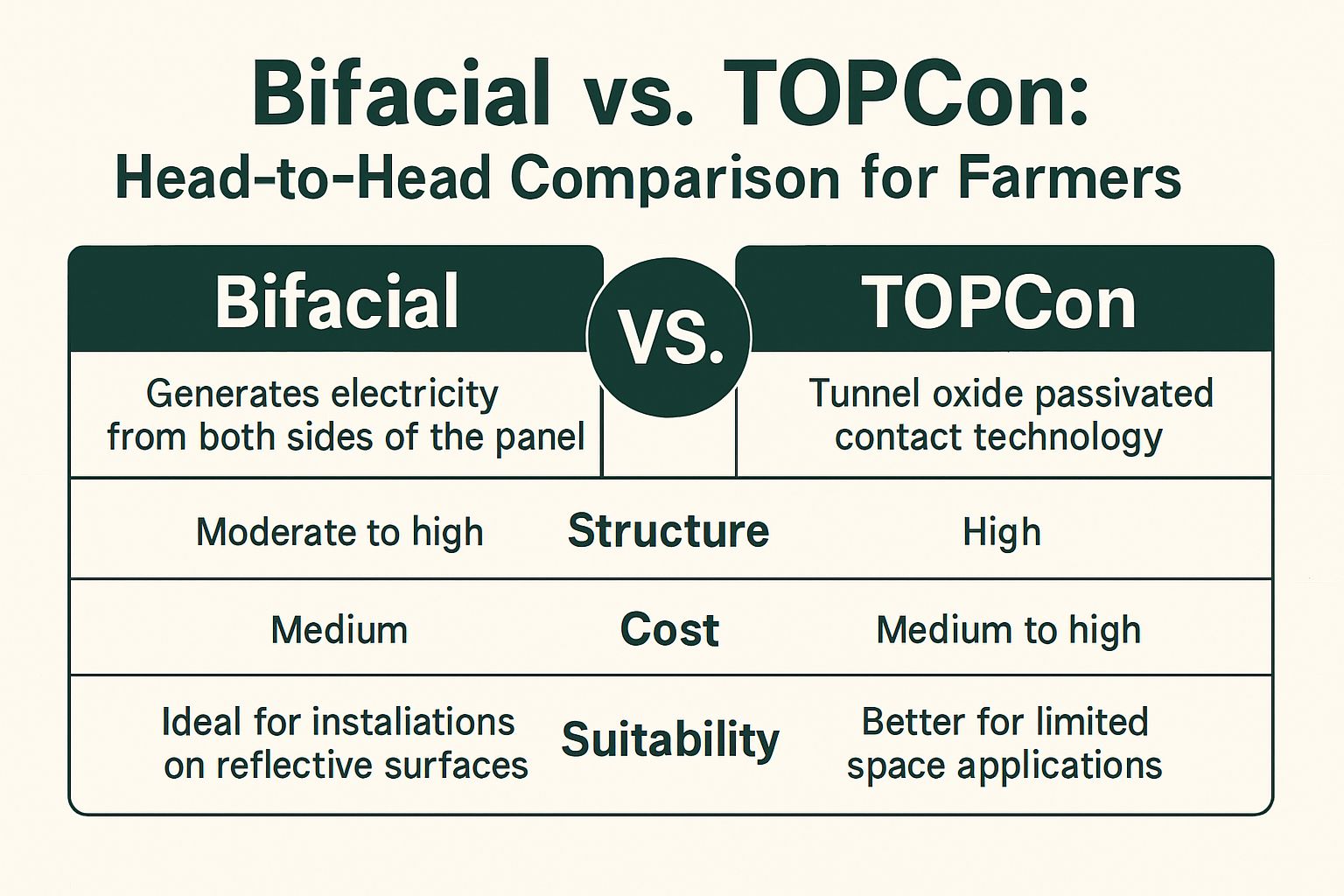
Bifacial vs TOPCon: Head-to-Head Comparison for Farmers
Comparing bifacial and TOPCon panels directly requires separating the two concepts first. Bifacial refers to panel construction — whether it captures light from one or both sides. TOPCon refers to cell technology — the internal architecture that determines conversion efficiency. A panel can be bifacial without being TOPCon, and a TOPCon panel can be either monofacial or bifacial. The comparison below treats standard bifacial PERC panels against monofacial TOPCon panels, which is the most common real-world purchasing decision farmers face.
|
Feature |
Bifacial PERC Panel |
TOPCon Panel |
|---|---|---|
|
Front-side efficiency |
20–21% |
22–23%+ |
|
Temperature coefficient |
-0.35% to -0.40% per °C |
-0.28% to -0.32% per °C |
|
Annual degradation rate |
0.45–0.55% per year |
0.30–0.40% per year |
|
Rear-side energy capture |
Yes (site-dependent) |
No (monofacial) |
|
Installation complexity |
Higher (mounting height critical) |
Standard |
|
Best suited for |
Ground-mount over reflective surfaces |
Rooftop, barn, shed, space-constrained sites |
Efficiency and Power Output
TOPCon panels win on front-side efficiency every time. A standard bifacial PERC panel delivers module efficiency in the 20–21% range, while commercial TOPCon panels regularly hit 22–23% from the front face alone. For a farmer installing 50 panels on a machinery shed roof, that efficiency gap translates to hundreds of additional watts of generating capacity from the exact same roof space — with no special mounting requirements, no reflective ground cover needed, and no site-specific conditions to manage.
Bifacial panels can close — and sometimes exceed — that efficiency gap when rear-side gains are factored in. But those gains are variable. A bifacial panel rated at 420W front-side output might deliver 450–470W under ideal reflective conditions, or it might deliver 422W on a standard farm rooftop. TOPCon output is predictable. Bifacial output depends on your site.
Performance in Real Farm Conditions
Australian farm environments are demanding on solar equipment. Panel surface temperatures regularly exceed 60°C during summer across inland regions, humidity accelerates material degradation in coastal areas, and many farms operate through extended periods of overcast or hazy skies. TOPCon’s lower temperature coefficient of around -0.30% per °C gives it a consistent edge in hot conditions, while its superior low-light response means it continues generating meaningful output on cloudy days when PERC-based bifacial panels start losing ground more quickly.
Installation Requirements and Mounting Costs
This is where bifacial panels introduce real cost complexity for farm installations. To capture rear-side gains, bifacial panels require elevated racking systems — typically a minimum of 500mm to 1 meter of ground clearance — along with increased row spacing to prevent rear-face shading. On a ground-mounted system over a large paddock, that means heavier steel racking, deeper pile foundations, and increased labor costs compared to a standard fixed-tilt system.
TOPCon panels install on standard racking systems with no special clearance requirements. For rooftop installations on farm sheds, they mount the same way as any conventional panel and require no additional site preparation. When installation costs are factored into the total system price, TOPCon setups on typical farm structures come in more cost-effectively per kilowatt of installed capacity than bifacial systems that require purpose-built elevated mounting.
Long-Term Degradation and Warranty
Degradation rate is one of the most underappreciated numbers in a solar panel comparison. Over a 25-year system life, even a 0.1% annual difference in degradation compounds into a meaningful gap in total energy output. TOPCon panels degrade at approximately 0.30–0.40% per year, compared to 0.45–0.55% per year for PERC-based bifacial panels. Leading TOPCon manufacturers, including those in the Australian Premium Solar product range, typically guarantee no more than 87–89% of rated output remaining at the 25-year mark — a stronger performance guarantee than most standard bifacial PERC warranties offer.
Upfront Cost vs. 25-Year Return
TOPCon panels carry a modest price premium over standard bifacial PERC panels — typically 5–10% higher per panel at current market prices. For a mid-sized farm system of 30–50kW, that premium might add $1,500–$4,000 to the upfront system cost. The question is whether that premium pays back over time, and in most farm configurations, it does.
The math favors TOPCon in the majority of farm scenarios. Higher front-side efficiency means more kilowatt-hours generated per year from day one. Lower degradation means that advantage compounds annually rather than eroding. And because TOPCon output is site-independent, it delivers its rated performance consistently — not only when ground reflectivity conditions are favorable.
Bifacial panels offer a stronger economic case specifically in large ground-mounted systems where the site genuinely supports rear-side capture. A well-designed 500kW agrivoltaic system over pale gravel with tracker mounting can generate enough additional energy from rear-side gains to justify both the panel cost and the elevated mounting expense. For a 30kW rooftop system on a grain storage shed, that same economic argument does not hold.
Which Farm Setups Suit Bifacial Panels
Bifacial panels are not a universal upgrade — they are a site-specific tool. When the site matches their requirements, they perform exceptionally. When it doesn’t, the rear-side technology you’ve paid for contributes almost nothing to your total output.
The farm setups where bifacial panels genuinely earn their place share a few common characteristics: large available land area, ability to elevate panels well above the ground surface, high-reflectivity ground cover, and sufficient row spacing to allow diffuse reflected light to reach rear panel faces without obstruction. If your proposed installation meets all four of those criteria, bifacial panels are worth serious consideration.
Ground-Mounted Arrays Over Reflective Surfaces
The ideal bifacial installation is a ground-mounted array positioned 1 meter or more above a light-colored reflective surface, with rows spaced far enough apart that each panel’s rear face has a clear view of the ground beneath and between rows. Crushed white limestone, pale gravel, or dry sandy soil all provide sufficient albedo to generate measurable rear-side contributions. In these configurations, documented rear-side gains of 8–15% above front-side output alone are achievable, and those gains directly improve system ROI on large installations. For more information on maximizing energy efficiency, consider exploring how bifacial solar panels can cut electric bills on farms.
Agrivoltaic Systems With High-Albedo Ground Cover
Agrivoltaic systems — where solar panels and agricultural activity share the same land — can be a strong fit for bifacial technology when the cropping or grazing system creates a naturally reflective ground surface. Dryland cereal crops in their standing straw phase, light-colored mulch systems in horticulture, and semi-arid grazing country with sparse pale vegetation all provide albedo conditions that support rear-side generation. In these dual-use systems, the elevated mounting required for bifacial performance also creates the ground clearance needed for machinery, livestock movement, or crop growth beneath the array.
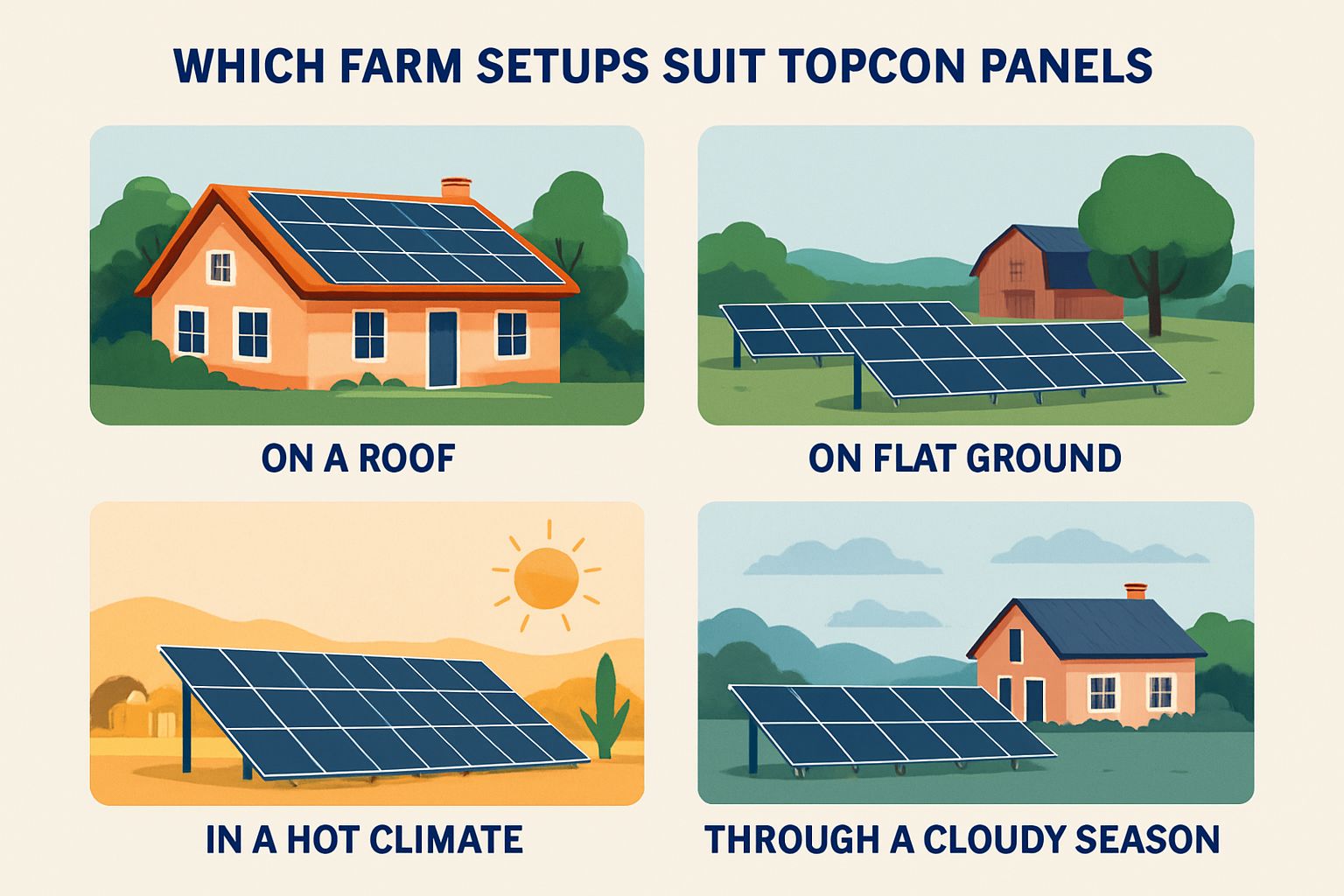
Which Farm Setups Suit TOPCon Panels
TOPCon panels suit the vast majority of farm installations because they deliver their rated performance without any site-specific conditions attached. Wherever you need reliable, predictable, high-efficiency solar generation — on a roof, on flat ground, in a hot climate, or through a cloudy season — TOPCon technology performs consistently.
Rooftop Installations on Sheds and Barns
Farm shed and barn rooftops are the most common solar installation location for working farms, and they are where TOPCon panels hold the clearest advantage over standard bifacial options. A corrugated iron roof provides no meaningful rear-side reflectivity for bifacial panels — the gap between the panel and the roof surface is too narrow, and the dark metal surface has a very low albedo. TOPCon panels on the same roof generate maximum front-side output from day one, require standard racking, and integrate cleanly with existing roof structures.
Real-world example: A mixed-enterprise farm in regional Victoria installing 40kW across two machinery sheds would see negligible rear-side benefit from bifacial panels given the standard roof-mount configuration. The same budget spent on TOPCon panels of equivalent wattage rating delivers higher module efficiency, lower degradation, and better hot-weather performance — with no additional mounting cost or site preparation required.
Rooftop solar on farm buildings also benefits from TOPCon’s lower temperature coefficient. Metal shed roofs absorb and radiate significant heat, raising panel ambient temperatures well above air temperature. TOPCon’s reduced sensitivity to heat-related output loss means it loses less generating capacity during the peak summer hours when farm energy demand — from irrigation pumps, cool rooms, and processing equipment — is typically at its highest. For farmers considering solar options, exploring the differences between monocrystalline and bifacial panels can provide valuable insights.
For multi-shed installations where maximizing output from a fixed roof area is a priority, TOPCon’s higher watts-per-panel rating also reduces the total number of panels needed to hit a capacity target. Fewer panels mean less racking hardware, fewer electrical connections, and a faster installation — all of which reduce total system cost and offset the modest per-panel price premium that TOPCon carries over standard bifacial PERC alternatives.
Farms in High-Temperature or Low-Light Climates
Australia’s farming regions span some of the most thermally demanding solar environments on earth. Inland Queensland, the Riverina, and the Western Australian wheatbelt all record sustained summer temperatures where panel surface heat regularly pushes past 65°C. In these conditions, bifacial PERC panels rated at -0.35% to -0.40% per °C deliver a tangible daily output advantage. At 65°C panel surface temperature — 25°C above the standard test condition — a TOPCon panel loses roughly 12% of rated output to heat, while a PERC bifacial panel loses 15–18%. Across a full summer, that gap adds up to real kilowatt-hours.
In Tasmania, southern Victoria, and high-rainfall coastal regions, the challenge flips to persistent cloud cover and diffuse light conditions rather than extreme heat. TOPCon’s superior passivation technology means its cells respond more efficiently to lower-intensity light — maintaining a flatter output curve through overcast mornings and hazy afternoons compared to PERC-based bifacial panels. For farms in these regions that depend on consistent solar generation to offset grid electricity costs across all seasons, TOPCon provides a more reliable baseline than bifacial PERC alternatives.
Space-Constrained Properties That Need Maximum Output Per Panel
Not every farm has unlimited roof space or available paddock area to dedicate to solar. Intensive horticulture operations, small-footprint piggeries and poultry sheds, and properties with significant shading constraints from trees or existing structures all face a common challenge: maximizing watts generated from a limited installation area. This is where TOPCon’s higher module efficiency per square meter becomes a direct financial advantage rather than just a spec sheet number.
A TOPCon panel of 400W physical size generates more electricity from the same roof area than a bifacial PERC panel of the same physical dimensions — because its front-side efficiency is genuinely higher, not dependent on site conditions. When roof space is the constraint, fitting more watts into fewer panels means reaching your target system capacity without expanding your mounting footprint, adding extra inverter circuits, or paying for additional racking. For space-constrained farm properties, TOPCon is consistently the more practical and cost-effective solution.
Bifacial TOPCon Panels: The Best of Both Technologies
The bifacial TOPCon panel is exactly what it sounds like — a solar panel that combines TOPCon cell architecture with a dual-glass bifacial construction. It captures the superior front-side efficiency and low degradation of TOPCon technology while also adding rear-side light capture capability for installations where ground reflectivity supports it. For large-scale farm ground-mount systems that meet the albedo and elevation requirements for bifacial gain, bifacial TOPCon panels represent the highest-performing option currently available in commercial solar manufacturing. Leading bifacial TOPCon modules now achieve front-side efficiencies above 22.5% with bifaciality factors of 75–80%, meaning a well-sited ground-mount system can realistically generate 25–30% more total energy than an equivalent monofacial PERC system from the same land area. If your farm setup supports bifacial rear-side capture and your budget allows for the elevated mounting system required, bifacial TOPCon panels are the most powerful and future-proof choice on the market today.

The Right Panel Choice Comes Down to Your Land, Not the Spec Sheet
Bifacial panels and TOPCon panels are both excellent technologies — but they solve different problems, and applying the wrong one to your farm is a decision you’ll recalculate every year for the next 25 years. For most Australian farm buildings, sheds, and rooftop systems, TOPCon delivers higher efficiency, lower degradation, simpler installation, and consistent performance without needing your property to cooperate. For large ground-mounted systems over high-albedo surfaces with purpose-built elevated racking, bifacial panels — especially bifacial TOPCon — can genuinely outperform any rooftop-only system in total energy generation. Walk your site before you choose your panel, and let your land tell you which technology belongs on it. Australian Premium Solar offers site-specific guidance to help farmers match the right panel technology to their unique property conditions and energy goals.
Frequently Asked Questions
The most common questions farmers ask when comparing bifacial and TOPCon panels come down to practical concerns: real-world output, installation fit, long-term value, and whether mixing technologies is viable. The answers below address each question directly based on verified technical data and real installation experience.
Can Bifacial Solar Panels Be Installed on a Farm Rooftop?
Yes, bifacial solar panels can be physically installed on a farm rooftop — but they will not deliver meaningful rear-side energy gains in that configuration. Standard rooftop racking positions panels 50–150mm above the roof surface, which is far too close to allow diffuse reflected light to reach the rear face of the panel. The roof surface itself, typically dark corrugated iron, also has a very low albedo rating that limits the reflective light available even if clearance were sufficient.
A bifacial panel installed on a farm shed roof will perform essentially identically to a monofacial panel of the same front-side efficiency rating — meaning you pay for dual-glass bifacial construction and receive no practical benefit from it in that application. TOPCon panels are the better rooftop choice for farm buildings in virtually every scenario.
How Much Extra Energy Do Bifacial Panels Generate From Rear-Side Reflection?
Under optimal conditions — elevated ground-mount racking at 1 meter or more, high-albedo surface below (albedo value of 0.4 or above), and adequate row spacing — bifacial panels can generate 10–15% additional energy compared to their rated front-side output. In utility-scale solar farms specifically engineered for bifacial performance, gains at the upper end of this range are well-documented. In typical farm ground-mount systems over standard soil or pasture, realistic rear-side gains are closer to 3–7%. On farm rooftops, rear-side gain is effectively zero.
Are TOPCon Solar Panels Worth the Higher Upfront Cost for Farmers?
For most farm installations, yes. TOPCon panels carry a 5–10% price premium over standard bifacial PERC panels, but that premium is recovered through higher annual energy generation from day one and lower degradation over the system’s 25-year life. A TOPCon system that generates an additional 3–5% more electricity per year than an equivalent PERC system will typically recover its price premium within 2–4 years of operation, then continue delivering that advantage for the remaining 20+ years of the system’s warranted life. In high-energy-cost farm operations — irrigation, refrigeration, processing — the financial case for TOPCon is particularly strong.
What Is the Typical Lifespan of TOPCon vs Bifacial Solar Panels?
Both TOPCon and bifacial PERC panels are typically warranted for 25–30 years of operation, but their degradation trajectories differ meaningfully. TOPCon panels degrade at approximately 0.30–0.40% per year, leaving around 88–91% of original rated output at the 25-year mark under leading manufacturer warranties. Standard bifacial PERC panels degrade at 0.45–0.55% per year, typically warranted to 80–84% of original output at 25 years. In physical terms, both technologies will operate well beyond their warranty periods — but TOPCon’s slower degradation means it continues generating more electricity per panel throughout its operational life.
Can Farmers Use Both Bifacial and TOPCon Panels in the Same Solar System?
Technically, yes — but it introduces complexity that most farm systems are better off avoiding. Mixing panel technologies in the same inverter string requires careful matching of electrical characteristics including voltage, current, and degradation rates. Mismatched panels in a single string will cause the higher-performing panels to be pulled down to the output level of the lowest-performing panel, eliminating the efficiency advantage you paid for. For more information on bifacial solar panels, you can read about their benefits for farmers.
If a farm property genuinely has both a suitable rooftop installation area and a large ground-mounted array over reflective surface, the cleanest approach is to run separate inverter systems — TOPCon panels on a dedicated rooftop inverter and bifacial panels on a dedicated ground-mount inverter. This allows each technology to operate at its optimal output point without constraining the other. It does add inverter and installation cost, so the economics need to be assessed against the actual rear-side gain achievable at the specific ground-mount site.



Leave a Reply