

Key Takeaways
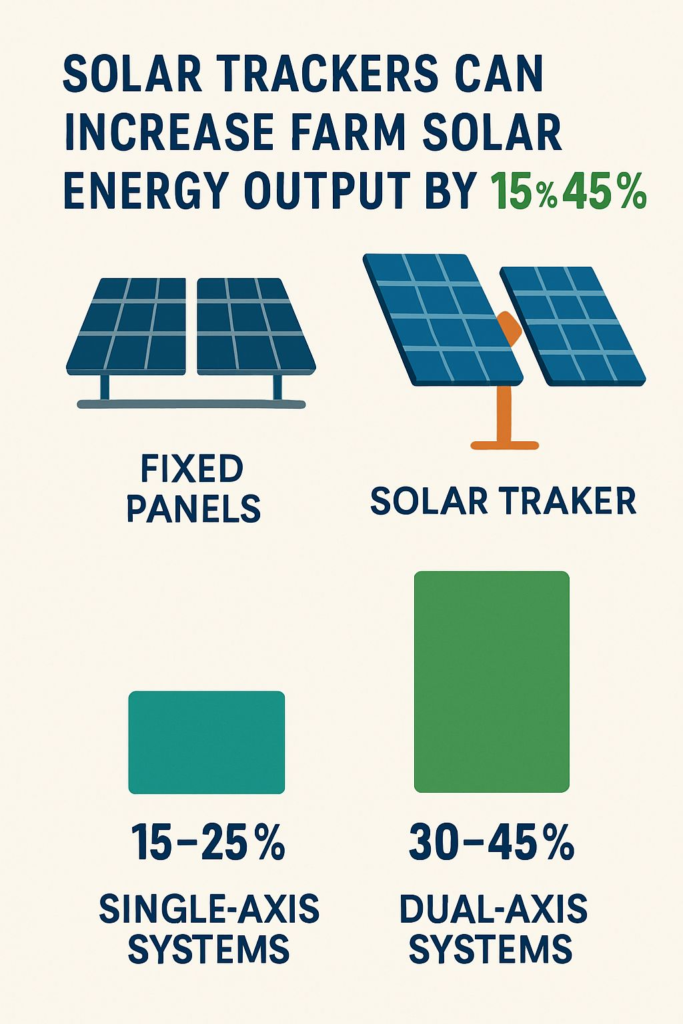
- Solar trackers can increase farm solar energy output by 15% to 45% compared to fixed panels — single-axis systems deliver 15–25% gains, while dual-axis systems push that up to 30–45%.
- Trackers align peak power generation with peak farm demand — meaning your irrigation pumps, ventilation systems, and processing equipment run on solar at the exact hours they need it most.
- The upfront cost is higher than fixed panels, but real-world farm installations show payback periods that make the investment worthwhile — especially with available agricultural incentives.
- Not every farm needs a dual-axis tracker — geography, energy load, and available land all determine which system delivers the best return for your specific operation.
- Growing Solar Mist provides expert guidance on solar tracking solutions designed specifically for agricultural operations looking to cut energy costs and boost sustainability.
Rising electricity costs are quietly draining farm profits — and solar trackers are one of the most powerful tools available to stop it.
Most farmers who install solar panels go with fixed-mount systems because they’re simpler and cheaper upfront. That’s a reasonable starting point. But fixed panels only hit peak efficiency for a narrow window around solar noon. Every hour before and after that window, they’re leaving energy on the table. On a working farm where pumps, lights, fans, and refrigeration run all day, that missed energy adds up fast.
Solar tracking systems solve this by doing exactly what the name suggests — they follow the sun. From the moment it rises in the east to when it sets in the west, a tracker keeps your panels pointed directly at the sun, capturing the maximum available energy at every hour of the day. For farmers serious about energy independence, this is the difference between a solar installation that covers part of your bill and one that transforms your operation. Growing Solar Mist specializes in helping agricultural operations navigate exactly this decision.
What a Solar Tracker Actually Does
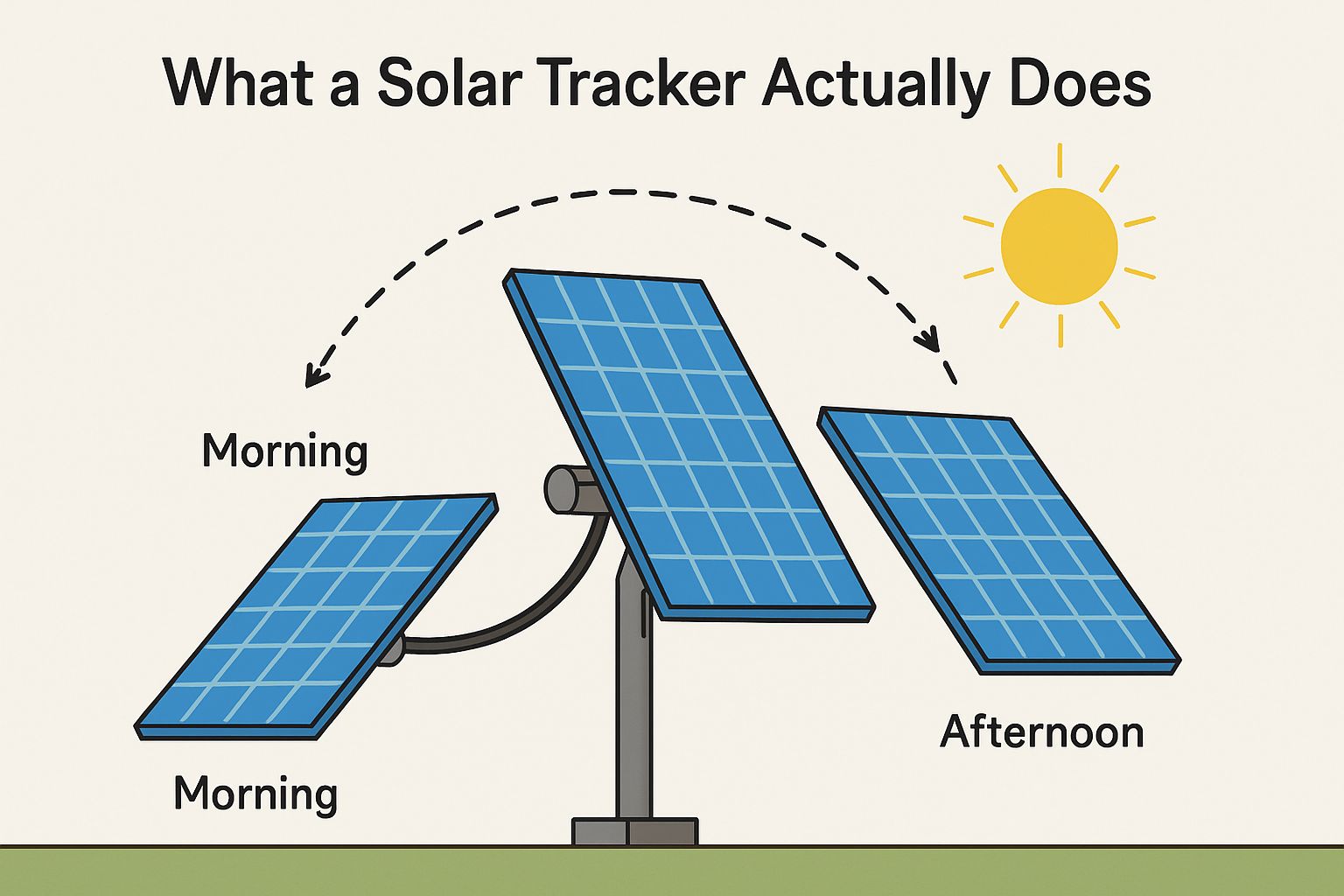
A solar tracker is a motorized mounting system that adjusts the angle and direction of your solar panels throughout the day to stay perpendicular to the sun. Instead of sitting at a fixed tilt and hoping sunlight hits at a useful angle, the panels move — continuously optimizing their position to capture the most photons possible at any given moment.
How Trackers Follow the Sun Throughout the Day
There are two ways a tracker can follow the sun: using sensors or using pre-programmed algorithms. Sensor-based systems (called active trackers) use light-sensing devices to detect where the sun is brightest and adjust accordingly. Algorithm-based systems (called passive trackers) use GPS coordinates and pre-calculated sun path data to move panels on a schedule. Many modern systems combine both approaches for maximum accuracy.
The mechanical movement itself is driven by either electric motors or hydraulic actuators. These systems are built for durability — they run every single day, often in harsh agricultural environments. High-quality trackers are engineered with weatherproofing, wind load tolerance, and low-maintenance drive systems that can handle years of continuous operation in field conditions. For farmers interested in exploring different solar panel options, here’s a comparison of solar panels that might be beneficial.
The result is that your panels are almost never pointing in the wrong direction. At 7 AM, they’re facing east. By noon, they’ve rotated to face directly overhead. By 4 PM, they’ve shifted west. This continuous alignment is what drives the dramatic energy production increases over fixed systems.
- Active trackers use light sensors to detect real-time sun position and adjust accordingly
- Passive trackers follow pre-calculated sun path algorithms based on location and date
- Hybrid systems combine both methods for the highest accuracy across changing weather conditions
- Electric motor-driven systems are most common in agricultural installations due to precise control
- Hydraulic actuator systems are used in larger utility-scale installations requiring heavy panel loads
Single-Axis vs. Dual-Axis Trackers: Which One Fits Your Farm
Single-axis trackers rotate on one plane — typically east to west — following the sun’s daily arc across the sky. They’re simpler, less expensive, and easier to maintain than dual-axis systems. For most farm operations in mid-latitude regions, single-axis trackers deliver a 15–25% boost in energy production over fixed panels, which is substantial for the cost difference involved.
Dual-axis trackers move on two planes simultaneously — east to west AND adjusting for the sun’s seasonal north-south shift throughout the year. This means the panel is always at the ideal angle regardless of the time of year or time of day. The payoff is a production increase of up to 30–45% over fixed panels, but it comes with higher installation costs, more complex maintenance, and greater wind load considerations. For farms in northern latitudes where seasonal sun angle variation is dramatic, or operations with very high daytime energy loads, dual-axis systems often justify the premium.
The Real Energy Numbers Farmers Need to Know
The most important number in any solar tracker conversation is how much additional energy it actually generates — because that directly translates into dollars saved or earned on your electricity bill.
Solar trackers can increase energy output by approximately 15% to 45% compared to fixed solar panel installations. The wide range reflects real variables: your geographic location, the type of tracker used, local weather patterns, and seasonal sun angle differences. A farmer in Arizona running a dual-axis system will see different gains than a farmer in Minnesota running a single-axis setup — and both will outperform their equivalent fixed-panel systems significantly. For more information on the best types of solar panels for agricultural use, check out this comparison of monocrystalline and polycrystalline panels.
What this means in practical terms is significant. If a fixed 100kW solar installation generates 130,000 kWh per year at a given location, a single-axis tracker on the same installation might generate 150,000–162,500 kWh. A dual-axis system could push that to 169,000–188,500 kWh. At an average commercial electricity rate of $0.12 per kWh, that difference can represent thousands of additional dollars in savings or revenue annually.
- Fixed panels: Peak efficiency only around solar noon; production drops sharply in morning and late afternoon hours
- Single-axis trackers: 15–25% more energy than fixed; best cost-to-benefit ratio for most farm operations
- Dual-axis trackers: Up to 30–45% more energy than fixed; highest output, best for high-demand or northern-latitude farms
How Much More Power a Tracker Produces vs. Fixed Panels
A real-world example illustrates the numbers clearly. A 200-acre vegetable operation in California installed a 150kW dual-axis tracking system and reduced annual electricity costs by $32,000 — a 68% decrease in their energy bills. That kind of result isn’t an outlier. It reflects what happens when you match the right tracking system to a farm with significant daytime energy demand and high local electricity rates.
Why Geographic Location Changes Your Output
Location has an outsized effect on tracker performance. Farms closer to the equator have a sun that travels a relatively consistent, high arc — meaning fixed panels can capture reasonable energy without tracking. As you move toward higher latitudes, the sun’s path becomes lower and more variable between seasons, which is precisely where trackers deliver their greatest advantage. A farm in northern states or Canada will see proportionally higher tracker gains than one in southern states, simply because there’s more angular variation to compensate for. For those interested in exploring different solar panel options, here’s a useful comparison of monocrystalline vs polycrystalline solar panels for farmers.
Daytime Energy Demand Alignment With Farm Operations
One underappreciated benefit of solar trackers is how well they align energy production with actual farm energy demand. Fixed panels peak around noon but farms use energy heavily from early morning through late afternoon — running irrigation, ventilation, milking equipment, and refrigeration across that entire window.
Trackers extend the high-production window to match that demand profile. Instead of generating most power during a short midday peak, a tracking system produces strong output from 8 AM through 5 PM. This means more of your energy-intensive farm operations run directly on solar power without drawing from the grid — which is where the real bill savings happen.

Where Solar Trackers Make the Biggest Difference on a Farm
Not all farm energy loads are created equal. Some applications benefit enormously from the extended production window that trackers provide, while others see more modest gains. Knowing where trackers add the most value helps farmers prioritize where to deploy them first — especially when working with limited capital budgets.
The farms that see the fastest payback on tracker investments share one common trait: they have large, consistent daytime energy loads. Operations that run equipment from sunup to sundown — irrigating fields, ventilating barns, refrigerating produce — are natural fits for solar tracking systems because the extended production curve covers exactly the hours those systems are running. Learn more about solar panels for farmers and how they can optimize energy usage.
Conversely, farms where most energy demand occurs at night — such as lighting-heavy operations or those relying on overnight refrigeration cycles — benefit more from battery storage paired with either fixed or tracking solar systems. Trackers alone won’t solve a nighttime demand problem, but for daytime loads, they’re hard to beat.
Irrigation Systems in Remote Fields
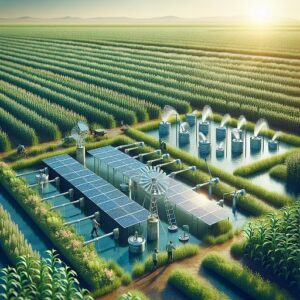
Irrigation is one of the highest energy costs on any crop farm, and it’s almost entirely a daytime operation. Pumping water from wells, reservoirs, or municipal sources to remote field locations requires sustained power across the entire irrigation window — often 6 to 10 hours per day during growing season. A solar tracking system paired with irrigation infrastructure means those pumps are running almost entirely on solar-generated power during peak demand hours, dramatically cutting the grid electricity draw that makes summer utility bills so painful.
Remote field locations add another layer of value. Running grid power to irrigation equipment in outlying fields often requires expensive trenching and electrical infrastructure. A solar tracker installed near the pump eliminates that cost entirely while delivering more consistent power than a fixed off-grid panel would generate.
Barn Ventilation, Lighting, and Livestock Equipment
Livestock operations run energy-intensive equipment around the clock, but the heaviest loads — ventilation fans, water pumps, feeding systems, and milking equipment — are concentrated during daylight hours. A tracked solar system that produces strong output from 8 AM through 5 PM aligns almost perfectly with this demand profile. Poultry operations especially benefit here, where large ventilation arrays run continuously during daylight to maintain safe barn temperatures. A 25% boost in solar production from a single-axis tracker can mean the difference between covering 60% of barn energy costs versus covering nearly all of them.
Cold Storage and Processing Facilities
Cold storage is one of the most power-hungry applications on a diversified farm. Refrigeration compressors run hardest during the warmest parts of the day — which happens to coincide precisely with when solar trackers are producing at their peak. This thermal-solar alignment is a genuine advantage. When ambient temperatures are highest and your refrigeration system is working hardest to maintain temperature, a tracking system is capturing the most sunlight and generating the most power. The result is that your most expensive energy demand is being offset at exactly the right time.
The Financial Case for Solar Trackers on Agricultural Land
The financial argument for solar trackers on farms is strong, but it requires looking at the full picture — not just the sticker price. Trackers cost more than fixed systems upfront. That’s a fact. But the question that actually matters is how much more energy they produce over 20 to 25 years, and whether that production premium pays back the cost difference with room to spare.
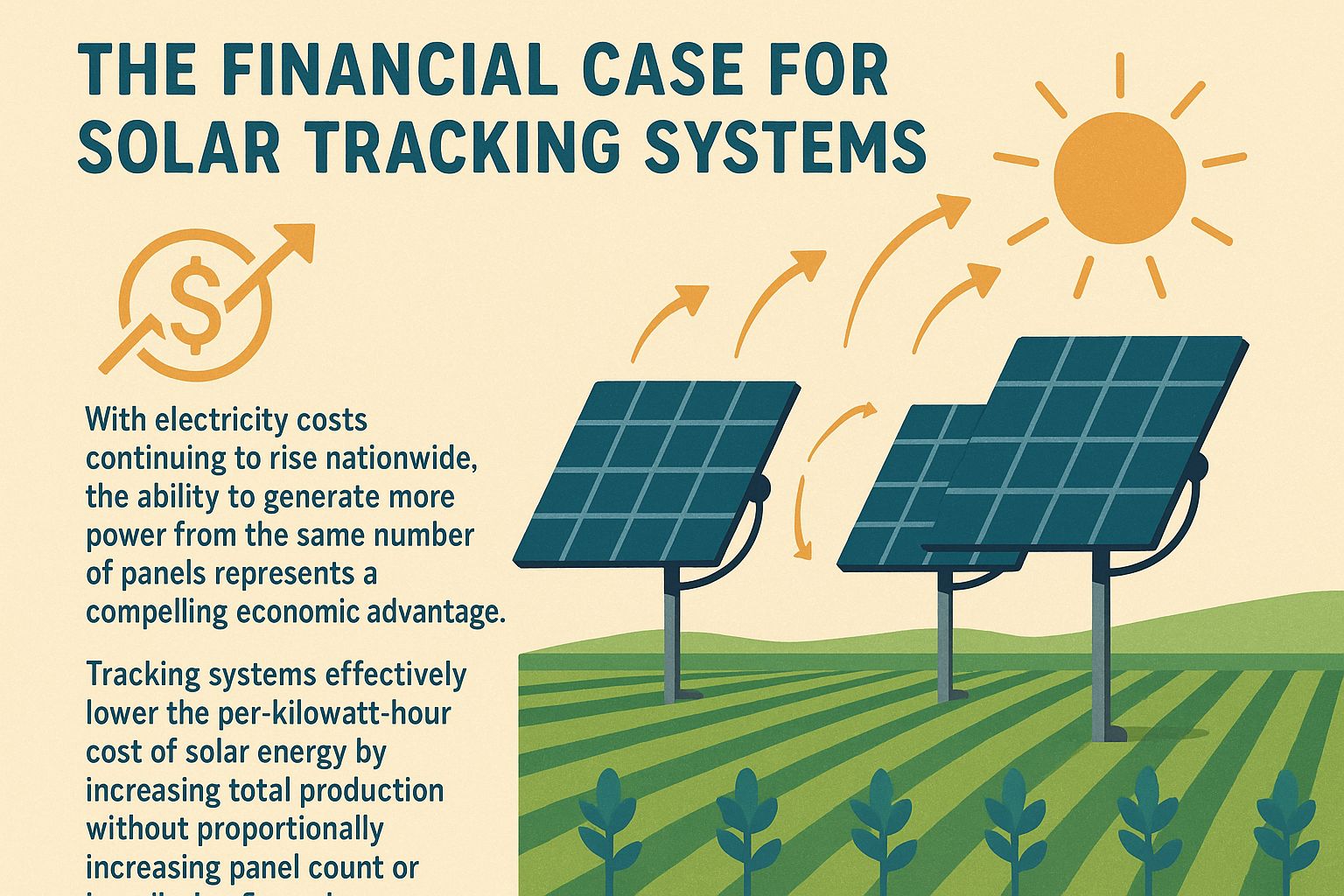
For most farms with significant daytime energy loads, the answer is yes — often decisively. The combination of higher energy output, lower electricity bills, potential net metering credits, and available agricultural incentives creates a financial case that fixed panels simply can’t match on an equivalent basis.
Upfront Costs vs. Long-Term Savings
Single-axis tracking systems typically cost 15–25% more than equivalent fixed-mount installations. Dual-axis systems can run 25–50% more than fixed. On a 100kW farm installation where fixed panels might cost $150,000 to $200,000 installed, a single-axis tracker system might run $175,000 to $250,000, and a dual-axis system could reach $200,000 to $300,000 depending on terrain and foundation requirements.
The long-term savings offset this premium significantly. A 150kW system generating 25% more energy annually due to tracking accumulates substantial additional savings year after year. Over a 25-year system lifespan, even conservative estimates show that the additional energy production from tracking systems outpaces the upfront cost premium — often by a factor of two or more when electricity rate inflation is factored in.
Typical Payback Period for Farm Installations
Payback periods for solar tracker installations on farms generally range from 6 to 12 years depending on system size, local electricity rates, available incentives, and energy consumption patterns. Farms with high daytime electricity usage and access to strong state or federal incentives routinely achieve payback in the lower end of that range.
After payback, the system generates essentially free electricity for the remaining 13 to 19 years of its useful life. For a farm operation planning generational continuity, that long tail of free energy production is arguably the most compelling part of the financial case. A tracker system installed today could still be cutting your grandchildren’s electricity bills in 2050.
Agricultural Solar Incentives That Reduce Your Investment
The U.S. federal Investment Tax Credit (ITC) currently allows farmers to deduct a significant percentage of their solar installation costs directly from their federal tax liability. Agricultural businesses structured as pass-through entities or corporations both qualify, making this one of the most accessible incentives available to farm operations of any size. For more information on choosing the right solar panels for your farm, consider this comparison of monocrystalline vs polycrystalline solar panels.
Beyond the federal ITC, the USDA’s Rural Energy for America Program (REAP) provides grants covering up to 25% of eligible solar project costs and loan guarantees for the remainder. For a farm installing a $200,000 tracking system, a REAP grant alone could reduce out-of-pocket costs by $50,000 — fundamentally changing the payback calculation.
Many states layer additional incentives on top of federal programs. Net metering policies allow farms to sell excess solar generation back to the grid at retail rates, creating an ongoing revenue stream from surplus power. Property tax exemptions for solar installations, available in many agricultural states, prevent the added system value from inflating annual property tax bills. When all available incentives are stacked together, the effective cost of a solar tracker installation can be reduced by 40–60% compared to the gross installation price.

Drawbacks Farmers Should Weigh Before Buying
Solar trackers are a powerful tool, but they’re not the right choice for every farm in every situation. Understanding the real limitations before committing to a purchase saves money, frustration, and the risk of installing a system that underperforms expectations.
The two primary concerns are cost and mechanical complexity. Both are manageable with proper planning, but farmers who go in without understanding them often end up with systems that don’t deliver the returns they expected. The goal isn’t to talk anyone out of solar trackers — it’s to make sure the decision is made with clear eyes.
There are specific farm scenarios where fixed panels genuinely outperform trackers on a financial basis. Small installations under 20kW, farms with very limited flat land, operations in regions with frequent high winds, and situations where the budget simply doesn’t allow for the premium — these are all cases where a well-designed fixed system may be the smarter first step. For those interested in how sun tracking solar panels can impact efficiency, further reading is available.
- Higher upfront cost — 15–50% more expensive than fixed systems depending on tracker type
- Moving parts require maintenance — motors, actuators, and drive systems need periodic inspection and servicing
- Greater wind load vulnerability — tracking systems have more surface exposure and require robust foundation engineering in high-wind areas
- More complex installation — site preparation, foundation work, and electrical integration take more time and specialized expertise
- Reduced benefit in consistently cloudy climates — trackers add the most value where direct sunlight hours are high; diffuse light conditions reduce the tracking advantage
Higher Installation Costs Than Fixed Systems
The cost premium for tracking systems is real and shouldn’t be minimized. Beyond the tracker hardware itself, installation requires more substantial foundation work to handle the dynamic loads created by moving panels. Electrical conduit runs, control system wiring, and in some cases concrete pier foundations add costs that don’t exist with simple fixed racking. Farmers on a tight capital budget should get detailed quotes from multiple installers and model the payback carefully before committing — the numbers usually work, but they need to be your numbers, not industry averages.
Maintenance Requirements for Moving Parts
Solar trackers have motors, drive systems, and articulating joints that fixed panels simply don’t have — and those components need attention. Most quality tracking systems require one to two maintenance visits per year to inspect motors, lubricate moving parts, check electrical connections, and verify alignment calibration. This isn’t a heavy maintenance burden, but it’s a real one. Factoring in $500 to $1,500 per year in routine maintenance costs is a reasonable assumption for a mid-sized farm installation, and that figure should be included in any honest payback calculation. For more information on how sun-tracking solar panels can benefit your installation, consider exploring additional resources.
The good news is that modern tracker systems from established manufacturers are built specifically for low-maintenance field operation. Drive systems on premium single-axis trackers are typically rated for 20+ years of continuous use. Remote monitoring capabilities — now standard on most commercial systems — allow farmers and installers to detect motor faults, alignment errors, or communication failures before they cause significant downtime or energy loss. A tracker that’s offline for two weeks due to an undetected motor fault costs real money in lost production, which is why monitoring systems are worth the investment.
Fixed Panels vs. Solar Trackers: Which One Is Right for Your Farm
The honest answer is that it depends on four things: your daily energy load, your geographic location, your available capital, and your land constraints. Use the table below as a practical starting point to match your farm profile to the right system.
|
Farm Profile |
Recommended System |
Primary Reason |
|---|---|---|
|
High daytime energy load, mid-to-large operation |
Single-axis or dual-axis tracker |
Extended production window offsets high daytime demand |
|
Northern latitude with high seasonal sun angle variation |
Dual-axis tracker |
Maximizes output across dramatic seasonal sun path changes |
|
Southern latitude with consistent, high sun arc |
Single-axis tracker or fixed |
Tracking premium less critical; fixed may deliver better ROI |
|
Small installation under 20kW |
Fixed panels |
Tracker premium hard to recover at small scale |
|
High-wind agricultural region |
Fixed panels or engineered single-axis |
Wind load management limits tracker viability without significant foundation investment |
|
Limited flat land, complex terrain |
Fixed panels |
Tracker installation requires more space and level ground |
|
Irrigation-heavy row crop operation |
Single-axis tracker |
Strong alignment between peak tracking output and peak pump demand |
|
Poultry or livestock barn with heavy ventilation load |
Single-axis or dual-axis tracker |
Daytime ventilation demand matches extended tracker production window |
“Solar Panel Efficiency for Farmers …” from growingsolarmist.com and used with no modifications.
Solar Trackers Are One of the Smartest Long-Term Investments a Farmer Can Make
When you look at the full picture — 15% to 45% more energy from the same panels, peak production aligned with peak farm demand, federal and USDA incentives reducing effective costs by up to 60%, and payback periods as short as six years — the case for solar trackers on working farms is genuinely compelling. Fixed panels are a good starting point. Tracking systems are a transformation.
The farms that benefit most are the ones running significant daytime energy loads: irrigation-heavy crop operations, livestock barns with ventilation and milking systems, cold storage and processing facilities where refrigeration peaks during the hottest afternoon hours. For these operations, every additional percentage point of solar production directly displaces grid electricity at full retail rates — and that math compounds over decades. Thin agricultural margins make every dollar of input cost reduction meaningful. A solar tracking system that eliminates $30,000 or more in annual electricity costs doesn’t just improve your bottom line this year — it changes the financial foundation of your operation for the next 25 years.
Frequently Asked Questions
How Much Do Solar Trackers Cost for a Farm Installation?
Solar tracker installation costs vary depending on system size and tracker type. Single-axis tracking systems typically cost 15–25% more than equivalent fixed-mount installations, while dual-axis systems run 25–50% more. On a 100kW farm installation where fixed panels might cost $150,000 to $200,000 fully installed, a single-axis tracker system could range from $175,000 to $250,000, with dual-axis systems potentially reaching $200,000 to $300,000 depending on site requirements and foundation work.
However, gross installation cost is only part of the equation. Federal Investment Tax Credits, USDA REAP grants covering up to 25% of project costs, state-level incentives, and net metering revenue can collectively reduce the effective out-of-pocket cost by 40–60%. Farmers should always model the incentive-adjusted cost, not the sticker price, when evaluating whether a tracker investment makes financial sense for their operation.
Do Solar Trackers Work Well in Cloudy or Variable Weather Conditions?
Solar trackers still generate power in cloudy conditions — all solar panels do — but the tracking advantage is reduced when direct sunlight is replaced by diffuse light. Trackers deliver their greatest benefit when direct beam radiation is high, which is when panel angle relative to the sun matters most. In consistently overcast climates, the production premium from tracking narrows compared to fixed systems.
For farms in variable-weather regions, the practical impact is that trackers deliver their biggest gains on the clear and partly cloudy days that make up the majority of the annual solar resource. A farm in the Midwest that experiences 200 clear or mostly clear days per year will still see substantial tracker benefits over a full year, even if individual overcast days look similar to fixed panel output. The annual aggregate production comparison is what matters for financial planning, not individual cloudy days.
How Much Maintenance Do Solar Trackers Require on a Working Farm?
Most commercial-grade solar tracking systems require one to two professional maintenance visits per year, covering motor inspection, lubrication of drive components, electrical connection checks, and calibration verification. Annual maintenance costs for a mid-sized farm installation typically run $500 to $1,500 depending on system size and installer rates — a modest figure relative to the energy savings generated.
Modern tracker systems include remote monitoring as a standard feature, which significantly reduces the risk of undetected failures causing extended downtime. Farmers can typically view real-time system performance, receive fault alerts, and track energy production from a smartphone app or web dashboard. This means maintenance is largely reactive to real issues rather than requiring constant hands-on attention — which matters a great deal on a working farm where time is always the scarcest resource.
Can Solar Trackers Power an Entire Farm Operation on Their Own?
A well-sized solar tracking system can cover a substantial portion — or in some cases all — of a farm’s daytime electricity demand. Whether it covers 100% depends on the size of the installation relative to total farm energy consumption, local solar resource availability, and whether battery storage is included to handle early morning, evening, or overnight loads. Farms with high daytime energy use and modest nighttime loads are the best candidates for near-complete solar coverage using tracking systems. Operations with significant overnight energy demand will need battery storage or grid connection to complement the solar installation regardless of whether they use trackers or fixed panels.
Are Solar Trackers Eligible for Agricultural Tax Credits or Grants?
Yes — solar trackers installed as part of a farm solar energy system qualify for the same incentive programs as fixed solar installations. The federal Investment Tax Credit (ITC) applies to the full installed cost of the system, including tracker hardware, foundation work, and installation labor. Agricultural businesses structured as sole proprietorships, partnerships, S-corporations, or C-corporations all qualify provided the system is used for business purposes. For more information on how solar tracking systems increase solar panel efficiency, visit this resource.
The USDA Rural Energy for America Program (REAP) is specifically designed for agricultural producers and rural small businesses, offering grants of up to 25% of eligible project costs and loan guarantees for the remainder. REAP has funded thousands of farm solar installations across the country and is one of the most farmer-accessible renewable energy programs available. Application cycles open periodically throughout the year, and working with a solar installer experienced in agricultural projects can significantly improve the quality and competitiveness of a REAP application.

Leave a Reply