

Key Takeaways
Cotton needs 27 to 51 inches of water during its growth period, making efficient irrigation crucial.
Drip irrigation can increase yields by up to 8.73% while reducing water use by 37.4%.
Solar irrigation systems offer a sustainable way to power irrigation, reducing reliance on non-renewable energy sources.
Understanding local climate, soil type, and water availability is essential when choosing an irrigation system.
Real-world examples show that adopting efficient irrigation methods can lead to significant water savings and higher crop yields.
Understanding Cotton’s Thirst
When it comes to growing cotton, water is as precious as gold. This crop, while tough enough to withstand dry spells, thrives when it can drink up just the right amount. Think of cotton plants as athletes; to perform their best, they need a steady intake of water throughout their growth cycle.
But how much is just right? It varies. The water needs of cotton depend on a few factors, like the local climate and the plant’s stage of growth. Typically, we’re looking at a range of 27 to 51 inches of water over the growing season. That’s a hefty amount, and it’s why being smart about irrigation isn’t just a good idea—it’s essential.
Water Requirements for Optimal Growth
Now, let’s dive deeper into what cotton really wants. In the early vegetative stage, cotton’s water needs are modest. But as it hits the flowering stage and beyond, the thirst ramps up. This is when precision in watering makes all the difference.
The goal is to meet the plant’s needs without overdoing it. Too little water, and the cotton won’t flourish. Too much, and you’re wasting water and potentially harming the crop. It’s a balancing act that requires careful monitoring and a responsive irrigation system.
Ripe for the Picking: Advantages of Precision Irrigation
Precision irrigation is like having a tailored suit versus one off the rack. It’s made just for your crop’s specific needs. This kind of attention to detail means less waste, better yields, and a happier planet. It’s a win-win-win situation.
But it’s not just about the amount of water. Timing is everything. Deliver water at the right stage of growth, and you’ll see cotton plants flourish. With precision irrigation, you’re in control, ensuring each drop of water goes exactly where and when it’s needed.
Regional Variations in Water Availability
Every region has its own story when it comes to water. Some areas might be swimming in rainfall, while others face droughts and declining aquifers. That’s why understanding your region’s water availability is crucial in choosing the right irrigation system for your cotton.
In areas with limited rainfall, farmers often turn to pivot or furrow irrigation to make up for what the skies don’t deliver. But with advancements in technology, there’s a more sustainable star on the horizon: solar irrigation.
Now let’s take a look at the top irrigation systems use with growing cotton.

Drip by Drop: Drip Irrigation Mastery
Drip irrigation is a game-changer for cotton farming. It delivers water directly to the base of the plant, minimizing evaporation and runoff. By using this method, every drop is used efficiently, and your cotton plants get exactly what they need to grow strong and healthy.
The Basics of Drip Irrigation for Growing Cotton
Setting up a drip irrigation system is like laying out a lifeline for your plants. Here’s what you need to do: Start by running a network of pipes along your cotton rows. From these pipes, tiny emitters will release water slowly and steadily, right at the root zone where it counts the most.
Map out your field to determine the layout of the pipes.
Install the mainline pipe connected to your water source.
Lay out the sub-main pipes and connect them to the mainline.
Attach the drip lines to the sub-mains, ensuring emitters are positioned near the plant base.
Test the system to make sure water is being delivered evenly across the field.
Remember, the key here is precision. You’re not just watering your cotton; you’re giving it a personalized drink that meets its unique needs.
This below table will show the pros and cons of using drip irrigation system to grow cotton over other systems.
|
Pros of Drip Irrigation for Cotton |
Cons of Drip Irrigation for Cotton |
|---|---|
|
Improved water use efficiency – Drip irrigation can apply water directly to the root zone, reducing evaporation and runoff compared to furrow or pivot irrigation. 1, 2 |
Higher initial capital cost – Drip irrigation systems have a larger upfront investment compared to other systems. 1 |
|
Increased crop yield and quality – Studies have shown drip irrigation can increase cotton yields and fiber quality compared to other methods. 3 |
Maintenance complexity – While less maintenance is required compared to pivots, drip systems still need monitoring for clogged emitters, rodent damage, etc. 1 |
|
Precision nutrient delivery – Drip systems allow for targeted application of fertilizers directly to the root zone. 2 |
Potential for uneven water distribution – Improper design or installation can lead to some areas receiving more or less water than needed. 2, 5 |
|
Reduced weed growth – The localized water application of drip irrigation minimizes weed growth between crop rows. 2 |
Skill required for setup and management – Drip systems require more technical knowledge to design, install and operate effectively. 2 |
|
Flexibility and automation – Drip systems can be easily integrated with smart irrigation controllers for flexible, automated scheduling. 1 |
Land ownership barriers – Producers who do not own the land may be hesitant to invest in a permanent drip system. 1 |
Installation Tips for Maximum Efficiency for Cotton
To get the most out of your drip irrigation system, consider the following tips:
Use pressure-compensating emitters to ensure uniform water delivery, regardless of changes in terrain or water pressure.
Choose a drip tape or tubing that’s durable and resistant to clogging.
Regularly check and clean filters to maintain a clear flow of water.
Automate your system with timers and moisture sensors to deliver water at the most effective times.
These steps will help you maintain an efficient system that saves water and boosts your cotton yield.
Monitoring and Maintenance: Keeping the System at Peak Performance to Grow the Most Cotton
Once your drip system is up and running, don’t just set it and forget it. Regular monitoring and maintenance are crucial. Check for leaks, blockages, and wear and tear. Replace parts as needed, and adjust the flow based on weather conditions and the plant’s growth stage.
Maintaining your system ensures it operates efficiently, saving you water and money in the long run.

The Circle of Life: Center Pivot Irrigation Explained
Another efficient way to water your cotton is with center pivot irrigation. Imagine a giant sprinkler that travels in a circle, showering your crops with water. This system can cover a large area with minimal labor, making it a favorite among cotton farmers with vast fields.
How Center Pivot Systems Revolutionize Cotton Watering
Center pivot systems are not only efficient but also versatile. They can be fitted with different nozzles for various water distribution patterns, and they can be adjusted for the height of your cotton plants. This ensures that water is delivered where it’s needed most, without wasting a single drop.
But that’s not all. These systems can also be used for chemigation and fertigation, delivering fertilizers and pesticides along with water. This means one less task for you and a healthier, more productive cotton crop.
This below table will show the pros and cons of using center pivot irrigation system to grow cotton over other systems.
|
Pros of Center Pivot Irrigation for Cotton |
Cons of Center Pivot Irrigation for Cotton |
|---|---|
|
Improved water use efficiency – Center pivot systems can apply water more efficiently with less evaporation and runoff compared to flood or furrow irrigation. 1, 2, 5 |
Higher initial capital cost – The mechanical arm and supporting infrastructure of a center pivot system represents a significant upfront investment for farmers. 4 |
|
Automated operation and simplified water delivery – Center pivots offer the potential for automated control and monitoring, reducing labor requirements. 1, 4 |
Circular pattern not matching square fields – The circular irrigation pattern can leave unirrigated corners in square or rectangular fields, though end guns can help mitigate this. 1, 4 |
|
Ability to apply agri-chemicals through the system – Center pivots allow for the uniform application of fertilizers and pesticides dissolved in the irrigation water. 1, 2 |
High energy costs – The continuous power required to drive the pivot’s motor and pump can result in significant operational expenses. 4 |
|
Uniform water distribution – Center pivots can provide very high application uniformity across the field, promoting even crop growth. 1, 2, 5 |
Potential for pressure variations – Topographic changes in the field can cause pressure variations along the pivot lateral, leading to uneven water application. 1 |
|
Flexibility and adaptability – Modern center pivot systems can be designed to accommodate varying field sizes and terrain. 1, 3, 4 |
Maintenance complexity – While less than other systems, center pivots still require monitoring and maintenance of components like sprinklers, valves, and drive mechanisms. 4 |
Customizing Your Pivot: Adapting to Field Size and Shape
No two fields are alike, and that’s why center pivots are designed to be adaptable. Whether your field is a perfect circle or has some tricky corners, you can customize your pivot to fit. Add corner arms or drop hoses to reach every part of your field and ensure even watering.
Furrow Irrigation: Traditional Techniques
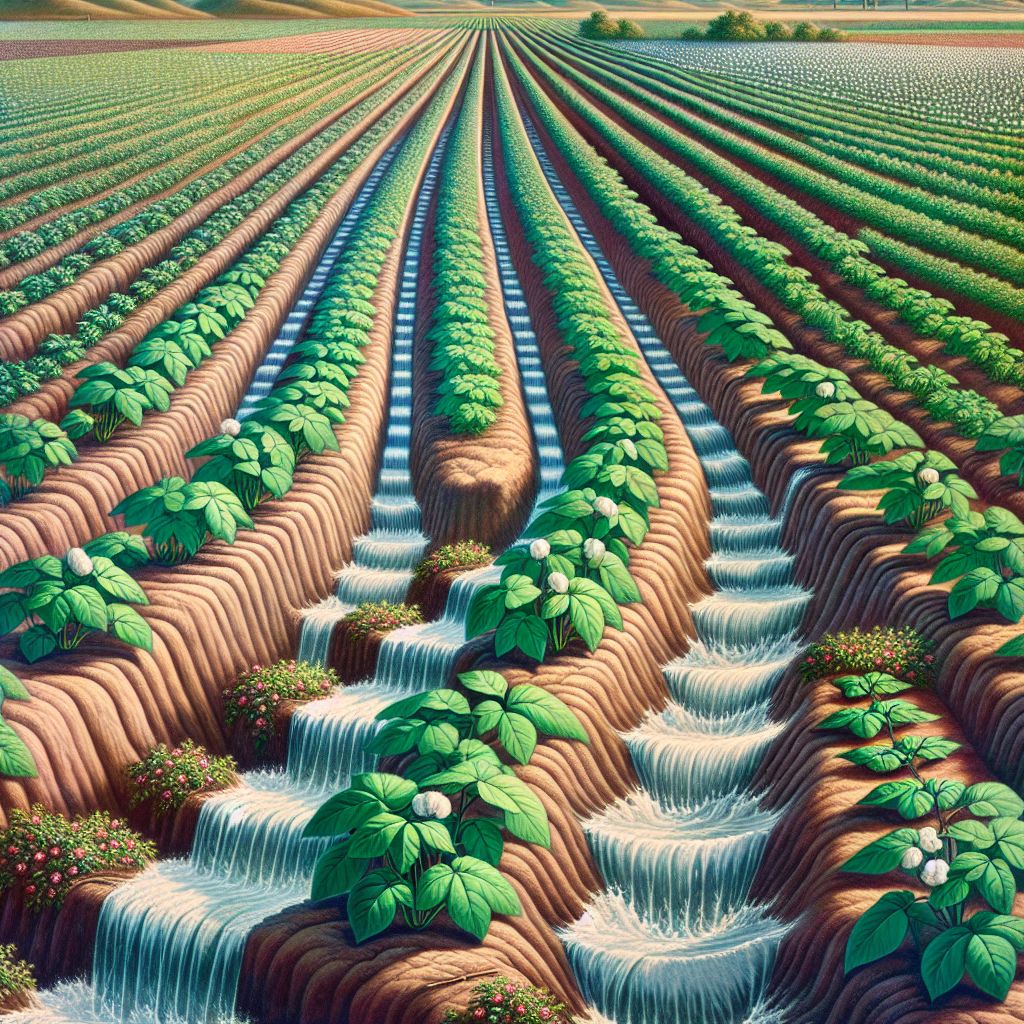
Furrow irrigation is one of the oldest methods out there. It’s simple: you create small channels or ‘furrows’ between the rows of cotton. Water flows down these furrows, soaking into the soil and reaching the plant roots. It’s a no-frills approach that’s been used for centuries. To understand the evolution of irrigation methods, you can read about how solar-powered irrigation enhances crop yield and health.
How Does Furrow Irrigation Work
To set up furrow irrigation, you’ll need to shape your land into raised beds with furrows in between. Then, you simply let water run down these furrows from one end of the field to the other. Gravity does the work, and your cotton gets watered in the process.
While furrow irrigation is less precise than drip or pivot systems, it can still be effective, especially if you’re working with a limited budget or have a smaller operation.
The Simple Advantages of Furrow Irrigation
Despite its simplicity, furrow irrigation has some clear benefits:
It’s cost-effective and easy to implement.
It uses equipment you likely already have on your farm.
It can be a good option if you have a consistent and ample water supply.
Just remember that furrow irrigation can lead to more evaporation and runoff, so it’s important to manage it carefully to avoid water waste.
This below table will show the pros and cons of using furrow irrigation system to grow cotton over other systems.
|
Pros of Furrow Irrigation for Cotton |
Cons of Furrow Irrigation for Cotton |
|---|---|
|
Lower initial investment and equipment costs compared to sprinkler or drip irrigation. 3 |
More labor-intensive to maintain water flow and manage the system compared to automated sprinkler or drip irrigation. 2, 4 |
|
Lower pumping costs per acre-inch of water applied compared to sprinkler irrigation. 3 |
Potential for poor uniformity of water application, with over-irrigation at the top of the field and under-irrigation at the bottom. 2 |
|
Allows for recirculation and reuse of irrigation runoff water, reducing water usage. 4 |
Not well-suited for sandy soils, which can lead to high water infiltration rates and poor water distribution. 4 |
|
Can reduce chemical leaching compared to other surface irrigation methods. 3 |
Salts can accumulate in the ridges between furrows, requiring periodic re-plowing to redistribute the salinity. 4 |
|
Dry soil in furrows enhances trafficability and reduces soil compaction compared to other surface irrigation. 5 |
Initial field preparation and leveling can be labor-intensive and costly. 4 |
|
Can achieve high crop yields with proper management practices. 4 |
Not suitable for all cotton crop types or growth stages. 4 |
Now that we look at the different irrigation systems, let’s make them more efficient with solar panels

Boost Your Irrigation System’s Efficiency with Solar Panels
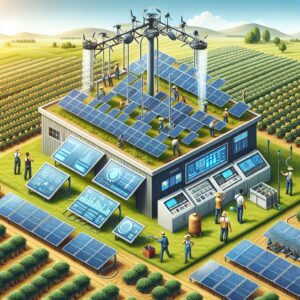
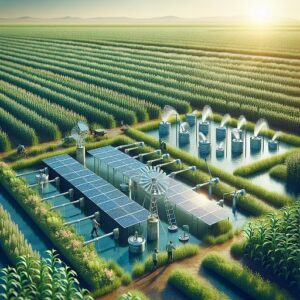
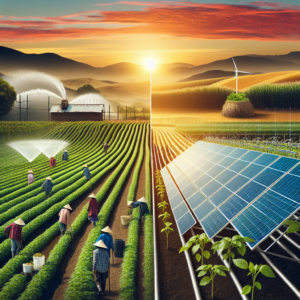
Here’s where the sun comes into the picture. Solar panels can be used to power your irrigation pumps, reducing or even completely removing the need for grid electricity or diesel. By using solar panels, you’re harnessing a renewable energy source that’s plentiful, especially in the sunny fields where wheat grows best.
Consider the Various Solar Panel Options for your Irrigation System
Solar panels come in a variety of types. Monocrystalline panels are known for their high efficiency and excellent performance in low-light conditions. Polycrystalline panels are a cost-effective choice that performs well in high-temperature environments. Thin-film panels are flexible and lightweight, but they take up more space. Factors such as your location, budget, and the size of your irrigation system will determine which type is best for you.
Choosing the Right Solar Panel for Your Irrigation System
Just like you would carefully select the right seed for your soil, you should also carefully select the right solar panel for your irrigation system. You need to consider the power requirements of your irrigation system, the amount of sunlight your location receives, and the space available for installing the panels. It’s always a good idea to consult with a solar expert to find the perfect fit for your farm.
As solar panels come in a variety of sizes and power levels, you’ll need to work out the total wattage required to power your pumps. From there, you can figure out how many panels you’ll need to meet this requirement. Keep in mind that choosing a solar-powered irrigation system is a long-term commitment that can result in substantial energy cost savings in the long run.
This below table will show how integrating solar panels with an irrigation system can improve efficiency for growing cotton:
| How Solar Panels Improve Irrigation Efficiency for Cotton |
|---|
| Reduced energy costs – Solar-powered irrigation systems eliminate the need for grid electricity or diesel fuel, significantly lowering operational expenses for cotton farmers. 1, 4 |
| Reliable water supply – Solar panels provide a consistent source of power to run irrigation pumps, ensuring a steady water supply for cotton crops even in areas with unreliable grid electricity. 1, 4 |
| Increased water use efficiency – Studies have shown that shading from solar panels can help retain soil moisture for cotton, reducing overall water requirements. 3 |
| Potential for increased yields – The microclimate created by solar panels has been shown to increase yields for some crops like tomatoes and chiltepin, which could translate to higher cotton production. 3 |
| Flexibility and scalability – Solar irrigation systems can be easily scaled up or down to match the water needs of cotton fields, providing flexibility for farmers. 4 |
| Environmental benefits – Solar-powered irrigation reduces carbon emissions and fossil fuel consumption compared to traditional systems, aligning with sustainable agriculture practices. 1, 4 |

The Proof Is in the Picking: Real-World Wins in Watering
Case Study: Drip Irrigation Success Stories in Arid Regions
In the arid landscapes of Australia, farmers have turned to drip irrigation to combat water scarcity and harsh conditions. A study by the Department of Primary Industries and Fisheries revealed that, over seven years, drip irrigation systems not only increased cotton yields by 8.73% but also slashed water usage by 37.4%. This is a testament to the fact that precision and efficiency can lead to remarkable improvements in both resource conservation and crop productivity.
Case Study: Pivot Irrigation Innovations in Large-Scale Farms
On the sprawling cotton farms of Texas, center pivot irrigation systems have been fine-tuned to maximize water efficiency. With the integration of smart technology, these systems can now respond to real-time data, adjusting water delivery to the precise needs of the crop. This adaptability has led to significant water savings while maintaining, and in some cases increasing, cotton yields. It’s a clear example of how traditional methods can evolve to meet modern demands for sustainability.
Case Study: Revitalizing Traditional Methods for Modern Sustainability
In Egypt, where water resources are historically overburdened, cotton farmers are revitalizing ancient furrow irrigation techniques with a modern twist. By lining their furrows with plastic to reduce seepage and evaporation, they’ve managed to maintain their cotton crops with far less water. This blend of old and new is breathing life back into practices that are both economically and environmentally sustainable.
Conclusion:
Efficient irrigation is the lifeline of sustainable cotton farming. With water being a precious commodity, the adoption of innovative irrigation systems, particularly those powered by solar energy, represents a significant step forward. Drip, pivot, and even updated traditional furrow methods offer farmers various options to optimize water use and enhance crop yields. By selecting the right system and pairing it with solar power, cotton farmers can not only reduce their environmental footprint but also ensure the long-term viability of their farms.
Ultimately, the integration of solar irrigation systems in cotton farming is more than just a technological upgrade; it’s a commitment to stewardship of the land and resources. As we’ve seen in the case studies from arid regions to large-scale farms, the benefits are clear: higher efficiency, better yields, and a healthier planet. It’s a path worth pursuing for any farmer looking to grow cotton—or any crop, for that matter—in today’s challenging agricultural landscape.
Frequently Asked Questions (FAQ)
When it comes to efficient water usage in cotton farming, there are always questions. Let’s address some of the most common ones:
How much water does cotton really need?
On average, cotton requires about 27 to 51 inches of water during its growth period. The exact amount can vary based on the climate, soil type, and cotton variety. Efficient irrigation systems are designed to meet these specific needs without wasting water.
Can efficient solar irrigation systems positively impact cotton quality?
Absolutely. By providing consistent and precise water delivery, solar irrigation systems can improve the overall health of the cotton plant, which often leads to better fiber quality. Healthy plants are better equipped to produce high-quality cotton.
Consistent water delivery ensures uniform growth.
Reduced plant stress from drought or overwatering can lead to higher quality cotton.
Efficient use of resources often correlates with better crop outcomes.
What is the most cost-effective irrigation system for small-scale cotton farmers?
For small-scale cotton farmers, the most cost-effective irrigation system could be a simple drip irrigation setup. It’s affordable, easy to install, and can be scaled to fit smaller operations. When combined with solar power, it also helps reduce energy costs.
Here are the key reasons why drip irrigation can be cost-effective:
– Low initial setup cost compared to large-scale systems.
– Reduced water usage lowers ongoing operational costs.
– Potential for manual operation if solar power is not feasible.
How does weather affect the choice of a solar irrigation system for cotton?
Weather patterns play a significant role in the choice of an irrigation system. In regions with abundant sunshine, solar-powered systems are ideal as they can harness a consistent energy source. In areas with less predictable sunlight, it’s crucial to have a backup power source or choose a system that can operate efficiently under variable conditions.
Are there government incentives for adopting efficient solar irrigation systems?
Many governments offer incentives for farmers who adopt sustainable practices, including solar irrigation systems. These can come in the form of tax breaks, grants, or subsidies. It’s worth researching local programs as they can significantly offset the initial investment costs and make the transition to solar irrigation much more feasible.
Remember to check:
– Federal and state-level programs.
– Local agricultural extension services for guidance.



Leave a Reply