

Key Takeaways
Solar-powered irrigation systems reduce energy costs and environmental impact.
Drip irrigation is the most efficient method for cannabis farming.
Monocrystalline solar panels are the best choice for high efficiency and longevity.
Initial setup costs for solar irrigation systems are higher, but long-term savings are significant.
Combining solar panels with automated irrigation enhances crop yield and quality.
Why You Should Use Solar Panels with an Irrigation System for Growing Cannabis
Using solar panels to power your cannabis irrigation system is a smart choice for several reasons. Not only does it help you save on energy costs, but it also reduces your environmental footprint. Let’s dive into the specific benefits.
Environmental Benefits
Solar-powered irrigation systems are incredibly eco-friendly. By harnessing the sun’s energy, you minimize the need for fossil fuels, which reduces greenhouse gas emissions. This is crucial for combating climate change and promoting sustainable farming practices.
Besides that, solar panels have a low impact on the environment during their production and installation phases compared to traditional energy sources. They don’t produce harmful pollutants or require water for cooling, making them a clean and green energy option.
Energy Independence and Cost Savings
One of the biggest advantages of using solar panels is the energy independence they offer. You won’t have to rely on the grid, which can be unreliable and expensive. Instead, you generate your own power, giving you control over your energy supply.
Most importantly, while the initial investment in solar panels can be high, the long-term savings are substantial. After the initial setup, your energy costs will be minimal, allowing you to allocate resources to other areas of your farm.
Long-Term Sustainability
Solar panels are designed to last for decades, often with warranties extending up to 25 years. This means you can count on a reliable energy source for the long haul. Additionally, as technology advances, the efficiency of solar panels continues to improve, making them an even more attractive option.
Enhanced Crop Production and Quality
By integrating solar power with your irrigation system, you can achieve more consistent and precise watering. This leads to healthier plants and higher yields. Consistent water supply is especially important for cannabis, which requires specific moisture levels to thrive.
Moreover, automated irrigation systems can be fine-tuned to deliver the exact amount of water needed, reducing waste and ensuring that your crops get the optimal amount of hydration.

Top Irrigation Methods Used by Cannabis Farmers
When it comes to irrigating cannabis, several methods are commonly used. Each has its own set of advantages and disadvantages. Let’s explore the most popular options.
Drip Irrigation Systems: Pros and Cons
Pros: Precise water delivery, water efficiency, reduced labor costs.
Cons: Initial setup can be expensive, requires regular maintenance to prevent clogs.
Drip irrigation systems are highly efficient because they deliver water directly to the plant’s root zone. This minimizes water loss due to evaporation and runoff, making it a great choice for cannabis farming.
However, these systems can be costly to install and require regular maintenance to keep them running smoothly. Clogged emitters can disrupt water flow, so it’s essential to check the system frequently. For more insights, you can read about the pros and cons of cannabis irrigation systems.
Flood and Drain Systems
Flood and drain systems, also known as ebb and flow systems, are another popular choice. These systems periodically flood the grow area with nutrient-rich water and then drain it away. This ensures that plants get the nutrients they need while preventing overwatering. For more information on efficient watering techniques, you can check out solar-powered irrigation systems for growing blackberries.
Aeroponics
Aeroponics involves growing plants in an air or mist environment without the use of soil. This method can be highly efficient, using up to 90% less water than traditional soil-based growing. However, it requires specialized equipment and knowledge to set up and maintain.
Ebb and Flow Systems
Ebb and flow systems work by flooding the grow tray with nutrient solution and then allowing it to drain back into a reservoir. This cycle repeats several times a day, ensuring that plants receive a steady supply of nutrients. It’s a versatile and effective method but can be more complex to set up compared to drip irrigation.
Now that we looked at irrigations systems, let’s take a look at the solar panels that will power them.

Top Solar Panels for Your Cannabis Farmers Irrigation System
Choosing the right solar panels for your irrigation system is crucial for maximizing efficiency and cost savings. Here are the top options to consider.
Monocrystalline Solar Panels
Monocrystalline panels are known for their high efficiency and long lifespan. They can convert more sunlight into electricity compared to other types of panels, making them ideal for farms with limited space. Additionally, these panels perform well in low-light conditions, ensuring that your irrigation system remains operational even on cloudy days.
Polycrystalline Solar Panels
Polycrystalline panels are another viable option for cannabis irrigation systems. While they are generally less efficient than monocrystalline panels, they are more affordable. These panels are made from silicon fragments melted together, which makes them less expensive to produce. They are a good choice if you have ample space and want to reduce initial costs.
Thin-Film Solar Panels
Thin-film solar panels are the least efficient but the most flexible and lightweight option. They can be installed on various surfaces, including curved or irregularly shaped areas. Although they require more space to produce the same amount of energy as crystalline panels, their lower cost and versatility make them an attractive option for some farmers.
Each type of solar panel has its advantages and drawbacks, so it’s essential to consider your farm’s specific needs and constraints when planning.
Here is a table showing the pros and cons of using different types of solar panels with an irrigation system on a farm:
|
Panel Type |
Pros |
Cons |
|---|---|---|
|
Monocrystalline Panels |
– High efficiency (15-22%), producing more power per square foot. 1, 2, 4 | |
|
Polycrystalline Panels |
– Lower upfront cost than monocrystalline. 1, 2 |
– Lower efficiency and shorter lifespan than monocrystalline. 2, 4 |
|
Thin-Film Solar Panels |
– Lowest upfront cost. 1, 2 |
– Lowest efficiency (7-13%). 2, 4 |
What is the Best Solar Panel for a Cannabis Farmer to Use
For most cannabis farmers, monocrystalline solar panels are the best choice due to their high efficiency and long lifespan. Although they come with a higher upfront cost, their ability to generate more power per square foot makes them a worthwhile investment. If budget constraints are a significant concern, polycrystalline panels offer a good balance between cost and efficiency.
Thin-film panels are best suited for farms with unique installation requirements or where space is not a limiting factor. Ultimately, the best choice will depend on your specific situation, including your budget, space availability, and energy needs.
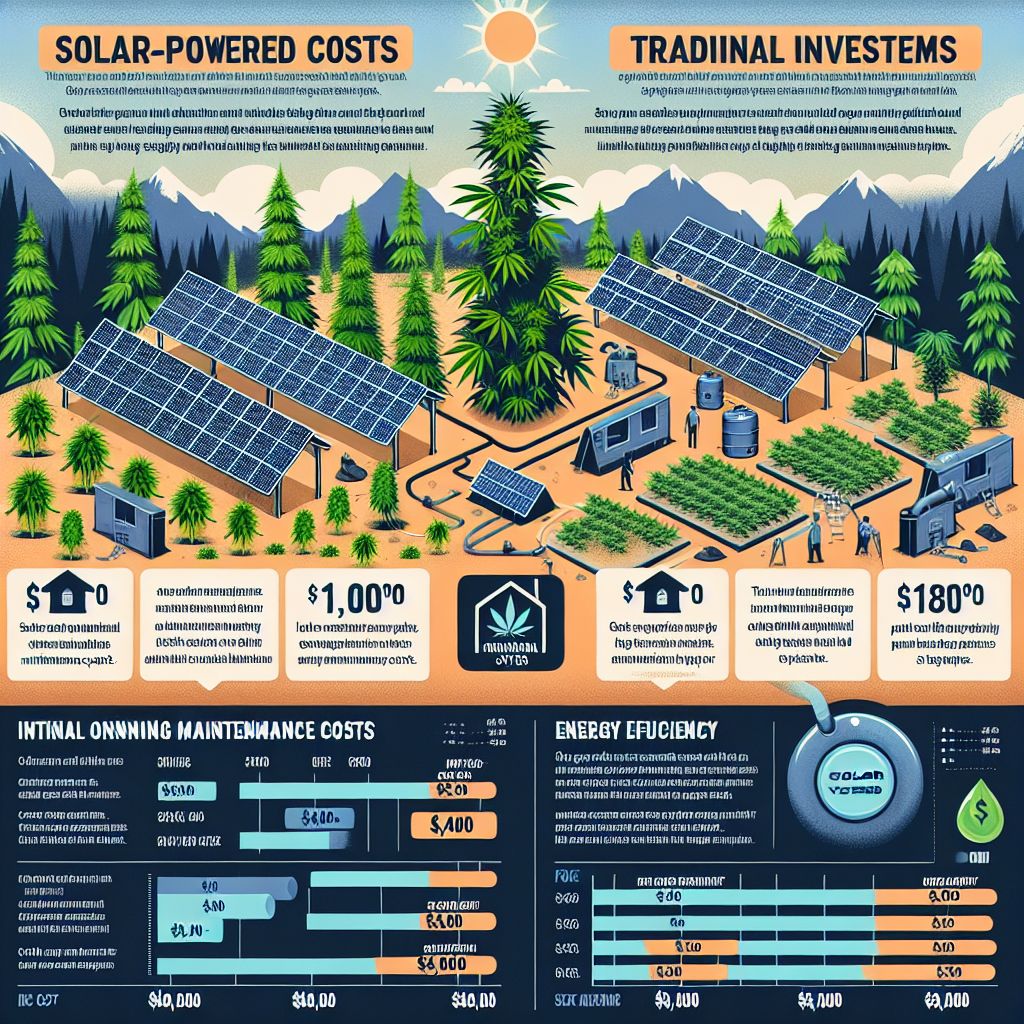
Cost and Efficiency Comparison: Solar Irrigation Systems Versus Traditional Irrigation Systems for Growing Cannabis
When comparing solar-powered irrigation systems to traditional systems, it’s essential to look at various factors, including initial setup costs, ongoing maintenance costs, energy efficiency, and return on investment.
Initial Setup Costs Comparison
Solar-powered irrigation systems typically have higher initial setup costs compared to traditional systems. This is due to the cost of solar panels, inverters, batteries, and other necessary equipment. For example, a solar irrigation system might cost between $10,000 and $20,000 to install, while a traditional system could cost around $5,000 to $10,000.
Ongoing Maintenance Costs Comparison
While the initial setup costs for solar systems are higher, the ongoing maintenance costs are generally lower. Solar panels require minimal maintenance, mainly involving periodic cleaning and inspections. Traditional irrigation systems, on the other hand, often have higher maintenance costs due to the need for regular servicing of pumps, engines, and other components.
Additionally, solar-powered systems eliminate the need for fuel, further reducing ongoing expenses.
Energy Efficiency and Savings for Both Systems
Solar-powered irrigation systems are more energy-efficient than traditional systems because they harness renewable energy from the sun. This reduces your reliance on fossil fuels and grid electricity, leading to significant cost savings over time. Traditional systems, in contrast, depend on electricity or fuel, which can be expensive and subject to price fluctuations. For a detailed guide on the efficiency and setup of solar panels for farm irrigation, check out this resource.
Return on Investment Comparison
Although solar-powered irrigation systems have higher upfront costs, their long-term savings make them a smart investment. The return on investment (ROI) for solar systems can be substantial, often paying for themselves within 5 to 10 years. In contrast, traditional systems may have lower initial costs but higher ongoing expenses, leading to a lower overall ROI.
Here is a table comparing the cost and efficiency of an irrigation system with and without solar panels:
|
Aspect |
Without Solar Panels |
With Solar Panels |
|---|---|---|
|
Initial Cost | ||
|
Operating Cost |
Very low or zero fuel/electricity costs after installation. 1, 4 | |
|
Efficiency |
Depends on energy source efficiency. 4 |
Depends on solar radiation, temperature, system design. 1, 4 |
|
Environmental Impact |
Higher carbon footprint. 1 |
Lower carbon footprint, renewable energy. 1 |
|
Location Flexibility |
Limited to grid-connected or fuel access areas. 3 |
Can be used in remote off-grid areas. 3 |
|
Maintenance | ||
|
Lifespan |
Shorter for fuel-based systems. 1 | |
|
Long-term Costs |
Higher due to recurring fuel/electricity bills. 1 |
Lower total 20-year costs by 50-60% compared to traditional systems. 1 |
|
Government Incentives |
Generally none |
Many governments provide tax credits, subsidies for solar irrigation. 1 |
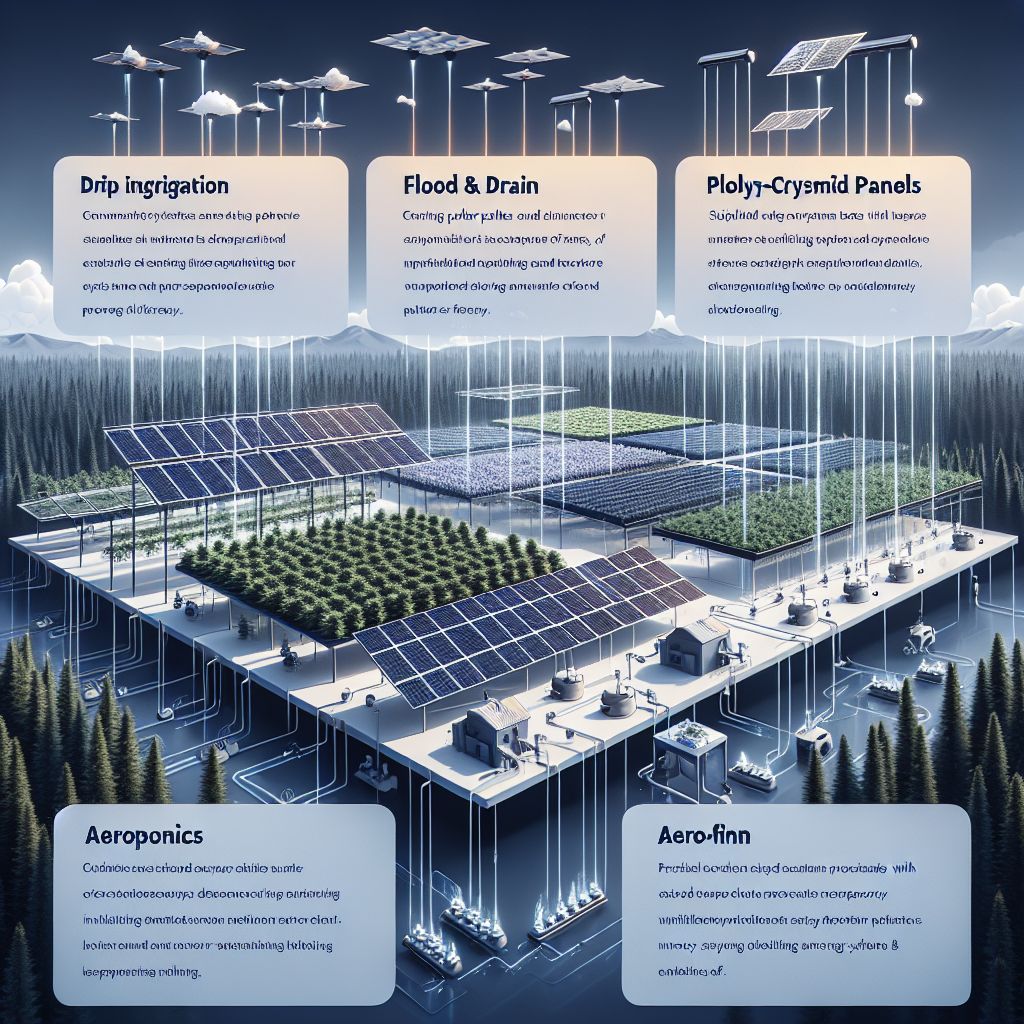
Which Combination of Solar Panels and Irrigation Systems Make the Most Efficient System for Your Cannabis Farm
To maximize efficiency, it’s crucial to choose the right combination of solar panels and irrigation systems. Here are some of the best options to consider.
Best Combinations: Drip Irrigation Systems connected to Monocrystalline Solar Panels
One of the most efficient combinations is using drip irrigation systems powered by monocrystalline solar panels. Drip irrigation provides precise water delivery directly to the plant’s root zone, reducing water waste and promoting healthy growth. Monocrystalline panels ensure a reliable and efficient power source, even in low-light conditions.
Other Good Combinations:
Besides drip irrigation with monocrystalline panels, other effective combinations include solar-powered irrigation for growing lentils.
Flood and Drain Systems with Polycrystalline Panels: This setup offers a balance between cost and efficiency, making it suitable for larger farms with ample space.
Aeroponics with Thin-Film Panels: Ideal for farmers looking for a highly efficient and flexible system, especially in areas with unique installation requirements.
Automation and Monitoring Tools: To make the System Even More Efficient
Integrating automation and monitoring tools can further enhance the efficiency of your solar-powered irrigation system. Automated systems can adjust water delivery based on real-time data, ensuring optimal hydration for your crops. Monitoring tools can help you track energy production and usage, allowing you to make informed decisions and optimize system performance.
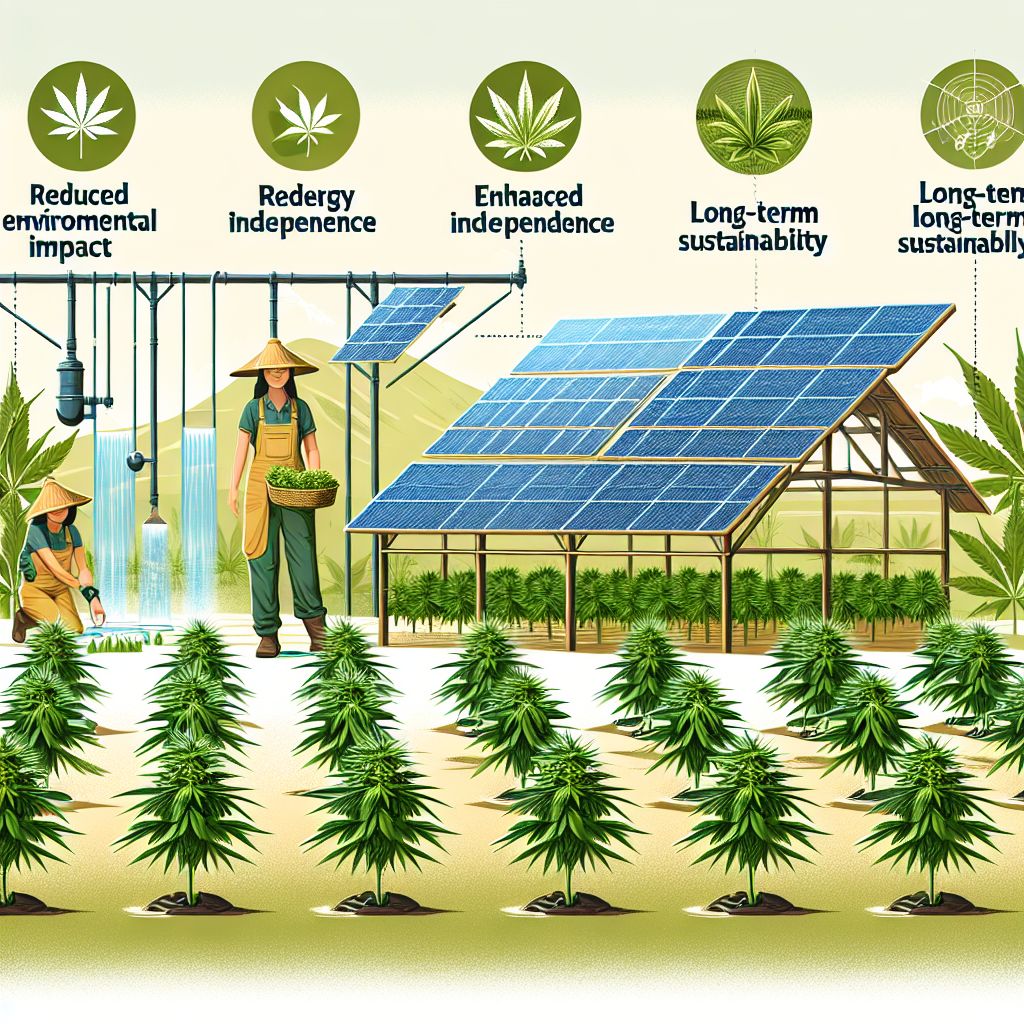
Conclusion: Is it a Smart Decision to Add Solar-Power to an Irrigation System for Your Cannabis Farm
In conclusion, adding solar power to your cannabis farm’s irrigation system is a smart decision for several reasons. The environmental benefits, energy independence, and long-term cost savings make it a worthwhile investment. Moreover, the enhanced crop production and quality achieved through precise and consistent watering can significantly boost your farm’s profitability. For more information on efficient watering techniques, check out this article on solar-powered irrigation systems.
Summarizing The Benefits
By choosing a solar-powered irrigation system, you can:
Reduce your environmental impact.
Achieve energy independence and lower energy costs.
Ensure long-term sustainability with minimal maintenance.
Enhance crop yield and quality through precise watering.
Overall, the combination of solar panels and efficient irrigation systems offers a sustainable and profitable solution for cannabis farmers.
Long-Term Financial and Environmental Impact
Solar-powered irrigation systems provide substantial long-term financial benefits. By reducing reliance on grid electricity or fossil fuels, you can save significantly on energy costs over time. These savings can be reinvested into your farm, allowing for further improvements and growth.
Environmentally, solar panels contribute to reducing carbon emissions and conserving natural resources. This aligns with sustainable farming practices and promotes a healthier planet. Additionally, using renewable energy sources can enhance your farm’s reputation, attracting environmentally conscious consumers and investors.
Final Recommendations
If you’re considering transitioning to a solar-powered irrigation system for your cannabis farm, start by assessing your current energy needs and irrigation requirements. Choose the right type of solar panels based on your budget and space constraints. Monocrystalline panels are generally the best choice for their efficiency and durability.
Implementing automation and monitoring tools can further enhance the efficiency and effectiveness of your irrigation system. Regular maintenance and monitoring will ensure that your system operates at peak performance, maximizing your investment’s benefits. For instance, you can explore more about solar-powered irrigation systems to understand how they can be beneficial for your crops.
By making this transition, you’ll not only improve your farm’s sustainability but also increase your crop yield and quality, leading to greater long-term profitability.
Frequently Asked Questions (FAQ)
Below are some common questions and answers about solar-powered irrigation systems for cannabis farms:
How much do solar-powered irrigation systems cost for cannabis farms?
What are the maintenance requirements for solar panels?
Can solar-powered irrigation work in all climates?
How do I determine the right solar panel size for my irrigation needs?
Are there any government incentives for solar-powered irrigation systems?
How Much Do Solar-Powered Irrigation Systems Cost for Cannabis Farms?
The cost of solar-powered irrigation systems for cannabis farms can range from $10,000 to $20,000, depending on the size and complexity of the system. This includes the cost of solar panels, inverters, batteries, and other necessary equipment. While the initial investment is higher than traditional systems, the long-term savings on energy costs can make it a worthwhile investment.
What Are the Maintenance Requirements for Solar Panels?
Solar panels require minimal maintenance. The main tasks involve periodic cleaning to remove dust and debris that can reduce efficiency, and regular inspections to ensure all components are functioning correctly. It’s also essential to check for any shading issues that could affect performance. Overall, solar panels are durable and designed to last for decades with minimal upkeep.
Can Solar-Powered Irrigation Work in All Climates?
Yes, solar-powered irrigation systems can work in various climates. However, their efficiency may be affected by factors such as sunlight availability and weather conditions. In regions with less sunlight, you may need to install additional panels to meet your energy needs. Advances in solar technology have made panels more efficient, allowing them to generate power even in low-light conditions.
How Do I Determine the Right Solar Panel Size for My Irrigation Needs?
To determine the right solar panel size, calculate your irrigation system’s power requirements. This includes the energy needed to run pumps, controllers, and any other equipment. Consider factors such as sunlight availability and panel efficiency. It’s often helpful to consult with a solar energy expert to ensure you choose the right size and type of panels for your specific needs.
Are There Any Government Incentives for Solar-Powered Irrigation Systems?
Yes, many governments offer incentives to encourage the adoption of solar-powered irrigation systems. These incentives can include tax credits, grants, and rebates. For example, the U.S. federal government provides a solar investment tax credit (ITC) that allows you to deduct a percentage of the installation cost from your federal taxes. Additionally, many states and local governments offer their own incentives. Check with your local authorities for specific programs and eligibility requirements.
“Solar-powered irrigation systems can significantly reduce energy costs and environmental impact, making them a smart investment for sustainable cannabis farming.”
By choosing a solar-powered irrigation system, you can make your cannabis farm more sustainable, efficient, and profitable. The initial investment may be higher, but the long-term benefits far outweigh the costs. With the right combination of solar panels and irrigation methods, you can achieve optimal crop yield and quality while minimizing your environmental footprint.







Leave a Reply