
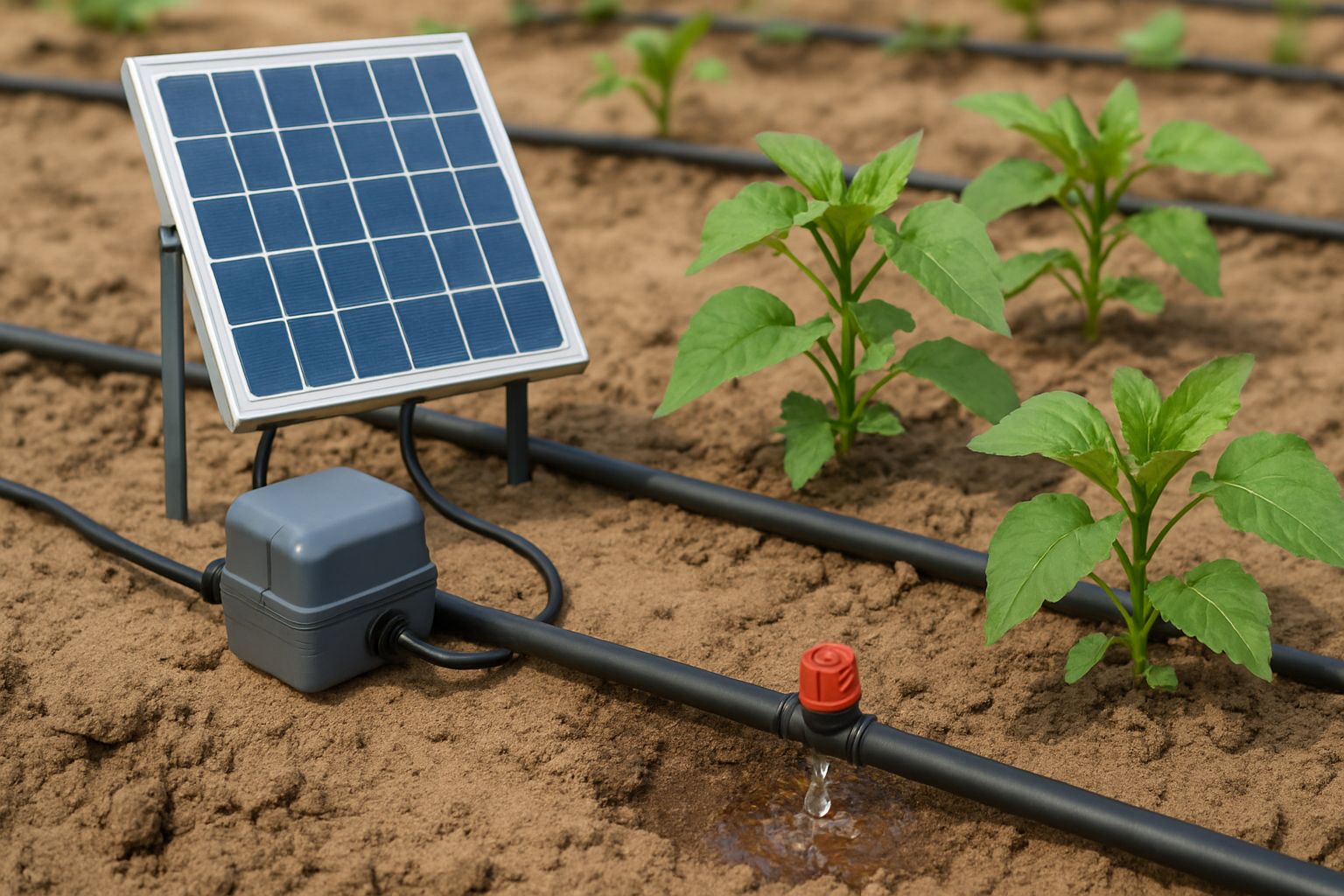
Article-At-A-Glance: Why Solar Drip Irrigation Is Changing Agriculture Forever
- Solar-powered drip irrigation systems deliver water directly to plant roots using solar energy, cutting water usage by up to 70% compared to flood irrigation.
- A 200W solar panel paired with a small DC pump can reliably irrigate a half-acre market garden with zero grid connection required.
- The average farm switching from diesel to solar drip irrigation reduces CO2 emissions by approximately 15 tonnes per year.
- Remote and off-grid farms benefit most, but smallholder operations in semi-arid regions see some of the most dramatic yield improvements.
- There’s a specific design step most farmers skip during setup that quietly kills system efficiency — we cover exactly what it is and how to avoid it.
Solar-powered drip irrigation is one of the most practical farm upgrades available today, and the numbers make the case better than any sales pitch. The core idea is simple: use free sunlight to pump water precisely where crops need it, eliminating two of farming’s biggest cost centers — energy and water waste — at the same time.
What a Solar-Powered Drip Irrigation System Actually Is
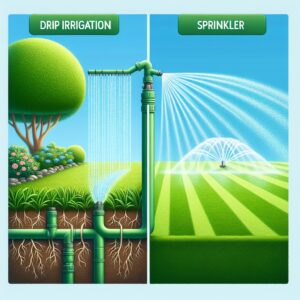
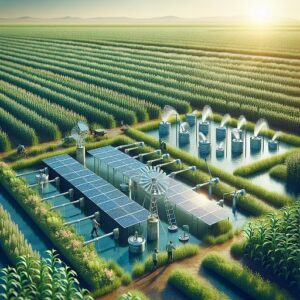
A solar-powered drip irrigation system is a water delivery setup that uses photovoltaic (PV) solar panels to generate electricity, which powers a pump that moves water through a network of tubes and emitters directly to the base of each plant. Unlike sprinkler systems that spray water into the air, drip systems release water at low pressure right at the root zone, where plants can actually use it.
The result is a closed-loop efficiency that conventional irrigation simply can’t match. Water isn’t lost to wind drift, evaporation from wet foliage, or runoff across bare soil. Every drop is directed with intent.
The Three Core Components Every System Needs
Strip any solar drip system down to its essentials and you’ll find three non-negotiable components working in sequence. Without all three properly sized and matched, the system either underperforms or fails entirely.
- Solar Panel Array: Captures sunlight and converts it to DC electricity. Panel wattage must match pump demand, accounting for peak sun hours in your region.
- DC Water Pump: Moves water from the source (well, tank, or reservoir) into the drip mainline. Brushless DC pumps are standard for solar applications due to their low startup current and long service life.
- Drip Distribution Network: Mainline pipe, sub-main lines, drip laterals, and emitters. Emitter flow rate (measured in liters or gallons per hour) must be matched to crop water demand and soil infiltration rate.
How Solar Panels Power the Water Pump
Solar panels produce direct current (DC) electricity when sunlight hits the photovoltaic cells. That electricity flows directly to a brushless DC submersible or surface pump — no inverter needed in most small-to-mid-scale setups. This direct DC-to-DC connection is actually one of the system’s biggest efficiency advantages, since converting DC to AC and back again wastes roughly 10–15% of generated power.
Larger installations or systems with battery storage do use a charge controller and sometimes an inverter, but for daytime-only pumping operations, the panel-to-pump direct connection keeps the design clean and cost-effective. The pump output varies naturally with sunlight intensity, pumping more water during peak sun hours and slowing during cloud cover — which in practice aligns well with crop evapotranspiration demand on hot, bright days.
How Water Gets Delivered Directly to Plant Roots
From the pump, pressurized water moves into a mainline pipe — typically polyethylene ranging from 25mm to 63mm diameter depending on farm size. That mainline feeds into sub-main lines running parallel to crop rows, which then connect to drip laterals. The laterals carry emitters spaced according to crop type: typically 30cm apart for vegetables, 50–100cm for fruit trees. To enhance efficiency, many farmers are exploring solar-powered irrigation systems to reduce energy costs and promote sustainability.
Emitters are the precision component of the entire system. Standard pressure-compensating emitters deliver a consistent 2–4 liters per hour regardless of pressure fluctuations along the line, ensuring the plant at the far end of a 200-meter lateral gets exactly the same water volume as the plant at the inlet. This consistency is what separates a well-designed drip system from one that starves the back rows while overwatering the front.
A basic filter — typically a 120-mesh screen or disc filter — sits between the pump outlet and the mainline to prevent emitter clogging, which is the most common cause of drip system failure. This single component, often costing less than $30, protects the entire network. For more information on essential components, check out farm solar panel system components.
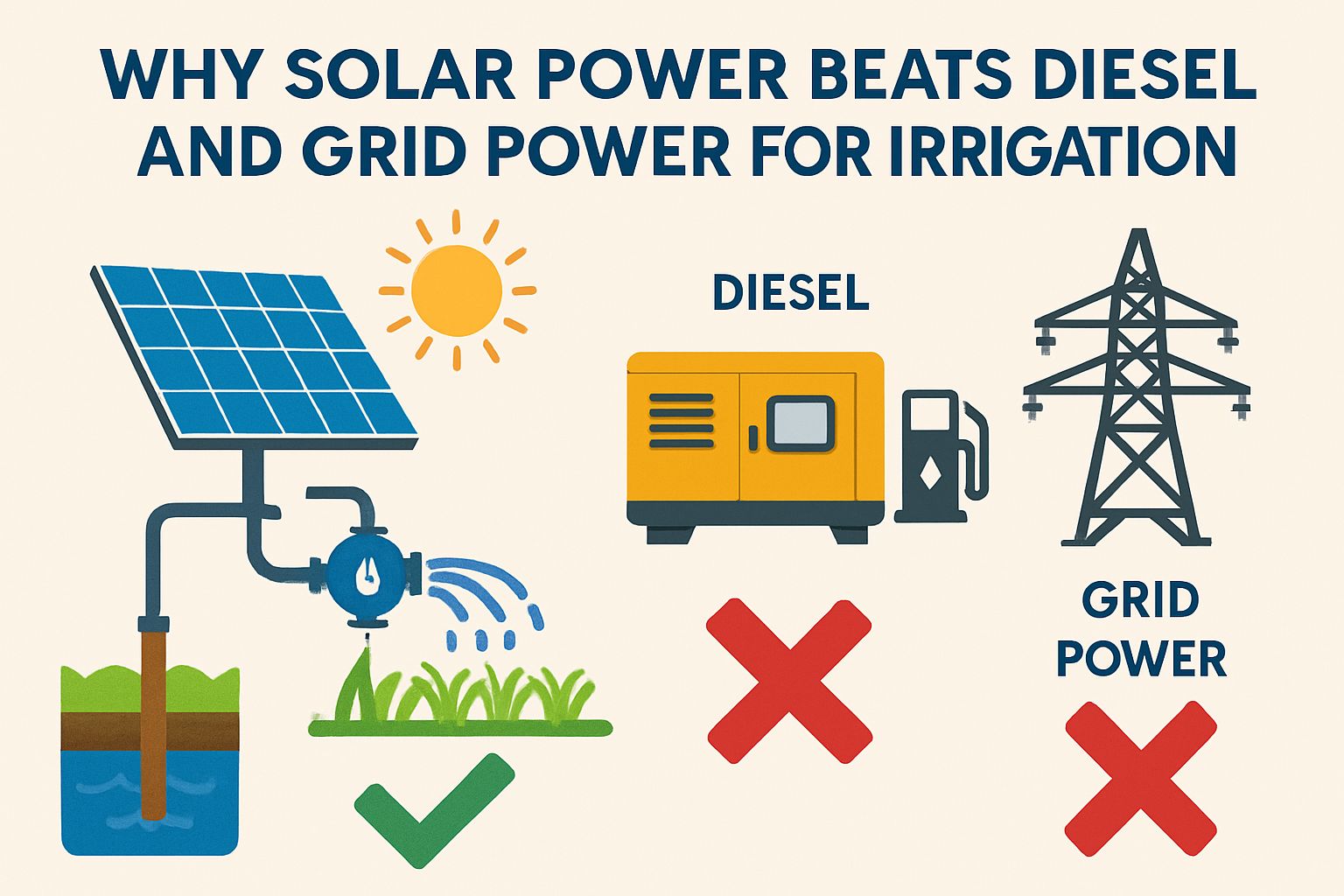
Why Solar Power Beats Diesel and Grid Power for Irrigation
Diesel pumps and grid-tied electric pumps have powered farm irrigation for decades, but both carry structural cost problems that compound over time. Diesel requires ongoing fuel procurement, engine maintenance, and exposure to fuel price volatility. Grid power ties farm operating costs directly to utility rate increases, which in many agricultural regions have climbed steadily for years.
Solar eliminates the fuel cost entirely. Once panels are installed, the energy input is free. A well-maintained solar panel array degrades at roughly 0.5% efficiency per year, meaning a system installed today still operates at approximately 90% of original capacity after 20 years — with no fuel bills across that entire span.
The Real Cost Difference Over Time
The upfront cost of a solar drip system is real and shouldn’t be understated. A small-farm system covering 1–2 acres typically runs between $1,500 and $4,000 installed, depending on panel capacity, pump type, and drip network complexity. A comparable diesel pump setup costs less initially — but that’s where the financial comparison reverses.
Diesel fuel, maintenance, and parts for a pump running 6 hours daily can easily reach $800–$1,500 per year on a small farm. The solar system’s break-even point typically falls between 2 and 4 years, after which every irrigation season represents pure cost savings. Over a 10-year period, the total cost advantage of solar over diesel on a 2-acre operation can exceed $10,000.
Cost Category
Diesel Pump System
Solar Drip System
Initial Setup Cost
$400 – $900
$1,500 – $4,000
Annual Fuel/Energy Cost
$800 – $1,500
$0
Annual Maintenance Cost
$200 – $500
$20 – $80
Estimated 10-Year Total
$11,000 – $21,000
$1,700 – $4,800
CO2 Emissions (annual)
High (diesel combustion)
Near zero
Carbon Emissions: Solar Drip vs. Diesel-Powered Irrigation
Beyond the financial case, the environmental difference is substantial. A drip irrigation system powered by diesel generates significant CO2 through combustion every single time it runs. The average farm switching to solar drip irrigation reduces its carbon dioxide emissions by approximately 15 tonnes per year compared to diesel-powered equivalents — a figure that compounds meaningfully across an entire farming community or region.
Over two million hectares of farmland globally are now irrigated using solar-powered systems, a number that reflects both the economic logic and the growing pressure on agriculture to reduce its environmental footprint. For farms pursuing organic certification or sustainability credentials, eliminating diesel from irrigation operations is a concrete, measurable step.
Farm Types That Benefit Most From Solar Drip Irrigation
Not every farm sees the same return from solar drip irrigation, but the technology scales remarkably well across operation sizes and crop types. The common thread among farms that benefit most is a combination of water scarcity, high energy costs, or limited infrastructure — exactly the conditions where solar drip delivers its sharpest advantages.
Understanding which farm profile matches your operation helps you set realistic expectations and prioritize the right system specifications from the start. For example, some farms may benefit from solar-powered irrigation systems to enhance efficiency and sustainability.
Off-Grid and Remote Farms
Remote farms without grid access are the clearest beneficiaries. For these operations, solar isn’t just economical — it’s often the only viable option short of running a diesel generator continuously. A solar drip system removes the dependency on fuel supply chains entirely, meaning no supply disruptions, no fuel storage risks, and no generator maintenance eating into farm labor hours. The system runs on sunlight, which arrives every morning regardless of road conditions or supplier availability.
Smallholder Farms in Semi-Arid Regions
Smallholder farmers in semi-arid and arid regions face a compounding problem: water is scarce, energy to pump it is expensive, and crop margins are thin. Solar drip irrigation addresses all three simultaneously. By delivering water precisely at the root zone, these systems stretch limited water supplies significantly further than any surface or sprinkler method.
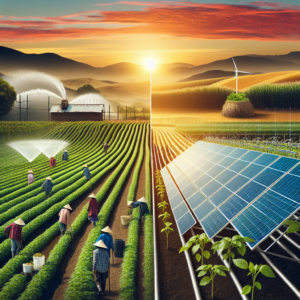
A 200W solar panel paired with a small brushless DC pump can reliably irrigate a half-acre market garden with no grid connection required. That’s a meaningful production area for a smallholder family, and the system cost is recoverable within a few growing seasons when fuel savings and yield improvements are factored together.
In semi-arid regions specifically, the alignment between peak solar irradiance and peak crop water demand is a natural advantage. The hottest, sunniest days — when crops need the most water — are also the days the solar panels produce the most power. The system essentially self-regulates around the climate it operates in.
Specialty Crop Operations: Orchards, Vineyards, and Berry Farms
High-value specialty crops justify the investment in precision irrigation more than any other operation type. Orchards, vineyards, and berry farms depend on consistent, targeted moisture delivery to produce fruit with the quality characteristics that command premium prices. Inconsistent watering leads to brix variation in grapes, split fruit in cherries, and uneven sizing in strawberries — all of which erode market value.
Drip systems already dominate irrigation in these crop categories for good reason. Adding solar power to an existing or new drip network in an orchard or vineyard simply removes the ongoing energy cost from an already-efficient system, improving the economics of every acre under production.
Organic Farms and Disease Pressure Reduction
Organic operations gain a specific agronomic benefit from drip irrigation that goes beyond water efficiency. Keeping foliage dry is one of the most effective cultural controls for fungal diseases like powdery mildew, botrytis, and downy mildew — pathogens that thrive when leaves stay wet. Drip irrigation delivers water below the canopy, leaving foliage dry and dramatically reducing disease pressure without any chemical intervention. For certified organic farms, this is a significant production advantage that directly supports yield quality and certification compliance.
How Much Water Solar Drip Irrigation Actually Saves
Irrigation Method
Estimated Water Use Efficiency
Typical Water Loss
Flood Irrigation
35 – 45%
55 – 65% (runoff, evaporation)
Sprinkler Irrigation
65 – 75%
25 – 35% (wind drift, evaporation)
Surface Drip Irrigation
85 – 90%
10 – 15%
Subsurface Drip Irrigation
90 – 95%
5 – 10%
The efficiency gap between flood irrigation and drip irrigation is not marginal — it’s transformational. A farm that previously applied 1,000 liters to deliver 400 liters to plant roots can achieve the same root-zone delivery with just 450–500 liters using a well-designed drip system. That’s the same crop outcome at less than half the water input.
This matters enormously in regions where water rights are capped, aquifer levels are declining, or seasonal rainfall is unreliable. Solar drip irrigation doesn’t just save money on pumping — it extends the productive range of a farm’s water supply across longer dry periods and more planted area.
Soil health benefits from this efficiency as well. Flood irrigation compacts soil structure, displaces oxygen from the root zone, and leaches nutrients below the reach of plant roots. Drip irrigation maintains consistent soil moisture without saturation, preserving soil aeration, microbial activity, and nutrient availability — all of which translate into stronger root systems and better long-term yields.
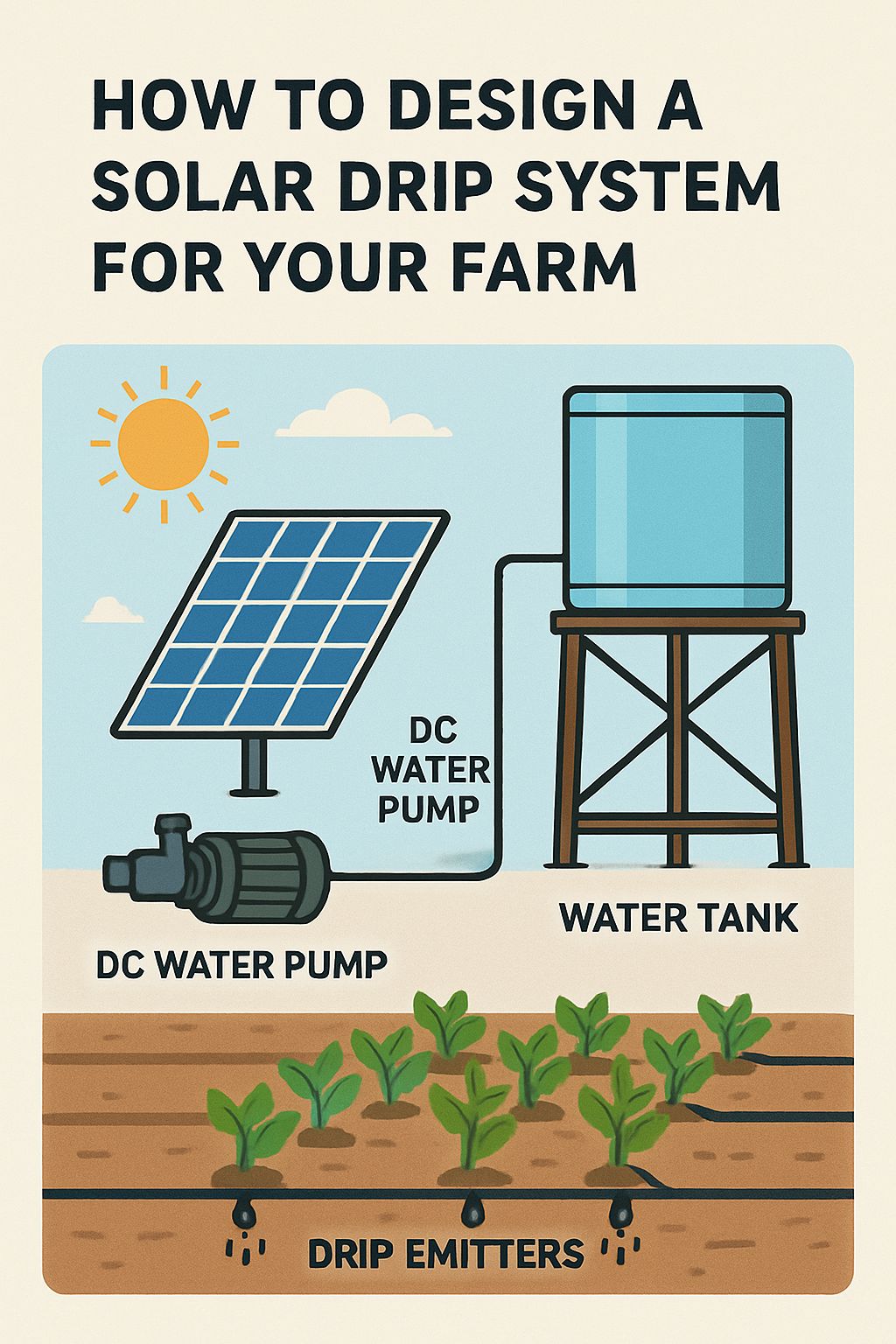
How to Design a Solar Drip System for Your Farm
Getting the design right before purchasing any components saves significant time and money. The most common and costly mistake farmers make is buying a pump based on price rather than hydraulic requirement, then discovering it can’t deliver adequate pressure to the far end of the drip network. A systematic design process eliminates that problem entirely. For more information on how solar energy can benefit your farm, explore the solar panel power solutions.
1. Calculate Your Farm’s Daily Water Requirement
Start with your crop’s daily evapotranspiration (ET) rate — the combined water lost through soil evaporation and plant transpiration. ET rates are published by agricultural extension services for most crops and climate regions, typically expressed in millimeters per day. Multiply the ET rate by your irrigated area to get your daily water volume requirement in liters or gallons. This number is the non-negotiable baseline your pump and panel system must be capable of delivering within the available daily sun hours.
2. Choose the Right Solar Panel Size and Pump Capacity
Once you know your daily water requirement, calculate the flow rate your pump needs to deliver. Divide total daily water volume by the number of peak sun hours in your region — typically 5–7 hours for most agricultural zones. This gives you the required pump flow rate in liters per hour. From there, match a brushless DC pump rated at or above that flow rate at your system’s operating pressure, which is determined by the elevation change between your water source and the highest point of your drip network, plus friction losses in the pipe.
Solar panel sizing follows directly from pump power demand. A pump drawing 150W requires at minimum a 200W panel to account for real-world efficiency losses from heat, wiring resistance, and panel soiling. In practice, sizing panels at 25–30% above pump rated power provides reliable performance across variable irradiance conditions without over-engineering the system.
3. Design the Drip Network Layout for Your Crop Rows
Lay out your mainline to minimize total pipe length while keeping sub-main runs roughly equal in length — this balances pressure across the network and ensures uniform emitter output from row to row. The mainline should run perpendicular to crop rows, with sub-mains branching off at regular intervals. Drip laterals then run parallel to each crop row, with emitters positioned at each plant or at consistent spacing depending on crop density. For more information on how to integrate solar power with your irrigation system, check out this article on solar-powered irrigation systems.
Pressure-compensating emitters are strongly recommended for any lateral longer than 50 meters or on sloped terrain. Standard non-compensating emitters vary output by up to 15% across a pressure range of 10–30 PSI — a variation that shows up visibly in uneven crop growth within weeks of planting. The small additional cost of pressure-compensating emitters is consistently justified by the uniformity of crop establishment and yield across the entire field. For more insights on enhancing farm efficiency, explore the benefits of solar-powered irrigation systems.
4. The Setup Step Most Farmers Skip That Kills Efficiency
The step most farmers skip is system flushing and pressure testing before the first irrigation cycle. After installation, debris from pipe cutting, fittings, and manufacturing residue sits inside every lateral line. Running the system without flushing first drives that debris directly into emitters, clogging them permanently within the first few operating hours. Open every lateral end cap, run the pump for 2–3 minutes until water runs clear, then cap and pressure-test the full network before planting. This single 30-minute procedure protects the entire system and takes most farmers exactly once to learn the hard way.
What Solar Drip Irrigation Costs and What Reduces That Cost
The upfront investment in a solar drip system is the most common reason farmers hesitate, and it deserves an honest breakdown rather than vague reassurance. System cost varies significantly based on farm size, water source depth, and component quality — but the structure of that cost is predictable and plannable.
For a small operation covering 1–2 acres, a complete solar drip system including panels, pump, controller, mainline, sub-mains, laterals, emitters, filter, and fittings typically runs between $1,500 and $4,000 installed. Scaling to 5 acres pushes that range to $5,000–$12,000 depending on pump capacity and panel array size. These are not trivial numbers, but they represent a one-time capital expense against decades of near-zero operating cost.
Farm Scale
Estimated System Cost
Typical Payback Period
Key Variable
Half-acre market garden
$800 – $1,800
1 – 2 years
Water source proximity
1 – 2 acre smallholder farm
$1,500 – $4,000
2 – 4 years
Panel wattage and pump depth
3 – 5 acre specialty crop farm
$4,500 – $10,000
3 – 5 years
Drip network complexity
10+ acre commercial operation
$15,000 – $40,000+
4 – 7 years
Battery storage and automation
Component quality is where cost decisions matter most. Cutting corners on the solar panel brand or emitter quality introduces failure points that cost more to fix mid-season than the savings achieved upfront. Investing in tier-1 monocrystalline panels — such as those manufactured by Jinko Solar or LONGi — and pressure-compensating emitters from established manufacturers like Netafim or Rain Bird pays for itself in system longevity and consistent performance over the first 5 years alone.
The pump is the heart of the system and the component most worth investing in. A brushless DC solar pump from a reputable manufacturer like Grundfos SQFlex or Lorentz PS2 is engineered specifically for variable solar input, handling the natural fluctuation in panel output without stalling or overheating. Generic pumps rated for stable grid power often fail within one or two seasons when subjected to the variable DC supply that solar panels produce throughout the day.
Government Subsidies and Incentives Available to Farmers
One of the most underutilized tools in solar drip adoption is the range of government subsidy programs available in most agricultural regions. These programs exist precisely because governments recognize the dual benefit of solar irrigation — it reduces agricultural water consumption and cuts farm-sector carbon emissions simultaneously.
In the United States, the USDA’s Environmental Quality Incentives Program (EQIP) provides cost-share payments covering up to 50–75% of the cost of implementing conservation irrigation practices, including solar-powered drip systems. The USDA Rural Energy for America Program (REAP) offers grants covering up to 25% of solar system installation costs for agricultural producers. Combined, these two programs alone can reduce net system cost by more than half for qualifying operations.
International programs are equally significant. India’s PM-KUSUM scheme subsidizes solar pumps for farmers at up to 90% of system cost in targeted states. Australia’s Farm Innovation Fund and similar state-level programs offer low-interest loans for irrigation efficiency upgrades. The European Union’s Common Agricultural Policy (CAP) includes agri-environment scheme payments that support precision irrigation adoption across member states. The key is applying before purchasing — most programs require pre-approval to qualify for reimbursement.
- USDA EQIP (USA): Cost-share payments of 50–75% for conservation irrigation, including solar drip systems.
- USDA REAP (USA): Grants covering up to 25% of solar installation costs for agricultural producers.
- PM-KUSUM (India): Solar pump subsidies up to 90% of system cost in targeted states.
- EU CAP Agri-Environment Schemes: Payments supporting precision irrigation adoption across member states.
- Australia Farm Innovation Fund: Low-interest loans for qualifying irrigation efficiency upgrades.
- State and provincial programs: Many US states, Canadian provinces, and Australian states offer additional top-up incentives — check with your local agricultural extension office for current listings.
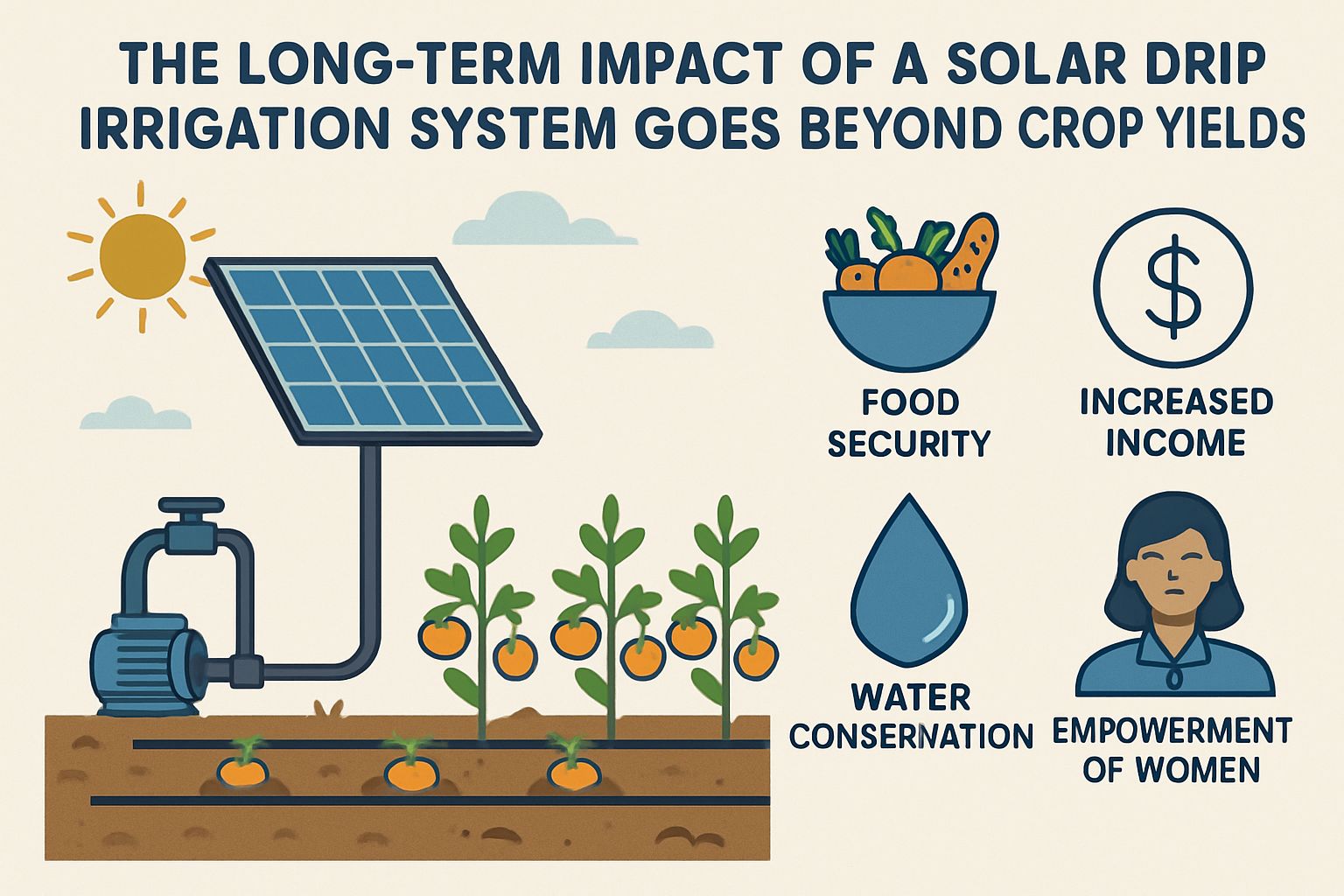
The Long-Term Impact Goes Beyond Crop Yields
The measurable outcomes of solar drip irrigation — water savings, energy cost reduction, yield improvement — are compelling on their own. But the longer-term structural benefits to a farming operation are what make this technology a genuine transformation rather than just an efficiency upgrade. Farms that install solar drip systems consistently report reduced labor hours spent on irrigation management, more stable crop production across variable rainfall years, and improved soil health metrics over multi-year periods. These are the compounding returns that show up in farm profitability over a decade, not just in the first season’s water bill.
The broader agricultural impact matters too. As water tables decline globally and climate variability increases, farming systems that can produce more food per liter of water become structurally more resilient. Solar drip irrigation is one of the few technologies that simultaneously addresses water scarcity, energy cost, and carbon emissions at the farm level — making it not just a business decision, but a genuinely future-proof production strategy for farmers who plan to still be farming in 20 years.
Frequently Asked Questions
Solar-powered drip irrigation raises practical questions from farmers at every scale. The answers below address the most common points of uncertainty with specific, actionable information rather than general reassurance.
Whether you’re evaluating a first installation or troubleshooting an existing system, understanding the operational realities of solar drip technology helps you make better decisions at every stage — from component selection through to long-term maintenance planning.
Can a Solar Drip Irrigation System Work on a Half-Acre Farm?
Yes — a half-acre market garden is actually one of the ideal scales for solar drip irrigation. A 200W monocrystalline solar panel paired with a brushless DC surface pump rated at 1,500–2,500 liters per hour is sufficient to irrigate a half-acre vegetable operation during standard peak sun hours. Total system cost at this scale typically falls between $800 and $1,800, making it one of the most accessible entry points into solar irrigation with one of the fastest payback timelines.
Do Solar Drip Systems Work on Cloudy Days or at Night?
A direct solar-to-pump system without battery storage will pump less water on overcast days and nothing at night — this is the fundamental operating characteristic of any direct DC solar pump setup. On partly cloudy days, most brushless DC pumps continue operating at reduced flow rather than shutting down entirely, which in practice means irrigation still occurs, just more slowly. For farms that require irrigation at specific times regardless of cloud cover, adding a battery bank and charge controller allows stored energy to power the pump during low-light periods or early morning hours. The trade-off is increased system cost, typically adding $400–$1,200 for a small-farm battery setup.
How Long Does a Solar-Powered Drip Irrigation System Last?
The solar panels are the longest-lived component. Tier-1 monocrystalline panels from manufacturers like Jinko Solar or LONGi carry 25–30 year performance warranties and degrade at approximately 0.5% efficiency per year — meaning panels installed today still perform at roughly 87–90% of original output after 25 years. The panels themselves rarely fail; most end-of-life replacements are driven by physical damage rather than electrical degradation.
Brushless DC pumps typically operate reliably for 8–15 years depending on water quality, operating hours, and maintenance. Drip laterals and emitters have a functional lifespan of 8–12 years with proper filtration and annual flushing. The filter housing and mainline polyethylene pipe are effectively permanent components under normal operating conditions. In practice, a well-maintained system installed today should deliver productive irrigation for 15–20 years before any major component replacement is required. For more information on sustainable irrigation, explore irrigation systems powered with solar panels.
What Crops Are Best Suited for Drip Irrigation?
Virtually any crop grown in rows or defined plant spacings is well-suited to drip irrigation. The crops that see the most dramatic efficiency and yield benefits are those with high water value — meaning crops where precise moisture control directly impacts marketable quality or quantity.
Vegetables consistently top the list: tomatoes, peppers, cucumbers, melons, lettuce, and brassicas all respond strongly to the consistent, targeted moisture delivery that drip systems provide. Fruit crops including strawberries, blueberries, raspberries, and grapes are heavily reliant on drip irrigation in commercial production precisely because moisture stress at critical growth stages causes irreversible quality loss.
Tree crops — citrus, stone fruit, avocados, and almonds — are among the highest-acreage drip-irrigated crops globally. Almonds in California, for example, are almost universally irrigated by drip or micro-sprinkler systems because the crop’s high water demand and the region’s water cost make any inefficiency economically unsustainable. Field crops like cotton and sugarcane are also increasingly irrigated by drip in water-scarce regions, though the economics are tighter given lower per-acre revenue.
Is Solar Drip Irrigation Difficult to Maintain Without Technical Support?
For the majority of maintenance tasks, no technical expertise is required. The most frequent maintenance actions — cleaning the filter, flushing lateral lines, and checking emitters for clogging — are straightforward physical tasks any farmer can perform with basic tools. A clean, well-designed system with quality filtration in place typically requires no more than 2–4 hours of maintenance attention per month during the growing season.
Solar panel maintenance is minimal: panels should be cleaned of dust and debris every 4–6 weeks in dry conditions, and electrical connections should be inspected annually for corrosion or loosening. Brushless DC pumps require no oil changes, no spark plug replacements, and no carburetor cleaning — the absence of engine maintenance is one of the frequently overlooked operational advantages of solar over diesel pumping.
For troubleshooting pump faults or controller issues, most manufacturers of systems like the Lorentz PS2 or Grundfos SQFlex provide remote diagnostics support and detailed fault code documentation that guides farmers through resolution without requiring an on-site technician. Building basic system literacy — understanding what normal operating pressure looks like, how to read a pump fault code, and how to identify a clogged emitter by visual crop stress patterns — takes one growing season and pays dividends for the entire life of the system.
Solar-powered drip irrigation systems are revolutionizing the agricultural landscape by providing an efficient and sustainable solution for water management. These systems are particularly beneficial for small-scale farmers, as they offer a cost-effective way to enhance crop yield while minimizing water usage. By harnessing solar energy, farmers can reduce their reliance on traditional power sources and lower their operational costs. For more insights on how solar-powered drip irrigation is transforming small-scale farming, you can explore this detailed article.

Leave a Reply