
Article-at-a-Glance
- Polycrystalline solar panels offer farmers a cost-effective renewable energy solution with typical savings of 50-75% on electricity bills while requiring 15-20% less initial investment than monocrystalline alternatives.
- These panels deliver an excellent balance of affordability and performance, with efficiency rates of 15-17% and payback periods of 5-7 years for most agricultural installations.
- Farmers can leverage multiple agricultural-specific incentives including USDA REAP grants covering up to 25% of installation costs and accelerated depreciation benefits.
- Polycrystalline panels demonstrate impressive durability in farm environments, withstanding dust, temperature fluctuations, and weather conditions with minimal maintenance requirements.
- Growing Solar Mist helps farmers transition to renewable energy with customized solar solutions designed specifically for agricultural applications and provides comprehensive installation support.
Farm energy costs continue to climb, eating into already thin profit margins for agricultural operations across the country. Affordable renewable energy isn’t just environmentally responsible—it’s becoming economically essential for modern farming operations to remain competitive and sustainable long-term.
The solution many farmers are discovering lies in polycrystalline solar panels, which offer an optimal balance between cost and performance for agricultural applications. Growing Solar Mist specializes in helping farmers implement these renewable energy systems that address their unique operational needs while providing significant cost benefits. With energy often representing 5-8% of a farm’s operating expenses, finding affordable alternatives like polycrystalline solar systems can transform a farm’s financial outlook.
Why are Farmers Turning to Solar Power
The agricultural sector faces unique energy challenges that make solar particularly attractive. Farms typically operate in remote locations where grid electricity is expensive or unreliable. Many agricultural processes—from irrigation and climate control to equipment charging and processing—require consistent power throughout the day. With conventional electricity rates continuing to rise at 2-3% annually, farmers are seeking alternatives that provide long-term price stability.
Solar power offers farmers energy independence, reducing vulnerability to utility rate hikes and power outages that can devastate crops or livestock operations. The distributed nature of solar installations also means farmers can generate power exactly where it’s needed—near pumps, outbuildings, or processing facilities—reducing transmission losses and infrastructure costs. This decentralized approach to energy production aligns perfectly with the distributed nature of most farming operations.
Beyond the immediate financial benefits, solar adoption positions farms for future sustainability requirements increasingly demanded by consumers, distributors, and regulators. Many farmers report that their solar investments have become marketing advantages, helping them differentiate their operations as environmentally responsible in competitive agricultural markets.
Why Farmers Are Using Polycrystalline Solar Panels Over Other Panels
When evaluating solar options, farmers increasingly select polycrystalline technology for its practical balance of cost and performance. Unlike premium-priced monocrystalline panels, polycrystalline options deliver nearly comparable efficiency at significantly lower initial investment costs—typically 15-20% less per watt. This cost difference becomes substantial when scaling to the larger systems required for agricultural operations.
The blue-speckled appearance of polycrystalline panels results from their manufacturing process, where multiple silicon crystals are melted together. This process uses silicon more efficiently than monocrystalline production, reducing waste and environmental impact while lowering costs. For farmers concerned with both environmental and financial sustainability, this manufacturing efficiency represents an additional benefit.
Another key advantage is polycrystalline panels’ performance in the varied conditions typical of farm environments. These panels maintain better efficiency than monocrystalline alternatives in higher temperature conditions—an important consideration for installations in open farm fields during summer months. Their performance characteristics align well with agricultural power needs, which often peak during daylight hours when solar production is at its maximum.
Here’s a table outlining why farmers are turning to solar power, covering various dimensions such as economic, environmental, and operational factors:
|
Reason |
Description |
Supporting Details |
|---|---|---|
|
Reduced Energy Costs |
Solar power allows farmers to generate their own electricity, significantly lowering or even eliminating monthly energy bills after the initial investment. This is especially impactful given that energy is often one of the top expenses on a farm. 1, 3 |
Solar panels can last 25–30 years, providing decades of free electricity. 1, 3 |
|
Stable & Diversified Income |
By leasing land for solar installations or participating in agrivoltaic projects, farmers can secure passive, predictable income streams, which is vital given the volatility of crop prices and farm revenues. 2, 4, 6 |
Leasing land for solar arrays provides guaranteed annual payments, helping stabilize farm finances. 4, 6 |
|
Increased Efficiency & Productivity |
Solar-powered systems (e.g., water pumps, dryers, electric fences) enhance operational efficiency, reduce reliance on fossil fuels, and improve productivity in irrigation, crop drying, and livestock management. 1, 10 |
Solar pumps provide reliable irrigation; solar dryers reduce post-harvest losses. 10 |
|
Sustainability & Environmental Impact |
Transitioning to solar reduces greenhouse gas emissions and fossil fuel dependence, supporting more sustainable and environmentally friendly farming practices. 1, 6 |
Solar energy produces no harmful emissions and lowers the farm’s carbon footprint. 1 |
|
Energy Independence |
Solar installations provide energy security, especially in rural or remote areas where grid power is unreliable or expensive to access. 1 |
Farmers gain control over their own energy production. 1 |
|
Government Incentives & Support |
Federal and state incentives, such as tax credits and grants, make solar adoption more affordable and attractive for farmers, accelerating the transition to renewable energy. 2, 4 |
The Inflation Reduction Act and USDA programs offer financial support for solar projects. 2, 4 |
|
Improved Land Use (Agrivoltaics) |
Combining agriculture and solar (agrivoltaics) allows for dual use of land, enabling crop production, livestock grazing, or pollinator habitats beneath or between solar panels. 4, 5 |
Farmers can “harvest the sun twice,” maximizing land value and productivity. 4, 5 |
|
Resilience Against Market Fluctuations |
Solar power helps buffer against unpredictable energy prices and unstable farm commodity markets, offering a more predictable cost structure and revenue stream. 2, 6 |
Solar mitigates risk from both energy and crop price volatility. 2, 6 |
|
Biodiversity & Ecosystem Benefits |
Solar farms can support biodiversity by providing habitats for pollinators and invertebrates, and grazing contracts for livestock under panels, 4, 7 |
Some solar sites integrate sheep grazing and pollinator habitats, supporting local ecosystems. 4, 7 |

What Makes Polycrystalline Solar Panels Cost-Effective for Farms
The cost-effectiveness of polycrystalline panels stems from multiple factors that particularly benefit agricultural applications. Their manufacturing process requires fewer precision controls than monocrystalline production, resulting in lower production costs that translate to savings for end users. For farms operating on tight margins, this initial cost difference can be the determining factor in making solar financially viable. Additionally, the energy cost savings from solar panels can significantly boost farm profits.
Lower Initial Investment Compared to Monocrystalline Options
The financial reality for most farming operations necessitates careful capital expenditure planning. Polycrystalline panels typically cost $0.50-0.70 per watt versus $0.60-0.90 for monocrystalline options, creating substantial savings on larger installations. For a typical 25kW farm system, this translates to $2,500-5,000 in upfront savings—capital that can remain available for other critical farm investments.
This cost advantage becomes even more significant when factoring in the total installation expenses. Since mounting hardware, inverters, and labor represent fixed costs regardless of panel type, the savings on the panels themselves directly impact the bottom line. Many agricultural operations report that these savings were decisive in enabling them to scale their solar installations to meet more of their energy needs.
The lower initial investment also improves key financial metrics like return on investment and internal rate of return that farm managers and agricultural lenders use to evaluate capital projects. With tighter margins than many other industries, these improved financial metrics can make the difference between project approval and rejection for farm solar installations.
Manufacturing Process Keeps Costs Down
The manufacturing process for polycrystalline panels utilizes a cost-efficient approach that directly benefits farmers. Rather than growing single silicon crystals—an energy-intensive and precise process required for monocrystalline panels—polycrystalline production melts multiple silicon fragments together in molds. This simpler process requires less energy, fewer specialized materials, and creates less waste, all contributing to the lower price point that makes these panels accessible for agricultural budgets.
Silicon used in polycrystalline panels doesn’t need the 99.999% purity levels required for monocrystalline production, reducing processing costs significantly. The fragmented crystal structure creates the distinctive blue appearance and slightly lower efficiency, but the 15-17% conversion rates remain more than adequate for most farm applications. When analyzing total cost-benefit, this small efficiency trade-off is usually outweighed by the substantial cost savings.
For farmers concerned about environmental impact, polycrystalline production generates approximately 30% less manufacturing waste than monocrystalline processes. This reduced environmental footprint aligns with sustainable farming principles while simultaneously delivering financial benefits through lower purchase prices, creating a win-win for environmentally conscious agricultural operations.
Great Performance-to-Price Ratio for Agricultural Applications
“We installed a 30kW polycrystalline system on our dairy operation three years ago. While monocrystalline might have given us 5-7% more power in the same space, the polycrystalline system cost us nearly $12,000 less upfront. That savings helped us expand the system size, actually generating more total electricity than if we’d gone with the more expensive option.” – James Patterson, Sunset Valley Dairy
The value proposition of polycrystalline panels becomes particularly evident when examining their performance relative to agricultural needs. While their efficiency rates of 15-17% fall slightly below monocrystalline’s 18-22%, this difference matters less for farms where space constraints are typically less restrictive than in residential or commercial settings. With abundant roof space on barns and outbuildings or open land for ground-mounted systems, slight efficiency differences become less significant when weighed against cost savings.
Temperature performance represents another important advantage in farm settings. Polycrystalline panels typically have better temperature coefficients than their monocrystalline counterparts, losing less efficiency as temperatures rise. For installations in hot, open farm fields or on metal agricultural buildings that heat up significantly, this characteristic helps maintain more consistent energy production during summer months when many farms experience peak energy demands for irrigation and cooling.
Typical Price Range and Payback Period for Farm Installations
For agricultural installations, polycrystalline systems typically range from $1.80-$2.40 per watt fully installed, compared to $2.10-$2.80 for comparable monocrystalline systems. This translates to approximately $45,000-$60,000 for a 25kW system that can significantly offset energy costs for small to medium-sized operations. With agricultural electricity usage often concentrated during daylight hours when solar production peaks, the alignment between generation and consumption improves financial returns.
Payback periods for farm polycrystalline installations typically range from 5-7 years, depending on local electricity rates, available incentives, and specific farm energy usage patterns. This falls well within the 25-30 year warranted lifespan of quality panels, providing decades of essentially free electricity after the initial investment is recovered. When factoring in protection against utility rate increases, many farmers find actual returns exceed initial projections as electricity costs continue rising faster than general inflation.
How Polycrystalline Panels Meet Farm Energy Needs
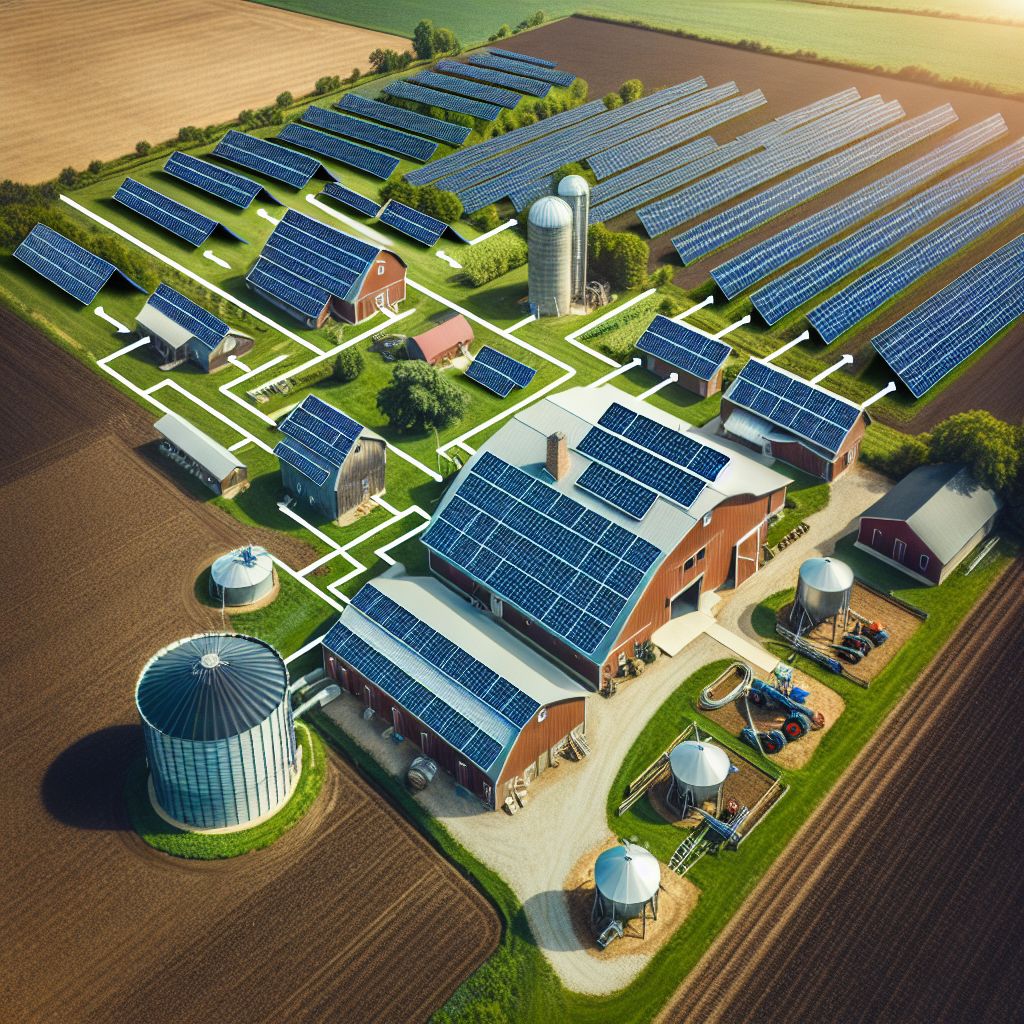
Agricultural operations have distinct energy requirements that polycrystalline panels address effectively. The distributed nature of farm energy usage—from barns and equipment sheds to irrigation pumps and processing facilities—aligns well with modular solar installations that can be placed strategically throughout the property. Polycrystalline panels’ reliability and minimal maintenance requirements also match the practical needs of busy farming operations where simplicity and dependability are essential.
Seasonal energy usage patterns on farms often correlate well with solar production cycles. Many agricultural operations experience peak energy demands during summer months for irrigation, cooling, and harvesting activities—precisely when solar production reaches its maximum. This natural alignment enhances the economic value of solar investments compared to commercial or residential applications where usage patterns may not match production cycles as closely.
Efficiency Rates and Power Output in Real-World Farm Conditions
Under typical farm conditions, polycrystalline panels perform remarkably well despite their slightly lower laboratory efficiency ratings. While manufacturer specifications typically show 15-17% efficiency rates, the actual energy harvest in agricultural settings often approaches 85-90% of what more expensive monocrystalline panels would produce in identical conditions. This narrow real-world performance gap makes the cost savings even more compelling for budget-conscious farm operations.
Environmental factors common to farms—including dust, pollen, and occasional shading from trees or structures—affect all panel types similarly, further diminishing theoretical efficiency differences. Polycrystalline panels also maintain better performance in the partial shading conditions that might occur on farms where complete unobstructed installation isn’t always possible. Their cell architecture makes them slightly less vulnerable to significant power drops when partially shaded compared to some monocrystalline designs.
For a typical 25kW farm installation in the central United States, polycrystalline panels will generate approximately 32,000-36,000 kWh annually, enough to power substantial agricultural operations. This output remains consistent through the panels’ 25+ year lifespan, with only modest degradation of approximately 0.5-0.7% annually—providing predictable energy production that farmers can rely on for long-term planning.
Space Requirements for Different Farm Operations
Space utilization becomes an important consideration when planning solar installations for different types of agricultural operations. A 25kW polycrystalline system typically requires approximately 1,600-1,800 square feet of installation area, whether on ground mounts or rooftops. For most farms, this represents a minimal footprint compared to available land or roof space, making the slightly larger area requirements of polycrystalline systems (versus monocrystalline) negligible in practical terms. For more information on key mounting considerations, explore additional resources.
Different farm types have varying energy needs and space considerations that impact system sizing. Dairy operations with high electricity demands for milk cooling, pumping, and climate control may require 50kW+ systems occupying 3,500+ square feet, while smaller specialty crop farms might need only 10-15kW systems using 800-1,000 square feet. The modular nature of polycrystalline systems allows for precise sizing to match specific farm requirements, with the ability to expand incrementally as needs grow.
Durability in Agricultural Environments
Agricultural environments present unique challenges for solar equipment with exposure to dust, moisture, temperature fluctuations, and sometimes livestock interaction. Polycrystalline panels excel in these conditions due to their robust construction and simpler cell structure. The panels typically feature tempered glass fronts, weatherproof backsheets, and aluminum frames that protect the cells from environmental stresses common on farms.
Most quality polycrystalline panels are rated for wind loads up to 2,400 Pascals and snow loads up to 5,400 Pascals—sufficient for all but the most extreme agricultural settings. This durability translates to reliable performance through seasonal weather challenges that farms regularly face. Many manufacturers specifically test their panels against agricultural conditions, including exposure to ammonia from livestock operations and saline environments in coastal farming regions. For more insights on how solar panels save farmers energy costs and boost farm profits, check out this article.
The temperature cycling that occurs in outdoor farm installations—from freezing winter nights to scorching summer days—poses less risk to polycrystalline panels than to some alternatives. Their simpler crystal structure experiences less stress during thermal expansion and contraction, contributing to their 25+ year operational lifespan even in harsh agricultural settings.
4 Ways Polycrystalline Solar Panels Save Farmers Money
The financial benefits of polycrystalline solar installations extend well beyond simple energy bill reduction. Farmers implementing these systems report multiple streams of savings and revenue that compound over time, substantially improving their operations’ financial sustainability. Understanding these diverse benefits helps explain why agricultural solar adoption continues accelerating despite initial investment requirements.
1. Reduced Monthly Electricity Bills
The most immediate and visible benefit comes from dramatically reduced utility bills, with most farm installations offsetting 50-75% of previous electricity costs. For operations with high daytime energy usage like dairies, packing facilities, or irrigated crops, these savings can represent thousands of dollars monthly. The predictable nature of these savings allows for more accurate budgeting and financial planning, reducing vulnerability to seasonal utility rate fluctuations. Learn more about the energy cost savings from solar panels for farmers.
The value of these savings increases over time as utility rates continue rising. While solar production remains constant, the avoided cost of grid electricity grows with each rate increase, accelerating the return on investment. Many farmers report their systems are performing better financially than initially projected precisely because utility rates have increased faster than conservative estimates used in their planning calculations.
2. Lower Maintenance Requirements
Polycrystalline systems require minimal maintenance, particularly important in busy agricultural operations where equipment upkeep already demands significant time. With no moving parts and simple electrical systems, solar installations typically need only occasional cleaning and annual electrical inspections. This contrasts sharply with conventional farm equipment that often requires frequent, costly maintenance.
The solid-state nature of solar panels means they continue functioning reliably through conditions that would challenge or damage other power equipment. Unlike generators that need fuel, filter changes, and regular servicing, solar systems operate autonomously with minimal intervention. This reliability translates to both direct maintenance savings and avoided downtime costs that can be substantial during critical agricultural periods.
3. Incentives and Tax Benefits for Agricultural Solar
- USDA Rural Energy for America Program (REAP) grants covering 25% of installation costs
- Federal Investment Tax Credit currently at 30% of system cost
- Accelerated depreciation allowing 100% first-year bonus depreciation
- State-specific agricultural solar incentives available in many regions
- Net metering programs allowing credit for excess electricity production
The financial landscape for agricultural solar installations has never been more favorable, with multiple incentive programs specifically targeting farm operations. These programs can combine to offset 50-60% of initial system costs, dramatically improving returns and shortening payback periods. The USDA’s REAP program particularly benefits farmers, offering both grants and loan guarantees specifically for agricultural renewable energy projects.
Tax benefits represent another significant advantage, with current federal policy allowing both investment tax credits and accelerated depreciation. For farm operations with tax liability, these benefits can be realized immediately, effectively providing immediate returns on the solar investment. Many agricultural accountants now specifically recommend solar investments as tax management strategies alongside their operational benefits.
4. Protection Against Rising Energy Costs
Perhaps the most significant long-term benefit is protection against continuously rising energy costs that affect agricultural profitability. By locking in energy costs through solar investment, farmers effectively hedge against future utility increases that have historically outpaced inflation. This cost certainty allows for more accurate long-term business planning and improved profitability projections.
The value of this energy independence grows throughout the system’s 25+ year lifespan. While initial calculations might show a 5-7 year payback period, the subsequent decades of inflation-protected energy production represent substantial ongoing returns. For multi-generational farm operations planning for long-term sustainability, this predictable energy cost control becomes increasingly valuable.
Farm-Specific Applications for Polycrystalline Solar Systems
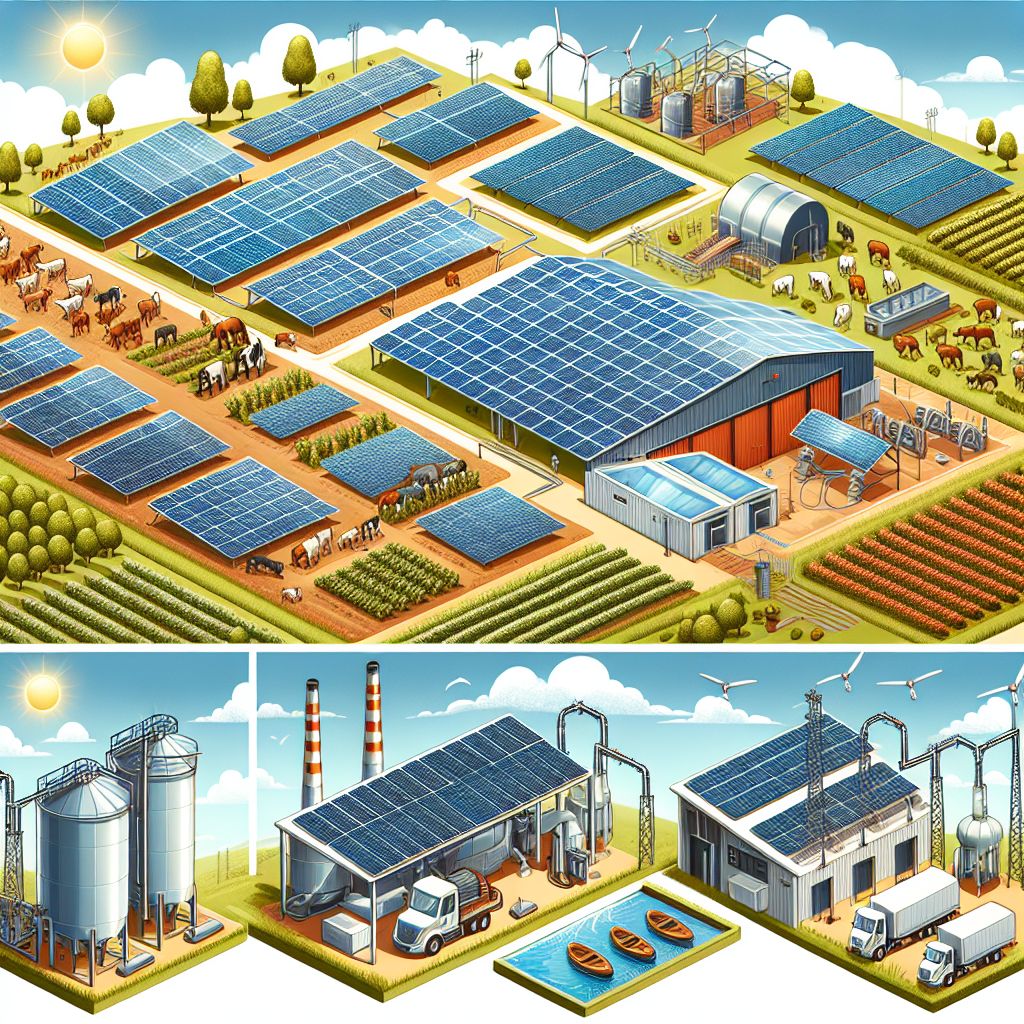
The versatility of polycrystalline solar systems makes them suitable for diverse agricultural applications, from powering essential equipment to supporting entire farm operations. Their scalability allows farms to target specific energy needs or implement comprehensive solutions depending on budget and requirements.
Powering Irrigation Systems
Irrigation represents one of the most energy-intensive and essential processes on many farms, making it an ideal candidate for solar power. Polycrystalline systems can directly power pumps during daylight hours when irrigation is typically most needed, or they can be paired with battery storage for consistent 24-hour operation. For farms in regions with net metering, excess production during non-irrigation seasons can generate credits applied during peak irrigation periods.
Solar-powered irrigation delivers particularly strong returns because irrigation often coincides with peak solar production during summer months. This natural alignment means farmers can maximize self-consumption without storage in many cases. Direct DC-powered pumping systems eliminate inverter losses, further improving efficiency for dedicated irrigation installations. Many farmers report 30-40% reductions in irrigation costs after implementing polycrystalline solar systems.
Livestock Facility Operations
Modern livestock facilities require consistent power for ventilation, lighting, feeding systems, and climate control—all applications well-suited for polycrystalline solar power. The predictable daytime energy production aligns well with peak ventilation needs during hot periods, while larger systems with net metering can offset 24-hour operational requirements. For remote facilities with poor grid connections, solar can provide more reliable power than often-interrupted utility service.
Dairy operations particularly benefit from solar installations due to their high, consistent energy demands for milk cooling, washing, and processing. With electricity often representing the third-highest operating cost for dairies (after feed and labor), solar investments can significantly improve operational profitability. The stable temperature requirements of dairy operations align well with solar production patterns, often allowing for 60-70% offset of total energy needs.
Cold Storage and Processing Equipment
Post-harvest cold storage and processing facilities present ideal applications for polycrystalline solar systems due to their high energy demands and critical importance to product quality. Solar production aligns well with cooling needs that intensify during daylight hours, particularly during harvest seasons when both solar production and cooling requirements reach their peak. For operations with consistent year-round processing, larger net-metered systems can provide substantial ongoing energy offsets.
The economic return on solar-powered cold storage is enhanced by the critical nature of reliable power for preserving crop quality and value. Even brief power interruptions can damage sensitive crops, making the reliability of distributed solar generation particularly valuable. Many specialty crop operations report that solar investments for cold storage facilities pay for themselves through a combination of energy savings and reduced crop losses from power-related quality issues.
Charging Electric Farm Vehicles and Equipment
As agricultural operations increasingly adopt electric utility vehicles, tractors, and equipment, on-site solar charging becomes increasingly valuable. Polycrystalline systems can provide dedicated charging infrastructure that eliminates fuel costs and reduces maintenance requirements for farm transportation. This application often delivers rapid returns as the eliminated fuel costs combine with reduced vehicle maintenance expenses to accelerate payback periods.
The environmental benefits of solar-charged farm equipment extend beyond eliminating emissions to reducing noise pollution that can stress livestock and wildlife. The combination of solar power with electric equipment creates truly sustainable farm operations with minimal external inputs, enhancing both environmental performance and operational resilience. As agricultural equipment manufacturers expand their electric offerings, solar charging infrastructure becomes an increasingly strategic farm investment.
The Farmers House
For farms where owners live on-site, extending solar power to residential use creates additional financial benefits while simplifying system design. Polycrystalline installations can be sized to address both farm operations and household needs, often improving the economics through more consistent year-round energy utilization. This approach allows farmers to leverage agricultural solar incentives while also benefiting from residential renewable energy credits where available.
The psychological value of powering both home and farm operations through self-generated renewable energy shouldn’t be underestimated. Many farmers report significant satisfaction from achieving energy independence that aligns with broader agricultural values of self-sufficiency and resource stewardship. This whole-farm approach to energy management often leads to greater awareness of consumption patterns and additional efficiency improvements throughout both living and working spaces.
Installation Considerations for Farm Properties
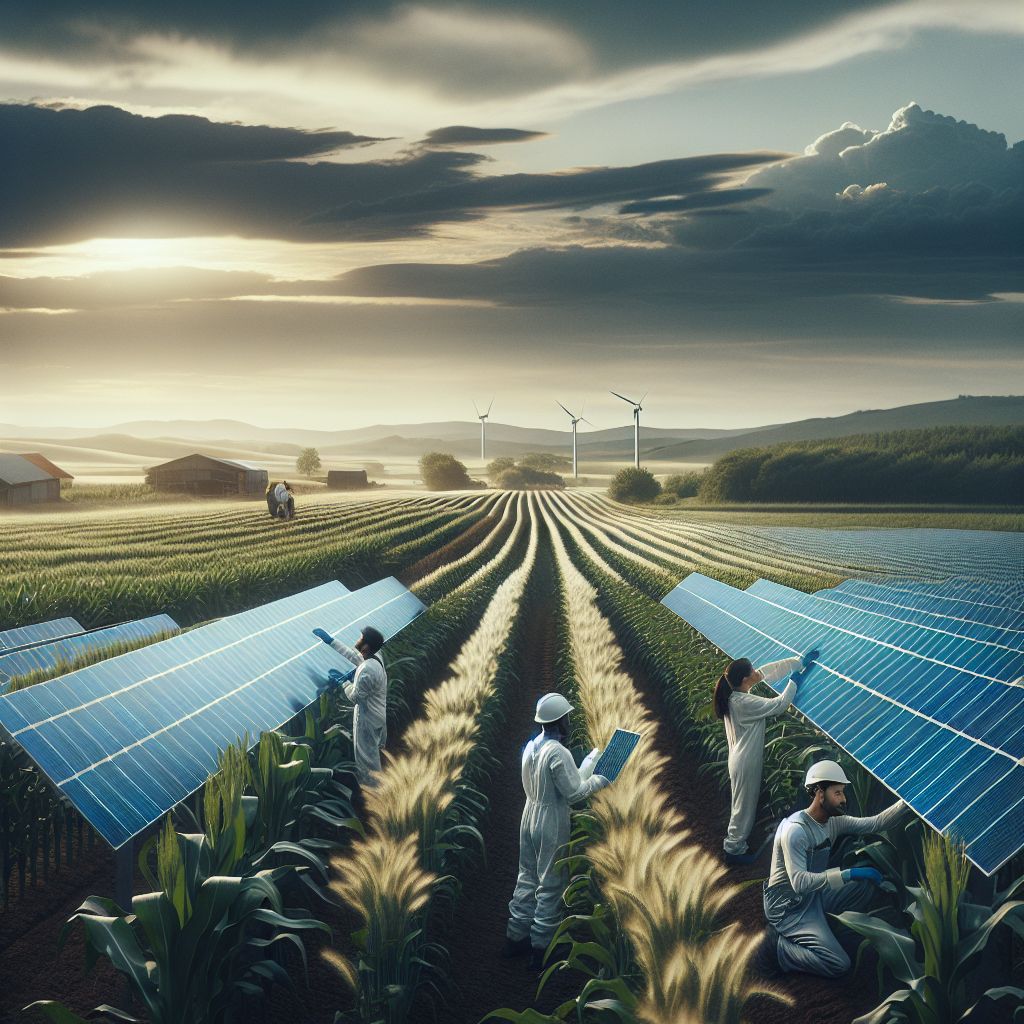
Agricultural properties present unique considerations for solar installations that differ significantly from residential or commercial settings. Working with installers experienced in farm applications ensures systems are designed to complement rather than interfere with agricultural operations. Understanding these considerations helps farmers maximize returns while minimizing disruption to their core activities. For those interested in exploring efficient solar solutions, polycrystalline solar panels are a viable option.
Ground-Mount vs. Roof-Mount Options
Farms typically have multiple installation options unavailable to other solar adopters, including abundant open land for ground-mounted systems, large barn or outbuilding roofs, and sometimes elevated structures over working areas or water features. This flexibility allows for optimized system placement based on specific farm needs rather than being constrained by limited installation locations. Ground-mounted systems offer easier maintenance access and optimal angle adjustment but require fencing if livestock are present.
Roof-mounted systems on agricultural buildings utilize otherwise unproductive space but require structural assessment to ensure the building can support the additional weight. Metal roofs common on farm structures offer simplified mounting options and excellent longevity that aligns well with solar panel lifespans. Some innovative farms are implementing elevated solar structures that allow continued agricultural use beneath the panels, creating dual-use spaces that maximize land productivity.
Positioning for Maximum Sun Exposure
Agricultural properties often have fewer shading obstacles than residential settings, allowing for ideal panel positioning that maximizes energy harvest. South-facing installations (in the Northern Hemisphere) typically generate the most total annual energy, though east-west splits can better match morning and afternoon consumption patterns for some farm operations. Tracking systems that follow the sun’s movement can increase energy harvest by 25-35% but add complexity and maintenance requirements that must be evaluated against the additional yield.
The open landscapes typical of farms also facilitate seasonal tilt adjustments for ground-mounted systems, allowing angle optimization for different sun positions throughout the year. This adjustment capability, while requiring periodic maintenance visits, can increase annual energy production by 5-8% compared to fixed installations. For irrigation-focused systems, optimizing for summer production when water needs are highest often takes precedence over maximizing total annual production.
Working Around Farm Operations During Installation
Timing solar installations around agricultural schedules minimizes disruption to farm activities. Winter installations often work well for crop operations during off-seasons, while livestock facilities may require careful phasing to avoid disrupting animal routines. Experienced agricultural solar installers understand these constraints and can develop implementation plans that accommodate critical farm operations.
Electrical integration requires particular attention on farms with existing complex power systems for equipment, irrigation, and processing. Properly interfacing solar generation with these systems ensures seamless operation and maximizes financial benefits through optimized energy use. Farms with three-phase power requirements need specialized inverter configurations that differ from standard residential installations, highlighting the importance of working with installers experienced in agricultural applications.
Comparing Polycrystalline to Other Solar Options
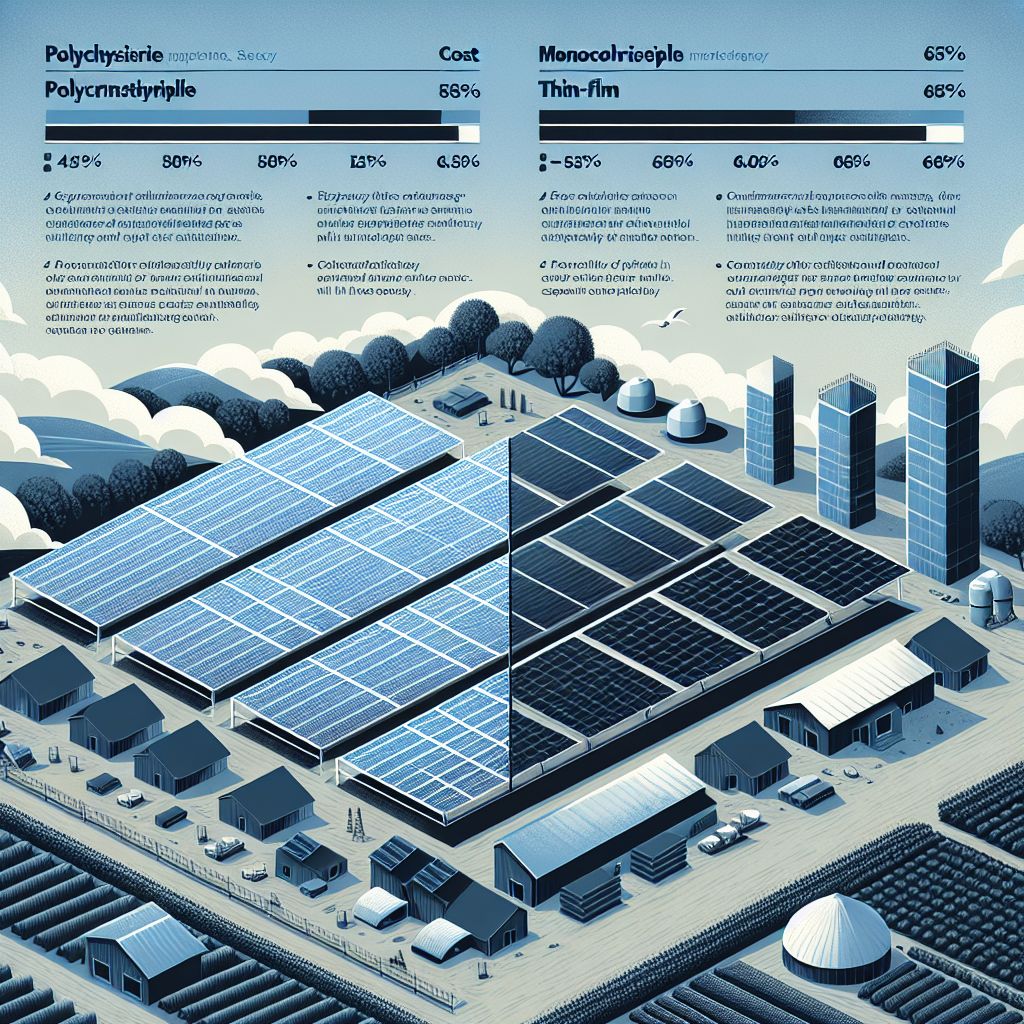
Understanding how polycrystalline technology compares to alternatives helps farmers make informed decisions aligned with their specific needs and constraints. Each solar technology offers distinct advantages and limitations that may prove more or less relevant depending on the particular agricultural application.
Polycrystalline vs. Monocrystalline: Cost and Performance
The primary difference between polycrystalline and monocrystalline panels lies in the balance between cost and efficiency. Monocrystalline panels offer higher efficiency rates of 17-22% compared to polycrystalline’s 13-17%, but at a 15-20% price premium. For space-constrained installations, monocrystalline’s higher power density may justify the additional cost, but most agricultural settings have sufficient installation area to make polycrystalline’s lower cost-per-watt more economically advantageous.
Performance characteristics also differ in ways relevant to farm installations. Polycrystalline panels typically perform better in high-temperature conditions common during summer agricultural operations, while monocrystalline panels have slight advantages in low-light conditions during winter months. The aesthetic difference—blue polycrystalline versus black monocrystalline—rarely factors into agricultural decisions where performance and economics take priority over appearance.
Polycrystalline vs. Thin-Film: Space and Efficiency Trade-offs
Thin-film technology represents another alternative with distinct characteristics compared to polycrystalline panels. These panels offer lower efficiency rates of 10-13% but may perform better in partial shading and high-temperature conditions. Their significantly lower efficiency requires approximately 1.5 times more installation area than polycrystalline systems for equivalent power production—rarely a constraint on farms with abundant space, but a consideration for roof-mounted systems with limited area.
The lightweight, flexible nature of some thin-film products allows installation on structures that cannot support heavier crystalline panels, potentially opening additional mounting locations on farms with older or lighter-duty buildings. However, their accelerated degradation rates and typically shorter warranties make them less suitable for the long-term investment approach most farms take toward solar infrastructure. For most agricultural applications, polycrystalline panels offer a more balanced combination of cost, performance, and longevity.
Here’s a detailed comparison table discussing the use of solar panels to power a farmer’s operations, comparing Polycrystalline, Monocrystalline, Thin-Film, and No Solar Panels:
|
Option |
Efficiency |
Cost |
Durability |
Best Use Case on Farms |
Advantages |
Disadvantages |
|---|---|---|---|---|---|---|
|
Monocrystalline |
Highest (typically 17–22%) |
Highest upfront investment |
Very durable, long life |
Farms with limited space but high energy needs |
– Maximum power output per area |
– Most expensive |
|
Polycrystalline |
Moderate (typically 13–17%) |
Lower than monocrystalline |
Durable, long life |
Farms with ample space and moderate budgets |
– Cost-effective |
– Lower efficiency |
|
Thin-Film |
Lowest (typically 10–13%) |
Lowest per watt |
Flexible, less robust |
Greenhouses, curved roofs, or unconventional surfaces; farms needing flexible panels |
– Lightweight and flexible |
– Lower efficiency |
|
No Solar Panels |
N/A |
Standard utility or fuel costs only |
N/A |
Farms relying on grid or diesel power |
– No upfront solar cost |
– Ongoing high energy costs |
Key Notes from table:
- Monocrystalline panels are ideal for maximizing energy in limited space and are best for high-demand operations.
- Polycrystalline panels suit farmers with more land, offering a cost-effective balance for most standard farm needs.
- Thin-film panels are chosen for their flexibility and performance in specific applications, despite lower efficiency.
- No solar panels means continued reliance on external energy sources, with no long-term savings or sustainability gains.
Farmers should choose based on their available space, budget, and the specific energy requirements of their operations. 1, 2, 5
Conclusion
Polycrystalline solar panels represent a particularly well-suited technology for agricultural applications, balancing affordability, performance, and reliability in ways that align with farm operational needs. The compelling economics—combining lower initial costs with substantial long-term energy savings—make these systems financially advantageous for farm operations of all sizes. When properly designed and implemented with agricultural requirements in mind, these systems consistently deliver returns that outperform many traditional farm investments.
The expanding ecosystem of agricultural solar incentives further enhances already favorable economics, creating unprecedented opportunities for farms to transition toward energy independence. With proper planning and implementation, polycrystalline solar systems can transform energy from a volatile expense to a controlled, predictable aspect of farm operations that enhances rather than constrains agricultural productivity and profitability.
Go over Key Points of this Article
Throughout this exploration of polycrystalline solar technology for agricultural applications, several consistent themes emerge that merit emphasis. The cost advantage of polycrystalline panels—typically 15-20% less expensive than monocrystalline alternatives—provides critically important access to solar benefits for budget-conscious farm operations. This affordability combines with performance characteristics particularly well-suited to agricultural settings, including better high-temperature efficiency and durability in challenging environmental conditions.
The diverse applications across irrigation, livestock facilities, processing, and storage demonstrate the versatility of these systems in addressing the multifaceted energy needs typical of modern farms. Whether implemented incrementally or as comprehensive solutions, polycrystalline installations consistently deliver the reliability and low maintenance requirements essential in busy agricultural operations. When supported by appropriate agricultural-specific incentives and financing strategies, these systems typically achieve payback periods of 5-7 years while providing 25+ years of operational benefits.
Is Using Polycrystalline Solar Panels to Power a Farms Operations a Smart Move for the Farmer
For the vast majority of agricultural operations, polycrystalline solar represents not just a smart investment but increasingly an essential strategy for long-term viability. As energy costs continue rising while crop and livestock prices remain subject to market volatility, controlling fixed expenses becomes crucial for sustainable profitability. Polycrystalline solar systems transform unpredictable energy expenses into fixed investments with predictable returns, providing both immediate savings and long-term financial security. Growing Solar Mist specializes in helping farmers navigate this transition with agricultural-specific solar solutions designed to maximize both operational benefits and financial returns.
Frequently Asked Questions
Farmers considering solar investments typically share common questions about implementation, performance, and financial aspects of polycrystalline systems. Addressing these concerns helps establish realistic expectations and supports informed decision-making when evaluating renewable energy options for agricultural operations.
How long do polycrystalline solar panels last on a farm?
Quality polycrystalline panels installed on farms typically carry 25-year power production warranties but frequently operate effectively for 30+ years. The actual degradation rate averages 0.5-0.7% annually, meaning panels will still produce approximately 80% of their original output after 25 years of service. Agricultural installations often see these conservative estimates exceeded when panels are properly maintained and protected from physical damage. The simple construction of polycrystalline cells contributes to their longevity, with fewer delicate connections that might fail compared to some alternative technologies.
Can polycrystalline panels withstand extreme weather conditions common in farming areas?
Modern polycrystalline panels are engineered to withstand challenging agricultural conditions, including high winds (typically rated for 140+ mph gusts), heavy snow loads (5,400+ Pascals), and hail impact (certified for 1-inch hailstones at terminal velocity). Their tempered glass coverings and aluminum frames provide robust protection against environmental stresses, while sealed construction prevents moisture ingress even in high-humidity environments. For areas with particularly extreme conditions, additional mounting reinforcements or protective measures may be recommended, though the panels themselves rarely represent the vulnerable component in properly designed systems.
What maintenance do polycrystalline solar panels require on a farm?
Maintenance requirements for farm-based polycrystalline systems are minimal, typically limited to periodic cleaning to remove dust, pollen, or bird droppings that might reduce efficiency. In most agricultural regions with regular rainfall, natural cleaning often suffices, though installations near particularly dusty operations may benefit from occasional manual cleaning. Annual electrical inspections to verify connection integrity and inverter function represent good practice but require minimal time commitment.
The lack of moving parts eliminates most maintenance concerns typical of farm equipment, with no filters to replace, fluids to change, or mechanical components to wear out. This minimal maintenance profile makes solar particularly well-suited to busy agricultural operations where equipment upkeep already demands significant attention. Many farms report spending less than 2-3 hours annually on solar system maintenance while enjoying uninterrupted operation.
How much farmland is needed for a polycrystalline solar installation?
Land requirements for ground-mounted polycrystalline systems depend on system capacity and configuration, but typically range from 70-100 square feet per kilowatt of capacity. A 25kW system—suitable for many small to medium farm operations—requires approximately 1,800-2,500 square feet or about 0.04-0.06 acres. This modest footprint represents negligible land diversion for most agricultural operations, particularly when installations utilize marginal areas with limited agricultural value.
Innovative approaches increasingly allow dual-use of land beneath and around solar installations, including grazing for small livestock, shade-tolerant crop production, or pollinator habitat development. These agrivoltaic strategies maximize land productivity while providing additional agricultural benefits beyond energy production. For farms with suitable building infrastructure, roof-mounted installations eliminate land use concerns entirely while utilizing otherwise unproductive space.
Are there special agricultural grants available for solar panel installation?
Agricultural operations enjoy access to several specialized funding sources unavailable to other solar adopters. The USDA Rural Energy for America Program (REAP) specifically targets farm renewable energy projects with grants covering up to 25% of project costs and loan guarantees for up to 75% of eligible expenses. These funds operate on dedicated agricultural allocations separate from general renewable energy incentives, often resulting in higher approval rates for qualified farm applications.
Beyond USDA programs, many states offer agriculture-specific solar incentives through departments of agriculture or rural development agencies. These may include specialized tax exemptions, dedicated rebate programs, or preferential loan terms for farm solar implementations. When combined with standard solar incentives like the federal Investment Tax Credit and accelerated depreciation, these agricultural-specific programs can reduce effective system costs by 50-60%, dramatically improving project economics and accelerating return on investment.
Ready to transform your farm’s energy future with affordable, reliable solar power? Growing Solar Mist specializes in agricultural solar solutions designed specifically for farming operations, with expertise in maximizing both performance and available incentives. Contact us today to discover how polycrystalline solar can reduce your operational costs while increasing your farm’s sustainability and resilience.

Leave a Reply