
Key Takeaways:
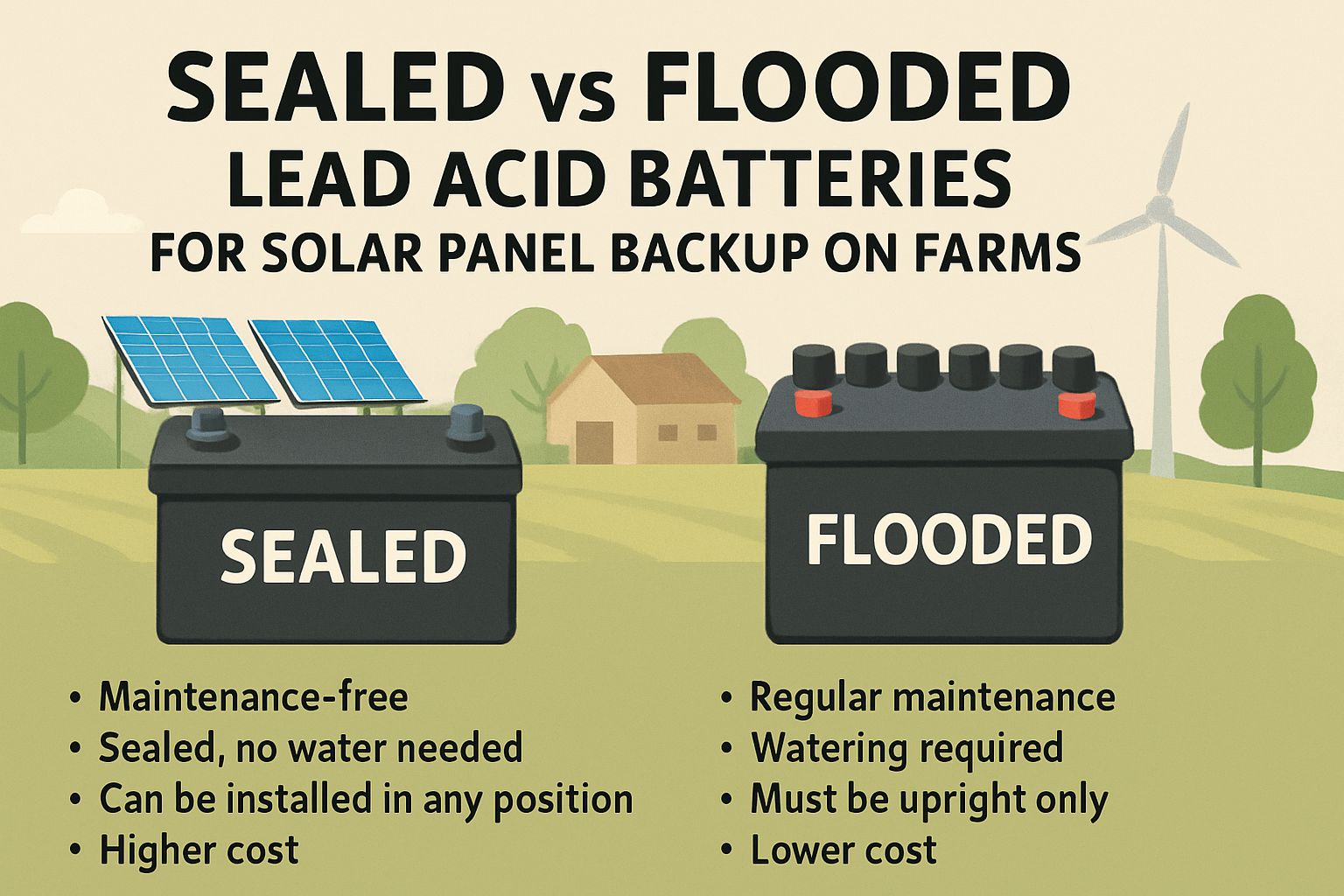
- Flooded lead acid batteries cost less upfront but demand regular maintenance — including water topping and ventilation — that sealed batteries simply don’t require.
- AGM and Gel batteries (both sealed lead acid types) offer installation flexibility and safer operation in enclosed farm buildings where hydrogen venting is a real concern.
- The Crown CR430 6V Flooded Lead-Acid Battery remains one of the most proven options for farms already set up with proper battery maintenance routines.
- Your climate, discharge pattern, and how hands-on you want to be with upkeep will determine which battery type wins for your operation.
- Mixing sealed and flooded batteries in the same bank is a mistake many farm owners make — keep reading to find out why it quietly destroys your system.
Pick the wrong battery for your farm solar setup and you won’t just lose money — you’ll lose power when you need it most.
Farms run on reliable energy. Irrigation systems, livestock ventilation fans, refrigeration for produce, and electric fencing all depend on consistent power delivery. When the grid goes down or your solar system needs battery backup, the battery bank you’ve built becomes the backbone of your entire operation. Choosing between flooded and sealed lead acid batteries isn’t a minor technical detail — it’s one of the most consequential decisions in your solar energy setup. For guidance on building farm-ready solar energy systems, resources from sustainable energy specialists can help you design a system matched to your specific load requirements.
Lead acid batteries have been powering off-grid and backup systems for over 160 years. That track record means there’s a wealth of real-world performance data behind each battery type — and clear winners depending on your situation.
Key Takeaways: Sealed vs. Flooded Lead Acid Batteries for Farm Solar Backup
|
Feature |
Flooded Lead Acid |
Sealed Lead Acid (AGM/Gel) |
|---|---|---|
|
Maintenance |
Regular water topping required |
Virtually maintenance-free |
|
Ventilation |
Produces hydrogen gas — requires venting |
Recombinant gas design — minimal venting needed |
|
Upfront Cost |
Lower |
Higher |
|
Cycle Life |
Moderate with proper care |
Comparable to flooded with less effort |
|
Installation Flexibility |
Must remain upright |
Can be mounted in multiple orientations |
The Battery Decision That Could Make or Break Your Farm’s Power Supply
Most farm operators approach battery selection the same way they buy equipment — lowest upfront cost wins. That logic works for some purchases, but with solar battery banks, it routinely leads to premature failure, unexpected maintenance costs, and dangerous situations in enclosed storage buildings.
The two primary categories of lead acid batteries used in farm solar systems are flooded lead acid and sealed lead acid — which breaks down further into AGM (Absorbent Glass Mat) and Gel batteries. Each has a distinct chemistry, maintenance profile, and performance envelope. Understanding the difference before you buy is the entire game.
What makes this decision particularly important for farms is the operational environment. Farm battery banks are often housed in outbuildings, exposed to temperature swings, dust, and vibration from nearby machinery. They’re frequently cycled hard — drawing deep during cloudy stretches and recharging fast when the sun returns. Not every battery chemistry handles that gracefully, which is why understanding solar technologies comparison for farmers is crucial.
What Is a Flooded Lead Acid Battery?
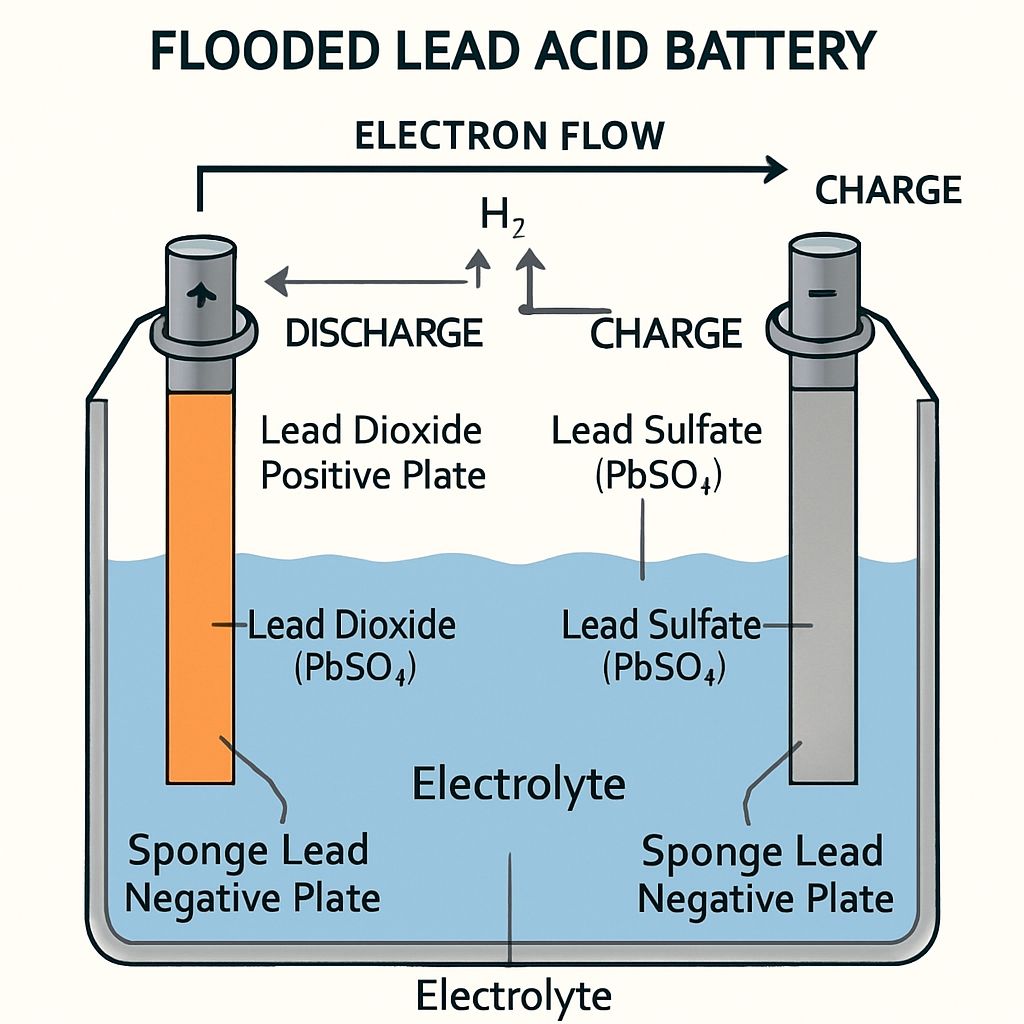
A flooded lead acid battery — also called a wet cell battery — is the original lead acid design. It contains lead plates submerged in a liquid electrolyte solution of sulfuric acid and water. During charging and discharging, a chemical reaction between the lead plates and the electrolyte stores and releases electrical energy.
How Flooded Batteries Store and Release Energy
When a flooded battery discharges, the sulfuric acid reacts with lead dioxide on the positive plate and sponge lead on the negative plate, producing lead sulfate and releasing electrons — that electron flow is your usable electricity. During recharging, the process reverses. The electrolyte breaks down, lead sulfate converts back, and the battery returns to its charged state.
The catch is that this recharging process also produces hydrogen gas as a byproduct of electrolysis. That’s not just a maintenance issue — it’s a genuine safety concern in enclosed spaces. Hydrogen is flammable, and in poorly ventilated farm outbuildings, it can accumulate to dangerous concentrations. Any flooded battery bank on a farm needs deliberate ventilation design built into the storage space.
Why Flooded Batteries Have Been the Farm Standard for Decades
The simple answer is cost and availability. Flooded lead acid batteries like the Crown CR430 6V Flooded L16 Battery have been widely available through agricultural co-ops and solar suppliers for decades at price points well below sealed alternatives. For farms with existing maintenance infrastructure and staff comfortable with battery upkeep, flooded batteries delivered solid value. Additionally, farms are increasingly exploring other solar technologies to complement their energy needs.
They’re also forgiving when it comes to overcharging — a flooded battery can tolerate equalization charges that would damage a sealed battery. That tolerance made them easier to manage with older, less precise solar charge controllers common on farms through the 1990s and early 2000s.
The Real Cost of Maintaining a Flooded Battery Bank
Maintenance on a flooded battery bank is non-negotiable. Every four to six weeks, the electrolyte level in each cell must be checked and topped off with distilled water. Terminals need cleaning to prevent corrosion buildup. Specific gravity readings with a hydrometer help track cell health. Equalization charges — deliberate overcharging cycles — are required periodically to prevent sulfation and stratification of the electrolyte.
On a working farm, that maintenance schedule competes with everything else demanding your time. Miss a few water checks during a dry summer, and cells can dry out and fail permanently. The labor cost is real, even if it rarely shows up in the battery’s sticker price. For a comprehensive lead-acid battery comparison, you can explore more about how different types of batteries perform under various conditions.
What Is a Sealed Lead Acid Battery?
Sealed lead acid batteries — officially called VRLA batteries (Valve Regulated Lead Acid) — use the same fundamental lead acid chemistry but redesign the internal structure to eliminate liquid electrolyte that needs topping. Instead, the electrolyte is either absorbed into a fiberglass mat (AGM) or suspended in a silica gel (Gel). Both designs recombine hydrogen and oxygen gases internally, eliminating the venting issue that makes flooded batteries a safety concern in tight spaces.
AGM Batteries: Best for High Discharge and Vibration-Heavy Environments
AGM batteries use a tightly compressed fiberglass mat saturated with electrolyte between the lead plates. That compression gives AGM batteries a lower internal resistance than flooded batteries, which translates directly to faster charge acceptance and higher discharge rates. On farms running high-draw equipment — irrigation pump starters, grain augers, electric fences with high-voltage pulsers — AGM batteries handle sudden large current demands better than gel alternatives.
The compressed internal structure also makes AGM batteries significantly more resistant to vibration damage, which matters in farm environments where battery enclosures may be mounted near running machinery or transported on vehicles. They can also be installed in multiple orientations — upright, on their side — giving you flexibility in tight utility spaces. For more information, you can read this lead acid battery comparison to understand their benefits further.
Gel Batteries: Best for Slow, Deep Discharge in Hot Climates
Gel batteries suspend the electrolyte in a silica-based gel, which gives them a specific performance advantage: superior tolerance for deep, slow discharges in high-temperature environments. Where AGM batteries can suffer capacity loss in sustained heat above 77°F (25°C), gel batteries maintain more stable performance in those conditions. For farms in hot southern climates where battery enclosures see summer temperatures regularly exceeding that threshold, gel chemistry holds an edge in long-term cycle life under real operating conditions. For more information on how solar technologies can benefit farmers, explore the comparison of solar technologies for farmers.
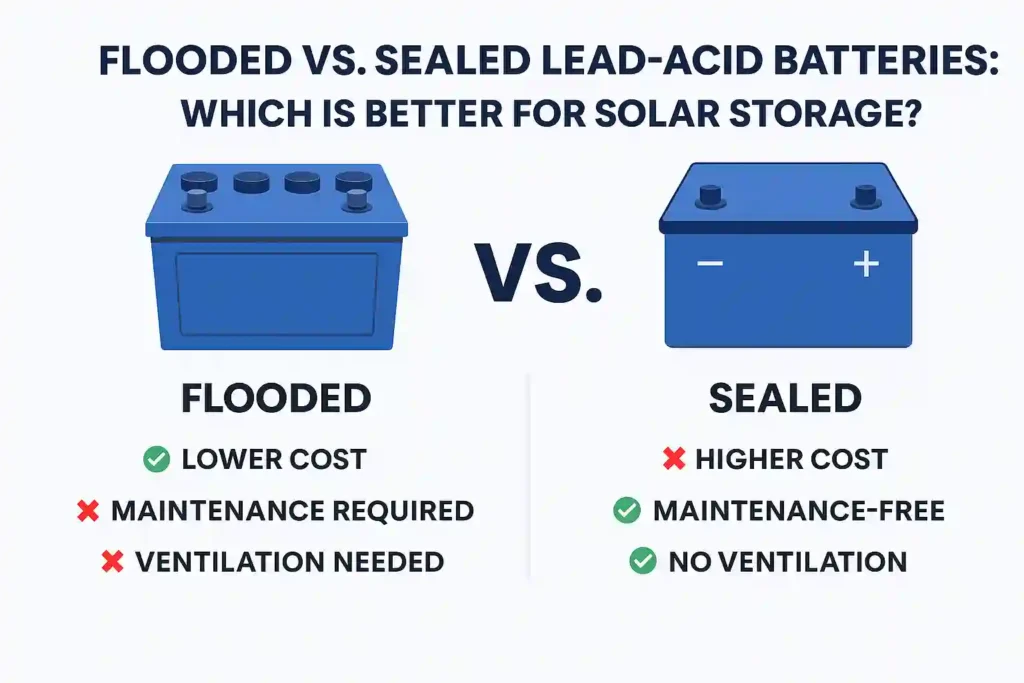
“Flooded vs. Sealed Lead-Acid Batteries …” from solarbatteriesquote.com and used with no modifications.
Sealed vs. Flooded Lead Acid: Side-by-Side Comparison
Once you understand what each battery type is, the real question becomes how they perform against each other in actual farm conditions. This isn’t a laboratory comparison — it’s about what happens when your solar bank is pushed hard through a three-day overcast stretch in January, or when temperatures in your battery shed hit 95°F in August.
The differences between flooded and sealed lead acid batteries go beyond maintenance schedules. They affect how you build your battery enclosure, how much you spend over a five to ten year ownership window, and how safely your system operates day to day.
Maintenance Requirements
Flooded batteries demand a committed maintenance routine — water levels checked every four to six weeks, terminals cleaned quarterly, specific gravity tested with a hydrometer, and periodic equalization charges performed to prevent sulfation. Sealed AGM and Gel batteries require none of that. Beyond keeping terminals clean and checking charge voltage settings on your solar charge controller, sealed batteries are essentially set-and-forget. For farm operators managing dozens of competing priorities, that difference in time commitment is significant.
Ventilation and Safety on the Farm
Flooded batteries release hydrogen gas during charging — a genuinely flammable hazard that requires deliberate ventilation design in any enclosed space. Battery sheds housing flooded banks need passive or active ventilation systems that prevent hydrogen accumulation above 4% concentration, which is the lower explosive limit. Sealed AGM and Gel batteries use internal gas recombination technology that eliminates this concern under normal operating conditions, making them a safer choice for battery enclosures inside barns, equipment rooms, or any structure where ventilation is difficult to engineer properly.
Installation Flexibility
Flooded batteries must remain upright at all times — tipping them risks spilling corrosive sulfuric acid electrolyte. Sealed batteries have no such restriction. AGM batteries in particular can be mounted sideways or at angles, opening up installation options in tight utility spaces or on mobile farm equipment. That flexibility can be the deciding factor when retrofitting battery storage into an existing structure where floor space is limited.
Upfront Cost vs. Long-Term Cost
Flooded batteries win on sticker price, often costing 30% to 50% less upfront than comparable AGM batteries. But the total cost picture shifts over time. Factor in the labor cost of routine maintenance, the cost of distilled water, the risk of premature failure from missed maintenance, and the cost of ventilation infrastructure required for safe installation — and the sealed battery’s higher purchase price starts to look like a reasonable trade. Over a full five to ten year battery bank lifespan, the gap between flooded and sealed total cost of ownership narrows considerably, and in some farm setups reverses entirely.
Cycle Life and Performance Under Farm Conditions
Cycle life — the number of complete charge and discharge cycles a battery delivers before capacity drops below 80% — is where battery chemistry really separates itself under farm conditions. Flooded lead acid batteries typically deliver 500 to 800 cycles at 50% depth of discharge when properly maintained. AGM batteries hit a similar range, while Gel batteries can edge higher under slow, deep discharge conditions.
The critical qualifier is depth of discharge. Lead acid batteries of all types degrade faster when regularly discharged below 50%. A farm system that regularly pulls its battery bank to 70% or 80% depth of discharge — common during extended cloudy periods — will significantly shorten battery lifespan regardless of which lead acid type is used. Proper system sizing to keep discharge depth moderate is as important as the battery chemistry choice itself.
Temperature compounds the performance picture. Lead acid batteries lose capacity in cold weather — a flooded battery at 32°F (0°C) may deliver only 70% to 80% of its rated capacity. Gel batteries handle temperature extremes somewhat better than AGM at the high end, while both sealed types generally outperform flooded batteries in sustained cold because the sealed electrolyte design maintains better plate contact under freezing conditions.
Real-World Farm Battery Performance Snapshot
A 48V flooded lead acid battery bank using Crown CR430 6V batteries wired in series-parallel configuration delivers strong capacity at low upfront cost — but requires monthly maintenance visits, a ventilated enclosure, and precise charge controller equalization settings to reach its rated cycle life. The same voltage bank built with AGM batteries costs more initially, installs safely in an unventilated utility room, and operates reliably with minimal oversight. For a farm operator 45 minutes from the nearest battery supplier, the AGM bank’s reduced failure risk alone may justify the price premium.
Which Battery Type Fits Your Farm Setup?
There’s no universal right answer here — the best battery for your farm depends on your specific combination of climate, budget, available maintenance time, installation environment, and how your solar system is sized relative to your load. What matters is matching battery chemistry to your actual operating conditions rather than defaulting to whatever is cheapest or most familiar.
Two farm operations can look identical on paper — same solar array size, same daily energy consumption, same geographic region — and still have different ideal battery choices based on who’s managing the system and what the battery enclosure looks like.
When Flooded Lead Acid Is the Right Call
Flooded lead acid batteries remain a legitimate, cost-effective choice for farms that already have proper ventilated battery storage, employ someone comfortable with routine battery maintenance, run older solar charge controllers with equalization charge capability, and are working with a tight initial capital budget. Operations that already use flooded batteries in forklifts or golf carts — and have the infrastructure and knowledge base to maintain them — face very little additional learning curve adding a flooded solar battery bank to the mix. The Crown CR430 6V Flooded L16 specifically has a long track record in agricultural solar applications precisely because it’s built for this type of demanding, high-cycle environment when properly maintained.
When Sealed Lead Acid Makes More Sense
Sealed AGM or Gel batteries become the stronger choice the moment any of the following conditions apply to your farm: your battery enclosure is inside an existing structure without dedicated ventilation, you don’t have reliable staff time to commit to monthly maintenance checks, your farm is in a hot southern climate where summer temperatures regularly push above 85°F in storage areas, or you’re building a new system and want to minimize long-term operational complexity. The higher upfront cost is the only real drawback — and on a system you’re planning to run for a decade, that cost premium typically amounts to less than the labor cost of five years of flooded battery maintenance.
The Verdict: Which Battery Should Power Your Farm Solar Backup
If you have the infrastructure, the maintenance discipline, and the budget constraints that make flooded lead acid the practical choice — go with a proven flooded battery like the Crown CR430 6V Flooded L16, build a properly ventilated enclosure, and commit to the maintenance schedule without exception. If any part of that equation is uncertain — the ventilation, the maintenance time, the staff reliability — sealed AGM batteries are the smarter long-term investment. They cost more on day one and save you from the compounding costs of neglected flooded battery maintenance across a decade of operation. For most farms being built or retrofitted with solar today, AGM sealed batteries are the practical default choice.
Frequently Asked Questions
These are the questions farm operators ask most often when deciding between flooded and sealed lead acid batteries for solar backup systems. The answers cut through the technical noise and focus on what actually matters for real farm conditions.
How long do flooded lead acid batteries last in a solar setup?
Flooded lead acid batteries in a solar setup typically last 5 to 10 years with proper maintenance — but that range is heavily dependent on how consistently they’re maintained and how deeply they’re discharged in daily operation. For a comprehensive comparison, you can check out this lead acid battery comparison.
At 50% depth of discharge with regular water topping, equalization charges, and terminal maintenance, a quality flooded battery like the Crown CR430 6V can reach the upper end of that range. Push discharge depth to 70% or 80% regularly, skip equalization cycles, or let electrolyte levels drop during summer heat, and you may see failure in three to four years.
Temperature management is the other major lifespan factor. Flooded batteries stored in enclosures that regularly exceed 77°F (25°C) experience accelerated plate corrosion and water loss — both of which shorten service life. Every 15°F rise above that threshold roughly cuts battery lifespan in half under sustained conditions.
The bottom line on flooded battery lifespan: the rated cycle life is achievable, but it requires consistent effort. Farms that treat flooded battery maintenance as optional rather than mandatory rarely see batteries reach their potential service life.
|
Battery Type |
Typical Lifespan |
Depth of Discharge |
Key Lifespan Factor |
|---|---|---|---|
|
Flooded Lead Acid |
5–10 years |
50% recommended |
Maintenance consistency |
|
AGM Sealed |
4–8 years |
50% recommended |
Charge voltage accuracy |
|
Gel Sealed |
5–10 years |
50% recommended |
Temperature management |
Can sealed lead acid batteries handle the power demands of a working farm?
Yes — sealed AGM batteries in particular are well-suited to the high-demand discharge cycles common on working farms. Irrigation pump starters, grain handling equipment, electric fence energizers, and refrigeration compressors all create high instantaneous current draws that AGM batteries handle well due to their lower internal resistance compared to flooded and gel alternatives. The key is proper bank sizing — a sealed battery bank needs to be sized so that even peak farm loads don’t push discharge depth beyond 50% on a regular basis. Undersized sealed battery banks fail just as quickly as undersized flooded banks, regardless of chemistry. For more on optimizing energy solutions on farms, explore HPBC solar panels for farms.
Do flooded batteries really need ventilation, and how serious is the risk?
The ventilation requirement for flooded lead acid batteries is not optional — it’s a genuine safety requirement. During charging, flooded batteries release hydrogen gas through the electrolysis process. Hydrogen is highly flammable and lighter than air, meaning it accumulates at ceiling level in enclosed spaces. The lower explosive limit for hydrogen is 4% concentration by volume in air — a threshold that can be reached in a small, poorly ventilated battery room during active charging.
For context, a typical farm battery bank being charged by a solar array on a sunny morning is actively gassing hydrogen for several hours. Any ignition source — a light switch, a power tool, a static discharge — in that space during charging presents a real explosion risk without adequate ventilation. This is not a theoretical concern: battery room explosions from hydrogen accumulation are a documented cause of property damage and injury in off-grid installations. If your battery enclosure is inside a barn, equipment room, or any other structure where you cannot engineer reliable passive or active ventilation, sealed batteries remove this risk entirely.
Is it worth paying more for AGM batteries over standard flooded batteries?
For most farm operators building or upgrading a solar system today, yes — AGM batteries are worth the premium. The price difference between comparable flooded and AGM battery banks typically runs 30% to 50% higher for AGM. But that gap is offset by eliminated maintenance labor, no ventilation infrastructure cost, lower risk of premature failure from missed maintenance, and greater installation flexibility. On a battery bank sized for a typical farm solar system, the maintenance labor savings over five years alone often exceeds the upfront price premium. The cleaner math favors AGM in most modern farm installations, particularly for operators who don’t have dedicated maintenance staff for battery systems.
Can I mix sealed and flooded lead acid batteries in the same solar battery bank?
No — mixing sealed and flooded lead acid batteries in the same battery bank is one of the most common mistakes in DIY solar installations, and it quietly destroys both battery types faster than either would fail on its own.
The core problem is charge voltage incompatibility. Flooded batteries require higher charge voltages — particularly during equalization cycles — that will permanently damage sealed AGM or Gel batteries. AGM batteries require precise charge voltage limits that, if applied to flooded batteries, result in chronic undercharging and accelerating sulfation.
When batteries with different voltage requirements are wired in the same bank, the charge controller must choose one voltage profile. Whichever battery type isn’t matched to that profile degrades faster, eventually pulling down the performance of the entire bank as the weaker batteries drag current from the stronger ones during discharge.
Beyond charge voltage, different battery types have different internal resistance characteristics. Batteries with lower internal resistance will absorb charge current faster and discharge faster — meaning mixed banks cycle unevenly, with some batteries doing the majority of the work while others sit underutilized. Uneven cycling is a direct path to premature failure across the entire bank.
The practical rule is simple: always build your battery bank with identical batteries — same chemistry, same manufacturer, same model, and ideally the same production date. If you’re expanding an existing flooded battery bank, replace the entire bank rather than adding new batteries alongside aging ones. The cost of doing it right is always less than the cost of replacing a failed mixed bank ahead of schedule.
For expert guidance on sizing and building a farm solar battery system that delivers reliable power for your specific energy needs, connect with a sustainable energy specialist who can match the right battery technology to your operation.
When considering solar panel backup options for farms, it’s essential to understand the differences between sealed and flooded lead acid batteries. Sealed batteries are maintenance-free and ideal for remote locations, while flooded batteries require regular maintenance but offer a longer lifespan. For farmers looking to enhance their solar panel systems, exploring advanced technologies like HPBC solar panels can provide efficient power solutions tailored to agricultural operations.





Leave a Reply