
Article-At-A-Glance
- Battery integration can increase solar irrigation system efficiency by up to 40% through continuous operation regardless of sunlight availability
- Adding batteries allows for strategic irrigation timing outside peak sun hours, optimizing both water usage and crop health
- Modern lithium-ion batteries offer 10+ years of service life with proper maintenance, providing long-term ROI for agricultural operations
- Battery storage systems protect irrigation equipment from power fluctuations, extending the lifespan of pumps and controllers
The Hidden Power Gap in Solar Irrigation Systems
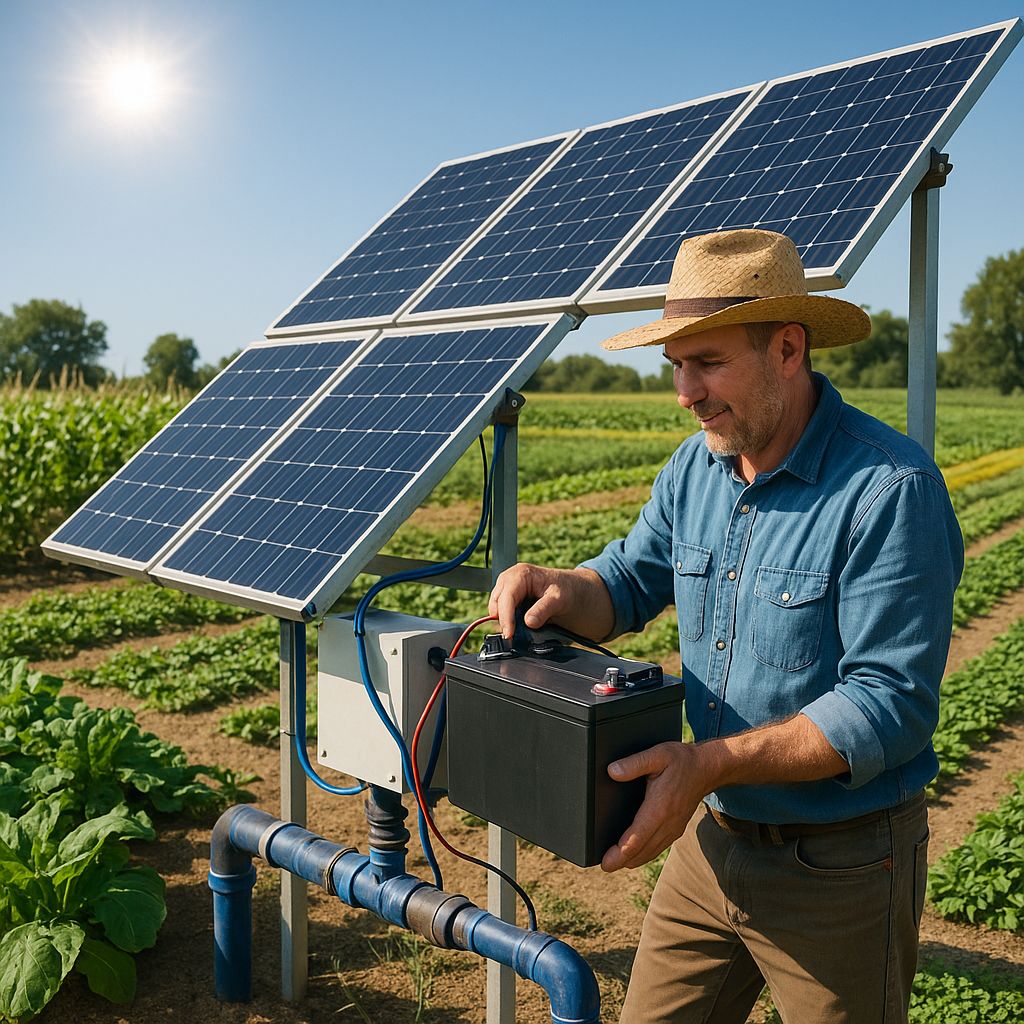
Solar irrigation systems have transformed modern agriculture by harnessing clean, renewable energy to water crops. But there’s a critical limitation hiding in plain sight. Without battery storage, these systems only function when the sun shines—creating a power gap that limits their full potential and efficiency. This discontinuity means irrigation stops during cloudy periods, at night, or during unexpected weather changes when your crops might need water most.
I’ve worked with hundreds of farms transitioning to solar irrigation, and this single weakness consistently undermines otherwise perfect systems. The good news? GrowingSolarMist’s battery integration solutions can bridge this gap, transforming intermittent irrigation into reliable, consistent crop support. Adding battery storage doesn’t just complement your solar setup—it fundamentally enhances the entire system’s capabilities while providing significant operational advantages that translate directly to improved yields and reduced resource waste.
How Batteries Transform Solar Irrigation Performance
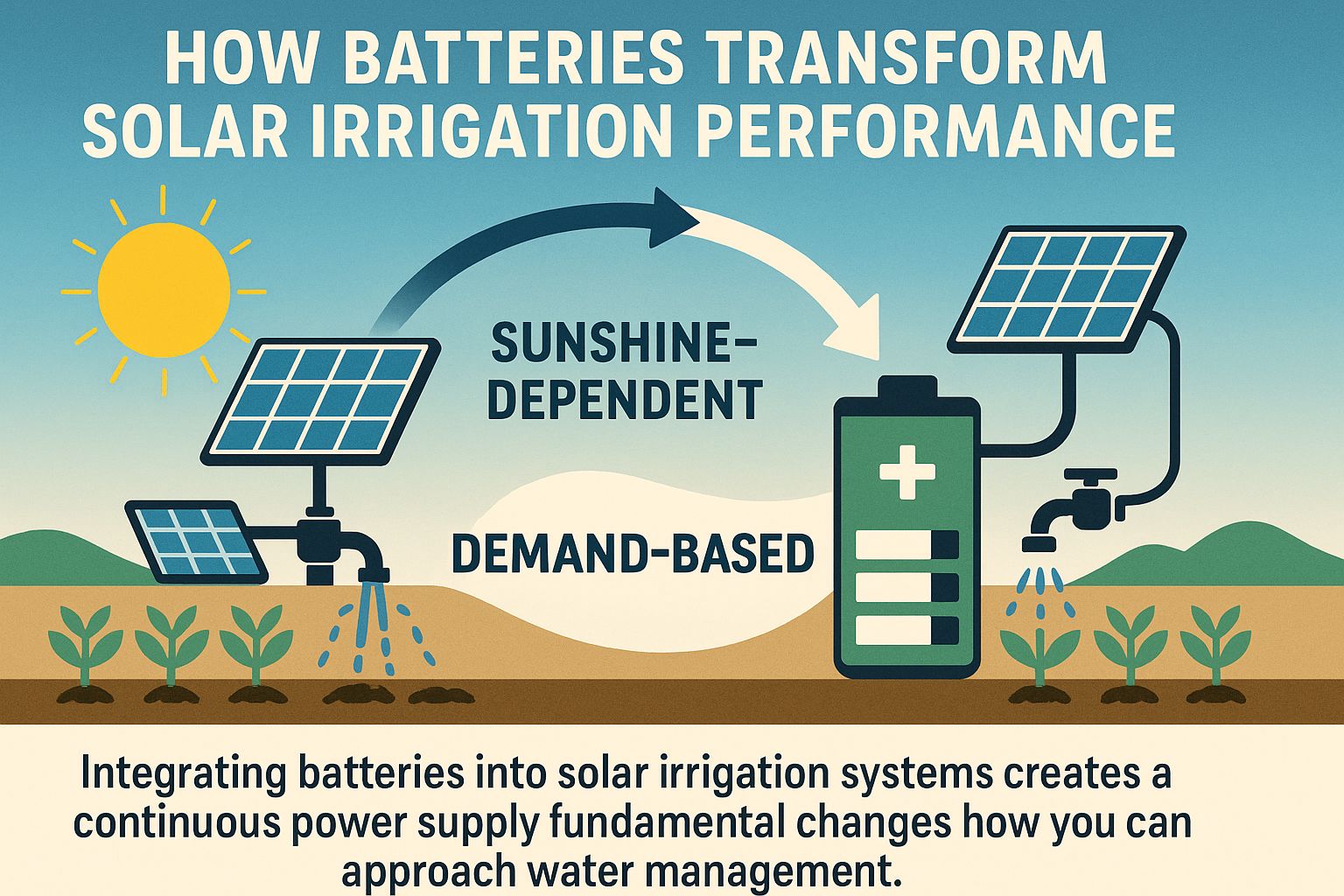
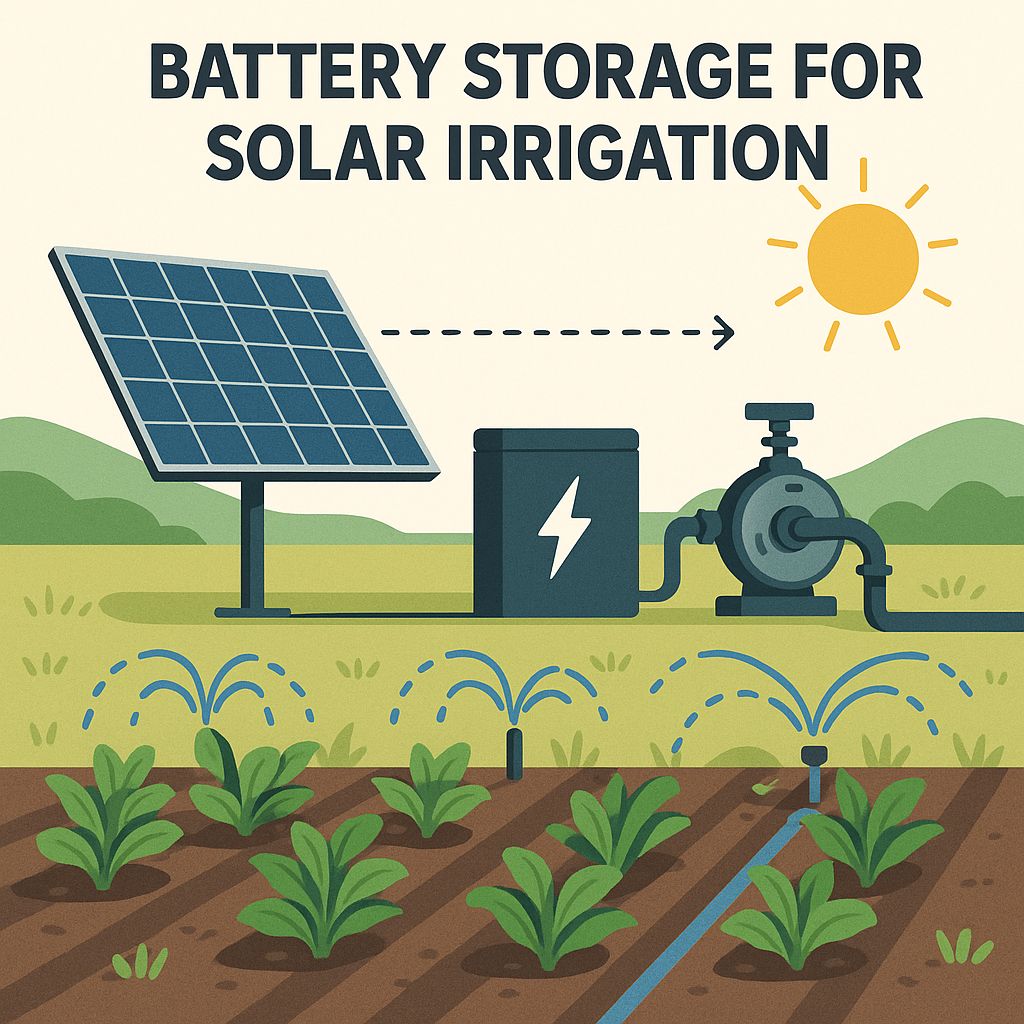
Integrating batteries into solar irrigation systems creates a continuous power supply that fundamentally changes how you can approach water management. Instead of being tied to daylight hours, batteries store excess energy generated during peak sunlight and make it available whenever irrigation is optimal for your specific crops. This shift from sunshine-dependent to demand-based irrigation represents a revolutionary improvement in agricultural water efficiency.
24/7 Water Access Despite Weather Conditions
Solar-only irrigation systems leave farmers vulnerable to nature’s unpredictability. When clouds roll in unexpectedly or during extended overcast periods, traditional solar systems simply shut down. Battery storage eliminates this vulnerability by providing consistent power regardless of temporary weather changes. This reliability is particularly critical during germination phases and stress periods when even short interruptions in watering schedules can significantly impact crop development and yield potential.
During a recent drought in California’s Central Valley, farms with battery-backed solar irrigation maintained consistent crop hydration while neighboring properties without storage capacity faced significant yield reductions. The difference was particularly noticeable in high-value crops where irrigation timing directly affects quality parameters that determine market value. Battery systems essentially provide weather-proofing for your irrigation strategy, ensuring continuity through cloudy days that would otherwise disrupt watering cycles.
Optimal Water Scheduling Outside Peak Sun Hours
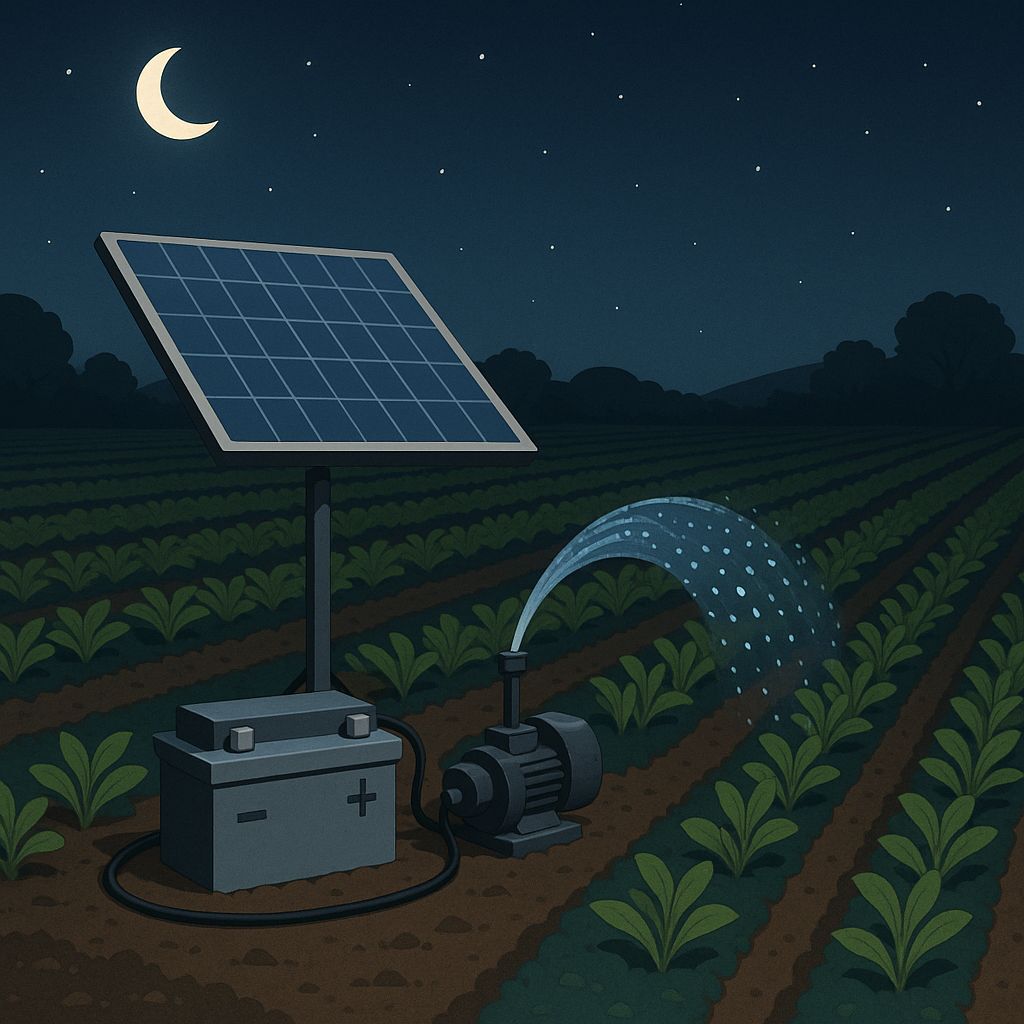
Evaporation rates are highest during peak daylight hours—precisely when traditional solar irrigation systems operate most efficiently. This unfortunate timing mismatch means much of your valuable water evaporates before plants can utilize it. Battery storage allows for strategic irrigation scheduling during early morning, evening, or night hours when evaporation rates are minimal and plants absorb water most efficiently.
“After adding battery storage to our solar irrigation system, we reduced water consumption by 27% while maintaining the same crop yield by shifting to evening watering cycles. The return on investment was realized within just two growing seasons.” — Maria Gonzalez, Organic Vegetable Producer
This ability to water crops during optimal biological windows rather than being constrained by sunlight availability represents one of the most significant efficiency improvements batteries can provide. For crops like leafy greens and berries, night watering also reduces disease pressure by allowing foliage to dry completely before daylight hours, further enhancing the value of time-flexible irrigation capabilities.
Protection Against Power Fluctuations
Solar irradiance naturally fluctuates throughout the day, causing power variations that stress irrigation equipment. These fluctuations force pumps to constantly adjust their operation, creating wear patterns that significantly reduce equipment lifespan. Batteries act as power conditioners, delivering consistent voltage and current to your irrigation system regardless of momentary solar input changes.
This steady power supply extends the operational life of pumps, controllers, and other sensitive components by eliminating harmful start-stop cycles and voltage spikes. The result is reduced maintenance costs, fewer replacement parts, and less system downtime during critical growing periods. For systems with variable frequency drives, battery integration can extend equipment lifespans by up to 40% compared to direct solar power systems without storage.
5 Real Efficiency Gains From Battery Storage
The efficiency improvements from adding batteries to solar irrigation systems extend far beyond simply providing power when the sun isn’t shining. These gains translate directly to operational benefits that impact your bottom line through multiple pathways. Understanding these concrete advantages helps clarify why battery integration represents a transformative upgrade rather than just an optional add-on.
1. Reduced Water Waste Through Consistent Pressure
Irrigation efficiency depends heavily on maintaining optimal pressure throughout the entire watering cycle. Traditional solar-direct systems experience pressure fluctuations as cloud cover changes, resulting in uneven water distribution and reduced irrigation uniformity. Batteries maintain consistent pressure regardless of momentary solar changes, ensuring uniform water application across your entire field.
For drip irrigation systems particularly, pressure consistency directly correlates with water use efficiency. Tests conducted on almond orchards showed that battery-backed solar systems achieved up to 17% better distribution uniformity compared to solar-direct systems, resulting in significant water savings while improving crop hydration. This pressure stability also prevents emitter clogging, a common issue when pressure drops allow sediment to accumulate in irrigation lines.
2. Lower Operating Costs Than Diesel Backup Systems
Many farms without battery storage resort to diesel generators as backup power sources during cloudy periods or for night irrigation. These generators introduce substantial operational costs including fuel, maintenance, and eventual replacement. Battery systems eliminate these ongoing expenses while providing similar reliability without the noise, pollution, or maintenance requirements of combustion engines.
The cost differential becomes particularly significant over time. A 20kW diesel generator consumes approximately 1.5 gallons of fuel per hour under load, translating to substantial annual costs for farms requiring regular backup power. Modern lithium battery systems, while requiring higher initial investment, operate virtually maintenance-free for 7-10 years with no fuel costs, creating long-term operational savings that diesel systems cannot match.
3. Extended Equipment Lifespan
Solar irrigation pumps experience maximum stress during startup and during low-irradiance periods when they struggle to maintain performance with insufficient power. Battery systems eliminate these stress points by providing surge capacity for startup requirements and consistent power during low solar periods. This operational stability directly translates to longer equipment life and fewer replacement cycles for expensive system components.
4. Ability to Run Multiple Systems Simultaneously
Without batteries, solar irrigation capacity is limited by instantaneous solar production, restricting the ability to operate multiple zones or integration with other farm systems. Battery storage allows for power accumulation and strategic deployment, enabling simultaneous operation of multiple irrigation zones or integration with other farm electrical needs such as cooling systems, lighting, or processing equipment.
This operational flexibility transforms how power can be distributed across farm operations, allowing for more sophisticated management strategies that optimize both irrigation and other critical systems. For diversified operations, this means being able to run packing sheds, cold storage, and irrigation simultaneously without requiring separate power systems for each function. Learn more about off-grid battery storage systems that can enhance these capabilities.
5. Decreased Grid Dependency
Many agricultural regions suffer from unreliable grid electricity, with frequent outages or brownouts disrupting irrigation schedules. Battery-backed solar systems create energy independence, allowing irrigation to continue uninterrupted regardless of grid conditions. This resilience is particularly valuable during peak growing seasons when even short irrigation interruptions can impact yield potential and quality.
For farms in remote locations or regions with expensive grid electricity, battery systems eliminate the need for costly utility line extensions while providing more reliable power than grid-connected properties often experience. This independence also shields operations from rising utility rates and demand charges, creating predictable energy costs for irrigation over the system’s lifespan.
Selecting the Right Battery Technology for Your Farm
Not all batteries are created equal when it comes to agricultural applications. The specific demands of irrigation systems require carefully matched battery technologies that can withstand agricultural environments while delivering the performance characteristics needed for reliable operation. Making the right selection significantly impacts system reliability, lifespan, and overall return on investment.
Lithium-Ion vs. Lead-Acid: Practical Differences
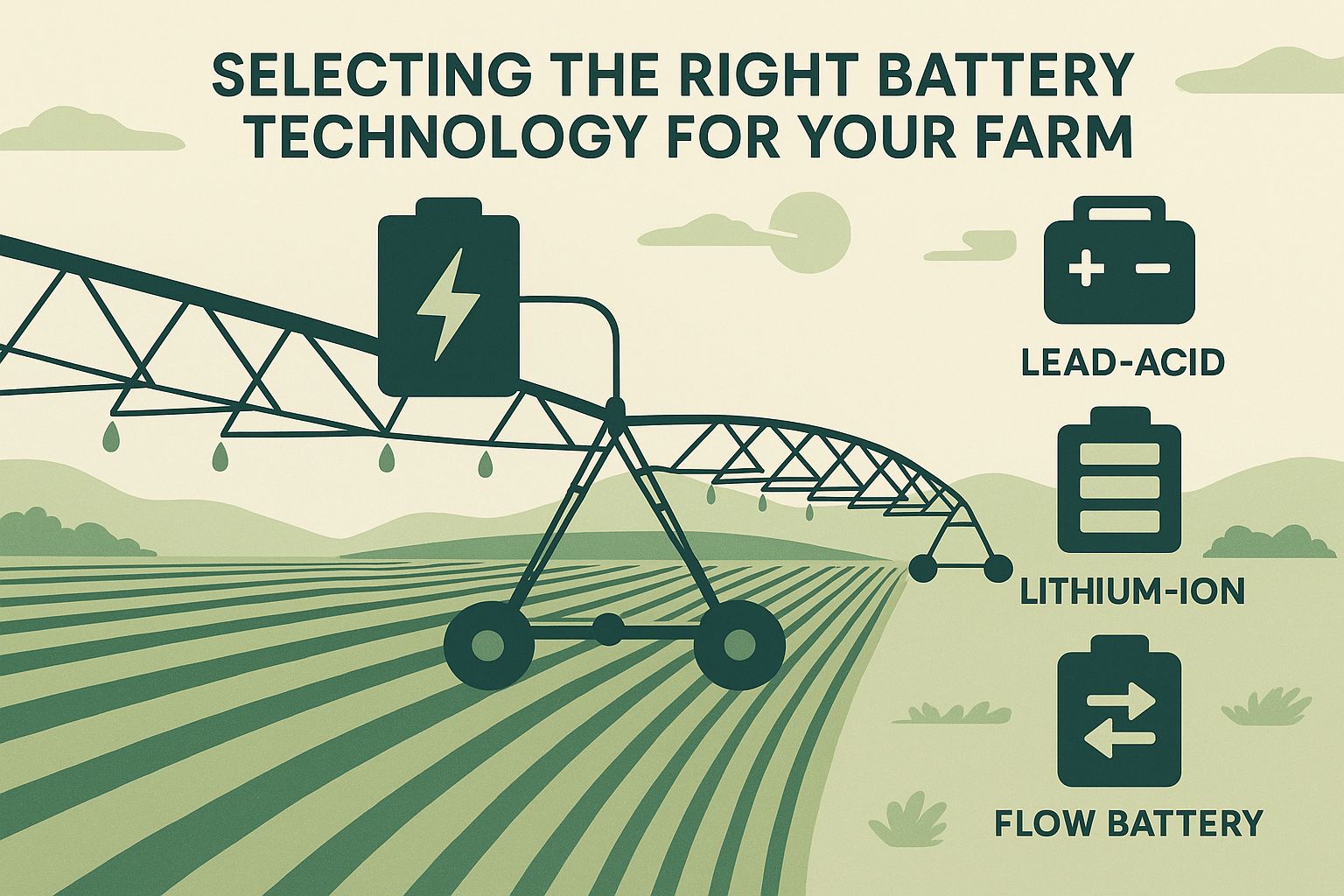
While lead-acid batteries have traditionally dominated agricultural applications due to their lower initial cost, lithium-ion technology offers compelling advantages that typically justify the higher purchase price. Lithium batteries provide approximately three times more usable capacity per pound, substantially higher charge/discharge efficiency, and dramatically longer cycle life. For irrigation systems that may cycle daily during growing seasons, lithium batteries typically deliver 7-10 years of service compared to 2-3 years for lead-acid under similar conditions. For more information on optimizing solar-powered irrigation systems, check out this guide.
Lithium batteries also maintain consistent voltage output throughout their discharge cycle, ensuring irrigation pumps receive optimal power until the battery is nearly depleted. This contrasts with lead-acid batteries that experience voltage sag as they discharge, potentially compromising irrigation performance during extended operation. For systems in remote locations, lithium’s minimal maintenance requirements and ability to remain partially charged for extended periods without damage provide additional practical advantages.
Matching Battery Capacity to Irrigation Demands
Properly sizing battery capacity represents one of the most critical aspects of system design. Undersized systems fail to provide sufficient runtime during low solar periods, while oversized systems increase costs unnecessarily. The ideal approach involves analyzing your specific irrigation requirements including pump size, daily runtime needs, and typical weather patterns to determine optimal storage capacity.
|
System Size (Pump HP) |
Recommended Battery Capacity (kWh) |
Typical Daily Runtime on Battery |
|---|---|---|
|
1-2 HP |
5-10 kWh |
3-6 hours |
|
3-5 HP |
10-20 kWh |
3-5 hours |
|
7-10 HP |
20-40 kWh |
2-4 hours |
|
15-20 HP |
40-80 kWh |
2-3 hours |
For most operations, designing for 1-3 days of autonomy provides the optimal balance between cost and reliability. This capacity allows for continuing irrigation through brief cloudy periods while avoiding the substantial expense of sizing for extended low-solar scenarios that rarely occur in most agricultural regions. Learn more about solar-powered irrigation systems to enhance your agricultural practices.
Climate Considerations for Battery Performance
Environmental conditions significantly impact battery performance and lifespan. In hot climates, lithium batteries offer superior heat tolerance compared to lead-acid alternatives, maintaining performance in temperatures that would rapidly degrade conventional batteries. For systems in extremely cold regions, proper battery housing with basic insulation or heating elements ensures reliable winter operation when irrigation may still be necessary for certain crops. For more information on how to integrate solar solutions in agriculture, check out our solar panels for farming guide.
Coastal regions with high humidity or farms with heavy dust conditions should prioritize sealed battery technologies with appropriate ingress protection ratings. These environmental factors should be explicitly discussed with system designers to ensure the selected battery technology can withstand your specific agricultural conditions while delivering reliable performance throughout its expected service life.
Here’s a table outlining key factors for farmers to consider when choosing a solar irrigation battery:
|
Factor |
Description |
|---|---|
|
Capacity |
The amount of energy the battery can store, measured in kilowatt-hours (kWh). Should match daily irrigation energy needs. 1, 2, 3 |
|
Depth of Discharge |
The percentage of battery capacity that can be safely used. Deep-cycle batteries allow for higher discharge rates. 2 |
|
Cycle Life |
Number of charge-discharge cycles the battery can undergo before significant capacity loss. Longer cycle life reduces replacement frequency. 2, 3 |
|
Efficiency |
How effectively the battery converts stored energy into usable power. Higher efficiency means less energy waste. 1, 3 |
|
Charging Rate |
How quickly the battery can be recharged by solar panels. Faster charging allows for more irrigation time. 1, 3 |
|
Temperature Tolerance |
Ability to perform in extreme temperatures. Important for outdoor agricultural settings. 2, 3 |
|
Maintenance Requirements |
Some batteries need regular maintenance, while others are maintenance-free. Consider long-term upkeep costs. 1, 3 |
|
Initial Cost |
Upfront investment required. Balance this with long-term benefits and energy savings. 1, 2 |
|
Compatibility |
Ensure the battery works with existing solar panels and irrigation equipment. 1 |
|
Scalability |
Ability to expand the system in the future as irrigation needs grow. 1, 2 |
When selecting a solar irrigation battery, farmers should carefully evaluate these factors based on their specific needs, climate conditions, and budget constraints. Consulting with a solar energy professional can help in making the most suitable choice for a particular farming operation.
Cost-Benefit Analysis: When Batteries Make Financial Sense
While battery storage clearly enhances irrigation system capabilities, the financial equation must make sense for your specific operation. Understanding both the costs and returns helps determine if battery integration aligns with your farm’s economic realities and management objectives.
Initial Investment vs. Long-Term Savings
Battery storage typically adds 25-40% to the initial cost of a solar irrigation system, representing a significant upfront investment. However, this cost should be evaluated against the cumulative benefits including extended watering windows, reduced water usage through optimal timing, equipment lifespan extension, and elimination of backup power expenses. For many operations, these combined benefits create payback periods of 3-6 years, with all subsequent benefits representing direct operational savings.
When calculating return on investment, it’s essential to include all cost factors that batteries impact, not just energy storage itself. The ability to irrigate during optimal biological windows rather than peak sun hours often creates water efficiency improvements of 15-30%, representing substantial savings in regions with high water costs. Similarly, equipment lifespan extension from consistent power quality can reduce replacement and maintenance costs by thousands of dollars over the system lifecycle.
Available Agricultural Incentives and Rebates
Many regions offer specific agricultural incentives for energy storage that can significantly reduce initial costs. These programs include USDA REAP grants, state-level agricultural energy programs, and utility incentives designed to reduce peak demand. Combined incentives often reduce battery system costs by 30-50%, dramatically improving project economics and shortening payback periods.
Beyond dedicated battery incentives, many operations qualify for additional benefits by documenting water conservation achievements enabled by battery-optimized irrigation timing. These water-focused incentives can provide supplementary financial benefits that further enhance project returns while supporting broader environmental goals.
ROI Calculation Based on Farm Size and Water Usage
Return on investment varies significantly based on operation scale and specific agricultural activities. Smaller, intensive operations growing high-value crops typically achieve faster returns than extensive operations with lower-value commodities. Similarly, regions with high water costs or restricted water availability often see accelerated returns through improved water use efficiency.
For a typical 10-acre vegetable operation with moderate water costs, battery integration often achieves complete payback within 4-5 growing seasons. Larger operations may see faster returns through scale efficiencies, while specialty crop producers frequently achieve payback in just 2-3 seasons due to the direct impact of optimized irrigation on crop quality and market value.
Real Farm Success Stories and Performance Data
Abstract calculations provide important guidance, but real-world implementation results offer the most compelling evidence for battery system benefits. These case studies from diverse agricultural operations demonstrate actual results achieved through battery integration.
Case Study: Small Vegetable Farm Cuts Water Costs by 40%
Blue Ridge Organics, a 12-acre diversified vegetable operation in Virginia, integrated a 15kWh lithium battery system with their existing 7kW solar array to power a 2HP submersible irrigation pump. By shifting 80% of their irrigation to evening hours when evaporation rates dropped dramatically, they reduced water consumption by 40% in the first season while maintaining identical crop yields. The system provided consistent 6-hour overnight watering cycles that eliminated the midday irrigation previously required without battery storage. With water costs of $2.75 per thousand gallons, the water savings alone created a 4.2-year payback period, not including additional benefits from improved crop quality and reduced disease pressure from eliminated leaf wetness during daylight hours.
Large-Scale Implementation Results from Commercial Growers
Western Almond Growers Cooperative implemented battery storage across 620 acres of drip-irrigated orchards, integrating 120kWh storage systems with existing 50kW solar arrays at each of their twelve pumping stations. The battery systems enabled precision irrigation timing coordinated with their deficit irrigation strategy, improving water productivity by 23% compared to their previous solar-direct approach.
Beyond water savings, the cooperative documented significant improvements in nut quality parameters directly attributable to optimized irrigation timing, resulting in an average price premium of $0.17 per pound. This quality improvement alone generated approximately $285,000 in additional revenue annually, creating complete system payback in less than three years despite the substantial initial investment in large-scale battery capacity.
Perhaps most impressively, the cooperative’s insurance provider reduced equipment coverage premiums by 18% after documenting the reduced equipment failure rates following battery integration. The elimination of power fluctuations dramatically decreased pump controller failures and mechanical wear on pump components, creating secondary financial benefits beyond the direct operational improvements.
- Average water savings across documented case studies: 22-37%
- Typical equipment lifespan extension: 35-60%
- Reported reduction in plant disease pressure from optimized watering timing: 14-30%
- Average payback period across all documented implementations: 3.8 years
- Percentage of farms reporting improved crop quality metrics: 87%
Future-Proof Your Farm with Battery-Backed Solar
Agricultural operations face increasing pressure from climate variability, water restrictions, and rising input costs. Battery-integrated solar irrigation provides resilience against these challenges by creating water use efficiency improvements, energy independence, and operational flexibility that traditional irrigation approaches cannot match. As climate patterns become less predictable, the ability to maintain precise irrigation schedules regardless of weather conditions provides critical operational stability.
Looking forward, battery costs continue to decline while performance improves, creating increasingly favorable economics for agricultural implementations. Operations that integrate battery storage now position themselves advantageously for future expansion while immediately benefiting from the efficiency gains these systems provide. The modular nature of modern battery systems also enables incremental capacity expansion, allowing farms to grow their storage capabilities as operational needs evolve or as budgets permit. For more information on utilizing solar technology in agriculture, explore solar-powered irrigation systems.
Conclusion: Is it a Smart Investment for the Farmer to Add a Battery to A Solar Irrigation System
For the majority of agricultural operations, battery integration represents one of the highest-return improvements available for existing solar irrigation systems. The combination of water efficiency gains, operational flexibility, equipment protection, and energy independence creates compelling economics even before considering available incentives or rebates. While specific returns vary based on individual farm characteristics, the documented benefits across diverse implementations demonstrate that battery storage transforms solar irrigation from a daytime-only solution to a comprehensive water management system capable of optimizing both resource use and crop outcomes.
Frequently Asked Questions
Based on our experience helping hundreds of farms integrate battery storage with their irrigation systems, these are the most common questions that arise during the planning process.
How long do batteries for solar irrigation systems typically last?
Modern lithium-ion batteries designed for agricultural applications typically provide 7-10 years of reliable service before capacity degradation reaches levels that impact irrigation performance. Most systems maintain at least 80% of their original capacity through the first 5 years of operation, with gradual degradation thereafter. This lifespan significantly exceeds traditional lead-acid batteries that typically require replacement every 2-3 years in similar applications.
Actual lifespan varies based on usage patterns, depth of discharge, temperature conditions, and maintenance practices. Systems that routinely discharge deeply during daily irrigation cycles may experience faster capacity degradation than those used primarily for occasional backup. Most manufacturers provide specific cycle-life ratings based on depth of discharge that can help predict expected service life for your specific usage pattern. For more insights, explore solar panels powering a farm’s irrigation system to understand how solar technology can impact system longevity.
Can I add batteries to my existing solar irrigation setup?
Most existing solar irrigation systems can be retrofitted with battery storage without replacing major components. The integration typically requires adding a charge controller, battery bank, and sometimes an inverter depending on your specific pump configuration. Direct current (DC) pump systems generally allow for simpler integration than alternating current (AC) setups, though both are readily adaptable to battery storage. For more information, you can explore how solar panels power a farm’s irrigation system.
The retrofit process typically takes 1-2 days for smaller systems, with minimal disruption to irrigation schedules. When evaluating retrofit options, have your existing solar array capacity assessed to ensure it provides sufficient charging capacity for your desired battery storage. Many farms find that modest solar expansion paired with battery addition creates the optimal combination for their irrigation needs.
Do batteries work efficiently in extremely hot or cold climates?
Battery performance is indeed affected by temperature extremes, but modern lithium batteries include thermal management systems that maintain performance across a wide operating range. For extremely hot climates (consistently above 100°F/38°C), battery enclosures with passive or active cooling systems prevent capacity degradation and maintain efficiency. In cold climates, insulated enclosures or heating elements ensure batteries maintain operational temperatures even during freezing conditions.
What maintenance is required for irrigation system batteries?
Lithium battery systems require minimal maintenance compared to traditional alternatives. Quarterly visual inspections for connection integrity, enclosure condition, and ventilation blockages represent the primary routine maintenance. Most systems include remote monitoring capabilities that automatically alert operators to performance anomalies requiring attention. Unlike flooded lead-acid batteries, lithium systems eliminate water level checks, terminal cleaning, and equalization charging requirements that historically created maintenance burdens for agricultural batteries.
Is it possible to expand battery capacity as my irrigation needs grow?
Modern battery systems utilize modular designs specifically intended to accommodate expansion. Additional battery modules can typically be integrated with existing systems without replacing control components, allowing capacity to grow incrementally as your operation expands. When initially designing your system, selecting equipment with expansion capacity slightly beyond your current needs provides the simplest pathway for future growth.
Many farms begin with battery capacity sized for their most critical irrigation zones, then expand coverage to additional fields or zones as they validate performance benefits and as budgets permit. This phased approach minimizes initial investment while creating a flexible platform for future expansion based on demonstrated returns. For more information on the best battery options, you can explore solar irrigation batteries for agriculture.



Leave a Reply