

Key Takeaways
- Farmers can reduce operational costs by 50-75% through solar panel investments while qualifying for a 30% federal tax credit through 2032.
- Agricultural solar systems typically achieve full return on investment within 4-8 years, providing 25+ years of nearly free electricity.
- USDA REAP grants can cover up to 25% of installation costs, significantly reducing the initial financial burden.
- Beyond energy savings, solar installations create new revenue streams through net metering and solar renewable energy credits.
- Innovative agrivoltaic systems allow farmers to generate power while continuing to use the same land for crop production.
Skyrocketing electricity bills are silently draining farm profitability across America. With energy costs representing one of the largest operational expenses for modern farming, finding sustainable solutions isn’t just environmentally responsible—it’s financially essential. Paradise Solar Energy has been helping farmers transform this challenge into opportunity through strategic solar investments.
Rising Energy Costs Are Eating Into Farm Profits
The agricultural sector faces a growing energy crisis as utility rates continue their upward trajectory. Most farms require substantial electricity for irrigation systems, climate control in livestock facilities, refrigeration, and equipment operation. These energy needs often result in monthly utility bills ranging from $1,500 to $5,000 for mid-sized operations, with larger farms facing bills exceeding $10,000 monthly.
What’s particularly concerning is the rate of increase—agricultural energy costs have risen approximately 5-7% annually over the past decade, far outpacing inflation. This trend creates significant pressure on already tight operating margins. For many farmers, energy now represents 15-30% of variable production costs, making it the second or third largest operational expense behind feed or fertilizer.
Weather volatility further compounds the problem. Extended drought periods require increased irrigation, while extreme temperature fluctuations demand more climate control for livestock—both directly translating to higher energy consumption precisely when profit margins are already stressed.

Solar Panels Slash Farm Operating Expenses
Converting to solar power creates immediate and significant reductions in operational costs. The average agricultural solar installation can offset 50-75% of a farm’s electricity needs, with many systems achieving payback in under a decade while continuing to generate power for 25+ years. These aren’t marginal savings—they represent a fundamental restructuring of farm economics.
The financial impact extends beyond simple utility bill reduction. Solar provides predictability in an industry plagued by variability. While weather patterns, commodity prices, and input costs may fluctuate wildly, your energy costs become fixed and predictable once solar panels are installed. This predictability is invaluable for cash flow management and long-term planning.
Average Energy Cost Reductions for Different Farm Types
Energy consumption patterns vary significantly across different agricultural operations, influencing the potential savings from solar investments. Dairy farms typically see the most dramatic savings, with potential reductions of $3,000-$5,000 monthly due to their continuous high electricity demand for milk cooling, pasteurization, and automated milking systems. Poultry operations follow closely with savings of $2,000-$4,000 monthly from ventilation and climate control needs. For more insights on the benefits of solar panels in farm operations, explore our detailed guide.
Crop farmers with substantial irrigation requirements can reduce pumping costs by $1,500-$3,500 monthly during growing seasons. Greenhouse operations, with their year-round climate control demands, often achieve monthly savings between $2,000-$3,000. These figures represent not just cost reductions but capital that can be reinvested into farm improvements, debt reduction, or family living expenses.
“We installed a 75kW system three years ago, and our monthly electricity bill dropped from averaging $3,200 to just $650. That’s over $30,000 annually we’re keeping in our operation instead of paying to the utility company.” — James Robertson, Dairy Farmer, Wisconsin
Protection Against Unpredictable Utility Rate Hikes
Perhaps the most overlooked benefit of agricultural solar investments is insulation from future rate increases. Historical data shows utility rates increasing at approximately 2.5-3.5% annually, but recent years have seen jumps as high as 8-10% in many rural areas. Solar effectively locks in your energy costs at today’s rates—or more accurately, at rates substantially below today’s costs after incentives are applied.
This protection becomes increasingly valuable over time as the gap between what you would have paid and what you actually pay grows exponentially. A farm saving $20,000 annually today might realize effective savings of $30,000 or more annually in ten years simply due to avoided rate increases. Few other farm investments offer this type of inflation-protected return.
Lower Maintenance Costs Than Traditional Energy Sources
Modern solar systems require minimal maintenance while delivering exceptional reliability. The absence of moving parts eliminates many of the maintenance concerns associated with traditional power sources like diesel generators or wind turbines. Most systems only require occasional panel cleaning and routine electrical inspections.
Annual maintenance costs typically run between $150-$300 for most farm-scale systems—a fraction of what’s required for traditional energy infrastructure. Quality solar installations come with comprehensive warranties, often 25 years on power production and 10-12 years on equipment. This predictability in both performance and maintenance expenses provides additional financial stability for farm operations.
Tax Incentives Make Solar More Affordable Than Ever
The financial landscape for agricultural solar investments has never been more favorable thanks to unprecedented government incentives. These programs dramatically reduce the effective cost of installation, transforming what might seem like a major capital expense into one of the safest farm investments available. When properly leveraged, these incentives can reduce the net system cost by 50-65%.
Strategic timing of these incentives can significantly impact your farm’s financial position. Many farmers find that installing solar systems in high-income years provides maximum tax benefit, effectively using tax credits to redirect money that would otherwise go to the IRS back into farm infrastructure. This approach transforms tax liability into productive farm assets.
Federal Investment Tax Credit (30% Through 2032)
The Federal Investment Tax Credit (ITC) represents the cornerstone of solar financial incentives. Through 2032, the ITC offers a dollar-for-dollar tax credit equal to 30% of the total system cost with no upper limit. This isn’t a deduction that merely reduces taxable income—it’s a direct reduction in what you owe the federal government. For a $100,000 system, that’s $30,000 directly off your tax bill.
The credit can be carried forward for up to 20 years if you can’t use it all immediately, ensuring you capture the full benefit even in years with reduced farm income. Additionally, the recent Inflation Reduction Act includes direct payment options for tax-exempt entities and transferability provisions that may benefit farm operations with limited tax liability. These changes ensure virtually every farm operation can monetize these incentives regardless of tax situation.
USDA REAP Grants Cover Up to 25% of System Costs
The Rural Energy for America Program (REAP) provides agricultural producers with grants covering up to 25% of renewable energy project costs. These are true grants—not loans—meaning this portion of your system cost never needs to be repaid. REAP grants range from $2,500 to $500,000 for renewable energy systems, with applications accepted year-round and competitive award cycles typically occurring twice annually. For more information on how solar energy can benefit farmers, check out this article on agricultural solar energy.
Beyond the grants, REAP also offers loan guarantee programs that can cover up to 75% of total eligible project costs. These guarantees often result in more favorable interest rates and terms from lenders who might otherwise be hesitant to finance agricultural solar projects. The combination of grants and loan guarantees can make financing remarkably affordable, often resulting in immediate positive cash flow where energy savings exceed loan payments from day one.
Accelerated Depreciation Benefits
Farm solar investments qualify for Modified Accelerated Cost Recovery System (MACRS) depreciation, allowing you to depreciate the entire system cost (minus 50% of the ITC) over just 5 years instead of the 25-30 year system lifespan. This accelerated schedule creates substantial tax deductions during the early years of system ownership, dramatically improving cash flow and shortening the effective payback period. For more on the financial advantages, explore the investment benefits of solar panels for farmers.
For many farmers, the combination of the 30% ITC and accelerated depreciation can recover nearly 60% of the system cost through tax benefits alone within the first five years. In high tax brackets, these benefits can make solar investments cash-flow positive almost immediately, with the remaining 40% of costs recovered through utility bill savings over the subsequent years.
State-Specific Agricultural Solar Incentives
Beyond federal programs, many states offer additional incentives specifically targeting agricultural solar adoption. These vary widely but often include production-based incentives, property tax exemptions, sales tax exemptions, and performance-based rebates. States like California, Massachusetts, New York, and Minnesota offer particularly generous incentive packages that can be stacked with federal benefits.
Agricultural property tax exemptions for solar improvements are particularly valuable, ensuring your farm’s assessed value (and resulting property tax) doesn’t increase despite the significant infrastructure addition. Some states have also implemented Agriculture-Specific Clean Energy Grant Programs providing funds exclusively for farm operations transitioning to renewable energy.

“Solar Panels Financial Benefits for …” from growingsolarmist.com and used with no modifications.
Return on Investment Timeline for Farm Solar Systems
With proper incentive utilization, most agricultural solar systems achieve full financial payback within 4-8 years, depending on system size, local utility rates, and available incentives. This represents an annual return of 12-25%—far exceeding traditional farm investments or financial instruments. The remaining 17-21 years of the system’s warranted life represent nearly pure profit through avoided utility costs.
This return profile is particularly compelling when compared to other farm capital investments. While equipment typically depreciates over time with diminishing returns, solar appreciates in effective value as utility rates increase. Few other investments offer this combination of tax advantages, operational cost reduction, and appreciation in effective value over time.
Factors Affecting Your Farm’s Specific ROI
Your farm’s solar ROI depends on several critical variables that should be carefully analyzed during system design. Local electricity rates and rate structures have the most significant impact—farms in areas with rates exceeding $0.14/kWh typically see payback periods under 5 years. System design efficiency, including orientation, tilt, and shading factors, can affect production by 15-20%. Available roof space or suitable ground mounting areas, combined with your farm’s consumption pattern, determine optimal system sizing for maximum financial return. Learn more about the benefits of solar energy in agriculture.
Real Farm Cost Savings: By The Numbers
The financial impact of solar investments varies by farm type, size, and operation model, but certain patterns emerge across sectors. Farms with high electricity demands for climate control, refrigeration, or irrigation typically see the most dramatic savings. When properly sized, these systems can reduce annual electricity costs by 70-90% while providing decades of reliable power. For more information on the top benefits of solar panels for farming, explore our detailed guide.
Beyond direct electricity savings, many farms report operational improvements from solar investments. The reliability of solar power reduces equipment damage from power surges and brownouts, while battery backup systems can prevent costly product loss during outages. Some operations report extended equipment lifespan due to the cleaner, more consistent power supply solar provides compared to grid electricity. For more insights on the benefits of solar energy in agriculture, check out this article on financial and environmental benefits.
The financial benefits compound over time as conventional electricity rates continue their upward trend. A system saving $15,000 annually today might effectively save $20,000+ annually in ten years simply due to avoided rate increases. This escalating return is unique to investments that offset ongoing operational costs, such as solar panel investments for farmers.
“Our 120kW solar array cost $210,000 before incentives but only $73,500 after the federal tax credit and REAP grant. With annual savings of $18,700, we’ll recover our net investment in just under 4 years. After that, it’s essentially 21 years of free electricity based on the panel warranty.” — Carlos Mendez, Almond Grower, California
The combination of tax benefits and operational savings creates a compelling financial case even for farms with tight capital constraints. Many agricultural operations report that solar investments rank among their highest-returning capital improvements, often outperforming land purchases or equipment upgrades on a pure ROI basis while simultaneously reducing operational risk.
Dairy Farms: Cooling and Refrigeration Savings
- Milk cooling and refrigeration systems typically account for 30-40% of dairy farm energy usage
- Vacuum pumps for milking systems consume an additional 15-20% of energy
- Lighting and ventilation requirements add 10-15% to electricity demands
- Solar installations covering these loads typically save $18,000-$35,000 annually for mid-sized operations
Poultry Operations: Ventilation and Climate Control
Poultry operations face substantial electricity demands for maintaining optimal growing conditions. Ventilation fans running nearly continuously represent 40-50% of energy consumption, while heating and cooling systems account for another 30-35% of the electricity bill. These critical systems directly impact bird health, growth rates, and ultimately, farm profitability.
Solar installations sized for these loads typically generate annual savings of $15,000-$30,000 for medium-sized operations with 3-5 houses. The consistent energy profile of poultry operations makes them particularly well-suited for solar, as consumption patterns remain relatively stable throughout the year. Many poultry farmers report that solar investments have created enough financial breathing room to escape the cycle of perpetual operational loans.
Crop Production: Irrigation System Efficiency
Irrigation represents the primary energy expense for many crop producers, with pumping costs fluctuating dramatically based on seasonal rainfall patterns. Solar-powered irrigation systems can reduce these costs by 60-80% while providing more consistent water delivery. For operations irrigating 200+ acres, this typically translates to annual savings of $10,000-$25,000, with drought years seeing even greater benefit.
The seasonal alignment between peak solar production and peak irrigation needs creates a natural efficiency. Many crop farmers find that properly sized systems generate excess power during non-growing seasons, which can be fed back to the grid for additional revenue through net metering programs. This seasonal complementarity improves the overall economics compared to operations with more consistent year-round demand.

“Solar Panels Income Revenue Streams for …” from growingsolarmist.com and used with no modifications.
Additional Revenue Streams From Your Solar Investment
Beyond direct cost savings, agricultural solar installations can generate supplemental income streams that further enhance ROI. These additional revenue opportunities often go overlooked in initial financial assessments but can significantly improve the overall economics of solar investments. Smart system design incorporates these potential value streams from the beginning.
Net Metering: Getting Paid for Excess Energy
Net metering programs allow farmers to feed excess electricity back into the grid when production exceeds on-farm needs, effectively running the meter backward. During peak solar production periods—often midday when farm operations may require less energy—your system can generate credits that offset consumption during evening hours or higher-usage seasons. In states with favorable net metering policies, farmers can accumulate substantial credit during low-usage periods to offset costs during high-demand months.
The financial value of net metering varies significantly by state and utility. The most favorable programs offer full retail rate compensation, meaning each kilowatt-hour you send to the grid is credited at the same rate you would pay to purchase that electricity. This 1:1 credit system effectively turns the grid into free battery storage for your solar production. Even in states with less generous compensation models, net metering typically improves project economics by 15-25%.
Solar Renewable Energy Credits (SRECs)
In states with Renewable Portfolio Standards, farmers can sell Solar Renewable Energy Credits (SRECs) generated by their systems. Each SREC represents 1,000 kilowatt-hours of solar electricity production and can be sold separately from the actual electricity. SREC values vary by market but typically range from $10 to $400 each, potentially generating thousands in additional annual revenue for larger systems.
Some farmers report that SREC income alone can cover 15-30% of their solar investment costs over the system lifetime. States with the most robust SREC markets include New Jersey, Massachusetts, Maryland, and Washington D.C., though programs exist in various forms across multiple regions. This market-based incentive creates a direct financial reward for the environmental benefits your solar system provides.
Financing Options Tailored for Agricultural Solar
The evolution of solar financing has created multiple pathways to implementation, even for farms with limited capital reserves. Modern financing structures can eliminate upfront costs entirely while still capturing the full spectrum of incentives and savings. The key is matching the financing approach to your farm’s specific financial situation and goals.
Zero-Down Solar Loans
Agricultural-specific solar loans have emerged as a popular financing option, with terms typically ranging from 7-15 years. These loans are often structured to ensure monthly payments remain lower than the electricity savings they generate, creating positive cash flow from day one. Many agricultural lenders have developed specialized solar loan products with interest rates comparable to equipment financing (currently 4-6.5%) and minimal closing costs.
The loan structure can be optimized to take full advantage of available tax incentives. Some farmers opt for bridge loans covering the full system cost, then apply the 30% federal tax credit as a principal reduction payment when received. This approach minimizes out-of-pocket expenses while still capturing the full tax benefit. Rural Energy for America Program (REAP) loan guarantees can further reduce interest rates by mitigating lender risk.
Power Purchase Agreements (PPAs)
Power Purchase Agreements offer a truly zero-down option where a third party owns the solar system installed on your property. The farm agrees to purchase the electricity generated at a predetermined rate, typically 10-25% below current utility rates, with predictable annual escalators (usually 1.5-2.5%). This model eliminates maintenance responsibilities and performance risk while still delivering immediate cost savings without capital expenditure.
For farms with limited tax liability or those preferring to preserve capital for other investments, PPAs provide an attractive entry point to solar benefits. Contract terms typically range from 15-25 years, with options to purchase the system at fair market value at predetermined intervals. While this approach sacrifices some long-term savings compared to direct ownership, it requires no upfront investment and generates immediate positive cash flow.
Equipment Leasing vs. Ownership
Solar leases combine elements of both loans and PPAs, providing fixed monthly payments rather than per-kilowatt-hour charges. Operating leases can offer off-balance-sheet financing with potential tax advantages, while capital leases typically include ownership transfer at lease end. The optimal structure depends largely on your farm’s tax situation, capital constraints, and long-term goals for the property. To explore more about the benefits of solar energy in agriculture, consider additional resources.
Many leasing companies specialize in agricultural solar and understand the unique considerations of farm operations. Lease terms can be customized to align with seasonal cash flow patterns, with some offering reduced payments during low-income periods. Equipment leasing can be particularly advantageous for farms looking to maintain liquidity or those approaching potential ownership transitions where capital preservation is prioritized.
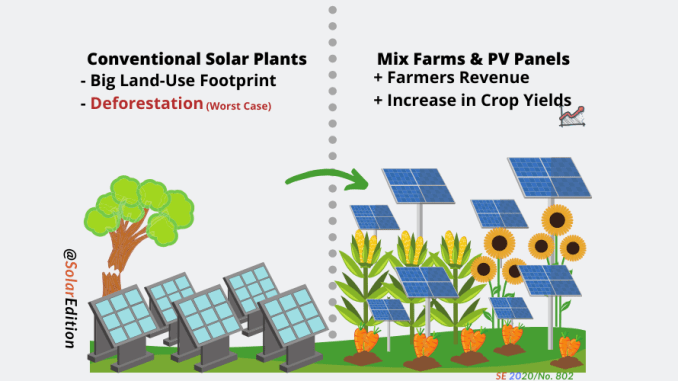
“Agrivoltaics, an approach, a solution …” from solaredition.com and used with no modifications.
Land Use Considerations and Dual-Purpose Installations
Innovative approaches to solar integration have eliminated the traditional either/or proposition between energy production and agricultural land use. Modern installations can complement rather than compete with farming activities, creating multiple revenue streams from the same acreage through thoughtful design and placement. For more insights, explore the top benefits of solar panels for farming.
Agrivoltaics: Growing Crops Under Solar Panels
Agrivoltaics—the practice of co-locating solar panels and crop production—represents one of the most promising developments in agricultural solar. Research from the University of Massachusetts and several European institutions demonstrates that certain crops actually thrive in the partial shade created by elevated panel arrays. Leafy greens, root vegetables, berries, and some herbs show yield increases of 10-30% in these conditions compared to full-sun exposure, particularly in hot, dry climates where solar shading reduces water stress.
The economic case for agrivoltaics becomes compelling when considering the dual revenue streams. Land that might generate $500-$1,200 per acre annually in agricultural revenue alone can potentially produce an additional $15,000-$25,000 in energy value with minimal reduction in crop yield. Some specialized systems feature tracking panels that can be programmed to optimize light exposure during critical growing periods, then maximize energy production during other times.
Roof-Mounted vs. Ground-Mounted Systems
Roof-mounted systems on existing farm buildings often represent the most cost-effective approach, eliminating concerns about agricultural land conversion. Modern barns, equipment sheds, and processing facilities frequently offer ideal south-facing roof exposure and can support substantial arrays without any impact on land availability. These installations typically cost 15-20% less than ground-mounted alternatives while keeping all productive land in service.
Ground-mounted systems offer advantages in orientation flexibility, cooling efficiency, and ease of maintenance, but require careful placement consideration. Many farmers utilize marginal land—areas with poor soil quality, irregular terrain, or prone to flooding—for ground-mounted arrays, effectively monetizing previously underperforming acreage. Elevated mounting systems can allow for grazing beneath panels, particularly with sheep whose height and grazing habits complement solar infrastructure with minimal risk of damage.
Long-Term Farm Financial Benefits Beyond Energy Savings
While immediate energy cost reduction drives most agricultural solar investments, the long-term financial benefits extend far beyond utility bill savings. These secondary advantages compound over time and often prove equally valuable in comprehensive financial analysis, particularly for operations planning for generational transition or long-term sustainability.
Increased Property Value
Research from the Lawrence Berkeley National Laboratory indicates that solar installations typically increase property values by 3-4% for residential properties, with comparable or greater impacts for agricultural properties with significant energy demands. For a $1.5 million farm operation, this can represent $45,000-$60,000 in added value before considering the ongoing income stream the system provides. Unlike many farm improvements that depreciate over time, solar installations often appreciate in effective value as electricity rates rise.
The property value increase becomes particularly significant for farms approaching generational transition or considering eventual sale. Solar installations with 15+ years of remaining warranty life and documented production history represent a tangible asset that can be clearly valued during property appraisal. Many farmers report that solar investments have become key selling points that differentiate their properties in competitive markets.
Marketing Advantage of Sustainable Farming
Consumers increasingly seek agricultural products from environmentally responsible sources, creating premium pricing opportunities for farms that can demonstrate sustainable practices. Solar-powered operations can leverage this consumer preference through direct marketing efforts, potentially commanding 5-15% price premiums in appropriate markets. The “solar-powered” designation proves particularly valuable for direct-to-consumer operations, organic producers, and specialty crop farms where environmental stewardship aligns with customer values.
Energy Independence and Operational Resilience
The value of energy independence becomes most apparent during grid disruptions when solar-equipped farms can maintain critical operations while neighbors face costly shutdowns. Systems incorporating battery storage or specialized inverters can provide emergency power during outages, preventing losses from equipment failure, climate control interruption, or processing delays. This resilience represents a form of operational insurance whose value, while difficult to quantify precisely, becomes immeasurable during crisis periods.
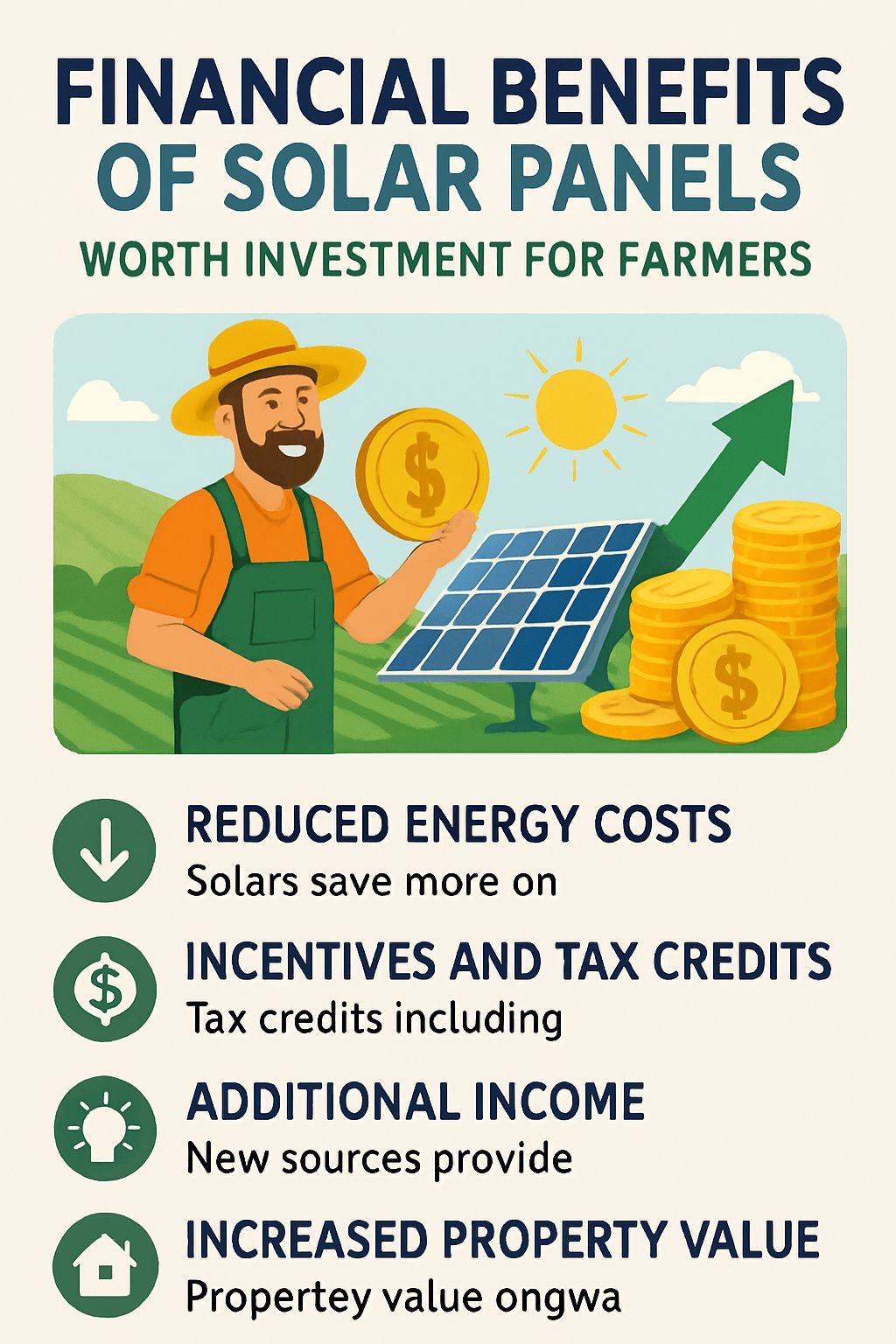
Conclusion: Do the Financial Benefits of Using Solar Panels Make the Investment Worth it for Farmers
The financial case for agricultural solar has never been stronger. With proper system design and incentive utilization, most farms can achieve payback periods under 8 years while securing energy price stability for 25+ years. The combination of immediate tax benefits, ongoing operational savings, and secondary value streams creates a compelling return profile that few other farm investments can match—particularly in the current high input-cost environment.
For farmers concerned about rising operational costs, unpredictable energy prices, and long-term sustainability, solar represents not merely an expense but a strategic investment in future profitability. Paradise Solar Energy specializes in helping agricultural operations navigate this transition with farm-specific system designs that maximize both energy production and financial returns. Our agricultural clients consistently report that solar ranks among their most financially rewarding farm improvements, delivering benefits that extend far beyond the balance sheet to create true operational resilience.
Frequently Asked Questions
Here are answers to the most common questions farmers ask when considering solar investments. These practical considerations address both the financial implications and operational realities of agricultural solar adoption.
How much farmland will I lose to a solar installation?
Ground-mounted systems typically require about 8-10 acres per megawatt of installed capacity. However, most farm operations don’t need to sacrifice productive land at all. Roof-mounted systems on existing structures create no land impact, while ground systems can be placed on marginal land unsuitable for efficient crop production. For reference, a 100kW system—sufficient for many medium-sized operations—requires approximately 1 acre if ground-mounted. Learn more about the benefits of solar panels for farm operations.
Many farmers are now implementing dual-use approaches that maintain agricultural production beneath appropriately designed solar arrays. Research shows certain crops actually benefit from the partial shading these systems provide, particularly in hot climates. Grazing operations find that sheep work exceptionally well with solar installations, effectively maintaining vegetation while utilizing the same land for both energy and livestock production.
Will a solar system work during power outages?
Standard grid-tied solar systems shut down during power outages as a safety measure to protect utility workers. However, systems can be designed with battery backup or specialized inverters that provide emergency power during grid failures. These hybrid systems can power critical farm operations—such as well pumps, refrigeration, or minimal climate control—even during extended outages.
The additional cost for backup capability typically adds 15-30% to system price but provides invaluable operational resilience. Many farmers find this capability particularly worthwhile in regions prone to weather-related outages or with unreliable grid infrastructure. Paradise Solar Energy can design systems with various levels of backup capacity based on your specific operational priorities and budget considerations.
How does weather affect the financial return on solar panels?
Modern system design accounts for regional weather patterns using decades of historical solar radiation data, ensuring production estimates remain reliable across seasons and years. While production varies day-to-day, annual output typically remains within 5-10% of projections. High-quality systems are engineered to withstand extreme weather conditions including heavy snow loads, high winds (100+ mph in hurricane zones), and hail impacts up to 1″ diameter.
Can I still get tax benefits if my farm operates at a loss?
Yes, in most cases. The 30% federal tax credit can be carried forward for up to 20 years until fully utilized. Additionally, recent legislation allows for transferability of credits in certain situations. Accelerated depreciation benefits can offset other income if you meet active participation requirements. Many farmers time their solar investments to coincide with high-income years to maximize immediate tax benefit utilization.
How do I find qualified agricultural solar installers?
Look for companies with specific experience in agricultural installations, as these differ significantly from residential or commercial projects. Qualified installers should understand farm-specific considerations including seasonal load patterns, potential for expansion, dust/debris management, and integration with existing farm electrical systems. They should also demonstrate expertise in agricultural incentive programs like REAP grants and relevant state programs.
Request examples of completed agricultural projects similar to your operation and speak directly with farmer references. Verify they have appropriate licensing, insurance, and North American Board of Certified Energy Practitioners (NABCEP) certification—the industry’s most respected credential. Paradise Solar Energy specializes in agricultural installations and maintains a portfolio of successful farm projects across multiple agricultural sectors.







Leave a Reply