
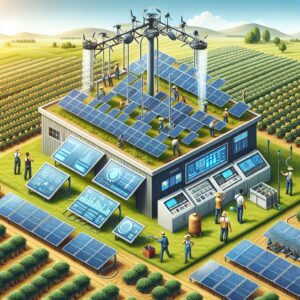
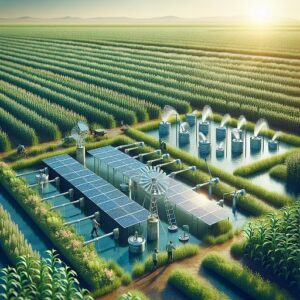
“Solar Panels Power Generation Process …” from growingsolarmist.com and used with no modifications.
Key Takeaways: Solar Investment for Agricultural Operations
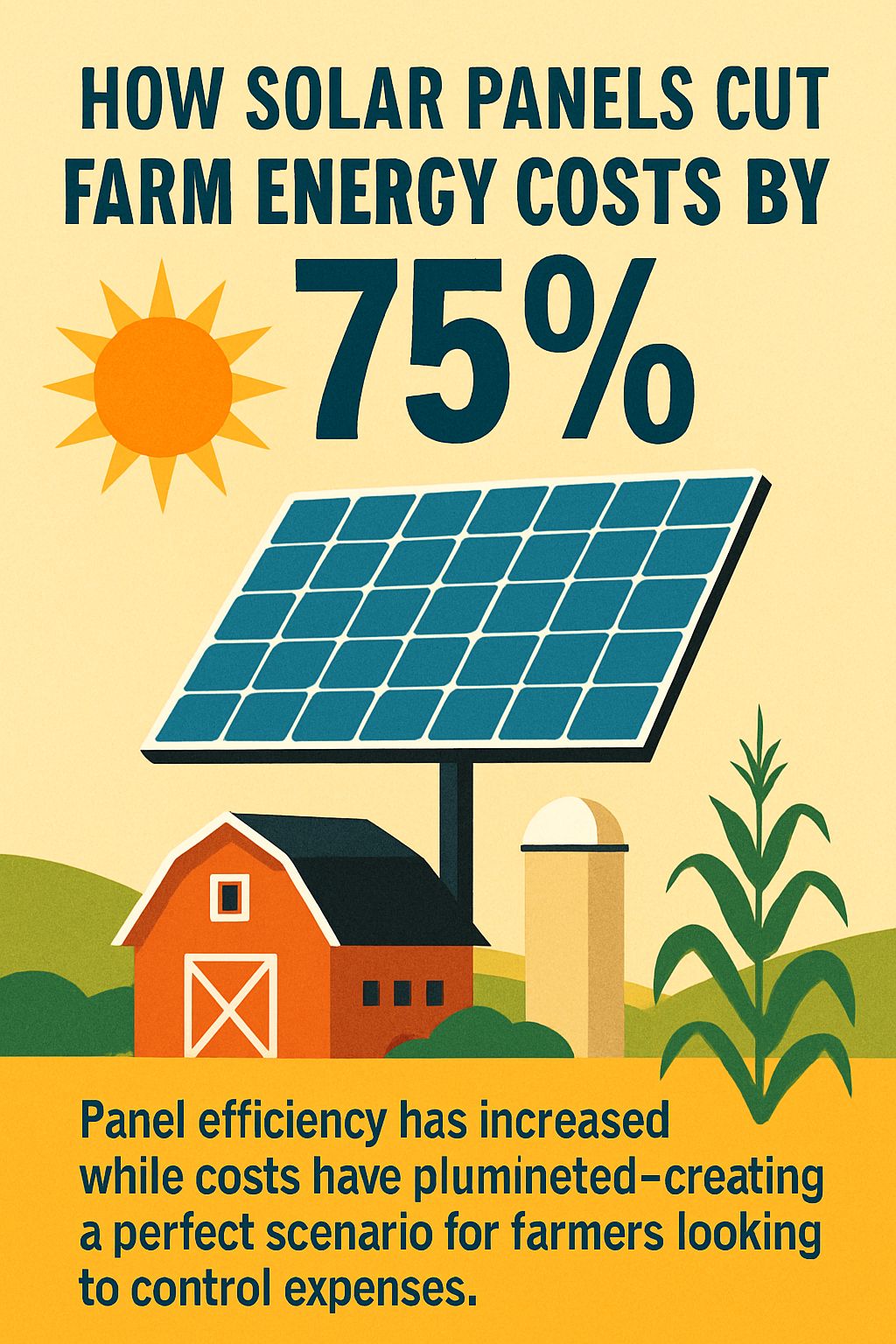
- Solar panels can reduce farm operating costs by up to 75% through immediate energy bill reduction and protection against rising utility rates
- Farmers can access USDA REAP grants covering up to 50% of installation costs alongside federal tax credits
- Agricultural solar installations typically achieve payback within 5-8 years while systems last 25+ years
- Solar energy provides reliable power for remote farm equipment and can create new income through net metering
- Proper assessment of energy usage, structural capabilities, and regional solar potential is crucial before installation
Farmers across America face mounting energy costs that eat into already thin profit margins. With electricity powering everything from irrigation systems to climate-controlled storage facilities, finding ways to reduce these expenses is no longer optional—it’s essential for survival. Solar energy has emerged as a powerful solution for agricultural operations of all sizes, creating both immediate savings and long-term sustainability. AG Solar Solutions helps farmers transition to renewable energy while maintaining their production goals, offering specialized expertise in agricultural solar installations.
The agricultural sector consumes over $10 billion in energy annually, with electricity representing one of the fastest-growing expenses on modern farms. As utility rates continue climbing at 2-3% yearly, many farmers find themselves caught in an unsustainable cycle of rising costs and shrinking profits. Unlike fuel, feed, or fertilizer prices that fluctuate with markets, electricity costs have shown a steady upward trajectory for decades, making them a perfect target for long-term cost reduction strategies.
The Real Cost of Powering Modern Farms
Energy expenses typically represent 5-10% of a farm’s operating budget, but this percentage has been steadily increasing. Dairy operations, which require constant refrigeration, can see energy costs approaching 30% of their variable production expenses. Poultry farms with climate-controlled buildings and irrigated crop operations face similar challenges, with monthly electricity bills often reaching thousands of dollars during peak seasons.
The financial strain is compounded by the seasonal nature of agricultural income, creating cash flow challenges that solar can directly address. By generating electricity on-site, farmers can transform an unpredictable variable expense into a fixed, manageable investment with a clearly defined payback period. This predictability allows for better budgeting and financial planning—a rare luxury in the agricultural sector where weather and market fluctuations create constant uncertainty.
“After installing our 50kW system, our monthly electric bill dropped from $1,200 to just $175. The system will pay for itself in six years, and everything after that is essentially free electricity for the next two decades.” — James Wilson, Dairy Farmer, Wisconsin
How Solar Panels Transform Farm Economics
The economic benefits of solar extend far beyond simple utility bill reduction. Agricultural operations that invest in solar technology gain multiple financial advantages that compound over time, creating both immediate savings and long-term value enhancement. These benefits work together to strengthen the farm’s economic resilience and sustainability.
Immediate Energy Bill Reduction
The most obvious benefit comes from direct electricity generation. A properly sized solar array can reduce a farm’s utility bills by 50-75% immediately upon installation. For operations with high electricity demands like dairy, poultry, or greenhouse production, this represents thousands of dollars in monthly savings. The electricity generated offsets purchases from the utility company on a one-to-one basis, creating substantial reductions from day one.
Solar production typically aligns well with agricultural energy usage patterns, especially for irrigation, which sees highest demand during sunny summer months when solar panels are most productive. This natural alignment maximizes the value of every kilowatt generated, ensuring optimal financial returns on the investment. Even in partial cloudy conditions, modern solar technology continues producing significant power output.
Protection Against Rising Utility Rates
Perhaps the most valuable aspect of farm solar installations is the hedge they provide against future electricity cost increases. While conventional energy costs rise 2-3% annually on average, solar locks in electricity rates for 25+ years at the initial investment price. This rate stability represents enormous savings over the system’s lifetime.
Consider a farm currently spending $24,000 annually on electricity. With a 3% annual increase, that same electricity will cost over $43,000 annually in just 20 years. A solar system eliminating 75% of that bill protects the farm from over $270,000 in cumulative electricity cost increases over those two decades. This financial projection doesn’t even account for periods of energy price volatility or inflation spikes that could make the savings even more dramatic.
Remote Power Access for Field Equipment
For farms with operations in remote locations where grid connections are expensive or unavailable, solar provides a revolutionary solution. Solar-powered pumping stations, electric fencing, monitoring equipment, and field lighting can operate independently from the grid, eliminating the need for costly utility extensions or unreliable generator systems.
Creating New Income Through Net Metering
Beyond cost savings, solar installations can generate actual revenue for farms through net metering programs. When your system produces more electricity than your operation consumes—common during midday hours or low-usage periods—this excess energy flows back into the grid. Your utility company credits your account for this contribution, essentially running your meter backward.
These credits offset nighttime usage or higher consumption periods, but in many cases, farms can generate more credits than they use. Depending on state regulations, these excess credits may result in actual payments from the utility company. Some agricultural operations report earning $5,000-10,000 annually from excess generation, creating a new income stream that requires zero additional labor or land management. For those interested in further enhancing their solar setup, considering on-grid solar panels can be a beneficial option.
Increased Property Value for Agricultural Land
Solar installations significantly enhance farm property values, with studies showing increases of $3-4 for every $1 of annual electricity savings. For a system saving $15,000 annually, this translates to a $45,000-60,000 property value increase. Unlike many farm improvements that depreciate over time, solar systems maintain this value enhancement throughout their operational lifespan.
The increased valuation brings additional benefits beyond potential resale value. It can strengthen your position for financing other farm improvements, potentially leading to better loan terms and expanded borrowing capacity. This enhanced asset base creates greater financial flexibility and resilience for the entire operation.
Federal and State Incentives That Make Solar Affordable
The economics of agricultural solar have been transformed by substantial government incentives designed specifically to help farmers transition to renewable energy. These programs can reduce the effective cost of installation by 50-75%, dramatically improving return on investment and shortening payback periods.
USDA REAP Grants: Up to 50% of Installation Costs
The Rural Energy for America Program (REAP) offers grants specifically designed for agricultural producers and rural small businesses. These grants can cover up to 50% of eligible project costs, with a maximum of $500,000 for renewable energy systems. The program also offers loan guarantees that can cover up to 75% of project costs, with a maximum guarantee of $25 million.
REAP grants are competitive but accessible to farms of all sizes. The application process requires energy audits and project planning documents, but the financial benefit justifies the effort. Many solar installers specializing in agricultural applications offer assistance with the REAP application process, significantly improving approval chances.
Federal Investment Tax Credit (ITC) Benefits
The federal solar investment tax credit currently allows farm businesses to deduct 30% of the total system cost directly from their tax liability. This is a dollar-for-dollar reduction in the taxes owed, not merely a deduction from taxable income. For a $100,000 solar installation, this represents a $30,000 direct reduction in federal taxes owed. To learn more about solar energy benefits, consider exploring solar energy options for your farm.
Even operations with insufficient tax liability can benefit by carrying these credits forward for up to 20 years. Additionally, farm businesses can now receive direct payment for the credit even without tax liability through the Inflation Reduction Act’s direct pay provisions—essentially converting the tax credit into a grant for qualified agricultural producers.
Accelerated Depreciation for Farm Business Assets
Beyond grants and tax credits, farm operations can utilize accelerated depreciation schedules for solar equipment. The Modified Accelerated Cost Recovery System (MACRS) allows businesses to depreciate 85% of the system value (after accounting for the 30% ITC) over just five years instead of the system’s 25+ year actual lifespan.
This accelerated schedule creates substantial tax benefits in the early years after installation, further improving cash flow and effective return on investment. When combined with Section 179 deductions and bonus depreciation provisions, these tax benefits can significantly enhance the financial performance of agricultural solar investments.
State-Level Agricultural Solar Programs
Beyond federal incentives, many states offer additional programs specifically targeting agricultural renewable energy adoption. These range from property tax exemptions for solar equipment to production-based incentives that pay farmers for each kilowatt-hour generated. Some states even offer specialized grant programs for agricultural solar applications, complementing the federal REAP program with additional funding opportunities.
“Solar ROI essentials: 7 factors that …” from www.anernstore.com and used with no modifications.
Breaking Down the Investment Timeline
Understanding the financial timeline of a solar investment helps farmers make informed decisions about system sizing, financing options, and long-term planning. While specific numbers vary based on location, system size, and energy usage patterns, the general investment trajectory follows a predictable pattern that delivers increasing returns over time.
Initial Installation Costs and Financing Options
Agricultural solar installations typically cost between $1.50 and $2.50 per watt before incentives, depending on system size, mounting requirements, and grid connection complexity. For a 100 kilowatt system—appropriate for medium-sized operations—this represents a pre-incentive investment of $150,000-250,000. For more information on powering farm operations, you can explore on-grid solar panels.
After applying the 30% federal tax credit and potential REAP grants, the effective cost frequently drops below $1 per watt—often reducing the actual out-of-pocket expense to $75,000-125,000 for that same 100kW system. Various financing options make this remaining investment accessible without major capital outlays, including equipment leases, agricultural-specific solar loans, and power purchase agreements that require zero upfront investment.
Typical Payback Period for Agricultural Operations
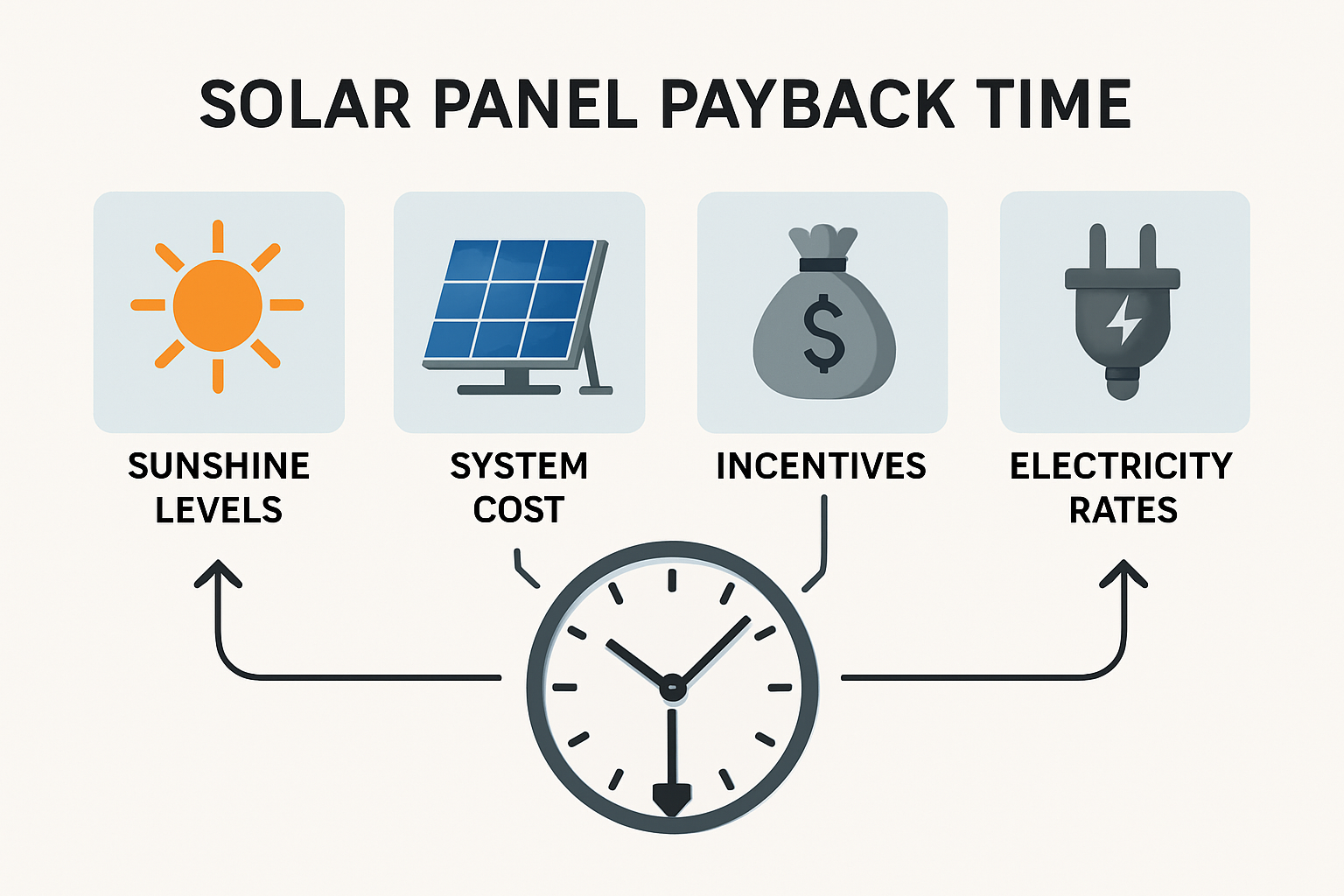
Most farm solar installations achieve complete payback within 5-8 years, depending on local electricity costs and available incentives. In states with high electricity rates like California or Massachusetts, payback periods frequently drop to 4-5 years or even less when combining all available incentives.
This payback calculation becomes even more favorable when considering the time value of the REAP grant and tax incentives, which are realized in the first year of operation. When these immediate benefits are factored in, many farmers see positive cash flow from their solar investment within the first year—long before the system reaches full payback.
The real financial advantage becomes apparent after payback, when the system continues producing essentially free electricity for 20+ additional years. A system that costs $100,000 after incentives and produces $18,000 in annual electricity savings will generate over $350,000 in cumulative benefits after reaching its payback point—a 350% return on the initial investment. For those considering off-grid solar panels, understanding the long-term financial benefits is crucial.
25+ Year System Lifespan and Warranty Considerations
Solar panel systems typically last 25-30 years with minimal degradation in performance, making them one of the most durable farm investments available. Modern panels maintain approximately 80-85% of their original production capacity even after 25 years of continuous operation. This exceptional longevity means that solar systems continue generating significant value long after achieving full financial payback.
Most agricultural solar installations include comprehensive warranty packages that protect your investment. Manufacturer warranties typically cover panels for 25 years, inverters for 10-15 years, and racking systems for 20+ years. Many specialized agricultural installers offer additional workmanship guarantees and production guarantees that ensure your system meets predicted generation targets. When evaluating proposals, prioritize warranty coverage and production guarantees that align with your long-term operational planning.
Real Concerns Farmers Should Consider
While solar presents tremendous benefits, responsible decision-making requires understanding potential challenges. Several legitimate concerns deserve careful consideration before proceeding with an agricultural solar installation. Addressing these factors proactively ensures your system meets expectations and delivers optimal value for your specific operation.
Land Use Tradeoffs for Ground-Mounted Systems
Ground-mounted solar arrays require approximately 6-8 acres per megawatt of capacity, potentially removing productive land from cultivation. However, innovative approaches like agrivoltaics (combining solar with compatible crops) can mitigate this concern by allowing dual use of the same land. Shade-tolerant crops, grazing livestock, or pollinator habitats beneath panels can maintain productive use while generating electricity above.
For operations with limited suitable land, roof-mounted systems offer an alternative that requires zero additional land use. Many agricultural buildings provide excellent solar potential with their large, unobstructed roof areas. Barn roofs, equipment storage buildings, and processing facilities often offer ideal mounting surfaces without affecting cropland availability. Some farmers even incorporate solar into new construction plans, designing buildings specifically to optimize solar production.
Seasonal Production Variations
Solar energy production fluctuates seasonally, with highest generation during summer months and reduced output during winter. This variability can create challenges for operations with consistent year-round electricity demands. Net metering programs help address this issue by allowing excess summer production to offset winter consumption, effectively using the grid as a giant battery.
For operations with seasonal energy demands that align with solar production cycles—like irrigation systems or cooling needs—this variability becomes an advantage rather than a limitation. Careful system sizing that accounts for your specific usage patterns ensures optimal economic performance throughout the year. Many agricultural solar specialists now offer detailed production forecasting that maps expected generation against your historical usage patterns by month.
Maintenance Requirements and Costs
While solar systems have no moving parts and require minimal maintenance, they aren’t completely maintenance-free. Regular inspection, occasional cleaning, vegetation management around ground-mounted arrays, and potential inverter replacement after 10-15 years represent ongoing responsibilities and costs. These maintenance requirements, though minimal compared to other farm equipment, should be factored into long-term financial projections.
Annual maintenance costs typically range from $300-500 for small systems to $1,000-2,000 for larger installations. This represents approximately 0.5% of the initial system cost annually—far less than maintenance for tractors, irrigation equipment, or other farm machinery. Many installation companies offer maintenance contracts that include regular inspections, cleaning, and monitoring services for a fixed annual fee, simplifying budget planning and ensuring optimal system performance. For more insights on solar energy benefits, consider reading about solar panels for farms.
Insurance and System Protection
Most farm insurance policies can be extended to cover solar installations, but this coverage requires explicit addition to your policy. Potential damage from severe weather, lightning strikes, or equipment failure should be addressed through appropriate insurance coverage. The incremental cost is typically modest—usually increasing premiums by 1-2% of the system value annually—but provides essential protection for your investment.
Beyond insurance, physical security considerations may include fencing for ground-mounted systems, lightning protection equipment, and monitoring systems that alert you to performance issues. These protective measures add marginally to project costs but significantly reduce long-term risk exposure. Modern monitoring platforms allow remote system performance tracking through smartphone apps, providing instant alerts if production drops unexpectedly.
Is Your Farm a Good Candidate for Solar Power?
Energy Usage Assessment: Finding Your Baseline
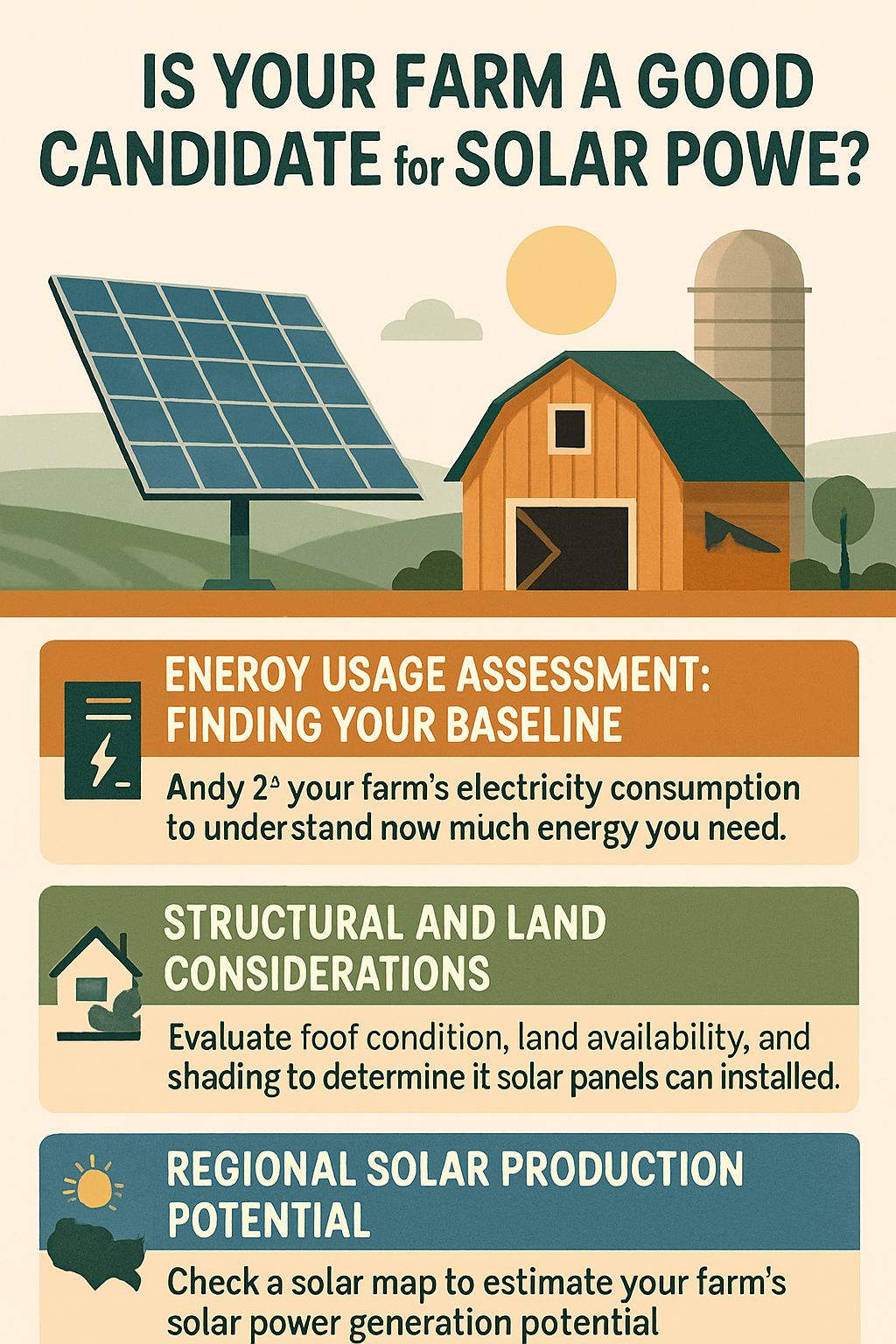
The foundation of any successful agricultural solar project begins with a comprehensive energy usage assessment. Collect at least 12 months of utility bills to establish your baseline electricity consumption and spending patterns. Pay particular attention to seasonal variations that might affect system sizing decisions. Operations with consistent year-round usage often benefit from systems sized to offset 70-80% of annual consumption, while those with highly seasonal patterns might optimize differently. For more insights on optimizing solar power for farms, explore on-grid solar panels powering farm operations.
Beyond current usage, consider future expansion plans or electrification of processes currently powered by fossil fuels. Many farms are transitioning diesel irrigation pumps, tractors, and other equipment to electric alternatives, potentially increasing electricity demand. Designing solar capacity with these future needs in mind prevents undersizing that would require costly system expansions later. Most agricultural solar specialists offer free energy assessments that analyze your specific usage patterns and recommend optimal system configurations.
Structural and Land Considerations
For roof-mounted systems, structural engineering analysis ensures your existing buildings can support the additional weight of solar panels and racking (typically 3-5 pounds per square foot). Many modern agricultural buildings easily accommodate this load, but older structures may require reinforcement. This evaluation should occur early in the planning process to identify any necessary structural upgrades. To explore more about solar energy solutions for agriculture, you can visit Ag Solar Solutions.
For ground-mounted installations, soil type, drainage patterns, and potential shading from buildings or trees require careful assessment. Ideal locations receive full sun exposure from 9am to 3pm daily and avoid prime cropland. South-facing slopes with 5-15 degree inclines often provide optimal production efficiency while utilizing land less suitable for cultivation. Some farmers strategically place ground-mounted systems along property boundaries or in irregular field corners that are challenging to cultivate with modern equipment. To ensure these systems remain efficient, farmers can explore using drones for monitoring and maintenance.
Regional Solar Production Potential
Solar production varies significantly by geographic region, with southwestern states receiving up to 30% more sunlight than northeastern regions. However, even farms in less sunny locations typically achieve excellent financial returns due to higher electricity rates in those regions. Modern system design software provides location-specific production forecasts based on decades of weather data, allowing precise financial projections tailored to your exact coordinates.
Your Solar-Powered Farm: Next Steps for Implementation
The journey toward solar adoption begins with gathering multiple proposals from qualified agricultural solar specialists. Look for companies with specific experience in farm installations and familiarity with agricultural grant programs like REAP. Request detailed production forecasts, financial analyses, and reference contacts from other agricultural clients. Comparing at least three proposals ensures competitive pricing and helps identify the most appropriate system design for your specific needs.
After selecting an installation partner, the permitting and interconnection process typically takes 2-3 months, followed by 1-3 weeks for physical installation. This timeline allows most farms to plan installations during off-peak operational periods. Your selected installer should manage utility interconnection applications, building permits, and incentive paperwork, providing a turnkey experience that minimizes disruption to your agricultural operations.
Financing represents another critical implementation step. Agricultural-specific solar loans, equipment leasing programs, and power purchase agreements offer pathways that require minimal upfront capital. Many farmers combine REAP grants with traditional farm credit financing to optimize cash flow. Your installation partner should provide detailed cash flow analysis for various financing scenarios, helping you select the option that best aligns with your farm’s financial situation.
“The installation process was remarkably smooth—completed in just eight days between harvests. The system has performed exactly as projected for three straight years, and the monitoring app lets me track production from anywhere. It’s the most predictable and trouble-free investment we’ve made in decades of farming.” — Maria Gonzalez, Organic Vegetable Producer, California

Bottom Line: Is Solar Panels Worth the Farmers Investment
For the vast majority of agricultural operations, solar power represents one of the most financially sound and environmentally beneficial investments available. With payback periods typically ranging from 5-8 years, 25+ year system lifespans, and protection against rising energy costs, the economic case is compelling. When combined with substantial tax benefits, grant opportunities, and potential revenue from net metering, solar installations deliver returns that few other farm improvements can match. AG Solar Solutions continues helping farmers nationwide transition to renewable energy while maintaining their production goals, providing the agricultural sector with sustainable power solutions for generations to come. For those considering off-grid solar panels, understanding the need for batteries in farm operations can enhance the overall efficiency of the system.
Frequently Asked Questions
- What size solar system do I need for a typical dairy operation?
- How do REAP grants work for small family farms?
- Can I install solar panels on barn roofs?
- What maintenance is required for agricultural solar systems?
- How do I know if my farm qualifies for solar incentives?
How long does a solar panel system typically last on a farm?
Modern agricultural solar installations reliably operate for 25-30 years with minimal degradation in performance. Most premium panels maintain at least 80% of their original production capacity even after 25 years of continuous operation in harsh farm environments. This exceptional longevity means your system will continue generating significant value decades after achieving financial payback.
Component lifespans vary slightly, with inverters typically requiring replacement after 12-15 years (a cost that should be factored into long-term financial projections). Mounting hardware, wiring, and structural components often last 30+ years with proper initial installation. Many farms operating systems installed in the early 2000s report minimal issues and consistent production even after two decades of continuous operation.
Can I power my entire farm operation with solar panels?
Many farms achieve 100% offset of their electricity consumption through solar, particularly when net metering programs allow excess summer production to offset winter usage. The feasibility depends primarily on available installation space and your energy consumption patterns. Operations with substantial electricity demands like dairy processing, cold storage, or greenhouse climate control may require larger arrays that combine rooftop and ground-mounted installations to achieve complete offset. For efficient solar power backup, consider exploring lithium-ion batteries as a solution.
For farms seeking complete energy independence including off-grid capability, battery storage systems can be integrated with solar installations. While adding batteries increases system costs significantly, it provides resilience against utility outages and enables operations in remote locations without reliable grid access. Agricultural battery storage has become increasingly affordable, with some specialized grant programs now supporting these resilience-focused installations.
What happens to my solar system during extreme weather events?
Modern agricultural solar installations are engineered to withstand extreme weather conditions common to farming regions. Quality systems can survive wind speeds of 140+ mph when properly installed, exceeding most regional building code requirements. Hail resistance is also substantial, with premium panels certified to withstand 1-inch hailstones at terminal velocity without damage. For farmers considering solar power, understanding the necessity of battery use in farm operations can be crucial.
|
Weather Condition |
System Design Feature |
Typical Certification Standard |
|---|---|---|
|
High Winds |
Reinforced mounting hardware and wind tunnel tested designs |
140-180 mph wind rating |
|
Hailstorms |
Tempered glass fronting and flexible mounting systems |
1″ hail at 50+ mph impact resistance |
|
Heavy Snow |
Steep mounting angles and reinforced frames |
50-75 lbs/sq ft snow load capacity |
|
Lightning |
Complete grounding systems and surge protection |
UL 1703 certification |
Snow accumulation temporarily reduces production but rarely causes physical damage. Most systems are designed with sufficient tilt to shed snow naturally, typically resuming production within days after heavy snowfall events. Some farmers report that the dark panels absorb solar radiation even through thin snow layers, accelerating melting compared to surrounding surfaces.
Lightning protection is a critical design element for agricultural installations, with proper grounding and surge protection systems preventing damage during electrical storms. These protective measures add marginally to installation costs but significantly reduce risk in storm-prone regions. Insurance policies specifically covering weather damage provide additional protection, offering replacement cost coverage for severe damage scenarios. For those interested in off-grid solutions, off-grid solar panels can be a viable option for powering a farm’s operations.
How do solar panels affect crop production if installed over fields?
The emerging field of agrivoltaics—intentionally combining solar energy production with crop cultivation beneath panels—shows promising results for certain crop types. Research demonstrates that shade-tolerant crops like leafy greens, herbs, berries, and some root vegetables often perform well or even better under the partial shade of solar panels. The panels create microclimate benefits including reduced evaporation, moderated temperature extremes, and protection from excessive sun exposure during peak summer conditions.
Several universities and the USDA are conducting extensive research on optimal panel spacing, height, and orientation to maximize dual production benefits. Preliminary findings suggest that strategic panel placement allowing 30-70% of sunlight to reach plants can maintain or even increase yields for appropriate crops while simultaneously generating electricity. This approach maximizes land use efficiency and creates two revenue streams from the same acreage—a significant advantage for farms with limited land resources. For farms interested in enhancing solar panel efficiency, the use of drones for monitoring is becoming increasingly popular.
Do I need to clean my farm solar panels regularly?
Agricultural environments create unique maintenance considerations for solar installations. While natural rainfall provides adequate cleaning in many regions, farms with significant dust from field operations, pollen during flowering seasons, or bird droppings may benefit from occasional cleaning. Studies show that dust and debris accumulation typically reduces production by just 2-5% annually in most agricultural settings, with rainfall removing much of this buildup naturally.
For installations in particularly dusty regions or near operations generating substantial airborne particles, quarterly cleaning may improve performance enough to justify the effort. Many farmers incorporate panel cleaning into existing seasonal maintenance routines, using extension poles with soft brushes and water. Professional cleaning services typically charge $150-300 per cleaning for average farm installations, but this cost is easily justified if it restores even 3-5% of system production. To ensure the longevity and efficiency of solar panels, it’s also crucial to protect them from animals and critters.
Snow removal is generally unnecessary and potentially damaging to panels. Most systems are designed with sufficient tilt to shed snow naturally, and attempting manual removal risks scratching panel surfaces. The production loss during snow cover is typically minor in the context of annual generation, particularly since these periods usually coincide with winter months when solar production is already at its seasonal minimum.

Leave a Reply