

Article-at-a-Glance
- Off-grid solar systems for farms require battery storage to maintain operations during nighttime and low sunlight periods, making batteries essential rather than optional.
- Farm solar systems differ significantly from residential setups, demanding larger capacity and more robust components to power agricultural equipment.
- Various battery technologies offer different advantages for farm applications, with lithium-ion providing longer lifespan and better performance despite higher upfront costs.
- Proper battery bank sizing is critical to ensure sufficient energy autonomy based on your farm’s specific operational needs and local weather patterns.
Transitioning to solar power can transform your farm’s energy independence, but there’s often confusion about whether batteries are truly necessary for off-grid systems. The short answer is yes—batteries aren’t just recommended but essential for any genuine off-grid farm operation.
Solar panels alone can only generate electricity when the sun shines, but farming operations don’t stop when darkness falls. From irrigation systems and livestock monitoring to refrigeration and security lighting, farms require consistent power around the clock.
What is an Off-Grid Farm Solar System?
An off-grid farm solar system is a complete energy solution that enables agricultural operations to function entirely independent of utility power. Unlike grid-tied systems that merely supplement conventional electricity, true off-grid systems generate, store, and manage 100% of a farm’s energy needs without any connection to external power infrastructure.
These systems typically consist of solar panels for energy generation, battery banks for storage, charge controllers to regulate power flow, and inverters to convert DC electricity to AC for standard equipment use. Additional components may include mounting hardware, monitoring systems, and sometimes backup generators for emergency situations during extended periods of insufficient sunlight.
Off-grid systems represent more than just energy independence—they’re complete power management ecosystems designed to maintain continuous operation regardless of external circumstances.
- Complete energy independence from utility companies
- Elimination of monthly electricity bills
- Immunity from grid outages and service disruptions
- Ability to operate in remote locations without power infrastructure
- Sustainable energy production with minimal environmental impact
The True Meaning of “Off-Grid” for Agricultural Operations
The term “off-grid” is often misused or misunderstood in agricultural contexts. True off-grid farming means complete disconnection from utility power infrastructure, with all electrical needs met through self-generated energy. This represents a fundamental shift from merely supplementing grid power to achieving total energy autonomy.
“Going off-grid isn’t simply about installing solar panels—it’s about creating a self-sufficient energy ecosystem that functions reliably in all conditions. For farms, this means carefully engineered systems that account for seasonal variations, weather patterns, and critical operational requirements.” — Agricultural Energy Specialist
For agricultural operations, going off-grid requires more extensive planning than residential applications. Farm systems must accommodate seasonal variations in both energy production and consumption patterns. Winter months typically offer fewer daylight hours precisely when heating requirements may increase for livestock operations, while summer might bring higher irrigation demands alongside peak solar production.
How Farm Solar Differs from Residential Systems
Farm solar systems operate on an entirely different scale than residential installations. Agricultural operations typically require significantly higher energy capacity to power equipment like irrigation pumps, refrigeration units, ventilation systems, and processing machinery. While a typical home might need a 5-10kW system, farms often require systems in the 25-100kW range or larger.
The daily energy consumption pattern also differs dramatically on farms. Residential energy use typically peaks in mornings and evenings when families are home, but agricultural operations often need consistent power throughout the day and night. Livestock monitoring systems, climate controls, security lighting, and refrigeration must function continuously regardless of solar production cycles.
Additionally, farm installations must withstand more challenging environmental conditions. Equipment is frequently exposed to dust, moisture, temperature extremes, and sometimes corrosive environments from livestock operations. This necessitates more robust components, specialized enclosures, and comprehensive maintenance protocols that aren’t typically required for residential systems.

Why Batteries are Non-Negotiable for Off-Grid Farm Solar
For farm operations, batteries aren’t just an add-on component to solar systems—they’re the foundation of reliable power delivery. Without battery storage, solar panels can only provide power during daylight hours with sufficient sunshine, creating an impractical situation for agricultural operations that require 24/7 electricity.
The inability to store excess energy means that all power generated during peak sunshine hours would be wasted rather than saved for later use. On a farm, this limitation would render a solar-only system practically useless for most critical applications, from refrigeration to livestock monitoring systems that require constant power regardless of weather or time of day.
The Day-Night Energy Challenge for Farming Operations
Farms face a fundamental mismatch between when solar energy is generated and when much of it is needed. While solar panels produce most power during midday sun, many agricultural operations require significant energy during early mornings, evenings, and overnight periods. Dairy farms, for example, typically require substantial power for milking operations twice daily, often before sunrise and after sunset.
Irrigation systems often run during early morning or evening hours to minimize water evaporation, precisely when solar production is minimal or nonexistent. Without batteries to store daytime energy for overnight use, farms would be forced to severely restrict operations to daylight hours only—an impractical approach for modern agriculture. Learn more about off-grid solar power systems for farms and how they can improve efficiency.
Even during daylight, passing clouds can cause significant fluctuations in solar power output. Battery storage smooths these variations, delivering consistent power regardless of momentary changes in solar conditions. This stability is crucial for sensitive equipment that requires uninterrupted electricity.
Critical Farm Systems That Need 24/7 Power
Modern farms rely on numerous systems that require continuous power regardless of sunlight availability. Climate control systems for livestock buildings, including ventilation, heating, and cooling, cannot experience downtime without risking animal health and welfare. Automated feeding systems, crucial for larger operations, need reliable electricity to maintain feeding schedules.
Refrigeration for dairy products, harvested produce, and medications represents another critical 24/7 power need. A power interruption of even a few hours can result in spoilage and significant financial losses. Security systems, including cameras and perimeter lighting, also require continuous operation to protect valuable livestock, equipment, and structures. For more on maintaining off-grid solar power systems for farms, read this article.
- Ventilation and climate control for livestock buildings
- Refrigeration for produce, dairy, and medications
- Water pumping systems for livestock and irrigation
- Security lighting and monitoring systems
- Automated feeding equipment
- Critical data collection and monitoring systems
Weather Reliability and Seasonal Production Gaps
Agricultural regions often experience extended periods of reduced sunlight due to seasonal weather patterns. Winter months bring shorter days and frequently overcast conditions that significantly reduce solar production precisely when heating requirements for livestock buildings may increase. Without substantial battery capacity, farms would face critical energy shortfalls during these challenging periods.
Even in ideal solar regions, consecutive days of cloudy or stormy weather can occur at any time of year. A properly designed battery bank provides the necessary energy buffer to maintain operations during these weather-related production gaps. The alternative—running a generator continuously during low-solar periods—creates substantial fuel costs and maintenance issues while negating many of the environmental benefits of solar power.
Battery Types for Farm Solar Systems
Selecting the right battery technology is a critical decision that directly impacts system performance, maintenance requirements, and long-term economics. Farm environments present unique challenges, including temperature variations, dust, and sometimes corrosive conditions that can affect battery performance and longevity.
Each battery technology offers distinct advantages and limitations that must be evaluated against specific farm requirements. The optimal choice depends on numerous factors including budget constraints, performance needs, physical space limitations, maintenance capabilities, and expected system lifetime. To better understand how solar power can enhance farm operations, consider exploring the solar power benefits for farmers.
|
Battery Type |
Typical Lifespan |
Depth of Discharge |
Maintenance |
Best For |
|---|---|---|---|---|
|
Flooded Lead-Acid |
5-7 years |
50% |
High |
Budget-conscious farms with maintenance capacity |
|
Sealed Lead-Acid (AGM) |
7-10 years |
50% |
Low |
Farms needing reduced maintenance |
|
Lithium Iron Phosphate |
10-15+ years |
80-100% |
Minimal |
Long-term investment for critical farm systems |
|
Flow Batteries |
20+ years |
100% |
Moderate |
Large operations requiring massive storage capacity |
Lead-Acid Batteries: Affordable but Maintenance-Heavy
Traditional flooded lead-acid batteries represent the most economical entry point for farm energy storage. Their lower upfront cost makes them attractive for budget-conscious operations, particularly when initial system cost is a primary concern. These batteries have decades of proven reliability in off-grid applications when properly maintained.
However, lead-acid technology comes with significant limitations. These batteries typically allow only 50% depth of discharge, effectively doubling the actual capacity needed compared to more advanced technologies. They require regular maintenance, including watering, equalization charges, and terminal cleaning. In farm environments, finding time for this maintenance can be challenging during busy seasons. For those looking to improve overall farm efficiency, exploring solar power solutions can be beneficial.
Physical space requirements also pose challenges, as lead-acid batteries are bulky and heavy compared to newer technologies. Their shorter lifespan—typically 5-7 years with optimal care—means replacement costs must be factored into long-term planning. For many farms, the total cost of ownership over 10-15 years may actually exceed more expensive but longer-lasting alternatives.
Lithium-Ion Options: Higher Cost with Superior Performance
Lithium iron phosphate (LiFePO4) batteries represent the premier choice for farm solar systems where performance and longevity are prioritized over initial cost. These batteries offer dramatically improved specifications compared to lead-acid, including 80-100% usable capacity, minimal voltage sag under heavy loads, and lifespans often exceeding 10-15 years. For high-demand agricultural operations, this performance advantage can be critical. Learn more about how solar power can enhance farm energy independence.
The maintenance-free operation of lithium batteries provides significant practical advantages in farm settings where labor is already stretched thin. Unlike lead-acid batteries, lithium systems don’t require regular watering, equalization charges, or specific ventilation requirements. They also perform better in partially charged states, eliminating the need for full recharge cycles that can disrupt farm operations.
While the upfront cost of lithium batteries typically runs 2-3 times higher than lead-acid equivalents, their total cost of ownership often proves lower over the system’s lifetime when accounting for replacement cycles, increased usable capacity, and reduced maintenance expenses. For farms planning long-term operations, lithium represents the most cost-effective solution despite the higher initial investment. For more insights on energy solutions for farms, explore farm energy independence with solar power.
Flow Batteries for Large Agricultural Operations
For extensive agricultural operations with massive energy storage requirements, flow batteries offer unique advantages worth considering. These systems store energy in liquid electrolyte solutions contained in separate tanks, allowing for independent scaling of power output and energy storage capacity. This flexibility makes them particularly suitable for large-scale farming operations with varying power profiles.
Flow batteries excel in applications requiring extended discharge duration—often capable of providing full-rated power for 6-12 hours or more. This extended runtime proves valuable for farms needing to power substantial equipment through overnight periods or during extended cloudy weather. Their remarkable cycle life, often exceeding 20+ years with minimal degradation, provides exceptional longevity for permanent agricultural installations.
Emerging Technologies Worth Watching
Several promising battery technologies are approaching commercial viability that could further transform farm energy storage options. Sodium-ion batteries offer potentially lower costs than lithium with comparable performance, while avoiding the use of rare earth materials. Solid-state batteries promise improved safety profiles and energy density once manufacturing scales up sufficiently to make them cost-competitive. These advancements in battery technology could significantly enhance off-grid solar power systems for farms, providing more efficient energy storage solutions.
For farms planning major solar installations in the coming years, these emerging options warrant monitoring as they move from research to commercial availability. However, existing lithium technologies already provide excellent performance for current agricultural implementations, making them the practical choice for installations planned in the near term.
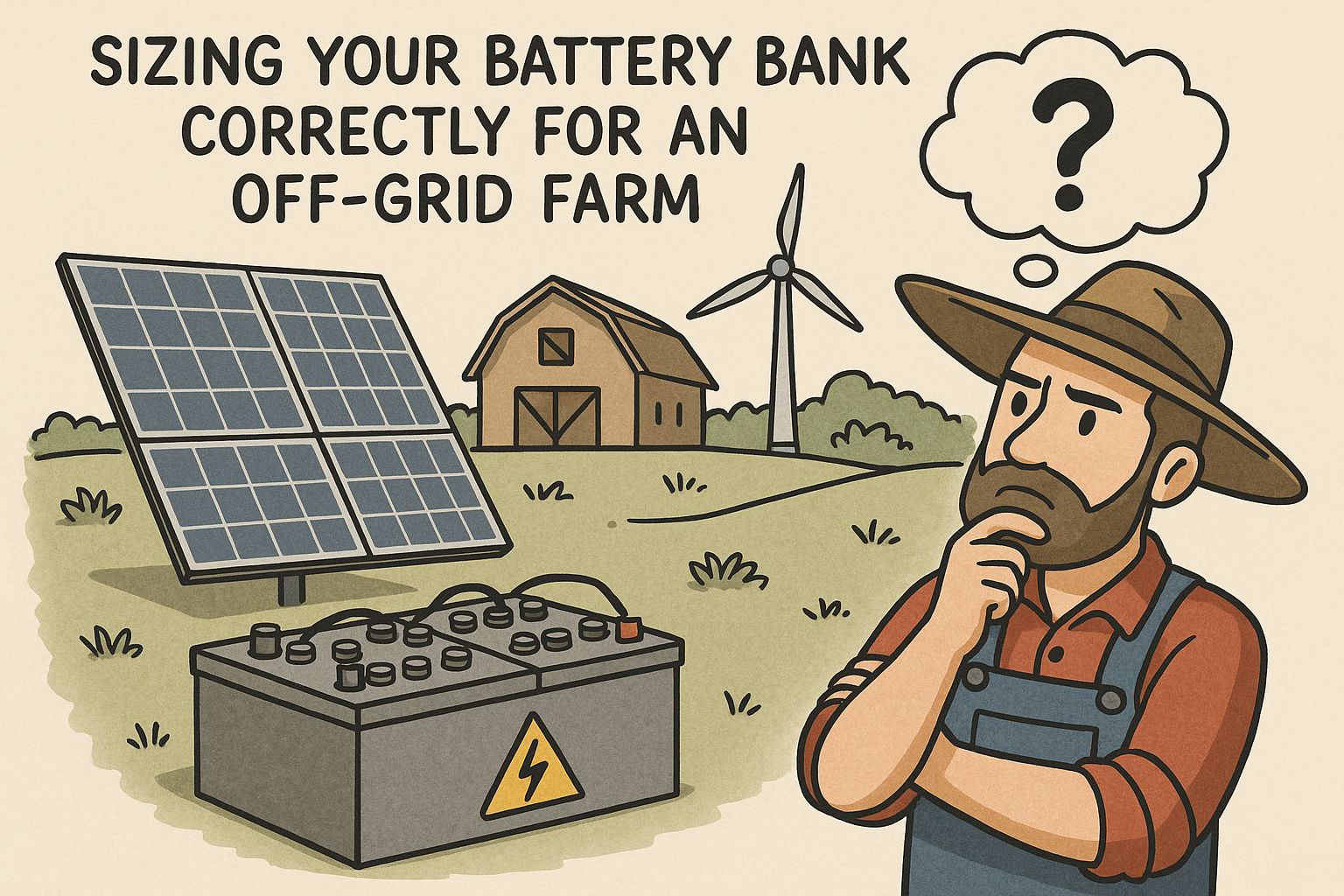
Sizing Your Battery Bank Correctly
Properly sizing a battery bank for farm operations requires balancing energy needs, system costs, and reliability requirements. Undersized systems leave operations vulnerable to power shortfalls during critical periods, while oversized systems inflate costs unnecessarily. The sizing process must account for both typical daily energy requirements and seasonal variations specific to your agricultural activities.
Most farms benefit from batteries sized to provide 2-5 days of autonomy—the period they can power essential systems without additional solar input. The appropriate autonomy period depends on local weather patterns, seasonal sun availability, and the criticality of uninterrupted power for specific farm operations.
Calculate Your Farm’s Daily Energy Requirements
Accurate energy consumption data forms the foundation of proper battery sizing. Begin by cataloging all electrical equipment used in farm operations, noting both their power rating (watts) and estimated daily runtime hours. Special attention should be paid to high-consumption equipment like water pumps, climate control systems, and refrigeration units that represent major energy demands.
For existing operations, reviewing historical utility bills provides valuable consumption patterns, though additional capacity should be allocated for future growth. Equipment-specific energy monitors can help identify consumption patterns for critical systems, revealing opportunities for efficiency improvements that might reduce required battery capacity.
Remember that energy needs often vary seasonally on farms. Winter months may require additional heating for livestock buildings, while summer brings increased irrigation demands. Your battery system must accommodate these seasonal variations, typically by sizing to the highest-demand season.
Determining Days of Autonomy Based on Local Weather
The appropriate days of autonomy—how long your batteries can power essential systems without solar input—depends significantly on local weather patterns and the criticality of your operations. Farms in regions with frequent overcast periods require more autonomy days than those in consistently sunny climates. Similarly, operations with critical systems like livestock support or cold storage need greater autonomy than operations that can temporarily suspend some activities.
Historical weather data for your specific location provides the most reliable foundation for these calculations. Review local solar irradiance data to identify typical durations of low-sun periods, particularly during winter months when solar production reaches its annual minimum. This analysis helps determine the minimum battery capacity needed to maintain operations through these challenging periods.
Common Sizing Mistakes That Leave Farmers in the Dark
The most frequent battery sizing error occurs when farms base calculations solely on average daily consumption without accounting for seasonal variations or critical peak loads. A system that meets average requirements will inevitably fail during high-demand periods or extended low-sun conditions. Always size based on worst-case scenarios rather than average conditions.
Another common mistake involves inadequate accounting for battery aging and capacity degradation over time. All batteries lose some capacity as they age, with lead-acid types typically losing 20-40% of their capacity before replacement becomes necessary. Including this degradation factor in initial sizing calculations ensures systems maintain sufficient capacity throughout their service life. For more insights on how off-grid battery storage systems are addressing energy challenges, explore this resource.
Finally, many farms underestimate the impact of extreme temperatures on battery performance. Most batteries deliver significantly reduced capacity in cold conditions, sometimes delivering only 60-70% of rated capacity during winter temperatures. Temperature compensation factors must be included in sizing calculations for systems exposed to seasonal temperature extremes. For those looking to reduce energy costs, consider how solar power can cut electricity costs and improve efficiency.
Hybrid Systems: When Partial Grid Connection Makes Sense
While true off-grid systems operate completely independent from utility power, hybrid systems maintain a grid connection while incorporating battery storage. For many farms, this middle-ground approach offers significant advantages, particularly in regions with unreliable but available grid service. Hybrid systems can prioritize solar production while using grid power as backup, or operate primarily on grid power while maintaining batteries for outage protection.
These systems typically cost less than full off-grid setups since they require smaller battery banks. The grid connection effectively serves as backup power, reducing the necessary days of autonomy compared to truly independent systems. For farms transitioning toward energy independence but concerned about initial investment costs, hybrid systems offer a practical stepping-stone approach.
Grid-Tie with Battery Backup for Critical Systems
Many farms implement a targeted approach to energy resilience by installing batteries sized specifically for critical systems rather than whole-farm operations. This strategy significantly reduces battery costs while still protecting essential functions like livestock support systems, refrigeration, and security during grid outages. Non-critical operations can be temporarily suspended during extended outages without endangering animals or perishable products. Learn more about achieving farm energy independence with solar power.
Advanced hybrid inverters can be programmed to automatically prioritize critical loads during outages, directing available battery power only to designated essential circuits. This load management capability ensures maximum runtime for truly important systems when operating on battery power alone.
Generator Integration for Extended Low-Sun Periods
Even well-designed solar+battery systems can benefit from generator backup during extended periods of insufficient solar production. Modern hybrid inverters can automatically start generators when battery levels drop below predetermined thresholds, then shut them down once recharging is complete. This automation minimizes generator runtime while ensuring continuous power availability.
When properly integrated, generators can provide a cost-effective insurance policy against exceptional weather patterns without requiring the massive battery banks that would otherwise be necessary. For farms in northern regions with limited winter solar production, this approach often proves more economical than sizing batteries alone for worst-case winter conditions.

“Off-Grid Farm Solar Panels: Battery Use …” from growingsolarmist.com and used with no modifications.
The True Cost of Battery Storage for Farm Operations
Understanding the complete economic picture of battery storage requires looking beyond initial purchase prices to examine lifetime costs, operational benefits, and potential revenue opportunities. While batteries represent a significant upfront investment, their ability to enable around-the-clock solar utilization transforms the economics of renewable energy for agricultural operations.
Most farm operations achieve positive return on investment from properly sized battery systems within 5-10 years, with continued economic benefits throughout the system’s operational life. When accounting for rising utility rates, increasing demand charges, and the operational security of energy independence, the business case for battery storage becomes compelling for most agricultural applications.
Initial Investment vs. Lifetime Value
Battery systems typically represent 30-40% of total costs for off-grid solar installations, making them a significant component of the initial investment. However, this upfront cost must be evaluated against the system’s operational lifetime and the ongoing value it provides. Premium lithium batteries carrying 10-year warranties and 15+ year expected lifespans distribute their initial cost across thousands of cycles, resulting in remarkably low per-kilowatt-hour storage costs over their operational life.
The true value proposition extends beyond simple energy storage to include power quality improvements, outage protection, and the ability to time-shift solar production to periods of farm demand. For operations with time-of-use utility rates or demand charges, batteries can deliver substantial ongoing savings by reducing peak consumption from the grid, often paying for themselves years before reaching end-of-life.
Real-World Success Stories
Across diverse agricultural settings, farmers are successfully implementing off-grid and battery-backed solar systems to achieve energy independence, reduce operational costs, and improve resilience. These real-world examples demonstrate the practical benefits of properly designed solar+battery systems in addressing the unique power requirements of different farming operations.
Dairy Farm Case Study: 24/7 Refrigeration and Milking Operations
A 200-cow dairy operation in Wisconsin installed a 75kW solar array coupled with a 300kWh lithium battery system to power their entire facility, including critical milking equipment, milk cooling systems, and barn ventilation. The system was designed to provide three days of autonomy during winter months when solar production reaches its annual minimum in northern latitudes.
- Eliminated $18,000 in annual electricity costs
- Maintained continuous operation through multiple grid outages
- Protected milk quality by ensuring uninterrupted refrigeration
- Qualified for $45,000 in USDA REAP grant funding
- Projected 7-year payback period on total system investment
The farm’s owner reports that beyond financial benefits, the system provides invaluable peace of mind during severe weather events when grid outages previously threatened milk production and animal welfare. The battery system automatically maintains power to critical systems regardless of grid conditions or time of day, eliminating concerns about power-related losses.
During a three-day winter storm that caused widespread regional power outages, the dairy maintained normal operations while neighboring farms struggled with generator failures and fuel supply challenges. The experience demonstrated the real-world reliability advantage of battery storage compared to conventional backup power solutions.
Irrigation Systems Powered by Solar + Battery Storage
A 500-acre organic vegetable operation in California implemented a solar-powered irrigation system incorporating 100kWh of battery storage to eliminate diesel generator use and reduce pumping costs. The system powers multiple high-efficiency variable frequency drive pumps that maintain precise water delivery schedules aligned with crop needs rather than generator availability or utility time-of-use rates.
Livestock Monitoring and Climate Control Success
A diversified livestock farm in Texas installed a distributed solar+battery system to power critical monitoring and climate control systems across multiple buildings housing different animal species. The system incorporates 50kW of solar panels with 200kWh of lithium battery storage, providing continuous power for ventilation, automated feeding systems, security cameras, and environmental monitoring equipment.
By maintaining uninterrupted operation of these systems, the farm reported a 15% reduction in mortality rates and significant improvements in growth rates across all livestock categories. The resulting productivity improvements accelerated the system’s payback period to under five years, substantially better than the initial eight-year projection based solely on energy cost savings.

“Off-Grid Farm Solar Panels: Battery Use …” from growingsolarmist.com and used with no modifications.
Conclusion: Are Batteries Needed for an Off-Grid Solar Panels System
“For any true off-grid agricultural operation, batteries aren’t simply an optional component—they’re the essential foundation that makes solar power practical and reliable enough for real-world farming applications. Without energy storage, solar panels alone cannot deliver the continuous power that modern agriculture requires.”
The evidence is clear: batteries are absolutely essential for off-grid farm solar systems. While the initial investment is substantial, properly sized battery storage transforms intermittent solar generation into reliable 24/7 power that can support everything from basic lighting to sophisticated automated equipment. Without batteries, solar panels alone cannot deliver the continuous, stable power that modern agricultural operations require.
The specific battery technology and capacity needed will vary based on each farm’s unique requirements, local climate conditions, and budget constraints. However, skimping on battery capacity inevitably leads to operational compromises that undermine the primary benefits of going solar. Investing in adequate storage from the beginning ensures your system delivers the performance and reliability needed to support continuous farm operations.
As battery technologies continue to improve and costs gradually decline, the economic case for farm energy storage will only strengthen. Forward-thinking agricultural operations are already leveraging these systems to achieve energy independence, operational resilience, and long-term cost stability in an era of increasingly volatile energy markets and weather patterns.
Frequently Asked Questions
Many farmers considering off-grid solar systems share common questions about battery requirements, system capabilities, and operational considerations. The following answers address these frequent inquiries based on real-world agricultural implementations and current technology capabilities.
These practical insights can help guide your planning process and set realistic expectations for what off-grid solar+battery systems can accomplish on your farm. Remember that every agricultural operation has unique requirements, so consultation with an experienced agricultural solar provider remains essential for developing optimized solutions for your specific needs.
For additional guidance on implementing off-grid solar systems for your agricultural operation, ShopSolarKits offers free consultations specifically focused on farm energy needs, helping you navigate both technical requirements and available incentive programs.
How long do solar batteries typically last on a farm?
Battery lifespan varies significantly based on technology, usage patterns, and maintenance practices. Lead-acid batteries typically provide 5-7 years of service in agricultural applications, while premium lithium iron phosphate batteries often exceed 10-15 years of operational life. The demanding nature of farm environments—including temperature fluctuations, dust exposure, and sometimes inconsistent maintenance—can reduce these lifespans compared to ideal laboratory conditions. For more insights on achieving farm energy independence with solar power, explore additional resources.
To maximize battery life, implement protective measures like temperature-controlled enclosures, regular system monitoring, and appropriate charge/discharge parameters. Many modern battery systems include built-in management systems that automatically maintain optimal operating conditions, significantly extending service life even in challenging farm environments.
Can I run heavy farm equipment directly from solar panels without batteries?
Direct solar-to-load operation is possible but highly impractical for most farm equipment due to power inconsistency. Solar output fluctuates constantly with cloud cover, and most heavy equipment requires stable power within specific voltage and frequency parameters. Without batteries to buffer these variations, equipment performance would be erratic and potentially damaging to motors and control systems.
What happens to my stored energy during extended cloudy periods?
During extended low-sun periods, battery levels will gradually decline based on your farm’s energy consumption rate. A properly sized system includes sufficient battery capacity to maintain essential operations through typical cloudy periods in your region. For exceptional weather events exceeding design parameters, many systems incorporate automatic generator integration that triggers backup power before batteries reach critically low levels, ensuring continuous operation regardless of solar conditions.
Are solar batteries safe to use in agricultural buildings?
Modern battery systems designed for agricultural applications incorporate extensive safety features that make them suitable for farm installation when properly housed. Lithium iron phosphate batteries in particular offer excellent thermal stability and resistance to cascading failures, making them significantly safer than older battery technologies. However, all battery installations should follow manufacturer guidelines for ventilation, temperature control, and fire safety measures. For more insights on how solar power can enhance farm efficiency, you can explore how solar power boosts farm efficiency.
For maximum safety, battery banks should be installed in dedicated spaces separate from hay storage, grain dust, or other potentially flammable agricultural materials. Climate-controlled battery rooms provide optimal performance while reducing safety risks associated with extreme temperatures or environmental contaminants common in farm settings.
How do extreme temperatures affect battery performance on my farm?
Temperature significantly impacts all battery technologies, though modern systems include features to mitigate these effects. Cold temperatures reduce available capacity and charging efficiency, while high temperatures accelerate degradation and can present safety concerns in some battery types. For optimal performance, batteries should be maintained between 50-85°F (10-29°C) regardless of ambient outdoor conditions.
- Lead-acid batteries may deliver only 50-70% of rated capacity at freezing temperatures
- Lithium batteries maintain better cold-weather performance but require reduced charging rates
- High temperatures accelerate chemical degradation in all battery types
- Temperature-controlled enclosures provide the most consistent performance in all seasons
- Battery monitoring systems prevent operation outside safe temperature ranges
When designing your system, factor in temperature considerations based on your local climate extremes. Insulated battery enclosures, climate control systems, or partially buried battery rooms can help maintain optimal operating temperatures year-round, maximizing both performance and lifespan.
For farms in extreme climate regions, appropriate battery housing may require additional investment but pays dividends through improved system efficiency and extended equipment life. Remote monitoring capabilities allow continuous oversight of battery conditions, alerting you to potential issues before they impact farm operations.
The journey to energy independence through off-grid solar requires careful planning and appropriate component selection, but the rewards include substantial operational savings, improved resilience, and sustainable farm operations for decades to come.



Leave a Reply