
Article-At-A-Glance
- LiFePO4 batteries deliver 3,000–10,000 charge cycles, lasting up to 27 years in daily farm use — far outlasting lead-acid alternatives that give out in 1–2 years.
- Solar panels alone can’t power a farm reliably — battery backup is the missing piece that keeps irrigation, livestock systems, and monitoring running 24/7.
- LiFePO4 chemistry is thermally stable and non-toxic, making it one of the safest battery technologies to store near livestock, hay, and farm equipment.
- Despite higher upfront costs, LiFePO4 systems deliver a significantly better long-term ROI than lead-acid — one case study farm installed a 48V, 100 kWh bank that provided over a full day of energy autonomy.
- Keep reading to find out which critical farm systems depend most on reliable battery backup — and what happens when they don’t have it.
Solar panels are only half the equation — without the right battery backup, a farm is still one cloudy day or grid failure away from losing everything.
For farmers who have invested in solar energy, the next step is ensuring that power is available when it’s actually needed: at night, during storms, and through the long stretches between sunny days. Growing Solar Mist has been at the forefront of helping farmers bridge that gap with the right energy storage solutions tailored to agricultural demands.
LiFePO4 Batteries Are the Solar Backup Solution Farms Have Been Waiting For
LiFePO4 — short for Lithium Iron Phosphate — is not just another battery chemistry. It is specifically suited for the kind of heavy, daily, long-term cycling that farm operations demand. While other lithium battery types compromise on safety or lifespan to achieve energy density, LiFePO4 strikes the balance farms actually need: reliable power output, thermal stability, and a lifespan measured in decades rather than years.
The agricultural world has long tolerated the limitations of lead-acid batteries simply because alternatives weren’t affordable or proven. That has changed. Quality LiFePO4 systems are now a practical investment for mid-to-large scale farms, and the numbers back it up convincingly.
Why Solar Panels Alone Are Not Enough for Farm Operations
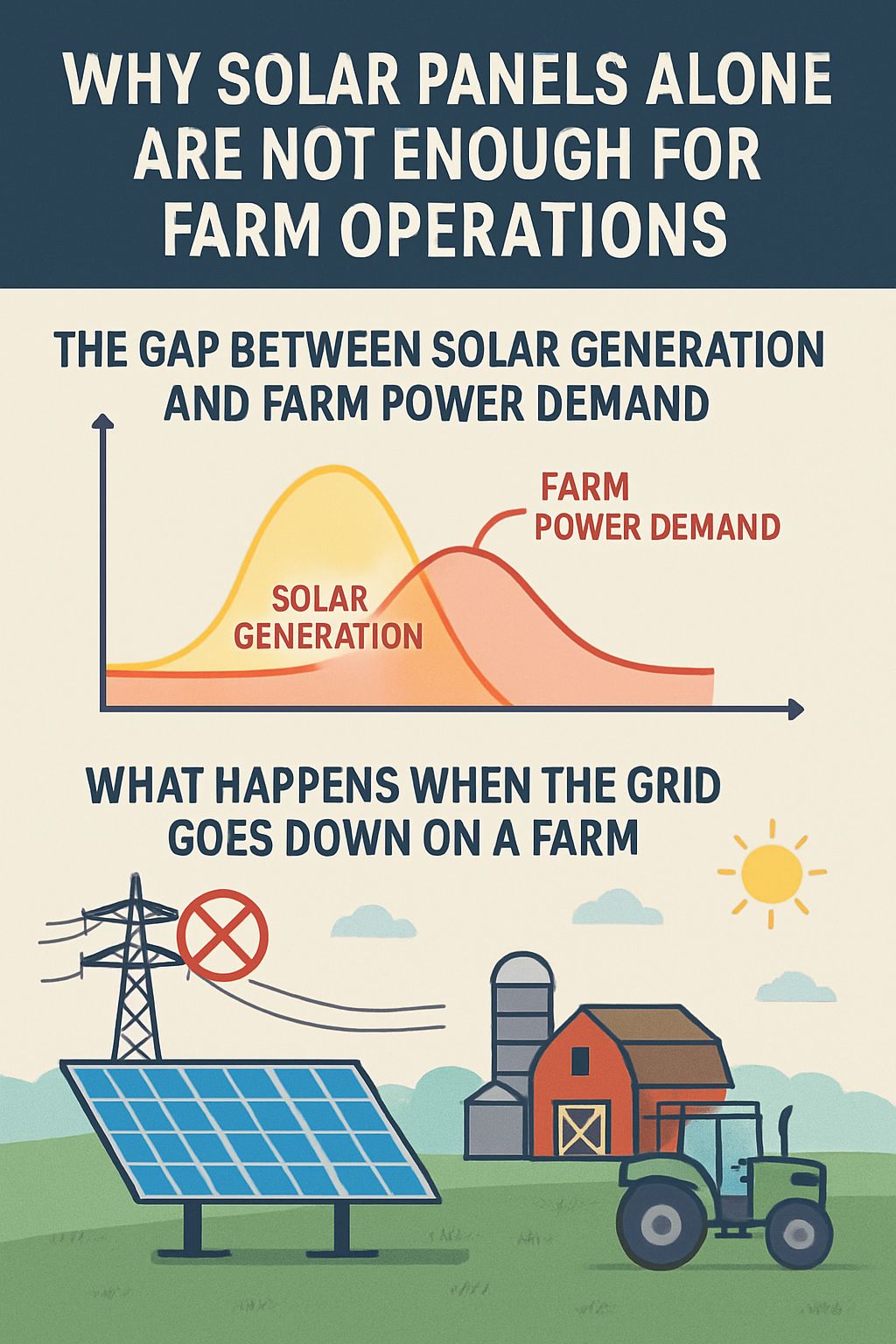
A solar array generates power when the sun shines — but farms don’t run on sunlight schedules. Livestock need climate control at 2 AM. Irrigation systems can’t wait for morning. Automated feeders run on timers. Without storage, solar power generated during peak afternoon hours simply goes to waste while the farm draws from an expensive, unreliable grid during the hours it’s needed most.
The Gap Between Solar Generation and Farm Power Demand
Solar generation peaks between 10 AM and 3 PM — but farm power demand is spread across all 24 hours. Early morning barn ventilation, evening lighting, overnight refrigeration for produce, and pre-dawn irrigation cycles all fall completely outside solar generation windows. Battery storage is what closes that gap, capturing excess daytime generation and deploying it exactly when and where the farm needs it.
The larger and more diversified a farming operation, the more critical that storage capacity becomes. A farm running poultry houses, irrigation systems, and cold storage simultaneously can’t afford even a short gap in power supply. Every hour of downtime carries real financial consequences — from lost crops to livestock stress to spoiled products.
What Happens When the Grid Goes Down on a Farm
Grid outages on farms aren’t just inconvenient — they’re costly. A failed irrigation pump during a drought can mean a full crop loss. A ventilation system shutdown in a poultry house during summer can kill birds within hours. Without battery backup, even a solar-equipped farm is fully exposed to these risks whenever the grid goes down.
Why Lead-Acid Batteries Fall Short in Agricultural Settings
Lead-acid batteries have been the default farm battery option for decades, but they were never built for the demands of modern agricultural solar systems. They typically deliver only 300–500 usable cycles at 50% depth of discharge before significant capacity degradation sets in. In a farm environment where daily charge-discharge cycles are the norm, that translates to replacement every 1–2 years.
Beyond lifespan, lead-acid batteries require regular maintenance — checking electrolyte levels, cleaning terminals, managing ventilation for off-gassing hydrogen. In a busy farm environment, that maintenance rarely happens on schedule, accelerating degradation further. They’re also heavy, space-inefficient, and sensitive to temperature swings that are routine in farm buildings.
What Makes LiFePO4 Batteries Different from Other Battery Types
Not all lithium batteries are created equal. The most common lithium-ion batteries used in consumer electronics — NMC (Nickel Manganese Cobalt) chemistry — offer high energy density but carry real risks of thermal runaway and have a significantly shorter cycle life than LiFePO4. For a farm environment where batteries may be stored near hay, wooden structures, and animals, that distinction matters enormously. Learn more about solar technologies for farms.
Battery Cycle Life Comparison
🔋 LiFePO4: 3,000–10,000 cycles (8–27 years of daily use)
🔋 Lithium-Ion NMC: 1,000–2,000 cycles (3–5 years)
🔋 Lead-Acid: 300–500 cycles (1–2 years)
LiFePO4 chemistry uses iron and phosphate — both abundant, non-toxic materials — in a molecular structure that is inherently more stable than competing lithium chemistries. That stability means it doesn’t overheat under heavy load, doesn’t require exotic cooling systems, and doesn’t pose a fire risk under normal agricultural operating conditions.
Lithium Iron Phosphate Chemistry: Why It Matters for Farms
The iron-phosphate bond in LiFePO4 cells is exceptionally strong, which is what gives this chemistry its thermal and chemical stability. Unlike NMC batteries that can enter thermal runaway if overcharged or physically damaged, LiFePO4 cells remain stable even under stress. For farms — where batteries may be exposed to dust, vibration from machinery, and temperature swings — this inherent robustness is a practical advantage, not just a technical specification.
LiFePO4 also maintains a remarkably flat voltage discharge curve. This means the battery delivers consistent, stable power output throughout most of its discharge cycle, only dropping off near the very end. Sensitive farm equipment — variable speed pumps, electronic monitoring systems, automated controllers — benefits directly from that voltage stability.
3,000 to 10,000 Charge Cycles vs. 500 to 1,000 for Lead-Acid
This single metric is often the deciding factor for farms evaluating the switch. At one full charge-discharge cycle per day — which is typical for a farm solar system — a quality LiFePO4 battery bank will last between 8 and 27 years. A lead-acid bank under the same conditions needs replacement every 1 to 2 years. Over a 10-year period, a farm could replace a lead-acid system five or more times for the cost of one well-specified LiFePO4 installation.
Thermal Stability and Fire Safety in Farm Environments
Fire risk is not an abstract concern on a farm. Hay, wooden structures, fuel storage, and dry feed materials create an environment where a battery fire could be catastrophic. LiFePO4 batteries have one of the lowest thermal runaway risks of any rechargeable battery chemistry available today. Their stable iron-phosphate molecular bonds resist breakdown even when overcharged, short-circuited, or exposed to high ambient temperatures.
This matters practically in buildings like equipment sheds, barn lofts, and utility rooms where batteries are commonly installed on farms. Unlike NMC lithium batteries that can ignite under fault conditions, LiFePO4 cells degrade gradually and predictably rather than failing catastrophically. Combined with a properly configured Battery Management System (BMS), LiFePO4 installations in agricultural settings meet the highest safety standards for proximity to livestock, wooden structures, and stored combustibles.
Core Benefits of LiFePO4 Batteries for Farm Solar Backup
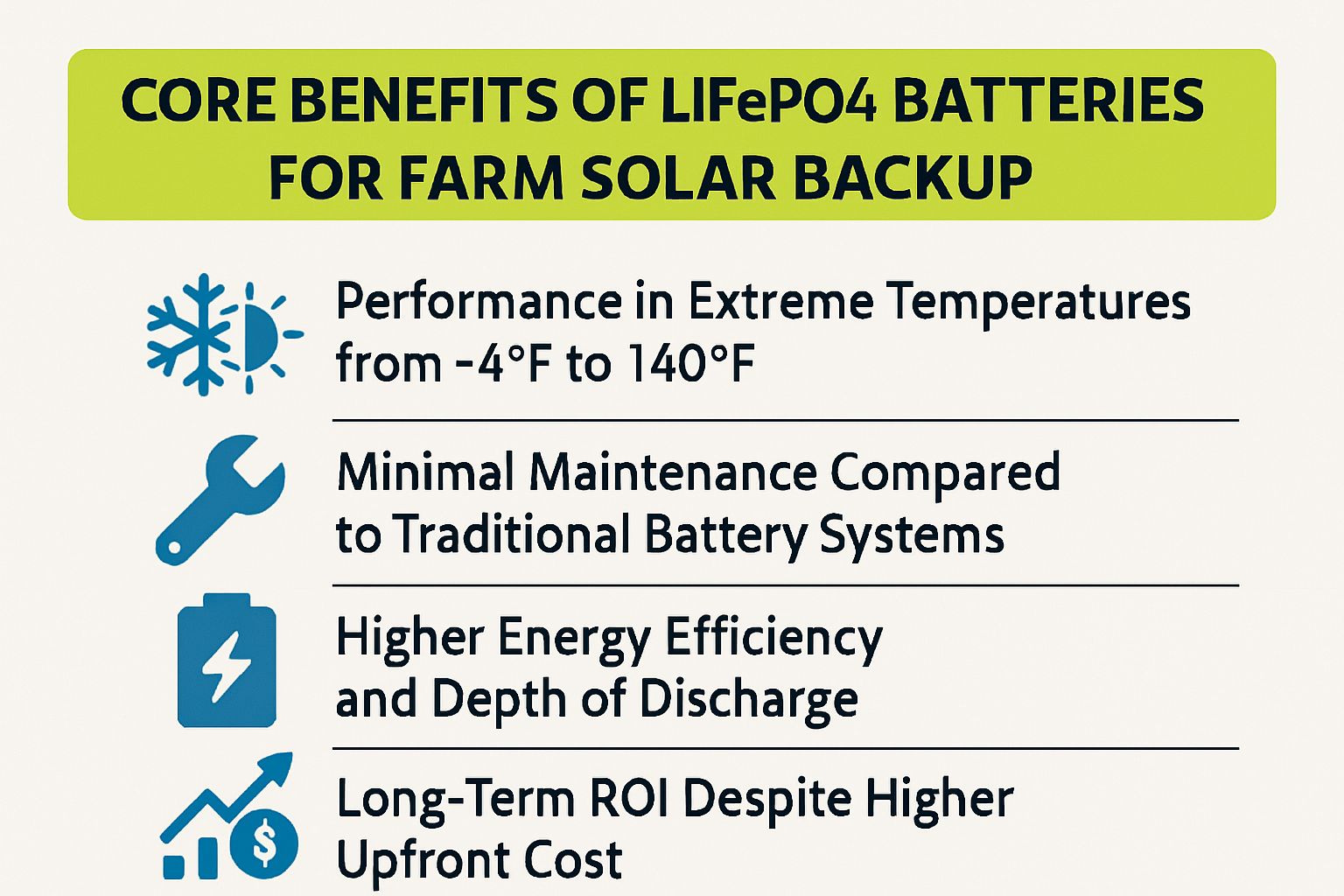
When you stack up all the advantages, LiFePO4 batteries don’t just edge out the competition in agricultural solar applications — they redefine what reliable farm energy storage actually looks like. From temperature tolerance to maintenance requirements, every performance characteristic lines up with what working farms genuinely need. For a deeper understanding of how solar technologies can benefit farms, explore this comparison of solar technologies.
Performance in Extreme Temperatures from -4°F to 140°F
Farm environments are harsh. Battery storage rooms in uninsulated barns can swing from well below freezing in January to over 100°F in August. Quality LiFePO4 batteries are rated to operate across a range of -4°F to 140°F (-20°C to 60°C), meaning they maintain functional capacity through the full range of conditions a working farm actually experiences. Lead-acid batteries, by contrast, lose significant capacity in cold temperatures — often 30–50% capacity loss at freezing — making them unreliable exactly when winter heating and water systems need backup power most.
Minimal Maintenance Compared to Traditional Battery Systems
LiFePO4 batteries are virtually maintenance-free. There is no electrolyte to check, no terminals to clean for acid corrosion, and no hydrogen off-gassing that requires dedicated ventilation systems. For a farm operator already managing equipment, livestock, crops, and staff, eliminating battery maintenance from the task list is a real operational benefit. Once installed with a quality BMS, a LiFePO4 system largely manages itself — monitoring cell balance, temperature, and charge state automatically.
Higher Energy Efficiency and Depth of Discharge
LiFePO4 batteries offer a round-trip energy efficiency of 95–98%, compared to 70–85% for lead-acid systems. That means more of the solar energy your panels capture actually reaches your farm equipment rather than being lost as heat during charging and discharging. Additionally, LiFePO4 batteries can be safely discharged to 80–100% depth of discharge (DoD) without damage, while lead-acid batteries should not be discharged below 50% DoD without significantly shortening their lifespan. In practical terms, a 100 kWh LiFePO4 bank delivers 80–100 kWh of usable energy. A lead-acid bank of the same rated capacity delivers only 40–50 kWh before damage risk begins. For more insights into solar panel efficiency, consider reading about how drones boost solar panel efficiency for farmers.
Long-Term ROI Despite Higher Upfront Cost
The upfront cost of LiFePO4 systems is higher than lead-acid — typically 2–3 times the initial purchase price. But when total cost of ownership is calculated across a 10-year period, LiFePO4 consistently wins. A farm that replaces a lead-acid bank every 1–2 years spends that premium back multiple times over, while also absorbing installation labor, downtime costs, and disposal fees with every replacement cycle. One documented farm case installed a 48V LiFePO4 battery bank with 100 kWh total capacity — providing more than a full day of energy autonomy — as the foundation of a complete off-grid transition that made the operation genuinely grid-independent.
Critical Farm Systems That Depend on Reliable Battery Backup
The real-world case for LiFePO4 storage on farms becomes clearest when you look at specific systems that cannot tolerate power interruptions. These aren’t edge cases — they are the core operational systems that determine whether a farm stays profitable during grid outages, storm events, or periods of low solar generation. For more insights on optimizing solar technologies for farms, explore our solar technologies comparison.
Irrigation Pumps During Drought and Grid Outages
Irrigation is one of the highest-draw systems on most farms, and also one of the least flexible — crops don’t wait for the grid to come back online. During drought conditions, when irrigation schedules are already aggressive, a grid outage without battery backup can mean missing critical watering windows entirely. A properly sized LiFePO4 battery bank can power submersible pumps, pivot irrigation systems, and drip networks through multi-day outages without interruption, protecting crops that may represent an entire season’s income.
Climate Control in Livestock Barns and Poultry Houses
Temperature management in poultry houses is not optional — it is a matter of animal survival. Broiler chickens in particular are highly sensitive to heat stress, and ventilation fan failure during summer can result in significant mortality within hours. Dairy barns, farrowing rooms, and egg-laying facilities all operate within tight temperature bands that require constant fan, heater, or cooling system operation.
A LiFePO4 battery backup system connected to a farm solar array keeps these climate systems running continuously, regardless of grid status. In a poultry operation running multiple houses, that continuity directly protects the value of each flock from placement to market weight.
The sizing for poultry house climate backup deserves specific attention. A single 40-foot broiler house may run 10–15 tunnel ventilation fans drawing 1–2 kW each at peak summer operation. That translates to a potential continuous load of 10–30 kW for climate control alone — meaning battery bank sizing for poultry operations needs to account for extended runtime, not just brief outages. For a deeper understanding of solar technologies that can support these operations, explore the solar technologies comparison for farmers.
Automated monitoring systems — temperature sensors, humidity controllers, alarm systems — add relatively small loads but are equally critical. These systems require clean, stable power to operate reliably, which is precisely the kind of output a LiFePO4 battery system with a flat discharge curve delivers.
Farm System Power Requirements & Battery Backup Considerations
Farm System
Typical Load
Backup Priority
Notes
Submersible Irrigation Pump
1.5 – 7.5 kW
Critical
High surge current at startup; size inverter accordingly
Poultry House Tunnel Fans
10 – 30 kW continuous
Critical
Runtime requirements can exceed 18+ hours/day in summer
Dairy Barn Ventilation
2 – 8 kW
High
Continuous operation required for milk quality compliance
Automated Feeders
0.5 – 2 kW
Medium
Timer-based; predictable load profile suits battery scheduling
Monitoring & Alarm Systems
100 – 500 W
Critical
Requires stable voltage; LiFePO4 flat curve ideal
Cold Storage / Refrigeration
1 – 5 kW
High
Continuous cycling load; high efficiency battery essential
Automated Feeding and Monitoring Systems
Automated feeding systems have become standard on modern livestock operations, running on precise schedules that directly affect animal growth rates, feed conversion efficiency, and overall herd health. When power fails, these systems stop — and the downstream effects compound quickly. A missed feeding cycle in a hog finishing barn or a fish farm recirculating system can affect animal welfare and production metrics in ways that show up directly on the bottom line. To ensure continuous operation, many farms are turning to LiFePO4 batteries for solar power storage.
LiFePO4 battery backup keeps automated augers, conveyors, feeding controllers, and monitoring sensors running through outages without interruption. Because these systems typically draw modest, predictable loads — usually between 0.5 and 2 kW — they are among the easiest farm systems to back up efficiently. The real value is in the monitoring layer: temperature alarms, feed level sensors, water quality probes, and security cameras all depend on continuous, stable power. A LiFePO4 system’s flat discharge curve ensures those electronics receive clean voltage right up until the battery is nearly depleted, preventing false alarms, data loss, and missed alerts.
LiFePO4 Solar Backup Is a Smart Long-Term Investment for Modern Farms
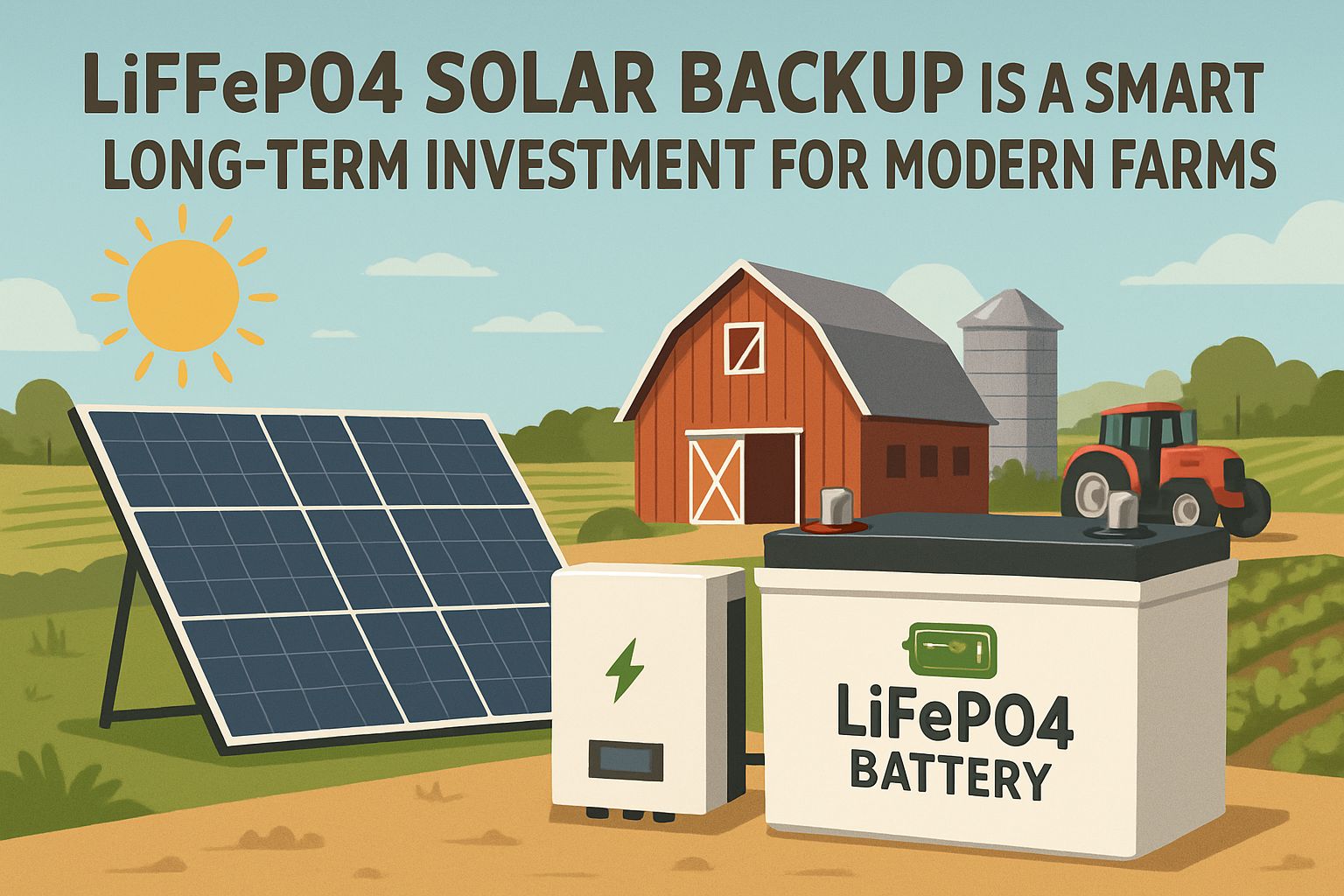
The math is straightforward once you look at it across a full decade. A LiFePO4 battery bank installed today will likely still be delivering reliable backup power when a lead-acid system installed at the same time would have been replaced four or five times over. Add in the efficiency gains, reduced maintenance burden, improved safety profile, and the operational continuity that protects crops, livestock, and revenue — and LiFePO4 solar backup stops looking like an expense and starts looking like one of the most defensible capital investments a modern farm can make. The 48V, 100 kWh systems now being deployed on working farms are delivering more than a full day of energy autonomy, and that kind of independence from an unreliable grid is exactly what agricultural operations need to grow with confidence.
Frequently Asked Questions
Switching to LiFePO4 solar backup raises practical questions — here are the most important ones answered clearly.
How long do LiFePO4 batteries last in a farm solar backup system?
Quality LiFePO4 batteries deliver between 3,000 and 10,000 complete charge-discharge cycles before significant capacity degradation occurs. For a farm running one full cycle per day, that translates to roughly 8 to 27 years of service life depending on the specific battery and usage pattern.
Factors that influence lifespan include operating temperature, average depth of discharge, and the quality of the Battery Management System managing the cells. Keeping discharge depth at or below 80% and operating within the rated temperature range will consistently push real-world performance toward the upper end of that cycle life range.
Can LiFePO4 batteries power an entire farm during a grid outage?
Yes — with appropriate sizing. A well-designed LiFePO4 solar backup system can power an entire farm’s critical loads through multi-day grid outages. The key is accurately calculating total farm load, prioritizing critical systems, and sizing the battery bank and solar array to meet those requirements. A 48V, 100 kWh LiFePO4 bank, as used in documented off-grid farm transitions, provides more than a full day of autonomy for a mid-sized operation — and multiple banks can be configured in parallel to scale capacity as needed.
Are LiFePO4 batteries safe to store near livestock and farm equipment?
LiFePO4 batteries are among the safest battery technologies available for agricultural environments. Unlike NMC lithium-ion batteries, LiFePO4 chemistry does not undergo thermal runaway under normal fault conditions — meaning they will not ignite if overcharged or physically damaged in the way other lithium chemistries can. They produce no toxic off-gassing during operation, require no ventilation provisions for hydrogen emissions like lead-acid batteries do, and use non-toxic iron and phosphate materials that pose no contamination risk to livestock or soil. With a properly installed BMS and appropriate electrical enclosures, LiFePO4 systems are well-suited for installation in barn utility rooms, equipment sheds, and outbuildings in direct proximity to animals and stored feed.
What is the difference between LiFePO4 and other lithium batteries for solar use?
The most common alternative lithium chemistry used in solar applications is NMC (Nickel Manganese Cobalt). NMC batteries offer higher energy density — meaning more power per kilogram — but they carry a significantly higher thermal runaway risk and deliver fewer cycles over their lifetime, typically 1,000 to 2,000 compared to LiFePO4’s 3,000 to 10,000.
For stationary farm applications where weight is not a constraint, the energy density advantage of NMC is irrelevant — and the safety and lifespan disadvantages become the deciding factors. LiFePO4 also maintains a flatter voltage discharge curve than NMC, delivering more consistent power output to farm equipment across the full depth of discharge. In agricultural solar applications, LiFePO4 is the clear engineering choice.
How many LiFePO4 batteries do I need to back up a farm irrigation system?
The calculation starts with your pump’s power draw and your required runtime. A standard 5 hp (3.7 kW) submersible irrigation pump running for 8 hours requires approximately 30 kWh of usable battery capacity. At 80% depth of discharge on a LiFePO4 system, you would need a battery bank with at least 37.5 kWh of rated capacity to cover that single load safely.
Startup surge current is a critical factor often overlooked in irrigation backup sizing. Electric motors draw 3 to 6 times their running current at startup, so your inverter must be rated to handle that surge — and your battery bank must be capable of delivering it without voltage sag. Always size the inverter to at least 3 times the pump’s running wattage to accommodate startup loads reliably.
If your farm runs multiple pumps across different zones or combines irrigation backup with other critical loads — barn ventilation, cold storage, monitoring systems — those loads must all be factored into the total bank size. A professional load audit before system design is strongly recommended for any operation with complex or high-draw requirements.
As a practical reference point: farms that have transitioned to full off-grid operation using LiFePO4 solar systems commonly install 48V battery banks in the 50 to 200 kWh range depending on operation size, with the 100 kWh configuration being a well-documented starting point for mid-sized operations seeking full-day autonomy. Growing Solar Mist specializes in helping farm operators design and size solar energy storage systems that match the real demands of working agricultural operations.




Leave a Reply