

- Solar panel integration can reduce farm carbon emissions by up to 30% compared to traditional energy sources by replacing fossil fuel-powered equipment and systems.
- Agrivoltaics—the practice of using land for both solar energy production and agriculture—optimizes land use while providing dual revenue streams for farmers.
- Solar installations help farmers reduce operational costs through energy savings, tax incentives, and potential income from selling excess electricity back to the grid.
- Modern solar technologies like semi-transparent panels and tracking systems allow for customized implementations that work with various crops and livestock operations.
- Beyond emissions reduction, solar panels on farms provide additional benefits including water conservation, crop protection, and climate resilience.
As energy costs climb and climate pressures intensify, farmers across the country are discovering a powerful solution hiding in plain sight: solar power. The agricultural sector, responsible for approximately 10% of U.S. greenhouse gas emissions, stands at a crucial turning point where clean energy adoption can dramatically reduce its carbon footprint. Farmonaut, a leader in agricultural technology solutions, has documented how integrating solar panels into farm operations represents one of the most effective strategies for modern farming sustainability.
The numbers tell a compelling story—when properly implemented, solar energy systems can slash farm-related emissions by up to 30% compared to conventional energy sources. This reduction comes primarily from replacing fossil fuel-powered equipment, irrigation systems, and facility operations with clean, renewable electricity generated onsite.
Solar Panels Cut Farm Emissions by Up to 30%
Farm operations require substantial energy inputs—from powering irrigation pumps to running processing equipment and climate control systems. Traditionally, this energy has come from diesel generators, propane heaters, and grid electricity often generated from coal or natural gas. Each of these conventional energy sources produces significant carbon emissions. When farms transition to solar power, they effectively eliminate these emission sources at their point of use.
The carbon reduction potential varies by farm type, size, and existing energy consumption patterns. Dairy operations, which require constant electricity for milking machines and refrigeration, often see the most dramatic emissions cuts when transitioning to solar—sometimes exceeding 30% of total farm emissions. Crop producers using electric irrigation pumps can reduce their carbon footprint by 20-25% through solar integration. Even small-scale vegetable farms can achieve 15-20% reductions by powering greenhouses, processing facilities, and cold storage with solar electricity.
Beyond the direct replacement of fossil fuels, solar panels provide secondary emission reductions through decreased transmission losses. When farms generate electricity on-site, they eliminate the 5-10% energy typically lost during long-distance transmission from centralized power plants. This efficiency gain further amplifies the environmental benefits of agricultural solar adoption.
Comparative Impact: Farm Energy Sources and CO₂ Emissions
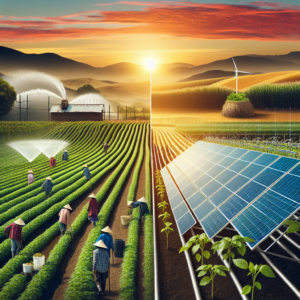
Farmers are increasingly turning to solar panels as a sustainable energy source to reduce carbon emissions. By harnessing solar energy, they can significantly decrease their reliance on fossil fuels, leading to a more environmentally friendly agricultural practice.
A 100-acre farm operating with conventional energy sources produces approximately 180 tons of CO₂ annually from energy use alone. The same farm with a comprehensive solar installation reduces emissions to approximately 126 tons—a 30% reduction that represents the carbon sequestration equivalent of planting over 800 trees annually.
The transition to solar power represents a rare win-win scenario for agriculture—reducing both environmental impact and operational costs. With current technology, most farms can offset 60-90% of their electricity consumption through strategic solar installations. The remaining energy needs can often be further reduced through complementary efficiency measures or covered by increasingly available renewable energy options from utility providers.
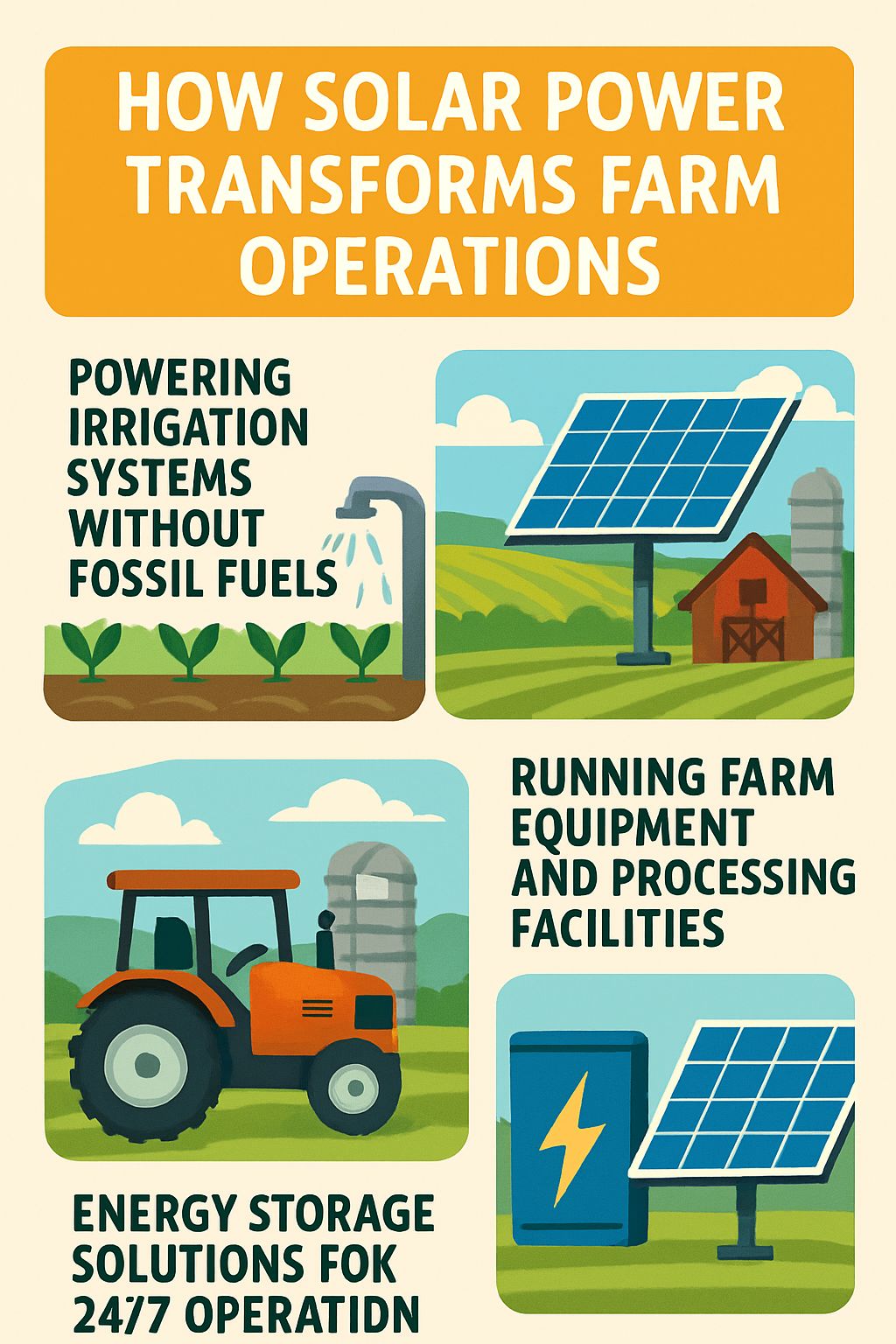
How Solar Power Transforms Farm Operations
The agricultural revolution powered by solar energy extends far beyond simple emissions reduction. Modern solar installations are transforming how farms function at every level, creating more resilient and efficient operations across diverse agricultural sectors. From powering essential equipment to enabling new farming approaches, solar technology is proving to be a versatile tool in the sustainable farmer’s toolkit.
Powering Irrigation Systems Without Fossil Fuels
Irrigation represents one of agriculture’s most energy-intensive processes, traditionally relying on diesel pumps or grid electricity to move water across fields. By transitioning to solar-powered irrigation systems, farmers can eliminate one of their largest sources of carbon emissions while also gaining independence from fluctuating fuel prices. Solar pumping systems have advanced significantly in recent years, offering solutions for both shallow and deep well applications across various farm sizes.
Modern solar irrigation setups often incorporate smart controls that optimize water delivery based on soil moisture sensors, weather forecasts, and crop requirements. This integration of renewable energy with precision agriculture technology not only cuts emissions but frequently reduces water usage by 15-30% compared to conventional systems. For farmers in drought-prone regions, this water conservation benefit provides an additional sustainability advantage beyond carbon reduction. Learn how solar panels benefit farmers in their operations and power solutions.
Running Farm Equipment and Processing Facilities
Beyond irrigation, solar energy effectively powers various electric farm equipment, from grain dryers and refrigeration units to ventilation systems in livestock facilities. With the advancement of battery storage technology, even equipment with intermittent high energy demands can now run on stored solar power. Farms with processing facilities particularly benefit from solar integration, as these operations typically consume significant electricity for cleaning, sorting, packaging and refrigeration.
The transition to electric equipment powered by solar represents a two-fold emissions reduction. First, it eliminates the direct emissions from combustion engines. Second, it improves overall energy efficiency since electric motors typically convert 85-90% of energy input to useful work, compared to 30-45% efficiency for internal combustion engines. This efficiency advantage means that even when solar panels cannot meet 100% of a farm’s energy needs, they still drive substantial emissions reductions through the overall electrification process.
Energy Storage Solutions for 24/7 Operation
Modern agricultural solar systems increasingly incorporate battery storage components that transform intermittent solar generation into reliable 24/7 power. These storage systems enable farms to capture excess daytime production and utilize that energy during evening hours or cloudy days. The latest generation of lithium iron phosphate batteries offers farmers 10+ years of operational life with minimal maintenance requirements, making them practical additions to agricultural solar installations.
For livestock operations requiring constant climate control and dairy farms needing reliable power for milking and refrigeration, battery backup provides crucial operational resilience. Beyond batteries, some innovative farms are exploring alternative storage methods, including compressed air systems, thermal storage using hot water tanks, and even hydrogen production during peak solar periods. These diverse approaches to energy storage help overcome one of the historical limitations of renewable energy – its intermittent nature – making solar a true one-to-one replacement for conventional power sources.
Dual-Use Solar: Grow Crops and Generate Power
The agricultural innovation generating the most excitement among sustainability experts is agrivoltaics – the practice of growing crops beneath and around solar panels on the same land. This dual-use approach resolves the perceived conflict between energy production and food production, creating complementary systems that often enhance both outputs. Researchers have documented numerous successful agrivoltaic implementations across diverse crops including tomatoes, lettuce, berries, certain grains, and various forage crops.
Agrivoltaics Boost Land Productivity
The most compelling aspect of agrivoltaics is its ability to increase overall land productivity. Studies from the National Renewable Energy Laboratory demonstrate that well-designed agrivoltaic systems can achieve 60-100% of conventional crop yields while simultaneously generating substantial clean energy. This combined production often results in land-use efficiency improvements of 30-70% compared to separate farming and solar installations.
Modern agrivoltaic designs utilize elevated mounting systems allowing for mechanical cultivation beneath panels. Semi-transparent bifacial panels, which generate electricity from both direct sunlight and reflected light from below, have proven particularly effective in agricultural applications. Some systems employ dynamic tracking technology that adjusts panel angles throughout the day to balance energy production with optimal light transmission to crops. These technological advancements continue to expand the range of agricultural products compatible with solar co-location.
Shade Benefits for Water Conservation
The partial shade created by solar panels offers significant advantages for many crops, especially in regions experiencing increasing heat and drought stress. Research has demonstrated that certain crops grown in agrivoltaic systems require 10-25% less irrigation water compared to those in full sun. This water conservation benefit stems from reduced soil evaporation and lower plant transpiration rates in the modified microclimate beneath panels.
The shade advantage extends beyond water savings to include quality improvements for certain crops. Leafy greens grown under partial solar panel shade often develop larger leaves with reduced bitterness. Some fruit crops show improved quality metrics, including higher sugar content and reduced sunscald damage. As climate change intensifies heat and drought challenges across agricultural regions, this protective aspect of agrivoltaics offers adaptation benefits alongside emission reductions.
How Livestock Grazing Works with Solar Installations
Solar grazing—the practice of managing livestock beneath and around ground-mounted solar arrays—represents one of the most successful and rapidly expanding forms of agrivoltaics. Sheep have proven particularly well-suited for solar grazing, effectively controlling vegetation without damaging infrastructure. The shade provided by panels creates comfortable grazing conditions during hot weather, often extending the productive grazing period.
The economic advantages of solar grazing benefit both farmers and solar operators. Livestock producers gain access to additional grazing land, often with improved forage persistence during drought periods. Solar facility operators reduce maintenance costs by eliminating mechanical mowing and herbicide applications. This synergy creates a rare win-win scenario where renewable energy production enhances agricultural production rather than competing with it.
Carbon Footprint Reduction Case Studies
Dairy Farm Slashes Emissions by 28% in Michigan
Hillcrest Farms, a 250-cow dairy operation in Michigan, installed a 200kW solar array in 2020 to power their milking parlor, refrigeration units, and processing facility. The comprehensive system, which included 10kWh of battery storage, eliminated approximately 175 tons of CO2 emissions annually—representing a 28% reduction in the farm’s total carbon footprint. Beyond emissions reduction, the solar installation created significant operational resilience, allowing continued milking operations during grid outages that had previously required backup diesel generators.
What made the Hillcrest project particularly noteworthy was its integration with existing energy efficiency measures. Prior to solar installation, the farm had upgraded to variable frequency drive milk pumps and heat-recovery systems on refrigeration units. These efficiency improvements reduced the required size of the solar array by approximately 25%, demonstrating how combined approaches can maximize both environmental and financial benefits. The farm’s comprehensive energy transition qualified it for carbon credit generation, creating an additional $15,000 annual revenue stream beyond direct energy savings.
California Orchard Eliminates Diesel Pumps
Valley Vista Orchards in California’s Central Valley replaced five diesel irrigation pumps with solar-powered electric pumps, eliminating over 40,000 gallons of diesel consumption annually. This conversion reduced the orchard’s direct carbon emissions by 430 tons yearly while simultaneously improving local air quality by eliminating diesel particulates and nitrogen oxides. The project’s $380,000 installation cost achieved payback within 4.5 years through combined fuel savings, maintenance reduction, and incentive programs.
Financial Benefits Beyond Carbon Reduction
While environmental sustainability drives many farmers toward solar adoption, the compelling financial case often seals the decision. Agricultural operations typically see some of the strongest economic returns from solar investments due to their high energy consumption, available land area, and qualification for both agricultural and energy incentive programs. When properly implemented, solar installations deliver multiple revenue enhancements and cost reductions that strengthen farm business models.
Solar Payback Period for Different Farm Types
The financial return timeline for agricultural solar varies significantly based on farm type, energy consumption patterns, and available incentives. Dairy farms and irrigated crop operations typically see the fastest returns, with payback periods ranging from 3-7 years due to their high, consistent electricity demands. Greenhouse operations generally experience 4-8 year paybacks, while diversified small farms might require 5-10 years to fully recoup their investment. These timelines have shortened significantly in recent years due to falling solar hardware costs and expanded incentive programs specifically targeting agricultural applications.
Most farmers view solar installations as infrastructure investments comparable to building construction or major equipment purchases. The key difference is that solar systems actively generate returns throughout their 25-30 year operational lifespan rather than experiencing ongoing depreciation. When analyzed using standard agricultural business metrics like Return on Investment (ROI) and Net Present Value (NPV), modern solar installations typically outperform many traditional farm capital investments.
Revenue from Selling Excess Electricity
Many agricultural solar installations generate electricity beyond the farm’s immediate needs, creating opportunities for additional revenue through various grid interconnection programs. Net metering policies, available in most states, allow farmers to receive retail-rate credits for excess electricity fed back to the grid. Some utilities offer specialized agricultural tariffs that account for seasonal variations in farm energy usage, enabling more advantageous credit accumulation during high-production summer months for use during lower-production winter periods.
Beyond net metering, some regions offer additional market mechanisms like Solar Renewable Energy Certificates (SRECs) that compensate farmers for the environmental attributes of their clean energy production. Community solar programs provide another potential revenue stream, allowing farmers to become local clean energy providers by selling subscriptions to nearby residents and businesses. These diverse revenue options transform solar from a simple cost-saving measure into a productive farm enterprise that generates income alongside traditional agricultural products.
Protection Against Rising Energy Costs
Perhaps the most significant long-term financial benefit of agricultural solar is protection against escalating and unpredictable energy costs. Unlike virtually every other farm input that experiences price inflation over time, solar-generated electricity maintains consistent costs throughout the system’s lifespan. This price stability creates valuable operational predictability for farm business planning. With utility electricity rates historically rising 2-4% annually and fossil fuel prices subject to dramatic market swings, solar installations effectively lock in energy costs for decades.
This price-hedging function becomes increasingly valuable as farms implement more electric technologies. Operations transitioning to electric tractors, utility vehicles, and processing equipment find that solar installations provide crucial protection against future energy price uncertainty. Many agricultural financial advisors now recommend solar as a fundamental risk management strategy comparable to crop insurance or forward contracting.
Tax Incentives and Carbon Credits
The financial case for agricultural solar is significantly enhanced by an array of tax incentives, grants, and emerging carbon market opportunities. The federal Investment Tax Credit currently covers 30% of qualified solar installation costs, with additional incentives available through USDA Rural Energy for America Program (REAP) grants covering up to 25% of eligible project expenses. Accelerated depreciation provisions allow farmers to recover their solar investment costs through tax deductions over a compressed 5-year schedule rather than the system’s 30-year useful life. For more information on how farmers can benefit, check out this article on farm energy cost reduction with solar panels.
Beyond direct incentives, farms with solar installations increasingly participate in voluntary and compliance carbon markets. These programs compensate farmers for documented greenhouse gas reductions, with current prices ranging from $15-45 per metric ton of CO2 equivalent avoided. As carbon markets mature and agricultural emissions face increasing scrutiny, the financial value of solar-driven carbon reductions continues to grow. Forward-thinking farms are already incorporating these carbon assets into their business models as significant supplemental revenue streams.
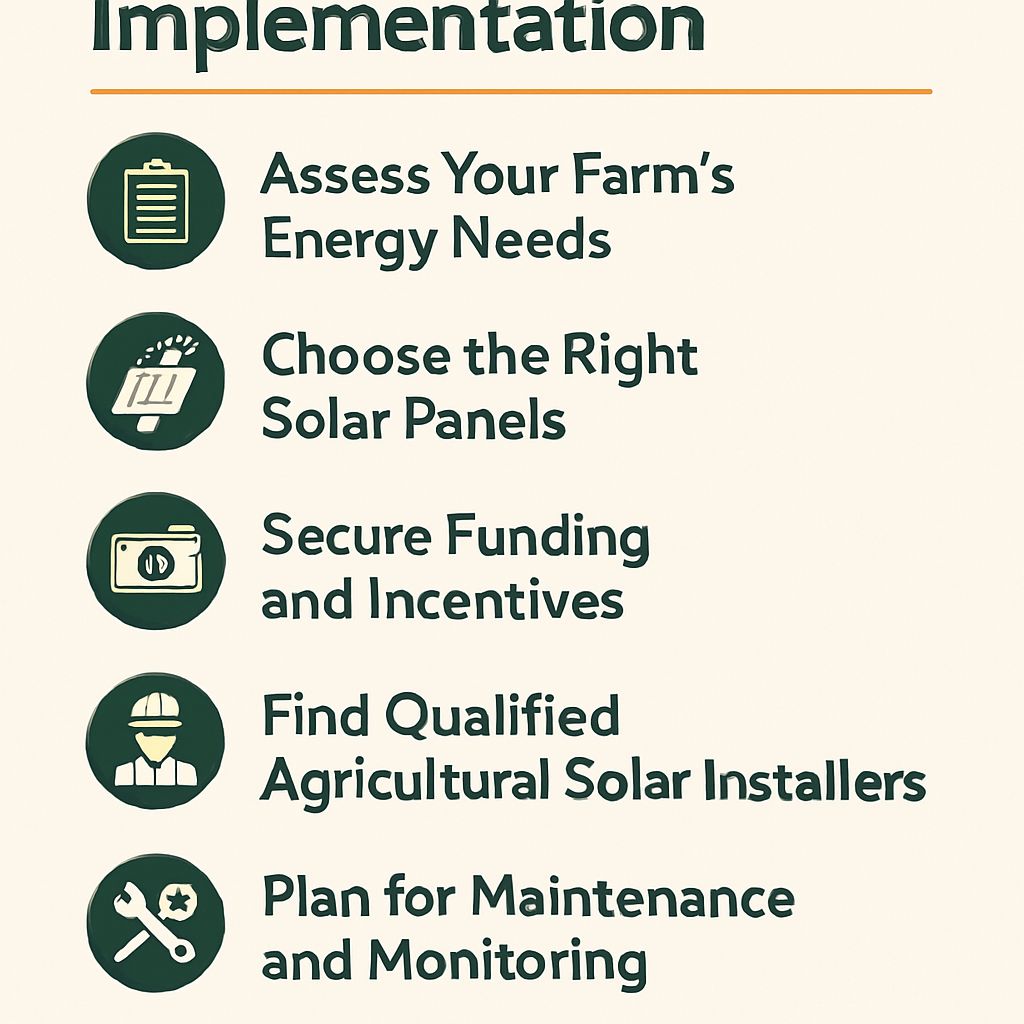
Practical Steps to Solar Implementation
Transitioning to solar energy requires thoughtful planning and implementation to maximize both environmental and financial benefits. Successful agricultural solar projects typically follow a structured development process that ensures system designs align with specific farm operational needs and site conditions. While each farm’s journey to solar adoption will be unique, these core steps provide a roadmap for effective implementation.
1. Assess Your Farm’s Energy Needs
Before contacting solar providers, conduct a comprehensive energy audit documenting your farm’s electricity consumption patterns over at least a full year. Note both total usage and demand variations by season, time of day, and specific operational activities. This baseline information allows for properly sized solar system design that aligns with your actual energy requirements. Many agricultural extension offices and rural electric cooperatives offer specialized farm energy audit services that include detailed consumption analysis and efficiency improvement recommendations.
Beyond current usage, consider future energy needs based on planned operational changes or expansion. If electrification of previously fossil-fueled equipment is anticipated, incorporate these additional demands into system sizing calculations. Most solar installations have 25+ year operational lifespans, making it essential to design for both current and projected energy requirements. This forward-looking approach ensures your solar infrastructure remains adequate throughout its operational life, maximizing long-term emission reduction benefits.
2. Choose the Right Solar Panels
Agricultural solar installations require thoughtful equipment selection that considers both environmental conditions and operational requirements. Monocrystalline silicon panels typically offer the highest efficiency (18-22%) and greatest durability, making them well-suited for space-constrained installations and harsh agricultural environments. Polycrystalline panels provide slightly lower efficiency (13-17%) at reduced cost, offering excellent value for ground-mount installations where space is less restricted. Specialized bifacial panels, which generate electricity from both direct sunlight and reflected light from below, can increase energy harvest by 5-30% in appropriate agricultural settings with reflective ground surfaces. Thin-film solar technologies present unique advantages for certain agricultural applications, particularly where weight constraints or unusual mounting surfaces exist. Their flexible nature allows installation on curved barn roofs, equipment storage buildings, or even portable structures that wouldn’t support conventional panels. Though less efficient at 10-13% conversion rates, thin-film panels perform better in partial shading and high-temperature conditions common in agricultural settings.
Beyond panel type, consider mounting system options aligned with your farm layout and operational needs. Fixed ground-mount systems offer simplicity and reliability with minimal maintenance requirements. Single-axis tracking systems, which follow the sun’s east-to-west movement, typically increase energy production by 15-25% for minimal additional cost. Elevated agrivoltaic systems that allow cultivation or grazing beneath panels require specialized mounting equipment but create dual-use opportunities. Each mounting approach offers different emission reduction and operational benefits that should be evaluated against your specific agricultural activities.
Here is a table summarizing the main types of solar panels for agricultural applications, highlighting their key characteristics, benefits, and limitations:
|
Solar Panel Type |
Key Features |
Best Uses in Agriculture |
Advantages |
Limitations |
|---|---|---|---|---|
|
Monocrystalline |
Single-crystal silicon, high efficiency, dark appearance |
Limited roof/land space; high-demand farms |
Highest efficiency (up to 22%), longest lifespan (25–30 years), reliable in smaller spaces |
Highest upfront cost, slightly less efficient in extreme heat |
|
Polycrystalline |
Multiple silicon crystals, bluish tone, moderate efficiency |
Large farm roofs/land, budget-conscious projects |
Lower cost per watt, stable performance, good for large-scale installations |
Lower efficiency (13–17%), needs more space, drops in high heat |
|
Thin-Film |
Flexible modules, thin, low weight, lower efficiency |
Curved/irregular surfaces, barns, greenhouse roofs |
Flexible installation, lightweight, better in low light/cloudy regions |
Shorter lifespan, lowest efficiency (<14%), requires most area |
|
Bifacial |
Absorbs sunlight from both sides, transparent back |
Open fields, reflective surfaces, agrivoltaics |
Can boost power output by up to 30% with good reflectivity (albedo); efficient land use |
Higher initial investment, requires careful ground preparation and mounting |
3. Secure Funding and Incentives
Navigating the complex landscape of agricultural solar financing requires investigating multiple funding pathways and incentive programs. Traditional financing options include farm operating loans, equipment loans with solar as collateral, and specialized clean energy financing with extended terms (10-25 years) aligned with system operational life. Many agricultural lenders now offer preferential rates for renewable energy projects due to their reliable return profiles and risk mitigation benefits. The Rural Energy for America Program provides both grants and guaranteed loans specifically for agricultural renewable energy installations.
Beyond conventional financing, innovative models like Power Purchase Agreements (PPAs) and solar leasing enable farms to implement solar with zero upfront capital expense. These arrangements typically involve third-party ownership of the solar system, with the farm purchasing the generated electricity at predetermined rates lower than utility costs. While these models sacrifice some long-term financial returns, they eliminate initial capital requirements and transfer maintenance responsibilities to the system owner. For farms with limited investment capital or those prioritizing operational rather than asset expenses, these third-party approaches can accelerate clean energy transition.
4. Find Qualified Agricultural Solar Installers
Selecting experienced installers with specific agricultural expertise significantly impacts both project success and long-term performance. Look for solar contractors who demonstrate understanding of farm operational patterns, agricultural electrical systems, and rural utility interconnection requirements. Qualified agricultural solar specialists should provide references from similar farm operations and documentation of relevant certifications like NABCEP (North American Board of Certified Energy Practitioners) credentials. The most effective installers typically collaborate with farm equipment dealers, irrigation specialists, and energy efficiency consultants to deliver integrated solutions rather than standalone solar arrays.
5. Plan for Maintenance and Monitoring
Maximizing emission reductions and financial returns requires ongoing system monitoring and maintenance. Modern agricultural solar installations incorporate sophisticated monitoring platforms that track performance metrics, detect potential issues, and quantify emission reductions. These systems provide both real-time and historical data accessible through web portals and mobile applications, enabling proactive maintenance decisions. Comprehensive monitoring also facilitates participation in carbon offset programs that require documented emission reductions with proper verification protocols.
While solar systems require minimal maintenance compared to most farm equipment, establishing routine inspection schedules ensures optimal performance. Typical maintenance includes panel cleaning (especially in dusty agricultural environments), vegetation management around ground-mounted arrays, and periodic electrical system checks. Many farms integrate these activities into existing maintenance routines, treating solar arrays as another farm infrastructure component requiring regular attention. Some installers offer performance guarantee contracts that include scheduled maintenance visits and production commitments, providing additional operational assurance.
Integrating Solar into Your Farm’s Future Will Help Reduce Its Carbon Emissions
Successful agricultural solar integration requires thinking beyond standalone panels to envision comprehensive energy transitions throughout farm operations. The most impactful approaches combine solar electricity generation with broader electrification initiatives that replace fossil-fueled equipment with electric alternatives. This systems-based strategy creates compounding emission reductions as more farm processes transition from direct fossil fuel consumption to solar-powered electricity. Forward-thinking farms are developing phased implementation plans that coordinate solar expansion with equipment replacement cycles, ensuring synchronization between energy production and consumption changes.

Conclusion: Is the Reduction of Carbon Emissions Worth the Investment for a Farmer to Purchase Solar Panels for His Farm
The evidence overwhelmingly indicates that solar installations deliver substantial value to most farm operations—both environmentally and financially. With properly designed systems achieving emission reductions of 20-30% while generating returns that outperform many traditional agricultural investments, solar represents a rare true win-win opportunity. As agriculture faces increasing pressure to reduce its environmental footprint while maintaining economic viability, solar energy offers a proven solution that addresses both imperatives simultaneously. For farmers concerned about climate impact, operational sustainability, and long-term business resilience, solar implementation represents not just a responsible choice but an increasingly necessary one. Farmonaut’s agricultural technology solutions can help farmers implement these sustainable practices while maximizing their productivity and profitability.
Frequently Asked Questions
The transition to solar-powered agriculture generates many practical questions from farmers considering these systems. Below we address the most common concerns based on real-world implementation experience across diverse agricultural operations. These answers reflect current technology capabilities and industry best practices as of 2023.
How much farmland do I need to dedicate to solar panels?
The land requirements for agricultural solar installations vary based on energy needs and implementation approach. Traditional ground-mount systems typically require approximately 5-8 acres per megawatt of capacity, potentially supplying enough electricity for a mid-sized operation (depending on energy intensity). However, modern agrivoltaic designs and rooftop installations dramatically reduce or eliminate dedicated land requirements. Rooftop systems on existing farm buildings often provide 30-50% of typical farm electricity needs without using any productive land. For larger energy demands, elevated agrivoltaic systems maintain 60-80% of the land’s agricultural productivity while generating solar power above. Many farms start with available building rooftops and expand to ground installations or agrivoltaics as needed to meet their complete energy requirements.
Will solar panels work in cloudy or northern climates?
Modern solar technology performs effectively across all agricultural regions, though energy production varies with local solar resources. Northern locations typically generate 70-80% of the electricity compared to sunbelt regions on a per-panel basis, requiring somewhat larger installations to achieve equivalent output. However, cooler northern climates actually improve panel efficiency, as solar cells operate more effectively at moderate temperatures than in extreme heat. Contemporary solar economics remain favorable even in less sunny regions due to improved panel efficiency, reduced equipment costs, and enhanced incentive programs often available in these areas. Many of the most successful agricultural solar projects operate in Midwestern and Northeastern states rather than traditional sunbelt locations, demonstrating viable economics across diverse climate zones.
Can I still qualify for organic certification with solar panels?
Solar installations are fully compatible with organic certification when properly designed and documented. The National Organic Program allows renewable energy infrastructure on certified organic land provided that materials and management practices comply with organic standards. Key considerations include using approved materials for ground mounting systems, implementing appropriate stormwater management, and maintaining required buffer zones. Most certification agencies require documentation that solar components don’t leach prohibited substances and that installation and maintenance activities use approved materials. Agrivoltaic systems require additional documentation regarding the potential microclimate modifications and their impacts on organic production practices. Working with an organic certifier during the solar design phase ensures compliance and prevents certification complications.
How do I maintain solar panels in dusty farm conditions?
Agricultural environments present unique maintenance challenges for solar installations due to dust, pollen, and equipment emissions. Most farm-based systems require cleaning 2-4 times annually, with frequency depending on local conditions and proximity to field operations. Modern self-cleaning panel coatings reduce dust accumulation, while angled installations allow rainfall to remove some debris naturally. Many farms integrate panel cleaning into existing equipment maintenance schedules using specialized brushes, filtered water systems, and proper safety protocols. For larger installations, automated cleaning systems including robotic brushes and programmed water sprayers offer labor-efficient solutions, though these add to initial system costs. Proper maintenance planning should include designated access pathways for cleaning equipment and safety protocols for personnel working around high-voltage systems.
What happens to my solar system during extreme weather events?
Contemporary agricultural solar installations incorporate robust engineering designed to withstand challenging farm environments and severe weather. Quality systems include wind resistance ratings of 120+ mph, hail impact protection for 1-inch diameter hailstones, heavy snow load capacity (40+ lbs/sq ft in northern regions), and comprehensive lightning protection systems. Modern panels use tempered glass that remains intact even when cracked, preventing debris hazards. During extreme events, intelligent inverters automatically disconnect from the grid to prevent backfeeding during power outages (protecting utility workers) while maintaining potential for off-grid operation with appropriate battery systems. Many agricultural solar installations have demonstrated remarkable resilience during severe weather events, continuing to generate power when conventional energy infrastructure fails.
Effective weather resilience requires appropriate system design for your specific location and climate risks. Work with installers who utilize region-specific engineering standards exceeding minimum building code requirements, particularly in areas prone to specific weather challenges like hurricanes, tornadoes or heavy snow loads. Some insurance providers offer specialized coverage for agricultural solar systems with policy features addressing weather-related risks and production guarantees.
For the ultimate protection against climate uncertainties, consider integrating battery storage systems that enable continued critical operations during grid outages. These systems automatically isolate from the damaged grid while continuing to supply essential farm loads like refrigeration, ventilation, and security systems. The resilience benefits of these solar-plus-storage systems often justify their additional cost, particularly for livestock operations where power interruptions can threaten animal welfare.

Leave a Reply