
Key Takeaways
Solar-powered irrigation systems can drastically cut down long-term operational costs compared to traditional systems.
Drip irrigation is the most efficient way to water lime orchards, minimizing water waste and ensuring optimal soil moisture.
Monocrystalline solar panels offer the highest efficiency and are perfect for farm use despite their higher initial cost.
Pairing solar panels with drip irrigation provides a sustainable and cost-effective solution for lime farmers.
Initial installation costs for solar-powered systems are higher, but they are worth it due to reduced energy expenses and environmental benefits.
Why Solar Panels Combined with an Irrigation System are Ideal for Lime Cultivation
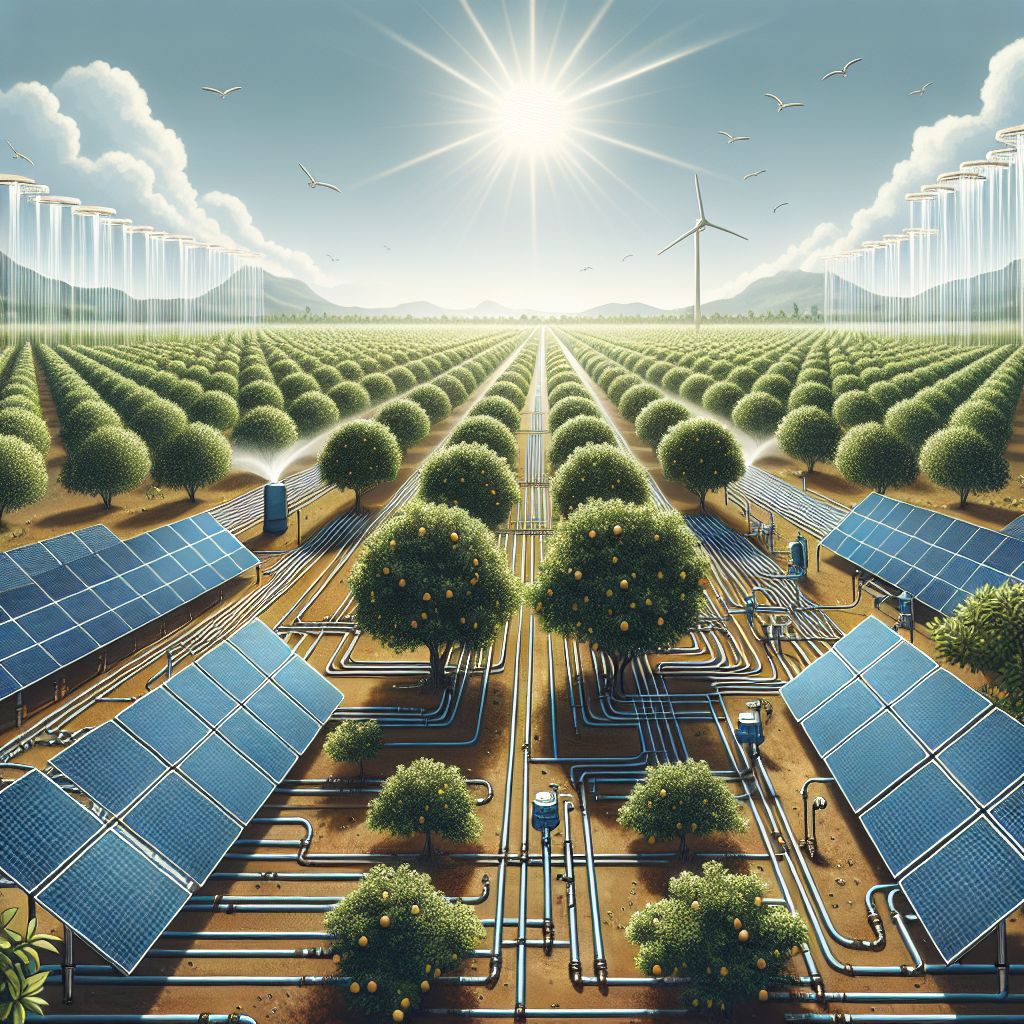
Efficient irrigation is key in lime cultivation. Solar-powered irrigation systems have many benefits that make them a great option for lime farmers. By using the power of the sun, these systems provide a dependable and sustainable energy source, reducing reliance on traditional power grids.
Advantages for the Environment
One of the main motivations to utilize solar panels for your irrigation system is the environmental advantage. Solar energy is clean and renewable, and it doesn’t produce any greenhouse gases when it’s operating. This indicates that by changing to solar-powered irrigation, you’re contributing to a healthier planet.
Long-Term Financial Benefits
Although the initial set up cost of a solar-powered irrigation system might seem steep, the cost benefits over time are substantial. Traditional irrigation systems often depend on grid electricity or fossil fuels, which can be expensive. On the other hand, solar energy is free once the system is in place. Over time, the savings on energy bills can counterbalance the initial investment, making it a financially wise decision.
Dependability and Freedom from Grid Power
For farmers in remote areas where electricity access can be unreliable or even nonexistent, solar-powered irrigation systems offer dependability and freedom from the grid. These systems ensure a steady water supply for your lime orchard, regardless of any external power disruptions, thanks to solar panels.

Top Irrigation Techniques Among Lime Growers
Selecting the appropriate irrigation technique is crucial to the health and yield of your lime orchard. Let’s look at the irrigation methods most often used by lime growers:
Drip Irrigation
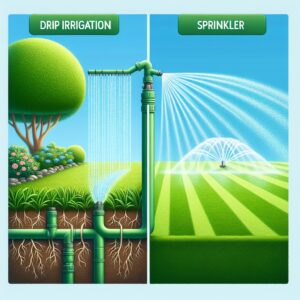
Drip irrigation is often considered the best way to water lime trees. It supplies water right to the root zone, which decreases evaporation and runoff. This technique guarantees that the trees get the correct quantity of water, encouraging strong growth and large harvests.
Sprinkler Irrigation
Watering with sprinklers is another common technique, particularly for bigger groves. It entails sprinkling water over the trees using a system of sprinklers. Although it isn’t as effective as drip watering, it can cover a larger area and is simpler to install.
Micro-Sprinklers
Micro-sprinklers are a smaller version of the traditional sprinkler system. They use smaller nozzles to deliver water in a more precise manner. This system provides a balance between the efficiency of drip irrigation and the coverage of traditional sprinklers.
Flood Irrigation
Flood irrigation is the process of completely flooding the orchard with water. Although this is the least efficient method and wastes a lot of water, it can be beneficial in areas where there is a lot of water. However, it is not recommended for lime orchards because it can lead to overwatering and soil erosion.
What’s the Ideal Irrigation System to Grow Lime?
Given the unique requirements of lime trees, drip irrigation appears to be the superior choice. It delivers water right to the roots, minimizing waste and maintaining the perfect soil moisture levels. Plus, it helps ward off diseases that can be caused by too much moisture on the leaves and stems.
Now that we looked at irrigation systems, let’s take a look at the solar panels that will power them.

Best Solar Panels for Your Lime Orchard’s Irrigation System
Picking the best solar panels is vital for the efficiency and effectiveness of your irrigation system. Here are the best options available:
Monocrystalline Solar Panels
Monocrystalline Solar Panels are famous for their superior efficiency and longevity. They are constructed from a singular crystal structure, which helps them to transform sunlight into electricity more efficiently. Even though they have a higher initial cost, their exceptional performance makes them a valuable investment for those growing limes.
These panels usually have an efficiency rate of 15-22%, which means they can generate more power per square foot than other types. Their durability also ensures they can last for over 25 years with proper maintenance, making them a reliable choice for long-term use. For instance, solar irrigation systems for growing limes benefit greatly from such efficient and durable panels.
Polycrystalline Solar Panels
Polycrystalline Solar Panels are a budget-friendly option compared to single-crystal panels. They are created from several silicon crystals, which reduces the production cost. However, this also leads to a lower efficiency rate, usually ranging from 13-16%. For more information on related systems, check out solar irrigation systems for growing oranges.
Even though they are not as efficient, polycrystalline panels remain a viable choice for lime growers looking for a balance between cost and effectiveness. These panels are also long-lasting, with a lifespan of 20-25 years, but they might require more room to produce the same level of power as monocrystalline panels.
Thin-Film Solar Panels
Thin-film solar panels are the least efficient of the three types, with an efficiency rate of around 10-12%. They are made by depositing thin layers of photovoltaic material onto a substrate, which makes them lightweight and flexible. This flexibility allows them to be used in a variety of applications, including on uneven surfaces.
Thin-film panels may not be the most powerful option, but they are a good choice when you have plenty of space and are budget-conscious. Plus, they’re easy to install and their sleek design can be quite attractive. For more information, check out this guide on solar irrigation systems.
Here is a table showing the pros and cons of using different types of solar panels with an irrigation system on a farm:
|
Panel Type |
Pros |
Cons |
|---|---|---|
|
Monocrystalline Panels |
– High efficiency (15-22%), producing more power per square foot. 1, 2, 4 | |
|
Polycrystalline Panels |
– Lower upfront cost than monocrystalline. 1, 2 |
– Lower efficiency and shorter lifespan than monocrystalline. 2, 4 |
|
Thin-Film Solar Panels |
– Lowest upfront cost. 1, 2 |
– Lowest efficiency (7-13%). 2, 4 |
Which Solar Panels are Most Suitable for Lime Cultivation
Monocrystalline solar panels are a top pick for lime growers because of their high efficiency and longevity. Even though they are more expensive upfront, their superior power generation per square foot and robustness make them a worthy investment over time. For more details on enhancing farm efficiency, check out this guide on solar panels for farms.
If you’re trying to save money initially, polycrystalline panels could be a good choice. Thin-film panels, on the other hand, might be the better option for certain scenarios where flexibility and a lighter weight are prioritized over efficiency.
Comparing Solar and Traditional Irrigation Systems for Lime Cultivation: A Look at Costs and Efficiency
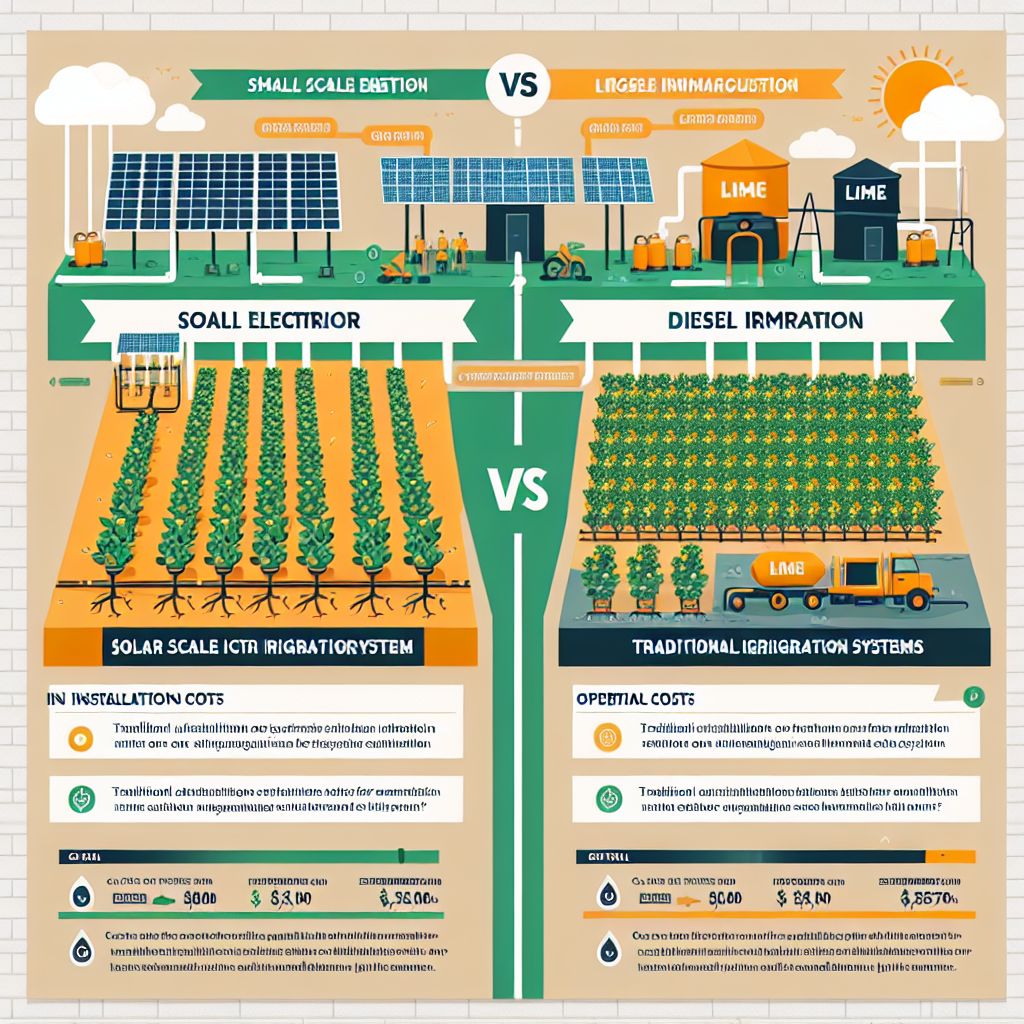
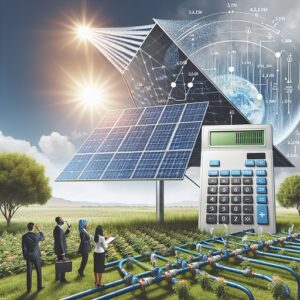
When you’re weighing up the pros and cons of solar irrigation systems against traditional methods, you need to think about both the upfront costs of installation and the ongoing running costs. Let’s take a closer look at what these might be.
Upfront Costs of Both Systems
The upfront costs for solar-powered irrigation systems can be more expensive than conventional systems. This is mainly because of the cost of solar panels, inverters, and other required components. However, these costs can fluctuate depending on the type and size of the system.
For instance, setting up a small solar irrigation system for a lime farm could set you back between $5,000 and $10,000. A larger system might cost anywhere from $20,000 to $50,000. On the other hand, conventional irrigation systems, which use grid electricity or diesel pumps, are usually less expensive to install, but they have higher running costs.
Here’s a table that shows the initial costs:
|
Type of System |
Cost of Initial Installation |
|---|---|
|
Small Scale Solar-Powered Irrigation |
$5,000 – $10,000 |
|
Large Scale Solar-Powered Irrigation |
$20,000 – $50,000 |
|
Traditional Irrigation |
$2,000 – $10,000 |
The Long-Term Operational Costs for Each System
Even though the initial installation costs for solar-powered systems are more expensive, the long-term operational costs are much less. Once the system is installed, solar energy is free, so you don’t have to worry about the cost of electricity or fuel going up.
On the flip side, conventional irrigation systems necessitate continuous outlays for electricity or diesel. In regions where energy is expensive, these costs can accumulate rapidly. Furthermore, solar-powered systems have fewer moving components, resulting in lower maintenance costs over time.
Here is a table comparing the cost and efficiency of an irrigation system with and without solar panels:
|
Aspect |
Without Solar Panels |
With Solar Panels |
|---|---|---|
|
Initial Cost | ||
|
Operating Cost |
Very low or zero fuel/electricity costs after installation. 1, 4 | |
|
Efficiency |
Depends on energy source efficiency. 4 |
Depends on solar radiation, temperature, system design. 1, 4 |
|
Environmental Impact |
Higher carbon footprint. 1 |
Lower carbon footprint, renewable energy. 1 |
|
Location Flexibility |
Limited to grid-connected or fuel access areas. 3 |
Can be used in remote off-grid areas. 3 |
|
Maintenance | ||
|
Lifespan |
Shorter for fuel-based systems. 1 | |
|
Long-term Costs |
Higher due to recurring fuel/electricity bills. 1 |
Lower total 20-year costs by 50-60% compared to traditional systems. 1 |
|
Government Incentives |
Generally none |
Many governments provide tax credits, subsidies for solar irrigation. 1 |
Choosing the Best Solar Panels and Irrigation Systems for Your Lime Orchard
For the most efficient lime orchard, you need to match the best solar panels with the right irrigation system. Here are some of the best combinations:
Top Solar Panel and Drip Irrigation Match: Monocrystalline Solar Panel and Drip Irrigation
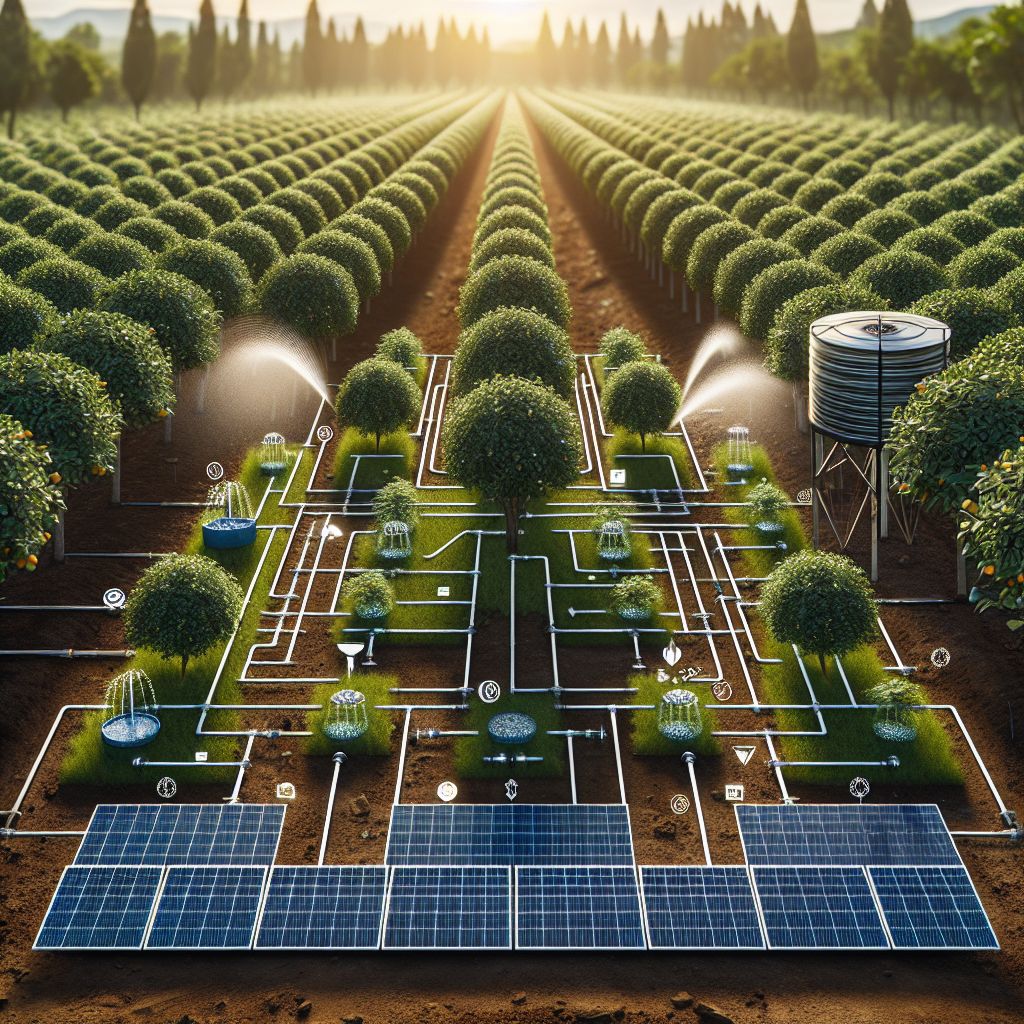
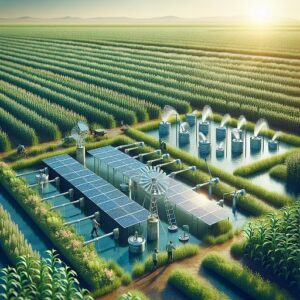
The pairing of monocrystalline solar panels with drip irrigation is the best practice for lime groves. The monocrystalline panels offer high efficiency and dependable power, and the drip irrigation delivers water accurately to the root area.
This system reduces water waste and increases energy efficiency, resulting in healthier trees and larger harvests. Even though it’s more expensive at first, it’s a wise investment because of the long-term benefits.
Best Solar Panel and Micro-Sprinkler Arrangement
If you’re looking to water a larger area or have specific watering needs, combining polycrystalline solar panels with micro-sprinklers can be a good option. This combination provides a nice balance of cost and efficiency.
“Farmers can use polycrystalline panels and micro-sprinklers for accurate watering at a lower startup cost, which is a practical choice for medium-sized lime orchards.”
This arrangement allows for adaptability and guarantees that water is distributed effectively, minimizing waste and encouraging the healthy growth of trees. For more information, check out this guide to growing and irrigating economically.
Choosing the Right Combination Based on Orchard Size and Weather
When deciding on the best combination for your lime orchard, think about the size of your orchard and the local weather. Monocrystalline panels with drip irrigation are perfect for small to medium-sized orchards in sunny areas. On the other hand, larger orchards or areas with inconsistent sunlight may do better with polycrystalline panels and micro-sprinklers.
In the end, the best mix will be determined by your individual requirements and financial constraints. By thoroughly considering these elements, you can design an effective and sustainable watering system that promotes the growth and yield of your lime orchard. For example, you can explore solar irrigation systems for growing oranges to find efficient watering solutions that might suit your needs.
Assessing Various Mixes Based on Grove Size and Weather
When assessing various mixes of solar panels and watering systems, it’s crucial to take into account the size of your lime grove and the specific weather conditions. Smaller groves in sunny areas can benefit greatly from monocrystalline panels combined with drip watering. This arrangement guarantees maximum efficiency and accurate water delivery, which is perfect for maintaining optimal soil moisture levels.
If you have a larger lime grove or an area with inconsistent sun exposure, you might find that polycrystalline panels paired with micro-sprinklers work best. This combination strikes a good balance between price and performance, making sure the water is spread out over a larger area. Plus, micro-sprinklers give you the ability to change up the watering patterns, which can be helpful in areas with unpredictable weather.

Conclusion: Should You Consider Solar-Power for Your Lime Orchard’s Irrigation System?
Integrating solar power with your irrigation system is a wise choice for a number of reasons. It provides long-term financial savings, ecological advantages, and self-sufficiency from the grid. By utilizing the sun’s energy, you can guarantee a dependable and sustainable water source for your lime orchard. For more information, check out this guide on solar panels for farm irrigation systems.
Furthermore, pairing solar panels with effective watering techniques such as drip irrigation can enhance the benefits, minimizing water waste and fostering robust tree development. Although the upfront costs might be more, the long-term savings and positive effect on the environment make it a valuable option for lime growers.
Benefits Overview
These are the main advantages of using a solar-powered irrigation system for your lime orchard:
Considerable savings on energy bills over the long term.
Reduced greenhouse gas emissions for environmental benefits.
Steady and consistent water supply that doesn’t rely on grid power.
Efficient use of water to minimize waste and promote healthy tree growth.
Solar panels that are durable and have low maintenance costs.
Possible Challenges and Considerations
Even though solar-powered irrigation systems have many advantages, there are some potential challenges to keep in mind:
While the initial installation costs are high, you’ll recoup your investment over time.
Sunlight is required for operation, which could be a problem in areas with inconsistent sunlight.
Solar panels require maintenance, but it’s usually not too much.
You may need to invest in additional storage solutions, such as batteries, to ensure a steady power supply.
FAQs
Here are some frequently asked questions about solar-powered irrigation systems for lime orchards:
What Savings Can I Expect by Transitioning to a Solar-Powered Irrigation System?
The savings you can anticipate by transitioning to a solar-powered irrigation system are contingent upon numerous factors, such as the size of your orchard, the kind of system you opt for, and local energy costs. On average, farmers can anticipate a reduction in their energy bills between 50-70% over the system’s lifespan.
How to Maintain Solar Panels?
Compared to other energy sources, solar panels require very little maintenance. All you need to do is clean them regularly to remove any dust or debris and occasionally check to make sure they’re working properly. Plus, most solar panels come with a 20-25 year warranty, so you can trust they’ll last a long time.
Are Solar Panels Capable of Supplying All the Power I Need for Irrigation?
Indeed, solar panels have the capacity to supply all the power you need for irrigation, particularly if you opt for high-efficiency panels such as monocrystalline. The trick is to correctly size your solar array to match the power demands of your irrigation system and the amount of sunlight in your area.
Do Governments Provide Incentives for Solar Panel Installation?
Indeed, various governments provide incentives for solar panel installation, including tax credits, rebates, and grants. These incentives can significantly lower the initial installation costs, making it more affordable for farmers to install solar-powered irrigation systems.
Look into incentives that might be available from local or federal government programs.
Speak with solar installation companies to get a sense of the potential financial benefits.
Think about financing options that might be available through agricultural programs.
What are Some Tips for Successfully Implementing Solar-Powered Irrigation Systems?
Here are some tips to help ensure the successful implementation of a solar-powered irrigation system:
Complete a detailed evaluation of your watering requirements and the amount of sunlight you have available.
Select solar panels that are highly efficient, such as monocrystalline, for the highest power yield.
Combine your solar panels with a watering technique that is efficient, such as drip irrigation.
Make sure to regularly maintain and inspect your solar panels to ensure they are performing at their best.
Utilize government incentives to lower the initial cost of installation.
By adhering to these guidelines, you can establish an irrigation system that is both sustainable and efficient, which will support the growth and productivity of your lime orchard for many years.

Leave a Reply