
Key Takeaways
- Strategic solar panel placement can increase farm energy production by up to 30% when optimally oriented, directly improving ROI and operational sustainability.
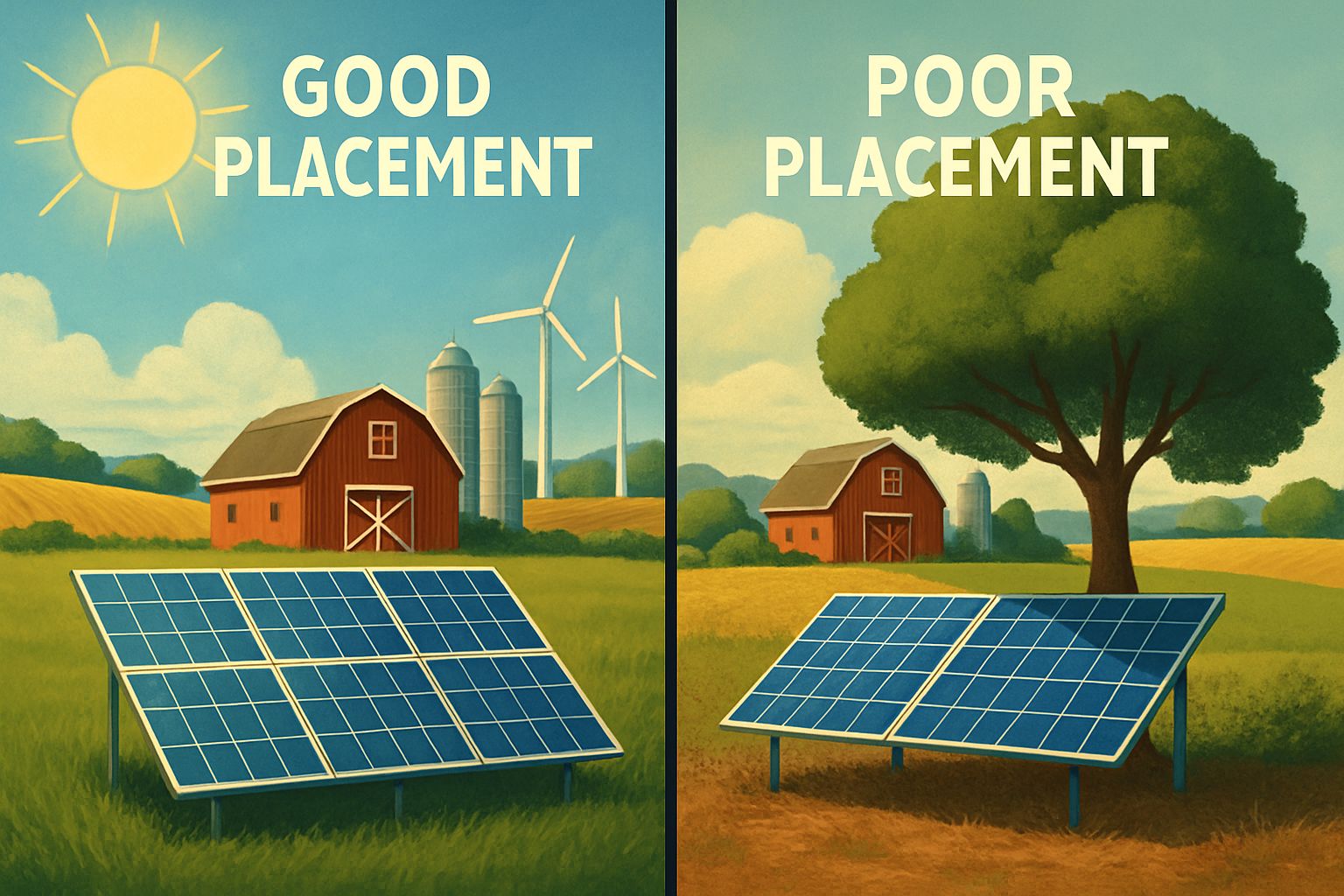
- Even partial shade on solar arrays reduces output by 25-40%, making shade-free placement the most critical factor for farm solar performance.
- Dual-use solar installations (agrivoltaics) allow for continued farming under panels, creating beneficial microclimates for certain crops while generating clean energy.
- The choice between ground-mounted and roof-mounted systems impacts both energy efficiency and land utilization on agricultural operations.
- 8M Solar specializes in agricultural solar solutions that enhance farm efficiency through sustainable energy integration tailored to your specific operation.
Your solar panels’ placement determines whether your farm’s renewable energy investment thrives or withers. The difference between optimal and poor positioning can mean harvesting 40% less energy—essentially leaving money on the table while still paying full price for your system. Strategic solar panel placement isn’t just about energy production; it’s about integrating renewable technology with your agricultural operations to create a synergistic relationship that benefits both.
Why Solar Panel Placement Makes or Breaks Your Farm’s Energy Investment
When farmers invest in solar technology, they often focus primarily on system size and panel efficiency ratings. However, these specifications become largely irrelevant if panels aren’t strategically positioned to capture maximum sunlight throughout the day and across seasons. Poor positioning decisions made at installation can handicap your system’s performance for its entire 25+ year lifespan, limiting both energy production and financial returns. The positioning of your array fundamentally determines how much sunlight your panels can convert into usable electricity for your farm operations.
The 30-40% Energy Loss from Poor Positioning
Incorrectly placed solar arrays can suffer production losses ranging from 30-40% compared to optimally positioned systems with identical components. This efficiency gap represents thousands of kilowatt-hours annually that could have powered irrigation systems, climate control in livestock buildings, or processing equipment. For a medium-sized farm operation, this translates to $3,000-$5,000 in unnecessary annual energy costs that proper placement would have eliminated. The compounded effect over a system’s lifetime can exceed $100,000 in lost energy production—all because of initial placement decisions. 8M Solar regularly helps farmers avoid these costly positioning mistakes through thorough site assessments that identify ideal placement locations.
How Strategic Placement Reduces Energy Costs by 70-90%
Properly positioned solar arrays typically reduce farm energy costs by 70-90%, providing decades of stable, predictable power pricing. This dramatic reduction fundamentally transforms farm economics by converting a variable monthly expense into a fixed asset that generates free electricity after the payback period. Strategic placement ensures your system achieves maximum production during peak rate periods, when electricity from the grid is most expensive. When panels are positioned to align with your farm’s specific energy usage patterns, you maximize both energy and financial returns.
A 100-kilowatt system strategically placed can offset approximately $15,000-$20,000 in annual utility costs for typical agricultural operations. These savings directly improve profit margins without requiring any changes to your core farming practices. Additionally, properly positioned arrays reach payback faster—typically 5-7 years compared to 8-12 years for poorly positioned systems—allowing you to enjoy free electricity for the majority of the system’s lifespan.
Creating Beneficial Microclimates with Proper Panel Integration
Beyond energy production, strategically placed solar arrays create beneficial microclimates that can enhance certain agricultural activities. The partial shade beneath panels reduces water evaporation by up to 30%, helping maintain soil moisture during dry periods. This microclimate effect is particularly valuable for water-intensive crops and can reduce irrigation requirements while improving drought resilience. Temperature moderation under panels can also extend growing seasons for certain crops and provide shade for livestock during intense summer heat. For more insights, check out this article on solar panel placement for farm efficiency.
Innovative farmers are increasingly using these microclimate benefits as part of their cultivation strategy, deliberately placing panels to create optimal growing conditions for specific crops. For example, partial shade from elevated panels has shown to increase yields for lettuce, spinach, and certain berries during hot summer months when these crops typically struggle. The integration of solar placement with agricultural planning represents the future of sustainable farming—where energy production and crop cultivation work together rather than competing for resources.

South-Facing Orientation: The Foundation of Farm Solar Success
The cardinal direction your panels face represents the single most fundamental placement decision. In the Northern Hemisphere, south-facing panels capture the maximum possible sunlight throughout the day as the sun arcs across the southern portion of the sky. This orientation provides the strongest foundation for solar success, particularly for fixed (non-tracking) systems common on agricultural operations. While seemingly obvious, many farm installations compromise on orientation due to existing building alignments or other constraints, resulting in significant production losses that persist for decades.
30% Energy Production Increase Compared to Other Directions
South-facing solar panels produce approximately 30% more energy annually than east or west-facing arrays of identical size and specifications. This production advantage directly translates to faster payback periods and improved financial returns. For a typical 50-kilowatt farm system, optimal southern orientation generates an additional 20,000+ kilowatt-hours annually compared to panels facing other directions—enough to power substantial agricultural equipment or processing operations.
When evaluating potential solar sites on your farm, prioritize locations that allow for uncompromised southern exposure. Even a 15-20° deviation from true south results in measurable production losses, while east or west orientations sacrifice significant energy potential. If building placement constrains orientation options, consider ground-mounted systems that can be perfectly aligned regardless of existing structure orientations.
Seasonal Sun Path Considerations for Your Location
The sun’s path varies dramatically across seasons, particularly in northern farming regions where winter daylight hours shrink substantially. Understanding your specific location’s seasonal sun patterns allows for optimal placement that accounts for these variations. During winter months, the sun travels a lower, shorter arc across the southern sky, making proper orientation even more critical for maintaining production during these periods. For more insights on the benefits of solar panels for farming, explore our detailed guide.
Ideal solar placement requires considering your farm’s latitude, which determines the optimal tilt angle for your panels. A general rule of thumb is to set the tilt equal to your latitude for best year-round performance. For example, farms located at 40° north latitude should ideally position panels at a 40° angle from horizontal. This positioning maximizes annual production by balancing summer and winter solar exposure patterns.
Seasonal sun patterns also impact spacing requirements between rows of ground-mounted panels. Insufficient spacing causes winter shading when sun angles are low, as each row can cast shadows on the row behind it. Professional solar designers use solar pathfinder tools and software simulations to visualize these seasonal patterns and determine proper spacing for your specific latitude.
When East-West Orientation Makes Sense for Morning/Evening Operations
While south-facing orientation maximizes total energy production, some farming operations benefit from east-west orientations that align with specific operational needs. Farms with significant morning energy demands—such as dairy operations with AM milking schedules—may benefit from eastern-facing arrays that generate more power during early hours. Similarly, operations with evening processing requirements might optimize with western exposure to capture late-day sunlight. For more insights on solar energy applications in agriculture, explore the top benefits of solar panels for farming.
East-west split arrays, where panels face in both directions, create a more balanced daily production curve that better matches consumption patterns on farms with consistent daytime energy usage. This configuration sacrifices some total production but distributes generation more evenly throughout the day, reducing reliance on grid electricity during morning and evening hours when many farms experience operational peaks.
For some agricultural operations, this production timing advantage outweighs the raw output benefit of southern orientation. A thorough energy audit revealing your farm’s usage patterns will determine whether this specialized orientation strategy makes sense for your specific operation.
Ground vs. Roof: Choosing the Right Mounting System for Your Farm
The decision between ground-mounted and roof-mounted solar systems represents one of the most significant placement choices for agricultural operations. Each approach offers distinct advantages that may align better with specific farm types, available space, and operational needs. This fundamental choice impacts not only energy production but also installation costs, maintenance requirements, and potential agricultural integration.
Benefits of Ground-Mounted Systems for Cooling and Maintenance
Ground-mounted arrays typically outperform roof installations by 8-12% due to superior airflow cooling that prevents efficiency losses from heat buildup. Solar panels lose approximately 0.5% efficiency for every degree Celsius above their rated temperature, making the cooling advantage significant in hot farming regions. Ground systems also facilitate easier cleaning and maintenance, crucial for agricultural environments where dust, pollen, and bird droppings regularly accumulate on panel surfaces.
The flexibility of ground mounting allows for perfect orientation and tilt regardless of existing structure alignments. This positioning advantage means you never compromise on solar exposure for convenience. Additionally, ground systems can be expanded more easily as your farm’s energy needs grow, providing valuable scalability that roof systems often lack due to space constraints.
When Roof Mounting Preserves Valuable Farmland
Roof-mounted systems preserve precious agricultural land for continued crop production or livestock grazing, making them ideal for farms where productive acreage is limited or particularly valuable. By utilizing the otherwise unused “airspace” above existing farm buildings, roof installations essentially create dual-purpose structures that provide both operational space and energy generation. Barns, equipment sheds, and processing facilities with large, structurally sound roofs become power plants without consuming additional land resources.
Roof mounting also typically costs 10-15% less than ground installations due to reduced structural requirements and foundation work. The existing building provides the necessary elevation and support structure, eliminating expenses associated with ground-mount racking systems. For farms with large metal buildings constructed within the past 20 years, roof systems often represent the most cost-effective solar solution with minimal structural modifications required.
Elevated Systems that Allow Continued Farming Underneath
Innovative elevated mounting systems represent the best of both approaches by allowing continued agricultural activity beneath ground-mounted arrays. These specialized installations raise panels 8-12 feet above ground level, providing clearance for grazing animals, certain field equipment, or shade-tolerant crop cultivation. The dual-land-use approach maximizes return per acre by generating both agricultural products and renewable energy from the same footprint.
The emerging field of agrivoltaics—the integration of solar energy with agriculture—shows particular promise for these elevated systems. Research demonstrates that certain crops, including many leafy greens, berries, and root vegetables, actually perform better under the partial shade created by properly spaced solar panels. The panels create favorable microclimates that reduce water requirements and protect sensitive plants from extreme heat and light stress.
Sheep grazing represents another successful integration strategy, with flocks maintaining vegetation around solar installations while benefiting from the shade and protection the panels provide. This symbiotic relationship eliminates mowing expenses while providing additional farm income through livestock production.
Cost Comparison Between Installation Types
Installation Type
Average Cost ($/watt)
Space Requirement
Maintenance Access
Cooling Efficiency
Standard Roof Mount
$2.20-$2.60
100 sq ft per kW
Limited
Moderate (Heat buildup issues)
Standard Ground Mount
$2.40-$2.90
150-200 sq ft per kW
Excellent
Excellent
Elevated Agrivoltaic
$2.80-$3.40
200-250 sq ft per kW
Good
Excellent
Tracking Ground Mount
$2.90-$3.60
250-300 sq ft per kW
Good
Excellent
Shade-Free Placement: The #1 Factor for Solar Panel Performance
While orientation receives much attention, shade avoidance represents the single most critical placement factor for farm solar systems. Even minimal shading dramatically impacts performance in ways that surprise many farmers. Modern solar panels connect cells in series, meaning shade on even 5-10% of a panel’s surface can reduce output by 25-40% due to the “weakest link” electrical effect. This disproportionate production loss makes identifying and avoiding all potential shade sources essential for system performance. For more insights on solar panel benefits, check out the top benefits of solar panels for farming.
Why Even Partial Shade Cuts Output by 25-40%
Solar panels operate based on the principle that the weakest cell determines the performance of the entire string. When shade falls on even a single cell, it creates high resistance that affects the entire panel. This phenomenon, known as the “Christmas light effect,” means one shaded cell can reduce an entire panel’s output by 30% or more. For agricultural installations where dust, pollen, and bird droppings are common, this sensitivity to partial shading becomes especially problematic.
Most farm solar arrays connect multiple panels in series strings, magnifying this effect across the system. A small tree shadow that covers just 5% of your array might reduce total system output by a quarter or more. This disproportionate impact makes shade avoidance far more important than minor improvements in panel efficiency or other technical specifications. The best high-efficiency panels on the market can’t overcome the dramatic production losses caused by even minimal shading.
Mapping Shade Patterns Across Seasons
Effective shade mapping requires understanding how shadow patterns change throughout the year. Winter shadows extend significantly longer than summer ones, sometimes reaching three times the height of the object casting them. This seasonal variation means objects that cause no shading during site assessment in summer may create substantial shadows during winter months when the sun sits lower in the sky. Professional solar assessments use specialized tools to model these seasonal shadow patterns before finalizing panel placement.
When evaluating potential solar locations on your farm, consider shadow patterns from all nearby objects, including buildings, equipment, silos, trees, and even temporary structures. Remember that young trees planted today may cast significant shadows on your panels in five to ten years as they mature. Plan for future growth and potential additions to farm infrastructure that might create shade in coming years.
Drone-based shade analysis offers advanced farms a comprehensive view of potential solar locations, capturing shadow movements throughout the day and identifying optimal placement zones. These tools generate heat maps showing cumulative sun exposure across your property, highlighting ideal locations for maximum production.
Distance Requirements from Trees, Buildings and Equipment
As a general rule, maintain a distance from potential shade sources equal to at least 2.5 times their height for southern exposures (in the Northern Hemisphere). For example, a 20-foot tall barn would require at least 50 feet of clearance to its north to prevent winter shadows from reaching solar panels. Eastern and western sides require 1.5-2 times the object height for morning and afternoon shade avoidance. These calculations assume relatively flat terrain; sloped land requires more complex shadow analysis.
Farm equipment and machinery storage areas should remain well separated from solar installations, not just for shade avoidance but to prevent dust and exhaust from degrading panel performance. Crop processing activities that generate airborne particles similarly should be distanced from solar arrays to minimize cleaning requirements and performance degradation. The ideal solar placement combines excellent southern exposure with sufficient distance from all farm operations that might create shade or airborne contamination.
5 Steps to Determine Your Farm’s Ideal Solar Placement
Finding your farm’s optimal solar placement doesn’t require guesswork. Follow this systematic approach to identify the locations that will maximize both energy production and operational integration. The process combines technical solar considerations with agricultural operational needs to create a customized strategy for your specific farm.
1. Complete a Comprehensive Site Assessment
Begin with a thorough evaluation of your property’s solar potential, identifying all locations with unobstructed southern exposure. This assessment should include shade analysis across seasons, not just current conditions. Measure solar access using a solar pathfinder tool or professional assessment that tracks sunlight availability throughout the day and year. Document existing structures, tree lines, and topographical features that impact potential placement options.
The site assessment should also evaluate soil conditions for ground-mounted options, roof structural capacity for rooftop systems, and proximity to your electrical interconnection point. The distance from your solar array to your electrical panel directly impacts wiring costs and system efficiency, with shorter distances minimizing both line losses and installation expenses. Additionally, consider future farm development plans to ensure solar placement won’t interfere with anticipated expansions or new construction.
2. Analyze Your Farm’s Energy Usage Patterns
Examine at least 12 months of electricity bills to understand your farm’s consumption patterns across seasons. Note when your operation uses the most energy—whether during summer irrigation, fall harvest processing, or winter heating periods. Identify daily usage patterns, particularly if your operation has predictable peak demand times like morning milking or evening processing. These patterns will guide optimal panel orientation to align production with consumption.
For operations with highly seasonal energy demands, placement should prioritize maximizing production during those peak periods rather than total annual output. For instance, farms with heavy summer irrigation loads benefit from a slightly flatter tilt angle that captures more summer sun, even if that reduces winter production. This customized approach ensures your system generates maximum power when your operation needs it most.
3. Match Panel Placement to Operational Requirements
Beyond energy production, consider how solar placement integrates with your farming activities. Evaluate whether panel locations will interfere with equipment movement, field access, or aerial applications. Consider whether elevated systems might create beneficial shade for livestock or heat-sensitive crops. Map out all regular farm activities and ensure solar placement enhances rather than hinders these operations.
For livestock operations, consider integrating panels with grazing rotations or providing shade in otherwise exposed pastures. Dairy farms might position arrays to shade holding areas or create cooler microclimates near milking facilities. Horticultural operations can explore agrivoltaic systems where certain crops grow beneath partially elevated panels. The most successful farm solar installations create synergies between energy production and agricultural activities rather than treating them as separate systems.
4. Calculate ROI for Different Placement Options
Develop financial models for several placement alternatives, comparing installation costs, expected energy production, and maintenance requirements. Remember that higher initial investment in optimal placement often yields better long-term returns through increased production. Calculate simple payback periods and 25-year return on investment for each option, accounting for panel degradation over time.
When comparing ground and roof options, factor in the opportunity cost of land use for ground systems versus the potentially lower production of roof installations. For farms with high-value crops, the income foregone from land dedicated to ground-mounted solar may significantly impact the actual ROI. Conversely, farms with marginal land might find ground systems far more economical when all factors are considered.
Include maintenance costs in your calculations, recognizing that easier access typically means more regular cleaning and better long-term performance. Systems requiring specialized equipment for access often suffer from deferred maintenance and corresponding production losses over time. To learn more about improving efficiency, explore the benefits of solar panels for farm operations.
5. Consult with Agricultural Solar Specialists
Partner with solar professionals who understand the unique requirements of farm operations rather than residential or commercial installers without agricultural experience. Agricultural solar specialists recognize the importance of planning around seasonal farm activities, equipment clearance needs, and integration with irrigation systems or livestock operations. They can provide valuable insights on placement options specific to your type of agricultural production.

Seasonal Tilt Adjustments to Maximize Year-Round Energy
For farms seeking to extract maximum value from their solar investment, seasonal tilt adjustments offer a practical way to boost annual production without the complexity of full tracking systems. By adjusting panel angles to match seasonal sun height, you optimize energy capture throughout the year despite changing solar paths. These adjustments are particularly valuable for agricultural operations with seasonal energy demands that align with natural solar patterns.
5-8% Annual Production Boost from Proper Tilting
Implementing a simple twice-yearly tilt adjustment strategy typically increases annual energy production by 5-8% compared to fixed systems set at average angles. This production boost comes from matching panel angles to seasonal sun heights—steeper in winter when the sun travels a lower path and flatter in summer when the sun rises higher. For a 50 kW farm system, this adjustment strategy can generate an additional 3,000-5,000 kilowatt-hours annually without any additional panel investment.
Manual vs. Automated Tracking Systems
Manual seasonal adjustments provide an excellent balance of improved performance and system simplicity. Typically adjusted twice yearly (spring and fall), this approach captures most potential production gains while minimizing mechanical complexity and maintenance requirements. The process involves simply changing mounting brackets to predetermined seasonal settings, usually taking just a few hours for an entire farm system. For more insights on optimizing solar panel placement, you can explore farm efficiency optimization.
Automated tracking systems that continuously adjust panel positioning throughout the day can increase production by 25-40% compared to fixed installations, but they come with significant trade-offs. These systems add substantial upfront costs, introduce mechanical failure points, require ongoing maintenance, and consume some of the energy they produce to operate motors and control systems. For most agricultural applications, the added complexity and maintenance requirements of full tracking systems outweigh their production advantages. To explore more about the investment benefits for farmers, check out this resource.
Aligning Tilt with High-Demand Agricultural Periods
Strategic farmers align their seasonal tilt adjustments with their operation’s peak energy demand periods. For example, dairy operations with high cooling needs during summer months benefit from flatter panel angles that maximize production during these periods, even if that slightly reduces overall annual output. Similarly, operations with significant winter energy demands, such as year-round greenhouse production, may maintain steeper winter angles longer to support those specific operational needs.
The optimal adjustment schedule depends on your specific agricultural activities and when your operation consumes the most energy. Farms with consistent year-round energy consumption typically adjust twice yearly—around March 21 and September 21—to align with the equinoxes. Operations with more seasonal energy patterns might implement three or four adjustments to better match production with specific agricultural cycles.
Dual-Use Solar: Combining Energy Production with Active Farming
The most innovative agricultural solar installations no longer force choices between energy production and farming—they combine both activities on the same land through thoughtful placement strategies. These dual-use approaches, often called agrivoltaics, represent the frontier of sustainable agriculture by creating complementary relationships between solar generation and crop or livestock production.
Agrivoltaics: Growing Crops Under Elevated Panels
Research from multiple agricultural regions demonstrates that certain crops actually perform better under the partial shade of properly designed solar arrays. These systems typically feature panels mounted 8-14 feet high with wider spacing than conventional installations, creating a dappled light environment below. This modified microclimate reduces water requirements by 20-30% through decreased evaporation while protecting plants from extreme heat and light stress during peak summer conditions. To explore more about how these systems benefit farm operations, check out the solar panels benefits for farm operations.
Leafy greens, root vegetables, berries, and certain herbs have shown productivity increases of 10-30% in these systems compared to full-sun cultivation in hot regions. The panels create favorable growing conditions by reducing plant stress while still providing sufficient light for photosynthesis. The economic advantage is substantial—generating both electricity and high-value crops from the same acreage while reducing irrigation demands. For more insights, consider the top benefits of solar panels for farming.
Livestock Grazing Benefits in Solar Fields
Sheep grazing represents the most successful livestock integration with solar installations, providing multiple benefits to both energy and animal production systems. The sheep naturally maintain vegetation around panels, eliminating mowing expenses while gaining access to sheltered grazing areas. Studies show that solar pastures can support approximately 80% of the sheep density of conventional pastures while simultaneously producing clean energy.
Shade-Tolerant Crops that Thrive with Partial Panel Coverage
Beyond the general benefits of agrivoltaic systems, certain crops demonstrate particular affinity for the modified light conditions beneath solar panels. Partial shade crops like ginseng, shiitake mushrooms, many berry varieties, and native medicinal herbs often command premium prices that complement solar revenues. These high-value specialty crops typically require shade cloth or other protection in conventional production systems—needs that strategically placed solar panels satisfy naturally while generating electricity.
Start Harvesting Solar Success with Smart Placement Decisions Today
Strategic solar panel placement represents your farm’s most important renewable energy decision—one that will impact your operation’s profitability and sustainability for decades. By prioritizing proper orientation, avoiding all potential shading, selecting appropriate mounting systems, and considering seasonal adjustments, you position your agricultural business to maximize both energy production and operational integration. Remember that the decisions you make today about panel placement will determine your system’s performance for its entire 25-30 year lifespan.
Frequently Asked Questions
As you plan your farm solar installation, you likely have specific questions about how placement affects your unique agricultural operation. These frequently asked questions address the most common concerns we hear from farmers considering solar integration.
Understanding these fundamental aspects of agricultural solar placement helps ensure your renewable energy investment delivers maximum returns while supporting your farm’s primary production goals.
How much land do I need for a farm solar system that can offset 100% of my energy usage?
For ground-mounted systems, plan on approximately 7-10 acres per megawatt of solar capacity, though this varies based on panel efficiency and row spacing. A typical mid-sized farm using 60,000 kWh annually would require approximately 45-50 kW of solar capacity, occupying about 1/3 to 1/2 acre of land. Roof-mounted systems require no additional land but depend on available suitable roof space—typically 350-400 square feet per 10 kW of capacity depending on panel efficiency. Learn more about the financial benefits of solar panels for farmers.
Can I still use farm equipment around ground-mounted solar panels?
Standard ground-mounted solar installations typically require a buffer zone of 15-20 feet for equipment operation to prevent accidental damage and avoid creating temporary shade. This separation helps ensure tractors, sprayers, and harvesters can operate normally without risk to the solar infrastructure. Access lanes should be planned during initial placement to maintain normal farm operations.
For operations requiring closer integration, specialized elevated mounting systems can provide 8-14 feet of clearance underneath panels, allowing for equipment passage or livestock movement. These systems cost approximately 15-25% more than standard ground mounts but enable continued productive use of the land beneath the array.
Some innovative farms design solar placement specifically to create beneficial zones for equipment washing, maintenance, or storage, taking advantage of the rain runoff patterns from panel surfaces. This integrated approach treats solar infrastructure as a multifunctional farm asset rather than a single-purpose energy system. For more insights, explore the best solar panel placement for farm efficiency.
How do snow accumulation and severe weather affect panel placement decisions?
In regions with significant snowfall, panels should be installed at a minimum 35-degree tilt to facilitate natural snow shedding. Panel rows require additional spacing in these areas to accommodate snow accumulation without creating mutual shading issues. Systems in heavy snow zones benefit from raised mounting that prevents panels from becoming buried during major snow events. For farmers considering the investment, understanding the benefits of solar panels can be crucial for making informed decisions.
For farms in high-wind areas, placement should account for both aerodynamic forces and potential flying debris. Lower profile installations with reinforced mounting generally perform better in these conditions. Wind breaks from natural features or tree lines can help protect systems when properly designed to avoid shading issues.
What are the current tax incentives for strategic solar panel placement on agricultural land?
Agricultural solar installations currently qualify for the federal Investment Tax Credit (ITC), which provides a 30% credit against tax liability for systems installed before 2032. Additionally, farm solar systems qualify for accelerated depreciation through the Modified Accelerated Cost Recovery System (MACRS), allowing for recovery of the investment over just 5 years. Many states offer additional agricultural solar incentives, including property tax exemptions, sales tax relief, and performance-based incentives that reward optimal placement and production.
How long does it typically take to recover the investment in properly placed farm solar systems?
Optimally placed farm solar systems typically achieve payback periods of 5-9 years in most agricultural regions, though this varies significantly based on local utility rates, available incentives, and specific farm energy consumption patterns. Systems that maximize southern exposure with optimal tilt angles and zero shading consistently perform at the faster end of this payback spectrum, highlighting the financial impact of proper placement decisions.
After the payback period, these systems typically generate free electricity for an additional 15-20 years, delivering substantial long-term savings. Farms with high daytime energy consumption patterns—such as dairy operations, packing facilities, or irrigation systems—generally see faster returns than those with primarily evening energy usage. For more insights, explore how farmers are embracing solar power.
The economics improve further when considering the rising trend of agricultural electricity rates, which have increased approximately 4-6% annually in most regions over the past decade. Properly placed solar systems effectively lock in electricity costs for decades, protecting farm operations from these continued utility rate increases.
Remember that placement decisions made at installation permanently impact system performance and financial returns. Taking time to optimize placement delivers benefits throughout the system’s entire operational life.







Leave a Reply