
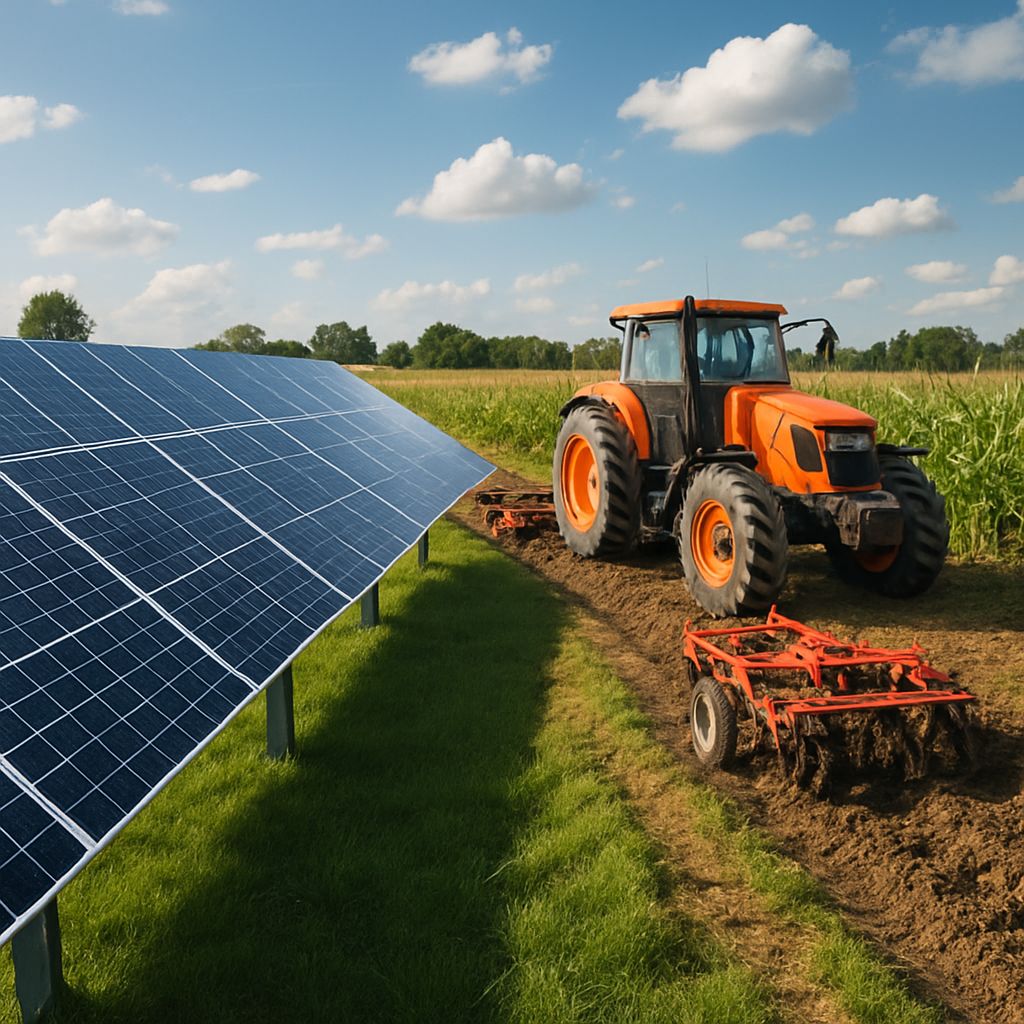
Key Takeaways
- Solar panels can reduce a farm’s operating expenses by up to 70%, creating substantial long-term savings on electricity costs.
- Farmers can access numerous financial incentives including the 30% federal tax credit, USDA REAP grants covering up to 25% of system costs, and state-specific agricultural rebates.
- Solar installations typically achieve payback in 5-8 years for agricultural operations while providing reliable energy for 25+ years.
- Implementing solar provides protection against rising utility rates, which have increased by an average of 3-5% annually over the past decade.
- Modern agrivoltaic systems allow farmers to continue growing crops or grazing livestock beneath solar arrays, effectively doubling land productivity.
What is Solar Power and Why Farmers Need it to Stay Ahead
Farm operations demand substantial energy for everything from irrigation systems to climate control for livestock. As energy costs continue to rise, farmers face tightening profit margins with traditional power sources. Solar power offers a sustainable alternative that converts free sunlight into electricity, dramatically reducing or eliminating utility bills while providing energy independence.
Today’s agricultural landscape requires innovation to maintain competitiveness, and energy management represents one of the most significant opportunities for cost control. Modern farming operations can consume tens of thousands of kilowatt-hours annually, making electricity one of the largest controllable expenses on most farms. By generating their own power through solar installations, farmers can lock in energy costs for decades, creating predictable expenses in an otherwise unpredictable business environment.
How Solar Panels Convert Sunlight to Electricity for Farm Operations
Solar photovoltaic (PV) systems work through a remarkably efficient process that requires no moving parts. When sunlight hits the silicon cells within solar panels, it excites electrons and creates an electric current. This direct current (DC) electricity travels through an inverter, which converts it to alternating current (AC) that’s compatible with farm equipment and buildings. The entire system integrates with the existing electrical infrastructure, allowing seamless power distribution to irrigation pumps, ventilation systems, refrigeration units, and other essential farm equipment. Modern solar technology has advanced significantly, with today’s panels maintaining 80-90% efficiency even after 25 years of operation—essentially providing a lifetime of reliable power for most agricultural applications.
Rising Energy Costs Threatening Farm Profitability
Agricultural operations face a growing challenge as energy expenses claim an increasingly larger portion of operating budgets. Utility rates have increased by 3-5% annually over the past decade, outpacing inflation and putting additional pressure on already thin profit margins. For energy-intensive operations like dairy farms, poultry houses, and irrigated crop production, electricity often represents 15-30% of variable production costs.
- Irrigation pumping costs can exceed $50,000 annually for farms with substantial water requirements
- Climate control for livestock facilities typically accounts for 40-60% of a farm’s total electricity consumption
- Cold storage and processing equipment operation often requires continuous power, creating year-round energy demands
- Off-peak pumping and operations become increasingly difficult as time-of-use rates penalize consumption during high-demand periods
Without intervention, these escalating energy costs threaten the long-term viability of many agricultural operations, particularly small and mid-sized family farms. Solar power provides a direct counter to this trend by shifting energy production to the farm itself, eliminating exposure to utility rate hikes and creating predictable energy expenses for decades.

“Solar Panels Benefits for Farmers …” from growingsolarmist.com and used with no modifications.
Financial Benefits of Solar Panel Investment for Farmers
The decision to invest in solar energy represents a strategic financial move for agricultural operations. Unlike many farm expenses that represent ongoing costs, solar installations provide immediate returns through reduced electricity bills while appreciating in value as utility rates increase. The economics become particularly compelling when considering current incentive programs specifically designed for agricultural applications.
- Reduced operating expenses through immediate 30-70% reduction in monthly electricity costs
- Protection against future rate increases, effectively locking in energy costs for 25+ years
- Increased property value without corresponding property tax increases in many jurisdictions
- Potential revenue stream through selling excess energy back to the grid via net metering
- Enhanced marketing opportunities through sustainable farming certification programs
When properly sized and configured, solar installations typically achieve complete return on investment within 5-8 years while continuing to produce power for decades afterward. This creates what financial analysts call “the solar dividend”—essentially free electricity for 15-20 years after the system has paid for itself. For farms with significant energy demands, this dividend can represent hundreds of thousands of dollars in operational savings over the system’s lifetime.
Immediate Reduction in Monthly Electric Bills
From the moment a solar system is commissioned, farms experience dramatic decreases in utility expenses. Agricultural operations with properly sized systems typically see 50-100% reduction in their electricity bills, creating immediate positive cash flow that can be redirected to other farm investments or operational needs. For dairy operations, which use substantial electricity for milk cooling, pasteurization, and cleaning systems, these savings often exceed $1,500-2,500 monthly. Poultry farms, which require continuous ventilation and climate control, frequently report savings between $2,000-4,000 per month after solar implementation. These immediate reductions create financial breathing room in tight agricultural budgets while improving overall farm resilience.
Protection Against Future Utility Rate Increases
One of the most compelling financial advantages of solar for agricultural operations is protection against rising electricity costs. While traditional farms remain vulnerable to utility rate hikes, solar-powered operations effectively lock in their energy costs for decades. Historical data shows utility rates increasing 3-5% annually, meaning what costs $1,000 today could exceed $2,600 in 20 years with traditional power sources.
By generating their own electricity, farmers essentially pre-purchase 25+ years of power at a fixed rate determined by their installation cost divided by lifetime production. This creates remarkable budget predictability in an industry where variable costs often determine profitability. For large operations with substantial energy requirements, this rate stabilization alone can justify solar investment, regardless of other financial incentives.
Tax Credits That Cut Installation Costs by 30%
The federal Investment Tax Credit (ITC) represents one of the most significant financial incentives for agricultural solar adoption. This program currently allows farmers to deduct 30% of the total system cost from their federal tax liability. For a typical farm installation costing $100,000, this translates to $30,000 in direct tax savings. Unlike deductions that merely reduce taxable income, this credit provides dollar-for-dollar reduction in actual taxes owed. To further enhance solar efficiency, farmers can explore how drones boost farm solar panel efficiency.
Agricultural operations structured as businesses can also take advantage of Modified Accelerated Cost Recovery System (MACRS) depreciation, which allows writing off the remaining system value over just 5 years instead of the 25+ year system lifespan. This accelerated depreciation creates substantial tax benefits in the initial years after installation, further improving project economics and shortening the payback period.
Accelerated Depreciation Benefits for Farm Businesses
Beyond the ITC, farm businesses can leverage powerful depreciation incentives that significantly improve solar economics. The Section 179 deduction allows qualifying agricultural businesses to deduct the full cost of solar equipment in the first year rather than depreciating it over multiple years. When combined with bonus depreciation provisions, these incentives can reduce effective system costs by an additional 15-25% beyond the ITC savings.
For farm operations with substantial tax liability, these accelerated depreciation benefits create immediate financial returns that dramatically improve project economics. Working with agricultural tax specialists to optimize these benefits is crucial, as proper structuring can sometimes reduce effective system costs by over 50% through combined incentives. This makes solar installations remarkably affordable compared to their long-term energy production value.
Net Metering: Getting Paid for Excess Energy Production
Many agricultural solar installations produce excess energy during peak sunlight hours or seasonal low-consumption periods. Net metering policies allow farmers to feed this surplus electricity back to the grid, effectively running their meters backward and receiving credit for the power they contribute. This system treats the utility grid as a giant battery, banking excess production for later use without requiring expensive on-site storage systems.
For farms with seasonal energy demands, like irrigation during growing seasons or heating during winter months, net metering creates remarkable flexibility. Summer production surpluses can offset winter consumption, creating year-round energy balance despite seasonal operation variations. While specific net metering policies vary by state and utility, most agricultural regions offer favorable terms that significantly enhance solar economics for farm operations.
Government Incentives Making Solar Affordable for Farms
Beyond federal tax incentives, numerous government programs specifically target agricultural solar adoption. These programs recognize both the economic challenges facing modern farming and the environmental benefits of renewable energy adoption in rural communities. Smart farmers leverage these incentives to dramatically reduce upfront costs while maximizing long-term returns on their solar investments.
USDA REAP Grants Covering Up to 25% of System Costs
The USDA Rural Energy for America Program (REAP) offers grants covering up to 25% of eligible solar project costs for agricultural producers. Unlike tax credits that require tax liability to utilize, these grants provide direct funding that reduces initial capital requirements. REAP grants range from $1,500 for smaller systems to $500,000 for larger installations, with the application process designed specifically for agricultural operations.
Competition for these funds remains strong, with successful applications typically demonstrating both financial need and significant energy savings potential. Farms in designated rural areas receive priority consideration, and working with experienced grant writers substantially improves approval chances. When combined with federal tax incentives, REAP grants can reduce effective system costs by over 50%, creating compelling economics even for budget-conscious operations.
State-Specific Agricultural Solar Incentives
Many states have implemented specialized incentive programs targeting agricultural solar adoption. These range from additional tax credits and property tax exemptions to performance-based incentives that pay farmers for each kilowatt-hour their systems produce. California’s Net Energy Metering Aggregation (NEMA) program, for example, allows farms to install solar arrays on non-productive land while applying credits across multiple electric meters throughout the property.
States like New York, Massachusetts, and Minnesota offer agricultural-specific solar incentives that can double federal benefits when properly leveraged. These programs often include simplified permitting processes and technical assistance specifically designed for farm applications. The combined effect of stacking federal, state, and local incentives can sometimes reduce effective system costs by 70-80% for qualifying agricultural operations.
Local Utility Rebate Programs for Farm Operations
Beyond government incentives, many rural electric cooperatives and agricultural service providers offer additional rebates for farm solar installations. These programs typically provide performance-based payments or upfront rebates based on system capacity. In some regions, utility companies offer Agricultural Energy Efficiency programs with specific carve-outs for renewable energy adoption, providing both financial incentives and technical guidance.
Local utility rebates generally range from $0.10 to $0.50 per installed watt, translating to $10,000-$50,000 for a 100kW system typical for medium-sized agricultural operations. These rebates often have simplified application processes compared to government programs and can be secured with assistance from local solar installers familiar with regional utility requirements. Combined with other incentives, these rebates can transform solar economics from merely sensible to extraordinarily profitable.

Real Return on Investment: Calculating Your Farm’s Payback Period
When evaluating solar investment for agricultural operations, understanding realistic payback periods and long-term financial returns proves essential. Modern analytical tools allow precise ROI calculations based on farm-specific energy usage patterns, local solar production potential, available incentives, and financing options. While general estimates provide useful starting points, customized financial analysis reveals the true value proposition for individual farm operations.
Typical 5-8 Year Payback Timeline for Agricultural Systems
Agricultural solar installations typically achieve complete payback within 5-8 years when all incentives are properly leveraged. This payback period—significantly shorter than the 25+ year system lifespan—creates decades of essentially free electricity after the initial investment is recovered. For dairy operations with consistent year-round energy demands, payback periods often trend toward the lower end of this range due to high capacity utilization.
Irrigation-dependent farms might see seasonal variations in their solar utilization but still achieve remarkable returns through net metering programs that credit excess summer production against winter consumption. The most financially successful agricultural solar projects typically optimize system sizing to match actual farm consumption patterns rather than maximizing total production capacity, ensuring efficient capital deployment and faster returns.
Long-Term Financial Projections Over 25+ Years
When evaluated over their full 25+ year lifespan, agricultural solar installations deliver extraordinary financial performance compared to most farm investments. A typical 100kW system producing approximately 130,000 kWh annually represents over $390,000 in electricity savings over 25 years at current rates. When factoring in projected utility rate increases of 3-5% annually, these savings frequently exceed $500,000-$650,000 for the same system.
The internal rate of return (IRR) for agricultural solar projects typically ranges from 12-20%, significantly outperforming many traditional farm investments. This performance becomes particularly impressive considering the low-risk nature of solar returns compared to weather-dependent crop production or volatile livestock markets. For farm succession planning, solar installations represent lasting infrastructure improvements that enhance property value while providing predictable returns for the next generation.
Financing Options That Create Positive Cash Flow from Day One
Modern agricultural solar financing has evolved to eliminate upfront capital requirements through specialized loan programs, power purchase agreements (PPAs), and lease structures. Agricultural-focused solar loans typically offer terms of 10-15 years with interest rates competitive with traditional farm equipment financing. When properly structured, monthly loan payments remain lower than the electricity savings they generate, creating immediate positive cash flow from installation day forward. For more insights, explore how on-grid solar panels can power farm operations effectively.
For farms preferring to avoid debt, third-party ownership models allow solar developers to install, own and maintain systems on farm property while selling the electricity to the farm at rates 10-30% below utility costs. These arrangements require zero capital investment while still delivering substantial savings. Some agricultural solar developers even offer harvest-schedule payment options that align system payments with farm revenue cycles, addressing the seasonal cash flow challenges inherent in many agricultural operations.
How Farmers Are Using Solar to Power Different Operations
Across the agricultural landscape, innovative farmers are deploying solar technology to power virtually every aspect of modern farm operations. The versatility of solar power makes it suitable for everything from small-scale organic vegetable operations to massive livestock facilities and grain processing centers. Understanding these applications helps farm managers identify their own best opportunities for renewable energy integration.
Irrigation Systems and Water Pumping
Water management represents one of agriculture’s most energy-intensive requirements, with irrigation pumps often accounting for 30-50% of total farm electricity consumption. Solar-powered irrigation systems dramatically reduce these costs while providing water exactly when crops need it most—during sunny periods. Direct solar-to-pump systems can operate without battery storage for daytime irrigation, while grid-connected systems allow pumping flexibility regardless of immediate sunlight conditions.
Modern solar-powered variable frequency drive (VFD) pumping systems optimize water delivery while reducing electricity consumption by an additional 15-30% compared to conventional pumps. For remote irrigation applications, standalone solar pumping systems eliminate the need for expensive utility line extensions, sometimes saving $15,000-$50,000 per mile in infrastructure costs. Farms with substantial irrigation requirements typically achieve the fastest solar payback periods, often recouping their investment in as little as 3-5 years while securing water availability during peak growing seasons.
Barn and Outbuilding Electricity Needs
Agricultural buildings present ideal solar installation opportunities due to their large, unobstructed roof areas and substantial energy requirements. Modern barn facilities often incorporate LED lighting, ventilation systems, automated feeding equipment, and monitoring technology—all powered efficiently through on-site solar generation. Roof-mounted systems on these structures typically require minimal additional structural support while protecting the underlying roofing material and extending its useful life. For more information on how solar panels are helping farmers, check out this expert article.
For older outbuildings with insufficient structural support for rooftop installations, ground-mounted systems placed adjacent to these facilities provide an excellent alternative. These systems can be optimally oriented for maximum production regardless of existing building alignment. Centralized solar arrays can power multiple farm buildings through appropriate interconnection systems, allowing simplified management and maintenance while serving diverse operational needs throughout the property. For more insights on how solar panels are helping farmers, check out this article.
Climate Control for Livestock Facilities
Modern livestock operations depend on precise climate control to ensure animal health, productivity, and welfare. Poultry houses, swine facilities, and dairy operations require substantial electricity for ventilation, heating, cooling, and humidity management—creating ideal applications for solar power. A typical commercial poultry house consuming 25,000-35,000 kWh annually represents a significant energy burden that solar can dramatically reduce.
Solar systems supporting livestock facilities often incorporate smart controllers that optimize energy usage based on animal needs and available solar production. During summer peak demand periods, when cooling requirements coincide with maximum solar production, these systems provide ideal alignment between energy generation and consumption. This peak-shaving capability proves particularly valuable in regions with demand-based utility pricing structures, sometimes reducing electricity costs by an additional 15-20% beyond direct energy savings.
Cold Storage and Processing Equipment
Post-harvest handling and storage facilities represent substantial energy consumers on many farms, with refrigeration often operating continuously throughout the year. Solar installations can offset 70-90% of this consumption when properly sized and configured. For operations with substantial seasonal fluctuations in refrigeration needs, solar production aligns naturally with summer and fall harvest periods when cooling demands peak.
Processing equipment for dairy operations, meat processing, grain handling, and value-added product manufacturing can similarly benefit from solar power. The consistent daily energy demands of these operations create predictable consumption patterns that solar designers can optimize against. Advanced monitoring systems allow farmers to track both energy production and consumption in real-time, enabling operational adjustments that maximize solar utilization and minimize grid purchases during peak rate periods.

Dual-Use Solar: Generating Energy While Continuing to Farm
The evolving field of agrivoltaics—simultaneously using land for both solar energy production and agricultural purposes—is transforming how farmers view solar adoption. Rather than choosing between energy production and traditional farming, innovative dual-use approaches allow both activities to coexist and sometimes even enhance each other. This integrated approach maximizes land productivity while creating multiple revenue streams from the same acreage.
Agrivoltaics: Growing Crops Under Solar Panels
Emerging research from agricultural institutions demonstrates that many crops perform exceptionally well when grown beneath appropriately designed solar arrays. The partial shading created by elevated panels reduces water stress, protects against extreme heat, and creates beneficial microclimate effects for many vegetable crops, berries, and shade-tolerant species. Studies from the University of Massachusetts found that certain crop yields increased 40-70% under solar panels compared to open-field cultivation during drought conditions.
Modern agrivoltaic systems typically elevate panels 8-12 feet above ground level, allowing standard farm equipment to operate beneath while providing optimal light conditions for selected crops. Adjustable or tracking systems can optimize light penetration based on crop requirements during different growth stages. For specialty crops with premium pricing and shade tolerance, this approach can potentially generate more agricultural revenue per acre while simultaneously producing valuable electricity—effectively doubling land productivity compared to single-use approaches.
Grazing Livestock Around Ground-Mounted Systems
Livestock integration represents one of the most successful dual-use approaches to agricultural solar. Sheep grazing beneath solar arrays provides natural vegetation management while converting otherwise unused land into productive pastoral space. These “solar shepherding” arrangements eliminate mechanical mowing requirements (reducing maintenance costs) while providing additional income from meat and wool production.
Poultry operations have similarly found success integrating solar with free-range egg production, with panels providing shade and predator protection for chickens. Some innovative beef operations utilize solar arrays within rotational grazing systems, creating beneficial microclimates that extend the grazing season while maximizing land productivity. These integrated approaches transform what might otherwise be single-purpose solar installations into multi-functional agricultural systems that address both energy and food production needs.
Strategic Placement to Maximize Land Productivity
Thoughtful solar placement allows farms to convert underperforming land areas into energy-producing assets without compromising primary agricultural operations. Less productive field margins, areas with poor soil quality, land adjacent to buildings or roads, and unusable corners created by center-pivot irrigation systems all present ideal solar locations. Some farms strategically place solar arrays on north-facing slopes that receive adequate sunlight for energy production but present challenges for conventional cropping operations.
Beyond Financial Benefits: Energy Independence for Farmers
While economic returns drive many agricultural solar decisions, energy independence represents an equally compelling benefit for modern farming operations. Rural electric infrastructure often faces reliability challenges, with agricultural customers typically experiencing more frequent and longer-duration outages than their urban counterparts. On-site solar generation, especially when coupled with appropriate storage solutions, provides crucial resilience against these disruptions.
Beyond reliability concerns, energy independence allows farms to operate with greater autonomy and reduced exposure to external market volatility. As agriculture becomes increasingly mechanized and technologically advanced, uninterrupted power becomes essential for operations ranging from automated milking systems to computer-controlled irrigation and climate management. Solar provides this critical energy security while aligning with agriculture’s traditional self-reliance values.
Protection Against Power Outages and Grid Failures
For livestock operations, food processing facilities, and cold storage installations, even brief power outages can create significant economic losses and animal welfare concerns. Grid-connected solar systems with battery backup capabilities can maintain critical functions during utility outages, preventing catastrophic failures in essential agricultural systems. These hybrid systems typically add 20-30% to basic solar installation costs but provide insurance against potentially much larger losses.
Modern solar+storage systems incorporate automatic transfer switches that seamlessly transition between grid and self-generated power during outages, maintaining continuous operation for critical farm systems. Unlike traditional backup generators requiring regular maintenance and fuel supplies, solar+storage systems operate maintenance-free and generate their own “fuel” daily. For remote agricultural operations where utility service interruptions occur more frequently, these resilience benefits often justify solar investment regardless of pure economic returns.
Agricultural operations with specific critical loads—like ventilation systems for confined livestock or refrigeration for perishable products—can design solar+storage systems that prioritize these essential functions during outages. This selective backup approach optimizes battery capacity requirements while ensuring the most valuable or vulnerable farm elements remain operational regardless of grid conditions.
Battery Storage Options for Around-the-Clock Power
Battery technology advancements have dramatically improved the economics and functionality of agricultural energy storage systems. Modern lithium-ion batteries provide 10+ year operational lifespans with minimal maintenance requirements, while new storage technologies like flow batteries offer even longer service lives for stationary agricultural applications. These systems enable farms to store excess daytime solar production for evening use, maximizing self-consumption and further reducing grid dependency.
Reducing Carbon Footprint for Sustainable Farming
As agricultural products increasingly face sustainability expectations from consumers, processors, and regulators, solar adoption provides tangible environmental benefits that enhance farm marketability. A typical 100kW agricultural solar system reduces carbon emissions by approximately 100 metric tons annually—equivalent to removing 22 cars from the road each year. For organic and specialty crop producers marketing directly to sustainability-conscious consumers, these environmental credentials create meaningful market differentiation and sometimes command premium pricing.

“Solar Power Boosts Farm Efficiency …” from growingsolarmist.com and used with no modifications.
Is Solar Panels Worth the Investment for Farmers
When evaluating the comprehensive benefits of agricultural solar—combining immediate economic returns, long-term energy security, and sustainability advantages—most farms find compelling justification for solar adoption. The question becomes not whether solar makes sense for agriculture, but rather which implementation approach best aligns with specific farm operations, available capital, and long-term objectives. With payback periods typically under 7 years and systems operating reliably for 25+ years, few agricultural investments offer comparable returns with such low risk profiles. For farms considering off-grid solar panels, understanding whether batteries are needed can further optimize the investment.
For farms planning intergenerational transitions, solar represents infrastructure improvement that benefits current operations while creating lasting value for future farm stewards. The energy independence provided by these systems aligns perfectly with agriculture’s self-reliance traditions while positioning operations for success in an increasingly resource-constrained future. As one Kansas farmer succinctly stated after his solar installation: “It’s the first farm investment I’ve made where I know exactly what my return will be, regardless of weather, markets, or politics.”
Frequently Asked Questions
As agricultural solar adoption accelerates, farmers naturally have questions about implementation details, technical considerations, and practical aspects of integrating these systems into working farm operations. The following responses address the most common questions based on real-world agricultural solar experience.
How much farmland do I need to dedicate for a solar installation?
Solar Land Requirements by Farm Size
Small Farm (50-100 acres): 0.25-0.5 acres for typical energy needs can be efficiently managed with off-grid solar panels.
Medium Farm (100-500 acres): 0.5-2 acres depending on operation type. For those considering solar energy, off-grid solar panels can be a viable option.
Large Farm (500+ acres): 2-10 acres for comprehensive energy coverage
Note: Roof-mounted systems require zero additional land, making them an ideal solution for farmers looking to protect their solar panels from animals.
The land requirements for agricultural solar installations depend primarily on your energy consumption and whether you’re pursuing ground-mounted or roof-mounted systems. A typical farm operation requires approximately 7-10 acres of solar panels per megawatt of capacity. For perspective, a 100kW system (sufficient for many mid-sized operations) requires roughly 0.5-0.7 acres if ground-mounted.
Roof-mounted systems eliminate the need for dedicated land allocation entirely, making them particularly attractive for operations with suitable building infrastructure. Many farms strategically combine both approaches—placing panels on available roof space and supplementing with ground-mounted arrays where necessary. This hybrid approach minimizes land impact while meeting total energy requirements.
Importantly, modern agrivoltaic designs allow continued agricultural production beneath and around solar installations, effectively eliminating the “either-or” decision between farming and energy production. Through elevated mounting systems, appropriate spacing, and compatible agricultural activities, many farms maintain 85-95% of the land’s productive capacity even after solar installation.
Will solar panels work during winter or cloudy days on my farm?
Solar systems continue generating electricity during winter and cloudy conditions, though at reduced output compared to clear sunny days. Modern solar designs account for these seasonal and weather variations by evaluating historical weather data specific to your farm location. In most agricultural regions, winter production typically ranges from 30-70% of summer peak capacity depending on latitude, local climate patterns, and panel orientation. This reduced winter production generally aligns well with seasonal farm operations that often have lower energy requirements during winter months.
Can I install solar panels myself to save on installation costs?
While farmers possess the practical skills for many aspects of solar installation, professional installation is strongly recommended for agricultural systems to ensure safety, proper integration with existing electrical infrastructure, and qualification for available incentives. Many agricultural incentive programs, warranties, and insurance policies specifically require professional installation by certified contractors. The most cost-effective approach typically involves farmers handling preparatory work like ground clearing or simple mounting structure installation, while partnering with qualified solar professionals for electrical connections, panel mounting, and system commissioning. For those interested in understanding the necessity of batteries in solar power systems, exploring further resources can be beneficial.
How do I know if my farm buildings have suitable roof space for solar?
- Orientation: South-facing roofs (or east/west with slightly reduced efficiency)
- Structural capacity: Typically requires 5-7 pounds per square foot load capacity
- Shading: Minimal obstruction from trees, silos, or other structures
- Age: Ideally less than 15 years remaining roof life before installation
- Material: Compatible with most metal, asphalt shingle, or membrane roofing
Professional solar assessments include structural engineering review to verify roof suitability before installation. For buildings with insufficient structural capacity, reinforcement options are often available and can be included in installation planning. Satellite imaging and drone surveys provide preliminary evaluations without requiring physical roof access during initial assessment phases.
Remember that buildings constructed specifically for solar installation can be designed from the outset to optimize energy production while serving agricultural functions. Many new barn and equipment storage facilities incorporate solar-ready design elements that minimize future installation costs while maximizing energy potential.
What happens to my solar system during extreme weather events?
Modern agricultural solar installations are engineered to withstand extreme weather conditions common to farming regions. Quality systems are typically rated to withstand winds of 120-140 mph, equivalent to Category 3-4 hurricanes. Hail resistance testing ensures panels can withstand impacts from 1-inch diameter hail traveling at terminal velocity. Snow load capacity generally exceeds local building code requirements, with most systems designed to support 30-50 pounds per square foot—far beyond typical agricultural snow accumulation.
During severe weather events, grid-connected solar systems automatically disconnect to prevent backfeeding into damaged utility lines, enhancing safety for farm personnel and utility workers. Once grid power and stability return, these systems automatically reconnect and resume normal operation without requiring farmer intervention. Systems with battery backup can continue powering critical farm functions throughout these events, providing essential resilience during increasingly common extreme weather disruptions.
Insurance coverage for agricultural solar typically integrates seamlessly with existing farm property policies, often with minimal premium increases relative to the asset value. Many insurers now offer specialized agricultural renewable energy coverage designed specifically for farm solar applications, providing comprehensive protection against weather damage, theft, and operational interruption. For those interested in enhancing their farm’s energy solutions, exploring off-grid solar panels can be a beneficial step.
At KC Solar, we’ve helped hundreds of agricultural operations across the Midwest transition to solar power, creating energy independence while dramatically reducing operational costs. Our agricultural specialists understand farming’s unique energy requirements and can design custom solar solutions that integrate seamlessly with your existing operation.
Solar panels have become an integral part of modern farming operations, providing a sustainable and cost-effective energy source. By harnessing the power of the sun, farmers can reduce their reliance on traditional electricity grids, ultimately lowering their operational costs. Additionally, the use of solar energy helps to minimize the carbon footprint of agricultural activities, contributing to a more environmentally friendly approach to farming. To further enhance the efficiency of solar panels, some farmers are turning to innovative technologies such as drones for monitoring, ensuring optimal performance and energy output.







Leave a Reply