

Key Takeaways
- South-facing solar panel orientation can increase energy production by up to 30% on farms compared to other directions, significantly improving ROI.
- Ground-mounted systems offer better cooling and maintenance access while roof-mounted options preserve valuable farmland and typically cost less to install.
- Even partial shade can reduce panel output by 25-40%, making shade-free placement the single most critical factor for farm solar performance.
- Seasonal tilt adjustments of solar panels can boost annual energy harvest by 5-8%, providing crucial power during high-demand agricultural periods.
- GrowingSolarMist specializes in helping farmers identify optimal solar placement strategies that align with unique agricultural operations and seasonal energy demands.
The placement of solar panels can make or break your farm’s renewable energy investment. With proper positioning, you’ll maximize energy production while poorly placed panels might generate 40% less power than their potential – effectively throwing money into the wind.
How Important is Solar Panel Placement to the Farm’s Overall Success
Strategic solar panel placement directly impacts your farm’s bottom line and operational efficiency. When correctly positioned, solar arrays can reduce energy costs by 70-90%, providing decades of stable, predictable power pricing. Beyond mere cost savings, properly placed panels integrate seamlessly with farming operations, avoiding interference with equipment movement while potentially creating beneficial microclimates for certain crops or livestock. GrowingSolarMist has helped hundreds of farms improve their energy independence through proper solar planning that considers the unique operational rhythms of agricultural businesses.
The financial implications of proper placement cannot be overstated. A 100kW system with optimal orientation and tilt can produce up to $6,000 more electricity annually than the same system with suboptimal placement. Over a 25-year panel lifespan, that’s $150,000 in additional energy value – often the difference between a mediocre and excellent investment return.
Beyond economics, strategic placement ensures reliability during critical agricultural periods. Properly positioned systems can be designed to maximize production during irrigation season or harvest, when farm energy demands typically peak and utility rates are highest.

How South-Facing Orientation Maximizes Farm Solar Energy Production
In the Northern Hemisphere, south-facing solar panels receive the most direct sunlight throughout the day, making this orientation the gold standard for maximizing energy harvest on farms. This simple directional choice can significantly impact your system’s production and financial returns over its multi-decade lifespan.
Why South-Facing Panels Capture 15-30% More Energy
South-facing panels (180° azimuth) receive direct sunlight during peak solar hours when the sun’s intensity is strongest. This orientation allows your panels to capture the sun’s trajectory from east to west throughout the day, maintaining optimal exposure during the critical 10am-2pm window when solar radiation is most intense. The difference is substantial – a properly oriented south-facing array typically generates 15-30% more electricity annually than east or west-facing alternatives with identical components.
For a typical 50kW farm system, this orientation advantage translates to approximately 10,000-18,000 additional kilowatt-hours annually – enough to power critical farm operations like irrigation pumps or cold storage. This production boost comes without increasing your installation footprint or equipment costs.
East-West Orientation: A Viable Alternative for Morning/Evening Energy Needs
While south-facing orientation maximizes total energy production, some farm operations benefit from alternative approaches. East-west split arrays (panels facing both directions) provide a more consistent production curve throughout the day, with generation peaking during morning and evening hours rather than midday. This configuration can be advantageous for operations with significant early morning needs (dairy milking) or evening demands (produce cooling, irrigation).
The production trade-off for east-west orientation is approximately 10-15% less total annual energy compared to south-facing arrays. However, this configuration allows for higher panel density on limited space and can better match time-of-use utility rates on farms with evening peak pricing. The decision ultimately depends on your specific operational patterns and energy consumption profile.
Optimal Tilt Angles Based on Your Farm’s Latitude
Once you’ve determined the optimal orientation, panel tilt becomes the next critical placement factor. As a general rule, fixed solar arrays perform best when tilted at an angle equal to your farm’s latitude. For example, a farm located at 40° north latitude would ideally tilt panels at approximately 40° from horizontal. This angle optimizes year-round production by balancing seasonal sun height variations. For more insights on how solar power boosts farm efficiency, check out this resource.
Regional weather patterns and seasonal farm operations may warrant adjustments to this rule. Northern farms with snowy winters often benefit from steeper tilts (latitude plus 10-15°) that shed snow and optimize for lower winter sun angles. Conversely, southern operations with peak summer demands might prefer shallower angles (latitude minus 5-10°) to maximize production during longer summer days.
Ground-Mounted vs. Roof Systems: Choosing What Works for Your Farm
The decision between ground-mounted and roof-mounted solar systems represents one of the most significant placement choices for agricultural operations. Each approach offers distinct advantages that may align better with specific farm types, available space, and operational priorities. For those looking to cut your farm’s electricity costs with solar power, understanding these options is crucial.
Farm-specific factors like land value, building condition, and operational flow should guide this decision rather than simply following what neighboring farms have done. What works perfectly for a dairy operation may be entirely unsuitable for a row crop farm or orchard with different space constraints and energy usage patterns.
Ground-Mount Benefits: Better Cooling, Easier Maintenance, and Optimal Positioning
Ground-mounted solar arrays offer unparalleled flexibility in orientation and positioning, allowing for perfect south-facing alignment and ideal tilt angles that maximize energy production. These systems benefit from natural air circulation beneath and around panels, improving cooling and efficiency – particularly important during hot summer months when panel efficiency naturally decreases as temperatures rise. Discover how solar power boosts farm efficiency and enhances agricultural operations.
From a practical farming perspective, ground systems provide superior accessibility for maintenance, cleaning, and snow removal. Technicians can easily inspect connections, replace components, and clean panels without the safety concerns associated with roof access. This accessibility typically results in lower maintenance costs and faster repair times when issues arise.
The primary drawback remains land usage. A typical 100kW ground-mounted system occupies approximately a quarter-acre of land that could otherwise support crops or livestock. However, innovative farmers are increasingly implementing agrivoltaic approaches that combine solar production with grazing, shade-tolerant crop production, or pollinator habitats beneath panels.
Roof-Mount Advantages: Land Conservation and Lower Installation Costs
Roof-mounted systems preserve valuable farmland while utilizing existing structures, making them particularly attractive for operations where every acre counts. Modern agricultural buildings with large, unobstructed roof areas often provide ideal solar platforms without consuming additional space. Installation costs typically run 10-15% lower than equivalent ground-mounted systems since they eliminate the need for extensive racking structures and foundation work.
When evaluating farm buildings for solar potential, structural integrity becomes the primary consideration. Many older agricultural structures weren’t designed with the additional 3-5 pounds per square foot that solar systems add. A structural engineering assessment is essential before proceeding with any roof installation to ensure safety and system longevity.
The primary limitations of roof-mounted systems include orientation constraints (you’re limited to the building’s existing alignment), reduced cooling efficiency, and more challenging maintenance access. These factors can reduce energy production by 5-15% compared to optimally positioned ground systems, though this disadvantage may be offset by the installation cost savings and land conservation benefits.
Space Requirements: 100-150 Square Feet Per Kilowatt for Ground Systems
When planning your farm solar installation, accurate space assessment prevents unpleasant surprises and ensures sufficient area for optimal panel placement. Ground-mounted systems typically require between 100-150 square feet per kilowatt of capacity, with the exact footprint depending on panel efficiency, racking configuration, and site-specific factors like required access paths and setbacks. For more information on how solar power can boost farm efficiency, consider exploring additional resources.
For context, a 25kW system – sufficient to offset much of the electricity for a medium-sized farm operation – requires approximately 2,500-3,750 square feet (roughly 1/16 to 1/12 of an acre). Larger commercial-scale agricultural installations of 100kW or more will occupy a quarter-acre or more, making site selection and land-use considerations increasingly important at this scale.
- Small farm system (10kW): 1,000-1,500 sq ft (approximately the size of a small barn)
- Medium farm system (50kW): 5,000-7,500 sq ft (roughly 1/8 acre)
- Large agricultural operation (200kW): 20,000-30,000 sq ft (about 1/2 acre)
- Commercial-scale farm installation (500kW+): 1+ acres with setbacks and access paths
Row spacing requirements significantly impact overall system footprint. Systems with sufficient spacing between rows to prevent self-shading during winter months when the sun sits lower in the sky will occupy the upper end of the space range. In contrast, more densely packed arrays that prioritize summer production may require less space but sacrifice some winter energy harvest.
Remember that these calculations focus on the solar array itself and don’t account for required setbacks from property lines, access paths for maintenance vehicles, or space for electrical equipment. Working with a solar designer experienced in agricultural installations ensures all these factors are properly considered in your farm’s site plan.
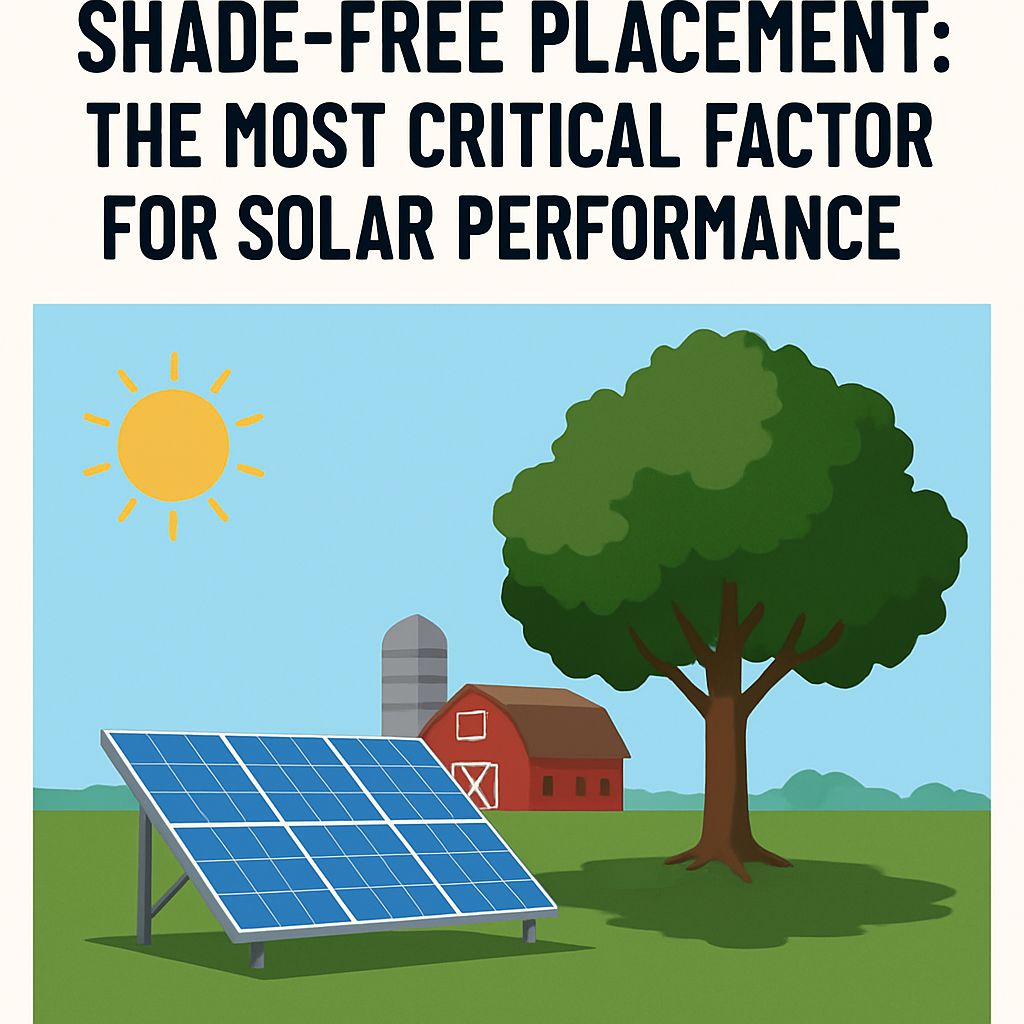
Shade-Free Placement: The Most Critical Factor for Solar Performance
Of all placement factors affecting farm solar performance, shade avoidance stands as the single most critical consideration. Unlike other positioning variables that might reduce efficiency by 5-15%, even modest shading can dramatically impact system production and financial returns. This principle applies universally across all farm types and system configurations. For more detailed guidance, you can refer to this article on solar panels for agricultural buildings.
Solar panels operate in series circuits, meaning shade on even a single panel can disproportionately affect an entire string’s output – similar to how one faulty Christmas light can disable an entire strand. While modern microinverters and power optimizers mitigate some shading impacts, they add cost and complexity without fully eliminating production losses. The simplest, most effective approach remains proper shade-free placement from the start.
How Even Partial Shade Reduces Panel Output by 25-40%
The impact of shade on solar panel performance extends far beyond the visibly shaded area. When shadow covers just 5-10% of a panel’s surface, output can drop by 25-40% due to the series connection of solar cells. This disproportionate effect makes even seemingly minor shade sources – from nearby silos, grain legs, utility poles, or seasonal tree shadows – significant threats to system production.
Farm environments present unique shading challenges compared to residential settings. Tall agricultural structures like grain storage, equipment sheds, and processing facilities can cast extensive shadows that shift dramatically with seasons. Additionally, dust accumulation from field operations creates a form of “operational shade” that gradually reduces panel efficiency until cleaned. Proper placement must account for both physical obstructions and these farm-specific operational factors.
Using Solar Pathfinders to Track Seasonal Shading Patterns
Solar pathfinders and sun path analyzers have become essential tools for agricultural solar planning, allowing farmers to precisely map shade patterns throughout the year before installation begins. These devices use a transparent dome with sun path diagrams to photograph and document potential obstructions across all seasons, identifying problematic areas that might not be obvious during initial site visits.
Minimum Distance Requirements from Trees and Structures
For agricultural installations, maintaining adequate distance from potential shade sources protects your investment and maximizes energy production. As a general rule, solar arrays should be placed at a minimum distance equal to 2-3 times the height of nearby structures or trees on the south, southeast, and southwest sides. For example, a 30-foot grain silo would require 60-90 feet of clearance to avoid significant shading of nearby panels.
When working with existing farm layouts where ideal spacing isn’t possible, prioritize morning and midday sun exposure over late afternoon production. Most solar energy is generated between 9am and 3pm, making eastern and southern clearance more critical than western spacing if compromises must be made. Some farmers find that removing or trimming selected trees provides a quick return on investment by substantially improving solar production.
Proximity to Farm Operations: Practical Considerations
Beyond the technical aspects of solar placement, proximity to your daily farming operations introduces important practical considerations that significantly impact system performance and maintenance requirements. The ideal placement balances optimal sun exposure with practical integration into your agricultural workflow.
Systems located too close to high-traffic areas face increased risk of accidental damage and dust accumulation, while those placed too far from operations centers incur higher installation costs due to extended wiring runs and potential voltage drop issues. The sweet spot varies by farm type but generally involves identifying areas that receive excellent sun exposure while remaining accessible yet protected from operational hazards. For more information on improving farm efficiency with solar power, check out this article.
Dust Impact from Nearby Field Operations
Dust generated by agricultural activities represents one of the most overlooked factors in farm solar placement. Field cultivation, harvesting, and gravel road traffic can generate significant dust that gradually accumulates on panel surfaces, forming a thin film that reduces light transmission and energy production. Studies show that dusty panels can lose 7-25% efficiency depending on dust composition and humidity levels, with losses accumulating until the next rainfall or cleaning.
When evaluating potential solar locations, consider prevailing wind patterns in relation to dusty operations like grain handling, field work, and livestock areas. Positioning arrays upwind of major dust sources rather than downwind can significantly reduce maintenance requirements and maintain higher production levels between cleanings. Similarly, maintaining adequate distance from gravel roads (minimum 100 feet where possible) prevents the finest dust particles from reaching panel surfaces during dry periods.
Distance to Electrical Infrastructure and Cost Implications
The proximity of solar arrays to existing electrical infrastructure directly impacts installation costs and system efficiency. Wire runs exceeding 300 feet from solar arrays to interconnection points not only increase material costs but also introduce voltage drop issues that can reduce system performance. For every 100 feet of additional wire distance, you might add $1,000-$2,000 in installation costs depending on system size and required conduit specifications. To learn more about how solar power can help reduce farm costs, check out cutting your farm’s electricity costs with solar power.
The ideal placement balances optimal sun exposure with proximity to your farm’s electrical service entrance or major distribution panels. Sometimes this means accepting a slightly less-than-perfect solar orientation in exchange for significant savings on wiring costs and reduced electrical losses. For remote farm locations far from existing service entrances, consider whether developing a separate grid connection might be more economical than extensive wire runs. For more insights, explore the solar power benefits for farmers to enhance operations efficiency.
Accessibility for Maintenance and Cleaning
Even the most perfectly positioned solar array requires periodic maintenance and cleaning to maintain optimal performance. Positioning systems in locations that allow easy access for maintenance vehicles and cleaning equipment ensures these essential tasks won’t be neglected. Arrays that require special equipment or complicated procedures to access often receive inadequate maintenance, leading to preventable production losses.
During site planning, establish clear access paths that accommodate maintenance vehicles without creating shading issues. For ground-mounted systems, ensure sufficient spacing between rows to allow cleaning equipment passage, typically 8-12 feet depending on the specific equipment you’ll use. Roof-mounted systems should include safe access points and fall protection accommodations that comply with workplace safety regulations.

Seasonal Adjustments That Boost Annual Energy Harvest
While fixed-tilt solar installations dominate the agricultural market due to their simplicity and reliability, farms with seasonal energy demands can benefit significantly from systems that adjust panel positioning throughout the year. These adaptable solutions allow you to maximize production during critical periods when energy demand peaks, such as irrigation season or harvest time.
Manual Tilt Adjustment Systems: 5-8% More Energy with Quarterly Changes
Manual tilt adjustment systems represent the most cost-effective approach to seasonal optimization, offering production gains of 5-8% annually compared to fixed systems. These installations use adjustable racking that allows angle changes typically four times yearly to match seasonal sun paths. By steepening panel angles in winter (latitude plus 15°) and flattening them in summer (latitude minus 15°), these systems capture more direct sunlight during each season, significantly boosting farm efficiency.
The economic advantage becomes clear when comparing the minimal additional equipment cost (typically 10-15% more than fixed systems) against the production gains. For a 50kW farm system, this might translate to an additional 2,500-4,000 kWh annually – worth $300-$600 in most utility territories. While manual adjustments require labor input, many farms find the quarterly maintenance visit provides a good opportunity to clean panels and inspect system components, combining routine maintenance with optimization.
Single-Axis Tracking: 15-25% Production Increase for Larger Farm Systems
For larger agricultural installations where maximizing production justifies additional investment, single-axis tracking systems offer substantial performance improvements. These systems automatically rotate panels east-to-west throughout the day, following the sun’s path and maintaining optimal exposure from dawn until dusk. The production advantage ranges from 15-25% annually compared to fixed systems, with the greatest gains during summer months when days are longest.
The decision to implement tracking technology involves balancing higher initial costs (typically 20-30% more than fixed systems) and additional maintenance requirements against improved energy production. Tracking systems include moving parts that eventually require service, making them best suited for farms with maintenance capabilities or strong service agreements. They also require additional spacing to prevent self-shading as panels rotate, typically increasing land requirements by 20-30% compared to fixed installations of equivalent capacity. Learn more about how to cut your farm’s electricity costs with solar power.
System Sizing and Configuration Based on Farm Energy Patterns
Proper solar placement extends beyond physical location to include system sizing and configuration that aligns with your farm’s specific energy consumption patterns. The most effective agricultural solar installations are carefully matched to both the quantity and timing of energy usage, creating synergy between production and consumption.
Matching Panel Capacity to Seasonal Farm Energy Demand
Agricultural operations typically have more seasonal energy demands than residential or commercial buildings, with consumption often peaking during specific growing or processing periods. Analyzing at least 12 months of electrical bills reveals these patterns and guides system sizing decisions that maximize financial returns. Rather than simply offsetting total annual consumption, strategic sizing targets the highest-value kilowatt-hours – typically those consumed during peak rate periods or demand charge windows.
For operations with pronounced seasonal demands, like irrigation-dependent farms, consider slightly oversizing solar capacity to cover peak summer needs while accepting some overproduction during shoulder seasons. This approach maximizes the offset of expensive summer electricity while potentially generating credits for other times of year. Conversely, year-round operations like dairy farms or poultry houses benefit from systems sized for consistent production that closely matches their steady consumption patterns.
Strategic Placement for Irrigation Systems and Cold Storage
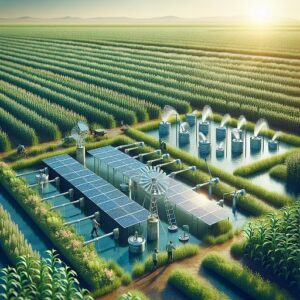
For farms with significant irrigation demands, positioning solar arrays near pump locations offers multiple advantages. Beyond reduced wiring costs, this approach allows for potential direct-drive systems that operate pumps during daylight hours without requiring battery storage or complex grid interaction. Such systems can be designed to run irrigation automatically when solar production reaches sufficient levels, matching water delivery with the sunniest (and often hottest) periods when crops need moisture most.
Similarly, cold storage facilities benefit from rooftop or nearby solar placement that delivers peak power during the hottest afternoons when refrigeration loads are highest. This alignment between peak solar production and peak cooling demand creates natural synergy that maximizes the value of each kilowatt-hour generated. Some advanced systems incorporate thermal mass or phase-change materials that essentially “store cold” generated during peak solar hours for use during non-productive nighttime periods. To explore more about how solar power can enhance farm efficiency, check out this article on solar power benefits for farmers.
5 Steps to Determine Your Ideal Farm Solar Placement Today
Finding your farm’s optimal solar placement doesn’t require guesswork. Follow this systematic approach to identify the locations that will maximize both energy production and operational integration. Discover how solar power boosts farm efficiency and enhances agricultural operations.
1. Complete a Comprehensive Site Assessment
Begin with a thorough evaluation of your entire property to identify potential solar locations with unobstructed southern exposure. Using a solar pathfinder or sun path analyzer, document seasonal sun patterns and potential obstructions throughout the year. Pay special attention to areas that receive full sun from 9am-3pm during all seasons, as these time windows deliver approximately 80% of daily solar energy. For more insights, explore how solar power boosts farm efficiency.
2. Analyze Your Farm’s Energy Consumption Patterns
Before finalizing placement, thoroughly analyze at least 12 months of utility bills to understand your farm’s electricity consumption patterns. Identify when your operation uses the most energy and whether these periods align with peak solar production times. This analysis helps determine whether standard south-facing arrays or alternative orientations might better match your specific needs.
3. Consider Future Farm Expansion Plans
When selecting solar placement, think beyond current needs to account for future farm expansion. Areas that seem perfect today might become problematic if you’re planning new buildings, grain storage, or processing facilities in the next 5-10 years. Since solar systems typically operate for 25+ years, selecting locations that accommodate your long-term vision prevents costly relocations later.
4. Evaluate Multiple Installation Locations
Rather than focusing on a single potential site, evaluate several viable locations across your property. Compare each option based on sun exposure, proximity to electrical infrastructure, accessibility for maintenance, and integration with farming operations. Sometimes combining multiple smaller arrays in different locations proves more effective than a single large installation, particularly for farms with distributed electricity usage across several buildings or operations centers.
Document each potential location’s advantages and limitations, including factors like soil conditions, drainage patterns, and flood risk that might affect ground-mounted installations. For roof options, assess structural capacity, remaining roof life, and orientation of existing buildings.
When evaluating multiple locations, consider these key factors:
Solar Placement Location Comparison
Location A: South Field Edge
+ Excellent southern exposure with no obstructions
+ Flat, well-drained soil with easy access
– 450 feet from main electrical service
– Visible from main road (aesthetic consideration)Location B: Equipment Shed Roof
+ Close to electrical infrastructure
+ No additional land use required
– 15° east of true south orientation
– Roof has only 10 years of remaining lifeLocation C: North Paddock
+ Good solar access with minimal shading
+ Can double as shade structure for livestock
– Requires fencing for animal protection
– Moderate slope requiring additional site work
5. Consult Agricultural Solar Specialists
While general solar installers understand basic principles, agricultural specialists bring invaluable insight into farm-specific considerations. These experts understand the unique challenges of integrating solar with agricultural operations, from equipment clearance needs to potential interactions with irrigation systems or livestock. GrowingSolarMist specializes in agricultural solar applications and can provide a free site assessment that accounts for your farm’s unique operational patterns and energy needs.
Farm Solar Placement Mistakes That Cost Thousands
Even well-intentioned farm solar projects can underperform when common placement mistakes undermine system production. These errors often aren’t apparent until after installation, when remediation becomes expensive or impractical. Understanding these pitfalls before you begin saves both frustration and financial loss.
The most expensive mistakes aren’t usually technical failures but rather planning oversights that gradually diminish system performance over years or decades. Unlike equipment failures that trigger immediate attention, suboptimal placement creates persistent efficiency drains that silently reduce financial returns throughout system life.
Case Study: Miller Family Farm Solar Mistake
The Miller family installed a 75kW ground-mounted solar array adjacent to their grain handling facility, aiming to offset substantial electricity costs from grain drying and storage. While initial production met expectations, they noticed steadily declining performance each fall during harvest season.
Investigation revealed that dust from grain handling operations was accumulating on panel surfaces, creating a fine film that reduced light transmission by 18%. Additionally, the seasonal operation of grain legs and augers created intermittent shading not apparent during system design.
Relocating the array would have cost $20,000, so they instead implemented a regular cleaning protocol and adjusted grain handling procedures. These adaptations helped but couldn’t fully recover the 12-15% annual production loss compared to optimal placement away from dust sources.
Understanding that placement mistakes compound over time helps prioritize proper planning. A 10% reduction in system output might seem minor initially, but across a 25-year system life, this equals 2.5 years of completely lost production – potentially tens of thousands of dollars in unrealized energy value.
The return on investment for careful planning and possibly higher initial costs to secure optimal placement frequently exceeds 1000% over system lifetime. Spending an extra $5,000 on ideal positioning that increases lifetime production by $50,000 represents one of the best investments available in agricultural operations.
Underestimating Seasonal Shading Changes
Many farms evaluate solar sites during summer when trees are fully leafed and the sun travels high across the sky. This approach misses critical winter shading issues when the sun sits lower on the horizon and barren tree branches cast very different shadow patterns. What appears perfectly unshaded in June might lose several hours of production daily during December through February.
The solution requires year-round shade analysis or software modeling that accurately predicts seasonal sun paths across your specific location. This comprehensive approach identifies locations that maintain production throughout the year rather than performing well during only certain seasons. Remember that winter sun, while less intense, still provides valuable energy production, particularly for farms with year-round operations like livestock facilities or cold storage.
Ignoring Farm Dust Sources
Agricultural environments generate substantial dust from multiple sources: field operations, unpaved roads, grain handling, and livestock areas. When solar arrays are positioned downwind from these dust generators, performance gradually degrades between cleanings as particulates accumulate on panel surfaces. The financial impact compounds when cleaning becomes more frequent or difficult due to poor placement decisions.
Strategically positioning arrays upwind of major dust sources significantly reduces maintenance requirements and maintains higher average performance. If dusty areas can’t be avoided entirely, consider increasing panel tilt angles above 15° to improve natural cleaning during rainfall, or budget for more frequent maintenance cleaning to maintain optimal performance. For more insights on enhancing farm efficiency, explore the best solar-powered farm tools.
- Position arrays minimum 100ft from gravel or dirt roads
- Avoid locations downwind of grain handling facilities
- Consider wind patterns during harvest seasons when dust generation peaks
- Install vegetative buffers between dust sources and solar arrays
- Select self-cleaning panel technologies for unavoidably dusty locations
The dust impact varies significantly by region and farm type, with arid climates and grain operations facing greater challenges than humid regions or livestock-focused farms. Local solar professionals with agricultural experience can provide guidance specific to your region’s conditions and typical farming operations. Discover how solar power benefits for farmers can improve operations efficiency.
Forgetting about Shade
The most consequential placement mistake remains inadequate attention to current and future shading. Even minimal shading during peak production hours can disproportionately impact system performance due to the series connection of panels. While modern power optimizers and microinverters mitigate some shading impacts, they add cost without eliminating the fundamental production loss from intercepted sunlight. Always prioritize completely shade-free locations even if they require longer wire runs or seem less convenient for other operational factors.
Poor Planning for Future Farm Expansion
Farms constantly evolve with new buildings, equipment, and operational needs. Solar arrays installed without considering five, ten, or twenty-year expansion plans may later become problematic as new structures create shading or access issues. What seems like an ideal location today might become severely compromised when that new equipment shed or grain bin becomes necessary.
Protect your investment by reviewing your farm’s master plan and anticipated growth direction before finalizing solar placement. If expansion plans remain uncertain, identify solar locations that preserve flexibility for future development in likely growth areas. Some farms even designate specific solar zones in their long-term planning, ensuring these areas remain unobstructed regardless of other operational changes.
Conclusion: Placement of Solar Panels is Something the Farmer Should Put Serious Thought into
The difference between mediocre and exceptional farm solar performance often comes down to placement decisions made before installation begins. By understanding the critical factors of orientation, tilt, shading, proximity to operations, and seasonal adjustments, you position your agricultural operation to maximize both energy production and financial returns. Remember that solar systems typically operate for 25+ years, making initial placement decisions among the most consequential long-term choices for your farm’s energy infrastructure. GrowingSolarMist helps farmers across the country implement solar solutions that complement their specific agricultural operations while maximizing energy production and financial returns.
Frequently Asked Questions
As you plan your farm solar installation, you likely have specific questions about how placement affects your unique agricultural operation. These frequently asked questions address the most common concerns we hear from farmers considering solar energy systems.
Each farm presents unique considerations based on operation type, geography, and energy needs. The answers below provide general guidance, but consulting with agricultural solar specialists ensures recommendations tailored to your specific situation.
How much land do I need for a 10kW farm solar system?
A 10kW ground-mounted solar system typically requires approximately 800-1,000 square feet of land (roughly 0.02 acres), assuming standard-efficiency panels and traditional fixed mounting. This area includes the panels themselves plus necessary spacing between rows to prevent self-shading and allow maintenance access. The exact footprint depends on several factors including panel efficiency, mounting system design, and site-specific considerations like terrain and required setbacks.
- Standard fixed ground mount: 800-1,000 sq ft
- Single-axis tracking system: 1,200-1,400 sq ft
- Dual-axis tracking system: 1,500-1,800 sq ft
Remember that these figures represent the solar array’s direct footprint and don’t include additional space for access paths, electrical equipment, or buffer zones that might be required by local regulations. Working with a solar designer familiar with agricultural installations ensures accurate space planning that accounts for your specific operational needs. For more insights, explore how solar power boosts farm efficiency and optimizes agricultural operations.
If land conservation is a priority, roof-mounted systems eliminate additional land requirements entirely by utilizing existing structures. A 10kW roof system typically requires about 650-800 square feet of unshaded roof space, depending on panel efficiency and mounting configuration. For more insights on optimizing solar panel placement on agricultural buildings, check out this guide on installing solar panels on barns.
Can I install solar panels over my crop fields?
Yes, innovative agrivoltaic systems that integrate solar panels with active crop production are becoming increasingly viable for certain farm operations. These dual-use installations position panels at increased heights (typically 8-12 feet minimum) and with wider spacing to allow sufficient light penetration for crop growth below. Research shows these systems can maintain 60-90% of conventional crop yields while generating significant solar energy, effectively doubling land productivity.
The approach works particularly well for shade-tolerant crops like leafy greens, herbs, and certain berries that benefit from partial protection from intense midday sun. Some vegetable crops even show quality improvements and reduced irrigation requirements under the modified microclimate created by overhead panels. The elevated mounting structures increase initial costs by 15-25% compared to standard ground mounts, but this premium is often justified by maintained agricultural productivity.
What’s the payback period for properly placed farm solar systems?
Optimally placed farm solar systems typically achieve payback periods of 5-9 years in most agricultural regions, though this varies significantly based on local utility rates, available incentives, and specific farm energy consumption patterns. Systems that maximize southern exposure with optimal tilt angles and zero shading consistently perform at the faster end of this payback spectrum, highlighting the financial impact of proper placement decisions.
Several factors can accelerate payback for agricultural installations beyond what residential or commercial systems achieve: preferential depreciation schedules for agricultural businesses, USDA REAP grant funding (covering up to 25% of project costs), and the ability to size systems that precisely match seasonal farm energy demands. Well-designed systems on high-energy-consuming operations like dairy farms, irrigated crop production, or food processing can sometimes achieve payback in as little as 4 years when all incentives and tax benefits are applied.
Should I choose fixed panels or tracking systems for my farm?
The choice between fixed panels and tracking systems depends primarily on your farm’s available space, budget constraints, and energy production goals. Fixed systems offer simplicity, reliability, and lower initial costs, making them the default choice for most agricultural installations under 100kW. With no moving parts, they minimize maintenance requirements and typically operate trouble-free for decades when properly installed.
Tracking systems become financially advantageous for larger installations where the 15-25% production increase justifies the additional 20-30% capital investment and increased maintenance requirements. They make particular sense for farms with high summer energy demands (like irrigation) since tracking systems maximize production during the longest days when fixed systems might overheat or miss early/late day production. The economics improve further in utility territories with favorable net metering policies that credit excess production at retail rates.
How do I protect my solar panels from farm equipment and animals?
Protecting solar installations in agricultural environments requires thoughtful placement and appropriate physical safeguards. For ground-mounted systems in equipment-heavy areas, establish clearly marked access paths that keep tractors and implements at safe distances, ideally with physical barriers like bollards or fencing at vulnerable corners. Elevate wiring and conduit at least 8-10 feet in equipment pathways to prevent accidental contact during field operations.
For installations near livestock areas, fencing is essential – particularly for curious animals like goats or cattle that might damage wiring or components. Chain link or welded wire fencing with a minimum 6-foot setback from array edges provides adequate protection while allowing maintenance access. Some farms successfully integrate solar with rotational grazing by using temporary electric fencing that allows controlled livestock access for vegetation management while protecting the solar infrastructure.

Leave a Reply