
Article-At-A-Glance
- Monocrystalline panels are the gold standard for residential rooftop installations — efficient, reliable, and cost-effective for most homeowners.
- Bifacial panels can produce 5% to 30% more energy than traditional single-sided panels, but only under the right conditions.
- The surface beneath and around your solar installation plays a massive role in whether bifacial panels are worth the extra cost.
- For commercial, ground-mounted, and utility-scale systems, bifacial panels almost always deliver a stronger long-term return on investment.
- Keep reading to find out which specific surfaces and setups unlock bifacial panels’ full energy potential — the answer might surprise you.
Bifacial Panels Produce More Power — But It’s Not That Simple
Choosing between monocrystalline and bifacial solar panels is one of the most consequential decisions you’ll make for a solar installation — and the right answer depends entirely on where and how the panels will be used.
Both panel types use monocrystalline silicon cells at their core, so they share a common foundation in terms of quality and longevity. The key difference is that bifacial panels are engineered to absorb light from both the front and rear surface, while monocrystalline panels only capture light from one side. That single design change creates a ripple effect across performance, installation requirements, and cost. Resources like Sunify Solar break down these differences in practical detail for anyone navigating the solar decision-making process.
What makes this comparison genuinely complex is that bifacial panels don’t automatically outperform monocrystalline panels in every scenario. In many standard rooftop installations, a bifacial panel will barely outperform its single-sided equivalent — and the price premium won’t be justified. Understanding when each panel type excels is what separates a smart solar investment from an expensive mistake.

What Is a Monocrystalline Solar Panel?
A monocrystalline solar panel is built using solar cells cut from a single, continuous crystal of silicon. That single-crystal structure gives the cells a uniform molecular alignment, which allows electrons to flow more freely and efficiently than in other panel types like polycrystalline. The result is a panel with high efficiency, a sleek dark appearance, and a long operational lifespan that has made it the dominant choice for residential solar installations worldwide.
These panels are the benchmark against which most other solar technologies are measured. When solar installers talk about a “standard” high-quality panel for home use, they are almost always referring to monocrystalline.
How Monocrystalline Cells Are Made
The manufacturing process behind monocrystalline cells is called the Czochralski method. A seed crystal of silicon is dipped into a vat of molten, highly purified silicon and then slowly pulled upward while being rotated. This draws a large cylindrical ingot of single-crystal silicon from the melt. That ingot is then sliced into thin wafers, which become the individual solar cells inside the panel. Because the entire ingot is one continuous crystal, the cells have almost no grain boundaries to disrupt electron flow — which is precisely what gives monocrystalline panels their efficiency edge.
Efficiency Range and Power Output
Modern monocrystalline panels typically achieve efficiency ratings between 17% and 22%, with premium models from manufacturers like SunPower and LONGi pushing toward the upper end of that range. For a standard 60-cell residential panel, this translates to power outputs ranging from roughly 300W to over 400W per panel under standard test conditions (STC). That level of output makes monocrystalline panels highly competitive for rooftops where available space is limited and maximizing watts per square meter matters.
Typical Lifespan and Warranty Coverage
Monocrystalline panels are built to last. Most manufacturers back them with a 25-year performance warranty, guaranteeing that panels will still produce at least 80% of their rated output after two and a half decades of use. Physical product warranties — covering defects in materials and workmanship — typically run 10 to 12 years. Real-world lifespans often extend well beyond 30 years when panels are properly installed and maintained.
What Is a Bifacial Solar Panel?
A bifacial solar panel generates electricity from both its front and rear surfaces. While the front face works exactly like a conventional monocrystalline panel — absorbing direct sunlight — the rear face captures light that has been reflected upward from the ground, rooftop, or surrounding surfaces. This dual-sided design is what gives bifacial panels their energy production advantage, and it’s also what makes their performance so heavily dependent on installation environment.
How Bifacial Panels Capture Light from Both Sides
The rear-side energy gain in bifacial panels is made possible by a transparent backsheet or dual-glass construction that allows light to pass through to the solar cells on the back of the panel. In traditional monofacial panels, the backsheet is opaque — it reflects and blocks rear light entirely. Bifacial panels replace that opaque layer with either a clear polymer backsheet or a second pane of tempered glass, exposing the rear cells to whatever light is bouncing up from below. For more information, you can read this guide on bifacial vs monofacial solar panels.
This design requires that the panels be mounted in a way that allows light to actually reach the rear surface. Key installation factors include:
- Tilt angle: Panels must be angled to allow reflected light to reach the rear cells — flat-mounted bifacial panels lose most of their rear-side gain.
- Clearance height: The greater the distance between the panel and the surface below, the more light can scatter and reflect upward onto the rear face.
- Surface reflectivity: Light-colored or highly reflective ground surfaces dramatically increase rear-side energy capture.
- Row spacing: In multi-row arrays, adequate spacing between rows prevents panels from shading each other’s rear surfaces.
Dual-glass bifacial panels offer an additional durability benefit — the glass-glass construction makes them more resistant to moisture ingress, UV degradation, and physical stress than panels with polymer backsheets. This is one reason bifacial panels often carry slightly longer performance warranties than their monofacial equivalents.
The Role of Albedo in Bifacial Energy Gain
Albedo is the measure of how much light a surface reflects, expressed as a value between 0 (no reflection) and 1 (perfect reflection). It is the single most important environmental variable determining how much extra energy a bifacial panel produces from its rear surface. Fresh white snow has an albedo of around 0.80–0.90, white gravel or sand sits near 0.25–0.40, and standard dark roofing materials can be as low as 0.05–0.10. A bifacial panel installed over a white geomembrane or light-colored gravel will consistently outperform the same panel installed over a dark asphalt surface.
15–30% Extra Energy Production: When It Actually Happens
The widely cited 5% to 30% rear-side energy gain for bifacial panels is real — but the upper end of that range requires near-ideal conditions. Ground-mounted systems with elevated racking, high-albedo surfaces, and optimal row spacing regularly achieve gains in the 15–25% range. Utility-scale solar farms with light-colored ground cover or highly reflective geomembranes can push closer to 30%. By contrast, a bifacial panel mounted flush against a dark residential rooftop may yield a rear-side gain of just 2–5% — often not enough to justify the higher panel cost over a standard monocrystalline alternative.

“Bifacial Solar Panel vs Monofacial …” from www.youtube.com and used with no modifications.
Monocrystalline vs Bifacial: Side-by-Side Differences
- Cell technology: Both use monocrystalline silicon cells — the difference is in how many sides are active.
- Light capture: Monocrystalline panels absorb light from one side only; bifacial panels absorb from both front and rear surfaces.
- Energy output: Bifacial panels can generate 5–30% more energy under optimal conditions.
- Installation requirements: Monocrystalline panels work on virtually any mount; bifacial panels need elevated, open racking to unlock rear-side gains.
- Cost: Bifacial panels carry a higher upfront price per panel and often require more specialized mounting hardware.
- Best environment: Monocrystalline panels excel on residential rooftops; bifacial panels shine in ground-mounted and commercial systems.
At their core, monocrystalline and bifacial panels are more similar than they are different. Both rely on high-purity monocrystalline silicon, both deliver excellent efficiency ratings, and both are built to last 25 years or more. The distinction that matters most is how each panel interacts with its installation environment — and that’s where their performance paths diverge sharply.
Think of monocrystalline panels as the precision tool — reliable, optimized, and purpose-built for the most common solar installation scenario: a residential rooftop. Bifacial panels are the high-performance option that rewards careful site planning with meaningfully greater energy output. Neither is universally superior. The right choice depends entirely on your specific site conditions, budget, and energy goals.
Energy Efficiency Compared
Standard monocrystalline panels operate at efficiency ratings of 17% to 22%. Bifacial panels, which also use monocrystalline cells on their front face, achieve similar front-side efficiency ratings — but their total system efficiency climbs higher once rear-side gain is factored in. In a well-optimized ground-mounted installation with a high-albedo surface beneath the array, a bifacial panel’s effective efficiency can reach the equivalent of 24–26%, depending on site-specific conditions. On a standard rooftop, that rear-side advantage largely disappears.
Durability and Weather Resistance
Monocrystalline panels with standard polymer backsheets are durable and proven across decades of real-world installations. Bifacial panels built with dual-glass construction take durability a step further — the glass-glass design resists moisture ingress, UV-induced degradation, and potential-induced degradation (PID) more effectively than polymer backsheet alternatives. In environments with high humidity, coastal salt air, or extreme UV exposure, the dual-glass bifacial construction offers a measurable long-term advantage in panel health and output stability.
Warranty Length Differences
Most monocrystalline panels come with a 25-year linear performance warranty, guaranteeing output won’t drop below 80% of rated capacity over that period. Product warranties covering manufacturing defects typically run 10 to 12 years for standard monocrystalline models.
Bifacial panels — particularly those with dual-glass construction — frequently carry longer warranty terms. Several leading manufacturers, including LONGi and JA Solar, offer 30-year performance warranties on their dual-glass bifacial products. This extended coverage reflects the inherently greater durability of the glass-glass design.
When comparing warranties, look beyond the headline number. A linear degradation warranty — which guarantees a specific output level at each year of the panel’s life — is more valuable than a tiered warranty that only checks performance at the end of a long period. Most premium monocrystalline and bifacial panels now offer linear coverage as standard.
Aesthetic and Design Differences
Monocrystalline panels have a uniform dark black or dark blue appearance that blends cleanly into most residential rooflines. Bifacial panels, with their transparent or glass rear surface, have a more industrial aesthetic — the visible cell structure on both sides gives them a distinctive look that suits commercial and ground-mounted applications far better than residential rooftops. For homeowners where visual integration with the home matters, monocrystalline panels remain the cleaner, more architecturally compatible choice.
Which Panel Type Costs More?
Bifacial panels cost more — there’s no avoiding that upfront reality. The dual-glass construction, more complex manufacturing process, and specialized mounting hardware required for ground-mounted bifacial arrays all contribute to a higher initial investment. However, the cost comparison between these two panel types is rarely straightforward when you account for the full system lifetime and the energy gains a properly installed bifacial array can deliver.
The more relevant question isn’t which panel costs more per unit — it’s which system delivers more energy per dollar invested over 25 to 30 years. In the right installation environment, bifacial panels can cross the break-even point on their price premium well within the system’s operational life. In the wrong environment, that premium is simply money left on the table.
Upfront Cost Difference
Bifacial panels typically cost 10% to 25% more per panel than comparable monocrystalline models at the point of purchase. Beyond the panel price itself, bifacial installations often require elevated racking systems — such as single-axis trackers or elevated fixed-tilt structures — that add further to the upfront system cost. For a large commercial or utility-scale project, that additional hardware investment can be substantial, though it is routinely justified by the long-term energy yield improvements.
Long-Term Return on Investment
In commercial, agricultural, and utility-scale installations where bifacial panels are used in their optimal configuration, the additional upfront cost is consistently recovered through higher energy production over the system’s life. Ground-mounted bifacial arrays with reflective ground cover can generate enough additional kilowatt-hours over a 25-year lifespan to recover the price premium within 10 to 15 years — leaving 10 to 15 years of pure additional energy gain beyond break-even. For residential rooftop installations, a standard monocrystalline panel will almost always deliver a better dollar-per-kilowatt-hour return, because the rear-side gain that justifies bifacial’s premium simply isn’t accessible from a flush rooftop mount. Learn more about how solar panels benefit agricultural use.
A useful way to evaluate this is to calculate the Levelized Cost of Energy (LCOE) — the total lifetime cost of the system divided by the total energy it produces. In high-albedo, elevated-mount scenarios, bifacial panels consistently achieve a lower LCOE than monocrystalline alternatives despite their higher upfront cost. In standard rooftop scenarios, the LCOE advantage typically favors monocrystalline.

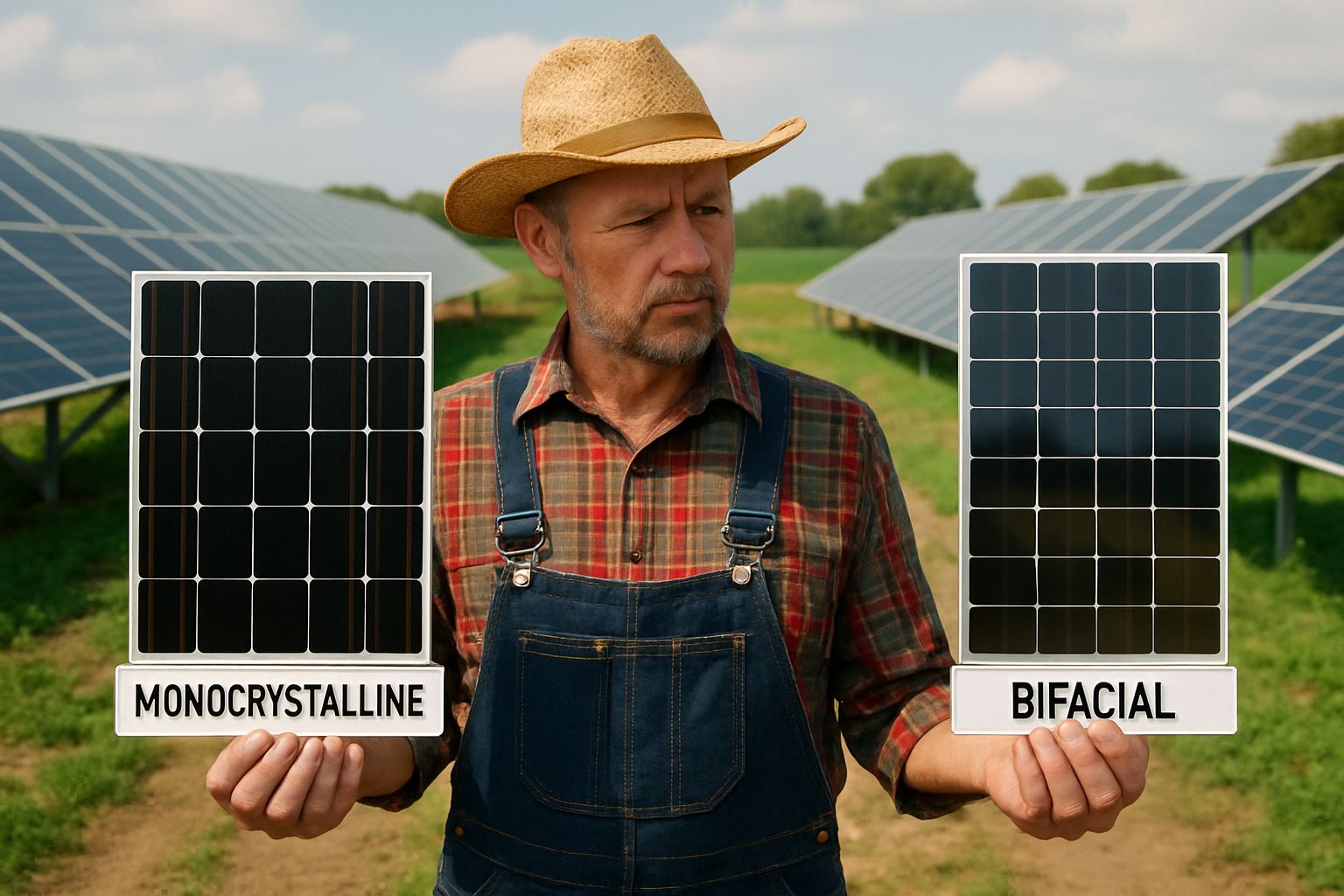
“Monocrystalline Panels for Farmers …” from growingsolarmist.com and used with no modifications.
Best Use Cases for Monocrystalline Panels
Monocrystalline panels are the right choice for the majority of residential rooftop installations, particularly where the roof surface is dark-colored, the mounting system sits flush or near-flush against the roof, and maximizing energy per square meter within a fixed budget is the priority. They are also the practical choice for small commercial rooftop systems, off-grid cabins, RV and marine applications, and any installation where simplicity of mounting, lower upfront cost, and proven long-term reliability matter more than squeezing out every last watt of potential energy production. For more information on how these panels can be utilized in agricultural settings, you can explore solar panels’ farm use and benefits.
Best Use Cases for Bifacial Panels
Bifacial panels are purpose-built for installations that can actually take advantage of their rear-side light capture. When the installation environment checks the right boxes — elevated mounting, reflective surface below, adequate row spacing — bifacial panels consistently outperform monocrystalline alternatives in total energy output over the system’s lifetime.
Ground-mounted residential systems with light-colored gravel, white geomembranes, or concrete pads beneath the array are strong candidates for bifacial technology. Agrivoltaic installations — where solar panels are mounted above crops or light-colored soil — also benefit significantly, since the open ground and frequent light reflection from plant canopies and soil create ideal rear-side conditions. One Minnesota case study documented bifacial panels producing 38% more energy than monocrystalline panels during winter months, driven entirely by the high albedo of fresh snow on the ground surface.
Commercial rooftops with white TPO or EPDM membrane roofing, which have albedo values significantly higher than residential asphalt shingles, can also support meaningful bifacial rear-side gains — particularly when panels are mounted on elevated ballasted racking rather than flush-mounted systems. Large-scale utility solar farms represent the most economically compelling use case of all, where the combination of open land, optimized row spacing, and purpose-selected ground cover allows bifacial arrays to routinely deliver 15–25% more energy than equivalent monofacial installations across the full system lifespan.
Ground-Mounted and Elevated Installations
Ground-mounted bifacial systems are where the technology truly earns its premium. When panels are elevated on fixed-tilt or single-axis tracker racking — typically 0.5 to 1.5 meters above the ground surface — reflected light from below has a clear, unobstructed path to the rear cells. Single-axis trackers that follow the sun throughout the day further amplify this advantage by continuously optimizing both front-side direct irradiance and rear-side reflected light capture simultaneously. In these configurations, bifacial panels regularly deliver rear-side energy gains in the 15% to 25% range, with well-documented cases exceeding 30% under high-albedo winter conditions.
High-Reflectivity Surfaces That Boost Output
The ground surface beneath a bifacial array isn’t just background scenery — it’s an active component of the energy system. Selecting or preparing a high-albedo surface beneath a bifacial installation is one of the highest-leverage decisions in system design. White or light-colored geomembranes specifically engineered for solar applications can achieve albedo values of 0.70 or higher, rivaling fresh snow as the most effective reflective surface available for ground-mounted arrays. Light-colored crushed gravel and white sand are practical lower-cost alternatives that still deliver albedo values of 0.25 to 0.40.
By contrast, installing bifacial panels over dark soil, asphalt, or unmaintained vegetation with albedo values below 0.15 significantly reduces rear-side gain and weakens the financial case for choosing bifacial over monocrystalline. If a bifacial installation cannot incorporate a reasonably reflective ground surface, the performance premium shrinks to the point where standard monocrystalline panels become the more cost-effective option.
Commercial and Utility-Scale Projects
At commercial and utility scale, bifacial panels are increasingly becoming the default choice rather than the premium option. The combination of open land, purpose-optimized row spacing, elevated racking, and professionally selected ground cover consistently unlocks the upper range of bifacial performance gains. Major utility-scale developers now routinely specify bifacial modules in project designs, with financial models built around verified rear-side gain data from energy yield assessments. The long operational lifespans of these projects — often 30 to 35 years — mean that even a modest rear-side gain of 10% compounds into an enormous additional energy yield over the system’s full life, comfortably justifying the higher panel and racking costs at the project outset.
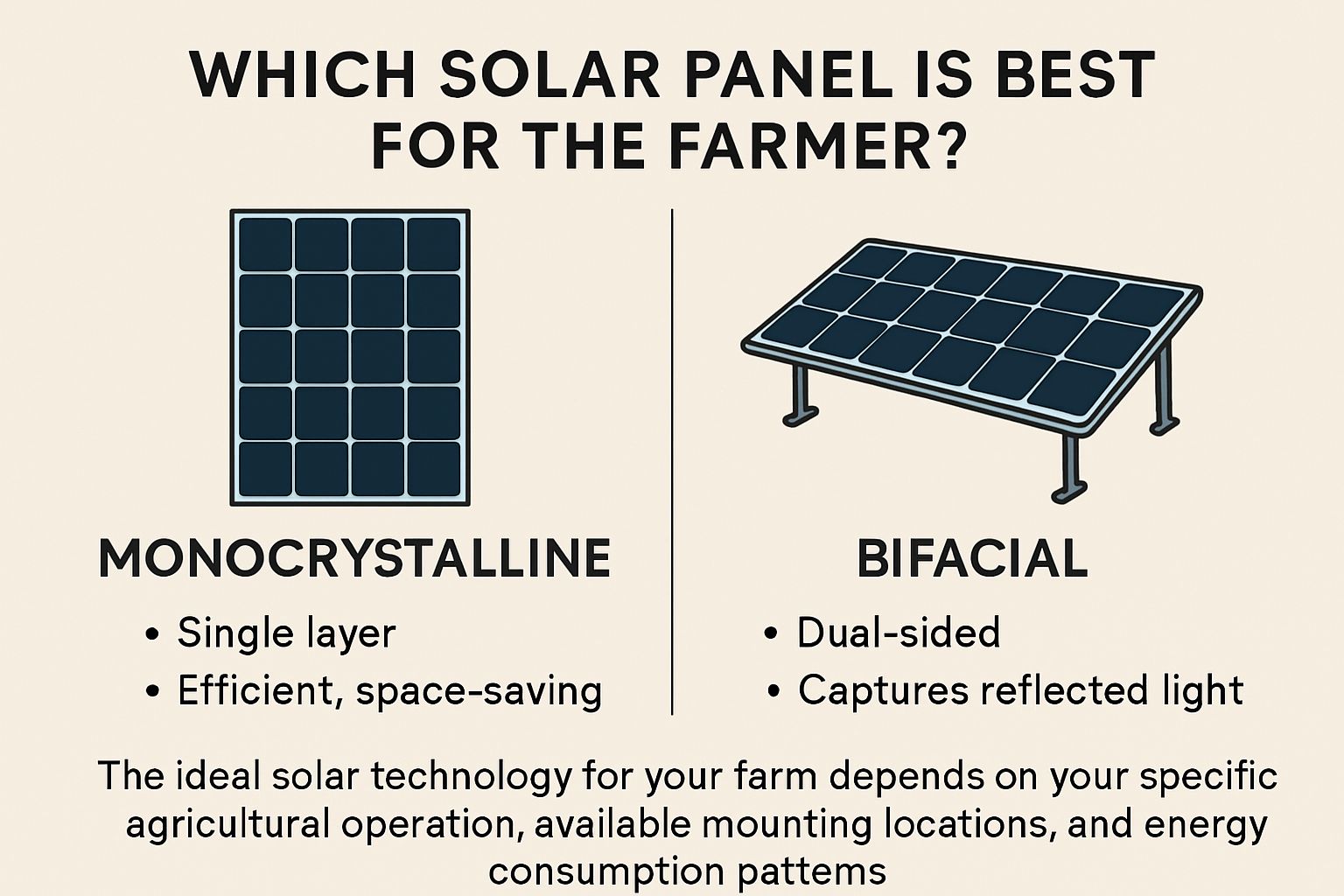
“Bifacial Solar Panels …” from growingsolarmist.com and used with no modifications.
Which One Is the Smart Choice for Most Homeowners?
For the vast majority of homeowners installing solar on a standard residential rooftop, monocrystalline panels are the smarter financial choice. A typical sloped residential roof with asphalt shingles provides almost no opportunity for bifacial rear-side gain — the panel sits close to the roof surface, the dark shingles reflect very little light upward, and the mounting geometry simply doesn’t allow reflected light to reach the rear cells in any meaningful quantity. In this scenario, paying a 10% to 25% premium for bifacial panels delivers almost none of the performance advantage those panels are designed to provide.
The exception worth noting is a residential ground-mount — a panel array installed in a backyard or open property rather than on the roof itself. If that ground-mount system is elevated on appropriate racking and has a reflective surface installed beneath it, a homeowner can absolutely justify bifacial panels and expect to see meaningful rear-side gains. But for the standard roof-mounted home solar installation, high-efficiency monocrystalline panels remain the most sensible, most cost-effective, and most proven choice available today.
Frequently Asked Questions
Here are the most common questions about choosing between monocrystalline and bifacial solar panels, answered directly based on real-world performance data and installation experience.
Are bifacial solar panels worth it for a residential roof?
- On a standard sloped roof with dark asphalt shingles, bifacial panels offer minimal rear-side gain — typically only 2% to 5%.
- The price premium for bifacial panels (10% to 25% more than comparable monocrystalline) is rarely recovered through that marginal performance improvement on a residential rooftop.
- If your home has a flat roof with white TPO or EPDM membrane and elevated racking, bifacial panels become a more viable option.
- For a ground-mounted residential system with a reflective surface installed below the array, bifacial panels can be well worth the investment.
In short — for a standard residential rooftop installation, bifacial panels are generally not worth the additional cost. The installation environment doesn’t provide the conditions needed to unlock their performance advantage, and a premium monocrystalline panel will deliver comparable real-world output at a lower price point.
Do monocrystalline panels work better in low-light conditions?
Monocrystalline panels perform well in low-light and diffuse light conditions thanks to the high purity and uniform crystal structure of their silicon cells. However, bifacial panels — which also use monocrystalline cells on their front face — perform equally well in low-light conditions from the front side. The rear-side gain in bifacial panels is primarily driven by reflected light rather than diffuse ambient light, so neither panel type holds a decisive low-light advantage over the other in most practical scenarios. The front-side low-light performance of both panel types is essentially equivalent when they share the same cell technology. To understand how solar panels work on farms, exploring their agricultural insights and benefits can provide additional context.
Can bifacial panels be installed flat on a rooftop?
Technically yes, but it largely defeats the purpose. A bifacial panel installed flat against a dark rooftop surface receives almost no reflected light on its rear face, reducing the rear-side energy gain to near zero. For bifacial panels to deliver meaningful performance gains, they need to be tilted at an angle and elevated sufficiently above the surface below to allow reflected light to reach the rear cells. Flat or flush-mounted bifacial panels on a standard rooftop will perform no better than a monocrystalline panel at the same price point — and often worse per dollar invested.
How much more do bifacial panels cost compared to monocrystalline?
Bifacial panels typically cost 10% to 25% more per panel than comparable monocrystalline models at the point of purchase. Beyond the panel price itself, ground-mounted bifacial installations often require elevated racking systems and reflective ground cover preparation, which add further to the total system cost. In large commercial and utility-scale projects, these additional costs are routinely justified by the long-term energy yield improvements. In residential rooftop applications, the price premium is rarely recovered through performance gains, making standard monocrystalline panels the more cost-effective choice for most homeowners.
What surface reflects the most light for bifacial solar panels?
Fresh white snow is the highest-performing natural reflective surface for bifacial panels, with an albedo value of 0.80 to 0.90 — meaning it reflects up to 90% of the light that strikes it back upward toward the panel’s rear cells. This is why bifacial panels in snowy climates, like the Minnesota installation that documented 38% winter energy gains over monocrystalline panels, can deliver their most dramatic performance advantages during the coldest months of the year.
For engineered surfaces, white geomembranes specifically designed for solar applications achieve albedo values of 0.70 or higher and represent the most consistent, highest-performing ground surface option available for year-round bifacial performance optimization. Light-colored crushed gravel and white sand are practical alternatives, delivering albedo values in the 0.25 to 0.40 range — lower than a geomembrane but still meaningfully better than dark soil or asphalt.







Leave a Reply