
Key Takeaways
- Drone solar panel monitoring cuts inspection time by up to 70% compared to traditional ground-level methods, making it one of the most efficient tools available for managing farm solar assets.
- Thermal imaging drones can detect hotspots, failed cells, and delamination issues that are completely invisible to the naked eye, catching problems before they become expensive repairs.
- Farmers using regular drone inspections report stronger warranty claims, better insurance outcomes, and measurable increases in annual energy output.
- The cost of a single professional drone inspection is a fraction of what a full ground crew charges, and one drone can cover hundreds of panels in a single flight.
- Keep reading to find out exactly how to set up a drone monitoring schedule that protects your solar investment year-round and maximizes energy revenue from day one.
Drones Are Changing How Farmers Protect Their Solar Investment
Solar panels are one of the biggest capital investments on a modern farm, and most farmers have no idea whether they’re performing at full capacity until something goes seriously wrong.
Traditional solar inspections meant sending workers onto rooftops, climbing through uneven terrain, or manually checking hundreds of individual panels one by one. It was slow, expensive, and dangerously incomplete. A single inspector walking a large solar array might miss dozens of developing faults that only show up under thermal imaging. By the time a problem became visible, the energy losses and repair costs had already stacked up.
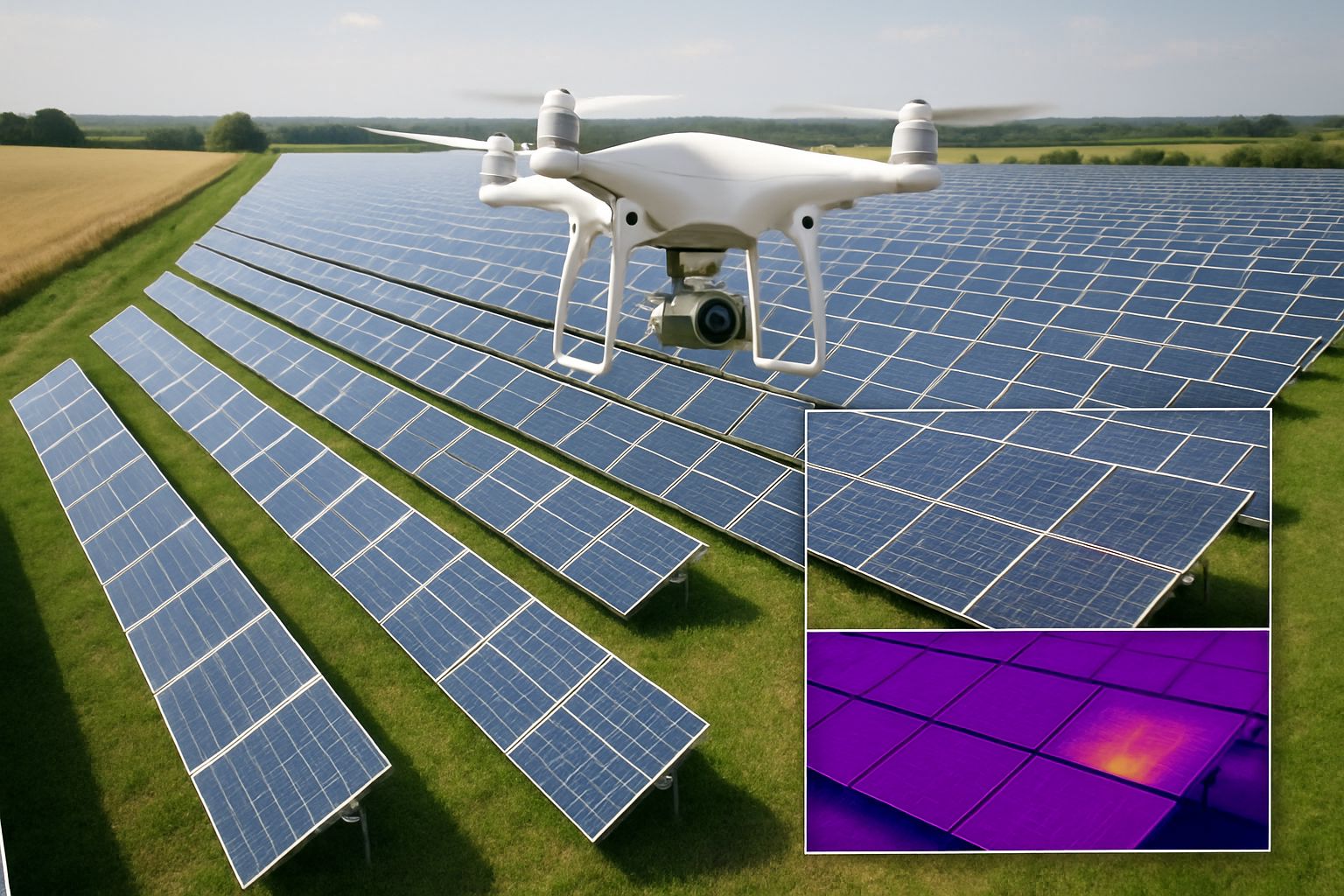
Drone solar panel monitoring changes the entire equation. Equipped with thermal cameras and high-resolution visual sensors, agricultural drones can scan an entire solar installation in a fraction of the time, transmitting precise data on every panel’s health directly to farm management software. Companies like GIS Drones specialize in exactly this kind of service, helping farm operators identify faults, document panel conditions, and build a maintenance strategy that keeps energy output high and repair bills low.
The shift toward drone-based monitoring is not just about convenience. It is about protecting revenue, extending the lifespan of expensive equipment, and making smarter decisions with real data instead of guesswork.
How Drone Solar Panel Monitoring Works on a Farm
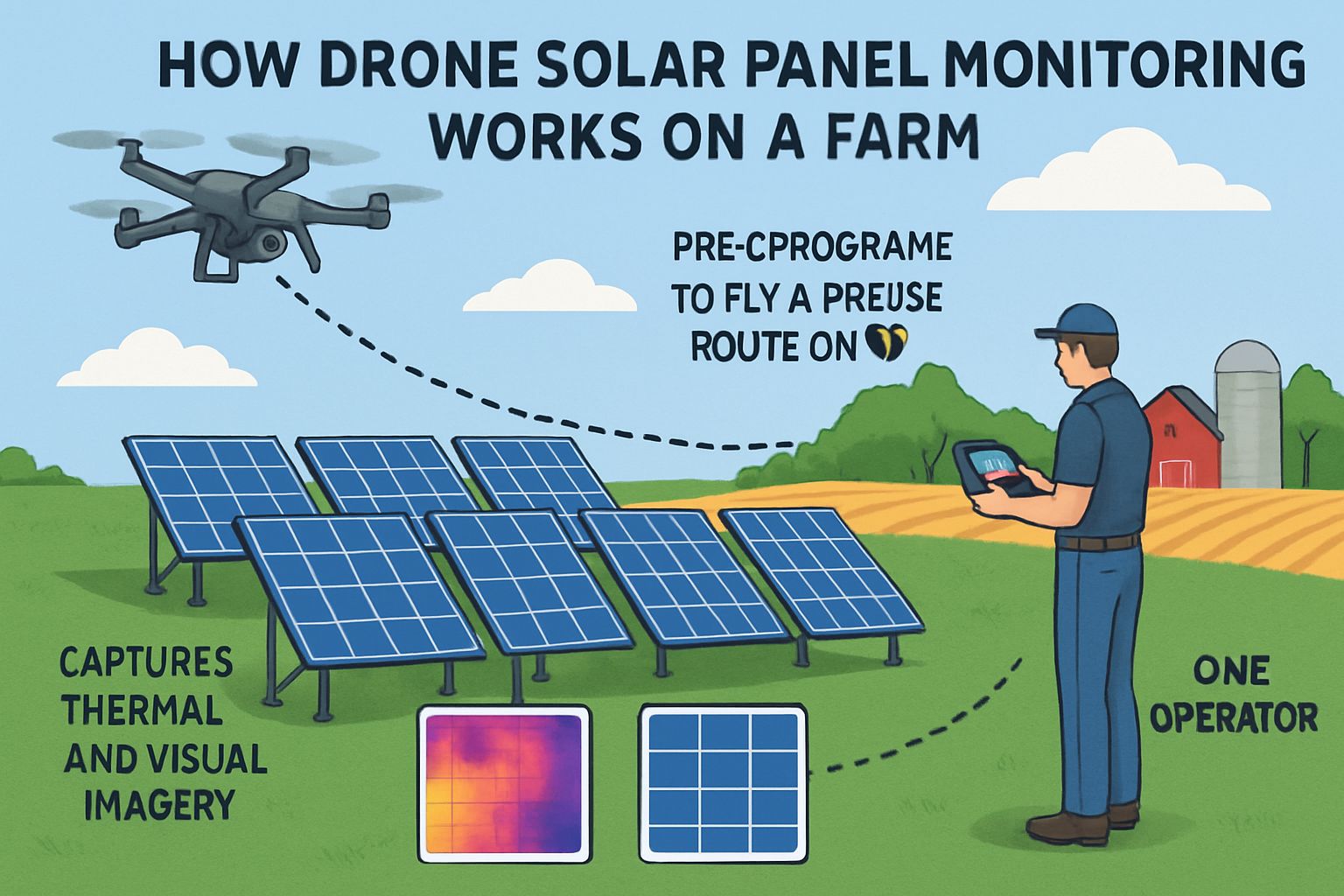
A drone solar panel inspection follows a structured process: the drone is pre-programmed to fly a precise route over the solar installation at a set altitude, capturing both thermal and visual imagery of every panel in the array. The entire flight can be automated, meaning one operator can run the inspection from the ground while the drone collects thousands of data points in a single pass.
Thermal Imaging Cameras Detect Hidden Panel Failures
Thermal imaging is the most critical tool in drone-based solar monitoring. Every solar panel generates heat as it operates, and a healthy panel distributes that heat evenly. When a cell fails, a bypass diode degrades, or a hotspot forms, that area emits a measurably different thermal signature that shows up clearly on infrared camera footage.
Hotspots are one of the most common and damaging faults in solar arrays. They occur when one cell underperforms and forces the surrounding cells to carry its load, generating concentrated heat that accelerates degradation across the entire panel. Without thermal imaging, a hotspot can go undetected for months while steadily destroying the panel from the inside.
Drone-mounted thermal cameras like the FLIR Vue Pro R and DJI Zenmuse XT2 can detect temperature differences as small as 0.05°C across a panel surface. That level of precision means even early-stage cell failures are flagged before they develop into full panel replacements. For farmers considering their solar panel options, it might be useful to explore the benefits of thin-film vs polycrystalline solar panels to ensure the best choice for their needs.
High-Resolution Visual Cameras Spot Physical Damage
Alongside thermal sensors, drones carry high-resolution RGB cameras that capture detailed visual imagery of panel surfaces. This allows inspection teams to identify physical damage including micro-cracks, delamination, soiling, bird droppings, and broken glass that thermal sensors alone might not flag. For more information on the applications and benefits of drones in solar inspections, visit Equinox’s Drones.
Micro-cracks are particularly important for farmers to monitor. They often develop after hailstorms or during transport and installation, and while they may not immediately affect output, they create structural weak points that worsen over time and can void manufacturer warranties if left undocumented.
Real-Time Data Transmission to Farm Management Systems
Modern inspection drones do not just collect data, they transmit it in real time. Using onboard LTE or Wi-Fi systems, thermal and visual data streams directly to a connected tablet or farm management platform during the flight. This means by the time the drone lands, the inspection report is already being generated. For farmers interested in maximizing efficiency, exploring best solar panels for agriculture can complement drone technology to further enhance farm management.
Integration with farm management software allows operators to track panel performance over time, compare inspections from different seasons, and build a complete maintenance history for every unit in the array. That historical data becomes invaluable when filing insurance claims or negotiating warranty repairs with panel manufacturers.
Drone Inspections Cut Farm Solar Maintenance Costs by Up to 97%
Cost reduction is one of the most compelling arguments for switching to drone-based solar monitoring, and the numbers are difficult to ignore. A study referenced by DJI Enterprise found that drone inspections have reduced inspection times by 70% compared to conventional methods. When you factor in labor costs, equipment rental, and the extended downtime that comes with traditional inspections, the savings climb even higher.
A ground-based inspection of a large solar farm typically requires a team of three to five technicians, specialized access equipment, and multiple days of work. A drone inspection of the same installation can be completed by a single certified operator in a matter of hours. The cost difference is substantial, and on working farms where time and labor are always stretched, that efficiency advantage has a direct impact on the bottom line.
- Labor savings: One drone operator replaces a crew of multiple ground inspectors
- Time savings: Inspections that took days are completed in hours
- Access savings: No scaffolding, cherry pickers, or roof access equipment required
- Safety savings: Zero risk of technician injury from falls or terrain hazards
- Data quality: Thermal imaging captures faults that visual walkthroughs routinely miss
One Drone Replaces an Entire Ground Inspection Team
A single agricultural drone equipped with a dual-sensor payload, such as the DJI Matrice 300 RTK paired with a Zenmuse XT2, can cover several hectares of solar panels in a single flight session. Pre-programmed flight paths ensure 100% coverage with no panels skipped, no human fatigue factor, and consistent altitude and image overlap for accurate analysis.
For larger solar installations spanning dozens of hectares, multiple automated flights can be queued and run sequentially with minimal operator input. What previously required a team working for days can now be completed by one person in an afternoon, with higher accuracy and a complete digital record of every finding. For more insights on this technology, explore drones for solar panel inspection.
Early Fault Detection Prevents Expensive Repairs
The real financial payoff from drone monitoring is not just in inspection savings. It is in what gets caught early. A single failing panel that goes undetected for a full season can drag down the output of the entire string it belongs to, costing a farm thousands in lost generation capacity before anyone notices.
How Farmers Earn More Revenue With Drone-Monitored Solar Panels
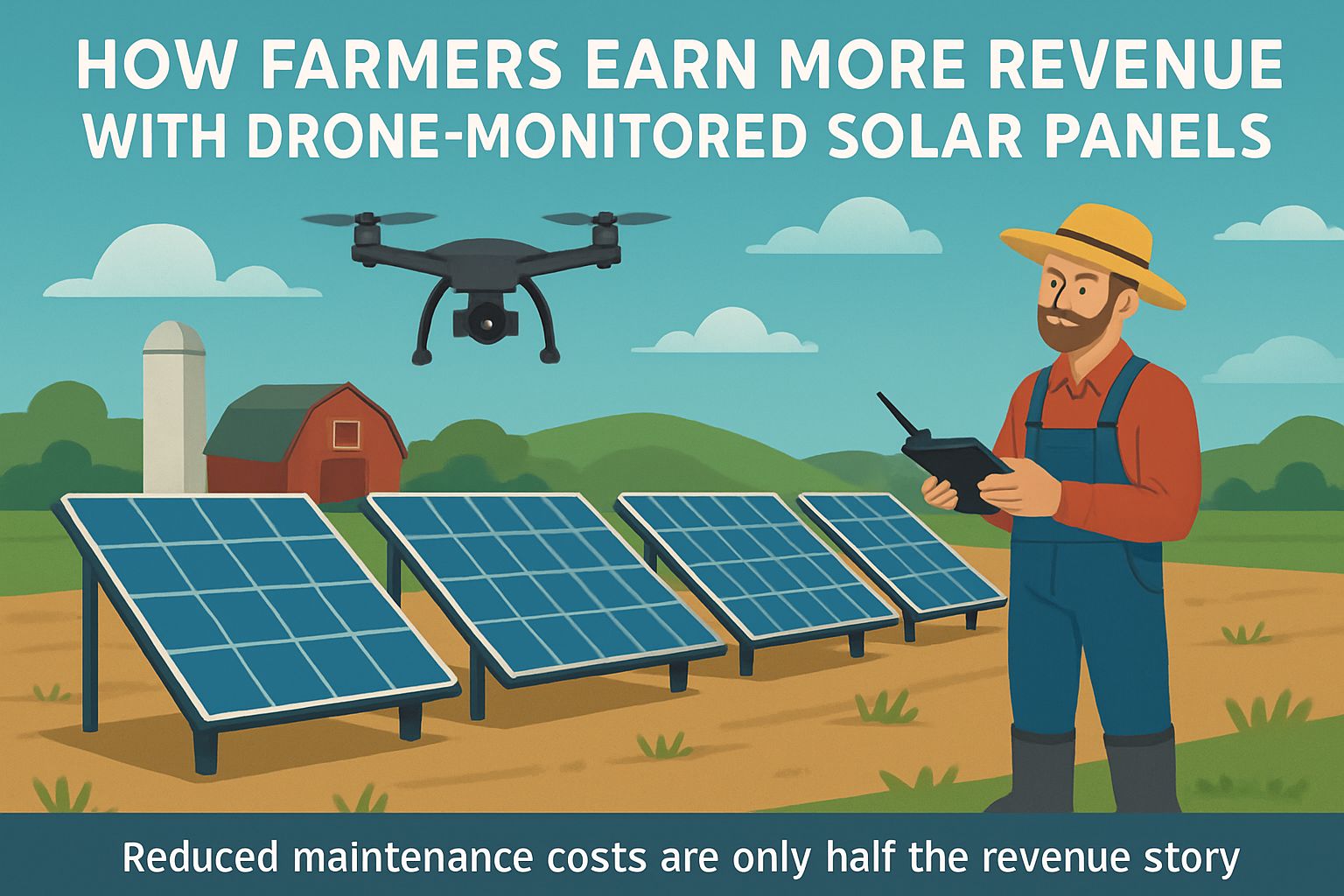
Reduced maintenance costs are only half the revenue story. Drone monitoring also directly increases the energy output of a solar installation by identifying and resolving the faults that silently reduce performance over time. For farmers interested in maximizing their solar investments, understanding the benefits of TOPCon solar panels can provide additional insights into enhancing energy efficiency.
Hotspot Detection Restores Lost Energy Output
A single hotspot on one panel can reduce the output of an entire string by 30% or more, depending on how the array is wired. Drone thermal imaging identifies these hotspots with pinpoint accuracy, giving farm operators the exact panel location, the severity of the temperature variance, and a prioritized repair recommendation. Fixing a hotspot-affected panel is often as simple as replacing a single bypass diode, a repair that costs far less than replacing the entire panel after it burns out completely.
Faster Inspections Mean Less Downtime and More Power Generation
Every hour a solar array spends offline during a manual inspection is an hour of lost energy generation. On a large farm installation during peak sunlight months, that lost generation translates directly into lost revenue, whether the farm is selling power back to the grid or using it to offset operational electricity costs. For those interested in maximizing efficiency, exploring the best solar panels for farmers can provide additional insights.
Drone inspections do not require panels to be powered down. The drone flies over the live array, collects thermal and visual data while the system continues generating power, and the inspection is completed without interrupting a single kilowatt-hour of production. That non-invasive approach preserves generation uptime and keeps the revenue stream uninterrupted throughout the inspection process.
Data Reports Support Warranty Claims and Insurance Settlements
One of the most underrated financial benefits of drone solar monitoring is the documentation it produces. Every inspection generates a georeferenced report that maps each fault to its exact panel location, with supporting thermal imagery, temperature readings, and visual photographs. When a farmer needs to file a warranty claim for a defective panel or lodge an insurance claim after storm damage, that level of documented evidence is the difference between a fast approval and a drawn-out dispute. Manufacturers and insurers respond far more favorably to a thermal-image-backed report than to a technician’s verbal assessment.
Drone Monitoring Protects Farm Solar Assets Year-Round
Solar panels face a constant barrage of environmental stressors across every season. Hail, high winds, frost, UV degradation, bird activity, and vegetation growth all create conditions that can silently reduce panel performance or cause physical damage that worsens over time. Learn more about the benefits of TOPCon solar panels for agricultural farms.
A scheduled drone monitoring program creates a continuous record of asset condition that makes it easy to spot deterioration patterns before they become critical failures. Rather than reacting to problems after the fact, farmers can use seasonal inspection data to anticipate maintenance needs, plan repairs during low-generation periods, and protect the long-term value of their solar investment.
Weather Damage Is Identified Before It Escalates
After a major weather event like a hailstorm or a period of high winds, the damage to solar panels is not always immediately visible from the ground. Micro-cracks, delamination, and loosened mounting hardware can look perfectly normal to the naked eye while quietly compromising the structural and electrical integrity of the panel.
Deploying a drone within 24 to 48 hours of a significant weather event gives farm operators a complete damage assessment before the situation escalates. Cracked panels left unaddressed allow moisture ingress that accelerates internal corrosion, and loose mounting hardware creates vibration stress that spreads micro-cracks further across the cell surface. Early detection from a post-storm drone flight can prevent what starts as minor weather damage from becoming a full panel replacement scenario.
Vegetation Overgrowth and Shading Issues Are Caught Early
Ground-mounted solar arrays on farms are particularly vulnerable to shading from vegetation growth. Even partial shading on a single panel can trigger a disproportionate drop in output across an entire string due to the series wiring configuration common in most farm installations. High-resolution drone imagery makes it easy to identify encroaching vegetation, overhanging branches, or weed growth that is casting shadows across panels, so farm operators can schedule targeted clearing before the shading impact compounds over an entire growing season.
Site Surveying Before Solar Installation Saves Farmers Money
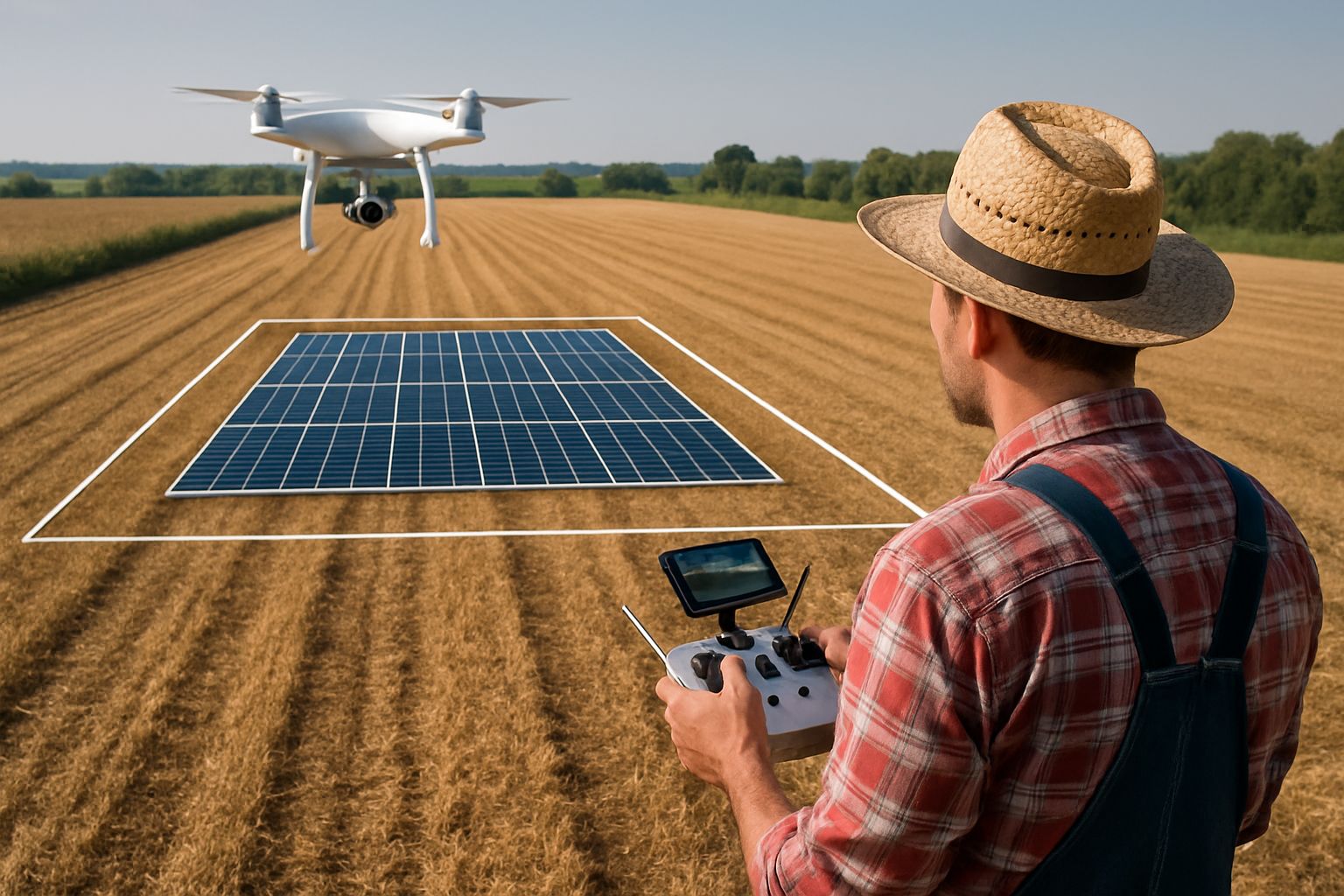
Drone technology is not only useful after solar panels are in the ground. Pre-installation drone surveys of farmland give installers and energy planners highly accurate topographic data, shading analysis, and land condition assessments that directly improve the design of the solar array. A properly sited installation based on real drone survey data avoids common placement mistakes like installing panels in natural shading zones, on unstable ground, or at suboptimal angles for the farm’s specific geographic location. Getting the layout right from day one means better energy yield, lower installation costs, and fewer corrective changes down the line. For farmers considering different types of panels, exploring thin-film vs polycrystalline solar panels can be beneficial.
How to Get Started with Drone Solar Panel Monitoring on Your Farm
Starting a drone monitoring program does not require a large upfront commitment. Most farms begin with a single baseline inspection to establish the current condition of their solar installation, then build a regular monitoring schedule from there based on the size of the array, the local weather conditions, and the farm’s energy revenue goals.
The most important first step is understanding what you currently have. That means knowing the total number of panels, the age and model of the installation, the wiring configuration, and whether any faults have already been identified. Armed with that information, a drone inspection service can design a flight plan that provides complete coverage and generates a report you can actually act on.
1. Audit Your Current Solar Setup and Identify Inspection Gaps
Before booking a drone inspection, gather all existing documentation on your solar installation. This includes the original installation plans, inverter performance logs, any previous inspection reports, and manufacturer warranty documentation for your panels. Knowing the age and model of your panels matters because older installations are statistically more likely to have developed hotspots, degraded bypass diodes, and micro-crack networks that thermal imaging will surface quickly. For farmers considering different types of solar panels, understanding the benefits of monocrystalline vs polycrystalline panels can be crucial.
If your farm has never had a formal solar inspection, treat the first drone flight as a discovery audit. The report will establish a documented baseline of every panel’s condition, flag any existing faults, and give you a prioritized list of repairs ranked by impact on energy output. That baseline becomes the reference point for every future inspection, making it easy to track degradation rates and measure the effectiveness of maintenance work over time.
2. Choose Between Hiring a Drone Service or Operating In-House
For most farms, hiring a professional drone inspection service is the more practical starting point. Professional operators bring certified equipment, trained pilots, and specialized solar inspection software that generates publication-quality reports with georeferenced fault mapping. The cost per inspection is predictable, there are no equipment maintenance obligations, and the operator handles all regulatory compliance requirements for commercial drone flights.
Larger agricultural operations with extensive solar assets may eventually find value in training an in-house operator and investing in a dedicated inspection drone. A platform like the DJI Matrice 350 RTK paired with a Zenmuse H20T dual-sensor payload gives an in-house team thermal and visual inspection capability across a wide range of agricultural assets beyond just solar panels. However, the training, certification, software licensing, and equipment costs represent a significant investment that only makes sense at a certain scale of solar installation.
3. Schedule Regular Drone Inspection Intervals
Most farm solar installations benefit from a minimum of two scheduled drone inspections per year, typically once in spring before peak generation season and once in autumn after the summer heat stress period. Farms in regions with severe weather, heavy dust, or significant bird activity may require quarterly inspections to maintain consistent performance. The key is building a fixed schedule rather than reacting only when something goes visibly wrong, because the most costly faults are the ones that develop silently over months without triggering an obvious alarm.
4. Use Inspection Reports to Guide Maintenance Decisions
A drone inspection report is only as valuable as the action it drives. Once you receive a georeferenced fault report, prioritize repairs based on the severity and location of each fault within your array’s wiring configuration. A hotspot on a panel that sits mid-string has a larger proportional impact on total output than the same fault on a panel at the end of a string, so understanding your wiring layout helps you sequence repairs for maximum revenue recovery.
Over multiple inspection cycles, the accumulated data reveals patterns that single inspections cannot. If the same section of your array consistently develops hotspots after summer, it may indicate a shading issue, an inverter imbalance, or a batch of panels from a specific production run that is degrading faster than expected. That kind of trend analysis transforms drone inspection data from a maintenance tool into a genuine strategic asset for long-term farm energy planning.
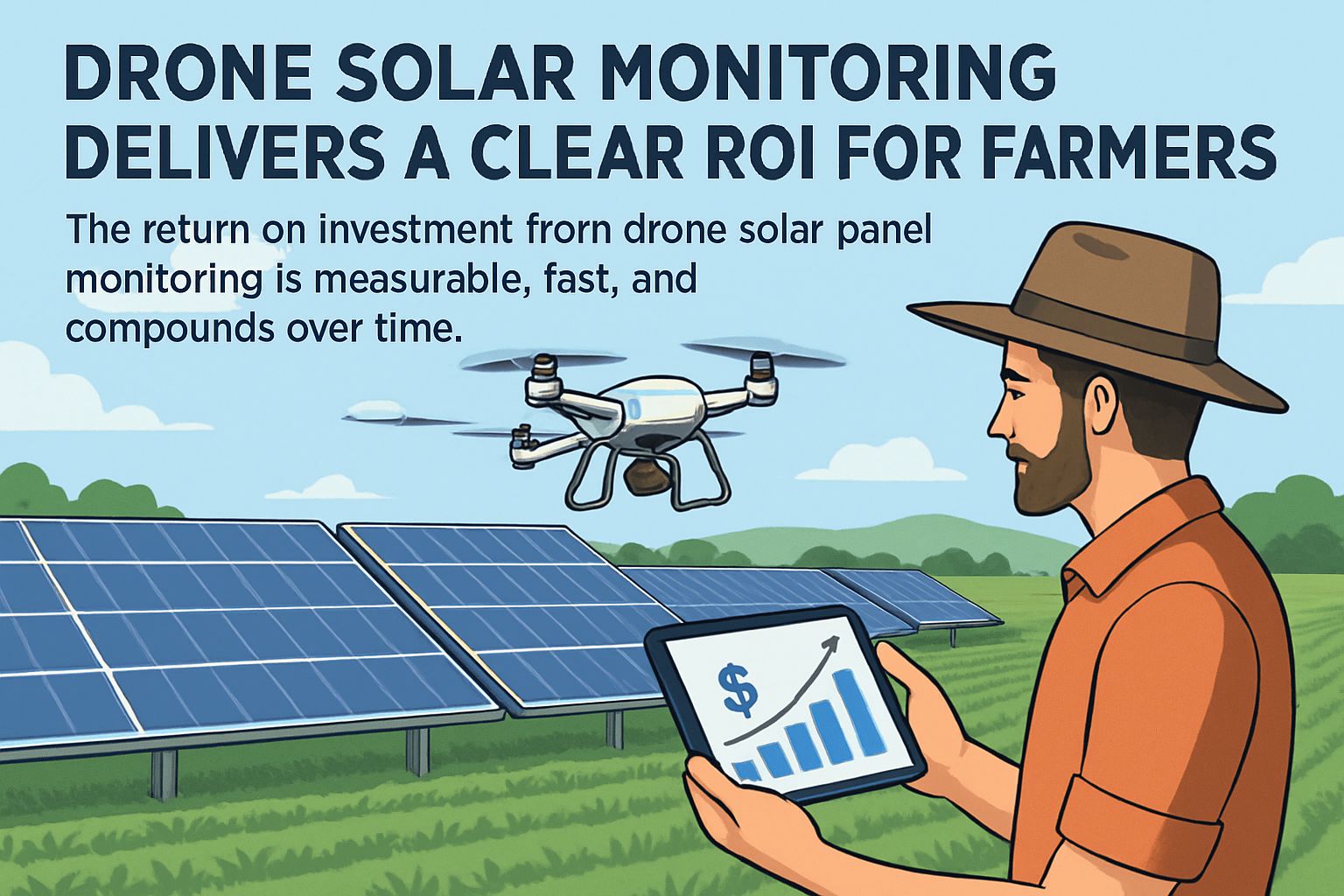
Drone Solar Monitoring Delivers a Clear ROI for Farmers
The return on investment from drone solar panel monitoring is measurable, fast, and compounds over time. Consider a mid-sized farm with a 500-panel ground-mounted installation. A traditional ground inspection of that array might cost thousands in labor and take several days to complete, with no thermal imaging capability included. A professional drone inspection of the same array costs a fraction of that, is completed in hours, and delivers thermal data that identifies faults responsible for energy losses the farm owner did not even know existed.
|
Inspection Method |
Time Required |
Thermal Imaging |
Relative Cost |
Panel Coverage |
|---|---|---|---|---|
|
Manual Ground Inspection |
2–4 days |
No |
High |
Incomplete |
|
Professional Drone Inspection |
2–6 hours |
Yes |
Low–Medium |
100% |
|
In-House Drone Program |
2–4 hours |
Yes |
Low (after setup) |
100% |
When a single drone inspection identifies and enables the repair of hotspot-affected panels that were dragging down string output by 25 to 30%, the energy revenue recovered across a full generation season easily outweighs the inspection cost many times over. Add in the documentation value for warranty claims, the reduced labor overhead, and the extended panel lifespan that comes from catching faults early, and the ROI case becomes impossible to argue against.
Frequently Asked Questions
Drone solar panel monitoring is a rapidly growing field, and farm operators often come to it with a specific set of practical questions. Below are the most common questions answered directly.
How often should farmers use drones to inspect solar panels?
Farmers should schedule drone solar panel inspections at least twice per year, with spring and autumn being the most strategically valuable timing. Spring inspections identify any damage accumulated over winter and ensure the array is performing at full capacity entering peak generation season. Autumn inspections assess the impact of summer heat stress and catch any hotspot development before the lower-output winter months. Farms with high dust exposure, significant bird activity, or frequent severe weather events should move to quarterly inspections to stay ahead of performance losses.
Can drones monitor solar panels in bad weather conditions?
Most commercial inspection drones are rated for operation in light wind and overcast conditions, but active rain, strong winds above 10 to 12 meters per second, and lightning storms ground all drone operations for both safety and data quality reasons. Thermal imaging in particular produces the most accurate results when flown within two hours of sunrise or sunset, or under consistent cloud cover, because direct midday sunlight creates thermal reflections that can obscure genuine fault signatures. Post-storm inspections are best conducted after the weather fully clears, typically 24 to 48 hours after a major event.
What types of faults can drone thermal imaging detect on solar panels?
Drone-mounted thermal cameras are capable of identifying a wide range of electrical and physical faults across a solar installation. The most commonly detected issues include:
- Hotspots: Localized overheating caused by cell failure, shading, or bypass diode degradation
- Bypass diode failures: Diodes that have failed open or short, disrupting current flow through the string
- Delamination: Separation of panel layers that traps moisture and accelerates cell corrosion
- String-level faults: Entire rows of panels underperforming due to inverter or connection issues
- Soiling patterns: Uneven dirt or debris accumulation that creates partial shading across cell surfaces
- Potential Induced Degradation (PID): Voltage-stress degradation visible as consistent thermal patterns across multiple panels
Each of these faults produces a distinct thermal signature, and experienced drone inspection operators combined with AI-assisted analysis software can categorize and prioritize them automatically within the inspection report.
Do farmers need special permits to fly drones over their solar installations?
Permit requirements for drone operations vary by country and region, but in most jurisdictions commercial drone flights, including those conducted by third-party inspection services, require the operator to hold a certified commercial drone license. In Australia, the Civil Aviation Safety Authority (CASA) requires all commercial drone operators to hold a Remote Pilot Licence (RePL) and operate under a certified Remotely Piloted Aircraft Operator’s Certificate (ReOC). In the United States, the FAA requires commercial operators to hold a Part 107 certification. Farmers hiring a professional drone inspection service should confirm that the operator carries full certification and appropriate liability insurance before any flight takes place over their property. For those considering solar installations, it’s beneficial to understand the best solar panels for farmers to maximize efficiency and output.
How much does a professional drone solar panel inspection cost for a farm?
The cost of a professional drone solar panel inspection depends on the size of the installation, the type of sensors used, the level of reporting required, and the geographic location of the farm. Smaller rooftop installations on farm buildings typically cost less to inspect than large ground-mounted arrays spanning multiple hectares. For more information on solar panel types, you can explore the best solar panels for farmers.
Generally, professional drone inspections that include both thermal imaging and high-resolution visual data with a detailed georeferenced fault report represent strong value compared to traditional manual inspection methods, particularly when the cost is measured against the energy revenue recovered from identifying and repairing faults. The documentation produced also carries financial value beyond the inspection itself, supporting warranty claims and insurance assessments that can recover costs many times the original inspection fee.
Farms considering an in-house drone program should budget for the drone hardware, dual-sensor payload, pilot certification training, inspection software licensing, and ongoing maintenance. Professional service arrangements eliminate those upfront costs entirely and remain the most cost-effective option for most farm operators, especially those conducting inspections only two to four times per year.
Drone technology has revolutionized the way farmers monitor their solar panels, boosting revenue and efficiency. By utilizing drones, farmers can conduct faster and more accurate inspections, identifying potential issues before they become costly problems. This technology not only saves time but also enhances the lifespan of solar installations. For those interested in exploring the benefits of drones in solar inspections, Equinox’s Drones provides valuable insights into this innovative application.

Leave a Reply