
Article At a Glance
- Farm solar installations can reduce monthly electricity bills by 70-100%, with payback periods typically ranging from just 4-8 years.
- The federal Investment Tax Credit (ITC) currently offers a 30% tax credit on solar installations, with additional USDA REAP grants available specifically for agricultural producers.
- Agrivoltaics — growing crops beneath solar panels — can actually increase certain crop yields by up to 30% while simultaneously generating electricity, a dual-use strategy that’s changing modern farming.
- There are multiple strategic locations on any farm to install solar — from barn rooftops to ground-mounted arrays — and choosing the right one makes a significant difference in long-term returns.
Farming is expensive enough without handing thousands of dollars to the utility company every single year.
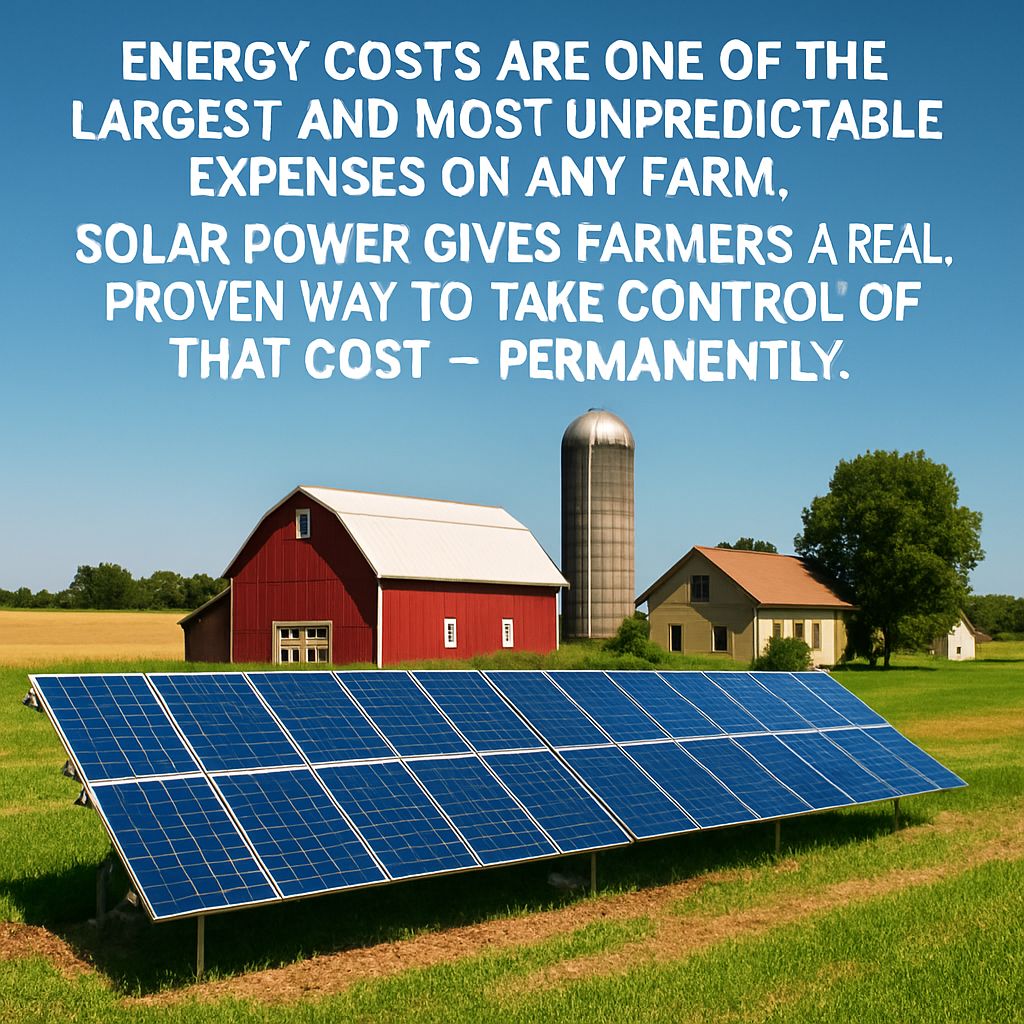
Energy costs are one of the largest and most unpredictable expenses on any farm. Whether you’re running irrigation pumps, climate-controlled poultry houses, or dairy cooling systems, your electricity meter never stops spinning. Solar power gives farmers a real, proven way to take control of that cost — permanently.
Solar Panels Can Cut Your Farm’s Energy Bill by Up to 100%
The math here is straightforward. A properly sized solar system generates enough electricity to offset the majority — and in many cases, all — of a farm’s energy consumption. Farms in states from California to New York are reporting monthly utility bills dropping by 70-100% after installation. For high-consumption operations like dairies, irrigated row crops, or commercial poultry houses, that can mean tens of thousands of dollars saved every single year. Over a system’s 25+ year lifespan, those savings are transformational.
The average payback period for a farm solar system is 4-8 years. After that window, the electricity your panels generate is essentially free. When you factor in tax credits, depreciation advantages, and protection against future utility rate hikes, the internal rate of return on farm solar investments frequently exceeds 15-20% — a figure that outperforms most traditional farm capital improvements. Discover how solar panels can boost crop growth and further enhance your farm’s efficiency.
5 Major Benefits of Solar Panels on Farms
Solar isn’t a one-trick solution. It delivers value across multiple dimensions of your operation simultaneously, and the benefits compound over time.
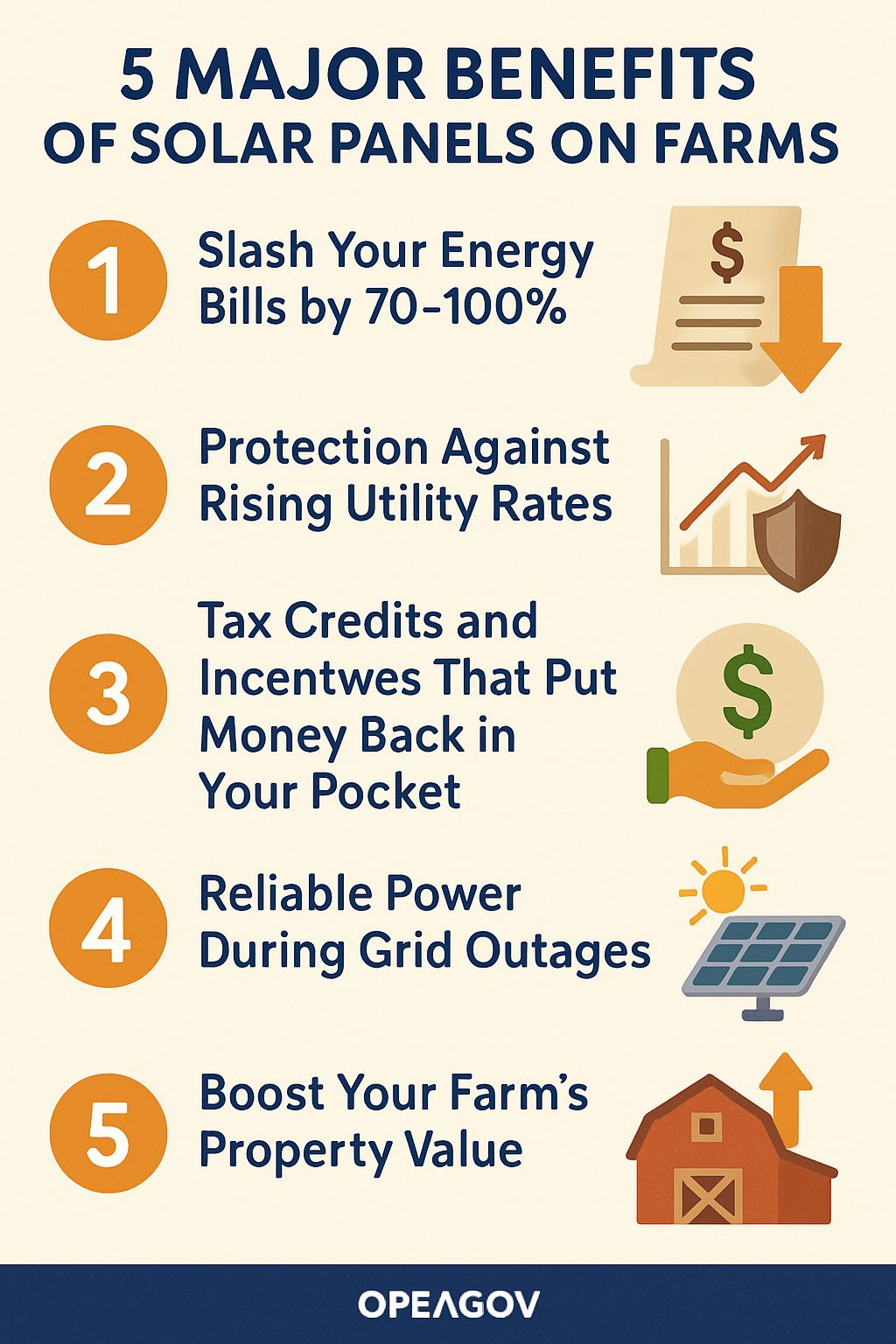
1. Slash Your Energy Bills by 70-100%
This is the headline benefit, and it’s the one that gets farmers’ attention fastest. Energy-intensive farm systems — irrigation, refrigeration, HVAC, lighting — run constantly. Solar panels generate power during peak daylight hours, directly offsetting grid consumption when your equipment is working hardest. Many farms eliminate their electricity bill entirely during high-production months. Discover how solar panels are boosting crop growth and providing additional benefits to farmers.
2. Protection Against Rising Utility Rates
Utility rates have increased consistently over the past two decades, and that trend shows no sign of reversing. Every kilowatt-hour your solar system generates is a kilowatt-hour you’re no longer buying at whatever rate the utility company decides to charge next year. Locking in your energy costs through solar production is a hedge that gets more valuable as grid prices climb.
3. Tax Credits and Incentives That Put Money Back in Your Pocket
The federal government currently offers a 30% Investment Tax Credit (ITC) on solar installations, which applies directly to your tax liability — not just as a deduction. Farmers can also access USDA Rural Energy for America Program (REAP) grants covering up to 25% of project costs, and bonus depreciation provisions allow accelerated write-downs on solar equipment. Stack these together and the net cost of going solar drops significantly from the sticker price.
4. Reliable Power During Grid Outages
When paired with battery storage, a farm solar system keeps critical equipment running during grid outages — something that can mean the difference between a manageable disruption and a catastrophic livestock or crop loss event. Energy independence isn’t just a financial win; it’s an operational resilience strategy.
5. Boost Your Farm’s Property Value
Solar installations are recognized by appraisers as value-adding infrastructure. A farm with an established solar system generating predictable energy savings carries a measurable premium over comparable properties without one. It’s an asset that grows your equity while it cuts your costs.
How Solar Panels Work on Farms
Understanding the basics of how farm solar systems operate helps you make smarter decisions about system sizing, placement, and configuration. The technology itself is straightforward, but the application on agricultural land has some unique considerations worth knowing.
From Energy Consumer to Energy Producer
Most farms are entirely dependent on the grid — every kilowatt-hour consumed is purchased from a utility at whatever rate they set. Solar flips that relationship. Instead of being a passive energy consumer, your farm becomes an active energy producer, generating its own power from sunlight and drawing from the grid only when production falls short of demand.
This shift has real operational significance. On sunny days, a well-sized system can generate more electricity than your farm consumes, pushing excess power back onto the grid through net metering arrangements. That surplus energy typically earns bill credits that offset nighttime or cloudy-day consumption, effectively using the grid as a giant battery without the upfront cost of physical storage. For more insights on how solar panels can benefit agriculture, check out how solar panels are boosting crop growth.
The transition from consumer to producer isn’t just financial — it changes how you think about energy on your farm. When your panels are generating, running the grain dryer, kicking on the irrigation pump, or firing up the feed mixer costs you nothing beyond what the sun provides. That fundamental shift in your relationship with energy is what makes solar one of the most strategically valuable investments a modern farm operation can make.
How Solar Panels Generate Electricity
Solar panels work by capturing photons from sunlight through photovoltaic (PV) cells, which are typically made from silicon. When photons strike the silicon cells, they knock electrons loose and create a flow of direct current (DC) electricity. An inverter then converts that DC electricity into alternating current (AC), which is the standard form used by all farm equipment and appliances. The entire process is silent, mechanical-component-free, and happens automatically from sunrise to sunset every single day.
Battery Storage and Grid Connection Options
System Type
How It Works
Best For
Key Consideration
Grid-Tied
Connected to utility grid; exports surplus power via net metering
Farms with reliable grid access seeking maximum savings
No power during outages unless battery backup added
Off-Grid
Fully independent; relies on battery storage for nighttime/cloudy days
Remote farm operations with no grid access
Requires significant battery bank investment
Hybrid
Grid-tied with battery backup for outage protection
Farms needing both savings and operational resilience
Higher upfront cost, maximum long-term flexibility
For most farm operations, a grid-tied system delivers the best combination of cost efficiency and simplicity. You benefit from net metering credits during high-production periods and maintain grid access as a reliable backup without the significant expense of a large battery bank. It’s the configuration that pencils out fastest for the majority of agricultural producers.
Hybrid systems are increasingly popular for farms where a power outage creates serious risk — livestock operations, dairy farms, or any operation with climate-sensitive animals or products. Adding battery storage to a grid-tied system means your critical loads stay powered even when the grid goes down, protecting animals and inventory without requiring a diesel generator burning expensive fuel.
Off-grid systems make the most sense for remote farm structures — outlying equipment sheds, irrigation pump stations, or pasture water systems — where running utility lines would cost more than the solar installation itself. In these applications, even a small panel array with modest battery storage eliminates the need for costly grid extension or regular generator fuel runs.
The Best Places to Install Solar Panels on Your Farm
One of the genuine advantages farms have over residential or commercial solar customers is space. Most agricultural operations have multiple viable installation locations, each with different cost profiles, energy production potential, and operational impacts. Choosing the right placement — or combining several — is key to maximizing your system’s performance and return on investment.
The ideal location on any farm balances three factors: unobstructed sun exposure throughout the day, minimal interference with ongoing farm operations, and proximity to the electrical loads being served. Getting all three right dramatically improves both energy output and installation economics.
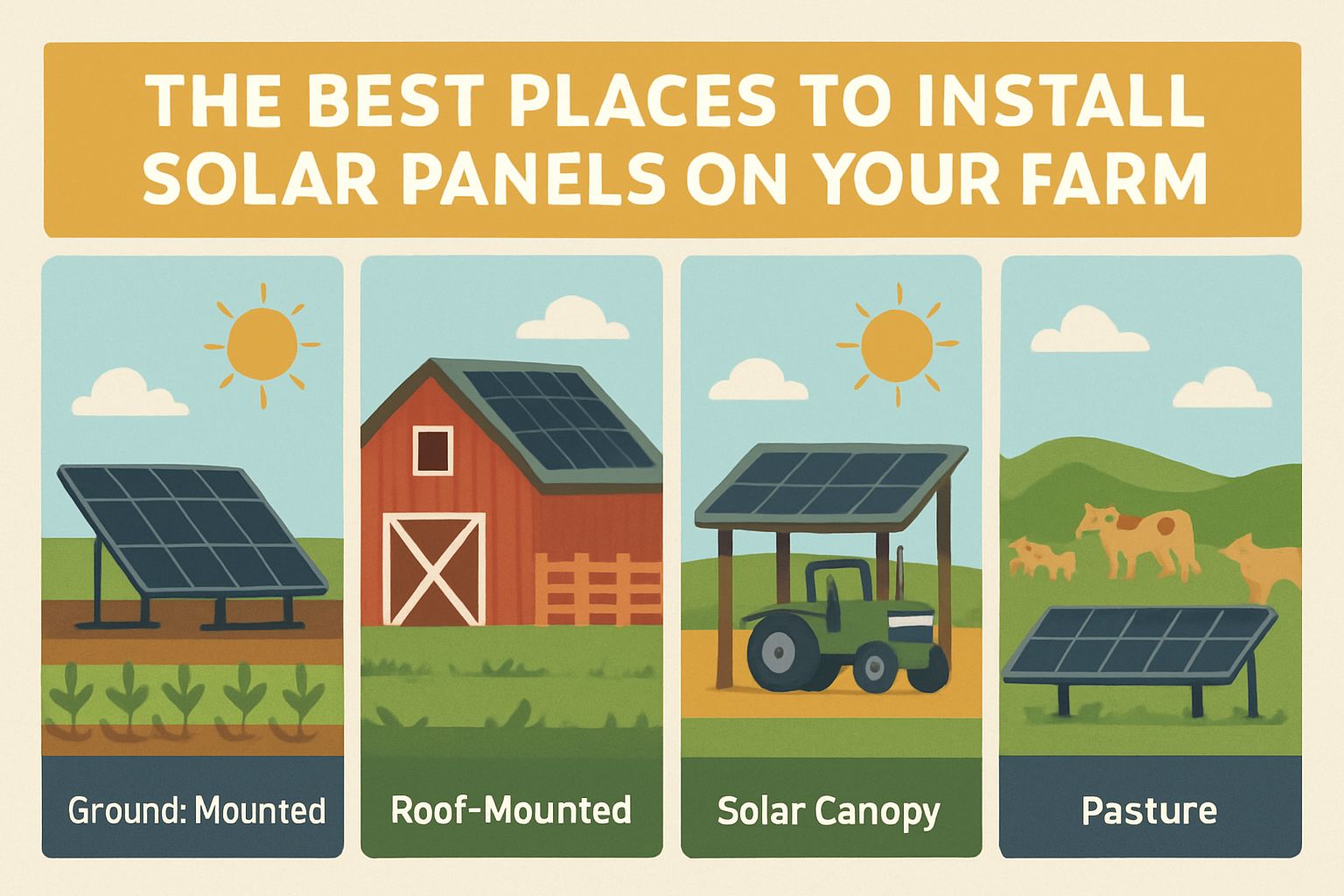
Roof-Mounted Panels on Barns and Farm Structures
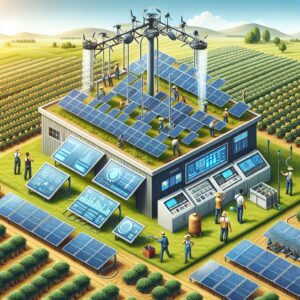
Barn rooftops are the most common starting point for farm solar — and for good reason. They put panels on existing structure without consuming any ground-level farm space, and large agricultural buildings often have roof areas that dwarf what’s available on a typical residential property. A single 80-foot dairy barn can comfortably host a system large enough to power significant portions of a farm’s daily operations. For more insights, explore the benefits of powering your farm with the sun.
South-facing roof sections with pitches between 15 and 40 degrees deliver optimal year-round production in most U.S. climates. East and west-facing roof sections are still productive and can be incorporated into larger systems to extend daily generation windows — capturing morning and afternoon sun that pure south-facing arrays miss during certain seasons.
Before committing to a roof-mounted system, it’s worth having the structure assessed for load capacity. Older barns with aging framing may need reinforcement to safely carry panel weight. That said, most modern metal agricultural buildings are well-suited to solar installation with little or no structural modification required.
Ground-Mounted Arrays on Unused Land
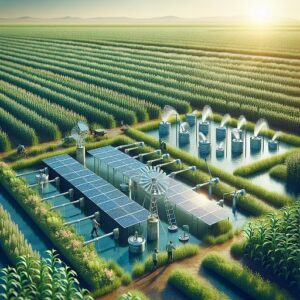
For farms with underutilized acreage — low-productivity corners, odd-shaped parcels, floodplain areas, or land between field sections — ground-mounted arrays are often the most cost-effective path to large-scale solar production. Ground mounts allow precise orientation and tilt angle optimization, and they can incorporate single-axis tracking systems that follow the sun throughout the day, increasing energy production by 20-30% compared to fixed installations.
Ground-mounted systems are also easier to maintain and expand than roof-mounted equivalents. Cleaning panels, performing inspections, and adding capacity later are all simpler when your array is at ground level and fully accessible. For larger farm operations targeting substantial energy offset or income generation through utility-scale leasing arrangements, ground mounts are typically the configuration of choice.
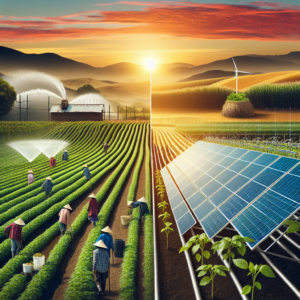
Agrivoltaics: Growing Crops Under Solar Panels
Agrivoltaics is one of the most exciting developments in modern sustainable agriculture — and it’s moving fast from research curiosity to practical farm strategy. The concept is exactly what it sounds like: installing solar panels above growing crops, simultaneously generating electricity and producing food from the same land area. For instance, you can boost tomato yield by growing them under solar panels for increased production.
Research has shown that certain crops actually perform better under partial solar shading than in full direct sun. Leafy greens, herbs, and some berry varieties have demonstrated yield increases of up to 30% under agrivoltaic installations, with the panels providing shade that reduces heat stress and cuts irrigation water demand simultaneously. For farmers in hot, arid regions, the water conservation benefit alone can be significant.
Panel height and spacing in agrivoltaic systems are designed to allow farm equipment access underneath, maintaining full operational use of the land. While the upfront engineering for these systems is more complex than a standard ground mount, the dual revenue potential — energy production plus crop yield — makes agrivoltaics one of the most financially compelling configurations available to forward-thinking farm operators.
Federal and State Incentives Available to Farmers
The financial case for farm solar is strong on its own merits, but the incentive landscape makes it genuinely exceptional. Federal programs, state-level policies, and agricultural-specific grants stack together in ways that can reduce the effective net cost of a solar installation by 50% or more before you’ve generated a single kilowatt-hour.
Navigating these programs takes some homework, but the payoff is substantial. Understanding what’s available — and making sure your installation is structured to qualify — is as important as the technical design of the system itself.
The 30% Federal Investment Tax Credit
- Credit amount: 30% of total system cost applied directly against your federal tax liability
- Eligible costs: Panels, inverters, mounting hardware, wiring, battery storage, and installation labor
- Who qualifies: Farm owners who pay federal income taxes and own (not lease) their solar system
- Carry-forward provision: Unused credit can be carried forward to future tax years if current liability is insufficient
- Bonus depreciation: Solar equipment qualifies for accelerated depreciation under MACRS, typically over a 5-year schedule — providing additional tax reduction on top of the ITC
The 30% ITC is currently available through 2032 under the Inflation Reduction Act, after which it is scheduled to step down. Farmers who have been considering solar but haven’t pulled the trigger are working within a defined window of maximum incentive availability — a window that is open right now but won’t stay that way indefinitely. For those interested in how solar can boost crop growth, now is the time to explore these benefits.
It’s worth noting that the ITC applies to the full installed system cost, not just equipment. That means professional installation, permitting fees, and even grid interconnection costs may be included in the credit calculation, making the effective benefit larger than many farmers initially assume.
For farm operations with complex tax situations — particularly those using Schedule F filings, pass-through entity structures, or operating at a loss in certain years — working with a tax professional familiar with agricultural solar incentives is essential to capturing the full value of the ITC and depreciation provisions.
USDA REAP Grants and Loan Guarantees
The USDA Rural Energy for America Program (REAP) is the single most valuable agricultural-specific solar incentive available, and it’s one that many farmers don’t know exists. REAP provides grants covering up to 25% of eligible project costs for agricultural producers installing renewable energy systems, with loan guarantees available for an additional portion of project financing. Combined with the federal ITC, a farm operation that successfully secures a REAP grant can offset more than half of its total solar installation cost before the system ever generates a kilowatt-hour.
REAP applications are competitive and require documentation of farm income, energy consumption history, and a technical report on the proposed system. Applications are accepted on a rolling basis with periodic funding cycles, so timing matters. Working with a solar installer experienced in agricultural incentive programs — one who understands how to structure projects for REAP eligibility — significantly improves your chances of securing grant funding. The paperwork investment is real, but so is the financial reward.
State-Level Solar Incentives and Net Metering
Beyond federal programs, most states offer their own layer of solar incentives that can meaningfully improve project economics. These vary significantly by state but commonly include:
- State income tax credits on solar installation costs, layered on top of the federal ITC
- Sales tax exemptions on solar equipment purchases, reducing upfront procurement costs
- Property tax exemptions that prevent solar installations from increasing your farm’s assessed property tax value
- Net metering policies that require utilities to credit your account at retail rates for surplus electricity your system pushes onto the grid
- Agricultural-specific grant programs administered at the state level through departments of agriculture or energy
Net metering deserves particular attention because it directly affects how much value you extract from every kilowatt-hour your system generates. In states with strong net metering policies, surplus summer production can bank credits that effectively pay for your winter grid consumption — making the annual math on your solar investment significantly more favorable than panel output numbers alone might suggest. Check your state’s current net metering rules before finalizing system sizing, as these policies continue to evolve.
Solar Panels Are One of the Smartest Investments a Farmer Can Make
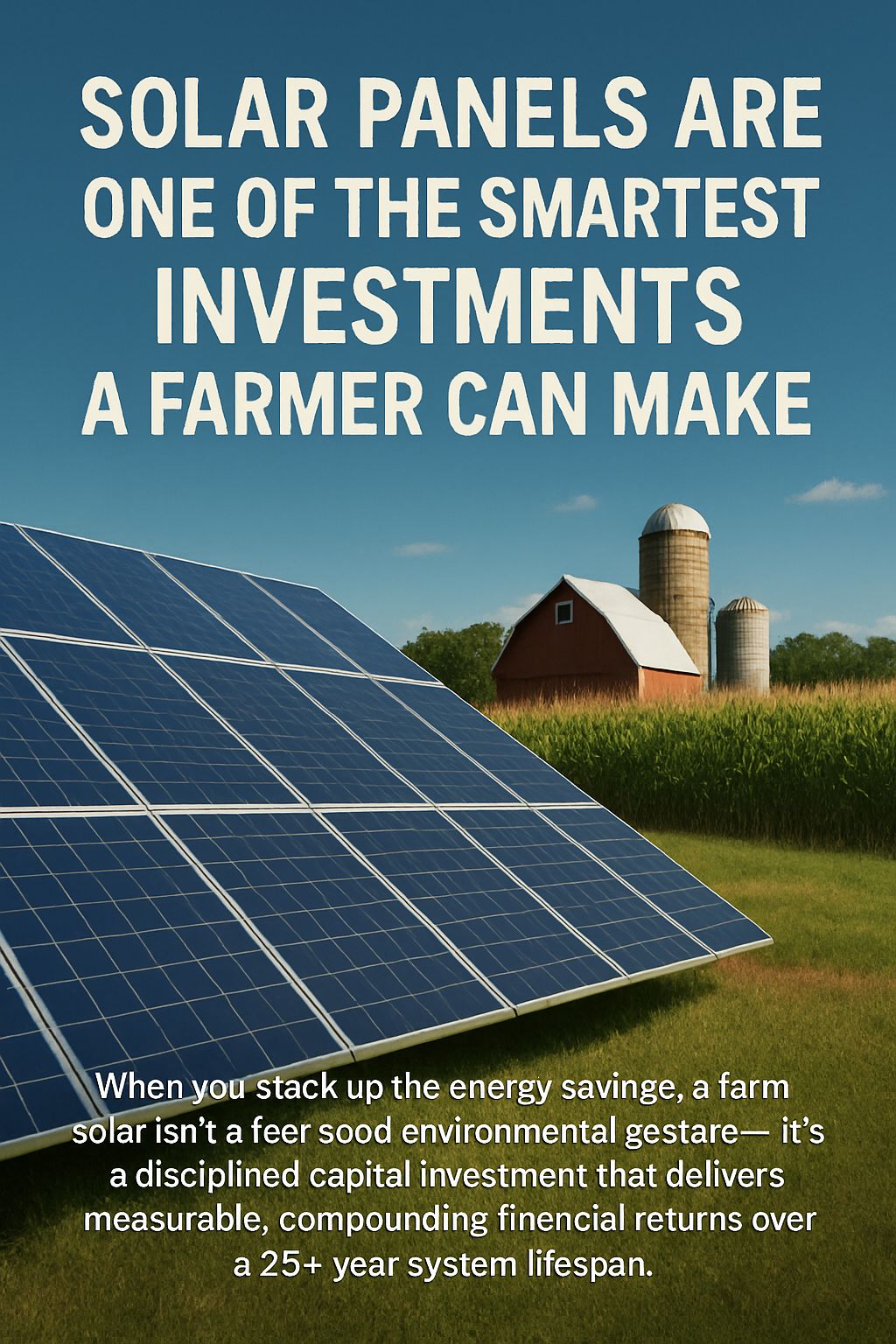
When you stack up the energy savings, the tax incentives, the property value increase, the operational resilience, and the long-term protection against rising utility rates, the conclusion is hard to argue with. Farm solar isn’t a feel-good environmental gesture — it’s a disciplined capital investment that delivers measurable, compounding financial returns over a 25+ year system lifespan. The farms that are installing solar today are locking in an energy cost advantage that their competitors won’t be able to match without making the same investment later, likely at higher prices. The sun rises every day whether you’re harvesting its energy or not. The only question is whether your farm is positioned to benefit from it. For example, increasing strawberry growth under solar panels is a practical way to enhance your farm’s productivity.
Frequently Asked Questions
Farmers considering solar tend to have similar questions — practical concerns about timelines, system capability, and whether the investment makes sense for their specific situation. The answers are more encouraging than most people expect going in, especially when considering the benefits of solar panels in farming.
Here are the most common questions agricultural producers ask before making the move to solar energy.
How Long Does It Take for Farm Solar Panels to Pay for Themselves?
The average payback period for farm solar systems is 4 to 8 years, depending on system size, local electricity rates, available incentives, and the farm’s energy consumption profile. High-consumption operations in states with elevated utility rates often land at the shorter end of that range. After the payback period, the electricity your system generates is essentially free for the remaining 17 to 21 years of the panel’s useful life. When you factor in REAP grants, the 30% ITC, and bonus depreciation, some operations see effective payback periods compress to 3 to 5 years.
Can Solar Panels Power an Entire Farm Operation?
Yes — with proper system sizing, solar panels can cover 100% of a farm’s electricity needs. The key is matching system capacity to actual consumption data from your utility history, accounting for seasonal variation in both production and demand. Energy-intensive operations like large dairies or commercial irrigation systems may require substantial array sizes, but the available roof and ground space on most farms makes full-offset systems entirely achievable. Your solar installer should perform a detailed load analysis before recommending system size.
What Happens to My Solar System During a Power Outage?
A standard grid-tied solar system without battery storage will automatically shut down during a grid outage — this is a safety requirement that prevents your system from back-feeding electricity onto lines where utility workers may be operating. However, a hybrid system with battery backup keeps your critical farm loads running independently of the grid during outages. For livestock operations, dairy farms, or any farm where a power outage creates risk of animal or crop loss, investing in battery storage as part of your solar system is a straightforward decision that pays for itself the first time the grid goes down at a critical moment.
Are Solar Panels Worth It for Small Farms?
Absolutely. While larger installations benefit from economies of scale, small farm operations often see excellent returns on appropriately sized solar systems. A small diversified farm, market garden, or hobby operation with a farmhouse and modest outbuildings can install a rooftop system that eliminates the residential and light agricultural electricity bill entirely. Federal and state incentives apply regardless of system size, and the 30% ITC is just as valuable proportionally for a small system as a large one. The break-even math works at virtually any scale where the farm has meaningful electricity consumption. For more insights, explore the benefits of powering your farm with solar panels.
How Long Do Solar Panels Last on a Farm?
Quality solar panels are warrantied for 25 to 30 years by most reputable manufacturers, with performance guarantees that panels will still produce at least 80% of their original rated output at the end of that period. In practice, many panels continue generating electricity well beyond their warranty period — just at gradually declining efficiency. The inverter, which converts DC electricity to usable AC power, typically carries a shorter warranty of 10 to 15 years and should be budgeted as a replacement item during the system’s life. For those interested in maximizing farm productivity, consider how you can grow mushrooms under solar panels to increase growth.
Farm environments do introduce specific durability considerations that are worth planning for. Dust, agricultural chemicals, bird activity, and hail exposure are all real factors in panel longevity and performance. Choosing panels rated for agricultural environments and scheduling annual professional inspections — including cleaning and electrical connection checks — keeps your system performing at peak output and catches minor issues before they become expensive failures.
Solar panels are becoming increasingly popular in the agricultural sector due to their ability to provide sustainable energy solutions. Many farmers are discovering that using solar panels not only reduces their carbon footprint but also enhances crop production. For instance, growing crops like strawberries under solar panels can significantly increase yield. Learn more about how to increase strawberry growth under solar panels for a more productive harvest.


Leave a Reply