
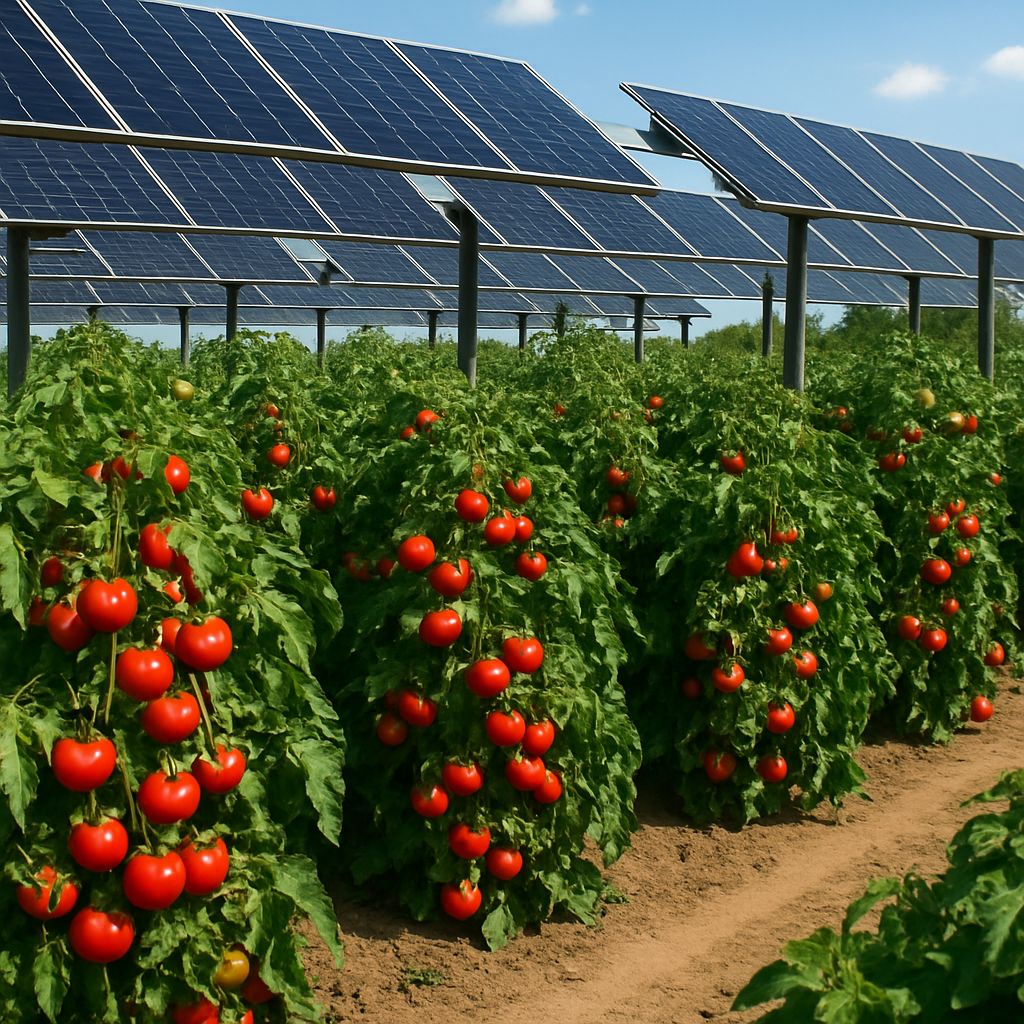
Article-At-A-Glance
- Tomato yields have been shown to double or even triple when grown under solar panels compared to traditional open-field methods.
- Agrivoltaic systems — combining solar energy and crop production — create a greenhouse-like microclimate that protects tomatoes from heat stress and reduces water use by up to 20-30%.
- Solar panels need to be elevated to at least six feet to accommodate tomato plants, which is standard for agrivoltaic installations but taller than most commercial arrays.
- The National Renewable Energy Laboratory (NREL) confirmed that tomatoes outperformed all other crops tested in agrivoltaic systems, while crops like wheat and potatoes showed negative results.
- Keep reading to find out exactly how to set up your solar array for maximum tomato production — and the one hidden benefit for farmworkers most growers completely overlook.
Growing tomatoes under solar panels isn’t just possible — it could be one of the smartest moves in modern sustainable agriculture.
The practice, known as agrivoltaics, pairs solar energy generation with crop production on the same land. Instead of choosing between farming and solar power, you get both — and in the case of tomatoes, the results are striking. 8760 Solar has documented how agrivoltaic systems are transforming the way growers think about land use and crop performance, making it a go-to resource for farmers exploring this approach.
What Is Agrivoltaics and Why Tomatoes Love It
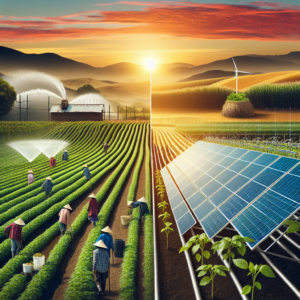
Agrivoltaics is the co-location of solar photovoltaic (PV) panels and agricultural crops on the same piece of land. The concept has gained serious traction over the last decade, particularly in regions where farmland is shrinking and energy demands are climbing. Rather than competing for space, the two systems support each other in ways that researchers are still uncovering.
Tomatoes, in particular, respond exceptionally well to agrivoltaic conditions. While they’re traditionally considered full-sun crops, tomatoes are highly sensitive to extreme heat — and that’s exactly where solar panels provide an unexpected advantage.
How Solar Panels Create a Greenhouse-Like Environment
Solar panels suspended above crop rows act as a partial canopy, filtering intense direct sunlight while still allowing enough light through for photosynthesis. This mimics the diffused light conditions inside a greenhouse. The shade reduces air temperature around the plants, slows soil moisture evaporation, and increases relative humidity — three conditions that tomato plants thrive in, especially during peak summer heat. Researchers have noted that growing tomatoes under solar panels can replicate greenhouse conditions in certain climates, meaning energy generated on-site could even power adjacent greenhouse structures.
Why Tomatoes Are the Top-Performing Agrivoltaic Crop
Not every crop benefits from partial shade — wheat, cucumbers, and potatoes have actually shown yield decreases in agrivoltaic systems according to NREL survey data. Tomatoes are different. They are sensitive to heat-induced fruit drop and blossom abortion, meaning that when temperatures spike, plants stop producing. The partial shade created by solar panels directly counteracts this problem, allowing the plant to focus energy on fruit development rather than heat stress response. This makes tomatoes one of the most naturally compatible crops for agrivoltaic systems.
The Science Behind Higher Tomato Yields Under Solar Panels
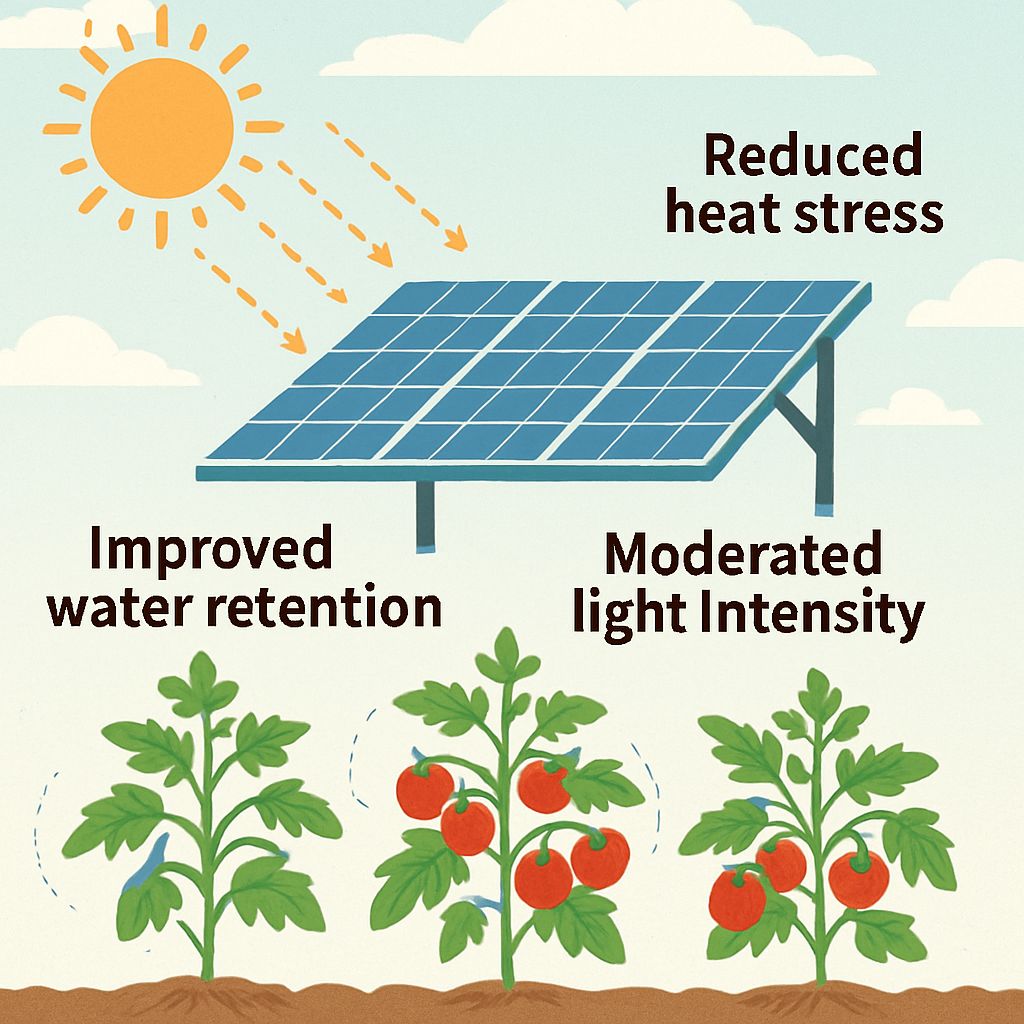
The yield improvements seen in agrivoltaic tomato research aren’t accidental — they’re the result of specific environmental changes that the solar canopy creates at the crop level. Three interconnected factors drive the results:
- Reduced heat stress: Partial shade keeps canopy temperatures lower, preventing blossom drop and fruit abortion during high-heat periods.
- Improved water retention: Lower evapotranspiration rates mean soil stays moist longer, reducing irrigation frequency without sacrificing plant health.
- Moderated light intensity: Diffused light from panel shade reduces photoinhibition — the process where excess light actually damages the plant’s ability to photosynthesize efficiently.
How Shade Stops Tomato Plants from Aborting Fruit
When tomato plants experience temperatures above 85°F (29°C) for extended periods, they abort developing blossoms and fruit as a survival mechanism. This is one of the leading causes of yield loss in open-field tomato production, particularly in hot, arid regions. Solar panels interrupt this cycle by reducing the intensity of solar radiation reaching the plant canopy, keeping temperatures in the productive range and allowing fruit to set and develop normally even during summer heat events.
Soil and Air Temperature Drops That Protect Your Crop
Agrivoltaic systems don’t just shade the plant — they cool the entire microclimate. The panels block a portion of incoming solar radiation from hitting the soil surface directly, which reduces soil temperature and slows moisture loss. Air temperatures in the space beneath panels have been measured as meaningfully lower than in adjacent open areas, creating a buffer zone that insulates the crop from extreme ambient heat. This cooling effect compounds over the growing season, consistently protecting yield potential at every stage of plant development.
How Solar Panel Shade Cuts Water Use Without Cutting Yield
One of the most practical advantages of growing tomatoes under solar panels is water savings. Reduced direct sunlight means lower evapotranspiration — the combined process of water evaporating from soil and transpiring through plant leaves. Agrivoltaic systems have been associated with water use reductions of 20-30% compared to open-field growing, without any corresponding drop in yield. For tomato growers in drought-prone regions like California’s Central Valley, this represents a significant operational and cost advantage.
What the Research Actually Shows
The scientific evidence supporting tomato production under solar panels is strong and growing. Multiple independent research institutions have studied agrivoltaic tomato systems under real farm conditions, and the results consistently point in the same direction — upward.
NREL Study: Tomato Yields Doubled at Agrivoltaic Sites
An August report from the National Renewable Energy Laboratory (NREL) surveyed agrivoltaic research sites across the United States and found that tomato yields doubled on average compared to non-agrivoltaic control sites. Notably, tomatoes were among the standout performers in the study, while several other crops including wheat, cucumbers, potatoes, and lettuce showed negative yield impacts under panels. This distinction is critical — not every crop is suited for agrivoltaics, but tomatoes appear to be uniquely positioned to benefit.
University of Arizona: 2-3x Yield Increase Over Traditional Methods
Researchers at the University of Arizona’s Biosphere 2 facility conducted one of the most comprehensive agrivoltaic studies to date, tracking chiltepin pepper, jalapeño, and cherry tomato plants grown in the shade of PV solar panels over several years. The study found that crop yields were two to three times larger than those achieved through traditional agricultural methods. Cherry tomatoes specifically doubled their yield when grown under solar panels — a result consistent with findings from other institutions and strong enough to shift the conversation from “can tomatoes grow under panels” to “why aren’t more farmers doing this.”
Oregon State Results: Lower Temperatures, Higher Soil Moisture
Oregon State University researchers planted tomatoes in three distinct zones: directly under solar panels, between rows of panels, and in a separate open-field control area. The solar array used in the study was close to 500 kilowatts total, and each growing group contained two plots with 40 tomato plants each. The results confirmed what the Arizona research suggested — tomatoes grown under and between panels experienced lower ambient temperatures and higher soil moisture retention compared to the control group. These two factors alone — cooler temperatures and better moisture — explain the majority of the yield improvements seen across agrivoltaic tomato research.
How to Set Up Solar Panels for Tomato Growing
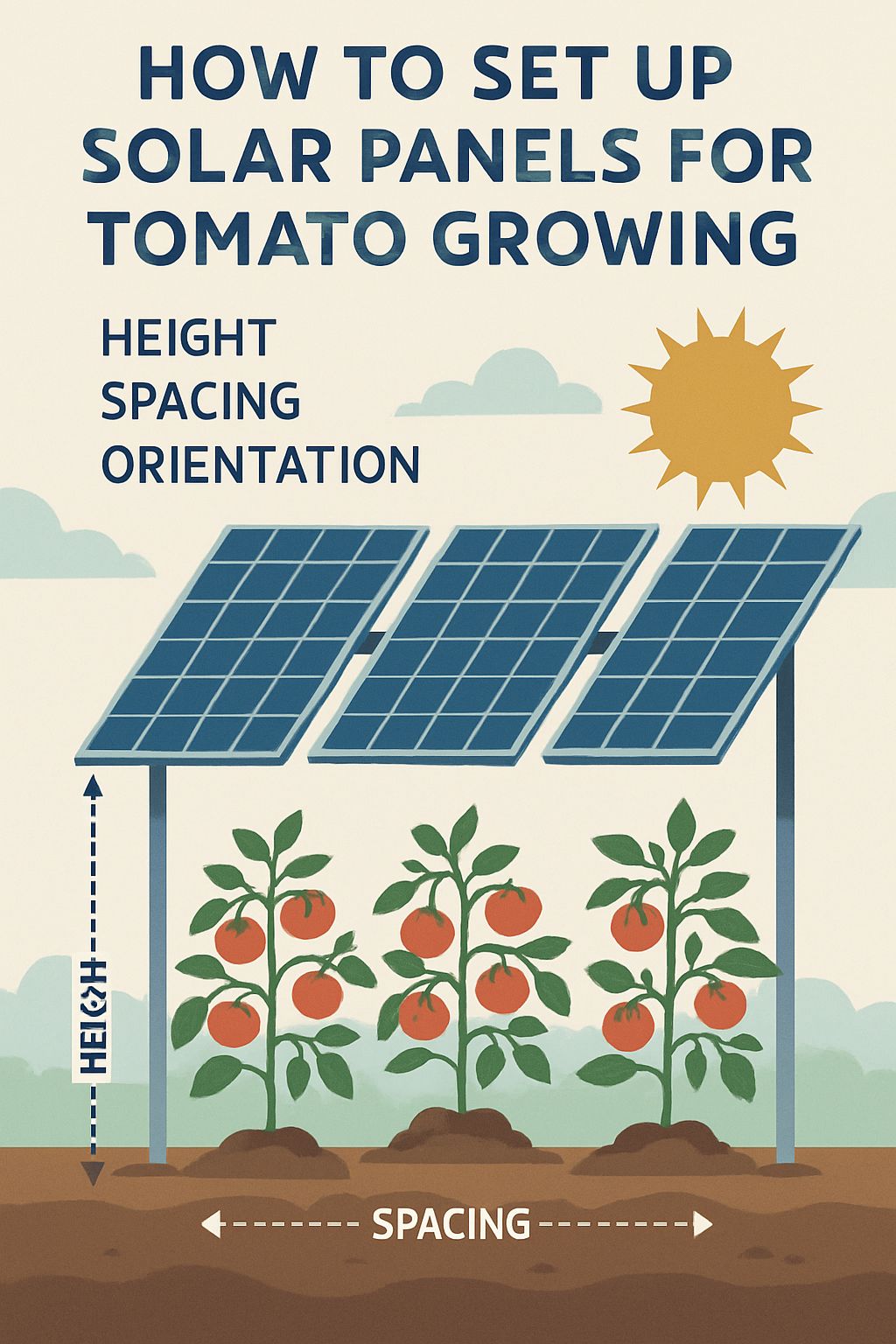
Setting up an agrivoltaic system for tomatoes requires more planning than simply installing panels above a garden bed. The height, spacing, and orientation of your array directly determines how much light reaches your plants, how easily you can access and harvest the crop, and whether the microclimate you create helps or hinders production. Get these variables right and you have a system that generates clean energy and a premium crop simultaneously.
1. Panel Height Requirements for Tomato Plants
Tomato plants typically grow to around five feet tall at maturity, which means your solar array needs to be elevated to a minimum of six feet to provide sufficient clearance for plant growth and airflow. This is taller than most standard commercial solar installations, but it is the accepted benchmark for agrivoltaic systems designed to support taller crops. The additional height does increase structural costs, but it also improves air circulation beneath the panels — which benefits both the plants and the panels themselves, since cooler panels operate more efficiently.
2. Planting Zones: Under Panels vs. Between Rows
Oregon State’s research demonstrated that both under-panel and between-row planting zones produced strong results, though with slightly different growing conditions. Plants directly under panels receive the most shade and the most protection from heat and moisture loss. Plants grown between rows get more direct light but still benefit from the temperature moderation of the surrounding array. A mixed planting strategy — using both zones — gives you the most flexibility and lets you observe which positioning performs best for your specific variety and climate.
3. Irrigation Adjustments for Shaded Growing Conditions
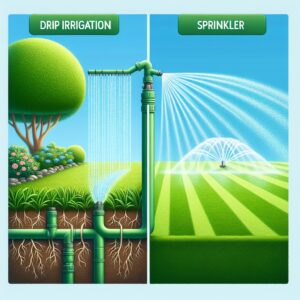
Because agrivoltaic conditions reduce evapotranspiration significantly, your existing irrigation schedule will likely overwater your tomato plants if left unchanged. Start by reducing irrigation frequency by 20-25% compared to your open-field baseline and monitor soil moisture carefully for the first few weeks. Drip irrigation is the most effective delivery method in agrivoltaic systems since it targets the root zone directly and minimizes surface evaporation further. Fine-tuning your irrigation setup to match the lower water demand of shaded tomatoes is one of the most impactful operational adjustments you can make.
4. Hand Harvesting Considerations Under Low-Clearance Arrays
Tomatoes are predominantly harvested by hand, which actually works in favor of agrivoltaic systems. Unlike mechanically harvested crops that require wide, unobstructed rows for equipment, hand-harvested tomatoes can be picked efficiently beneath elevated panels with six feet or more of clearance. For more insights on sustainable farming practices, explore solar-powered irrigation systems that can complement agrivoltaic setups.
Farmworkers harvesting under panels also benefit from shade during peak heat hours — a genuine health and productivity advantage that is rarely discussed in agrivoltaic literature but has real-world significance in regions where heat illness is a documented occupational risk.
For small to mid-scale operations, standard hand-harvesting practices require minimal modification in an agrivoltaic layout. Larger operations running mechanical harvesting equipment will need to evaluate row spacing and panel height more carefully to determine compatibility with their machinery.
The Real Challenges of Growing Tomatoes Under Solar Panels
Agrivoltaics is a powerful system, but it isn’t without friction. The challenges are real and worth understanding before committing to an installation — particularly at commercial scale.
Most of the obstacles fall into two categories: upfront infrastructure costs and equipment compatibility. Neither is insurmountable, but both require honest planning to address effectively.
Higher Installation Costs for Elevated Arrays
Elevating solar panels to six feet or higher — the minimum needed for tomato production — requires more robust mounting structures than standard ground-mounted arrays. This translates directly into higher material and labor costs during installation. Estimates vary depending on location, array size, and terrain, but elevated agrivoltaic structures consistently cost more per watt than conventional ground-mount systems. The offset comes from dual land use value: the same acreage generates both energy revenue and crop revenue simultaneously, which over time can justify the additional upfront investment.
Machinery Limitations on Large-Scale Farms
Large commercial tomato operations that rely on mechanical harvesting equipment face a real compatibility challenge with agrivoltaic panel layouts. Standard harvesting machinery often requires row widths and overhead clearance that conflict with typical solar panel spacing and support structures. For operations where mechanization is essential to economic viability, retrofitting an existing agrivoltaic layout — or designing one from scratch that accommodates both — requires close coordination between agricultural engineers and solar installers. This is solvable, but it adds complexity and cost to the planning process.
Solar Panel Types Best Suited for Agricultural Use
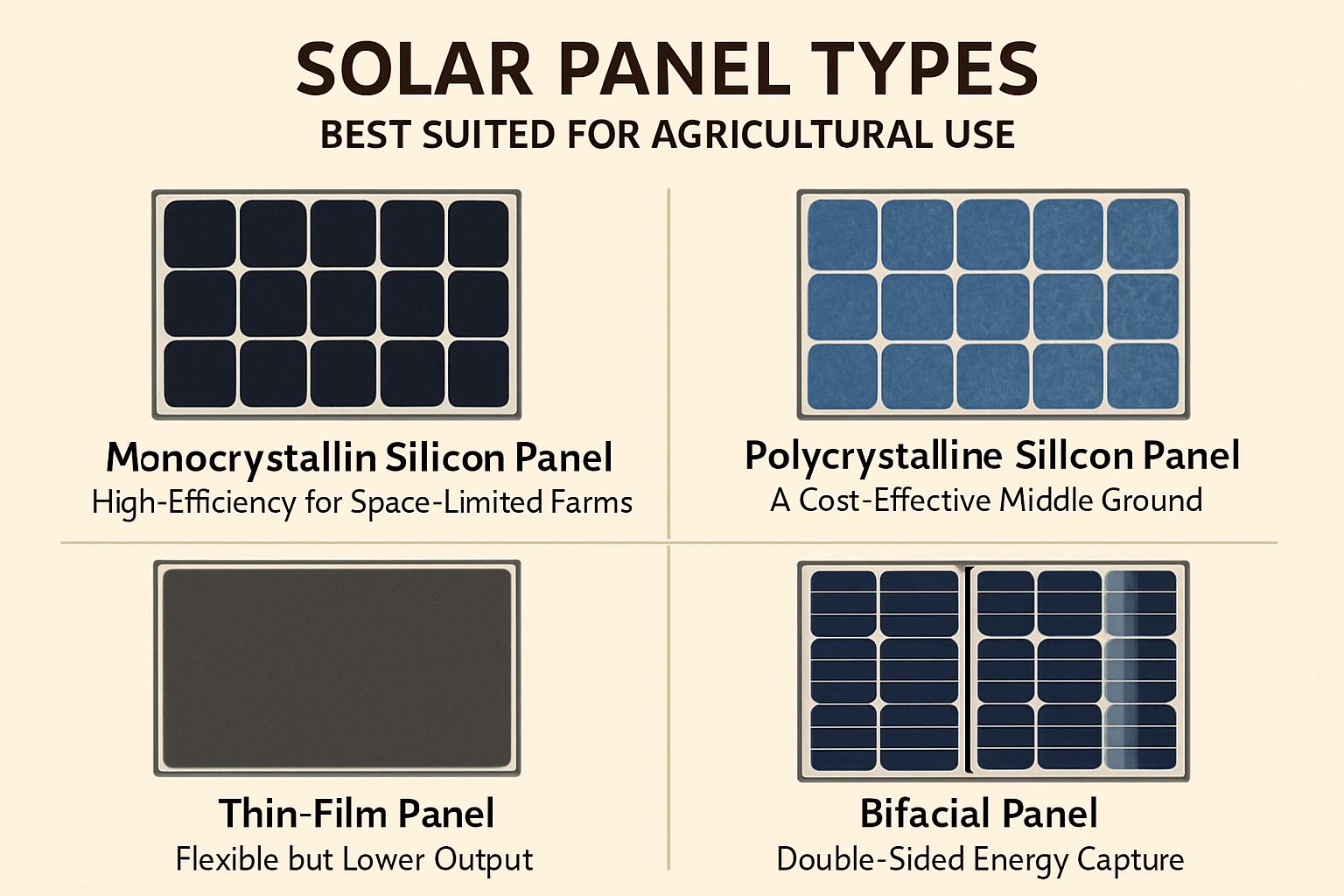
Not all solar panels perform equally in agrivoltaic applications. The four main panel types each bring a different combination of efficiency, cost, and physical flexibility to the table — and the right choice depends on your farm’s size, budget, and energy goals. For more insights, explore the benefits of solar panels for farmers.
Here is a comparison table of the four best solar panel types for agricultural use — focusing on features, efficiency, and suitability for farms.
|
Solar Panel Type |
Efficiency Range |
Cost per Watt (Approx.) |
Key Advantages for Agriculture |
Limitations |
Best Farm Applications |
|---|---|---|---|---|---|
|
Monocrystalline Panels |
17–22% 1 |
$0.90–$1.50 2 |
High efficiency, compact design, long lifespan, performs well in all climates |
Higher upfront cost |
Space-limited farms, rooftops, and irrigation systems 1 |
|
Polycrystalline Panels |
13–17% 3 |
$0.70–$1.00 3 |
Lower cost, durable, long lifespan, strong in direct sunlight |
Requires more space, less efficient in cloudy conditions | |
|
Thin-Film Panels |
10–13% 5 |
$0.50–$0.90 2 |
Lightweight, flexible, better low-light/shaded performance |
Lower efficiency, shorter lifespan |
Greenhouses, barns, shaded or irregular terrain 5 |
|
Bifacial Panels |
18–22%6 |
$1.00–$1.60 6 |
Captures light from both sides, high energy yield, great for reflective surfaces like grass or soil |
Higher cost, more complex installation |
Agrivoltaics (dual-use with crops), open-field installations 6 |
Each panel type interacts differently with the crop environment below. Monocrystalline panels, for example, produce more energy per square foot, meaning you need fewer panels to hit your energy target — which can translate into more open light gaps between panels for your tomato plants.
Bifacial panels capture light from both sides, including light reflected upward from the soil or mulch beneath them. In agrivoltaic settings with light-colored ground cover or reflective mulch, bifacial panels have been shown to produce approximately 3% more electricity annually than standard panels over bare soil, with gains of up to 9% during peak summer months according to University of Arizona research — making them a particularly compelling option for dual-use installations.
Thin-film panels offer physical flexibility that rigid crystalline panels don’t, but their lower efficiency means you’ll need significantly more surface area to generate equivalent power — a tradeoff that may not work on farms where land is at a premium.
Monocrystalline Silicon Panels: High Efficiency for Space-Limited Farms
Monocrystalline silicon panels are cut from a single continuous crystal structure, which gives them the highest electron mobility and therefore the highest energy conversion efficiency of any standard panel type. For agrivoltaic tomato operations where you need to maximize energy output without covering every square foot of growing space with panels, monocrystalline is the logical choice. If you’re interested in understanding the cost considerations of solar irrigation systems, this guide provides valuable insights for farmers.
Their higher efficiency means fewer panels are needed to reach a given power target, which directly affects how much shade falls on your crop. Fewer panels mean more light gaps, and more light gaps mean better light distribution across your tomato rows — an important consideration for maintaining adequate photosynthesis while still achieving the heat and moisture benefits of partial shade.
The main drawback is cost. Monocrystalline panels carry a higher price per watt than polycrystalline or thin-film alternatives. However, for most agrivoltaic operations where land is limited and both energy and crop yield need to be optimized, the efficiency premium is generally worth it.
When evaluating monocrystalline options for agricultural use, look for panels with anti-reflective coatings and robust frame construction designed to handle elevated mounting configurations and exposure to agricultural environments including dust, humidity, and irrigation spray.
- Efficiency range: 17-22% under standard test conditions
- Longer lifespan: typically 25-30 years with minimal degradation
- Better low-light performance than polycrystalline alternatives
- Higher upfront cost offset by reduced panel count and superior long-term output
- Ideal for farms where maximizing both energy density and crop light exposure is a priority
Polycrystalline Silicon Panels: A Cost-Effective Middle Ground
Polycrystalline silicon panels are made by melting multiple silicon fragments together, which creates a less uniform crystal structure than monocrystalline panels. This results in slightly lower efficiency — typically 13-17% — but also a meaningfully lower manufacturing cost. For tomato growers with larger land areas where covering more ground with panels is feasible, polycrystalline panels offer a practical middle ground between performance and budget.
In agrivoltaic systems with more generous land availability, the lower efficiency of polycrystalline panels can actually work in your favor. More panels spread across a wider area creates a more even shade distribution across your tomato rows, which can reduce hot spots and produce a more consistent microclimate across the entire growing zone. If your operation prioritizes uniform crop conditions over maximum energy density, polycrystalline panels are worth serious consideration.
Thin-Film Panels: Flexible but Lower Output
Thin-film panels are produced by depositing photovoltaic material onto a flexible substrate, making them lighter and more adaptable in shape than rigid crystalline alternatives. Their efficiency typically ranges from 10-13%, which is the lowest of the four main panel types. For most commercial agrivoltaic tomato operations, thin-film panels are not the primary choice — you simply need too many of them to generate meaningful power output. However, on smaller plots or irregular terrain where standard rigid mounting structures are impractical, thin-film panels can provide a workable solution for light partial shading without the structural overhead of a full elevated array.
Bifacial Panels: Double-Sided Energy Capture
Bifacial panels capture sunlight from both their front and rear surfaces, collecting direct radiation from above and reflected light from the ground or mulch below. In agrivoltaic installations, this dual-capture capability is particularly valuable. University of Arizona research found that agrivoltaic bifacial panels produced approximately 3% more electricity annually than identical panels mounted over bare soil, with efficiency gains reaching up to 9% during peak summer months. That energy surplus comes directly from the transpiration and reflected light generated by the crops growing beneath them — a genuine symbiotic relationship between the panels and the plants.
- Front-side efficiency: Comparable to standard monocrystalline panels at 18-22%
- Rear-side gain: Additional 5-30% energy yield depending on ground reflectivity
- Best ground cover pairing: Light-colored mulch or reflective soil amendments maximize rear-side capture
- Structural note: Requires mounting that allows light to reach the rear surface — standard flush mounts don’t work
- Long-term value: Higher upfront cost offset by superior lifetime energy output in dual-use farm settings
For agrivoltaic tomato operations where maximizing energy revenue is as important as maximizing crop yield, bifacial panels are the most strategically sound choice. The feedback loop between crop transpiration and panel cooling means your tomato plants are actively contributing to better solar performance — while the panels simultaneously protect your crop from heat stress.
The key installation requirement for bifacial panels in an agrivoltaic context is ensuring the mounting system holds panels high enough and at an angle that exposes the rear surface to reflected ground light. This aligns naturally with the six-foot minimum elevation already required for tomato production, making bifacial panels a particularly clean fit for this type of system. For more information on related systems, explore the solar irrigation system cost guide.
Why California Tomato Growers Need This Now
California’s tomato industry generates over a billion dollars annually, and it is facing compounding pressures from three directions simultaneously: rising temperatures reducing yield reliability, water scarcity driving up irrigation costs, and energy prices increasing operational overhead. Agrivoltaic systems address all three problems in a single infrastructure investment. Partial panel shade reduces heat-induced crop losses. Lower evapotranspiration cuts water demand by 20-30%. On-site solar generation offsets energy costs for pumping, cooling, and processing. For California tomato growers operating on tightening margins, agrivoltaics is not a future-facing experiment — it is a present-day risk management strategy backed by peer-reviewed research and field-tested results.
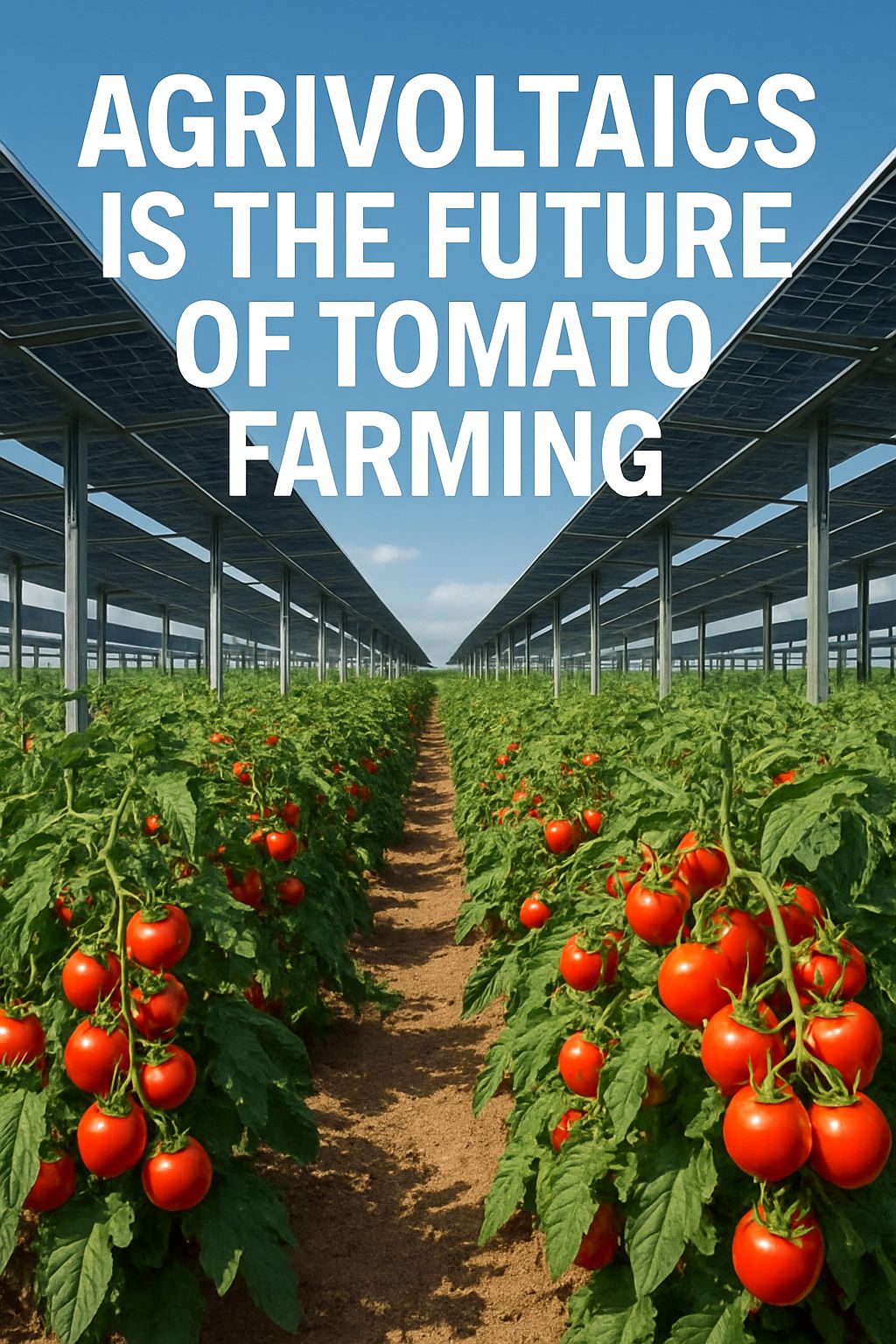
Agrivoltaics Is the Future of Tomato Farming
The convergence of climate pressure, water scarcity, energy costs, and land constraints makes agrivoltaic tomato production one of the most strategically sound directions in sustainable agriculture today. The research is consistent across multiple institutions — NREL, the University of Arizona, Oregon State — and the results point clearly toward doubled or tripled yields, reduced water demand, and on-site clean energy generation, all from the same footprint of land. The practical challenges around elevated installation costs and machinery compatibility are real but solvable, and the dual revenue stream from crops and energy makes the economics increasingly compelling. Tomatoes and solar panels are not competing for the same land anymore — they are working together to make both more productive.
Frequently Asked Questions
Here are the most common questions growers ask when exploring agrivoltaic tomato production for the first time.
How Much Can Solar Panels Increase Tomato Yields?
Based on current research, tomato yields in agrivoltaic systems have been shown to double compared to open-field production in NREL survey data, and University of Arizona studies documented yield increases of two to three times compared to traditional methods. Cherry tomatoes specifically doubled their yield in the University of Arizona’s Biosphere 2 research, where plants were tracked over multiple growing seasons under PV solar panels.
Results vary depending on climate, panel configuration, tomato variety, and irrigation management. Hot, arid regions with intense summer sun tend to see the most dramatic improvements because the shade and cooling effect of panels directly counteracts the primary cause of yield loss — heat-induced blossom and fruit abortion. In more temperate climates with naturally moderate temperatures, yield gains are still positive but generally less dramatic.
Do Tomato Plants Need Full Sun or Can They Grow in Shade?
Tomatoes are traditionally described as full-sun crops, but they are actually highly sensitive to excessive heat and light intensity. Above 85°F (29°C), tomato plants begin aborting blossoms and fruit as a heat stress response. The partial shade created by solar panels — filtered, diffused light rather than complete shade — keeps plants within their productive temperature range while still providing adequate light for photosynthesis. This distinction matters: agrivoltaic shade is not the same as deep shade, and tomatoes grown under appropriately spaced panels are not light-starved. They are light-optimized.
How High Do Solar Panels Need to Be to Grow Tomatoes Underneath?
Solar panels in an agrivoltaic system designed for tomato production need to be elevated to a minimum of six feet. Standard tomato plants reach approximately five feet at maturity, so six feet provides the minimum clearance for plant growth, air circulation, and worker access during hand harvesting. This six-foot height is taller than most conventional ground-mounted commercial arrays, which typically sit closer to two to three feet above ground. Elevated agrivoltaic mounting structures cost more than standard ground mounts, but the additional height also improves airflow beneath the array — which benefits panel cooling efficiency and plant health simultaneously.
Does Growing Tomatoes Under Solar Panels Save Water?
Yes — agrivoltaic systems consistently reduce water consumption in tomato production, with research indicating reductions of 20-30% compared to open-field irrigation baselines. The savings come from two mechanisms operating simultaneously. First, reduced direct sunlight lowers soil surface temperature, which slows evaporation from the ground. Second, the cooler air microclimate beneath the panels reduces the rate at which plants transpire water through their leaves.
The combined effect means your soil retains moisture longer between irrigation cycles, allowing you to irrigate less frequently without creating drought stress in your plants. In practice, most growers transitioning to agrivoltaic systems need to recalibrate their irrigation schedules downward — starting with a 20-25% reduction and adjusting based on observed soil moisture and plant response.
For water-stressed regions like California’s Central Valley, the San Joaquin Valley, and parts of the American Southwest, this water reduction isn’t just an operational efficiency — it directly addresses one of the most pressing constraints on tomato production viability in those areas. Paired with on-site solar energy generation, the water savings alone can significantly alter the long-term economics of growing tomatoes in regions where irrigation water is increasingly scarce and expensive. Learn more about how growing crops under solar panels can benefit these areas.
Can Small-Scale Farmers Use Agrivoltaics for Tomato Production?
Absolutely. While much of the published research has been conducted at research station scale or on mid-to-large commercial farms, the core mechanics of agrivoltaic tomato production work at any size. A small-scale grower with even a modest elevated panel installation can create the same shade-and-cool microclimate that drives yield improvements at larger operations. The ratio of benefit to panel count is consistent regardless of total system size.
Small-scale farmers actually have a practical advantage in agrivoltaic adoption: they are far less dependent on mechanical harvesting equipment. Since hand harvesting is standard at small scale, the machinery compatibility challenges that complicate large commercial agrivoltaic layouts simply don’t apply. You can design your panel layout around your crop rows without worrying about whether a mechanical harvester can navigate the space.



Leave a Reply