
Article-At-A-Glance
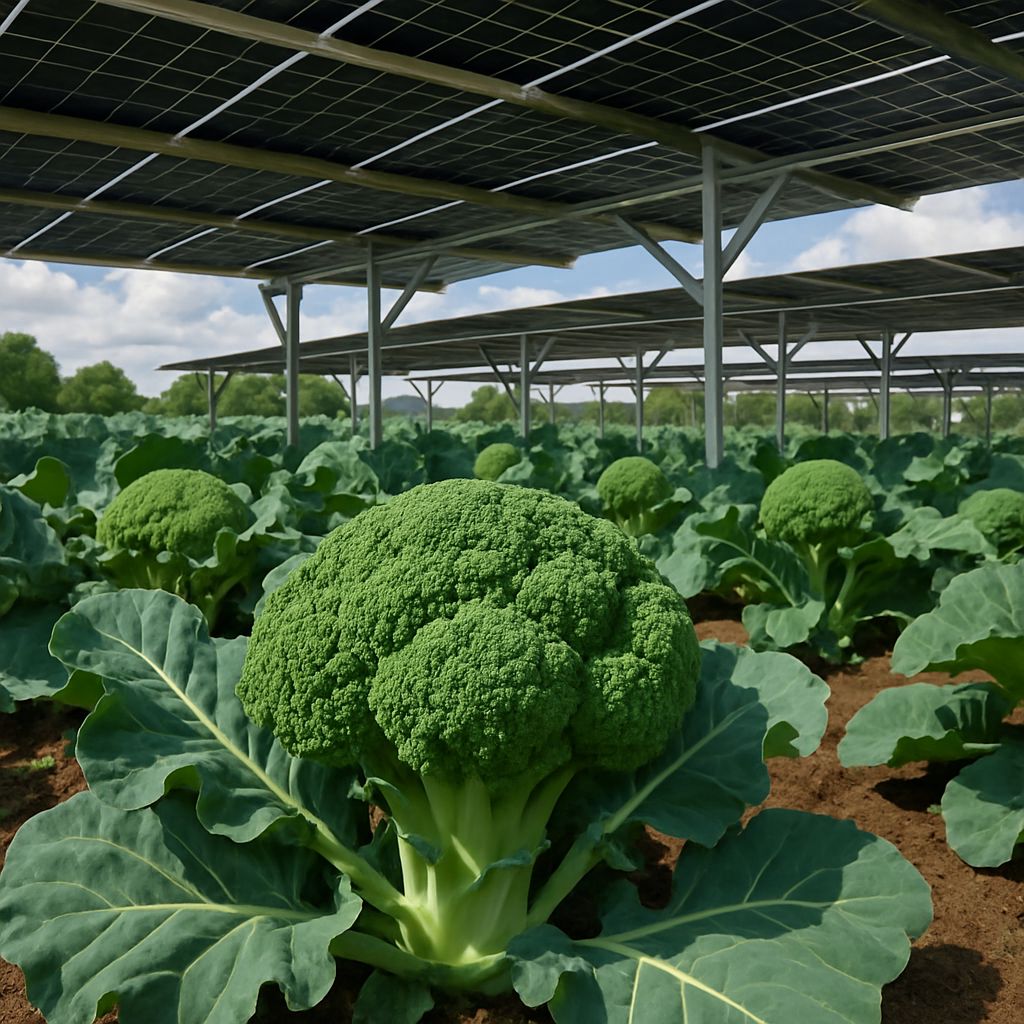
- Growing broccoli under solar panels produces deeper green heads, tighter florets, and higher-quality crops that command better prices at market.
- Agrivoltaic systems reduce water consumption by 20–30% while creating a cooler microclimate that protects broccoli from heat stress.
- Farmers who combine solar energy income with broccoli production are unlocking dual revenue streams from the same acre of land.
- Panel height, spacing, and orientation are critical factors — get these wrong and you could limit both your harvest and your solar output.
- Research published in peer-reviewed agricultural journals confirms yield improvements and quality gains for broccoli grown in partial shade agrivoltaic systems.
Farmers growing broccoli under solar panels are quietly outcompeting conventional growers — and the science explains exactly why.
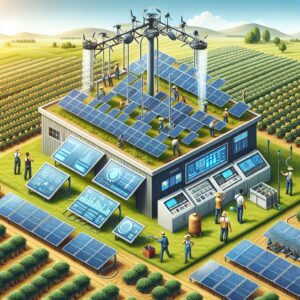
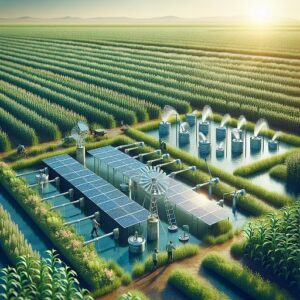
The concept is called agrivoltaics, and it’s reshaping how forward-thinking farmers think about land use. Instead of choosing between solar energy and food production, agrivoltaic systems let you do both simultaneously on the same piece of land. Broccoli, it turns out, is one of the crops that responds exceptionally well to this setup. For farmers looking to explore the full range of crops that work in these systems, 8760 Solar’s guide on agrivoltaics breaks down which vegetables deliver the strongest results under panels.
The shade from solar panels does something unexpected — it actually improves broccoli in ways that matter most to buyers. The heads turn a richer, deeper green. The texture becomes more appealing. And the plants require significantly less irrigation to reach harvest. These aren’t minor improvements. They’re the kind of quality markers that grocery store buyers and farmers market customers notice immediately.
What Agrivoltaics Actually Does to Broccoli
Broccoli is a cool-season crop that struggles under intense heat. When temperatures climb, broccoli heads can loosen, yellow, or develop hollow stems — all quality defects that reduce marketability. Solar panels change that equation by acting as a dynamic buffer between the sun and the soil.
The panels intercept a portion of direct solar radiation while still allowing diffused light to reach the crop canopy. This creates a microclimate underneath that runs measurably cooler and retains more soil moisture than open fields. For broccoli specifically, this is close to ideal growing conditions.
How Partial Shade Changes the Way Broccoli Grows
Broccoli doesn’t need full, uninterrupted sunlight to produce strong heads. It needs consistent light and stable temperatures — two things that agrivoltaic systems deliver well. Under partial shade, broccoli plants redirect energy more efficiently, investing in head development rather than fighting heat stress through the leaves.
The reduced evapotranspiration under panels means the soil stays moist longer between irrigation cycles. This alone can cut water usage by 20 to 30 percent compared to open-field broccoli production, according to research on agrivoltaic crop systems. In drought-prone regions or on farms with limited water access, that reduction isn’t just sustainable — it’s a competitive advantage.
Why Broccoli Turns a Deeper Green Under Solar Panels
The deeper green color that develops in panel-shaded broccoli comes down to chlorophyll production. When plants receive diffused rather than intense direct light, they produce more chlorophyll to capture available photons more efficiently. More chlorophyll means darker, richer green tissue — exactly the visual quality signal that moves product off shelves faster.
- Higher chlorophyll density produces the deep green color preferred by grocery buyers
- Diffused light conditions reduce the bleaching effect that direct sun can cause on broccoli heads
- Cooler canopy temperatures slow the yellowing process that shortens post-harvest shelf life
- Reduced UV exposure helps maintain tighter, more uniform floret structure
This color improvement isn’t cosmetic — it’s a direct indicator of higher chlorophyll content, which is tied to the nutritional profile of the vegetable. Research on agrivoltaic broccoli production has found that the shade-grown heads maintained nutritional value comparable to or exceeding open-field crops.
The Link Between Reduced Heat Stress and Tighter Heads
Heat is broccoli’s primary enemy. When soil and air temperatures rise above optimal ranges, broccoli heads begin to loosen and separate — a process called “riciness” that makes the crop unmarketable. Solar panels suppress peak temperatures under the canopy, keeping conditions closer to the 60–65°F range where broccoli performs best. The result is tighter, denser heads that hold their structure longer from harvest through distribution.
The Yield and Quality Gains Are Backed by Research
This isn’t experimental theory anymore. Multiple studies from agricultural research institutions across Asia, Europe, and North America have documented measurable improvements in broccoli grown under solar panel canopies. The evidence is consistent enough that Japan — the current global leader in agrivoltaics with over 2,000 farms — has included brassica crops like broccoli among its most successful agrivoltaic pairings.
What the Journal Agronomy Study Found
Research published in agricultural science journals on agrivoltaic systems has documented that crops grown under partial solar shade show yield outcomes that match or exceed open-field production in many climates. For broccoli specifically, the combination of reduced heat stress, improved moisture retention, and enhanced chlorophyll production contributes to heads that are both larger and more visually appealing than conventionally grown counterparts. The study framework examined how microclimate variables created underneath solar panels — including temperature, humidity, and light diffusion — directly influenced crop development across multiple growth stages. To learn more about the benefits of solar panels for farmers, explore additional resources.
How Solar Shade Reduces Hollow Stem Defects
Hollow stem is one of the most frustrating quality problems in commercial broccoli production. It develops when plants grow too fast during periods of intense heat and high light exposure — the internal tissue can’t keep pace with the rapid outer growth, leaving a cavity in the stalk. This defect isn’t visible from the outside, but it gets flagged during packing and processing, costing growers significant revenue per bin. To mitigate these issues, some farmers are exploring the benefits of solar panels for providing shade and reducing heat stress on crops.
Solar panels slow that rapid, stress-driven growth by moderating temperature and light intensity. The more even growing conditions underneath the panels encourage steady, consistent cell development throughout the stalk. Farmers growing broccoli in agrivoltaic systems report measurably lower rates of hollow stem defects — a direct quality improvement that translates to less waste and more marketable product per acre.
The Financial Case for Growing Broccoli Under Solar Panels
The math on agrivoltaic broccoli farming works from two directions at once. You’re not just improving your crop — you’re generating electricity revenue from the same land simultaneously. For farmers operating on tight margins, that dual income stream fundamentally changes what’s possible on a single acre.
- Solar lease or ownership income provides consistent, weather-independent revenue regardless of crop prices
- Premium crop pricing becomes achievable when broccoli heads are deeper green and structurally tighter
- Reduced irrigation costs directly lower operating expenses by 20–30% on water bills
- Extended growing seasons in warmer climates allow additional harvest cycles per year
- Lower heat stress losses reduce the percentage of unmarketable heads per harvest
These aren’t hypothetical gains. Farms operating agrivoltaic systems across South Korea, Japan, and parts of the American Southwest have documented the compounding effect of these advantages season over season. The upfront infrastructure investment is real, but so is the long-term return.
It’s also worth noting that broccoli’s relatively low canopy height makes it particularly well-suited to the space underneath elevated solar arrays. Unlike tall crops that might interfere with panel access or shading angles, broccoli sits comfortably beneath the panels without compromising the system’s energy output.
Solar Income vs. Crop Income: What the Numbers Show
Agrivoltaic systems generate two revenue lines from one piece of land — solar energy output and crop sales. While exact figures depend heavily on local electricity rates, solar incentives, land quality, and market prices for broccoli, the principle holds across most operating environments: the combined income per acre from a dual-use agrivoltaic system consistently outperforms either land use in isolation. For farmers evaluating the investment, the crop quality improvements alone — fewer defects, better color, longer shelf life — often justify the comparison before solar income is even factored in.
How Dual Land Use Increases Farm Revenue Per Acre
Traditional farming calculates revenue as a single output per acre. Agrivoltaic broccoli production breaks that model entirely. The same acre now produces kilowatt-hours of electricity alongside bushels of high-quality broccoli — two products with separate market prices, separate buyers, and separate income schedules. This diversification also reduces the financial risk that comes with crop-only farming, where a single bad season can erase an entire year’s margin.
Why Broccoli Farmers Without Solar Panels Are Leaving Money Behind
Every season a broccoli farmer operates in full sun without panel coverage is a season of avoidable heat stress losses, higher water bills, and single-stream revenue. As agrivoltaic adoption accelerates — particularly in water-stressed regions where broccoli production is concentrated — the farmers who move early will lock in the infrastructure advantages, the premium positioning, and the dual income before land and installation costs climb further.
How to Set Up Your Field for Agrivoltaic Broccoli Production
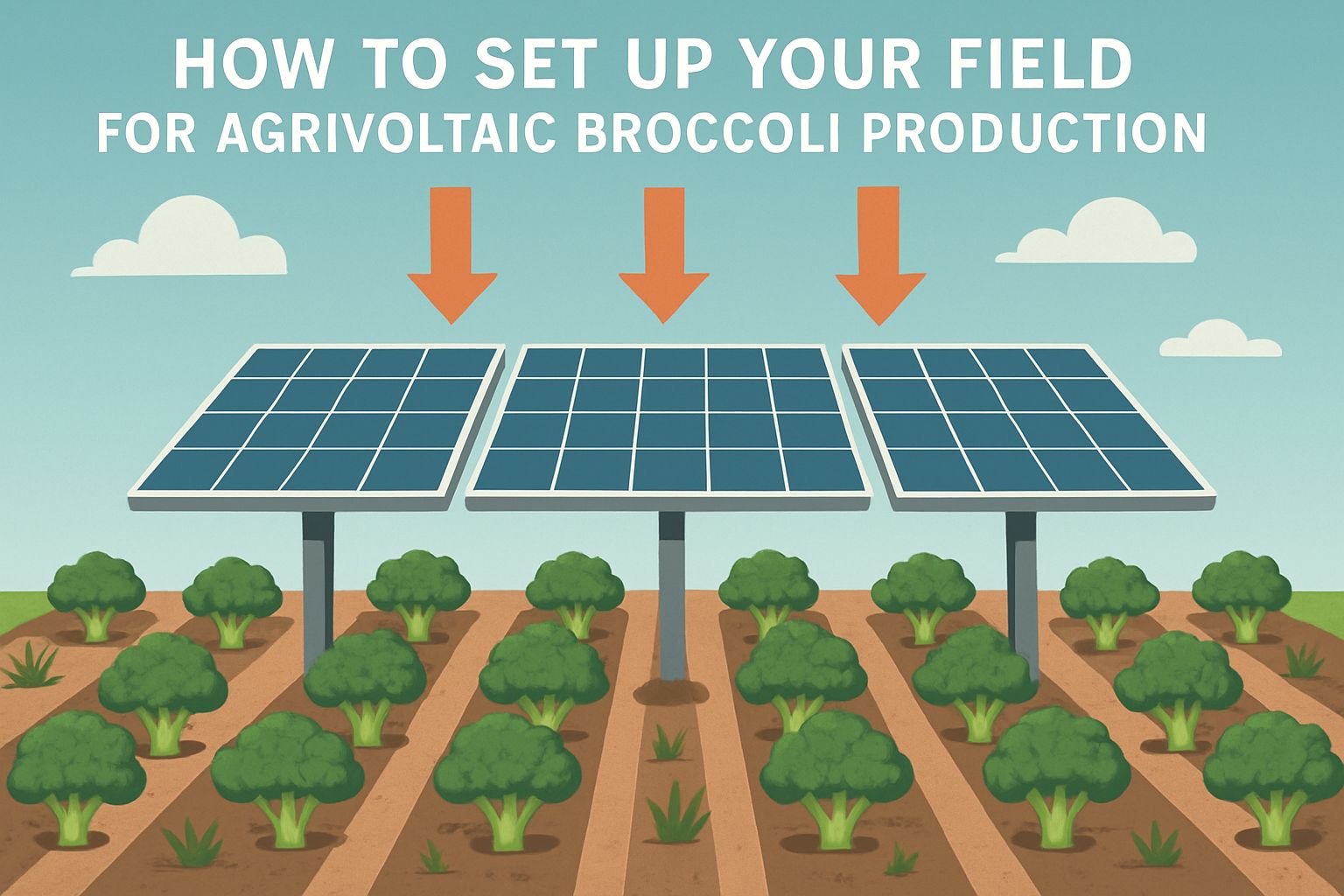
Getting the setup right matters as much as the decision to adopt it. Panel placement, row orientation, spacing, and soil management all interact with each other — and with your specific climate. A well-designed agrivoltaic system for broccoli isn’t just panels over rows. It’s a carefully calibrated growing environment where every variable is working in the crop’s favor.
Panel Height and Spacing Requirements for Broccoli Rows
Broccoli typically reaches 18 to 30 inches in height at maturity, which gives agrivoltaic designers flexibility in panel elevation. Panels mounted at 8 to 12 feet above ground level allow standard farm equipment — including transplant machinery and harvest aids — to operate freely beneath the array without modification. This clearance height is now considered a practical standard in most commercial agrivoltaic installations designed for vegetable crops.
Row spacing under the panels should account for both the broccoli’s light requirements and the shadow patterns cast by the array throughout the day. East-west panel orientation with north-south crop rows tends to distribute shade most evenly across the growing area. Aim for panel density that achieves 30 to 50 percent shade coverage — enough to reduce heat stress and moisture loss without dropping light levels below the broccoli’s photosynthetic threshold.
Soil Preparation and Moisture Management Under Panels
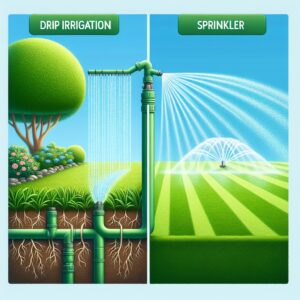
The reduced evaporation under solar panels changes how you should approach irrigation scheduling. Soil moisture persists longer between watering cycles, which means over-irrigation becomes a real risk if you carry your open-field habits into a panel-covered system. Before planting, invest in soil moisture monitoring — even basic capacitance sensors placed at root depth give you the data to irrigate precisely rather than on a fixed schedule.
Soil preparation itself follows standard broccoli protocol: well-drained loam with a pH between 6.0 and 7.0, worked to at least 12 inches deep to accommodate the tap root. Compost incorporation at 3 to 4 inches pre-plant builds the organic matter content that supports the moisture-retention benefits the panels create above. The goal is a soil profile that holds water efficiently without becoming waterlogged — a balance the panel microclimate makes easier to maintain.
Seasonal Timing: When to Plant for Maximum Benefit
The agrivoltaic advantage is most pronounced during the shoulder seasons — late spring and early fall — when ambient temperatures are climbing toward the range that stresses broccoli in open fields. Planting 2 to 3 weeks later in spring than you would in an open field takes advantage of the panel’s heat buffering at the exact point in the season when it delivers the most protection. Fall crops benefit similarly, with the panels extending the viable growing window by moderating early heat at the start of the season. For more on how solar panels benefit agriculture, check out the advantages of solar panels for farmers.
What Climate Zones See the Strongest Results
USDA hardiness zones 6 through 9 — covering much of California’s Central Valley, the mid-Atlantic, and the Pacific Northwest — see the most consistent agrivoltaic broccoli benefits. These are regions where summer heat regularly pushes broccoli quality down in conventional systems, making the panel’s temperature moderation effect most valuable. Arid and semi-arid climates amplify the water savings component further, with the 20–30% irrigation reduction carrying more financial weight where water costs are high and supply is constrained.
Solar Panel Types Best Suited for Agricultural Use
Not every solar panel works equally well in an agrivoltaic broccoli system. The choice of panel technology affects energy output, shade distribution, installation cost, and long-term maintenance requirements — all of which interact with the farming operation underneath. Understanding the tradeoffs between panel types helps you match the technology to your specific farm goals and budget.
The four main panel types used in agricultural solar installations each bring distinct characteristics to the agrivoltaic equation. Monocrystalline panels deliver the highest efficiency per square foot, which matters when you’re trying to maximize energy output while minimizing the footprint of the array over your crop rows. Polycrystalline panels offer a cost-effective middle ground with slightly lower efficiency but proven durability in outdoor agricultural environments. Thin-film panels are flexible and lightweight but produce less power per unit area, making them better suited to supplemental shade applications than primary energy generation. Bifacial panels capture light from both sides of the module, increasing total energy yield — a meaningful advantage when the panels are elevated above reflective soil or mulch surfaces common in broccoli production.
Monocrystalline Silicon Panels: High Efficiency for Space-Limited Farms
Monocrystalline silicon panels are the top choice for farmers who want to maximize energy output without dedicating excessive land area to the solar array. These panels convert sunlight to electricity at efficiency rates of 20 to 23 percent — the highest available in commercial agricultural installations. For broccoli operations where every row of growing space matters, monocrystalline panels let you generate substantial solar income while keeping the array footprint compact enough to maintain adequate light distribution across the crop canopy.
Polycrystalline Silicon Panels: A Cost-Effective Middle Ground
Polycrystalline panels run 13 to 17 percent efficiency and cost meaningfully less per watt than monocrystalline alternatives. For farmers entering agrivoltaics for the first time with a mid-range capital budget, polycrystalline systems offer a proven, durable entry point. The slightly lower efficiency means you’ll need marginally more panel area to hit the same energy output targets, but on larger broccoli operations with sufficient acreage, that tradeoff is often financially favorable compared to the premium cost of monocrystalline systems.
Thin-Film Panels: Flexible but Lower Output
Thin-film panels are manufactured from materials like cadmium telluride or amorphous silicon, giving them a flexible, lightweight profile that standard rigid panels can’t match. Their efficiency typically ranges from 10 to 13 percent — lower than crystalline options — but their uniform, diffuse shading pattern has specific advantages for crops like broccoli that benefit from even light distribution rather than the sharp shadow lines cast by rigid panel arrays.
The practical limitation of thin-film in a commercial agrivoltaic context is energy yield per acre. If electricity generation is a primary revenue objective alongside broccoli production, thin-film systems will require significantly more mounting infrastructure to match the output of crystalline alternatives. They work best in supplemental shade applications or on farms where the primary goal is crop protection rather than maximum solar income.
Bifacial Panels: Double-Sided Energy Capture
Bifacial panels are increasingly the preferred choice for purpose-built agrivoltaic installations. By capturing reflected light from the ground surface on the panel’s rear side, bifacial modules generate 10 to 20 percent more electricity than comparable monofacial panels under the same conditions. When installed above broccoli rows with light-colored mulch or bare soil, the ground reflectivity amplifies this rear-side gain further — making bifacial technology a natural fit for farms where both energy output and crop quality are top priorities.
Here is a comparison table of the four best solar panel types for agricultural use — focusing on features, efficiency, and suitability for farms.
|
Solar Panel Type |
Efficiency Range |
Cost per Watt (Approx.) |
Key Advantages for Agriculture |
Limitations |
Best Farm Applications |
|---|---|---|---|---|---|
|
Monocrystalline Panels |
17–22% 1 |
$0.90–$1.50 2 |
High efficiency, compact design, long lifespan, performs well in all climates |
Higher upfront cost |
Space-limited farms, rooftops, and irrigation systems 1 |
|
Polycrystalline Panels |
13–17% 3 |
$0.70–$1.00 3 |
Lower cost, durable, long lifespan, strong in direct sunlight |
Requires more space, less efficient in cloudy conditions | |
|
Thin-Film Panels |
10–13% 5 |
$0.50–$0.90 2 |
Lightweight, flexible, better low-light/shaded performance |
Lower efficiency, shorter lifespan |
Greenhouses, barns, shaded or irregular terrain 5 |
|
Bifacial Panels |
18–22% 6 |
$1.00–$1.60 6 |
Captures light from both sides, high energy yield, great for reflective surfaces like grass or soil |
Higher cost, more complex installation |
Agrivoltaics (dual-use with crops), open-field installations 6 |
These four types of solar panels represent the most effective options for agricultural operations, allowing farmers to select between high efficiency (monocrystalline, bifacial) and lower-cost scalability (polycrystalline, thin-film) depending on land availability, sunlight exposure, and budget.
Is Growing Broccoli Under Solar Panels Right for Your Farm?
If you grow broccoli in a region with hot summers, limited water resources, or both — agrivoltaics is worth a serious evaluation. The combination of improved head quality, reduced irrigation demand, lower heat stress losses, and dual-stream revenue addresses the most persistent challenges in commercial broccoli production simultaneously. The upfront infrastructure investment is real, but so is the long-term compounding advantage over conventional single-use land. Farms in USDA zones 6 through 9 with at least 1 to 2 acres dedicated to broccoli production are the strongest candidates for a financially viable agrivoltaic system. Start with a solar site assessment alongside an agronomic review of your specific field conditions — both inputs are necessary to size a system that serves the crop and the energy goals in equal measure.
Frequently Asked Questions
Agrivoltaic broccoli farming raises practical questions that deserve direct, specific answers. The sections below address the most common concerns from farmers evaluating whether panel-shaded production fits their operation.
These answers draw from peer-reviewed agricultural research, documented agrivoltaic farm outcomes, and established horticultural practice — not theory.
Does growing broccoli under solar panels reduce the size of the heads?
No — and in many documented cases, the opposite is true. Research on agrivoltaic brassica production has found that the combination of reduced heat stress, stable soil moisture, and diffused light conditions supports consistent head development that matches or exceeds open-field outcomes. The key variable is shade density: systems calibrated to 30 to 50 percent shade coverage maintain sufficient photosynthetically active radiation for full head formation while delivering the microclimate benefits that protect quality.
What type of solar panel setup works best for broccoli crops?
Elevated bifacial panels mounted at 8 to 12 feet, oriented east-west with north-south crop rows, represent the current best-practice configuration for commercial agrivoltaic broccoli production. This setup distributes shade evenly across the growing area, allows standard farm equipment to operate freely underneath, and maximizes total energy output through rear-side light capture. Monocrystalline or bifacial monocrystalline panels deliver the highest efficiency for farms prioritizing both crop quality and solar income.
Can small-scale farmers benefit from agrivoltaic broccoli growing, or is it only for large operations?
Small-scale and market garden operations can absolutely benefit — the entry point is lower than most farmers assume. Modular agrivoltaic systems designed for 0.25 to 1 acre installations are now commercially available, and community solar programs in several states allow small farm operators to participate in shared solar infrastructure without bearing the full capital cost of a dedicated array.
The crop quality improvements from partial shade — deeper color, tighter heads, reduced heat defects — benefit small producers selling direct to consumers at farmers markets and through CSA programs, where visual quality and premium pricing are most directly connected. A small-scale agrivoltaic setup can differentiate a farm’s broccoli in a crowded local market while reducing the water and heat management labor that small operations often struggle to sustain.
How much water can I save by growing broccoli under solar panels?
Agrivoltaic systems consistently reduce crop water demand by 20 to 30 percent compared to open-field production, based on research measuring evapotranspiration rates under panel canopies across multiple climates and crop types. For broccoli specifically, the combination of reduced direct solar radiation on the soil surface and lower canopy air temperatures slows moisture loss significantly between irrigation cycles.
In practical terms, a 1-acre broccoli planting that requires 18 to 22 inches of irrigation water annually in an open field may require only 13 to 17 inches under a well-designed agrivoltaic array. In water-stressed production regions like California’s Salinas Valley — where a large share of U.S. commercial broccoli is grown — that reduction can translate directly into lower water costs, better compliance with allocation limits, and improved resilience during drought years.
Does the shade from solar panels affect the nutritional value of broccoli?
The nutritional profile of panel-shaded broccoli is maintained and, in some respects, enhanced compared to open-field production. The deeper green color that develops under diffused light conditions is a direct indicator of higher chlorophyll concentration — and chlorophyll-rich broccoli also tends to carry elevated levels of glucosinolates, the sulfur-containing compounds associated with broccoli’s well-documented health benefits.
Heat stress in open-field production is known to degrade certain heat-sensitive nutrients, particularly vitamin C, before and during harvest. The cooler microclimate created under solar panels reduces this pre-harvest nutrient degradation, helping the crop reach harvest with its nutritional content more fully intact. For more information on how solar panels can help increase crop yields, check out this detailed article.
Research on agrivoltaic vegetable production has found no evidence of nutritional deficits in shade-grown brassicas at shade densities appropriate for agrivoltaic systems. The concern that reduced light limits nutritional development applies to deep shade conditions well beyond what any properly designed agrivoltaic array produces over a broccoli crop.


Leave a Reply