
Key Takeaways
- Flooded lead-acid deep cycle batteries provide farmers with reliable solar energy storage at 40-60% lower initial cost than lithium alternatives.
- When properly maintained, quality lead-acid deep cycle batteries typically last 5-7 years in agricultural solar applications, making them a cost-effective investment.
- These batteries power essential farm operations during nighttime and cloudy periods, including irrigation systems, climate control, and security lighting.
- Regular maintenance including water level checks and proper ventilation is crucial for maximizing battery lifespan and safety in farm environments.
- Understanding depth of discharge patterns can dramatically extend battery life, providing significant long-term savings for agricultural operations.
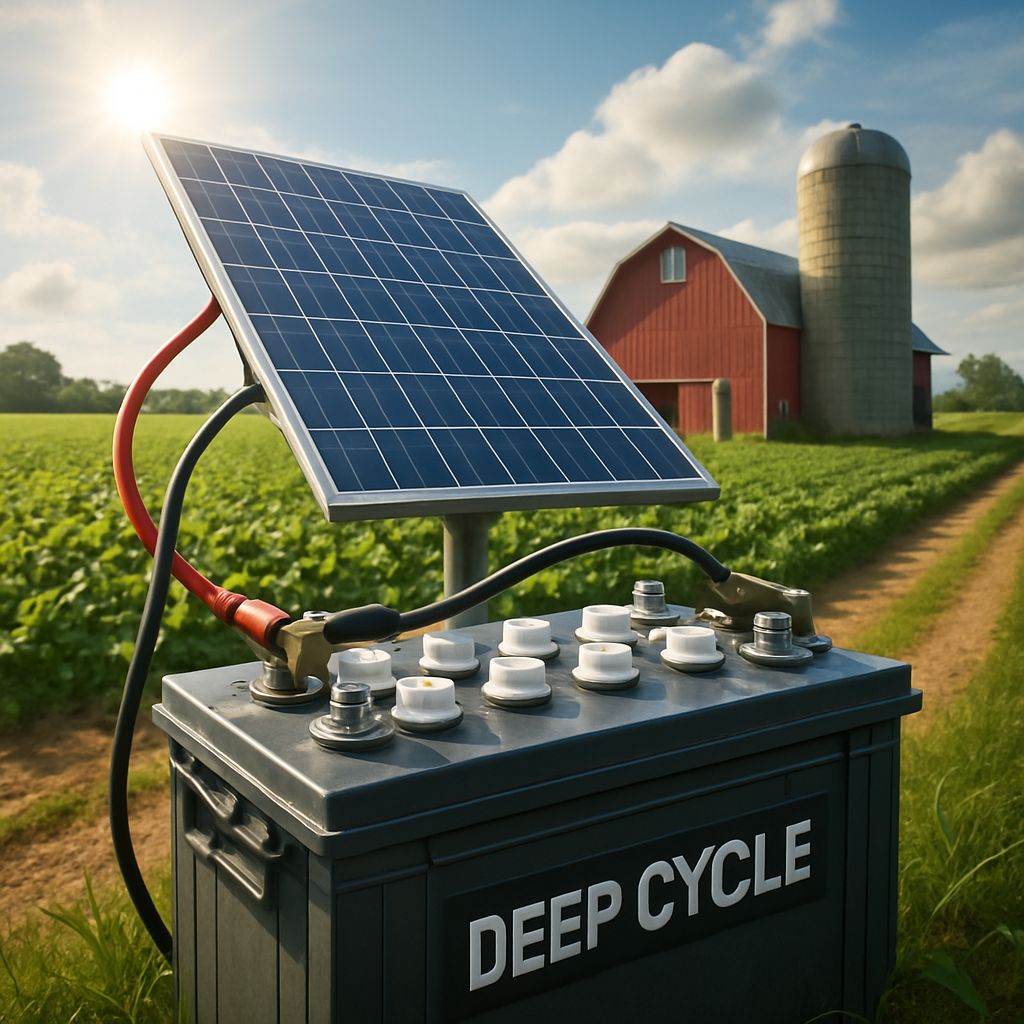
Sustainable power isn’t just about generating electricity when the sun shines—it’s about ensuring your farm operates efficiently 24/7. Lead-acid deep cycle batteries transform intermittent solar power into reliable farm energy that works around the clock. Whether you’re running irrigation systems overnight or keeping livestock comfortable during cloudy weather, these battery systems bridge the gap when your panels aren’t producing. Growing Solarmist shows how these time-tested batteries continue to be the backbone of agricultural energy independence despite newer technologies entering the market.
Why Flooded Lead-Acid Batteries Are Farm Solar Systems’ Secret Weapon
When farming operations go solar, the question isn’t just about generating power—it’s about storing it effectively. Flooded lead-acid batteries have remained the agricultural industry’s preferred choice for decades despite flashier alternatives entering the market. Their proven reliability in harsh farm environments combines with significantly lower upfront costs—typically 40-60% less than comparable lithium systems—making them particularly attractive for operations with tight capital constraints. These workhorses deliver consistent performance across seasonal demands while offering the ruggedness needed to handle temperature fluctuations in barns and outbuildings.
The economics become even more compelling when considering the complete lifecycle. While lithium batteries boast longer theoretical lifespans, properly maintained lead-acid systems often achieve 5-7 years of reliable service in agricultural settings—delivering exceptional value through multiple harvest cycles. This practical performance record is why many experienced farmers continue choosing these batteries even as newer technologies emerge. Their simplicity also means local repair and recycling options are readily available in rural areas where specialized technical support might be limited.
Deep-Cycle Flooded Lead-Acid Batteries Explained
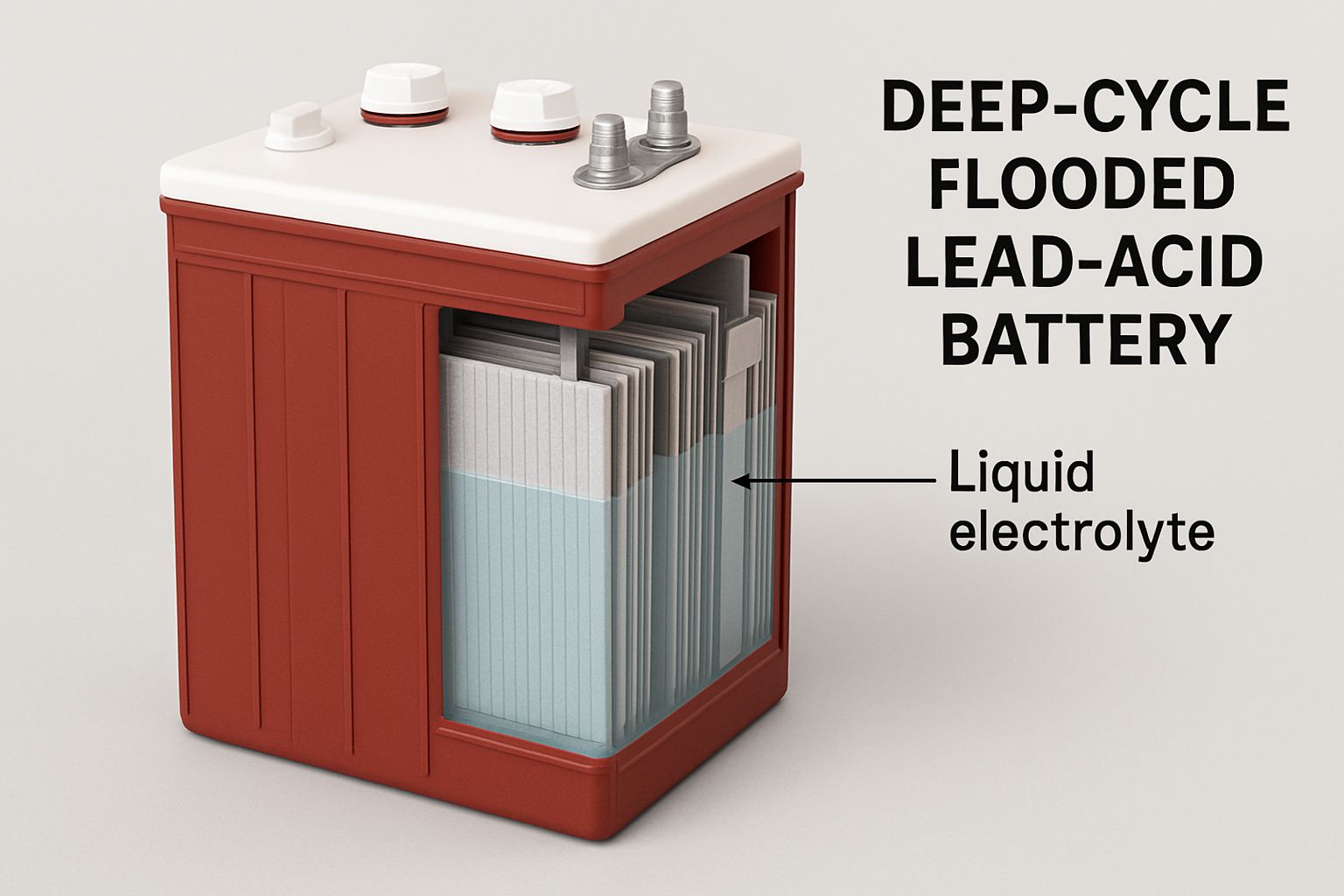
Unlike standard automotive batteries designed for quick bursts of starting power, deep-cycle batteries are specifically engineered for the sustained energy delivery that farm operations require. Their construction features thicker lead plates and specialized internal components that withstand repeated charging and discharging without rapid degradation. This fundamental difference makes them capable of releasing energy gradually over extended periods—perfect for powering critical systems overnight or during multiple cloudy days. The “flooded” designation refers to their liquid electrolyte design, which allows for greater energy density at lower cost compared to sealed alternatives. For more information on how these batteries fit into off-grid solar panel systems for farms, you can explore additional resources.
These batteries essentially function as energy reservoirs, storing excess electricity generated during peak sunlight hours and releasing it when production drops. The technology is remarkably mature, with over 160 years of development refining their performance and reliability. This maturity translates to predictable operation even under the variable conditions typical of farm environments. Their simple construction also makes them more forgiving of less-than-perfect charging conditions, an important consideration when working with the fluctuating power generation inherent in solar systems.
What Makes a Battery “Deep-Cycle” and Why It Matters for Farms
The “deep-cycle” designation isn’t just marketing terminology—it represents a fundamental design philosophy that directly impacts farm operations. Standard batteries prioritize delivering high amperage for short durations, whereas deep-cycle versions are engineered to provide moderate, consistent power over extended periods. This distinction becomes critical when powering essential equipment like water pumps, refrigeration units, or ventilation systems that must operate continuously regardless of solar panel output. The thicker lead plates and specialized separators in deep-cycle batteries resist warping and deterioration during the repeated discharge cycles that farm systems demand.
For agricultural applications, this deep-cycling capability translates directly to operational reliability. When irrigation systems need to run through the night or livestock buildings require continuous climate control during cloudy periods, these batteries deliver consistent performance without premature failure. While standard batteries might seem like a money-saving alternative initially, they typically deteriorate rapidly under the deep discharge patterns common in farm solar systems. This premature failure creates not only replacement costs but potentially catastrophic interruptions to critical farm operations during peak growing seasons.
The capacity to handle depth of discharge—regularly using 50-80% of the battery’s stored energy—makes deep-cycle batteries the only practical option for serious agricultural solar installations. This discharge tolerance directly corresponds to how many hours your essential systems can operate during periods of low or zero solar production. For farms in northern regions where winter days are short or areas prone to extended cloudy periods, this deep-discharge capability becomes even more critical for maintaining continuous operations across seasonal transitions.
The Internal Structure of Flooded Lead-Acid Batteries
Understanding the internal structure helps farmers appreciate why proper maintenance matters so much:
• Lead Plates: Thicker than automotive batteries, designed for repeated deep cycling
• Liquid Electrolyte: Sulfuric acid solution that requires periodic checking and topping off
• Sediment Space: Room at bottom for shed material to collect without shorting plates
• Vent Caps: Allow hydrogen gas release during charging, essential for safety
This exposed liquid electrolyte design creates both advantages and responsibilities for farm operators. The open cells allow for easy monitoring of electrolyte levels and specific gravity—a direct indicator of charge state that helps prevent damaging over-discharge situations. This visibility provides invaluable early warning of potential issues before they develop into system failures. However, this same design requires regular maintenance checks to ensure electrolyte levels remain above the plates, preventing permanent damage that can dramatically shorten battery life.
The venting system represents another critical design element for farm applications. During charging, especially in the final stages, these batteries release hydrogen gas that must be safely dispersed. This necessitates installing battery banks in well-ventilated areas away from potential ignition sources—an important consideration when planning system placement within existing farm buildings. While this venting requirement adds an installation consideration, it also enables the batteries to accept higher charging currents without overheating, allowing faster recovery after deep discharge events.
Key Specifications Farmers Should Understand
When selecting batteries for farm solar systems, understanding several key specifications becomes essential for proper system sizing. Battery capacity, measured in amp-hours (Ah), directly determines how long your equipment can run between charging cycles. For example, a 400Ah battery bank can theoretically deliver 40 amps for 10 hours before requiring recharge—though practical limitations reduce this somewhat. Voltage ratings (typically 12V, 24V, or 48V) must match your inverter and overall system design, with higher voltage systems generally offering better efficiency for larger operations. For more insights, explore how off-grid solar panels power farm operations.
Cycle life represents another critical specification, indicating how many charge-discharge cycles the battery can withstand before capacity significantly deteriorates. Quality flooded lead-acid batteries typically deliver 1,200-1,500 cycles when limited to 50% depth of discharge—translating to several years of daily use. This specification becomes particularly important when comparing different battery technologies and brands, as it directly impacts long-term operational costs. When reviewing manufacturer specifications, look for cycle life data tested under agricultural conditions rather than ideal laboratory settings for more realistic performance expectations.
Cold-weather performance merits special attention for farms in northern climates, as battery capacity temporarily decreases as temperatures drop. Quality flooded lead-acid batteries typically retain about 75-80% of their rated capacity at 32°F (0°C), compared to their performance at 77°F (25°C). This capacity reduction must be factored into winter system sizing to ensure critical operations remain powered during cold periods. The good news is that flooded batteries’ thermal mass helps them maintain more consistent internal temperatures than smaller sealed units, providing some inherent protection against brief cold snaps.
Depth of Discharge: The Critical Number for Battery Lifespan
Perhaps no single factor influences battery lifespan more dramatically than depth of discharge (DoD)—how much energy you regularly withdraw before recharging. While deep-cycle batteries can technically discharge to 80% of capacity, routinely doing so significantly shortens their usable life. Most manufacturers recommend limiting regular discharge to 50% to optimize longevity and value. This recommended discharge limit becomes a fundamental design parameter when sizing your battery bank for farm applications, effectively doubling the capacity needed compared to theoretical requirements.
The relationship between discharge depth and battery lifespan follows an exponential rather than linear curve. A battery regularly discharged to 50% might deliver 1,500 cycles, while the same battery discharged to 80% might last only 500 cycles—a 66% reduction in lifespan from just a 30% increase in discharge depth. This dramatic relationship makes proper system sizing one of the most economically significant decisions when designing farm solar backup systems. Investing in additional battery capacity initially often delivers exceptional returns through extended system life, reduced maintenance, and greater operational reliability.
How These Batteries Power Your Farm When Solar Panels Can’t
The fundamental value of battery backup systems emerges during the predictable daily solar generation gap and unpredictable weather events that limit production. During normal operation, your solar array produces excess electricity during peak daylight hours—energy that would otherwise be wasted or sold back to the grid at wholesale rates. Your battery system captures this surplus production, creating an energy reservoir you control. This stored power then becomes available precisely when you need it most: during evening irrigation schedules, overnight livestock monitoring, or early morning operations before the sun reaches productive angles. For more insights on off-grid solar power systems for farms, explore how they function efficiently during night and weather challenges.
Beyond the predictable day-night cycle, these battery systems provide crucial resilience during weather disruptions. A properly sized system bridges multiple days of reduced solar production during stormy or cloudy periods, maintaining critical operations when grid-tied systems without storage would falter. This weather independence becomes particularly valuable during growing season storms that might otherwise interrupt irrigation cycles or climate control during sensitive crop stages. The battery system essentially functions as an insurance policy against production interruptions, with the premium being the initial investment and maintenance costs.
For farms in areas with unreliable utility service, the stability these systems provide becomes even more valuable. Rather than experiencing the full impact of grid outages, your critical systems continue operating seamlessly through transitions between solar, battery, and grid power. This continuity protects sensitive equipment from damage caused by abrupt power interruptions while ensuring that climate-controlled environments for livestock or stored produce maintain consistent conditions. Many farmers report this operational stability alone justifies their battery investment, independent of the energy cost savings.
The Day-Night Cycle of Farm Energy Storage
The daily rhythm of energy flow through a farm solar-plus-storage system follows a predictable pattern that maximizes self-consumed energy. During morning hours, as solar production begins ramping up, systems typically draw directly from panels while simultaneously beginning to recharge batteries depleted overnight. By midday, most systems generate surplus electricity that rapidly completes battery charging before potentially powering optional daytime loads or exporting to the grid. Late afternoon sees production gradually tapering while farm activity often increases—a transition period where systems intelligently balance remaining solar input with strategic battery discharge to minimize grid dependency.
As darkness falls, the system transitions completely to battery power for essential overnight operations—irrigation systems, security lighting, climate control, and monitoring equipment. Advanced charge controllers manage this transition automatically, optimizing battery life by preventing excessive discharge while ensuring critical systems remain operational. This seamless day-night cycling happens without operator intervention, maintaining continuity for sensitive equipment and processes. For operations with time-flexible energy needs, smart controllers can schedule optional high-consumption activities during peak production periods, further increasing self-consumption and reducing reliance on stored power.
Weather Resilience: Keeping Systems Running During Storms
When forecast accuracy directly impacts profitability, maintaining operational continuity through weather disruptions becomes essential. Lead-acid battery banks provide crucial buffers during extended cloudy periods that can significantly reduce solar production for days at a time. A properly sized system typically delivers 2-3 days of autonomy for critical loads—meaning essential operations continue uninterrupted even when solar panels generate minimal electricity. This resilience prevents irrigation interruptions during critical growth stages, maintains stable environments in livestock buildings, and keeps security systems operational when they’re most needed. For more information on enhancing farm operations, explore how off-grid solar power systems can boost efficiency.
Beyond gradual weather patterns, these systems provide invaluable protection during severe events that might damage utility infrastructure. When regional storms knock out grid power—potentially for days in rural areas—farms with battery backup maintain operational independence. This self-sufficiency has proven particularly valuable during harvest seasons when power interruptions could otherwise result in significant crop losses. Many farmers report that this disaster resilience, though used infrequently, ultimately justifies their entire battery investment through prevented losses during just one or two critical events.
5 Crucial Farm Systems These Batteries Can Power
1. Irrigation Systems That Work Through The Night
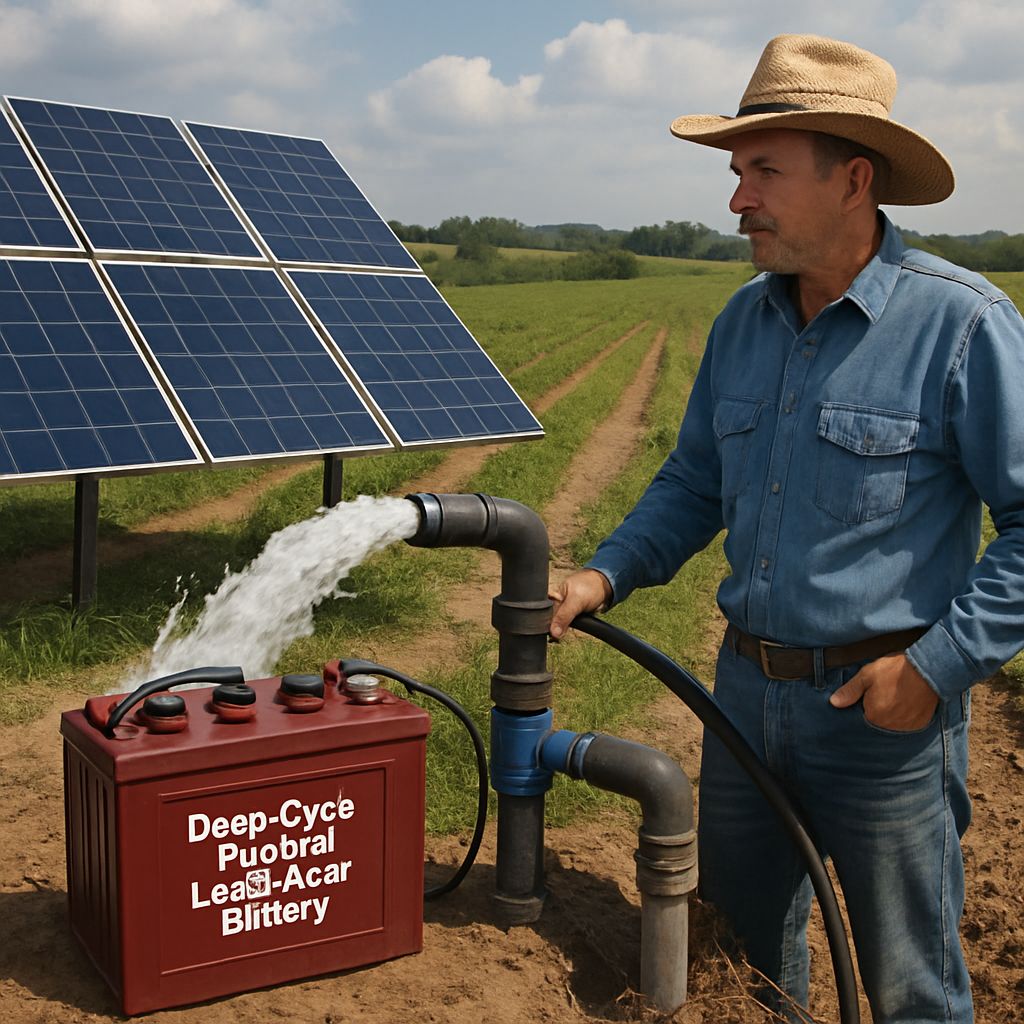
Modern agricultural efficiency often depends on precisely timed irrigation cycles that frequently need to operate during off-peak hours. Deep-cycle batteries enable programmable irrigation systems to maintain optimal soil moisture levels regardless of sunlight availability. This capability proves especially valuable during critical growing phases when water timing directly impacts yield potential. By powering pumps, controllers, and automated valves through the night, these systems help farmers optimize water usage while reducing evaporation losses associated with daytime irrigation. Learn more about off-grid solar power systems for farms and their efficiency.
The ability to schedule irrigation during optimal biological windows—often early morning hours—significantly improves water efficiency compared to systems constrained by solar production hours. Many crops benefit from receiving water during cooler periods when evaporation rates are lowest and plants can maximize uptake efficiency. Battery-backed systems provide this scheduling flexibility while simultaneously reducing competition for daytime solar production that might power other essential farm operations. For operations in areas with time-of-use utility rates, nighttime irrigation powered by batteries stored during peak solar hours can dramatically reduce operational costs compared to running pumps on expensive evening grid power.
Pressure-regulated drip irrigation systems particularly benefit from battery backup, as they require consistent power to maintain the precise pressure ranges that ensure uniform water distribution. Voltage fluctuations or interruptions can cause pressure irregularities that result in uneven crop development across fields. Battery systems provide the stable power these precision systems require, maintaining tight pressure tolerances throughout irrigation cycles regardless of solar production variability. This consistency translates directly to more uniform crop development, reduced water waste, and ultimately higher marketable yields.
2. Climate Control for Livestock Buildings
Maintaining optimal environmental conditions in livestock facilities directly impacts animal health, welfare, and production efficiency. Battery backup systems ensure that ventilation fans, heaters, coolers, and automated curtain controllers continue functioning regardless of solar panel output or grid availability. This continuous operation prevents dangerous temperature fluctuations that can stress animals and reduce productivity. During summer heat waves, uninterrupted ventilation becomes literally lifesaving, preventing heat stress that can cause significant livestock losses within hours of system failure. For those considering sustainable energy solutions, off-grid solar panels can be a viable option for powering farm operations.
Modern poultry and swine operations particularly depend on precise climate control systems with minimal tolerance for interruptions. Battery systems provide the operational resilience these sensitive environments require, maintaining air quality and temperature even during extended cloudy periods. This consistency supports optimal growth rates, feed conversion efficiency, and animal health metrics that directly impact profitability. Many producers report that preventing even one climate control failure during extreme weather events justifies their entire battery system investment through avoided livestock losses.
The overnight operation capability proves especially valuable for facilities using natural ventilation supplemented by mechanical systems. During warm nights when passive airflow may be insufficient, battery-powered exhaust fans can maintain air quality without requiring expensive utility power. Similarly, winter heating systems can maintain critical minimum temperatures during overnight hours when temperatures often reach their lowest points. This 24-hour operational capability ensures animals experience consistent environmental conditions that support optimal biological functions regardless of external weather patterns or solar production cycles.
3. Cold Storage for Harvested Crops
Post-harvest preservation represents a critical economic control point where product quality and marketable life are established. Battery backup systems maintain consistent cooling for refrigerated storage areas that preserve freshly harvested produce, extending marketable windows and reducing spoilage losses. This capability proves particularly valuable for high-value perishables like berries, leafy greens, and orchard crops where temperature fluctuations can rapidly accelerate quality degradation. By ensuring refrigeration compressors, air handlers, and control systems remain operational regardless of solar production, batteries protect harvest value during the critical initial cooling phase.
Beyond primary cooling, many specialty crops require precise humidity control that depends on continuous system operation. Battery systems ensure humidifiers, dehumidifiers, and circulation fans maintain optimal storage environments without interruption. This environmental stability preserves not only apparent quality characteristics but also nutritional value and food safety parameters that premium markets increasingly demand. For operations producing for quality-sensitive export markets, documented temperature stability throughout storage often supports premium pricing that directly enhances profit margins.
The energy independence these systems provide becomes particularly valuable during fall harvest seasons when regional grid demand often peaks and utility reliability may decrease. By capturing excess solar production during daytime hours, batteries provide overnight cooling capacity that operates independently from utility constraints. This self-sufficiency ensures that cooling operations continue uninterrupted even during brownouts or planned utility maintenance that might otherwise compromise storage conditions during critical harvest periods. For operations with significant cold storage requirements, this harvest-season reliability often provides the most compelling economic justification for battery investments.
4. Security Systems and Lighting
Protecting valuable equipment, livestock, and stored inputs remains a constant concern for modern farming operations. Battery backup systems ensure that security cameras, motion sensors, access control systems, and perimeter lighting remain operational regardless of solar production or grid availability. This continuous protection deters theft and unauthorized access while providing valuable monitoring capabilities for remote areas of larger operations. The always-on nature of battery-backed systems eliminates security gaps that might otherwise occur during power interruptions or overnight periods when solar production ceases.
Strategic lighting powered by battery systems serves both security and operational purposes, illuminating critical work areas during early morning or evening hours when natural light proves insufficient. This extended workday capability becomes particularly valuable during compressed planting and harvest windows when maximum productive hours directly impact seasonal outcomes. By supporting flexible work scheduling independent from daylight constraints, battery-backed lighting systems help operations maximize labor efficiency and equipment utilization during critical seasonal transitions.
For livestock operations, overnight monitoring systems powered by battery backup provide essential oversight for calving, lambing, or farrowing activities that frequently occur during darkness. These systems alert managers to animals requiring assistance while continuously recording conditions in production facilities. Many producers report that early intervention capabilities enabled by these always-on monitoring systems significantly reduce livestock losses and veterinary costs. The peace of mind these systems provide, knowing critical areas remain monitored regardless of power conditions, delivers value beyond direct economic returns through reduced management stress during high-pressure production phases.
5. Well Pumps and Water Purification
Consistent water availability underpins virtually every aspect of agricultural production. Battery systems ensure that well pumps, pressure tanks, and water treatment equipment operate continuously regardless of solar conditions or grid status. This reliability proves particularly critical for livestock operations where even short interruptions in water availability can impact animal health and production metrics. By maintaining steady water pressure and volume throughout the day-night cycle, battery-backed pumping systems support optimal livestock hydration patterns while ensuring cleaning and sanitizing operations can proceed on appropriate schedules.
Water quality management increasingly depends on continuous treatment processes that maintain biological safety parameters. Battery backup ensures that UV sterilization, chlorination systems, filtration equipment, and monitoring devices operate without interruption. This treatment continuity prevents potential contamination events that might otherwise occur during power transitions or outages. For operations under food safety certification programs, documented continuous water treatment often represents a compliance requirement that battery systems help satisfy through verifiable operational records. For more information on how solar power can enhance farm operations, check out solar-powered farm tools and equipment.
For irrigation reservoirs and storage systems, battery-powered pumps maintain appropriate water levels by capturing excess well production during optimal solar hours for later use. This time-shifting capability maximizes the productivity of existing water infrastructure while ensuring sufficient reserves remain available for critical needs regardless of immediate pumping capacity. Many operations report that this water security aspect alone justifies battery investments, particularly in regions experiencing increasing water scarcity or regulatory constraints on pumping schedules. The resilience these systems provide against both weather variables and utility interruptions delivers comprehensive water security that supports operational continuity across all farm systems.
Real Cost Analysis: Lead-Acid vs. Lithium for Farm Applications
When evaluating battery options for agricultural applications, the initial investment difference between technologies remains significant. Quality flooded lead-acid batteries typically cost 40-60% less than lithium alternatives with equivalent usable capacity. For a typical farm system providing 20kWh of usable storage, this translates to approximately $4,000-6,000 for lead-acid versus $10,000-15,000 for lithium. This substantial initial savings makes lead-acid systems particularly attractive for operations with limited capital budgets or those seeking faster financial returns. The mature technology also means more standardized components and wider availability of replacement parts in rural areas where specialized lithium battery service might be limited.
However, comprehensive cost analysis requires examining the complete lifecycle rather than just upfront expenses. While lithium batteries typically last 10-15 years compared to 5-7 years for lead-acid, they require virtually no maintenance during that period. Lead-acid systems demand regular water level checks, periodic equalization charging, and terminal cleaning to achieve their full lifespan potential. When calculating true ownership costs, this maintenance labor (typically 1-2 hours monthly) must be factored into the equation. Despite these considerations, many agricultural operations still find that properly maintained lead-acid systems deliver lower lifetime costs per kilowatt-hour stored, particularly when farm labor can absorb routine maintenance within existing equipment care schedules.
Operational considerations beyond direct costs also influence technology selection for specific farm contexts. Lead-acid systems generally tolerate a wider range of charging conditions and equipment quality, making them more forgiving in challenging rural electrical environments. Their simpler construction means repairs often require less specialized knowledge, an important consideration for remote operations. Conversely, lithium systems offer significant advantages in installations where space is severely limited, extreme temperature ranges exist, or very deep cycling is required. This practical balance between economic and operational factors explains why both technologies continue finding appropriate applications across diverse agricultural settings rather than one completely displacing the other.
Initial Investment Comparison
|
Battery Type |
Initial Cost (per kWh) |
Expected Lifespan |
Maintenance Requirements |
Space Requirements |
|---|---|---|---|---|
|
Flooded Lead-Acid |
$150-250 |
5-7 years |
Monthly water checks, terminal cleaning |
Larger footprint, ventilated space |
|
Sealed Lead-Acid (AGM) |
$250-350 |
4-6 years |
Minimal, terminal inspection only |
Moderate space, no ventilation required |
|
Lithium Iron Phosphate |
$500-700 |
10-15 years |
Virtually none |
Compact, flexible placement |
This cost structure explains why many agricultural operations begin with flooded lead-acid systems despite the maintenance requirements. The substantially lower initial investment allows farms to establish battery storage capabilities while minimizing upfront capital commitments. This approach proves especially valuable for operations testing battery integration before expanding to larger systems. The modular nature of battery banks also facilitates gradual transitions between technologies, with many farms maintaining lead-acid systems for baseline capacity while adding lithium components for specific high-demand applications where their performance advantages justify the premium cost.
Lifespan and Replacement Costs
Battery lifespan in agricultural settings often differs significantly from manufacturer ratings due to the challenging operational conditions farms present. Quality flooded lead-acid batteries typically deliver 1,200-1,500 cycles at 50% depth of discharge in real-world farm applications—translating to 3-4 years when cycled daily, or 5-7 years with less frequent cycling. This practical performance means replacement costs must be factored into long-term operational budgets, with many farms establishing rolling replacement programs that distribute these expenses over time. The good news is that well-maintained flooded batteries typically maintain about 80% of their original capacity until relatively near end-of-life, providing consistent performance throughout most of their service period.
Temperature conditions dramatically impact realized lifespan, with batteries in unconditioned farm buildings experiencing accelerated aging compared to those in climate-controlled spaces. Each 10°F (5.6°C) above the ideal 77°F (25°C) operating temperature typically reduces battery life by approximately 50%. Conversely, very cold conditions temporarily reduce capacity without necessarily shortening overall lifespan. These temperature effects make properly insulated battery rooms or climate-controlled enclosures worthwhile investments in extreme climate regions, often doubling realized battery life compared to exposed installations. The substantial lifespan extension these environmental controls provide typically delivers compelling returns despite their additional initial cost.
Recycle value represents another important economic factor unique to lead-acid technologies. At end-of-life, these batteries retain significant value through established recycling programs, with the lead content particularly valuable. This recycling value—typically $5-10 per typical farm battery—effectively reduces replacement costs while ensuring environmentally responsible disposal. Many battery suppliers offer core credits that formalize this value recovery, further improving lifecycle economics. This mature recycling infrastructure gives lead-acid technologies a sustainability advantage over newer battery chemistries with less established end-of-life processing systems. For more insights on solar power’s impact on farm operations, explore how off-grid solar panels power farm operations.
Maintenance Requirements and Associated Expenses
Flooded lead-acid batteries require regular maintenance that represents both a time commitment and potential expense for farm operations. Water level checking typically needs monthly attention, with distilled water additions required more frequently during summer months or periods of heavy cycling. Equalization charging—a controlled overcharge that reverses cell imbalances—should be performed quarterly or whenever battery performance seems diminished. Terminal cleaning and corrosion prevention should occur every 3-6 months, with special attention during humid seasons. While these activities require relatively simple skills, they demand consistency and attention to detail for optimal battery preservation.
This maintenance commitment typically translates to approximately 1-2 hours monthly for a medium-sized farm battery bank. When calculating true ownership costs, this labor must be valued appropriately—either at employee wages if staff perform the work, or at opportunity cost rates for owner-operators. Specialized tools and supplies for battery maintenance represent minor but ongoing expenses, typically $50-100 annually for testing equipment, distilled water, terminal cleaners, and protective materials. While relatively modest, these costs accumulate over the system lifetime and should factor into comprehensive economic analyses when comparing battery technologies.
Maintenance quality directly impacts realized battery lifespan, creating a direct economic link between care practices and replacement frequency. Batteries receiving proper maintenance typically achieve the upper end of their potential cycle life, while neglected systems often require replacement at the minimum end of lifespan ranges or earlier. This variable outcome means that farms with established equipment maintenance protocols generally experience better economic returns from lead-acid systems than operations struggling with consistent maintenance execution. This relationship explains why operations with dedicated maintenance personnel often prefer lead-acid technologies despite their care requirements, while farms with limited labor availability may find the maintenance-free nature of lithium systems more appropriate despite higher initial costs.
Proper Installation and Maintenance for Maximum Lifespan
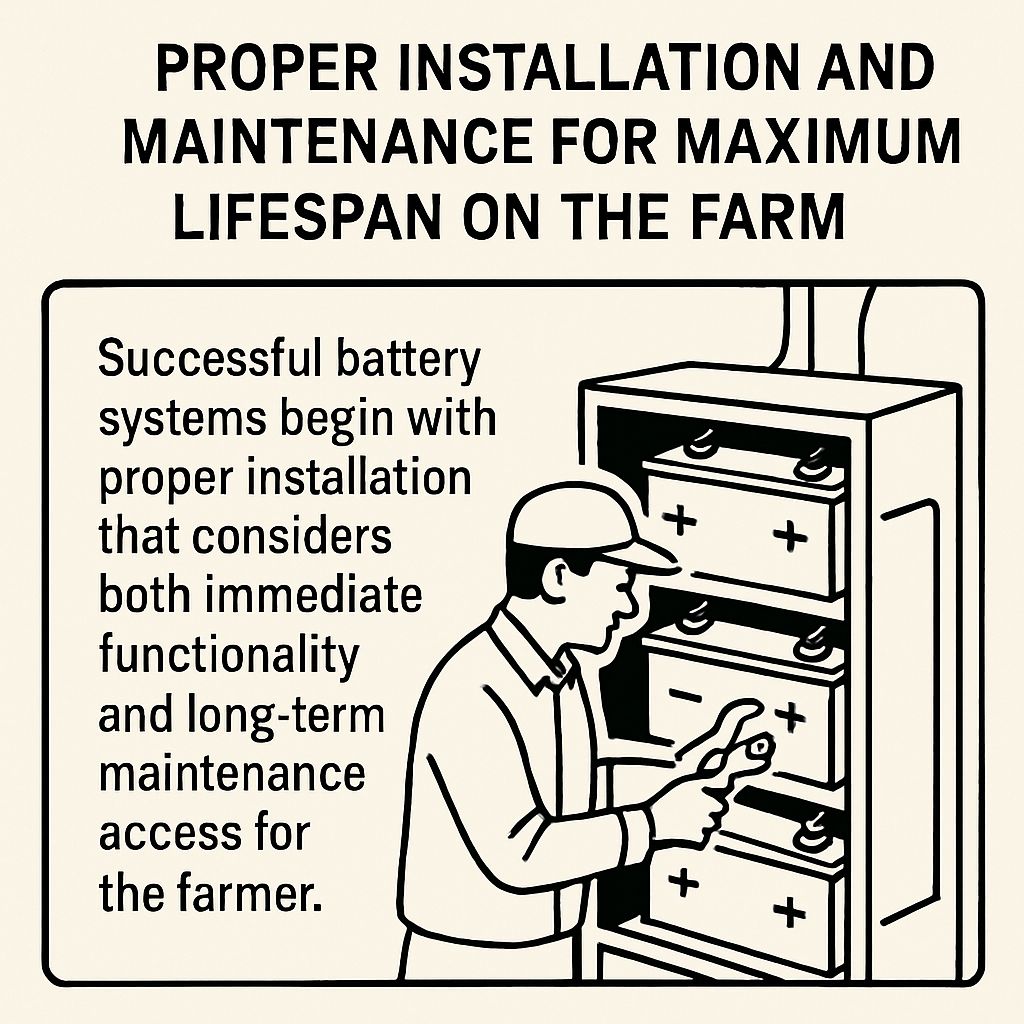
Successful battery systems begin with proper installation that considers both immediate functionality and long-term maintenance access. Batteries should be positioned on sturdy, level platforms that isolate them from ground moisture while providing stable support for their substantial weight. Cable connections should use appropriately sized conductors with proper terminal hardware, avoiding dissimilar metals that accelerate corrosion. Strategic placement near the main electrical distribution panel minimizes voltage drops while keeping batteries accessible for routine service. For flooded batteries, installation must include appropriate ventilation provisions and spill containment measures that satisfy both safety requirements and environmental regulations.
Beyond physical installation, electrical configuration significantly impacts battery longevity. Charge controllers must match battery chemistry with appropriate voltage setpoints and charging profiles. Most quality solar charge controllers offer specific settings for flooded lead-acid batteries that optimize the critical absorption and float charging stages. System designers should avoid paralleling batteries of different ages or conditions, as weaker cells will degrade stronger ones through uneven current distribution. Monitoring equipment that tracks battery state-of-charge, temperature, and cycle history provides valuable management information while helping identify potential issues before they cause permanent damage. These monitoring systems, while representing additional initial expense, typically pay for themselves through extended battery life and prevented system failures.
Temperature management represents another critical installation consideration for maximizing battery performance and longevity. Batteries function best between 60-75°F (15-24°C), with significant capacity reduction at lower temperatures and accelerated degradation at higher temperatures. Strategic placement in naturally temperature-moderate locations like below-grade rooms or north-facing structures helps minimize environmental extremes. For more challenging locations, passive measures like insulated enclosures or strategic ventilation can significantly moderate temperature variations. In extreme climates, active heating or cooling systems may prove economically justified through substantially extended battery life and improved performance consistency.
Ventilation Requirements for Battery Rooms
Safety Alert: Proper ventilation prevents dangerous hydrogen gas accumulation
Flooded lead-acid batteries release hydrogen gas during charging—especially in the final charging stages. This colorless, odorless gas becomes explosive at concentrations as low as 4% in air. Proper ventilation is not optional—it’s essential for safety.
Effective battery room ventilation requires both air intake at low levels and exhaust outlets at the highest point of the enclosure. This configuration creates natural convection that removes hydrogen gas, which rises rapidly due to its extremely low density. For smaller installations, passive ventilation using properly sized vents (typically providing at least 1 square inch of vent area per 5 amp-hours of battery capacity) often proves sufficient. Larger systems benefit from thermostatically controlled exhaust fans that activate during charging cycles or whenever temperatures exceed optimal ranges. These active systems provide additional safety margins while helping maintain ideal operating temperatures that extend battery life.
Battery room design should eliminate potential ignition sources near ceiling level where hydrogen concentrations would be highest. Electrical fixtures installed in these areas should use sealed, explosion-proof components rated for hazardous locations. Light switches, inverters, and other spark-producing components should be positioned at lower levels where hydrogen is less likely to accumulate. Physical barriers preventing objects from falling across battery terminals provide additional protection against accidental shorts that could create ignition sparks. While these precautions might seem extensive, they represent standard safety practices that have allowed millions of flooded batteries to operate without incident in agricultural applications worldwide.
Beyond safety considerations, proper ventilation delivers significant performance benefits by moderating temperature extremes that accelerate battery aging. Excessive heat particularly damages batteries, with each 10°F above ideal operating temperature potentially halving battery lifespan. Strategic ventilation that exhausts hot air during summer while minimizing cold air infiltration during winter helps maintain optimal temperature ranges year-round. This temperature management directly translates to extended service life, with properly ventilated installations typically achieving the upper ranges of expected cycle life compared to batteries exposed to extreme temperature variations. The economic value of this lifespan extension easily justifies the modest additional costs proper ventilation systems require. For more on maintaining energy systems, explore off-grid solar panel systems for farms.
Water Level Monitoring and Refilling Schedule
|
Season |
Checking Frequency |
Typical Water Usage |
Special Considerations |
|---|---|---|---|
|
Summer |
Every 2-3 weeks |
Higher due to evaporation |
Check more frequently during heatwaves |
|
Spring/Fall |
Monthly |
Moderate |
Adjust based on cycling patterns |
|
Winter |
Every 4-6 weeks |
Lower in cold environments |
Always check before potential freezing weather |
Maintaining proper electrolyte levels remains the single most important maintenance task for maximizing flooded battery lifespan. Water levels should always cover the lead plates completely while remaining below the fill well indicator—typically maintaining about ¼ inch above the plates. Checking levels becomes particularly important during seasonal transitions when temperature and usage patterns change. Only distilled, deionized, or specifically purified water should be used for refilling, as minerals in tap water accumulate within cells and create internal short circuits that permanently damage batteries. The modest cost of distilled water ($1-2 per gallon) represents an insignificant expense compared to the substantial lifespan reduction that mineral contamination causes.
Uneven water consumption between cells often indicates developing problems that require attention before they cause permanent damage. Cells consuming water significantly faster than others typically suffer from higher charging voltage due to increased internal resistance. This condition, if left uncorrected, accelerates degradation and eventually leads to premature failure. Addressing these imbalances through equalization charging—a controlled overcharge process that brings all cells to full charge—can restore proper function and extend overall battery life. This process should be performed quarterly as preventive maintenance or whenever significant cell imbalances appear during regular water level checks.
Water consumption increases dramatically during warmer months due to both higher evaporation rates and more active gassing during charging cycles. Summer maintenance schedules should adjust accordingly, with many farm operations finding bi-weekly checks necessary during peak heat. Battery watering systems that maintain consistent levels automatically represent worthwhile investments for larger installations, reducing maintenance labor while ensuring optimal levels even during busy seasonal transitions. These systems typically pay for themselves within 1-2 years through reduced maintenance time and extended battery life resulting from more consistent electrolyte levels. For more information on how solar power can help reduce farm maintenance costs, explore our article on solar power and maintenance expenses.
Temperature Management for Optimal Performance
Temperature represents both an operational and lifespan variable for farm battery systems, with proper management delivering significant economic benefits. In cold environments, battery capacity temporarily decreases—typically delivering only 70-80% of rated capacity at freezing temperatures—while charging acceptance also reduces significantly. These temporary effects require appropriate system sizing to ensure sufficient winter capacity while preventing charging issues that could damage batteries. Conversely, excessive heat permanently accelerates internal corrosion and water consumption, with sustained temperatures above 80°F (27°C) significantly reducing overall lifespan. This temperature sensitivity makes strategic placement and environmental management critical aspects of successful farm battery installations.
Farm Success Stories: Real-World Performance Data
The Reynolds Family Dairy in Wisconsin demonstrates how thoughtfully implemented battery systems deliver tangible operational benefits beyond simple energy savings. Their 48V flooded lead-acid battery bank provides 30kWh of usable storage capacity integrated with a 22kW solar array. This system powers critical ventilation, lighting, and milk cooling equipment through both overnight periods and occasional utility outages. Since installation four years ago, they’ve documented a 78% reduction in utility electricity consumption while maintaining continuous operation through seven grid outages exceeding 4 hours each. Their comprehensive maintenance program, which includes weekly inspections and quarterly equalization charging, has maintained battery capacity at 92% of original specifications despite Wisconsin’s challenging temperature extremes. Most significantly, they’ve calculated that emergency power availability prevented approximately $45,000 in potential livestock losses during a three-day regional power outage following severe summer storms.
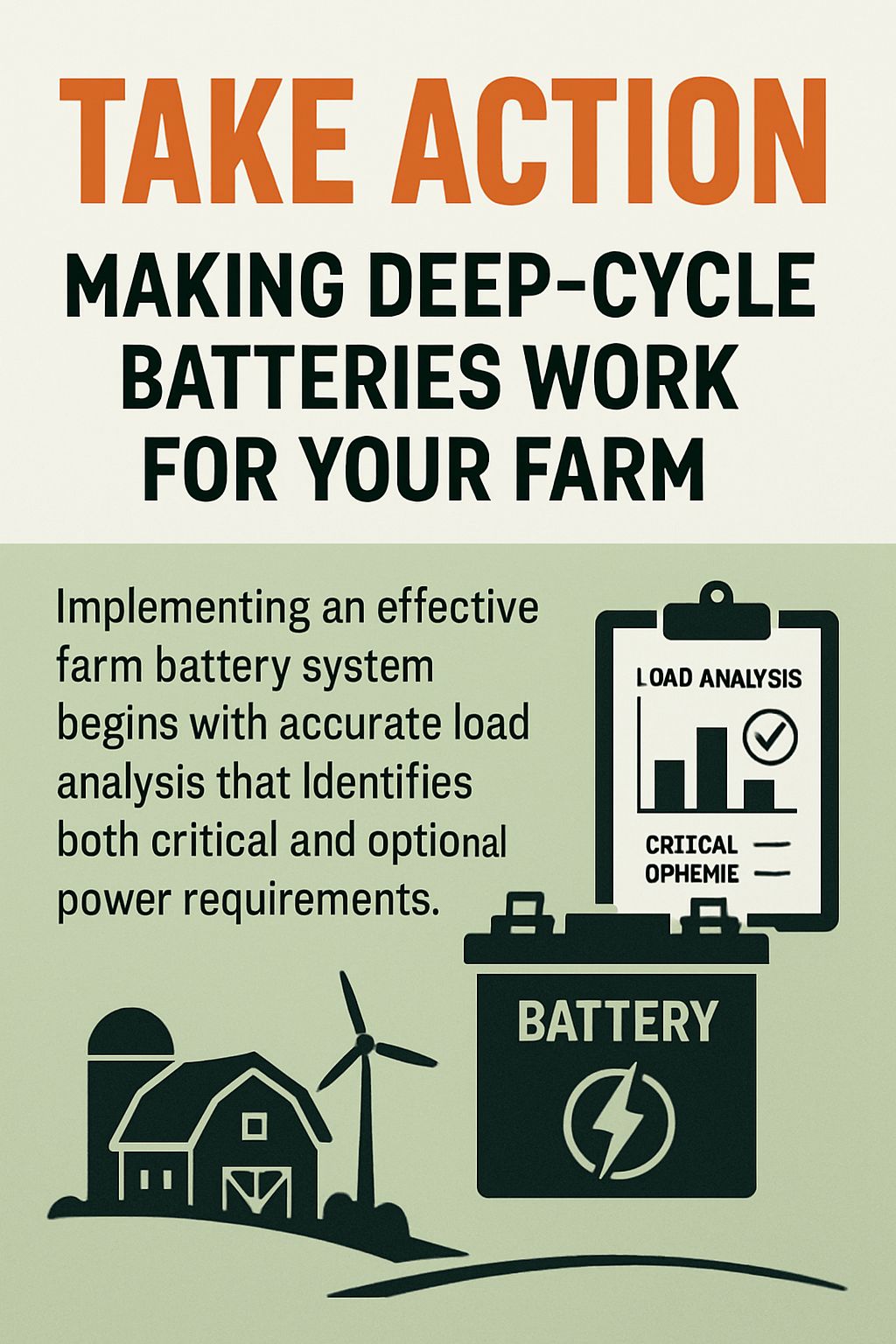
Take Action: Making Deep-Cycle Batteries Work for Your Farm
Implementing an effective farm battery system begins with accurate load analysis that identifies both critical and optional power requirements. Start by documenting the power consumption of essential equipment that must operate continuously—irrigation controllers, livestock ventilation, security systems, and refrigeration units. Next, catalog secondary systems that offer operational flexibility regarding when they operate—water pumping, grain handling, and workshop equipment. This load segregation creates the foundation for proper system sizing while identifying opportunities for strategic load scheduling that maximizes self-consumed solar energy.
Consulting with an agricultural-specific renewable energy designer provides valuable expertise that prevents costly system mismatches. Look for professionals with documented experience in farm installations rather than primarily residential systems, as agricultural applications present unique requirements. Request references from existing agricultural clients with similar operations to verify real-world performance. Quality system designers will provide comprehensive economic analysis showing expected payback periods, maintenance requirements, and long-term operational costs. They should also help identify potential grants, tax incentives, and agricultural-specific funding opportunities that can significantly improve project economics.
Successful implementation requires realistic maintenance planning that matches your operation’s capabilities and constraints. If regular maintenance seems challenging given your current labor situation, consider sealed battery technologies or maintenance service contracts despite their additional costs. For operations comfortable with routine equipment care, investing in quality battery maintenance tools and training key personnel delivers significant long-term value. Many battery suppliers offer maintenance training programs specifically for agricultural applications, covering practical techniques that maximize battery performance under farm conditions. This knowledge investment typically pays substantial dividends through extended battery life and improved system reliability.
Start small with critical loads before expanding as experience and confidence grow. This phased approach minimizes initial risk while providing practical learning opportunities before larger investments. Many successful farm battery systems began by powering just security lighting and monitoring equipment before expanding to include irrigation, climate control, and eventually larger equipment.
- Document current energy usage patterns before installation to establish accurate baselines
- Install comprehensive monitoring that tracks battery performance and identifies optimization opportunities
- Establish clear maintenance protocols with assigned responsibilities and documentation systems
- Schedule seasonal system reviews that adjust settings for changing farm operational patterns
- Create contingency plans for extreme weather events that may require modified battery management
Frequently Asked Questions
Farm operators considering battery systems typically share common questions about practical implementation aspects. These questions reflect legitimate concerns about fitting these systems into existing operations while maximizing their economic and functional benefits. Understanding these common considerations helps develop realistic expectations while identifying critical success factors for your specific situation.
The following responses address the most frequent questions based on extensive field experience with agricultural battery installations across diverse farming operations and climate conditions. While general principles remain consistent, specific applications should always consider your unique operational requirements, local climate patterns, and existing infrastructure capabilities.
How long do flooded lead-acid batteries typically last in farm agricultural solar applications?
When properly maintained, quality flooded lead-acid batteries typically deliver 5-7 years of reliable service in agricultural applications. This lifespan assumes regular cycling to 50% depth of discharge, proper maintenance including monthly water level checks, and protection from extreme temperatures. Batteries consistently discharged more deeply or subjected to maintenance neglect often last only 3-4 years, while those used in lighter cycling applications with excellent maintenance sometimes exceed 8 years. This variable lifespan directly correlates with three manageable factors: depth of discharge patterns, maintenance quality, and temperature control measures. Operations willing to invest in proper installation, consistent maintenance, and appropriate cycling patterns typically achieve the upper end of this lifespan range, significantly improving long-term economics compared to systems where these factors receive less attention.
Do I need to install special ventilation for a battery bank in my barn?
Yes, proper ventilation is absolutely essential for any enclosed space containing flooded lead-acid batteries. These batteries release hydrogen gas during charging—a colorless, odorless gas that becomes explosive at concentrations as low as 4% in air. At minimum, passive ventilation should provide at least one square inch of vent area per 5 amp-hours of battery capacity, with vents positioned to create natural convection flow. Low-level intake vents paired with high-level exhaust outlets utilize hydrogen’s natural buoyancy to create effective passive ventilation in many installations.
For larger systems or spaces with limited natural airflow, active ventilation using explosion-proof fans provides additional safety margins. These systems should activate automatically during charging cycles when hydrogen production peaks. Beyond safety considerations, proper ventilation helps maintain optimal battery temperatures that extend service life. Never install flooded batteries in completely sealed enclosures or spaces with potential ignition sources near the ceiling where hydrogen concentrates. Barns with existing ventilation systems may require modifications to ensure adequate airflow specifically around battery installations rather than relying on general building ventilation that might not adequately address the battery area.
Can flooded lead-acid batteries freeze during winter on my farm?
Properly charged flooded lead-acid batteries with correct electrolyte specific gravity will not freeze until temperatures reach approximately -60°F (-51°C)—far below even extreme agricultural environments. However, partially discharged batteries with diluted electrolyte can freeze at much higher temperatures, with batteries at 50% charge freezing around -4°F (-20°C) and severely discharged batteries freezing near 20°F (-7°C). This relationship between state-of-charge and freezing point makes winter battery management particularly important in cold climates. Maintaining higher minimum charge levels during winter months provides natural freeze protection while preserving battery condition. Insulated battery enclosures that moderate temperature extremes represent worthwhile investments for northern operations, helping maintain more consistent operating temperatures that improve both performance and longevity while providing additional freeze protection during extreme cold periods.
What’s the minimum maintenance schedule I should follow for these batteries?
For reliable operation in farm environments, flooded lead-acid batteries require at minimum: monthly water level checks with distilled water additions as needed, quarterly terminal cleaning and inspection, quarterly specific gravity measurements using a calibrated hydrometer, and semi-annual equalization charging to restore cell balance. This schedule intensifies during summer months when higher temperatures increase water consumption and accelerate chemical reactions—often requiring bi-weekly water checks during peak heat. Beyond these preventive measures, batteries benefit from monthly visual inspections for signs of corrosion, case bulging, or electrolyte leakage that might indicate developing problems. While this maintenance schedule represents additional operational responsibility, it directly correlates with realized battery lifespan. Operations following these minimum protocols typically achieve expected service life, while those performing maintenance more frequently often extend battery life 15-25% beyond manufacturer ratings—delivering significant economic benefits through delayed replacement costs.
Are there any agricultural tax incentives for installing solar battery backup systems?
Yes, several tax incentives can significantly improve the economics of farm solar battery systems, though specific programs vary by location and change periodically. At the federal level, the Investment Tax Credit (ITC) currently allows agricultural businesses to claim 30% of battery system costs as a tax credit when installed with new solar systems. Starting in 2023, standalone battery installations without new solar also qualify for this credit. Many states offer additional incentives including property tax exemptions for renewable energy improvements, sales tax exemptions on equipment purchases, and accelerated depreciation schedules specific to agricultural energy systems. Some agricultural-specific grant programs through USDA Rural Development or state departments of agriculture provide partial funding for renewable energy projects that include storage components. Consulting with an agricultural tax specialist familiar with renewable energy incentives helps identify all applicable programs while ensuring proper documentation for maximum benefit. These combined incentives typically reduce effective system costs by 40-60%, substantially improving project economics and shortening payback periods. For more information on lead-acid battery systems, visit this lead-acid solar pros and cons guide.
Beyond direct incentives, many agricultural operations qualify for specialized utility rate structures that particularly benefit battery-equipped systems. Time-of-use agricultural rates with significant differences between peak and off-peak pricing create additional economic opportunities for strategic battery cycling that shifts consumption away from expensive rate periods. Some utilities also offer demand charge reduction programs or capacity payments specifically for battery systems that can reduce grid load during peak demand events. These operational incentives, while less obvious than direct tax benefits, often deliver substantial ongoing value that complements upfront incentives. For more information on battery systems, check out the pros and cons of lead-acid solar batteries.
For growing farm operations looking to become more sustainable while managing energy costs, solar battery backup systems represent a proven investment. Growing Solarmist helps agricultural businesses navigate the technical and economic considerations of implementing these systems effectively. To optimize energy efficiency, consider best solar panel placement for your farm.




Leave a Reply