
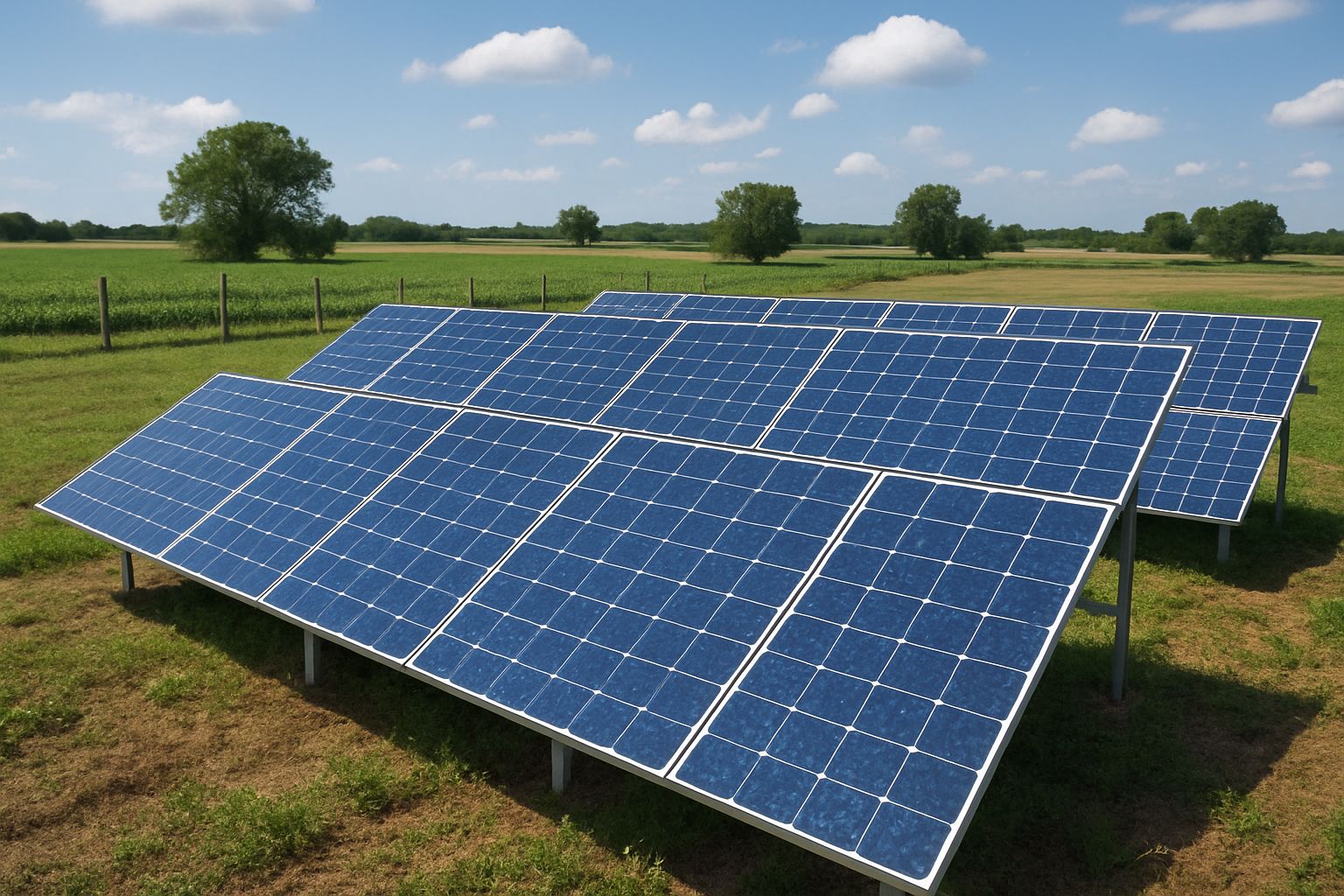
Article-at-a-Glance
- Polycrystalline panels cost 15-20% less than monocrystalline, saving farms $5,000-$10,000 on a typical 50kW system
- These panels actually perform better in sustained summer heat, with temperature coefficients of -0.40% to -0.45% per °C versus monocrystalline’s -0.35% to -0.40%
- Most farm installations pay for themselves in just 5-7 years, faster than grain storage or irrigation upgrades
- Polycrystalline systems carry 25-year warranties and often keep producing power for 30 years or more
- Later in this article, we’ll break down exactly which farm applications—from irrigation to cold storage—match best with polycrystalline technology
Polycrystalline solar panels deliver the best value-per-watt in farm solar today, combining lower upfront costs with heat tolerance that actually outperforms pricier alternatives.
If you’ve been comparing solar options for your farm, barn, or rural property, you’ve probably noticed the price gap between panel types can feel confusing. Polycrystalline panels solve that confusion by offering a proven middle ground—cheaper than monocrystalline, more efficient than thin-film, and tough enough to handle whatever weather your land throws at it. For farmers weighing these decisions, resources like Growing Solar Mist break down exactly how these systems perform under real agricultural conditions, not just lab tests.
Before diving into specific numbers, it helps to understand why polycrystalline panels have earned their reputation as the budget-smart choice for agricultural solar.
Why Polycrystalline Panels Make Sense for Farm Budgets
Money matters when you’re covering acres of farmland with solar panels instead of just a residential roof. Polycrystalline panels address that reality head-on by costing significantly less per watt while still delivering reliable power output year after year.
The savings aren’t theoretical—they show up directly in your installation quote and your long-term return on investment.
Price Per Watt Compared to Monocrystalline
Polycrystalline panels run $0.50 to $0.70 per watt for the panels alone, while monocrystalline panels cost $0.60 to $0.90 per watt. That difference might look small on paper, but it compounds fast once you’re talking about farm-scale installations covering tens of kilowatts.
Real Dollar Savings on 25kW, 50kW, and 100kW Systems
Scale changes everything with solar economics. On a 25kW system, choosing polycrystalline over monocrystalline saves $2,500 to $5,000 in panel costs alone. Bump that up to a 50kW system and you’re looking at $5,000 to $10,000 in savings. Go all the way to 100kW—common for larger operations—and the gap widens to $10,000 to $20,000.
Total Installed Cost Expectations for Farm-Scale Arrays
Full installation costs for polycrystalline systems typically land between $1.50 and $2.50 per watt once you factor in mounting, wiring, inverters, and labor. A 50kW system, for example, generally costs $75,000 to $125,000 fully installed before any incentives kick in. Those incentive programs can meaningfully reduce that number, which we’ll cover later in this article.
How Polycrystalline Cells Are Made and Why It Matters
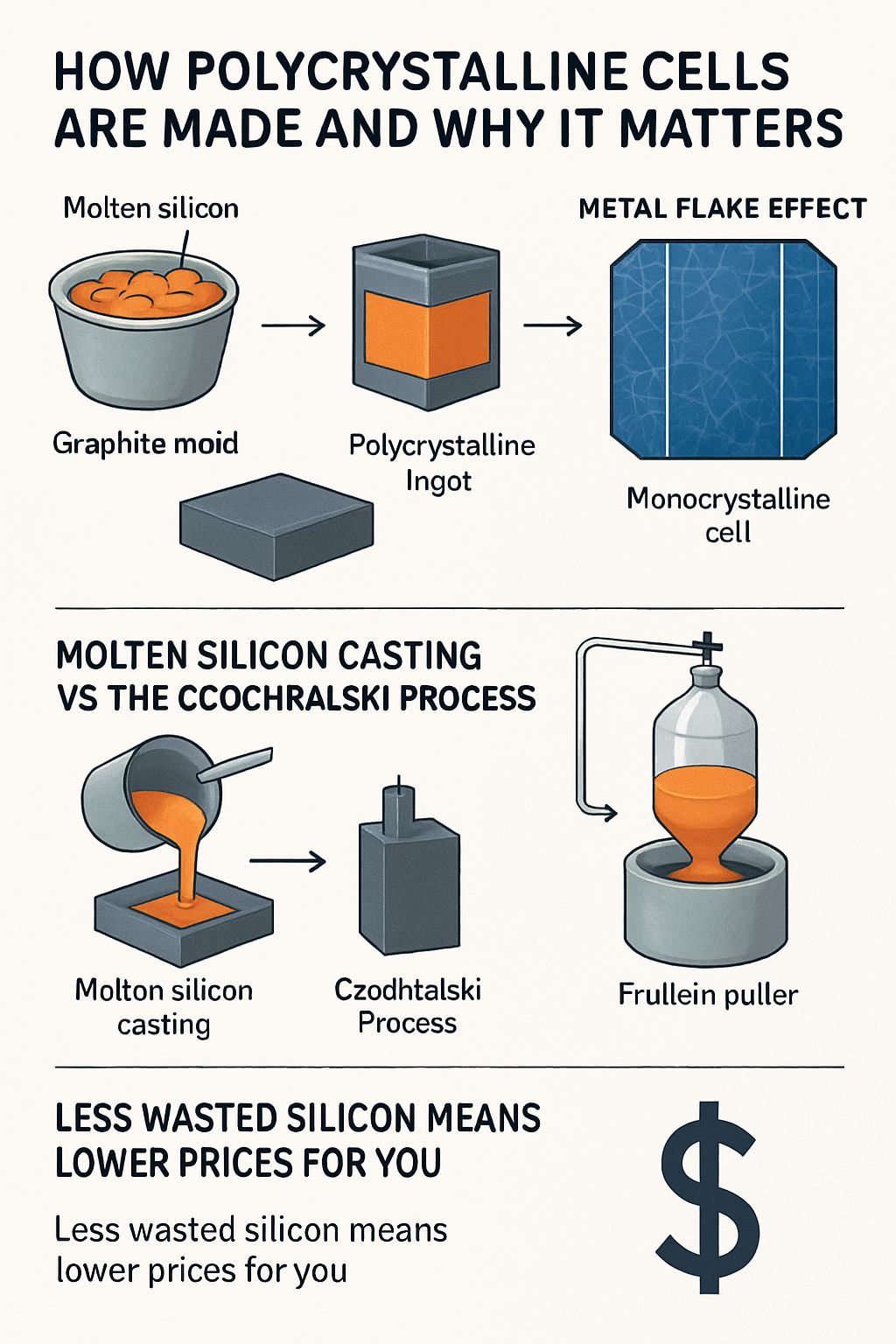
Understanding how these panels are built explains exactly why they cost less without sacrificing much performance. The manufacturing process itself is the secret behind the savings.
Polycrystalline cells start as silicon fragments melted together in a ceramic crucible, then formed inside a graphite mold to create an ingot. That ingot gets poured into a cast rather than pulled into a single crystal structure, which is the key difference from monocrystalline production.
This process leaves a visible signature on the finished product—a “metal flake effect” and mosaic-like surface pattern created by the different crystal formations within each cell.
Molten Silicon Casting vs the Czochralski Process
Monocrystalline panels use the Czochralski method, where a single silicon crystal is slowly pulled from molten silicon to create a uniform structure. Polycrystalline manufacturing skips that labor-intensive step entirely, instead casting molten silicon directly into square molds. This shortcut is exactly what keeps production costs—and your final price—lower.
Less Wasted Silicon Means Lower Prices for You
The casting method wastes less raw silicon compared to the Czochralski process used for monocrystalline cells. Less wasted material means manufacturers can produce panels more efficiently, and those savings get passed down the supply chain to farmers and installers. It’s a straightforward reason why polycrystalline panels have historically undercut monocrystalline pricing without disappearing from the market.
Efficiency Numbers You Need to Know
Efficiency ratings tell you how much sunlight a panel converts into usable electricity, and this is where polycrystalline panels make their biggest compromise—though not as big as some assume.
Typical Output Range of 13-17 Percent
Modern polycrystalline panels typically achieve 15-17% efficiency, with some models stretching the range to 13-17% depending on manufacturer and build quality. Mitsubishi Electric has even pushed practical-sized polycrystalline cells to 19.3% efficiency in controlled testing, proving the technology still has room to improve.
How Polycrystalline Stacks Up Against Monocrystalline Output
Monocrystalline panels typically reach 17-22% efficiency, putting polycrystalline panels at roughly 70-80% as efficient as their pricier counterpart. For farms with ample open land—which describes most agricultural properties—that efficiency gap matters far less than it would on a cramped residential roof. You simply add a few more panels to match the output, and you’re still coming out ahead financially given the per-watt savings.
Built to Last: Lifespan and Durability on the Farm
A solar investment only pays off if the panels stick around long enough to earn back their cost and then some. Polycrystalline panels were built with exactly that kind of staying power in mind.
These panels come engineered to withstand rain, snow, hail, and the kind of punishing wind that rural properties often face. The robust frame structure isn’t just for show—it’s what keeps your investment protected through decades of Midwest storms or coastal gusts.
25-Year Warranties and 30-Year Real-World Lifespans
Most polycrystalline panels carry 25-year performance warranties, meaning manufacturers guarantee a minimum output level for a quarter century. In practice, these panels often keep generating usable electricity for 25 to 30 years or more, stretching well beyond the warranty window.
What Happens to Your Savings After Payback
Here’s where the real financial magic happens. Once your system hits its payback period—typically 5 to 7 years for farm installations—everything after that is essentially free electricity. With a 25-30 year lifespan, that leaves 18 to 20 years of power production at effectively zero marginal cost. No fuel bills, no rising utility rates eating into your margins, just steady output month after month.
Heat Performance Where It Counts Most
Solar panels and heat don’t always mix well, but polycrystalline technology handles sustained high temperatures better than you might expect—and better than its more expensive monocrystalline cousin. For those interested in the environmental benefits for farmers, polycrystalline panels offer a sustainable solution that can thrive in hot conditions.
Temperature Coefficient Explained in Plain Terms
Every solar panel loses some efficiency as temperatures climb above standard testing conditions. This loss gets measured as a “temperature coefficient,” expressed as a percentage drop per degree Celsius. Polycrystalline panels carry a coefficient of -0.40% to -0.45% per °C, while monocrystalline panels sit at -0.35% to -0.40% per °C.
Why Polycrystalline Wins During Peak Summer Demand
At first glance, that number might look like a disadvantage for polycrystalline. But real-world farm conditions tell a different story. Polycrystalline panels actually hold up better in sustained high-heat environments—exactly the conditions you’ll find during peak summer months when irrigation pumps, cooling fans, and refrigeration units are working their hardest. That’s not a coincidence; it’s the exact window when your farm needs maximum solar output, and polycrystalline delivers when it matters most.
Best Farm Uses for Polycrystalline Panels
Not every energy need on a farm looks the same, and that’s exactly why polycrystalline panels fit so naturally into agricultural operations. Farms typically run several distinct power-hungry systems, each with its own usage pattern throughout the day and season.
What makes polycrystalline panels particularly well-suited here is the direct alignment between peak sun hours and peak farm energy demand. Unlike a household that might need power in the evening for lights and appliances, most farm operations draw their heaviest loads during daylight hours—precisely when solar panels produce the most electricity.
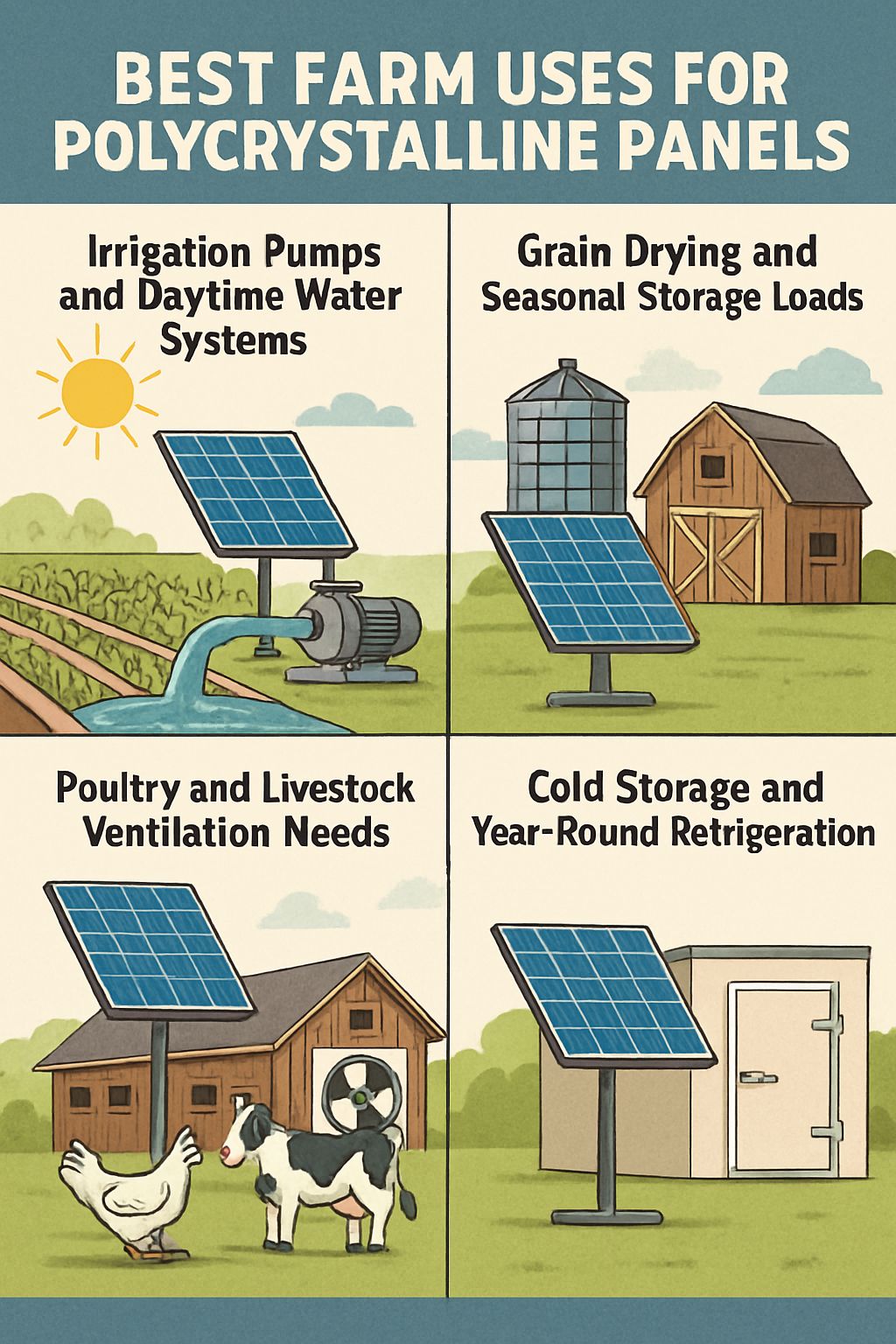
Four farm systems in particular line up almost perfectly with solar production curves. For more insights on how solar panels can enhance agricultural productivity, check out how solar panels boost crop growth.
Irrigation Pumps and Daytime Water Systems
Irrigation pumps are high-draw systems that operate almost exclusively during daytime hours, making them a textbook match for solar power. Since these pumps need their heaviest output exactly when the sun is strongest, polycrystalline panels can offset a massive chunk of irrigation electricity costs without any battery storage complexity.
Grain Drying and Seasonal Storage Loads
Grain drying and storage facilities have seasonal but intensive energy needs, typically ramping up during harvest season—which conveniently overlaps with peak summer solar production. This timing match means farmers get maximum solar output right when grain operations need it most.
Poultry and Livestock Ventilation Needs
Ventilation systems for poultry houses and livestock barns run continuously with fairly predictable load profiles. While these systems don’t shut off at night, the daytime solar production still offsets a significant portion of the continuous draw, reducing overall grid dependence.
Cold Storage and Year-Round Refrigeration
Cold storage and refrigeration units carry a steady, year-round base load that doesn’t fluctuate much with the seasons. This consistent demand justifies sizing a larger polycrystalline system, since the panels will have reliable work to do every single day of the year, not just during harvest or growing season.
How Fast Will Your System Pay for Itself
Every farmer asks the same question before committing to solar: when do I actually see a return? With polycrystalline panels, that answer tends to come faster than most other farm infrastructure investments.
Payback periods depend on system size, local electricity rates, and how much sun your region gets, but the numbers consistently favor polycrystalline for budget-conscious operations.
- Most farm installations using polycrystalline panels pay for themselves in 5 to 7 years
- Broader farm solar payback periods, including larger or smaller systems, range from 5 to 10 years
- After payback, panels typically keep producing for another 18 to 20 years at essentially no additional cost
That timeline puts solar squarely in competitive territory against other capital investments farmers regularly consider.
5-7 Year Payback Timelines for Farm Installations
A 5 to 7 year payback window means your solar investment starts generating pure profit well before many other farm upgrades even break even. This speed comes from the combination of lower polycrystalline panel costs and substantial electricity bill reductions once the system is operational.
Shorter payback periods also mean less financial risk. The faster you recoup your investment, the less exposure you have to changing electricity rates, equipment issues, or shifts in farm operations that could affect your original calculations.
Cutting Your Electric Bill by 70-90 Percent
Solar panel systems can reduce farm electricity bills by 70 to 90 percent, which is the real engine driving that fast payback timeline. For an operation spending thousands of dollars monthly on grid power—especially during irrigation or cooling season—that kind of reduction adds up to serious savings year after year. Discover more about using solar panels to power your farm and maximize your savings.
Consider a mid-sized operation with a $3,000 monthly electric bill tied to irrigation and refrigeration. Cutting that by even 70% saves $2,100 every month, or roughly $25,200 annually. Multiply that across a 25-30 year panel lifespan and the total savings dwarf the original installation cost many times over.
A farm spending $2,500/month on grid electricity before solar, after installing a properly-sized polycrystalline system, might see that bill drop to $375-$750/month—savings of $1,750 to $2,125 every single month, or $21,000 to $25,500 per year.
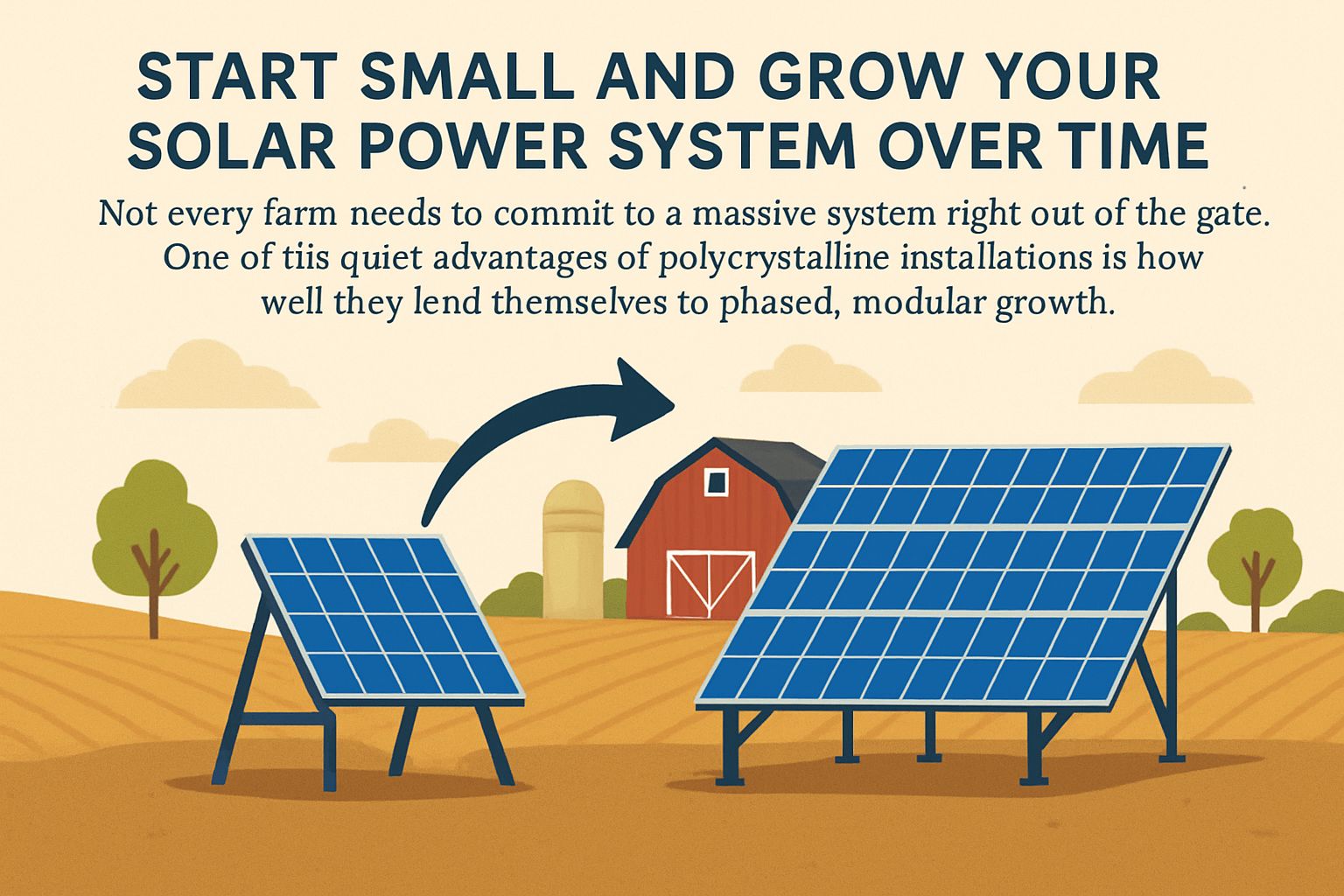
Start Small and Grow Your System Over Time
Not every farm needs to commit to a massive system right out of the gate. One of the quiet advantages of polycrystalline installations is how well they lend themselves to phased, modular growth.
Phasing From 25kW to 75kW as Cash Flow Allows
Farmers can start with a smaller system—say 25kW—to cover immediate needs like irrigation pumps, then add additional panels in later years as cash flow improves or energy demands grow. This modular approach spreads out the capital expense and lets the first phase’s savings help fund the next expansion. For more insights, explore how solar power benefits farmers environmentally.
Economies of Scale on Larger Installations
Bigger systems generally bring down the per-watt installation cost, since fixed expenses like permitting, design, and certain labor tasks get spread across more panels. A farm that eventually scales from 25kW to 75kW or beyond often finds the later additions cost less per watt than the original installation, making the long-term expansion financially attractive.
This scalability also means farmers aren’t locked into guessing their exact future energy needs upfront. Start with what makes sense today, then let the system grow alongside the operation.
Polycrystalline Panels vs Other Farm Investments
When farmers weigh where to put their capital, solar isn’t competing in a vacuum—it’s competing against grain bins, irrigation upgrades, and other infrastructure that all promise their own returns. Polycrystalline solar holds up remarkably well in that comparison.
- Polycrystalline solar systems: 5-7 year payback
- New grain storage bins: 10-15 year payback
- Irrigation system upgrades: 8-12 year payback
Side by side, solar isn’t just a nice environmental gesture—it’s often the fastest-returning capital investment available to a farm operation.
That speed matters because farm budgets are finite, and every dollar spent on one upgrade is a dollar not spent elsewhere. Solar’s quicker payback frees up capital sooner for the next investment, whether that’s new equipment, land, or further energy expansion.
Grain Storage Infrastructure Payback Comparison
New grain bins typically take 10 to 15 years to pay back their cost through improved storage efficiency and reduced spoilage. While still a worthwhile investment for many operations, that timeline is roughly double what polycrystalline solar requires to break even.
Irrigation Upgrades Payback Comparison
Irrigation infrastructure upgrades run 8 to 12 years before paying for themselves, another solid but slower-moving investment compared to solar. Interestingly, irrigation and solar pair naturally together—since irrigation pumps draw their heaviest power during the same daylight hours solar panels produce the most electricity.
|
Investment Type |
Typical Payback Period |
|---|---|
|
Polycrystalline Solar System |
5-7 years |
|
Irrigation System Upgrade |
8-12 years |
|
New Grain Storage Bins |
10-15 years |
Looking at this table, it’s easy to see why more farmers are putting solar at the top of their capital improvement list rather than treating it as an afterthought.
None of this means grain bins or irrigation upgrades aren’t worth pursuing—they absolutely are, depending on your operation’s specific bottlenecks. But when it comes to pure speed of return, polycrystalline solar consistently outpaces these traditional farm infrastructure investments.
Livestock Housing Payback Comparison
Livestock housing improvements, like upgraded barns or climate-controlled facilities, typically fall into a similarly extended payback window as grain storage, often taking well over a decade to fully recoup costs through improved animal health and productivity. Solar still edges ahead on raw payback speed, though the two investments often work well together since better livestock housing frequently increases electricity demand for ventilation and climate control—demand that polycrystalline panels can help offset.
Pairing these investments strategically, rather than choosing one over the other, often makes the most financial sense. A farm upgrading livestock housing might find that adding solar at the same time helps manage the increased energy load from day one, rather than waiting years to address rising utility costs separately.
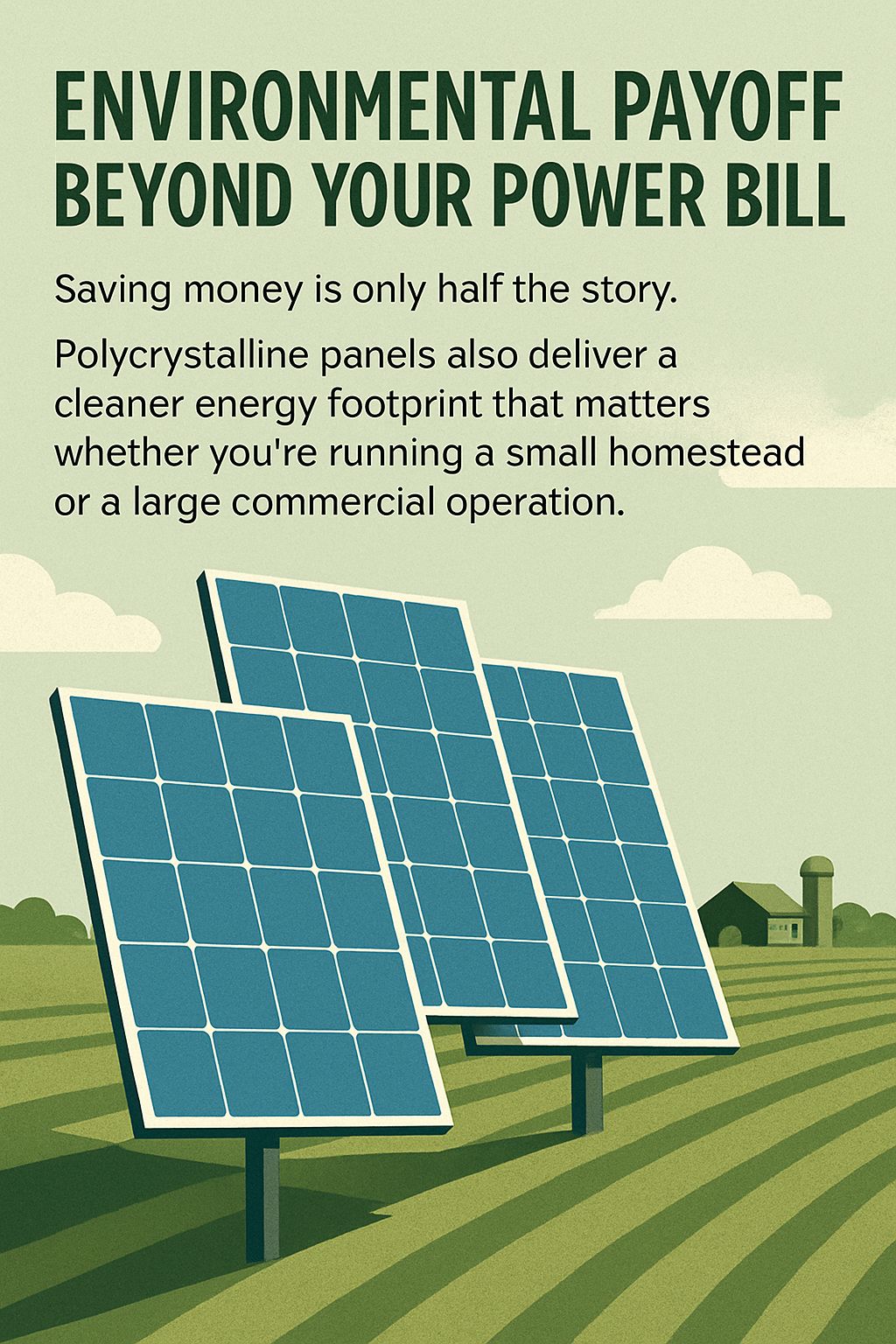
Environmental Payoff Beyond Your Power Bill
Saving money is only half the story. Polycrystalline panels also deliver a cleaner energy footprint that matters whether you’re running a small homestead or a large commercial operation. Learn more about solar power’s environmental benefits for farmers.
Electricity generated from polycrystalline panels comes without greenhouse gas emissions or other harmful pollutants during operation. Every kilowatt-hour your farm pulls from the sun is a kilowatt-hour that didn’t require burning fossil fuels, which adds up to a meaningful reduction in your operation’s overall environmental footprint over a 25-30 year system lifespan.
Zero-Emission Electricity from Your Roof or Field
Once installed, polycrystalline panels produce power with zero direct emissions. There’s no exhaust, no combustion, and no ongoing fuel consumption—just sunlight converted directly into usable electricity for your farm’s irrigation, cooling, or storage needs.
Lead-Free Manufacturing Innovations
Some manufacturers have moved away from traditional soldering methods that contain lead, developing newer techniques that eliminate this material from the production process entirely. This shift makes polycrystalline panels not just cleaner in operation, but also cleaner in how they’re built, reducing the environmental impact across the panel’s full lifecycle rather than just during its working years.
Where Polycrystalline Panels Fall Short
No technology is perfect, and polycrystalline panels do come with trade-offs worth understanding before you commit to a system. Knowing these limitations upfront helps you make a clear-eyed decision rather than discovering surprises after installation.
The good news is that most of these drawbacks matter far less on farm properties than they would in tighter residential settings, which is exactly why polycrystalline remains such a popular choice for agricultural solar.
Lower Efficiency Than Monocrystalline Options
Polycrystalline panels top out around 15-17% efficiency, compared to 17-22% for monocrystalline panels. This means you’ll need somewhat more roof or ground space to generate the same amount of power. For most farms with open acreage, this isn’t a dealbreaker—it’s simply a matter of adding a few extra panels to an already spacious array.
Fragility Risks from Debris and Heavy Wind
While polycrystalline panels are built with sturdy frames designed for rain, snow, and hail, a few practical risks still deserve attention on working farms:
- Flying debris during severe storms or high wind events can occasionally crack panel surfaces, especially in open fields without windbreaks
- Equipment like tractors, combines, or loaders operating near ground-mounted arrays can pose accidental impact risks if clearance isn’t planned carefully
- Hail larger than panels are rated to withstand can cause damage, though this remains relatively rare with properly certified equipment
Most of these risks get minimized through smart site planning—positioning arrays away from heavy equipment traffic paths and choosing panels with hail-impact certifications suited to your regional weather patterns.
Routine inspections after major storms also catch small issues before they become bigger problems, keeping your system running at full capacity throughout its decades-long lifespan.
Overall, these fragility concerns are manageable with basic precautions, and they rarely outweigh the cost benefits polycrystalline panels bring to a farm-scale installation.
Extra Space Requirements for Equal Power Output
Because polycrystalline panels run slightly less efficient per square foot than monocrystalline alternatives, matching the same total power output requires more physical space. For a 50kW system, this might mean installing around 167 polycrystalline panels rated at 300W each, compared to roughly 143 monocrystalline panels rated at 350W each. On farmland where space is rarely the limiting factor, this difference translates to a minor layout adjustment rather than a genuine obstacle. To explore more about the benefits of using solar panels on farms, consider reading about solar panels boosting crop growth.
Polycrystalline Panels Remain the Smart Choice for Budget-Conscious Farms
When you weigh lower upfront costs, strong heat performance, and payback periods faster than most other farm infrastructure investments, polycrystalline panels consistently come out as the practical choice for agricultural solar—especially on properties where space is abundant and budget efficiency matters more than squeezing out every last percentage point of panel efficiency.
Frequently Asked Questions
Solar questions tend to follow familiar patterns once farmers start seriously evaluating their options. Here are the ones that come up most often, including inquiries about financial benefits for farmers.
These answers should help clarify any remaining uncertainty before you move forward with a quote or installation plan.
Are polycrystalline panels worth it for a small homestead?
Yes, polycrystalline panels work well for small homesteads, particularly if you have adequate roof or ground space to offset their slightly lower efficiency compared to monocrystalline options. The lower per-watt cost often makes polycrystalline the more budget-friendly choice for smaller operations looking to maximize savings without sacrificing long-term reliability.
How much roof or land space do I need per kilowatt?
Space requirements vary by panel wattage, but as a general guide, a 50kW system using 300W polycrystalline panels requires roughly 167 panels. Each standard panel typically covers around 17-20 square feet, so you’ll want to plan for adequate clearance, spacing between rows, and room for maintenance access alongside the panels themselves.
Will polycrystalline panels still work on cloudy or cold days?
Polycrystalline panels continue generating electricity on cloudy days, though output drops compared to full sun conditions. Interestingly, cold weather doesn’t hurt performance the way extreme heat can—panels often perform slightly better in cooler temperatures since their temperature coefficient means efficiency actually improves as temperatures drop below standard test conditions.
Can I mix polycrystalline panels with monocrystalline panels in one system?
Technically it’s possible to mix panel types, but most installers recommend against it for a single array since differing efficiencies and electrical characteristics can complicate system design and reduce overall performance. If you want both panel types, it’s generally better to wire them as separate arrays with their own dedicated inverters rather than combining them in one string.
What size system do I need to power an average farm?
Farm installations typically start at 25kW and scale up to 100kW or more, depending on the specific operation’s energy demands. A mid-sized agricultural operation can consume 3 to 5 times more electricity than a typical household, so sizing usually comes down to evaluating your irrigation, refrigeration, ventilation, and storage needs together rather than relying on a single standard figure. To learn more about the financial benefits for farmers, consider exploring how solar panels can maximize savings and profit.
Working with an experienced solar installer to review your farm’s actual utility bills and peak usage patterns remains the most reliable way to land on the right system size for your specific operation.
If you’re ready to explore what a properly sized polycrystalline system could save your farm, Growing Solar Mist specializes in helping agricultural operations find the right fit for their budget and energy needs.


Leave a Reply