
Key Takeaways
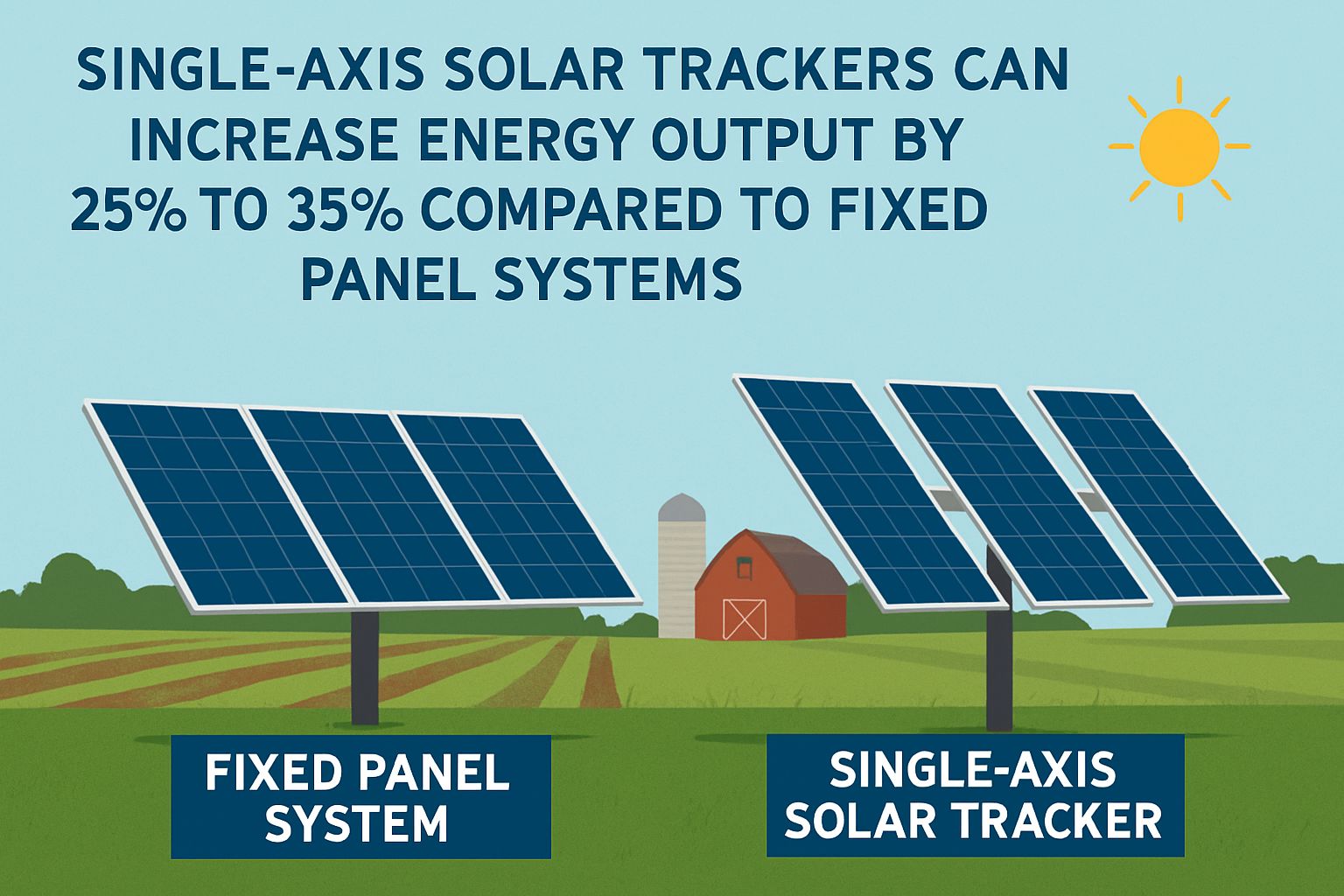
- Single axis solar trackers can increase energy output by 25% to 35% compared to fixed panel systems, making them one of the highest-impact upgrades for farm solar installations.
- Unlike dual axis systems, single axis trackers use a simpler mechanical design that follows the sun from east to west — keeping costs lower while still delivering serious performance gains.
- The best results come from flat, open land in warm and dry climates — conditions that describe a huge portion of productive agricultural land across the U.S.
- There are real tradeoffs to consider before installing, including higher upfront costs and wind exposure challenges that fixed panels simply don’t face.
- Agrivoltaic farming — combining solar energy production with active crop or livestock operations — is one of the fastest-growing use cases for single axis tracking systems on working farms.
Single Axis Solar Trackers Boost Farm Energy Output by Up to 35%
If you’re running solar panels on agricultural land and they’re fixed in place, you’re leaving a significant amount of energy — and money — on the table every single day.
Fixed panels are aimed at a static angle that’s optimized for average sun position throughout the year. That means they perform reasonably well at solar noon, but underperform badly in the morning and evening hours when the sun sits low at an angle that fixed panels simply can’t capture effectively. A single axis solar tracker solves this problem by rotating panels along a single axis — typically following the sun’s east-to-west arc across the sky throughout the day. The result is a system that stays aligned with peak sunlight for far more hours than any fixed installation can achieve.
For farmers, this isn’t just a technical improvement. It’s a direct boost to the return on investment of your entire solar installation. Agrivoltaic and farm-scale solar specialists have consistently shown that tracking systems can change the financial equation of a solar project significantly, especially on larger land areas where the cost-per-watt advantage of trackers scales up quickly.
What Is a Single Axis Solar Tracker?
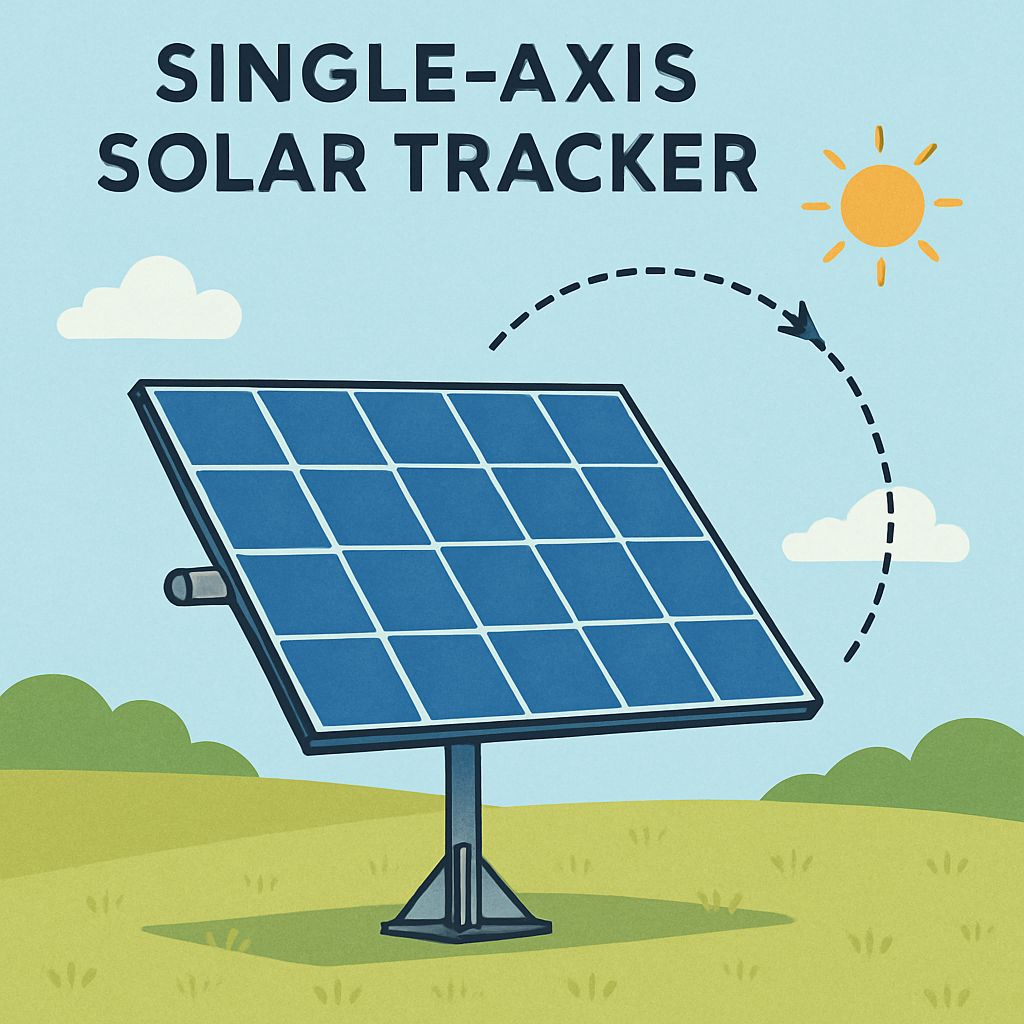
A single axis solar tracker is a mounting system that rotates solar panels along one fixed axis to follow the sun’s movement. Most systems rotate on a horizontal north-south axis, allowing panels to tilt and sweep from east to west as the sun travels across the sky each day. The movement is typically driven by a motorized actuator controlled by sensors or pre-programmed algorithms that calculate the sun’s position based on time and location.
How a Single Axis Tracker Moves
Think of it like a seesaw that slowly tilts throughout the day. In the morning, the panels face east to catch the rising sun. By midday, they level out to face directly upward. By late afternoon, they’ve tilted westward to capture the setting sun. This continuous adjustment keeps the panel surface as close to perpendicular to incoming sunlight as possible — which is exactly where solar panels produce maximum output.
The rotation angle and speed are managed automatically. Most modern single axis trackers use a combination of GPS-based sun-position algorithms and light sensors to fine-tune movement, even accounting for cloud cover and seasonal changes in the sun’s path.
Single Axis vs. Dual Axis Solar Trackers
A dual axis tracker adds a second axis of rotation, allowing panels to adjust both east-west and north-south. This means the system can also compensate for the sun’s changing elevation across seasons — not just its daily arc. Dual axis systems can push energy gains up to 30% or more beyond fixed panels, compared to the 25% to 35% range typical of single axis systems. However, dual axis trackers are mechanically more complex, cost significantly more to install, and require more maintenance. For most farm-scale operations, single axis trackers hit the sweet spot between performance and practical cost.
Fixed Panels vs. Tracking Systems on Farm Land
Fixed panels on agricultural land are common because they’re simple and inexpensive to install. But fixed systems are permanently aimed at a compromise angle — usually the average solar elevation for that latitude — which means they’re never perfectly aligned with the sun except for a brief window around midday. On a working farm where energy costs can be substantial and land area is available, the output gap between fixed and tracked systems becomes very meaningful at scale.
The Core Benefits of Single Axis Solar Trackers for Farmers
The case for single axis trackers on farm land comes down to three interconnected advantages that compound on each other: more energy from the same hardware, smarter use of available land, and a better financial return compared to dual axis alternatives.
25% to 35% More Energy From the Same Number of Panels
This is the headline benefit and it’s well-supported. A solar panel system equipped with a single axis tracker consistently produces 25% to 35% more electricity than an identical fixed system in the same location. That gain comes entirely from better sun alignment throughout the day — the panels themselves are identical. You’re not buying more hardware to generate more power; you’re simply using the hardware you already have far more effectively. For more information on optimizing solar panel use, explore the benefits of HJT solar panels for farming operations.
For a farm running a 100kW solar installation, a 30% output increase means the equivalent of an extra 30kW of generating capacity — without purchasing a single additional panel. At scale, this kind of output improvement can meaningfully offset farm energy costs, reduce grid dependence, or increase revenue from net metering arrangements with local utilities.
Better Land-Use Efficiency for Agricultural Properties
One of the most overlooked benefits of single axis trackers on agricultural land is how they change the land-use equation. Because each tracked panel produces significantly more energy, you need fewer panels to hit a target energy output — which means less land consumed by the solar installation itself. This is especially valuable on working farms where every acre has productive agricultural value. Tracking systems allow farmers to meet their energy goals while preserving more land for crops or livestock, a balance that fixed systems struggle to achieve at the same scale. For more on solar panel options, explore PERC solar panels for agriculture.
Lower Cost Than Dual Axis Systems With Strong Returns
Dual axis trackers offer marginally higher energy output, but the cost and complexity jump is substantial. Single axis trackers deliver most of the performance benefit at a fraction of the added complexity. The mechanical design is simpler, installation is more straightforward, and long-term maintenance demands are considerably lower. For farmers considering solar options, comparing monocrystalline and bifacial solar panels can also provide insights into maximizing efficiency and cost-effectiveness.
- Single axis trackers have lower installation costs than dual axis systems
- Simpler mechanical design means fewer components that can fail
- Longer operational lifespan due to reduced mechanical stress
- Maintenance schedules are more predictable and less frequent
- Strong ROI on flat, open agricultural land where installation is most efficient
The financial payback on a single axis tracker installation is driven by the energy gain relative to the added system cost. On flat agricultural land — where installation is simplest and wind exposure is manageable — that payback timeline is significantly shorter than many farmers expect.
It’s also worth noting that the recurring maintenance costs for single axis systems, while real, are generally predictable and modest compared to the ongoing energy value the tracking system generates. A well-maintained single axis tracker on a suitable site will reliably outperform a fixed system for the entire operational life of the solar installation — typically measured in decades.
How Single Axis Trackers Improve Solar Panel Performance
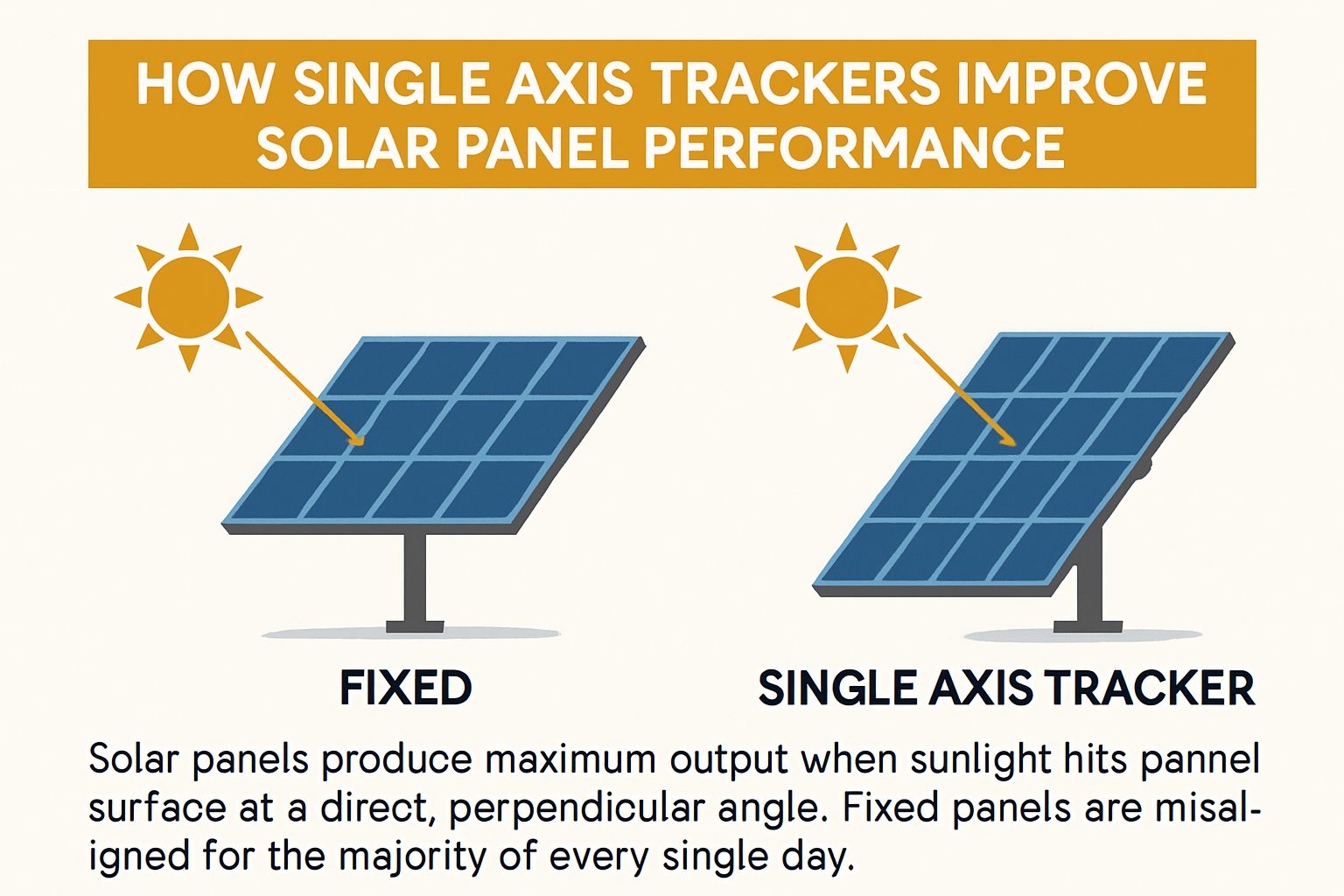
The performance gap between tracked and fixed solar panels isn’t a minor technical detail — it’s a fundamental difference in how much of the available sunlight your system actually captures. Solar panels produce maximum output when sunlight hits the panel surface at a direct, perpendicular angle. Every degree of misalignment between the panel and the sun reduces output. Fixed panels are misaligned for the majority of every single day.
Single axis trackers continuously correct that misalignment. By rotating panels to follow the sun’s arc, a tracking system keeps panels closer to perpendicular alignment with incoming sunlight from sunrise to sunset. The cumulative effect of that continuous correction, compounded across every day of the year, is what produces the 25% to 35% output advantage that tracking systems consistently deliver.
Why Fixed Panels Lose Output in the Morning and Evening
Fixed panels are angled to capture peak solar energy around midday when the sun is highest in the sky. But the sun spends the majority of its daily arc at lower angles — rising slowly in the morning and descending through the afternoon. During these hours, fixed panels are catching sunlight at a shallow, oblique angle that dramatically reduces the energy hitting the panel surface. On a typical day, a fixed panel may only be operating at close to peak efficiency for a few hours around solar noon. The rest of the day, output drops off significantly on both sides of that window. To understand how solar tracking systems can improve energy output, you can explore this detailed guide on solar trackers.
How Tracking Extends Peak Production Hours
A single axis tracker extends the period of near-peak production by keeping panels aligned with the sun throughout its full daily arc. Instead of a sharp efficiency curve that peaks briefly at noon and drops steeply on either side, a tracked system produces a much broader, flatter energy curve — generating strong output from early morning through late afternoon. This extended high-output window is what translates directly into the 25% to 35% annual energy gain. On long summer days especially, the additional hours of strong production add up to a substantial difference in total daily energy generation.
Where Single Axis Solar Trackers Work Best
Single axis trackers perform best in specific site conditions. Getting those conditions right is what separates an installation that delivers its full financial potential from one that underperforms or creates ongoing maintenance headaches. Three site factors matter most: terrain, climate, and the scale of the operation.
Flat Open Land Makes Installation Simpler and Cheaper
Single axis trackers are ground-mounted systems that require stable, level terrain to function correctly. Flat land simplifies the foundation work, reduces installation labor costs, and ensures that the tracking mechanism operates smoothly without the complications that uneven terrain introduces. Agricultural land — particularly cropland in major farming regions — is often ideally suited to tracker installation for exactly this reason. The same flat, open fields that make farming practical also make single axis tracker installation straightforward and cost-efficient.
Warm and Dry Climates Reduce Maintenance Demands
Climate plays a significant role in how well single axis trackers perform over time. Warm, dry regions offer more total sunshine hours per year, which directly increases the energy output advantage of tracking over fixed systems. More sunshine hours means more hours during which the tracker’s alignment advantage is actively generating additional power. For more on how solar technology benefits agriculture, explore the advantages of HJT solar panels.
Dry conditions also reduce the mechanical wear and corrosion risks that come with high humidity and frequent precipitation. The moving parts in a single axis tracker — primarily the motorized drive system and pivot components — last longer and require less frequent servicing in dry climates than in wet ones. This keeps the total cost of ownership lower over the system’s lifespan.
That said, trackers are designed to operate across a wide range of climates. Modern systems include weatherproofing, corrosion-resistant materials, and wind-response features that allow them to function reliably in conditions far outside the ideal. The climate advantage for warm, dry regions is real but shouldn’t discourage farmers in other regions from evaluating trackers — the energy gain is still meaningful in most U.S. agricultural climates.
- High sunshine hours: Maximizes the daily output advantage of tracking over fixed panels
- Low humidity: Reduces corrosion risk on mechanical components
- Minimal extreme weather: Reduces the frequency of wind-response shutdowns
- Stable temperatures: Reduces thermal expansion stress on tracking hardware
- Low precipitation: Keeps panel surfaces cleaner with less frequent washing required
Large-Scale Farm Operations Benefit Most From Tracking Systems
The financial case for single axis trackers gets stronger as the scale of the installation increases. The added cost of tracking hardware represents a smaller percentage of total project cost at larger scales, while the energy gain — which scales directly with system size — becomes increasingly significant. A large farm running a multi-hundred kilowatt solar installation will see a far more compelling ROI on tracker hardware than a small residential-scale system would.
Large operations also tend to have higher energy costs to offset, stronger financing access for the higher upfront investment, and more available flat land suited to tracker installation. Utility-scale solar farms have used single axis trackers as standard equipment for years precisely because the economics at scale are so compelling. Farm-scale installations in the 50kW to 500kW range are increasingly hitting the same economic sweet spot. For a deeper understanding of the different types of solar panels used in agriculture, explore this comparison of solar panels.
Honest Drawbacks Farmers Should Know Before Installing
Single axis trackers are not the right solution for every farm and every site. The benefits are real and well-documented, but so are the tradeoffs. Understanding the limitations before committing to an installation is what separates a well-planned solar investment from a costly mistake.
- Higher upfront cost compared to fixed panel systems of equal capacity
- Moving parts introduce mechanical failure risk that fixed systems don’t have
- Wind exposure can create stability challenges on open agricultural land
- Requires flat terrain — hilly or uneven land significantly complicates installation
- More complex installation requires experienced contractors familiar with tracker systems
- Not ideal for small systems where the added hardware cost doesn’t justify the energy gain
None of these drawbacks are dealbreakers for a well-suited site. But they do define the conditions under which single axis trackers make the most financial sense — and the conditions under which a fixed system might actually be the smarter choice.
The wind stability issue deserves particular attention on open agricultural land. Large flat fields often have significant wind exposure, and solar trackers are designed with wind-response protocols that automatically lay the panels flat when wind speeds exceed safe operating thresholds. While this protects the hardware, it also means the system stops tracking — and stops generating at peak output — during high-wind events. In consistently windy locations, the cumulative effect of these shutdowns can meaningfully reduce the tracker’s annual output advantage.
Mechanical maintenance is the other factor farmers need to plan for honestly. Fixed panels have virtually no moving parts and require minimal servicing beyond occasional cleaning. Single axis trackers require periodic inspection of drive motors, pivot joints, sensors, and control systems. This isn’t a deal-breaking burden for most operations, but it does represent a real ongoing cost and operational responsibility that fixed systems simply don’t carry.
Higher Upfront Cost Than Fixed Panel Systems
The added hardware and installation cost of a single axis tracker system over a comparable fixed installation is the primary financial hurdle. That additional investment needs to be recovered through the energy output gain over time. On a suitable site — flat land, good sun hours, large system scale — the payback period for the tracker premium is typically manageable and the long-term ROI is strong. On a site that doesn’t fit those conditions well, the math gets harder and the case for tracking weakens considerably.
Moving Parts Require Periodic Maintenance
Single axis trackers contain motorized drive systems, pivot joints, sensors, and electronic control components — none of which exist in a fixed panel installation. Each of these components requires periodic inspection and occasional servicing to keep the system operating correctly. For most farm operations, this means scheduling annual or semi-annual maintenance checks with a qualified solar technician. The cost is real but predictable, and it’s easily factored into the long-term financial model of the installation. A well-maintained tracker system will reliably outperform a fixed installation for its entire operational life.
Wind Exposure Can Create Stability Challenges
Open agricultural land is often the most wind-exposed terrain a solar installation can sit on. Single axis trackers are engineered with wind-response protocols that detect high wind speeds and automatically rotate panels to a flat, low-resistance position to protect the hardware. This stow position minimizes the structural load on the tracker during storm events and prevents mechanical damage. The protection works well, but it comes with a production cost — while panels are stowed flat, the tracking advantage is gone and output drops to fixed-panel levels or below.
In locations with frequent high-wind events, the cumulative hours spent in stow position can noticeably reduce the annual energy advantage of tracking over fixed systems. Farmers in consistently windy regions should factor this into their site assessment before committing to tracker hardware. A detailed local wind analysis — not just average wind speed, but frequency and duration of gusts above tracker operating thresholds — is a worthwhile step in the pre-installation planning process. For more insights, explore solar trackers and their benefits.
Single Axis Solar Trackers Are the Smart Choice for Most Farms
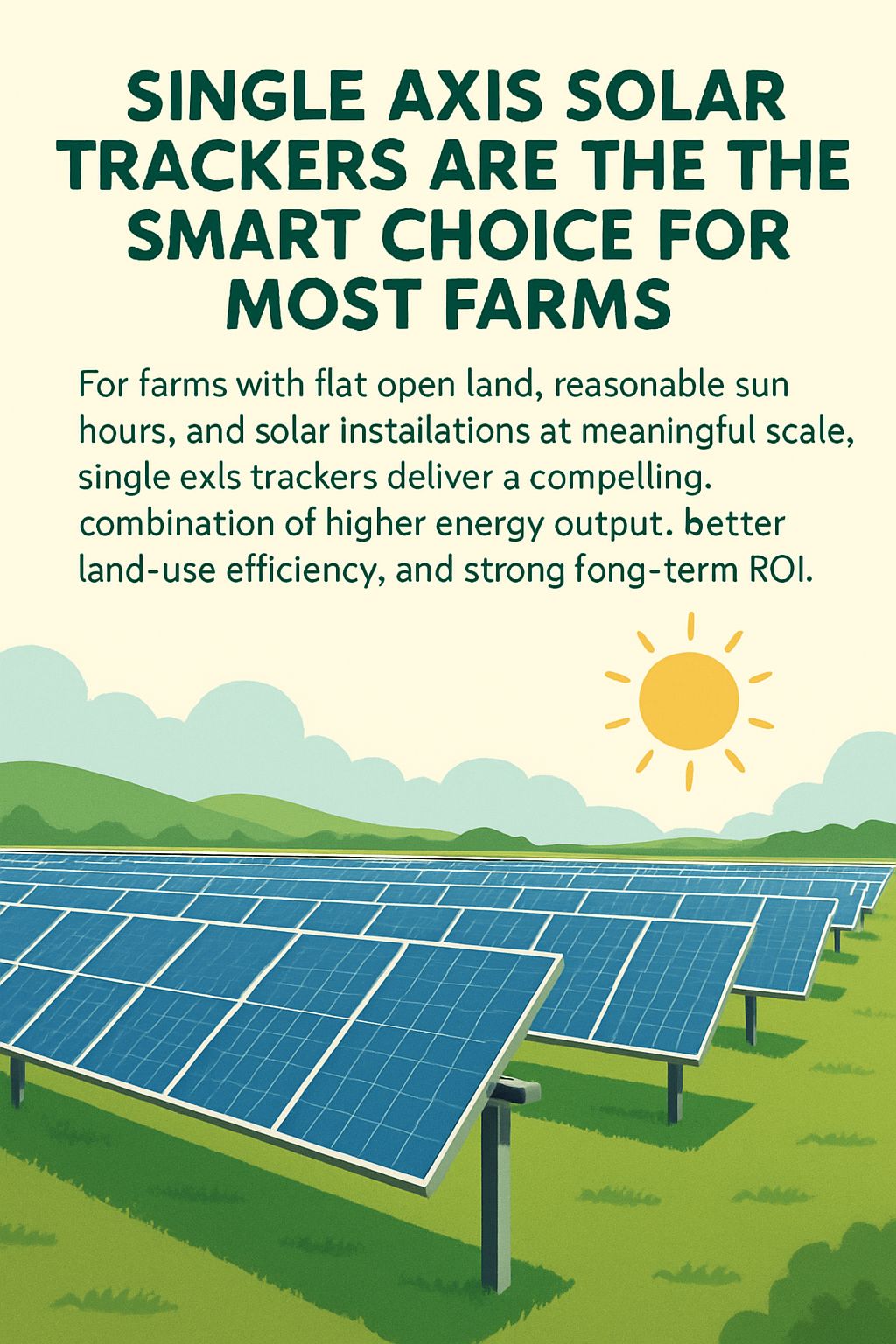
For farms with flat open land, reasonable sun hours, and solar installations at meaningful scale, single axis trackers deliver a compelling combination of higher energy output, better land-use efficiency, and strong long-term ROI. The 25% to 35% energy gain over fixed panels isn’t a theoretical number — it’s a consistent, well-documented result that translates directly into real financial value over the life of the installation. The tradeoffs are real but manageable on the right site, and for most large-scale agricultural solar operations, the case for tracking over fixed is clear.
Frequently Asked Questions
The most common questions farmers ask about single axis solar trackers come down to three things: how much extra energy they actually produce, whether the added cost makes sense, and what it takes to keep them running over time.
How Much More Energy Does a Single Axis Solar Tracker Produce Compared to Fixed Panels?
A single axis solar tracker produces 25% to 35% more energy than a fixed panel system of identical size and hardware in the same location. This gain comes from continuous east-to-west panel rotation that keeps solar panels closer to perpendicular alignment with the sun throughout the full daily arc — not just at solar noon when fixed panels are at their best. For farmers considering different types of solar panels, understanding the best use in agriculture can help optimize energy production.
The exact gain varies based on location, seasonal sun angles, and system configuration. Sites with higher annual sunshine hours and more pronounced seasonal variation in sun position tend to see gains at the higher end of this range. Locations with significant cloud cover or frequent wind-stow events may see gains closer to the lower end. Either way, the output advantage of a properly installed single axis tracker over a fixed system is consistent and meaningful across virtually all agricultural locations in the continental United States.
Are Single Axis Solar Trackers Worth the Extra Cost for Small Farms?
For smaller farm installations — typically below 50kW — the financial case for single axis trackers becomes harder to make. The added hardware cost of tracking represents a larger percentage of total project cost at small scale, while the absolute energy gain in kilowatt-hours is proportionally smaller. The payback period on the tracker premium stretches out, and in some small-scale scenarios, a fixed system with additional panels may deliver better economics than a tracked system with fewer panels.
That said, small farms with unusually high electricity costs, strong net metering rates, or plans to scale up their solar installation over time may still find trackers worthwhile even at smaller initial system sizes. The decision depends heavily on local electricity pricing, available incentives, site characteristics, and long-term energy goals. A detailed financial model comparing tracked versus fixed options at the specific system size and site conditions is the right way to make this call — not a general rule of thumb.
How Often Do Single Axis Solar Trackers Need Maintenance?
Most single axis tracker manufacturers and installation contractors recommend a full maintenance inspection once or twice per year. A standard service visit covers lubrication of pivot joints and drive components, inspection of motor and actuator function, verification of sensor calibration, review of control system performance logs, and visual inspection of structural mounting hardware for signs of wear or corrosion.
Between scheduled service visits, the tracker’s onboard control system continuously monitors performance and flags anomalies. Most modern systems can transmit performance data remotely, allowing service providers to identify issues before they become failures. Unscheduled maintenance events — outside the normal annual or semi-annual schedule — are relatively uncommon on well-installed systems operating within their design parameters.
Maintenance Task
Frequency
Typical Cost Range
Full system inspection
Annually or semi-annually
Varies by system size
Drive motor lubrication
Annually
Included in service visit
Sensor calibration check
Annually
Included in service visit
Structural hardware inspection
Annually
Included in service visit
Control system firmware update
As released by manufacturer
Often remote/no additional cost
Panel surface cleaning
As needed based on dust/debris
Varies by location and access
Can Single Axis Solar Trackers Be Used With Agrivoltaic Farming Systems?
Yes — and this is one of the most exciting and fast-growing applications for single axis trackers on working farms. Agrivoltaic systems combine active solar energy production with ongoing agricultural use of the same land, either growing crops beneath or between solar panels or grazing livestock in the shaded areas the panels create. Single axis trackers are well-suited to agrivoltaic configurations because their ground-level footprint can be designed with row spacing and panel height that accommodates farming equipment and crop management beneath the array.
The dynamic shading created by a tracking system — where panel position and shadow patterns shift throughout the day — can actually benefit certain crops by reducing peak heat stress during the hottest midday hours while still allowing adequate light for photosynthesis. Research into agrivoltaic systems is still developing, but early results from installations across the U.S. and Europe show that carefully designed agrivoltaic arrays with single axis trackers can support productive agricultural operations while generating substantial solar energy from the same land area simultaneously.
What Is the Lifespan of a Single Axis Solar Tracker on a Farm?
A well-maintained single axis solar tracker is designed to operate for 20 to 30 years, which aligns with the typical operational lifespan of the solar panels themselves. The structural components — steel frames, mounting posts, and foundation hardware — are built to last the full system lifetime under normal agricultural site conditions. The mechanical drive components, including motors and actuators, may require replacement once during that lifespan depending on operating conditions and maintenance quality.
The control electronics and sensors have a somewhat shorter expected service life and may need upgrading or replacement over a 20 to 30 year operational period as technology evolves and original components become obsolete. Planning for these mid-life component replacements in the long-term financial model of the installation gives a more accurate picture of total lifecycle cost.
Climate and site conditions play a significant role in actual lifespan outcomes. Trackers operating in dry, moderate climates with predictable wind patterns and consistent maintenance schedules consistently reach or exceed their designed service life. Systems in harsh conditions — high humidity, frequent extreme wind events, or corrosive environments — may require more frequent component replacement and more intensive ongoing maintenance to reach full design lifespan. For a comparison of solar panel types that can withstand various environmental conditions, check out this comparison of thin-film and polycrystalline solar panels.
For farmers evaluating the long-term investment case, the key question isn’t just how long the tracker lasts — it’s how much additional energy it generates over that lifetime compared to a fixed system. Even at the conservative end of the performance range, a single axis tracker operating for 25 years on a well-suited agricultural site will generate a substantial cumulative energy advantage that far exceeds the added hardware and maintenance cost of the tracking system. That long-term value is ultimately what makes single axis trackers such a compelling choice for serious farm-scale solar operations. To explore tracking solutions designed specifically for agricultural and farm-scale solar projects, visit our team of solar specialists who can help you evaluate whether a single axis tracker is the right fit for your operation.
Single-axis solar trackers are becoming increasingly popular among farmers who are looking to optimize the efficiency of their solar panels. These systems allow the panels to follow the sun’s path throughout the day, maximizing energy absorption and increasing overall power output. For those interested in learning more about how solar tracking systems can enhance solar energy output, this article on solar tracking systems offers detailed insights.


Leave a Reply