
Article-At-A-Glance: Solar Micro-Sprinkler Irrigation
- Solar micro-sprinkler irrigation systems can reduce water consumption by up to 50% and cut energy costs by up to 70% compared to conventional grid-powered irrigation methods.
- Government incentives, including federal tax credits, can offset up to 30% of installation costs, making the switch to solar irrigation more financially accessible for farmers of all scales.
- Micro-sprinklers operate at lower pressures than traditional sprinklers, delivering water precisely where crops need it — reducing runoff, evaporation, and fertilizer waste simultaneously.
- Solar panels used in these systems carry 25–30 year manufacturer warranties, giving farmers decades of reliable, low-maintenance performance with minimal ongoing costs.
- Keep reading to discover which crops benefit most from solar micro-sprinklers, and whether this system is the right investment for your specific farm operation.
Switching to solar micro-sprinkler irrigation is one of the smartest moves a farmer can make for both long-term profitability and sustainable land management. GrowingSolarMist provides in-depth guidance on implementing these systems across a variety of farm types and crop operations, making it a go-to resource for farmers ready to modernize their approach to water management.
How Does a Micro-Sprinkler Irrigation System Work
Quick System Overview: A micro-sprinkler irrigation system draws water from a source — well, reservoir, or municipal supply — passes it through a filtration system, regulates it to low operating pressure, and delivers it through small rotating or fixed sprinkler heads positioned close to plant root zones. The result is precise, low-volume water delivery that minimizes evaporation and maximizes crop uptake.
Micro-sprinkler systems are built around a straightforward principle: deliver the right amount of water, to the right place, at the right time. Unlike flood or furrow irrigation that saturates entire fields, micro-sprinklers target specific zones — individual plants, rows, or orchard trees — ensuring every drop serves a purpose.
The system’s efficiency comes from its design. Water travels from the source through mainlines and submains, passes through filters that prevent clogging, gets pressure-regulated, and finally reaches micro-sprinkler heads that distribute water in controlled patterns. The entire process wastes remarkably little water compared to traditional methods.
Water Delivery from Source to Sprinkler Head
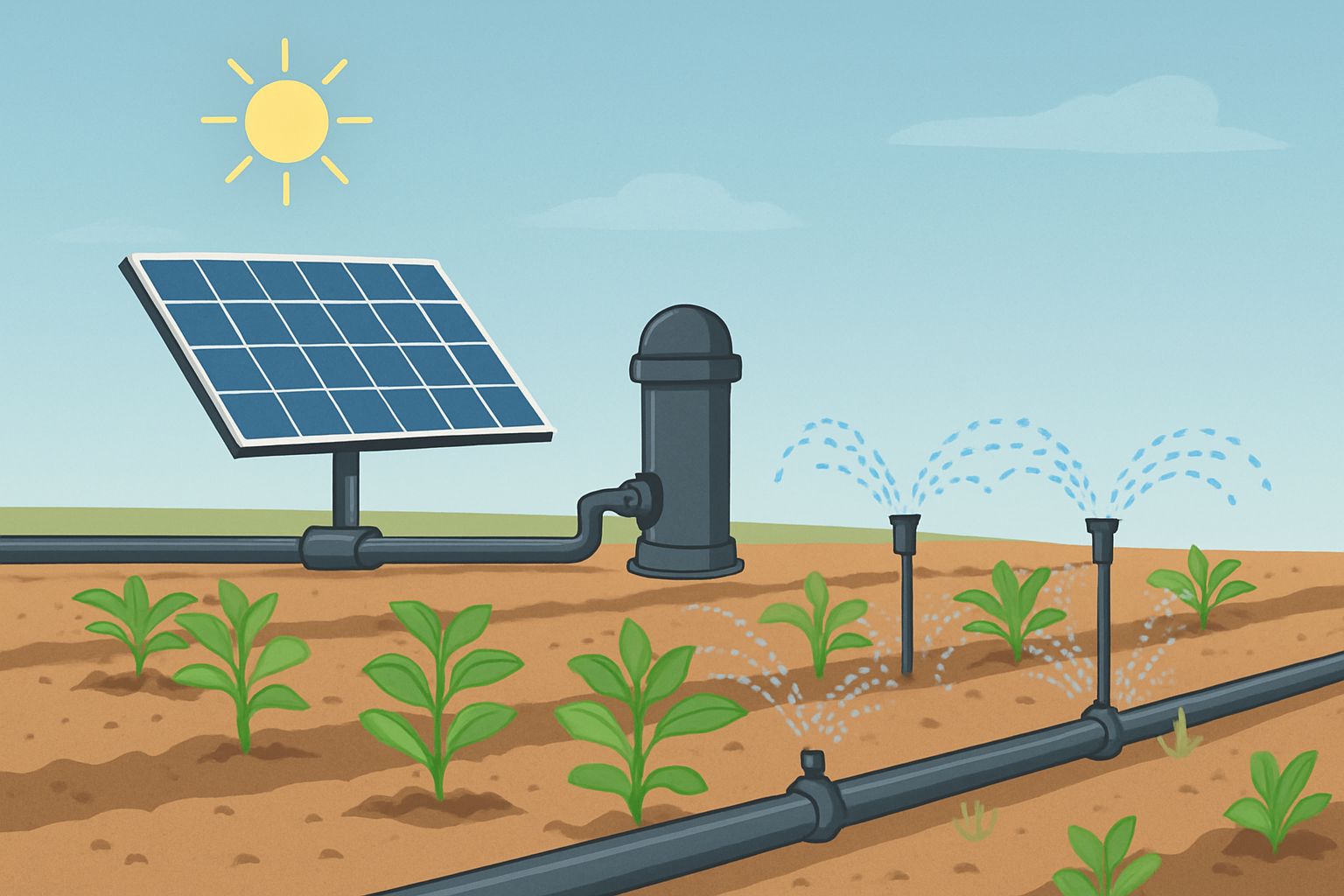
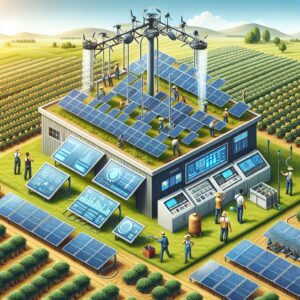
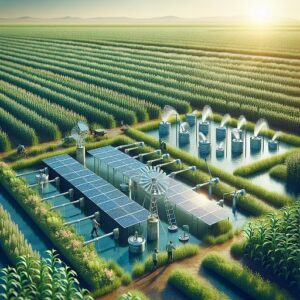
Water moves through a solar micro-sprinkler system in a carefully managed sequence. A pump — powered by solar panels — draws water from a well, pond, or storage tank and pushes it into the mainline pipe network. From there, it branches into lateral lines that run alongside crop rows or around individual trees. For more information on how these systems integrate, read about connecting micro-sprinklers with solar panels.
Before water reaches the sprinkler heads, it passes through a filtration stage. This typically includes a combination of screen filters and disc filters rated to remove particles down to 120–200 mesh, protecting the small orifices in micro-sprinkler heads from blockage. Pressure regulators follow, bringing line pressure down to the 15–30 PSI range that micro-sprinklers require for optimal performance.
How Micro-Sprinkler Heads Distribute Water
Micro-sprinkler heads are engineered to distribute water in precise, repeatable patterns. Depending on the head type selected, they can produce full-circle, half-circle, or quarter-circle coverage patterns with radii typically ranging from 3 to 15 feet. Rotating heads use a small spinner or deflector to spread water evenly, while fixed-pattern heads use molded deflectors to direct flow into specific zones.
Flow rates for individual micro-sprinkler heads are very low — typically between 4 and 50 gallons per hour depending on orifice size and operating pressure. This low-volume delivery keeps soil moisture consistent without oversaturation, which directly supports root health and reduces disease pressure from overly wet growing conditions.
Pressure Requirements for Micro-Sprinkler Systems
Pressure management is critical in any micro-sprinkler system. Too much pressure causes misting and drift, wasting water to evaporation. Too little pressure results in uneven distribution and poor coverage overlap. The optimal operating range sits between 15 and 30 PSI for most residential and agricultural micro-sprinkler heads.
- Minimum operating pressure: 15 PSI for most standard micro-sprinkler heads
- Optimal operating range: 20–25 PSI for uniform distribution patterns
- Maximum recommended pressure: 30 PSI before misting and drift losses increase
- Pressure regulators: Required at each lateral line to maintain consistency across uneven terrain
- Solar pump sizing: Must account for elevation changes and total dynamic head in addition to flow rate requirements
On farms with varied topography, pressure-compensating micro-sprinkler heads are a smart upgrade. These heads maintain consistent flow output across a wide pressure range — typically 15 to 45 PSI — which means slopes and elevation changes don’t create dry spots or oversaturated zones within the same irrigation zone.
Adding Solar Power to a Micro-Sprinklers Irrigation System Makes It More Efficient
The combination of solar power and micro-sprinkler irrigation creates a system that is greater than the sum of its parts. Solar energy eliminates the ongoing fuel or electricity costs that make conventional irrigation expensive to operate, while micro-sprinklers ensure that every unit of pumped water is used efficiently rather than wasted through runoff or evaporation.
How Solar Panels Power the Irrigation Pump
Photovoltaic (PV) solar panels convert sunlight directly into DC electricity, which either powers a DC-compatible pump directly or gets converted to AC power through an inverter to run a standard pump motor. The solar array is sized based on the pump’s power requirements, the number of daily operating hours needed, and the average peak sun hours at the farm’s location.
For most small to medium farm operations, a solar array in the 1–5 kW range is sufficient to power micro-sprinkler irrigation during daylight hours. Variable-speed pump controllers — often called MPPT (Maximum Power Point Tracking) controllers — adjust pump speed in real time to match available solar output, ensuring the system runs optimally even during partial cloud cover rather than shutting down entirely. Learn more about connecting micro-sprinklers to solar panels for an efficient irrigation system.
Battery Storage for Irrigation at Night or on Cloudy Days
Battery storage is an optional but valuable addition to solar irrigation systems. Lithium iron phosphate (LiFePO4) battery banks can store excess solar energy generated during peak sunlight hours and release it to power the pump during early morning or evening irrigation cycles when solar production is low. This extends operational flexibility significantly for crops that require early-morning watering to reduce heat stress during the day.
For farms in regions with frequent cloud cover, battery storage provides the consistency that direct solar-powered pumping cannot. A properly sized battery bank can sustain irrigation for 6–12 hours beyond available sunlight, depending on system design and daily water volume requirements.
Energy Savings Compared to Grid-Powered Irrigation
The financial case for solar-powered irrigation is compelling. Once the system is installed, the solar energy that runs the pump costs nothing — compared to diesel fuel at current market prices or grid electricity rates that typically increase year over year. Across multiple published farm case studies, solar-powered micro-sprinkler systems have demonstrated energy cost reductions of up to 70% compared to grid-powered equivalents.
On a practical level, a conventional electric pump running 6 hours daily for a 6-month growing season can cost hundreds to thousands of dollars per year in electricity depending on local rates and system size. A solar-equivalent system eliminates the majority of that cost entirely after the initial capital investment is recovered, which typically occurs within 3 to 7 years for most mid-sized operations.
Remote Monitoring and Smart Controls with Solar Systems
Modern solar irrigation systems can integrate with GSM or Wi-Fi-based monitoring platforms that give farmers real-time visibility into system performance from any smartphone or computer. These platforms track solar panel output, battery charge levels, pump operating hours, flow rates, and system pressure — flagging anomalies before they become costly failures. For more information, explore what every farmer needs to know about solar irrigation systems.
Smart controllers take automation a step further by connecting irrigation scheduling to soil moisture sensors and local weather data feeds. When rainfall is detected or soil moisture thresholds are met, the system automatically skips scheduled irrigation cycles — conserving water without requiring manual intervention. This level of precision management was previously only accessible to large agribusiness operations, but solar-integrated smart irrigation has made it practical for farms of all sizes.
Key Benefits of Solar Micro-Sprinkler Irrigation for Farmers
The benefits of solar micro-sprinkler irrigation extend well beyond simple water savings. When you combine precise water delivery with zero-cost solar energy, the result is a system that reduces input costs, improves crop quality, and builds long-term farm resilience — all at the same time.
Farmers who make the switch consistently report improvements across multiple areas of their operation simultaneously. Lower water bills, reduced energy costs, healthier crops, and less time spent managing irrigation manually all compound into a significant operational advantage over time. For more details, check out why connecting micro-sprinklers with solar panels is beneficial for farmers.
Water Savings of Up to 50% Versus Traditional Methods
Solar micro-sprinkler systems can reduce water consumption by up to 50% compared to conventional flood or overhead sprinkler irrigation. This happens because micro-sprinklers deliver water directly to the root zone at low flow rates, giving soil time to absorb moisture before applying more. There is minimal surface runoff, very little evaporation loss, and no wasted water on non-crop areas between rows. For farms operating in water-scarce regions or those paying for irrigation water by volume, this reduction in consumption translates directly into measurable cost savings every single season.
Lower Operating Costs and Faster ROI
After the upfront installation investment, the ongoing operating costs of a solar micro-sprinkler system are remarkably low. Solar panels generate free electricity for 25–30 years, the pump requires minimal servicing, and micro-sprinkler heads are low-maintenance components that last for years under normal conditions. The elimination of monthly electricity or diesel fuel bills is the most immediate financial impact most farmers notice.
Return on investment timelines vary based on farm size, local energy costs, and available incentives, but most mid-sized operations recover their installation costs within 3 to 7 years. After that breakeven point, the system essentially operates at near-zero cost for the remaining 20-plus years of its lifespan — generating ongoing savings that directly improve farm profitability every season.
Consistent Soil Moisture for Healthier Crops
Crop health is directly tied to soil moisture consistency. Boom-and-bust irrigation cycles — where fields are heavily watered and then allowed to dry significantly before the next irrigation — stress plants, reduce yield quality, and increase susceptibility to disease. Micro-sprinklers solve this by delivering small, frequent applications of water that keep soil moisture levels stable within the optimal range for crop growth. The result is more uniform plant development, better fruit sizing in orchards, and reduced blossom drop in vegetable crops.
Government Incentives That Offset Installation Costs
The upfront cost of solar micro-sprinkler installation is significantly reduced by available government programs. In the United States, the federal Investment Tax Credit (ITC) currently allows farmers to deduct 30% of solar system installation costs from their federal taxes. Additional state-level rebates, USDA REAP (Rural Energy for America Program) grants covering up to 25% of project costs, and agricultural water conservation incentive programs can stack on top of the federal credit — making the effective out-of-pocket cost substantially lower than the sticker price suggests.
Best Crops and Farm Types for Solar Micro-Sprinklers
Solar micro-sprinkler systems are remarkably versatile, but they deliver their greatest advantages in specific crop and farm contexts. Understanding where this technology excels helps farmers make confident, well-informed investment decisions before committing to installation.
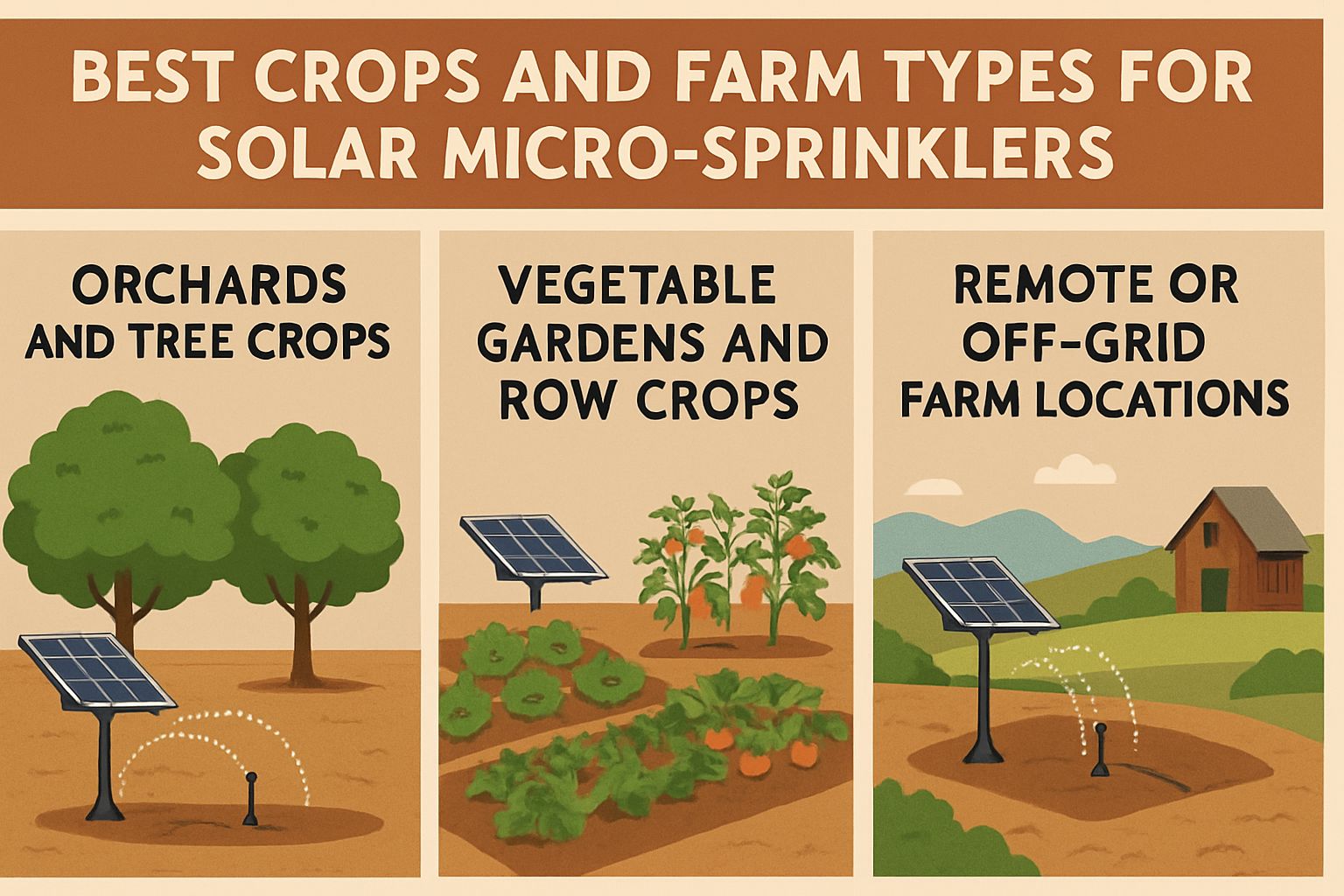
Orchards and Tree Crops
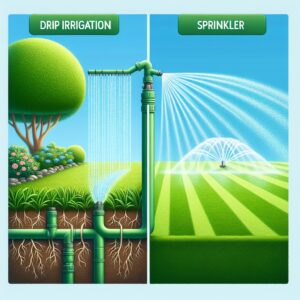
Tree crops are among the best-suited applications for micro-sprinkler irrigation. Fruit and nut trees have established root zones that benefit from the wider coverage pattern micro-sprinklers provide — typically 6 to 15 feet in radius — delivering water across the full root zone rather than just at the trunk base the way drip emitters do. For more information on why connecting micro-sprinklers to solar panels is beneficial for farmers, explore further insights.
Citrus, almonds, pistachios, avocados, apples, and stone fruits all respond exceptionally well to micro-sprinkler irrigation. Beyond routine watering, micro-sprinklers serve a critical secondary function in orchards: frost protection. When temperatures drop toward freezing, micro-sprinklers can be activated to coat tree blossoms and young fruit with a thin layer of ice that, counterintuitively, protects plant tissue from frost damage by releasing latent heat as water freezes — a well-established frost protection technique used in commercial orchards across California and Florida.
The low operating pressure of micro-sprinklers also means that solar pumps sized for orchard irrigation don’t need to be oversized. This keeps the solar array and battery storage requirements manageable, which directly reduces total system cost for orchard installations.
Micro-Sprinkler Coverage by Tree Crop Type
Crop Type
Recommended Sprinkler Radius
Typical Flow Rate Per Head
Key Benefit
Citrus (mature)
10–15 ft
25–40 GPH
Full root zone coverage + frost protection
Almonds / Pistachios
8–12 ft
20–35 GPH
Uniform moisture for even nut sizing
Avocados
6–10 ft
15–25 GPH
Shallow root hydration without waterlogging
Apples / Stone Fruits
8–12 ft
20–30 GPH
Frost protection + consistent sizing
When designing a micro-sprinkler layout for orchards, positioning heads at the drip line of the tree canopy — rather than at the trunk — ensures water is delivered where feeder roots are most active and most capable of efficient water uptake.
Vegetable Gardens and Row Crops
For vegetable production, micro-sprinklers offer the ideal balance between the broad coverage of overhead sprinklers and the precision of drip tape. Crops like peppers, tomatoes, squash, cucumbers, and leafy greens benefit from the moderate coverage radius of micro-sprinklers, which keeps foliage moisture lower than overhead sprinklers while still providing enough aerial humidity to support healthy transpiration in hot, dry climates. Row spacing in most vegetable operations aligns well with micro-sprinkler spacing intervals of 5 to 10 feet, making system design and installation straightforward for most farm layouts.
Remote or Off-Grid Farm Locations
Perhaps no farm type benefits more dramatically from solar micro-sprinkler irrigation than remote and off-grid operations. Farms located far from electrical grid infrastructure face a difficult choice under conventional irrigation models: run expensive diesel generators or invest in costly grid extension. Solar irrigation eliminates both options entirely, providing reliable pump power wherever sunlight is available — which, practically speaking, is virtually everywhere crops are grown.
Off-grid solar irrigation also removes the logistical burden of fuel delivery and storage that diesel-powered pumps require. A properly sized solar array with battery backup operates autonomously across the growing season with only periodic maintenance checks, giving remote farm operators a level of operational independence that grid-dependent systems simply cannot match.
Environmental Impact of Solar Micro-Sprinkler Irrigation
The environmental case for solar micro-sprinkler irrigation is as strong as the economic one. Agriculture is responsible for approximately 70% of global freshwater withdrawals according to the Food and Agriculture Organization of the United Nations, making irrigation efficiency one of the highest-impact levers available for reducing agricultural water stress. Solar micro-sprinklers directly address this challenge by delivering more crop output per unit of water consumed. For more insights on how solar irrigation systems can benefit agriculture, explore further resources.
Beyond water conservation, replacing diesel or grid-powered pumps with solar eliminates a meaningful source of carbon emissions at the farm level. Diesel irrigation pumps emit CO₂ continuously during operation — a cost that solar systems reduce to near zero after manufacturing. Across an entire growing season, a single solar-powered irrigation system can eliminate several tons of CO₂ equivalent emissions that a diesel pump alternative would have produced, contributing meaningfully to farm-level carbon reduction goals that are increasingly important to both regulators and agricultural buyers.
Reduction in Carbon Emissions from Fossil Fuel Pumps
Diesel-powered irrigation pumps are a significant but often overlooked source of greenhouse gas emissions on working farms. A single diesel pump running 6 hours per day across a 180-day growing season can consume thousands of liters of fuel and emit several metric tons of CO₂ annually. Replacing that pump with a solar-powered equivalent doesn’t just reduce operating costs — it eliminates those emissions almost entirely, turning your irrigation system from a carbon liability into a carbon-neutral operation.
The climate benefit compounds across time. Solar panels generating irrigation power for 25–30 years displace diesel fuel consumption season after season, with each passing year representing additional emissions avoided. For farmers navigating increasingly stringent environmental regulations or seeking to meet sustainability benchmarks required by food retailers and export markets, this emissions reduction is a practical operational advantage, not just an environmental talking point.
Less Fertilizer and Pesticide Runoff into Waterways
- Targeted water delivery keeps moisture within the root zone, reducing the volume of water that moves across the soil surface and carries dissolved fertilizers into drainage channels and waterways.
- Lower application volumes mean less total water moving through the soil profile, reducing leaching of nitrogen and phosphorus into groundwater below crop root zones.
- Reduced surface wetness on foliage and between rows lowers fungal disease pressure, decreasing the frequency of fungicide applications needed across the growing season.
- Fertigation compatibility allows soluble fertilizers to be injected directly into the irrigation system, delivering nutrients precisely to the root zone and dramatically improving uptake efficiency compared to broadcast surface applications.
- Minimal soil disturbance from low-pressure delivery preserves soil structure and reduces erosion that carries pesticide residues into adjacent water bodies during heavy rainfall events.
The water quality benefits of micro-sprinkler systems extend well beyond the farm boundary. Agricultural nutrient runoff is one of the leading contributors to freshwater eutrophication — the process by which excess nitrogen and phosphorus cause algae blooms that deplete oxygen in rivers, lakes, and coastal zones. Farmers who adopt precision irrigation are actively reducing their contribution to this downstream environmental problem.
Fertigation — the practice of delivering dissolved nutrients through the irrigation system — is particularly well-suited to micro-sprinkler setups. Because micro-sprinklers deliver water slowly and consistently, injected fertilizers have time to move into the soil and be absorbed by roots before leaching below the root zone. Studies on fertigated orchard and vegetable crops consistently show improved nutrient use efficiency compared to broadcast fertilizer application, meaning farmers achieve equivalent or better yields with lower total fertilizer inputs.
From a regulatory standpoint, farms that can demonstrate reduced nutrient runoff through precision irrigation are increasingly well-positioned in regions where agricultural water quality regulations are tightening. In states like California, Florida, and across the European Union, farms operating near sensitive waterways face growing scrutiny over runoff management. Solar micro-sprinkler systems offer a technically credible and documentable solution to these compliance pressures.
Is Solar Micro-Sprinkler Irrigation Worth the Investment for the Farmer
For the vast majority of farmers evaluating this technology, the answer is yes — and the financial data supports that conclusion clearly. When you stack up to 50% water savings, up to 70% energy cost reduction, 25–30 years of solar panel operational life, available government incentives covering up to 30% of installation costs through the federal ITC plus additional USDA REAP grants, and the compounding value of consistently healthier crops over time, the total return on a solar micro-sprinkler investment is substantial. The breakeven window of 3 to 7 years for most mid-sized operations leaves 20 or more years of near-zero-cost irrigation performance on the back end — a financial profile that very few other farm capital investments can match.
Frequently Asked Questions
Farmers considering solar micro-sprinkler systems tend to share a common set of questions before committing to installation. The answers below address the most important practical considerations based on real-world system performance and verified cost data.
How long does it take for a solar micro-sprinkler system to pay for itself?
Most solar micro-sprinkler systems reach their financial breakeven point within 3 to 7 years, depending on farm size, local electricity or diesel fuel costs, available government incentives, and the volume of water the system manages. Larger operations with higher baseline energy costs tend to recover their investment faster because the savings generated each season are proportionally greater.
The federal Investment Tax Credit alone can reduce the effective installation cost by 30% in the first year, which meaningfully shortens the payback period for farms that qualify. When USDA REAP grants — which can cover up to 25% of eligible project costs — are stacked on top, some farmers have reported effective payback periods as short as 2 to 3 years on well-sized systems with strong local solar resources.
After the breakeven point, the system continues operating at near-zero energy cost for the remaining lifespan of the solar panels — typically 20 or more additional years. That long tail of cost-free irrigation performance is what makes the investment so compelling from a whole-farm financial planning perspective.
Can solar micro-sprinklers work in areas with limited sunlight?
Yes. Solar irrigation systems can be designed to operate effectively in regions with lower average solar irradiance — it simply requires a larger solar array or battery storage capacity to compensate for reduced daily energy generation. MPPT pump controllers are particularly valuable in low-sunlight regions because they continuously optimize energy extraction from available sunlight, keeping the pump running efficiently even during overcast conditions rather than stalling below a fixed power threshold.
Battery storage is the key enabler for consistent performance in cloud-prone regions. A properly sized LiFePO4 battery bank stores surplus energy on sunny days and releases it during low-irradiance periods, ensuring irrigation schedules are maintained regardless of daily weather variation. The additional upfront cost of battery storage in these regions is typically offset by the elimination of diesel backup generation that conventional systems would otherwise require.
It’s worth noting that even regions considered low-sunlight by global standards — parts of the Pacific Northwest, northern Europe, or highland tropical zones — still receive sufficient solar irradiance to make solar irrigation viable. A qualified solar irrigation designer can model your specific location’s solar resource using tools like NASA’s POWER dataset or NREL’s PVWatts calculator to size your system accurately for local conditions.
What size solar panel setup do I need for my farm?
- Determine your pump’s power requirement in watts or kilowatts — this is the foundational input for all solar array sizing calculations.
- Calculate your daily operating hours — how many hours per day the pump needs to run to deliver the required water volume to your crops.
- Identify your location’s peak sun hours — the average daily hours of solar irradiance equivalent to 1,000 W/m², which typically ranges from 3.5 to 6.5 hours depending on geography and season.
- Apply a system efficiency factor of approximately 0.75 to 0.85 to account for wiring losses, inverter inefficiency, temperature derating, and soiling on panel surfaces.
- Add battery storage capacity if you need irrigation capability beyond daylight hours, sizing the bank to cover your required off-sun operating hours.
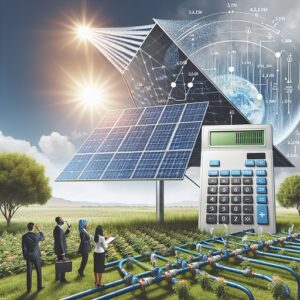
As a practical example: a 1.5 kW pump running 5 hours per day in a location with 5 peak sun hours per day would require approximately a 2 kW solar array after applying an efficiency factor of 0.75. That translates to roughly 5 to 6 standard 370–400W commercial solar panels — a modest installation that fits comfortably on a ground-mount frame near the water source. For more insights on solar irrigation systems, you can explore additional resources.
Small market garden operations with pumps under 500W can often get by with as few as 2 to 3 panels. Large commercial orchard or row crop operations with high-volume pumps in the 5–10 kW range will require proportionally larger arrays, but the per-watt cost of solar panels has dropped dramatically over the past decade, making even large installations increasingly cost-competitive.
Working with a certified solar irrigation designer is strongly recommended before purchasing equipment. Getting the array sizing wrong — either undersized causing inadequate pump performance, or oversized increasing upfront cost unnecessarily — is the most common and most avoidable installation mistake farmers make when attempting to design systems independently.
Most reputable solar irrigation suppliers offer free system sizing consultations that include a detailed load analysis, solar resource assessment for your specific location, equipment recommendations, and a cost-benefit projection covering the full system lifespan. Taking advantage of these consultations before committing to any equipment purchase is one of the most valuable steps a farmer can take in the planning process.
Are solar micro-sprinkler systems difficult to install and maintain?
Installation complexity depends on system scale. Small farm and homestead systems in the 0.5–2 kW range with straightforward water sources can often be installed by mechanically competent farm operators with guidance from supplier documentation. Larger commercial systems with complex pump configurations, battery storage, and automated controls are best handled by qualified solar irrigation contractors who can ensure proper system integration, electrical safety compliance, and warranty preservation on major components.
- Solar panels: Clean panel surfaces every 1–3 months to remove dust, bird droppings, and debris that reduce energy output. Inspect mounting hardware annually for corrosion or loosening.
- Pump: Check shaft seals and bearings annually. Service intervals vary by pump type — follow manufacturer specifications, typically every 1,000–2,000 operating hours.
- Filters: Flush and inspect screen and disc filters at the start of each irrigation season and monthly during operation. Clogged filters are the most common cause of pressure loss and uneven distribution in micro-sprinkler systems.
- Micro-sprinkler heads: Inspect distribution patterns during the first irrigation cycle of each season. Replace clogged or damaged heads — individual heads typically cost only a few dollars each and are simple to swap in the field.
- Battery bank: If your system includes battery storage, check terminal connections and state-of-charge periodically. LiFePO4 batteries require minimal maintenance compared to older lead-acid alternatives.
The overall maintenance burden of a solar micro-sprinkler system is genuinely low compared to diesel-powered alternatives. Diesel pumps require regular oil changes, fuel filter replacements, injector servicing, and fuel storage management — ongoing tasks that solar systems eliminate entirely. The most time-consuming maintenance task in a solar micro-sprinkler system is typically the routine filter inspection, which takes only minutes per session.
Solar panels themselves are remarkably durable. Modern commercial panels are rated to withstand hail up to one inch in diameter at 50 mph impact velocity, high wind loads, and temperature extremes well beyond normal agricultural operating conditions. The 25–30 year performance warranties that reputable manufacturers provide are a genuine reflection of the technology’s durability under real-world conditions, not a marketing exaggeration.
For farmers new to solar irrigation, joining a regional agricultural extension network or online farming community focused on sustainable irrigation is a practical way to access peer knowledge from operators who have already worked through the learning curve. Real-world maintenance tips from experienced solar irrigation farmers are often more practically useful than equipment manuals alone.
What government incentives are available for solar irrigation systems?
The most significant incentive currently available in the United States is the federal Investment Tax Credit (ITC), which allows qualifying farmers to deduct 30% of total solar system installation costs directly from their federal income tax liability. This credit applies to both the solar panels and associated equipment including inverters, mounting systems, and battery storage when batteries are charged primarily by solar — meaning the full system installation qualifies, not just the panels themselves. For more details on solar irrigation systems, check out what every farmer needs to know.
The USDA Rural Energy for America Program (REAP) offers grants covering up to 25% of eligible renewable energy project costs for agricultural producers and rural small businesses, with loan guarantee support available for an additional portion of project financing. REAP applications are accepted on a rolling basis with periodic funding windows, and many states layer additional agricultural water conservation incentive programs on top of the federal baseline — making the combined incentive package in some states remarkably compelling for early adopters.
State-level programs vary significantly, but farmers in water-stressed regions including California, Arizona, Texas, and across the Southeast frequently have access to water district conservation rebates, agricultural energy efficiency programs, and low-interest green financing options specifically designed for irrigation infrastructure upgrades. Consulting with a local agricultural extension office or a solar contractor familiar with your state’s incentive landscape before system design is finalized ensures you capture every available incentive dollar — which can collectively reduce effective installation costs by 40–50% in favorable incentive environments.

Leave a Reply