
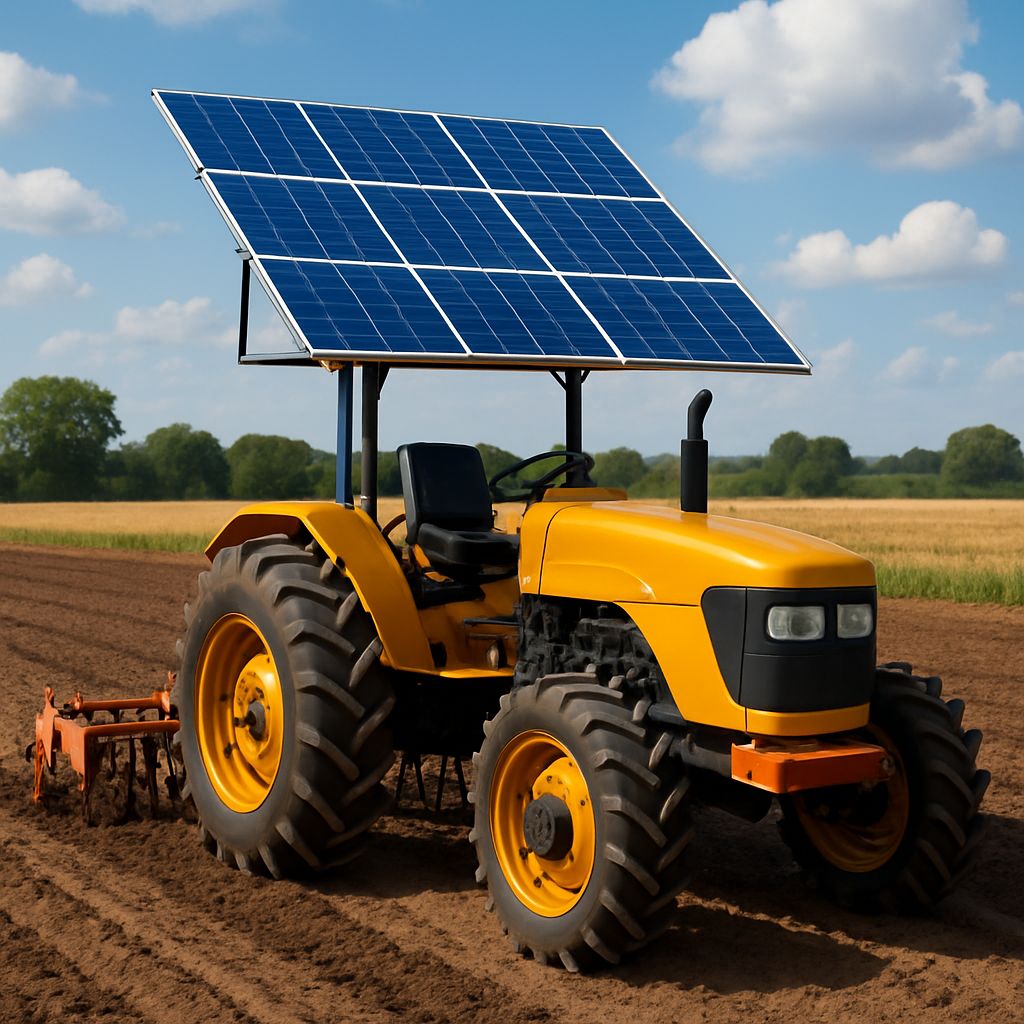
Key Takeaways
- Solar-powered farm equipment can reduce operational costs by up to 70% compared to traditional fuel-powered alternatives
- Modern solar irrigation systems can effectively water up to 5 acres on a single sunny day without grid electricity
- Federal tax incentives can cover up to 30% of the initial investment in agricultural solar equipment
- Battery storage technology now allows solar farm equipment to operate through nighttime hours and cloudy days
- Renewables Inc. offers specialized solar solutions designed specifically for various farm sizes and agricultural needs
Farm Energy Costs Are Skyrocketing: Solar Equipment Offers a Solution
Farm cash flow is always a challenge. Rising fuel prices, unpredictable weather, and the need for reliable equipment can make it tough for farmers to stay ahead. That’s why more and more farms are turning to solar-powered farming equipment. From solar-powered irrigation systems to electric tractors charged by the sun, this technology is changing how food is grown and helping farmers keep more money in their pockets. Renewables Inc. has been at the forefront of developing specialized solar solutions that address the unique energy needs of modern agriculture operations.
The farming landscape is changing rapidly as climate concerns and rising energy costs push agriculture toward sustainable solutions. Solar-powered farm tools represent the perfect intersection of practical efficiency and environmental stewardship. With energy costs comprising up to 15% of total farming expenses, finding alternatives that reduce this burden while maintaining productivity is essential for long-term viability.
The Hidden Cost of Traditional Farm Equipment
Farming is one of the most energy-intensive industries. Equipment needs fuel, water systems need power, and storage facilities require lighting and cooling. All of this adds up to high costs. The average mid-sized farm spends between $35,000-$50,000 annually on energy expenses alone. Diesel-powered tractors and irrigation systems account for approximately 65% of this energy consumption, creating a significant financial burden that cuts directly into profit margins.
What many farmers don’t realize is how much maintenance conventional equipment requires. Fossil fuel-powered machinery demands regular oil changes, filter replacements, and engine servicing – all adding hidden costs beyond just the fuel. These maintenance requirements not only drain financial resources but also consume valuable time that could be spent on more productive farming activities.
The instability of fuel prices creates another layer of uncertainty for farm budgeting. When diesel prices spike unexpectedly, as they often do during planting or harvest seasons, profit projections can be instantly undermined. Solar-powered alternatives eliminate this vulnerability by tapping into a free, consistent energy source that doesn’t fluctuate with global markets or geopolitical tensions.
How Climate Change Is Making Solar Power More Attractive
Climate change isn’t just a distant threat – it’s already affecting farms through unpredictable weather patterns, extended droughts, and increased energy demands for cooling and irrigation. As temperatures rise, conventional equipment becomes less efficient, consuming more fuel while producing more emissions – creating a costly cycle. Solar-powered equipment breaks this cycle by producing zero emissions during operation while maintaining consistent performance regardless of ambient temperature fluctuations.
Many regions are experiencing longer growing seasons accompanied by more intense sunlight – precisely the conditions where solar technology thrives. This climate shift actually increases the efficiency and output of solar panels, essentially turning a challenge into an opportunity. Farms in sun-rich regions can now harvest solar energy with greater efficiency than ever before, effectively transforming environmental challenges into renewable energy advantages.
Why More Farmers Are Switching to Solar-Powered Tools
Beyond just cost savings, solar-powered farm equipment offers remarkable operational benefits. Unlike conventional equipment that requires refueling trips or electrical connections, solar tools can operate independently in remote locations. This flexibility allows farmers to utilize previously impractical areas and optimize land usage for maximum productivity. The mobility of many solar solutions means farmers can deploy resources exactly where needed without the limitations of fuel logistics or power lines. For more insights, explore the top benefits of solar panels for farming.
Solar equipment typically has fewer moving parts than traditional machinery, resulting in significantly reduced maintenance needs and downtime. Many farmers report up to 80% fewer mechanical issues with solar-powered systems compared to combustion engines. This reliability is particularly valuable during critical planting and harvesting windows when equipment failures can have catastrophic impacts on crop yields and quality.
For forward-thinking farmers looking toward the next decade and beyond, solar-powered equipment represents not merely an alternative but an imperative. Those who embrace these technologies now gain both immediate benefits and strategic positioning as agricultural policies increasingly favor sustainable practices. Many agricultural markets are beginning to offer premium pricing for crops grown using renewable energy, creating additional revenue opportunities for early adopters of solar farm equipment.
How Solar-Powered Farm Equipment Actually Works
Understanding the mechanics behind solar farm equipment demystifies the technology and highlights its practical applications. The core components – photovoltaic panels, charge controllers, battery systems, and inverters – work together to capture, store, and convert solar energy into usable power for various farm operations. This integrated system creates a renewable energy ecosystem that can power everything from small sensors to large tractors.
The Science Behind Solar Panels on Farms
Farm-grade solar panels differ significantly from residential versions, designed specifically to withstand agricultural environments and operating conditions. These specialized panels use monocrystalline or polycrystalline silicon cells that convert sunlight directly into electricity through the photovoltaic effect. The efficiency of modern agricultural solar panels has improved dramatically, with conversion rates now reaching 20-24% – nearly double what was possible just a decade ago.
Battery Storage Systems: Making Solar Work 24/7
The evolution of battery technology has transformed solar from a daytime-only power source into a 24/7 farm solution. Modern lithium iron phosphate (LiFePO4) batteries provide 3,000-5,000 charging cycles – translating to 8-10 years of reliable service even with daily use. These specialized agricultural battery systems include thermal management technology that allows them to operate effectively in extreme temperatures from -4°F to 131°F, covering the conditions found in most farming regions.
Smart battery management systems (BMS) optimize energy storage and distribution based on equipment needs and weather forecasts. These systems can prioritize critical farm operations during periods of limited sunlight, ensuring that essential functions like livestock water pumps never lose power. Some advanced installations include modular battery arrays that farmers can expand over time as their solar capacity and equipment needs grow, providing a scalable solution that grows with the farm operation.
Integration with Existing Farm Equipment
Contrary to popular belief, transitioning to solar doesn’t require replacing all farm equipment at once. Retrofit kits allow many diesel machines to incorporate solar-assisted electric systems, reducing fuel consumption by 30-50% without sacrificing power. The most practical approach typically involves a hybrid strategy – converting high-use, stationary equipment to solar first while gradually transitioning mobile equipment as technology improves and budgets allow.
Modern solar equipment comes with standardized power connections and adapters that ensure compatibility across different manufacturers and machine types. This interoperability means farmers aren’t locked into single-vendor solutions and can integrate solar components that best fit their specific needs and budget constraints. For older equipment, conversion specialists can provide custom solar integration solutions that preserve the functionality of cherished machines while reducing their operational costs.
Weatherproofing and Durability Features
Farm environments demand equipment that withstands harsh conditions, which is why agricultural solar systems incorporate specialized durability features. Modern panels use tempered glass that can withstand 1-inch hailstones at terminal velocity and have frames rated for 140 mph wind loads. Sealed junction boxes prevent moisture intrusion even during heavy rain or irrigation overspray, while UV-resistant cables maintain their integrity despite years of sun exposure. These rugged design elements ensure that solar farm equipment maintains performance and reliability through challenging agricultural conditions that would quickly degrade standard commercial solar installations.
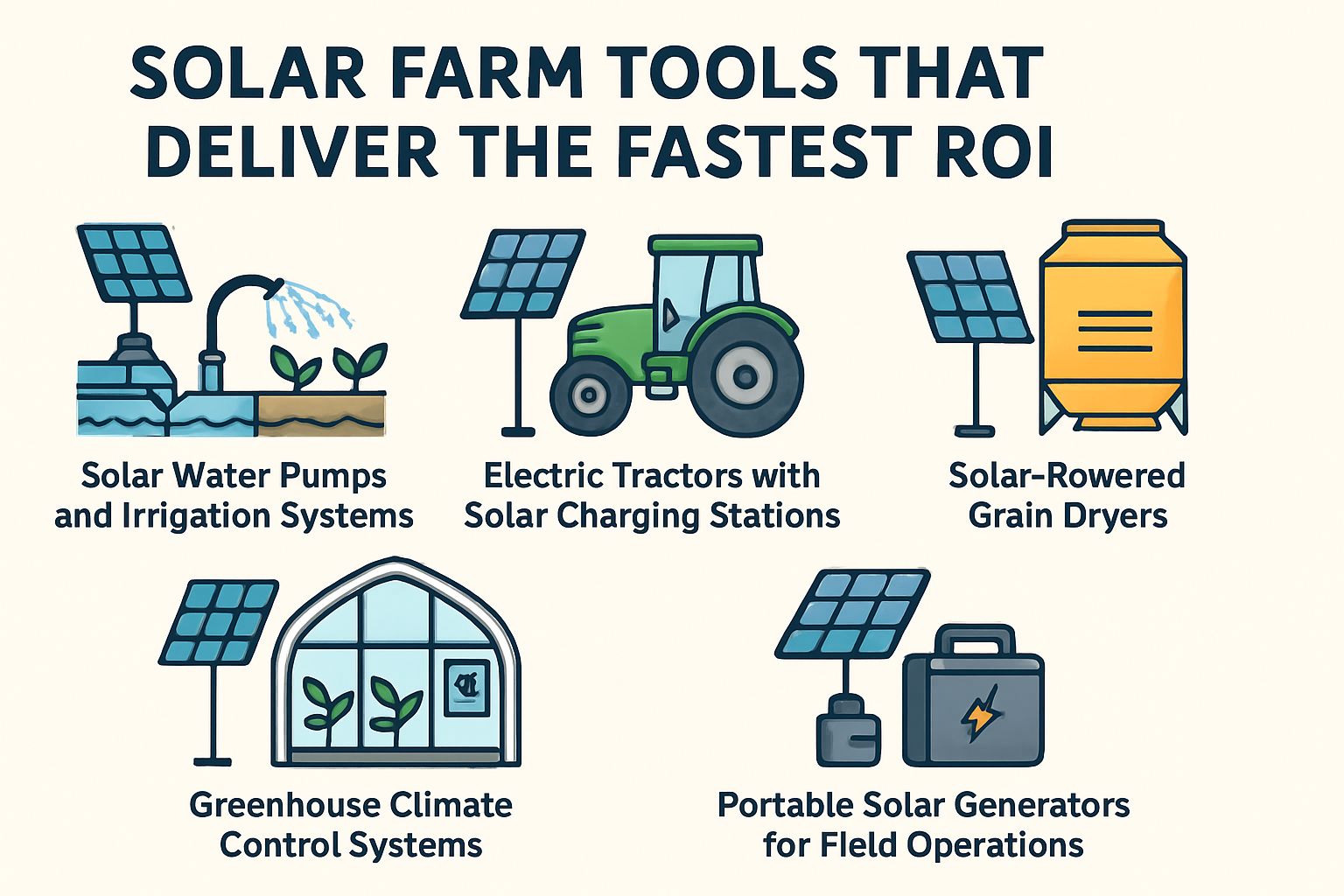
5 Solar Farm Tools That Deliver the Fastest ROI
When implementing solar solutions, strategic equipment selection can dramatically accelerate your return on investment. The following five tools consistently demonstrate the quickest path to profitability across diverse farming operations. Each addresses a specific high-energy farm function while offering substantial operating cost reductions compared to conventional alternatives. By prioritizing these high-ROI implementations, even farms with limited capital can begin their solar transition while seeing meaningful financial benefits within the first season.
1. Solar Water Pumps and Irrigation Systems
Solar irrigation systems deliver the fastest payback period of any agricultural solar investment, typically recouping costs within 2-3 growing seasons. These systems eliminate the need for grid electricity or diesel generators that traditionally power water movement across fields. A standard 2-kilowatt solar pumping system can move approximately 20,000 gallons daily – enough to irrigate 3-5 acres depending on crop type and climate conditions.
The efficiency gains extend beyond just energy savings. Remote monitoring capabilities allow for precise water delivery based on soil moisture sensors, reducing water usage by up to 30% compared to conventional irrigation methods. This optimization not only conserves a precious resource but also improves crop health through more consistent moisture management. For livestock operations, solar pumping systems ensure reliable water access in remote pastures without the expense of running power lines or the ongoing cost of fuel delivery.
2. Electric Tractors with Solar Charging Stations
Electric tractors paired with solar charging infrastructure represent the next frontier in sustainable farm operations. These vehicles eliminate diesel costs while requiring 60-70% less maintenance than conventional tractors. A typical 40-horsepower electric tractor costs approximately $0.60 per operating hour in energy compared to $4.50-$6.00 for diesel equivalents – savings that accumulate rapidly with regular use. Modern models now offer 6-8 hours of continuous operation on a single charge, sufficient for most daily farming tasks.
The solar charging component transforms these tractors from merely “electric” to truly sustainable tools. A properly sized charging station, typically 10-15kW, can fully recharge an electric tractor in 4-6 hours using only sunlight. This self-contained energy system creates complete independence from both fuel deliveries and grid electricity, providing reliable power even during utility outages or fuel supply disruptions. For many farmers, the combination of operational savings and energy resilience justifies the initial investment, with complete system payback occurring within 4-7 years depending on usage patterns.
3. Solar-Powered Grain Dryers
Traditional grain drying consumes enormous energy, often accounting for 30-40% of a grain farm’s total energy budget. Solar-powered alternatives use targeted heat distribution systems that require 50-70% less energy while improving drying uniformity. These systems combine solar thermal collectors for air heating with photovoltaic panels to power air circulation fans, creating a comprehensive drying solution that operates with minimal external energy inputs.
Beyond the obvious energy savings, solar grain dryers offer significant quality advantages. The more consistent, lower-temperature drying process reduces the risk of overheating that can damage grain quality and nutritional value. This preservation of crop quality can translate to premium pricing opportunities, further enhancing the economic return. For farms in remote locations, solar drying eliminates the logistical challenges and costs associated with propane or diesel delivery, providing both convenience and predictable operating expenses regardless of fuel market fluctuations.
4. Greenhouse Climate Control Systems
Solar-powered greenhouse systems create ideal growing environments while slashing energy costs that typically consume 15-20% of greenhouse production expenses. These integrated systems combine solar panels for electricity with solar thermal collectors for heating, creating year-round growing capabilities with minimal external energy requirements. Smart controllers adjust ventilation, irrigation, and supplemental lighting based on real-time conditions, optimizing both energy usage and plant growth factors simultaneously.
5. Portable Solar Generators for Field Operations
Portable solar generators have revolutionized remote field operations by eliminating the need for noisy, maintenance-intensive gas generators. These self-contained power stations combine high-efficiency panels, battery storage, and multiple output options to power everything from electric tools to soil testing equipment. Modern units delivering 2-5kWh can support a full day of field maintenance activities, sensor deployments, or temporary irrigation requirements. Their silent operation and zero emissions make them ideal for sensitive applications where exhaust fumes or noise could damage crops or disturb livestock, providing both practical and environmental advantages over conventional portable power options.
Breaking Down the Numbers: When Solar Equipment Pays for Itself
Understanding the financial timeline of solar farm equipment helps establish realistic expectations and proper planning. Unlike many farm investments that depreciate immediately, solar equipment builds equity through ongoing energy production and operational savings. The financial analysis must consider both direct savings (fuel, electricity, maintenance) and indirect benefits (tax incentives, depreciation, improved crop quality) to fully capture the return profile.
While initial costs remain higher than conventional alternatives, the gap continues to narrow as production scales increase. Solar equipment prices have declined approximately 70% over the past decade while efficiency has improved substantially. This improving cost-performance ratio means installations today offer significantly better returns than identical systems from just five years ago. Learn more about the benefits of solar panels for farming.
The payback mathematics vary by equipment type and farm usage patterns, but most agricultural solar implementations now achieve breakeven within 4-7 years. This timeline represents less than half the expected operational lifetime of the equipment, meaning most systems will deliver 10-15 years of essentially “free” energy after recovering their initial investment cost. For farmers considering long-term operational sustainability, few alternative investments offer comparable returns with similar risk profiles.
Initial Investment vs. Long-Term Savings
The average 25kW solar system for agricultural applications costs between $50,000-$75,000 before incentives but eliminates approximately $6,000-$9,000 in annual energy expenses. This creates a natural payback period of 7-9 years, but with available tax credits and accelerated depreciation, the actual financial breakeven typically occurs in years 4-6. After this point, the system continues generating value through energy savings for an additional 20+ years with only minimal maintenance costs, representing one of the most predictable long-term investments available to agricultural operations.
Tax Credits and Agriculture Incentives That Cut Costs
The financial landscape for agricultural solar investments has never been more favorable, with federal incentives currently covering up to 30% of qualified expenses through the Renewable Energy Investment Tax Credit. This direct reduction in tax liability significantly accelerates the payback timeline for solar farm equipment. Beyond federal programs, most states offer additional agricultural solar incentives, including property tax exemptions, sales tax waivers, and specialized grant programs specifically for farm operations.
The USDA’s Rural Energy for America Program (REAP) provides both grants and guaranteed loan financing specifically for agricultural producers installing renewable energy systems. These grants can cover up to 25% of eligible project costs, and when combined with federal tax credits, can reduce the effective cost of solar equipment by more than half. Many farmers are surprised to learn that specialized agricultural solar installations often qualify for accelerated depreciation under the Modified Accelerated Cost Recovery System (MACRS), allowing for better tax treatment than many other farm capital investments.
Maintenance Expenses Comparison: Solar vs. Conventional
The maintenance differential between solar and conventional equipment creates substantial long-term savings that compound over time. Traditional diesel equipment requires regular oil changes, filter replacements, and engine servicing, costing an average of $1,800-$2,500 annually for a mid-sized tractor. By comparison, solar-electric equipment maintenance typically costs just $200-$400 per year, primarily for basic inspections and occasional panel cleaning. This maintenance gap widens further when considering the increasing complexity and specialized service requirements of newer diesel engines with emissions control systems.
Solar irrigation systems demonstrate perhaps the most dramatic maintenance contrast. Conventional pump systems require impeller replacements, seal maintenance, and regular engine service – averaging $1,200-$1,500 annually for a typical agricultural setup. Equivalent solar pumping systems need only minimal maintenance costing $150-$300 yearly, with many components carrying 10-year warranties. The elimination of fuel-related contamination issues further enhances reliability, reducing costly downtime during critical irrigation windows.
Energy Independence: Eliminating Fuel Costs
The elimination of ongoing fuel expenses represents the most immediately tangible benefit of solar farm equipment. A typical 100-acre operation consumes 2,000-3,000 gallons of diesel annually, representing $6,000-$9,000 at current prices. Solar alternatives eliminate this recurring expense entirely, creating predictable operating costs regardless of fuel market volatility. This stability is particularly valuable for long-term crop planning and contract pricing, as energy input costs remain constant rather than fluctuating with petroleum markets.
Beyond direct savings, energy independence provides strategic advantages during supply disruptions. Recent years have demonstrated the vulnerability of fuel supply chains to weather events, international conflicts, and transportation challenges. Farms relying on solar power continue operations uninterrupted during these disruptions, maintaining productivity while competitors may face operational constraints. This resilience can be particularly valuable during harvest periods when timing is critical and weather windows may be limited.
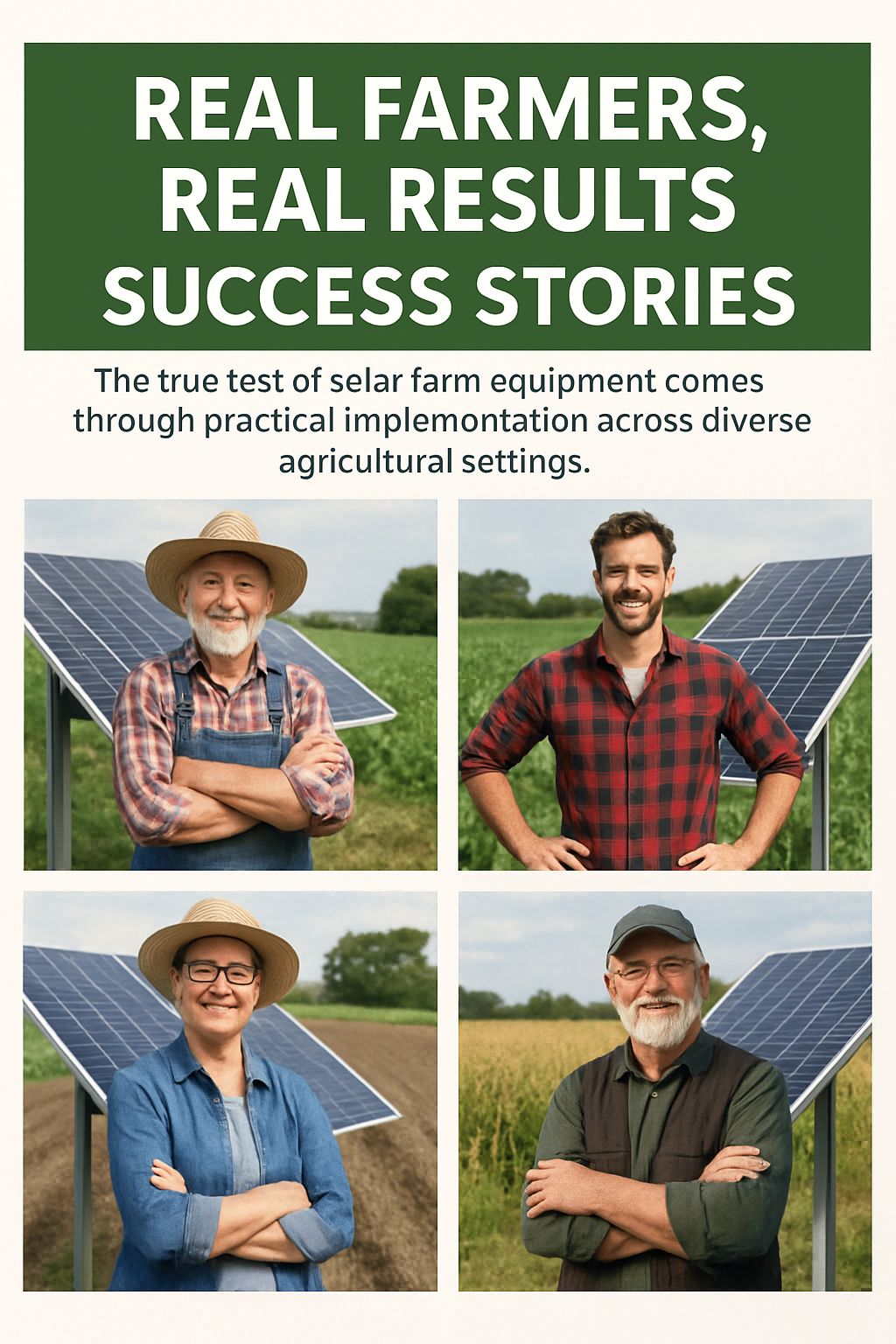
Real Farmers, Real Results: Success Stories
The true test of solar farm equipment comes through practical implementation across diverse agricultural settings. The following case studies represent verified results from working farms that have successfully integrated solar technology into their operations. These examples span different regions, farm sizes, and production types, demonstrating the adaptability of solar solutions to various agricultural contexts. Each highlights specific challenges overcome and quantifiable benefits achieved through strategic implementation of solar-powered farm equipment.
Midwestern Grain Farm Cuts Energy Bills by 68%
The Andersen family farm in central Illinois integrated solar-powered grain drying and handling equipment across their 640-acre corn and soybean operation. Their 45kW system powers grain elevators, augers, and a modified drying system that uses solar thermal collectors to preheat air. The installation cost $112,000 but qualified for $33,600 in federal tax credits and a $20,000 USDA REAP grant, reducing their effective investment to $58,400. First-year energy savings reached $16,800 compared to previous propane and grid electricity expenses, putting them on track for complete payback within 3.5 years.
“What surprised us most wasn’t just the energy savings, but how the more consistent solar drying improved our grain quality,” notes operator Keith Andersen. “We’re seeing less stress cracking in our corn and better test weights, which has helped us secure premium contracts with specialty grain buyers.” The system’s monitoring capabilities have also enabled more precise moisture management, reducing overdrying while ensuring proper storage conditions. During a regional power outage following severe storms in 2021, the Andersens continued drying operations while neighboring farms faced significant delays, demonstrating the resilience advantage of solar farm equipment.
California Vineyard Achieves Payback in Just 3 Years
Sunridge Vineyards in Sonoma County installed an integrated solar system powering their irrigation, frost protection, and processing equipment. The 68kW system combines both fixed and tracking panels that follow the sun throughout the day, maximizing energy production during critical growing periods. The $175,000 system qualified for California’s generous agricultural solar incentives along with federal tax credits, reducing effective cost to $92,000. With California’s high electricity rates, first-year savings reached $31,000, putting the vineyard on a 3-year payback timeline.
Beyond energy savings, Sunridge reports significant quality improvements from their solar frost protection system, which provides more consistent temperature regulation than their previous propane heaters. “We’ve seen a 30% reduction in frost damage in vulnerable areas of the vineyard,” reports vineyard manager Elena Vasquez. “The system’s precise temperature monitoring allows for microzone protection that activates only where needed, rather than heating the entire vineyard unnecessarily.” This targeted approach not only saves energy but has improved overall fruit quality and yield consistency. The vineyard has leveraged their sustainable practices in marketing materials, helping secure distribution with eco-conscious retailers who pay premium prices for sustainably produced wines.
Small Family Farm’s Transition to Solar Operations
Blue Creek Family Farm, a 35-acre diversified vegetable operation in western Oregon, demonstrates how even smaller farms can successfully implement solar technology. Owners Sarah and Michael Chen installed a 12kW system powering their irrigation, cold storage, and small electric tractor. Their phased approach began with solar water pumping, followed by cold storage refrigeration, and finally the addition of their electric tractor charging station. The incremental implementation allowed them to spread the $42,000 total investment over three years, making it financially manageable without large capital reserves.
The Chens report annual energy savings of approximately $4,800, primarily from eliminated irrigation pumping costs and reduced cooler operation expenses. “What doesn’t show up directly in the numbers is how the solar equipment has improved our quality of life,” notes Sarah Chen. “No more noise from generators, no diesel fumes while harvesting, and significantly less time spent on equipment maintenance.” The farm has successfully marketed their solar-powered produce through local farmers markets and CSA programs, highlighting their sustainable growing practices. They’ve found customers willing to pay 15-20% premiums for produce grown using renewable energy, further enhancing the return on their solar investment.
Choosing the Right Solar Equipment for Your Farm Size
Selecting appropriate solar equipment requires matching technology to specific farm needs and operational scale. The optimal configuration varies dramatically between small specialty crop producers and large commodity operations. Understanding these differences helps farmers avoid both underpowered systems that fail to meet needs and oversized installations that unnecessarily inflate costs and extend payback periods.
The evaluation process should begin with a comprehensive energy audit identifying current usage patterns and costs across all farm operations. This baseline establishes clear metrics for measuring potential savings and helps prioritize which equipment should transition to solar first. A professional agricultural solar assessment can then match available technologies to these specific needs, creating a customized implementation plan that maximizes return on investment. For more insights, you can explore solar-powered farming equipment to enhance your farm’s efficiency.
Small Farms (Under 50 Acres)
Small-scale operations benefit most from modular, portable solar solutions that can serve multiple functions as needs change throughout the growing season. A typical starter system includes 5-10kW of solar capacity, suitable for powering irrigation for up to 10 acres, small electric tools, and basic cold storage. These systems typically cost $15,000-$30,000 installed but can reduce operating costs by $2,000-$4,000 annually. Small farms should prioritize solar irrigation first, as this typically represents their largest energy expense and offers the quickest payback, followed by refrigeration and small electric equipment charging stations.
Medium Operations (50-500 Acres)
Mid-sized farms require more substantial installations typically ranging from 25-75kW, capable of powering multiple systems simultaneously including irrigation, processing equipment, and partial facility needs. These farms benefit from strategic placement of multiple smaller arrays rather than a single large installation, allowing targeted power delivery to specific high-use areas like pump houses, processing facilities, and equipment barns. Investment ranges from $60,000-$180,000 but typically generates $12,000-$36,000 in annual energy savings. The ideal approach usually involves a phased implementation starting with the highest-energy operations (typically irrigation and primary processing) followed by gradually electrifying tractors and other mobile equipment as capital becomes available.
Large-Scale Farming Enterprises
Commercial-scale operations require comprehensive solar strategies often exceeding 100kW capacity to make meaningful impacts on their substantial energy requirements. These large installations typically combine ground-mounted arrays with building-integrated systems that maximize available space without sacrificing productive land. Costs range from $200,000 to several million depending on scale, but generate proportional savings that create acceptable payback periods. Many large operations benefit from “solar sharing” approaches that place elevated panels above certain crops, providing both power generation and beneficial partial shading for heat-sensitive varieties. For these substantial installations, power purchase agreements (PPAs) offer an alternative to direct ownership, eliminating upfront capital requirements while still reducing energy costs through fixed-rate contracts typically 15-20% below market rates.
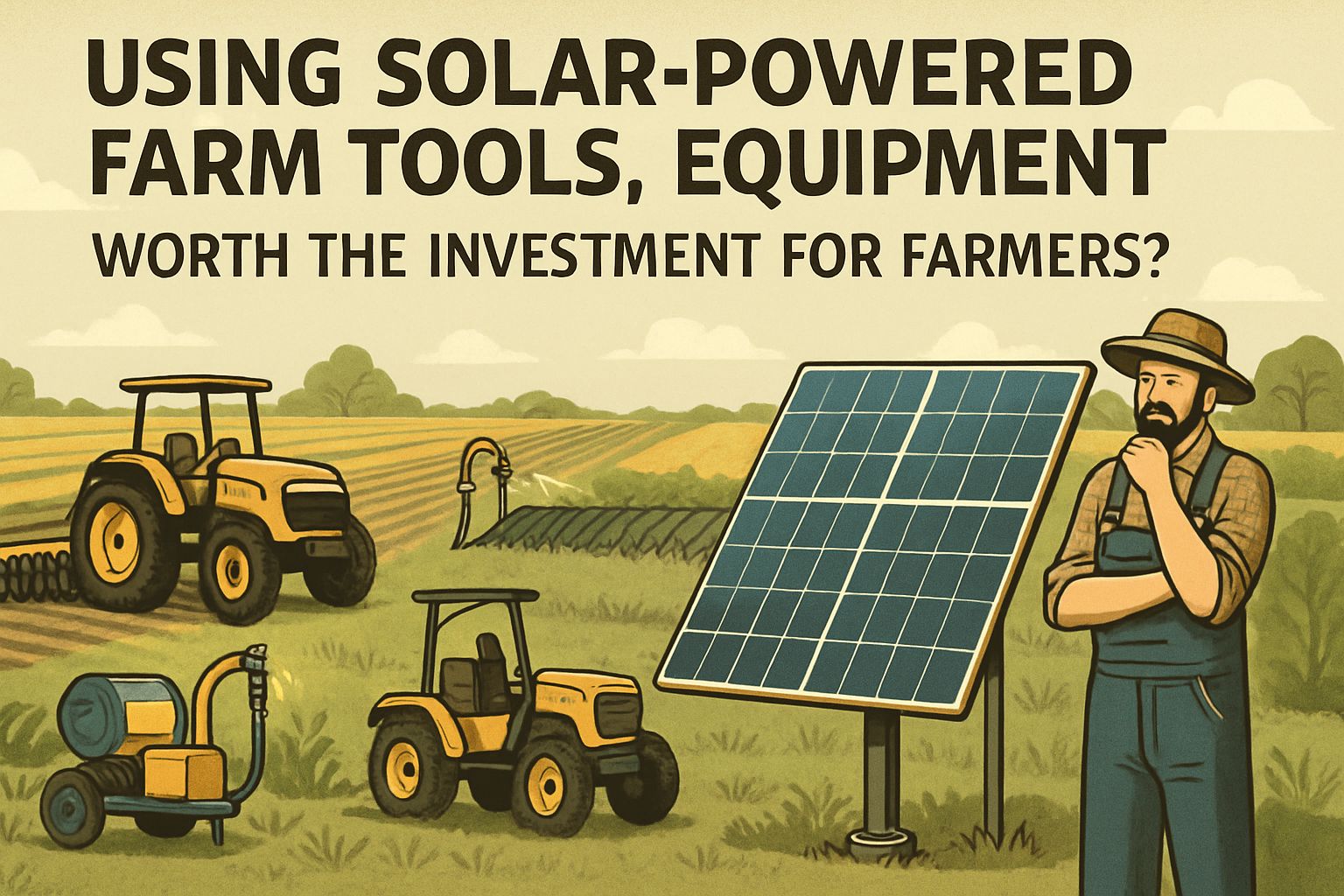
“Best Solar-Powered Farm Tools …” from growingsolarmist.com and used with no modifications.
Conclusion: Are Solar-Powered Farm Equipment Worth the Farmer’s Investment
For farmers looking to lower costs and operate more sustainably, solar-powered farming equipment is a smart investment. With today’s technology, you can power essential farm operations using clean, free energy from the sun — saving money now and for decades to come. By choosing the right equipment for your specific needs and taking advantage of available incentives, most farms can achieve payback within 3-7 years while gaining energy independence that protects against rising fuel costs and supply disruptions. Whether you’re running a small family operation or managing thousands of acres, solar farm equipment offers both immediate benefits and long-term advantages in an increasingly resource-constrained agricultural landscape. Renewables Inc. can help you explore the most effective solar solutions for your specific farming operation.
Frequently Asked Questions
Below are answers to the most common questions farmers ask when considering solar-powered equipment for their operations. These responses are based on current technology capabilities, verified performance data, and actual implementation experiences across diverse agricultural settings.
How long do solar panels last on farm equipment?
Agricultural-grade solar panels typically carry 25-year power production warranties but often function effectively for 30+ years. Most manufacturers guarantee at least 80% of original output capacity after 25 years of use. The actual lifespan depends somewhat on environmental conditions, with panels in extreme temperature regions experiencing slightly faster degradation rates. Regular cleaning and occasional inspection generally constitute the only maintenance required throughout this operational lifetime. For mobile equipment applications, specialized reinforced panels designed to withstand vibration typically offer 15-20 year warranties, still far exceeding the lifespan of conventional engine components.
Can solar-powered equipment work in cloudy or northern regions?
Yes, modern solar equipment functions effectively even in regions with less-than-ideal sun conditions. While output decreases proportionally to sunlight availability, properly sized systems with adequate battery storage can maintain reliable operation even during extended cloudy periods. Northern farms typically need 20-30% larger solar arrays than southern equivalents but still achieve favorable economics due to their generally higher conventional energy costs. Many northern operations actually see excellent summer production that compensates for winter shortfalls, as longer daylight hours and cooler temperatures (which improve panel efficiency) create ideal solar conditions during the critical growing season.
What happens to solar farm equipment during power outages?
Properly designed solar farm systems continue functioning during grid outages, providing critical operational resilience. Systems incorporate automatic transfer switches that disconnect from the grid during outages (a safety requirement) while maintaining power flow to essential farm equipment. Battery storage components become particularly valuable during these periods, enabling continued operation through nighttime hours. Many farmers specifically design their systems with energy security in mind, prioritizing critical functions like livestock watering, refrigeration, and security systems to remain operational regardless of grid status.
Do I need to replace all my farm equipment at once?
No, a phased approach typically makes more financial sense for most operations. Begin with the highest energy-consuming, stationary equipment like irrigation systems, grain dryers, or cold storage compressors, as these offer the quickest payback. Mobile equipment can be gradually replaced as older machines reach the end of their service life or as capital becomes available. This incremental strategy spreads investment costs while still capturing significant energy savings from the highest-consumption applications first. Many farms effectively operate hybrid systems where some functions run on solar power while others temporarily continue using conventional energy until full transition becomes feasible.







Leave a Reply