
Key Takeaways
- Solar-powered irrigation systems can reduce farm water usage by 20-30% in the first year through precision delivery and smart controls
- Farmers can achieve up to 30% reduction in electricity costs while simultaneously improving water efficiency through solar technology
- Solar panels provide dual benefits on farms by generating clean energy while physically reducing water evaporation in strategic placements
- Most solar water management systems achieve complete return on investment within 4-7 years while qualifying for significant government incentives
- Growing Solarmist helps farmers implement customized solar irrigation solutions that address both energy and water conservation needs
Water scarcity is no longer a future problem—it’s here now, and farms feel it first. As aquifers deplete and climate patterns shift, finding sustainable ways to irrigate crops has become essential rather than optional for modern agriculture. Solar-powered irrigation systems offer a powerful solution by addressing both energy and water efficiency simultaneously.
Water Crisis on Modern Farms: Why It Matters Now
Agriculture consumes approximately 70% of the world’s freshwater resources, with much of it lost to evaporation, runoff, and inefficient distribution. For many farmers, water has become both increasingly expensive and increasingly scarce. Growing Solarmist has been at the forefront of helping farmers transition to more sustainable irrigation practices that preserve this precious resource while maintaining or improving yields.
The traditional reliance on grid electricity or diesel generators to power irrigation systems compounds the problem. These conventional energy sources not only contribute to climate change but also represent a significant expense that cuts into farm profitability. As weather patterns become more unpredictable, farmers need irrigation systems that can adapt quickly while minimizing water waste.
- 70% of global freshwater goes to agriculture
- Many farming regions face severe groundwater depletion
- Energy costs for pumping water continue to rise
- Climate change is creating more erratic rainfall patterns
Modern farming faces a dual challenge: producing more food with less water while reducing environmental impact. The integration of solar technology into irrigation systems addresses both concerns, creating a pathway to truly sustainable agriculture that protects resources for future generations.
How Solar Panels Transform Farm Water Management
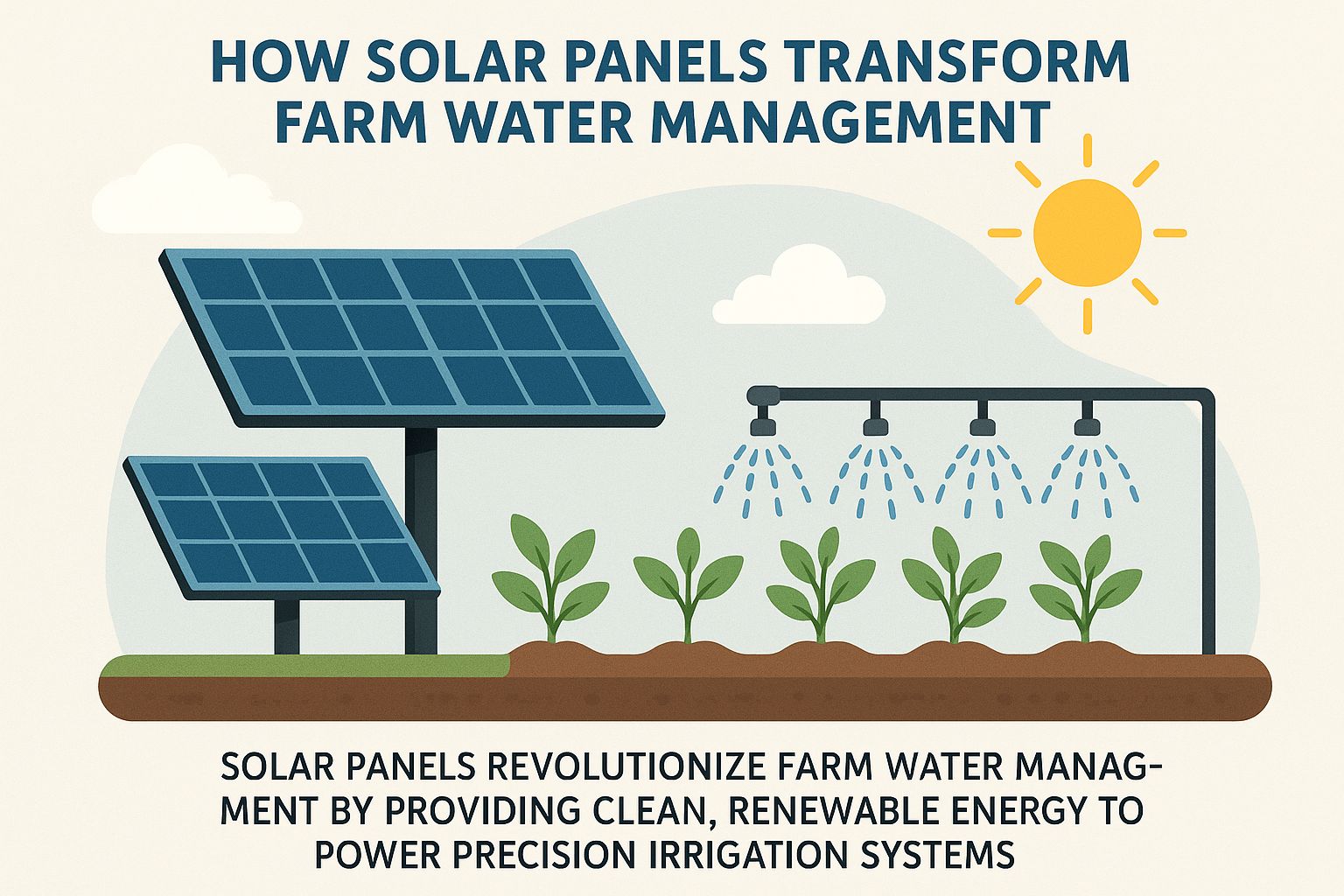
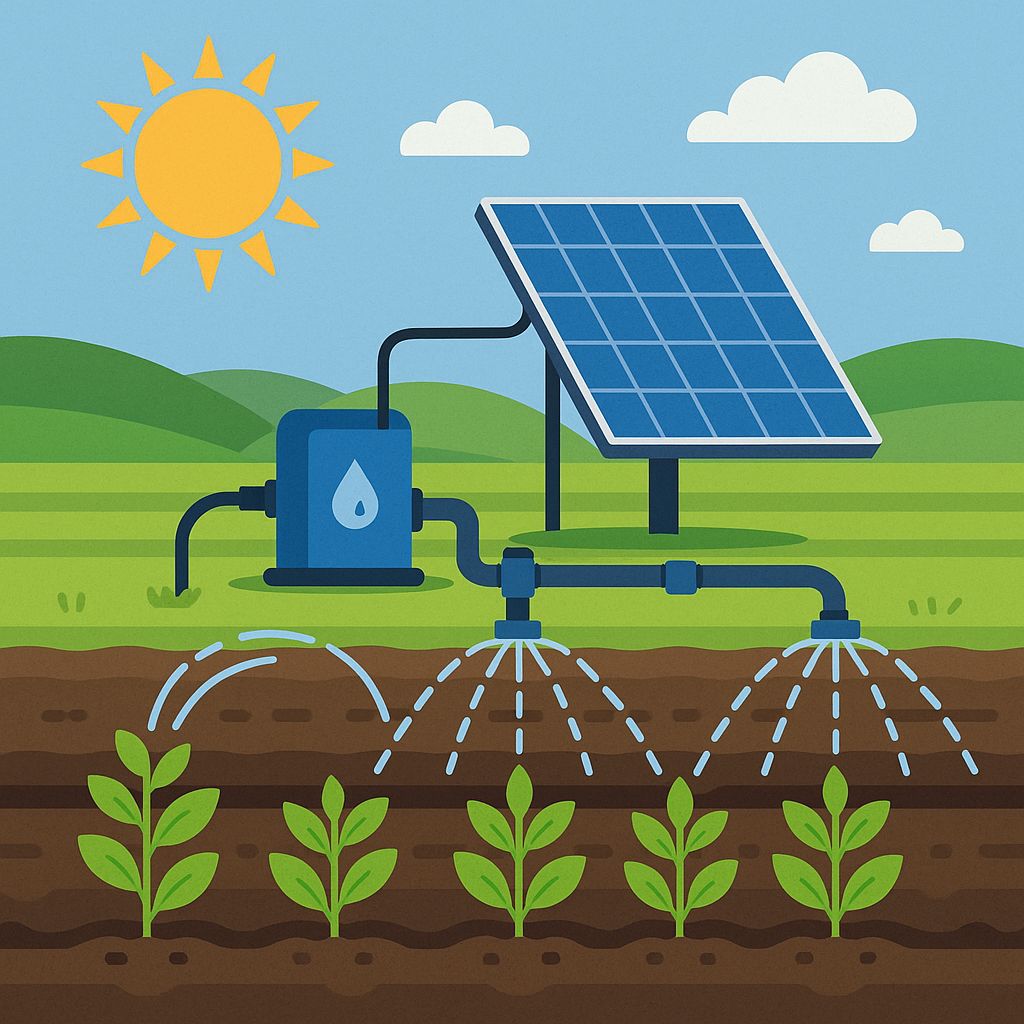
Solar panels revolutionize farm water management by providing clean, renewable energy to power precision irrigation systems. Unlike traditional grid-powered systems that run on fixed schedules regardless of actual need, solar-powered systems can be designed to deliver exactly the right amount of water at the right time. This fundamental shift eliminates one of the biggest sources of water waste in agriculture.
Beyond simply powering pumps, solar technology enables an entirely new approach to irrigation. When integrated with smart controllers, moisture sensors, and weather monitoring systems, solar-powered irrigation becomes responsive to real-time conditions. This intelligence is the key to achieving significant water savings while maintaining optimal growing conditions.
Solar-Powered Drip Irrigation Systems
Drip irrigation represents one of the most efficient water delivery methods available, and when powered by solar energy, it becomes even more sustainable. These systems deliver water directly to plant root zones, minimizing evaporation and virtually eliminating runoff. The slow, precise application ensures that plants receive consistent moisture without the stress of alternating dry and saturated conditions.
Solar-powered drip systems operate at lower pressure than conventional irrigation, which reduces energy requirements while extending the life of system components. Most importantly, these systems can function independently of the electrical grid, making them ideal for remote fields or areas with unreliable power supply.
The modular nature of solar drip systems allows farmers to start small and expand as needed. A typical configuration includes solar panels, a DC pump controller, filters, mainlines, and drip tape or tubing. Water savings compared to flood irrigation can reach 60%, while crop yields often increase due to more consistent soil moisture levels.
For row crops, vegetable production, and orchards, solar drip irrigation provides precise control over water application rates. This precision becomes especially valuable when integrating fertigation—the application of water-soluble fertilizers through irrigation systems—reducing both water and fertilizer usage while improving nutrient uptake efficiency.
- Delivers water directly to root zones, reducing evaporation by up to 60%
- Operates at lower pressure, requiring less energy
- Functions independently from electrical grid reliability
- Scales easily from small plots to large operations
- Enables precise fertigation for improved nutrient management
Smart Irrigation Controllers That Reduce Waste
Smart irrigation controllers represent the brain of any efficient water management system. These devices integrate with soil moisture sensors, weather stations, and satellite data to make real-time decisions about when and how much to irrigate. Unlike traditional timers that operate on fixed schedules regardless of conditions, smart controllers adjust watering based on actual plant needs, soil conditions, and weather forecasts.
Most advanced controllers can be monitored and adjusted remotely via smartphone apps, allowing farmers to manage irrigation from anywhere. When unusual conditions arise—such as an unexpected heat wave or rainfall—adjustments can be made immediately without requiring a physical visit to each controller. This responsiveness prevents both under-watering during stress periods and wasteful over-watering following natural precipitation.
The integration of solar power with these smart systems creates a self-sufficient irrigation solution that operates independently of grid power. During peak growing seasons when both sunlight and water needs are highest, these systems perform at maximum capacity precisely when needed most.
Water Recycling Systems Powered by Solar Energy
Water recycling represents one of the most promising approaches to agricultural water conservation. Solar-powered pumping systems can capture, filter, and recirculate drainage water that would otherwise be lost. This approach is particularly valuable in greenhouse operations and hydroponic systems where water can be continuously reused after proper treatment.
Field operations can also benefit from recycling systems that capture runoff at the lower end of sloped fields and pump it back to storage reservoirs for reuse. The energy required for this pumping traditionally represented a significant cost barrier, but solar power has made recycling economically viable for more farming operations. By recirculating water instead of drawing fresh supplies for each irrigation cycle, farms can dramatically reduce their total water requirements.
Evaporation Reduction Through Panel Placement
Solar panels offer a dual benefit when strategically positioned over water storage facilities. Beyond generating electricity, they physically block sunlight from reaching the water surface, significantly reducing evaporation losses. In hot, arid regions, open-air water storage can lose inches of water weekly to evaporation—a substantial volume when multiplied across large reservoirs. For farmers considering solar solutions, understanding the dark side of solar panels can help in making informed decisions about their implementation.
Floating solar arrays installed directly on irrigation ponds and reservoirs can reduce evaporation by up to 80% while simultaneously generating power for pumping. These systems have the added advantage of running more efficiently due to the cooling effect of water beneath the panels. The shade they provide also inhibits algae growth, improving water quality and reducing the need for treatment.
“Our floating solar system reduced water loss by 70% while providing all the energy needed to run our irrigation pumps. During the hottest summer on record, we maintained full production without drawing additional water from our wells.” — Bill Jacobsen, Central Valley Almond Grower
Rainwater Harvesting Integration
Solar power enables efficient integration of rainwater harvesting into farm water systems. The intermittent nature of rainfall often requires storage and pumping infrastructure to make collected water useful for irrigation. Solar-powered pumping systems can transfer harvested rainwater from collection points to storage tanks or directly to irrigation networks without ongoing energy costs.
For many farms, especially those in regions with seasonal rainfall patterns, capturing precipitation during wet periods for use during dry seasons can significantly reduce dependence on groundwater or municipal sources. The combination of rainwater harvesting and solar pumping creates a truly sustainable water cycle that maximizes natural inputs while minimizing resource depletion.
Real-World Water Savings from Solar Irrigation
The transition to solar-powered irrigation consistently delivers measurable water savings across diverse agricultural operations. These savings stem from multiple factors: precise application, reduced evaporation, real-time adjustments, and the ability to operate shorter, more frequent irrigation cycles that maintain optimal soil moisture without excess. For farmers looking to enhance their irrigation systems, exploring best farm batteries for solar panels can be a worthwhile investment.
Average Water Reduction: 20-30% in First Year
Data collected from hundreds of farm conversions shows that most operations achieve 20-30% water reduction in their first year after implementing solar-powered precision irrigation. These savings typically increase over time as farmers become more familiar with system operation and fine-tune settings for their specific crops and soil conditions.
The water conservation impact becomes even more significant when calculating the total volume saved. A 100-acre farm that previously used 24 inches of irrigation water annually can save over 5 million gallons in a single growing season after converting to solar-powered precision irrigation. This reduction not only conserves the resource but also lowers pumping costs and reduces nutrient leaching.
Case Study: Midwest Corn Farm Cuts Water Use by 40%
The Henderson family farm in Nebraska provides a compelling example of solar irrigation efficiency. After installing a 15kW solar array powering variable frequency drive pumps and connected to soil moisture sensors, they reduced water application by 40% compared to their previous center pivot system. The soil moisture sensors prevented over-irrigation by triggering pumps only when readings dropped below programmed thresholds.
Their system included water storage components that allowed for pumping during peak solar hours while distributing irrigation during optimal evening hours. This approach maximized both solar energy capture and water use efficiency. The reduced pumping hours also extended equipment life and lowered maintenance costs.
Seasonal Adaptation Capabilities
One of the most valuable aspects of solar-powered irrigation is its ability to adapt to changing seasonal conditions. As day length and solar intensity vary throughout the growing season, these systems automatically adjust to available energy. This natural alignment often correlates well with crop water needs, which typically peak during the same high-sunlight periods when solar energy is most abundant.
During shoulder seasons with lower water requirements, excess solar production can be directed to other farm operations or, in grid-connected systems, sold back to utilities. This flexibility ensures that the investment in solar infrastructure provides benefits throughout the year, not just during peak irrigation periods. For more insights, explore using the sun to power your farm.
Financial Benefits Beyond Water Savings
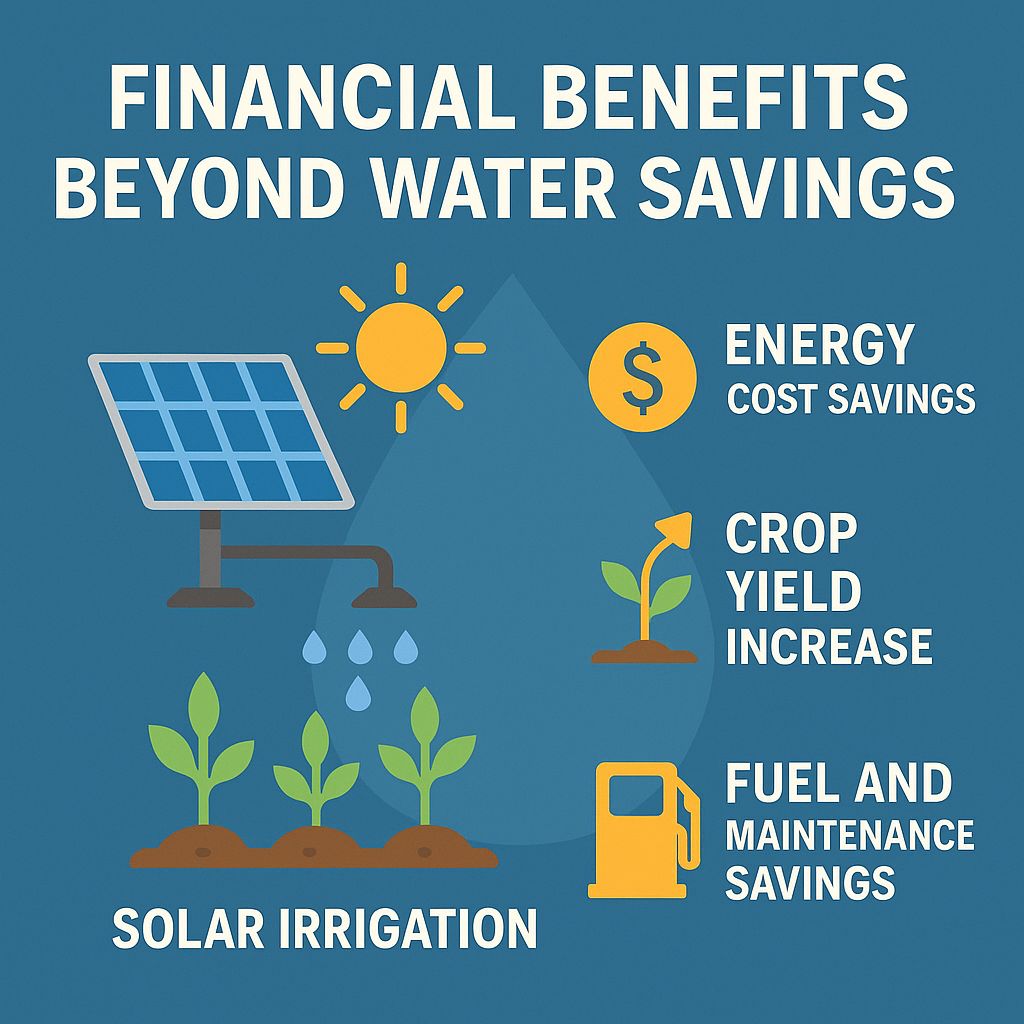
While water conservation represents the primary environmental benefit of solar irrigation, the financial advantages often drive adoption decisions. The combination of reduced operating costs, incentive programs, and production improvements creates a compelling economic case for conversion. For those considering battery backup options, exploring lead-acid deep cycle battery investments can further enhance the financial benefits of solar irrigation systems.
Reduced Electricity Costs for Pumping
The energy required for water pumping represents one of the largest operational expenses on irrigated farms. Diesel or grid-powered pumps incur ongoing fuel or electricity costs that continue to rise year after year. Solar-powered pumping systems eliminate or drastically reduce these expenses, with most systems providing free energy after the initial investment period. For large operations, these savings can amount to tens of thousands of dollars annually.
Variable frequency drives (VFDs) powered by solar panels allow pumps to operate at precisely the pressure and flow rate needed, rather than running at full capacity. This matching of output to requirement not only saves water but also reduces wear and tear on equipment, extending system life and decreasing maintenance costs. The elimination of fuel deliveries also removes supply chain vulnerabilities that can threaten irrigation reliability during critical growing periods.
Government Incentives and Tax Credits
Federal and state incentives significantly reduce the initial investment in solar irrigation systems. The federal Investment Tax Credit (ITC) currently allows farmers to deduct 30% of the cost of solar energy systems from their federal taxes. Many states offer additional tax incentives, grants, or low-interest loan programs specifically for agricultural solar projects. The USDA’s Rural Energy for America Program (REAP) provides grants covering up to 25% of project costs and loan guarantees up to 75% for eligible agricultural producers.
Accelerated depreciation provisions in the tax code allow farmers to recover their solar investments even faster through deductions. The Modified Accelerated Cost Recovery System (MACRS) enables agricultural businesses to depreciate solar assets over just five years, creating significant tax advantages in the early years after installation. When combined with direct incentives, these tax benefits can reduce the effective cost of a solar irrigation system by 50-60% in many cases.
Increased Crop Yields from Precision Watering
The financial return from solar irrigation extends beyond cost savings to include potential revenue increases from improved yields. Precision watering helps maintain optimal soil moisture levels throughout the growing season, preventing both water stress and overwatering that can reduce production. Many farmers report yield increases of 10-15% after implementing precision irrigation powered by solar energy, particularly in drought-prone regions or during unusually dry seasons.
Consistent moisture levels also improve crop quality characteristics like fruit size, sugar content, and overall appearance—factors that often command premium prices in the marketplace. For specialty crop producers, these quality improvements can translate to significant revenue increases beyond the basic yield enhancements. The reliability of solar-powered systems also reduces the risk of irrigation failures during critical growth stages, providing insurance against catastrophic crop losses.
Payback Period: Typically 4-7 Years
When accounting for all financial benefits—energy savings, water cost reductions, tax incentives, and yield improvements—most solar irrigation systems achieve complete return on investment within 4-7 years. After this payback period, the systems continue generating value for decades, with most solar panels carrying 25-year warranties and often functioning well beyond that timeframe. This long operational life creates exceptional long-term value compared to conventional irrigation systems with their ongoing fuel or electricity costs.
The financing landscape for solar irrigation has also improved dramatically, with many agricultural lenders now offering specific loan products for renewable energy investments. These financing options often feature terms aligned with the expected payback period, allowing the energy and water savings to cover loan payments. Some manufacturers and installers also provide lease-to-own arrangements that eliminate the need for large upfront capital outlays.
Setting Up Your Solar Water System
Implementing a solar-powered irrigation system requires careful planning to ensure optimal performance for your specific conditions. The process begins with a comprehensive assessment of your water needs, existing infrastructure, and site characteristics. Taking a methodical approach to system design and installation maximizes both water efficiency and financial returns.
Farm Water Audit: First Steps
A thorough water audit establishes your baseline usage patterns and identifies the greatest opportunities for efficiency improvements. This audit should examine current irrigation methods, water sources, energy costs, and distribution systems. Measuring soil moisture retention capabilities across different fields helps determine optimal irrigation scheduling and volumes. Most importantly, the audit should quantify current water use per acre for each crop, establishing clear metrics for measuring future improvements. For farmers considering solar solutions, understanding the best farm batteries for solar panels can also be a crucial part of the audit.
The audit also provides an opportunity to identify problem areas like excessive runoff, uneven distribution, or high evaporation zones. These issues can often be addressed through system design modifications before implementing the solar conversion. Understanding seasonal water demand fluctuations helps properly size both pumping capacity and potential storage requirements to maintain reliability throughout the growing season.
Sizing Your System Correctly
Proper system sizing balances initial investment against long-term performance. Undersized systems may fail to meet peak water demands, while oversized systems represent unnecessary capital expenditure. The calculation must account for daily water requirements during peak season, pumping head (vertical lift plus friction losses), and available solar hours. System designers typically use software modeling to match pump specifications, solar array capacity, and irrigation requirements.
Storage considerations—both electrical and water—play a crucial role in system sizing. Battery storage can extend pumping hours beyond daylight, while water storage reservoirs provide buffers for meeting peak demands. The optimal balance between these components depends on your specific cropping patterns, climate conditions, and reliability requirements. Many systems incorporate hybrid approaches that maintain grid connections as backup while maximizing solar utilization.
Integration with Existing Irrigation
Most farms already have substantial investments in irrigation infrastructure. Fortunately, solar power systems can often integrate with existing distribution networks, sprinklers, or drip systems. Adaptations typically focus on pump controllers, pressure regulation, and filtration components rather than replacing entire distribution systems. This approach minimizes conversion costs while still capturing the efficiency benefits of solar power.
The control system interface represents a critical integration point. Modern solar irrigation controllers can operate autonomously or connect to existing farm management systems through standard protocols. This integration allows irrigation to coordinate with other farm operations and data sources. The transition period may require operating both old and new systems in parallel until performance verification is complete.
Equipment Checklist
1. Solar panels (monocrystalline vs. polycrystalline vs. Thin-Film vs. Bifacial)
Panel selection significantly impacts system performance and longevity. Monocrystalline panels offer higher efficiency and perform better in high temperatures, making them ideal for most farm applications despite their higher initial cost. Polycrystalline panels provide a more economical option with slightly lower efficiency, suitable for installations with ample space. Thin-film panels work well in partially shaded conditions but require more surface area. Bifacial panels capture reflected light from the ground surface, providing 5-30% energy gain in appropriate installations, especially over reflective surfaces like water.
- Monocrystalline: Highest efficiency (19-22%), excellent heat tolerance, longest lifespan
- Polycrystalline: More affordable, slightly lower efficiency (13-17%)
- Thin-film: Flexible installation options, works better in partial shade
- Bifacial: Captures light reflected from surfaces below, ideal for water reservoir installations
Panel mounting systems must withstand environmental conditions while maintaining optimal tilt angles. Fixed-tilt ground mounts provide simplicity and reliability, while single-axis tracking systems can increase energy production by 25-35% by following the sun’s daily path. Dual-axis tracking offers maximum energy capture but introduces mechanical complexity that may not justify the additional cost in most agricultural applications. To explore more about using solar power on farms, check out the benefits of solar panels for farms.
System layout should consider shade patterns, maintenance access, and potential for future expansion. For installations near water features, corrosion-resistant materials and proper grounding become especially important. The mounting height should accommodate any potential flooding or snow accumulation while remaining accessible for cleaning and maintenance.
The orientation and angle of fixed panels should be optimized for your specific latitude and seasonal water needs. In most agricultural applications, panels oriented to maximize summer production (when irrigation demands are highest) make more sense than configurations designed to maximize annual energy production.
Here is a table summarizing the main types of solar panels for agricultural applications, highlighting their key characteristics, benefits, and limitations:
|
Solar Panel Type |
Key Features |
Best Uses in Agriculture |
Advantages |
Limitations |
|---|---|---|---|---|
|
Monocrystalline |
Single-crystal silicon, high efficiency, dark appearance |
Limited roof/land space; high-demand farms |
Highest efficiency (up to 22%), longest lifespan (25–30 years), reliable in smaller spaces |
Highest upfront cost, slightly less efficient in extreme heat |
|
Polycrystalline |
Multiple silicon crystals, bluish tone, moderate efficiency |
Large farm roofs/land, budget-conscious projects |
Lower cost per watt, stable performance, good for large-scale installations |
Lower efficiency (13–17%), needs more space, drops in high heat |
|
Thin-Film |
Flexible modules, thin, low weight, lower efficiency |
Curved/irregular surfaces, barns, greenhouse roofs |
Flexible installation, lightweight, better in low light/cloudy regions |
Shorter lifespan, lowest efficiency (<14%), requires most area |
|
Bifacial |
Absorbs sunlight from both sides, transparent back |
Open fields, reflective surfaces, agrivoltaics |
Can boost power output by up to 30% with good reflectivity (albedo); efficient land use |
Higher initial investment, requires careful ground preparation and mounting |
2. Pump controller and inverter
The pump controller serves as the system’s command center, managing the flow of power from solar panels to pumps based on water demand signals. Controllers with maximum power point tracking (MPPT) technology can increase energy harvest by 20-30% compared to basic models. Direct current (DC) pumps can connect directly to solar arrays for simple installations, while alternating current (AC) pumps require inverters to convert solar DC power to AC.
Advanced controllers incorporate features like soft starting to reduce mechanical stress, automatic shut-off protection for low water conditions, and data logging capabilities that track performance over time. Many now include remote monitoring and control capabilities via cellular or satellite connections, allowing operators to adjust settings or troubleshoot problems from anywhere. These smart features ensure the system operates at peak efficiency while protecting equipment from damage.
3. Water storage solutions
Water storage serves as a buffer between intermittent solar energy availability and consistent irrigation needs. Options range from earthen reservoirs and lined ponds to aboveground tanks constructed from concrete, steel, or high-density polyethylene. The optimal storage capacity depends on daily water requirements and the desired autonomy period—typically 1-3 days of reserve capacity provides adequate reliability without excessive cost.
Elevation differences between storage and distribution points can create gravity-fed pressure that reduces or eliminates the need for additional pumping. Every 2.31 feet of elevation provides approximately 1 psi of water pressure, making elevated storage an efficient design feature when topography permits. For flat terrain, pressure tanks or booster pumps maintain consistent distribution pressure from ground-level storage facilities.
4. Moisture sensors and weather stations
Soil moisture sensors provide real-time data on water availability in the root zone, enabling precise irrigation decisions. Modern systems typically use multiple sensor types and depths to create a comprehensive profile of soil water conditions. Capacitance sensors measure volumetric water content, while tensiometers assess how hard plants must work to extract available moisture. Placing sensors in representative locations throughout fields accounts for soil variations and ensures accurate monitoring.
On-farm weather stations integrate with irrigation controls to adjust watering based on environmental conditions. Temperature, humidity, wind speed, solar radiation, and rainfall measurements provide critical inputs for evapotranspiration calculations that determine plant water needs. These stations typically connect wirelessly to central controllers and can trigger automatic adjustments like irrigation cancellation after significant rainfall events.
5. Distribution components
The distribution network delivers water from storage to crops with minimal losses. Mainlines and submains should be properly sized to balance pressure requirements against friction losses, with pressure-compensating emitters ensuring uniform application regardless of field topography. Filtration systems prevent clogging in drip irrigation, while pressure regulators protect components from damage and maintain optimal operating conditions. For those interested in energy solutions, lithium-ion batteries offer efficient energy solutions for agricultural needs.
- Drip irrigation components: pressure-compensating emitters, drip tape, flush valves
- Sprinkler components: impact sprinklers, micro-sprinklers, rotators
- Control components: automatic valves, flow meters, pressure sensors
- Filtration systems: screen filters, disc filters, media filters
- Fertigation equipment: injection pumps, mixing tanks, backflow preventers
Zone control valves allow different areas to receive customized irrigation regimes based on crop type, growth stage, or soil conditions. Flow meters monitor water usage and can detect leaks or blockages by comparing actual flow rates against expected values. Modern systems incorporate flow monitoring with automatic shutdown capabilities that prevent water waste from line breaks or other failures. For farms utilizing solar energy, integrating these systems with solar-powered irrigation systems can enhance efficiency and sustainability.
Fertigation components integrate nutrient delivery with irrigation, improving efficiency by placing fertilizers directly in the root zone when plants are actively taking up water. Injection pumps with precise dosing capabilities ensure accurate application rates, while backflow prevention devices protect water sources from contamination. The combination of water and nutrient efficiency through fertigation can reduce total fertilizer use by 20-30% while improving crop response.
Maintenance access points should be incorporated throughout the distribution system for inspection, flushing, and repairs. Automatic flush valves at the ends of drip lines prevent sediment buildup, while air release valves at high points prevent air locks that can disrupt flow. These components enhance system longevity and maintain distribution uniformity over time.
Environmental Impact of Solar Water Management
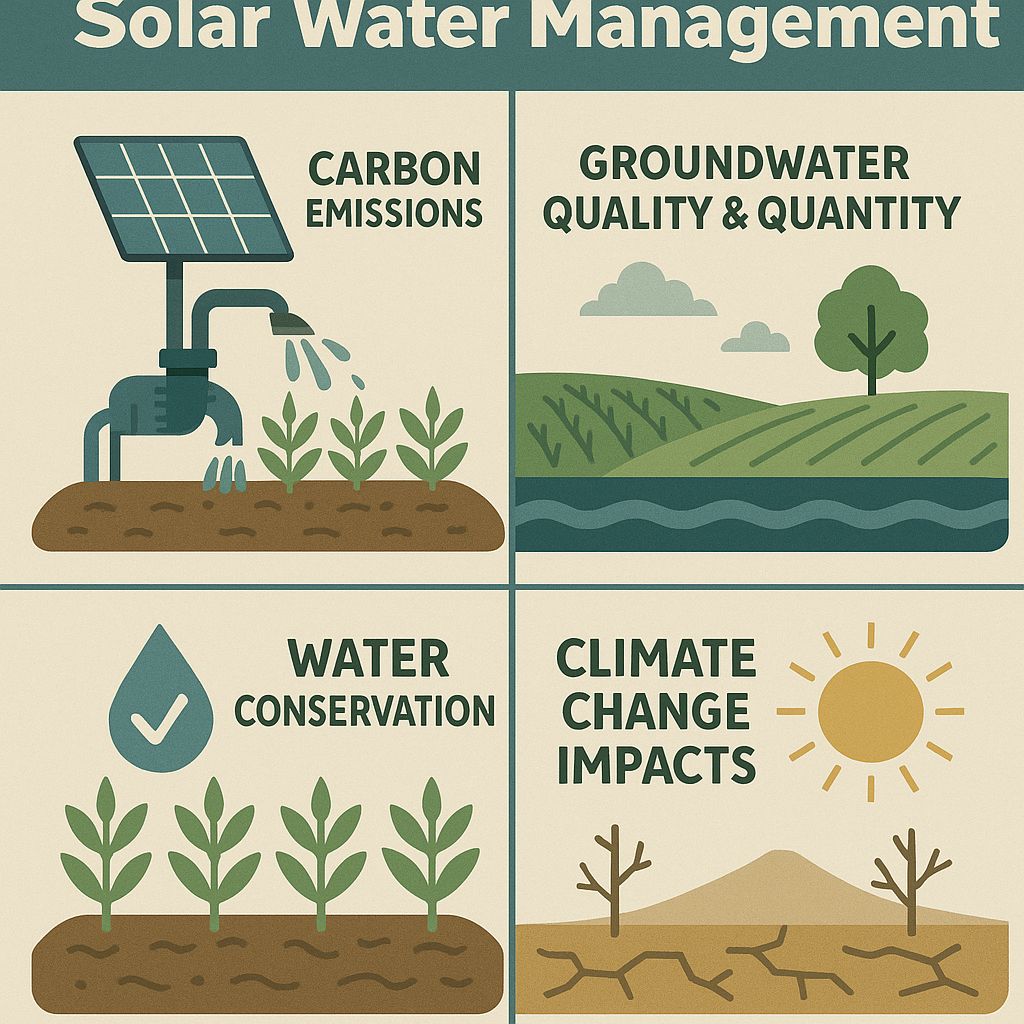
The environmental benefits of solar-powered irrigation extend far beyond water conservation. These systems address multiple aspects of agricultural sustainability, from reducing carbon emissions to preserving groundwater quality and quantity. As climate change impacts intensify, these environmental advantages become increasingly valuable both for individual farm resilience and broader ecosystem health.
Carbon Footprint Reduction
Traditional irrigation systems powered by diesel engines or grid electricity derived from fossil fuels contribute significantly to agriculture’s carbon footprint. A typical diesel pump operating for 1,000 hours per season emits approximately 27 tons of CO₂. Solar-powered irrigation eliminates these direct emissions entirely, supporting both farm-level sustainability goals and broader climate change mitigation efforts.
Beyond operational emissions, solar systems also reduce the embodied carbon associated with fuel transportation and electrical transmission infrastructure. For remote agricultural operations, the elimination of fuel deliveries can save thousands of transportation miles annually. When aggregated across the agricultural sector, widespread adoption of solar irrigation could reduce emissions by millions of tons while improving energy independence.
Groundwater Preservation Benefits
Aquifer depletion threatens agricultural viability in many regions, with withdrawal rates exceeding natural recharge. By reducing total water application volumes through greater efficiency, solar irrigation systems help slow groundwater depletion rates. Some advanced systems incorporate aquifer monitoring and automatically adjust extraction rates to maintain sustainable levels based on real-time data rather than fixed pumping schedules.
The precision application of water also reduces the leaching of nutrients and salts into groundwater. Conventional flood irrigation or excessive sprinkler application can transport nitrates and other water-soluble compounds beyond the root zone and into aquifers. Solar-powered precision systems maintain optimal soil moisture without excessive percolation, protecting groundwater quality while improving nutrient retention in the crop root zone.
Reduced Chemical Runoff
Precise water delivery significantly reduces surface runoff that can carry agricultural chemicals into waterways. By maintaining soil moisture at optimal levels without saturation, solar irrigation systems prevent the formation of runoff flows that transport sediment, fertilizers, and pesticides off-field. This containment of agricultural inputs protects stream health, reduces algal bloom risks in receiving waters, and preserves aquatic ecosystem function.
The Future of Your Farm: Solar Water Systems as Long-Term Investments
Investing in solar-powered water management represents a strategic decision that positions your farm for long-term success in a changing climate and agricultural economy. These systems provide resilience against both energy price volatility and water availability challenges that are expected to intensify in coming decades. The modular nature of solar technology also allows for incremental expansion and upgrades as needs change and technologies advance, protecting the initial investment while accommodating future innovation.
Conclusion:
Solar-powered irrigation systems transform how farms use water, creating opportunities for significant conservation while improving crop production and reducing operating costs. By harnessing the sun’s energy to power precision water delivery, these systems align agricultural practices with environmental sustainability goals without compromising productivity. Whether you’re farming in water-stressed regions or simply looking to reduce input costs, solar irrigation offers compelling advantages that will only increase in value as water and energy constraints intensify. Growing Solarmist provides comprehensive solar irrigation solutions designed specifically for agricultural operations of all sizes, helping farmers achieve water independence through renewable energy.
Frequently Asked Questions
These common questions address key considerations for farmers evaluating solar irrigation systems. Understanding these factors helps in planning successful implementations that meet specific farm needs while maximizing return on investment.
The answers below reflect real-world experience from hundreds of agricultural installations across diverse growing conditions and crop types. Each farm situation remains unique, however, and professional site assessment provides the most accurate guidance for your specific operation.
How much water can I actually save with a solar irrigation system?
Most farms achieve 20-30% water savings in the first year, with some reaching 40-50% reduction after system optimization. The exact savings depend on your current irrigation method, soil type, crops grown, and climate conditions. Converting from flood irrigation to solar-powered drip systems typically yields the highest percentage savings, while transitions from existing sprinkler systems to solar-powered precision sprinklers show more moderate improvements. Your savings will be greatest in situations where current water application significantly exceeds actual crop requirements or where distribution uniformity is poor.
What’s the minimum farm size needed to make solar water systems worthwhile?
Solar irrigation can be economically viable for operations as small as 3-5 acres, especially for high-value crops or in regions with high electricity costs. The economics improve with scale, but modular system design allows starting small and expanding over time. For very small operations, portable solar pumping systems that can be moved between locations offer an entry-level option with lower initial investment.
Rather than acreage alone, the determining factors often include current irrigation energy costs, water expenses, available incentives, and crop value. High-value specialty crops like berries or vegetables can justify more sophisticated systems on smaller acreages than commodity crops. Similarly, areas with expensive electricity, limited grid access, or severe water constraints may find solar irrigation economical even for smaller plots.
Do solar panels work for all crop types?
Solar irrigation systems can be adapted to virtually any crop type by selecting appropriate water delivery components and control parameters. Row crops, orchards, vineyards, vegetables, and field crops all benefit from precision water delivery powered by solar energy. The key differences lie in the distribution components rather than the energy source—drip emitters for row crops and trees, micro-sprinklers for ground crops with broader root systems, or precision sprinklers for field-scale production. System design should consider specific crop water needs, root zone characteristics, and seasonal demand patterns.
What maintenance is required for solar water systems?
Solar irrigation systems require minimal maintenance compared to fossil fuel alternatives. Panel cleaning represents the most frequent task, typically needed 2-4 times annually depending on local dust conditions. This usually involves simple water rinsing or light brushing to remove accumulated dust that can reduce efficiency. System inspections should check for electrical connections, monitor pump performance, and verify sensor function at the beginning of each growing season.
Distribution components require standard agricultural irrigation maintenance—checking for leaks, cleaning filters, flushing lines, and inspecting emitters for clogging. The elimination of internal combustion engines significantly reduces mechanical maintenance requirements, with solar pumps typically operating for 5-7 years before requiring service. Most systems include monitoring capabilities that alert operators to performance issues before they become critical, allowing preventive maintenance rather than emergency repairs.
Can I still use my solar water system during cloudy or rainy days?
Modern solar irrigation systems incorporate multiple strategies for operation during periods of limited sunlight. Battery storage can provide energy for critical irrigation during extended cloudy periods, though this adds cost to the system. Water storage represents a more economical approach, allowing excess water to be pumped during sunny periods and stored for use when solar production decreases. Many farms implement hybrid systems that maintain grid connections as backup while prioritizing solar power whenever available.
It’s worth noting that irrigation requirements often naturally decrease during cloudy or rainy periods due to reduced evapotranspiration and potential natural rainfall. Smart controllers adjust irrigation schedules based on weather conditions, automatically reducing water application when natural moisture is available. This natural alignment between solar availability and irrigation needs improves the practical functionality of these systems beyond what theoretical calculations might suggest. For more information on optimizing solar panel systems for farms, check out the best farm batteries for solar panels.
Solar panels have become an essential tool for improving water efficiency on farms. By harnessing solar energy, farmers can power their irrigation systems more sustainably and reduce their reliance on traditional energy sources. This not only helps in conserving water but also reduces the overall carbon footprint of agricultural operations. For more information on how solar energy is revolutionizing farming, visit this Earth Day article.







Leave a Reply