

“What is Heterojunction Technology (HJT …” from solup.com and used with no modifications.
Key Takeaways
- HJT solar panels deliver 22–26% efficiency, outperforming most conventional farm solar installations and generating more power from the same roof or land area.
- Farmers can realistically cut monthly electricity bills by up to 85% with a properly sized HJT system, with full payback typically achieved within 5–7 years.
- The bifacial design captures reflected light from the ground, making open farmland one of the best possible environments for this technology — a major advantage standard panels can’t match.
- Federal programs like the USDA REAP grant and 30% ITC can dramatically reduce upfront installation costs, making HJT accessible even for mid-sized operations.
- Agrivoltaic farming — growing crops directly beneath HJT solar arrays — is emerging as one of the most productive dual-use land strategies in modern agriculture. Keep reading to see which crops thrive under panels.
HJT solar panels are quietly changing what’s financially possible on the modern farm — and the numbers are hard to ignore.
Farming is one of the most energy-intensive industries on the planet. Irrigation pumps run for hours, grain dryers cycle through the night, cold storage never switches off. Energy costs eat directly into margins that are already razor-thin. Growing Solar Mist covers the full scope of how HJT solar technology is being applied across agricultural operations, from small family farms to large commercial growers.
What are HJT Solar Panels
HJT stands for Heterojunction Technology. It’s a solar cell design that layers two different types of silicon — a crystalline silicon wafer sandwiched between ultra-thin amorphous silicon films — to capture a wider spectrum of sunlight than a single-material cell can manage. The result is a panel that converts more of the light hitting it into usable electricity.
Standard monocrystalline panels use a single layer of silicon and top out at around 20–22% efficiency under real-world conditions. HJT panels consistently hit 22–26% efficiency, and the best commercial units are pushing past that. That gap might sound small, but on a working farm where you’re covering hundreds of square meters of roof or ground space, even a 3–4% efficiency advantage translates into thousands of additional kilowatt-hours per year.
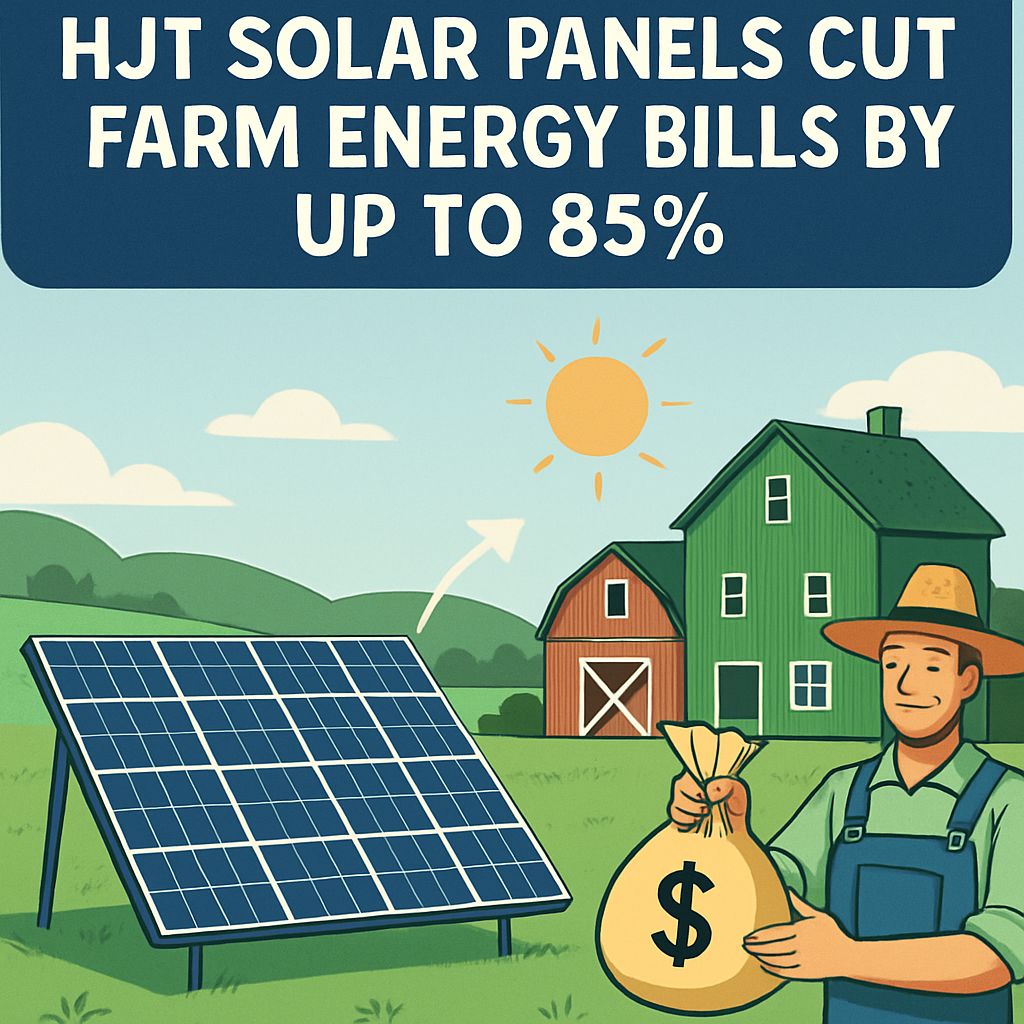
HJT Solar Panels Cut Farm Energy Bills by Up to 85%
A mid-sized grain and livestock operation can easily spend $3,000–$6,000 per month on electricity during peak seasons. HJT solar doesn’t just trim that bill — it can gut it. Farms with properly designed systems routinely report reductions of 70–85% on their monthly energy costs, with some off-grid setups eliminating grid dependence entirely.
The payback window on an HJT installation for farming typically lands between 5 and 7 years, depending on system size, local utility rates, and available incentives. After that crossover point, the energy the system produces costs the farm essentially nothing for the remaining 20-plus years of the panel’s rated life. That’s a fundamental shift in how a farm’s operating costs are structured.
Beyond the raw bill savings, HJT systems provide something conventional energy contracts never can: price certainty. Utility rates have climbed steadily for decades. Locking in your energy production with solar insulates the operation from those increases permanently.
What Makes HJT Different from Standard Solar Panels
The core difference is the cell architecture. Traditional monocrystalline PERC panels use a back-surface passivation layer to reduce energy loss, but they’re still working with a single silicon junction. HJT panels create two junctions — one at each silicon interface — which means electrons have more opportunities to be captured before they recombine and are lost as heat.
This also explains why HJT panels handle heat so much better. Every solar panel loses efficiency as temperatures rise, measured by the temperature coefficient. Standard panels typically carry a coefficient of around -0.35% to -0.45% per degree Celsius above 25°C. HJT panels come in at roughly -0.24% to -0.26% per degree Celsius. On a 95°F summer afternoon in a farm field, that difference is significant — HJT panels lose only about 10–12% of rated capacity versus 15–20% for conventional panels.
Why Farms Are the Ideal Environment for HJT Technology
Open agricultural land is one of the best deployment environments HJT panels could ask for. The bifacial capability of most HJT panels — the ability to generate power from both the front and back surfaces — depends on reflected light bouncing off the ground below. Farmland, particularly light soil, gravel paths, and harvested fields, reflects significantly more light than urban rooftops surrounded by dark materials. That reflected light contribution can add 10–30% more energy generation on top of the panel’s direct-sunlight output.
How HJT Solar Panels Work on a Farm
Understanding the basics of how these panels function helps farmers make smarter decisions about system design, placement, and sizing. For a deeper comparison, check out the benefits of monocrystalline vs. thin film solar panels.
The Heterojunction Cell Structure Explained Simply
Picture a sandwich. The middle layer is a thin wafer of crystalline silicon — the same base material used in most solar panels. On each side of that wafer, manufacturers deposit an ultra-thin layer of amorphous (non-crystalline) silicon. These layers act as highly effective passivation zones, dramatically reducing the energy losses that occur when electrons reach the cell’s surface. The front of the panel also gets a transparent conductive oxide coating that lets light through while still conducting electricity. Each of these layers is measured in nanometers — the entire cell structure is thinner than a human hair.
How Bifacial Design Captures More Light Across Open Land
Most HJT panels are bifacial, meaning the back of the panel is also photovoltaically active. When mounted on elevated ground-mount racking or raised agrivoltaic structures, light that passes through gaps between panels — or simply reflects off the ground — hits the rear surface and generates additional electricity. On a working farm with light-colored soil or crop residue, bifacial gains are consistently in the 10–25% range above the panel’s front-side rating. For a 100kW system, that could mean the effective output is closer to 110–125kW without adding a single extra panel.
Performance in Extreme Heat, Cold, and Low-Light Conditions
Farm environments are brutal. Panels bake in summer heat, freeze through winter nights, and spend weeks under overcast skies during rainy seasons. HJT panels are engineered for exactly these conditions. The amorphous silicon layers perform well in diffuse, low-intensity light — which means HJT panels start generating power earlier in the morning and continue later into the evening than standard panels. During cold winter months, the lower temperature coefficient actually works in the farm’s favor: cold, clear days can produce surprisingly strong output from HJT arrays.
Durability metrics back this up. Most HJT panels carry degradation rates of only 0.25–0.30% per year, compared to 0.5–0.7% for standard monocrystalline panels. After 25 years, a quality HJT panel is still operating above 93% of its original rated capacity. For a farm investment that needs to perform for three decades, that retention matters enormously.
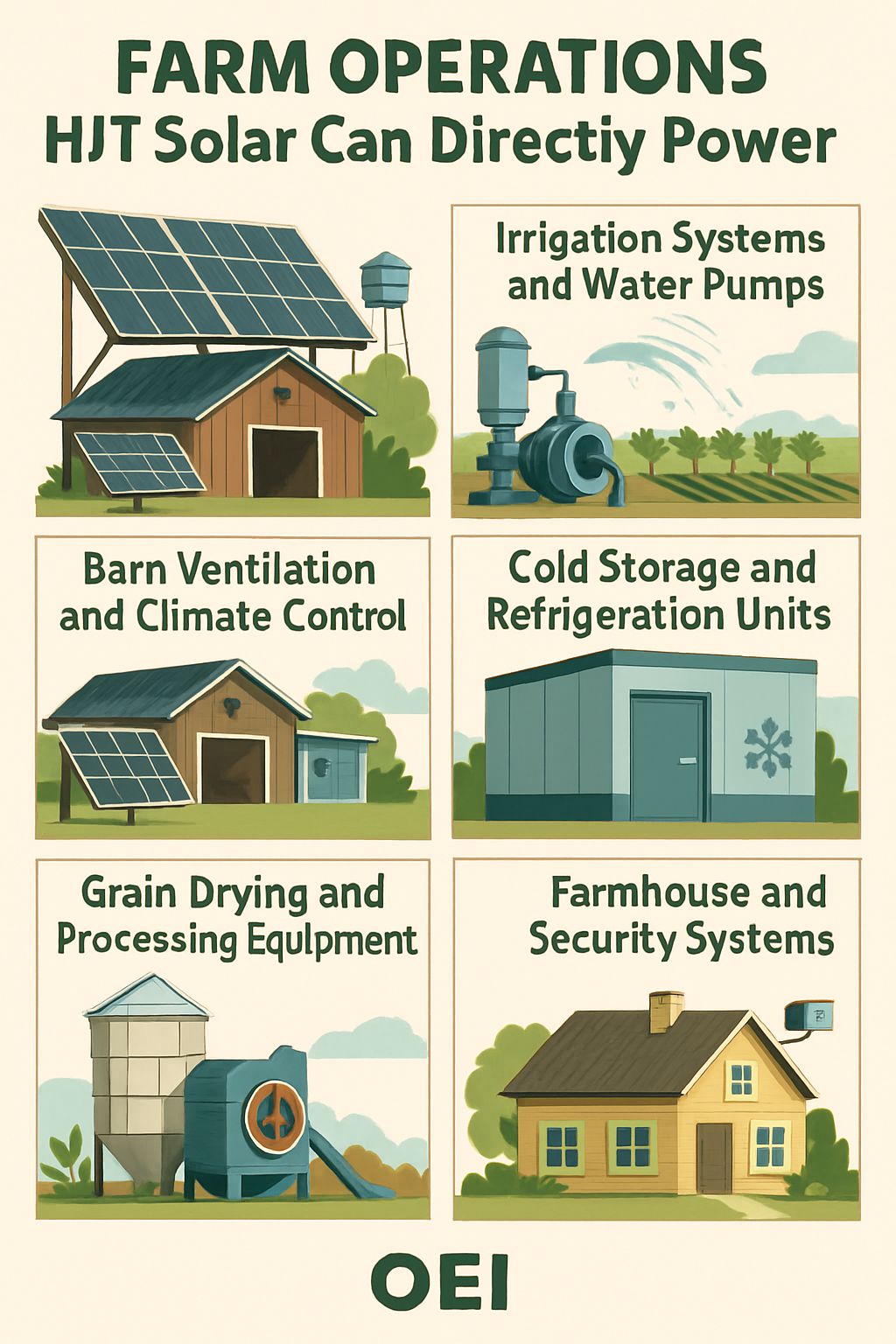
Farm Operations HJT Solar Can Directly Power
HJT solar systems can be matched to virtually any farm energy load — from the smallest water pump to a full-scale grain processing facility. Here’s how the technology maps to the real workloads on a working farm.
Irrigation Systems and Water Pumps
Irrigation is one of the largest and most consistent energy loads on any crop farm. Center-pivot systems, drip networks, and submersible well pumps run for long daily cycles during the growing season — often during the same peak daylight hours when a solar array is producing at maximum output. This natural alignment between solar production and irrigation demand makes HJT solar a near-perfect match for pump-driven water systems.
Off-grid pump setups are especially effective with HJT panels. For remote fields where grid connection costs are prohibitive, a dedicated HJT array paired with a variable frequency drive (VFD) pump controller can deliver reliable irrigation power with no monthly utility bill and no trenching costs. Systems can be scaled from a single 5kW array running a small submersible pump to multi-array installations managing full center-pivot networks across hundreds of acres.
- Grid-tied systems let farmers offset pump energy costs through net metering, banking solar credits during off-peak hours.
- Off-grid systems with battery storage or direct DC pump drives eliminate grid dependency for remote field locations entirely.
- Hybrid configurations combine solar priority with grid backup, ensuring irrigation never stops due to cloudy weather.
- VFD pump controllers match pump speed to available solar output in real time, maximizing water delivery efficiency across variable light conditions.
Farms that have converted irrigation systems to HJT solar power report some of the fastest payback periods of any agricultural solar application, largely because irrigation energy costs are so predictable and consistent season over season.
Barn Ventilation and Climate Control
Poultry houses, hog barns, and dairy facilities run ventilation systems around the clock to maintain air quality and animal health. These systems draw continuous power — often representing 30–40% of a livestock operation’s total energy consumption. HJT solar arrays mounted on barn rooftops can directly offset this load, and the south-facing pitch of most agricultural buildings provides an excellent installation surface.
For climate-controlled livestock facilities, the peak ventilation demand in summer aligns closely with peak solar production, just as it does with irrigation. A well-sized rooftop HJT installation on a large poultry house can cover the majority of ventilation energy needs during the hottest months when both electricity demand and solar output are at their highest simultaneously.
Cold Storage and Refrigeration Units
Cold storage is a non-negotiable energy load for produce farms, dairy operations, and meat processors. Refrigeration compressors run continuously, and a single large walk-in cooler can consume 8,000–15,000 kWh per year on its own. Multiply that across multiple storage units on a diversified farm and refrigeration can easily become the single largest line item on the electricity bill.
HJT solar pairs exceptionally well with cold storage loads because refrigeration demand, while constant, is manageable with a properly sized battery-backed solar system. Excess daytime solar production charges battery banks that then power compressors through the night, effectively making cold storage a 24-hour solar-powered operation without requiring grid connection at all. For more on solar solutions, explore the benefits of monocrystalline solar panels for farming operations.
Grain Drying and Processing Equipment
Grain drying is one of the most energy-intensive processes in row crop agriculture. A propane or electric grain dryer processing a large corn harvest can burn through enormous amounts of energy in a compressed post-harvest window. While a solar system won’t replace propane-fired drying entirely, HJT arrays can offset the substantial electrical loads tied to augers, conveyors, fans, and monitoring systems that run alongside drying operations.
The strategic play here is using solar-generated electricity throughout the growing season to bank net metering credits, then drawing those credits down during the high-energy harvest and drying period in fall. This credit-banking approach effectively lets summer sunshine subsidize fall grain processing costs — a smart financial move that many grain farmers are already executing. To learn more about how solar panels can maximize energy efficiency on farms, check out this guide on bifacial solar panels.
Farmhouse and Security Systems
The farmhouse, outbuildings, and perimeter security systems represent a consistent baseline load that HJT solar handles with ease. Modern farm security setups — including camera networks, motion lighting, electric fence energizers, and alarm systems — draw relatively modest power but run continuously. Covering these loads with solar frees up grid capacity for heavier equipment and further reduces the monthly bill. For farm families living on-site, residential energy costs fold naturally into the same solar installation that serves the agricultural operation, improving the overall return on the system investment.
The Real Cost Savings HJT Solar Delivers for Farmers
The financial case for HJT solar on farms is built on four pillars: direct energy bill reduction, accelerated tax depreciation, federal grant funding, and long-term price stability. Stack all four together and the economics become genuinely compelling for most medium-to-large operations.
Monthly Electricity Bill Reductions Farmers Can Expect
A properly designed HJT system sized to cover 80–100% of a farm’s baseline energy load will typically reduce monthly electricity bills by 70–85%. For a farm spending $4,000 per month on electricity, that’s $2,800–$3,400 back in the operation’s pocket every single month. Over a full year, that’s $33,600–$40,800 in savings — before accounting for any incentive programs.
The exact reduction depends on local utility rates, net metering policy in your state, system sizing, and seasonal production variability. Farms in high-irradiance states like California, Texas, and the Southeast tend to see the fastest returns, but even northern agricultural states with shorter summers report strong 7–10 year payback timelines when incentives are factored in. For those considering solar options, understanding the best solar panels for farmers can further enhance the efficiency and return on investment.
MACRS Depreciation and Tax Advantages for Farm Solar
Farm solar installations qualify for the Modified Accelerated Cost Recovery System (MACRS) depreciation schedule, allowing the full system cost to be depreciated over just 5 years for federal tax purposes. When combined with bonus depreciation provisions — which have allowed 80–100% first-year depreciation in recent years — this can generate a substantial tax deduction in the very first year of operation. For a farm structured as an LLC or S-Corp, this depreciation flows directly through to the owner’s personal tax return, reducing taxable farm income significantly in the year the system is placed in service. Learn more about maximizing energy savings with bifacial solar panels for farm operations.
USDA REAP Grants and Federal Tax Credits That Cut Installation Costs
The USDA Rural Energy for America Program (REAP) grant covers up to 50% of a solar installation’s total project cost for eligible agricultural producers and rural small businesses. Combined with the federal Investment Tax Credit (ITC) — currently set at 30% under the Inflation Reduction Act — it’s mathematically possible for a farm to recover 60–70% of its total installation cost through grants and tax credits alone, depending on application success and tax position.
- USDA REAP Grant: Covers up to 50% of eligible project costs for agricultural producers.
- Federal ITC (30%): A direct tax credit equal to 30% of the total system installation cost.
- MACRS 5-Year Depreciation: Accelerated depreciation schedule specifically for solar equipment.
- State-Level Incentives: Many states layer additional rebates, property tax exemptions, and sales tax exclusions on top of federal programs.
- Net Metering Credits: Excess solar production sold back to the grid offsets future electricity costs.
REAP applications are competitive and run on a quarterly cycle. Working with an experienced solar developer who understands the agricultural grant process significantly improves approval odds and ensures the project documentation meets USDA requirements.
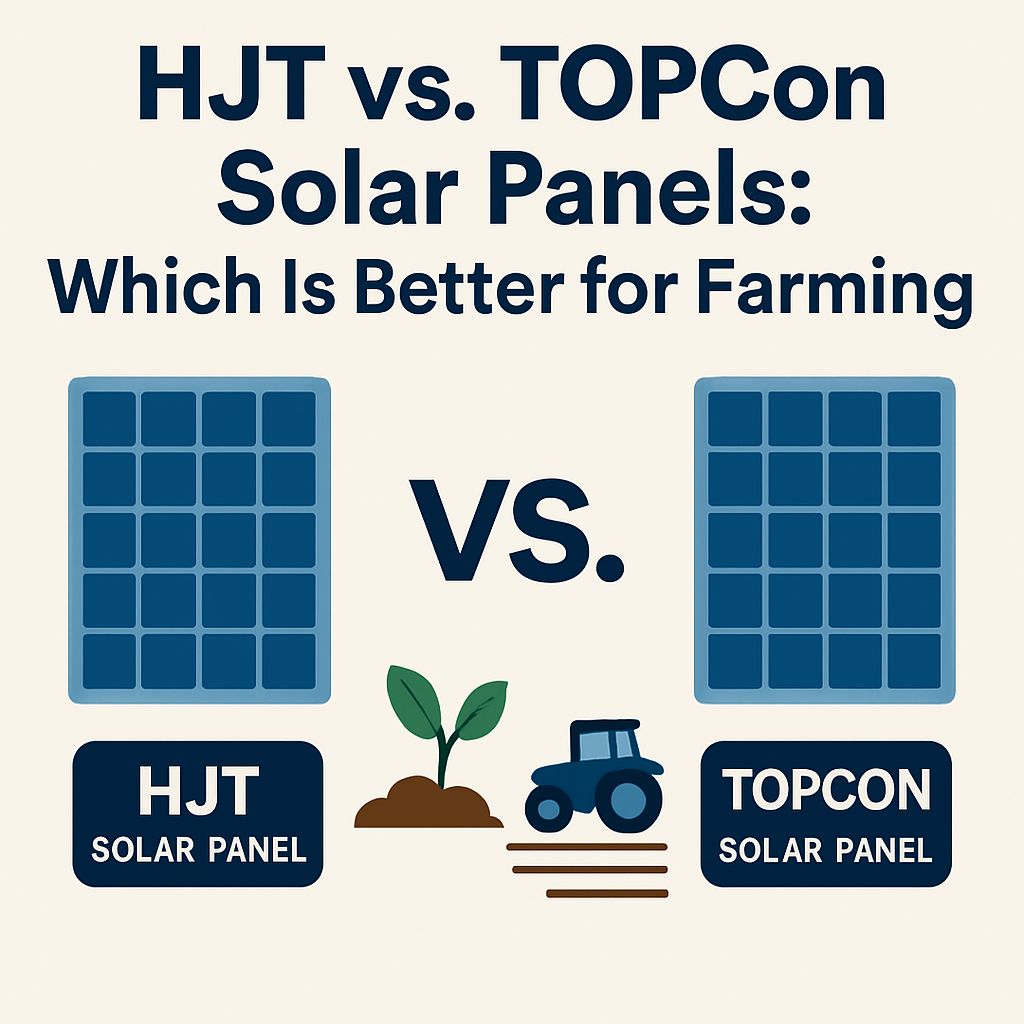
HJT vs. TOPCon Solar Panels: Which Is Better for Farming
TOPCon (Tunnel Oxide Passivated Contact) panels are HJT’s closest technology rival and the comparison comes up constantly in agricultural solar conversations. Both are high-efficiency, next-generation technologies that outperform older PERC panels — but they’re not identical.
Feature
HJT Panels
TOPCon Panels
Efficiency Range
22–26%
21–24%
Temperature Coefficient
-0.24% to -0.26% / °C
-0.30% to -0.35% / °C
Low-Light Performance
Excellent
Very Good
Bifacial Capability
Standard on most models
Available on select models
Annual Degradation Rate
0.25–0.30%
0.40–0.50%
Typical Upfront Cost
Higher
Moderate
Best Farm Application
High-heat, space-limited, agrivoltaic
Budget-conscious, large open arrays
For farms operating in hot climates, with limited roof or ground space, or pursuing agrivoltaic setups where maximum output per panel matters, HJT is the stronger choice. TOPCon makes more financial sense for large flat-land installations where cost per watt is the primary driver and heat exposure is moderate. Over a 25-year lifespan, HJT’s lower degradation rate means it consistently outproduces TOPCon panels of the same rated capacity — a critical factor for long-term farm energy planning.
Agrivoltaic Farming: Growing Crops and Generating Power Simultaneously
Agrivoltaic farming — the practice of co-locating solar panels and agricultural production on the same land — is one of the most exciting developments in modern sustainable agriculture. Instead of choosing between energy production and food production, agrivoltaic systems deliver both from the same acreage simultaneously. HJT panels, with their high efficiency and bifacial design, are among the most effective panel technologies for agrivoltaic deployment.
What Agrivoltaic Farming Actually Looks Like
In practice, agrivoltaic installations use elevated mounting structures that position solar panels 8–14 feet above the ground, leaving enough clearance for farm equipment to pass underneath and for crops to receive adequate sunlight. The panels are typically spaced to allow partial sunlight to reach the ground in alternating patterns throughout the day, creating a dynamic light environment that many crops adapt to effectively.
The structures themselves serve dual functions. The racking system provides shade that reduces crop water stress during hot summer periods, while the panels above generate electricity for the farm’s operational needs or grid export. Research from institutions studying agrivoltaic systems has found that the microclimate created beneath elevated solar arrays can actually reduce water consumption in crops by 20–50% compared to fully exposed field conditions — a significant benefit in drought-prone agricultural regions.
Agrivoltaic System Configurations Used on Working Farms:
Configuration Type
Panel Height
Best For
Equipment Access
High Clearance Ground Mount
10–14 ft
Row crops, vegetables
Full tractor access
Greenhouse-Integrated
Roof-mounted
Specialty crops, seedlings
Internal only
Orchard Canopy Arrays
Above tree canopy
Fruit trees, berries
Limited
Pasture Solar (Silvopasture)
8–10 ft
Livestock grazing
Livestock and small equipment
Pasture-based agrivoltaic setups — sometimes called solar grazing — are gaining particular traction among livestock farmers. Sheep are the most commonly used grazing animal beneath solar arrays, as their size allows them to move freely under standard racking heights while naturally managing vegetation that would otherwise require mechanical mowing. Several solar farms across the U.S. have formalized this arrangement through lease agreements with local shepherds, creating an additional revenue stream for both the solar operator and the grazing farmer. For more insights, you can explore how HJT solar panels are powering farming operations.
The economic model strengthens considerably when agrivoltaic income streams are combined. A single acre of agrivoltaic farmland can simultaneously generate solar electricity revenue, continue producing crop or livestock income, and potentially qualify for both agricultural and renewable energy tax incentives — a triple-stacked return that conventional single-use land simply cannot match.
Which Crops Perform Best Under HJT Solar Arrays
Not every crop thrives under partial shading, but a surprisingly broad range of food crops perform well — and in some cases better — under agrivoltaic conditions. Shade-tolerant and shade-intermediate crops are the primary candidates, and results from operational agrivoltaic farms consistently show that the right crop-panel pairing produces yields comparable to fully open-field production.
Leafy greens are among the standout performers. Lettuce, spinach, kale, and Swiss chard all show strong adaptability to the dappled light conditions beneath elevated HJT arrays. These crops can actually suffer from excessive direct sun exposure in midsummer, making the partial shade provided by solar panels a genuine agronomic benefit rather than a compromise. Berry crops — including strawberries, raspberries, and blueberries — have also shown favorable responses to agrivoltaic conditions in multiple research trials.
Pasture grasses and forage crops perform reliably under solar arrays, maintaining adequate production for livestock grazing. Root vegetables like carrots and beets, along with herbs such as basil and cilantro, round out the list of crops that adapt well to agrivoltaic environments.
Crop Category
Examples
Agrivoltaic Performance
Key Benefit
Leafy Greens
Lettuce, Spinach, Kale
Excellent
Reduced heat stress, extended season
Berry Crops
Strawberries, Raspberries
Very Good
Lower water demand, fruit quality
Forage / Pasture
Ryegrass, Clover, Alfalfa
Good
Maintains grazing productivity
Root Vegetables
Carrots, Beets
Good
Soil moisture retention
Culinary Herbs
Basil, Cilantro, Parsley
Good
Reduced bolting in summer heat
Full-Sun Row Crops
Corn, Soybeans
Limited
Requires careful panel spacing
How to Size an HJT Solar System for Your Farm
Sizing is where most farm solar projects either succeed or fall short. An undersized system leaves money on the table and fails to cover peak loads. An oversized system increases upfront costs without delivering proportional returns. Getting this right requires looking at your actual energy consumption data — not rough estimates — and matching panel output to the specific demand profile of your operation. For those interested in understanding more about solar panel options, consider exploring monocrystalline vs bifacial solar panels to find the best fit for your farm’s needs.
The good news is that farms generate excellent energy data. Utility bills, irrigation run-time logs, grain dryer fuel records, and equipment hour meters all feed into an accurate consumption baseline. Most solar developers will request 12–24 months of utility bills as the starting point, then layer in equipment-specific load data to build a complete picture of when and how your farm consumes electricity throughout the year.
A critical but often overlooked factor in farm solar sizing is the difference between your average daily load and your peak demand. A farm might average 300 kWh per day across the year but spike to 800 kWh on days when the grain dryer, irrigation system, and cold storage are all running simultaneously. The solar system doesn’t need to cover every peak in real time — that’s what grid connection or battery storage handles — but the design needs to account for those spikes to avoid demand charge penalties from the utility.
Farm Type
Estimated Daily Energy Use
Recommended System Size
Estimated Annual Savings
Small Hobby Farm (<50 acres)
30–80 kWh/day
10–25 kW
$3,000–$8,000/year
Mid-Size Crop Farm (50–500 acres)
150–400 kWh/day
50–150 kW
$15,000–$45,000/year
Large Grain Operation (500+ acres)
500–1,200 kWh/day
200–500 kW
$60,000–$150,000/year
Dairy or Livestock Facility
300–700 kWh/day
100–250 kW
$35,000–$85,000/year
Greenhouse / Specialty Produce
200–600 kWh/day
75–200 kW
$25,000–$70,000/year
Calculating Your Farm’s Daily Energy Consumption
Pull your last 12 months of utility bills and identify both your total monthly kWh consumption and your peak demand charges. Divide each monthly total by the number of days in that month to get your average daily consumption. Identify the three highest-consumption months — those represent your design load. A 200 kW HJT system in a high-irradiance region producing 5–6 peak sun hours per day will generate roughly 1,000–1,200 kWh daily during summer months, dropping to 400–600 kWh in winter. If your peak months average 800 kWh per day, that system covers your demand with room to export during summer and relies on the grid or stored credits to supplement during winter.
Matching Panel Output to Seasonal Energy Demand
Farms don’t consume energy evenly across seasons, and neither do solar panels produce it evenly. The design goal is to align your highest-output solar months with your highest-consumption farm months wherever possible. Fortunately, on most crop farms, this alignment is natural — summer brings both maximum solar irradiance and peak irrigation, ventilation, and cooling loads. The challenge arises in the fall harvest and drying season, which often extends into October and November when solar production is declining.
The practical solution is to deliberately oversize the system slightly relative to summer baseline loads so that the surplus production during peak months builds up net metering credits. Those credits then cover the gap when fall energy demand spikes and solar output drops. A system sized at 110–120% of your annual baseline consumption typically achieves the best financial balance, covering year-round needs without generating so much excess that net metering credits go unused.
Season
Solar Production Level
Typical Farm Energy Demand
Net Position
Spring
High (rising)
Moderate (planting, irrigation start)
Surplus — build credits
Summer
Peak
High (irrigation, ventilation, cooling)
Balanced to slight surplus
Fall
Moderate (declining)
Very High (harvest, grain drying)
Draw on stored credits
Winter
Low
Low to Moderate (heating, base loads)
Partial grid supplement
This seasonal production and demand cycle is exactly why net metering policy in your state matters so much to the financial outcome of a farm solar investment. States with full retail-rate net metering deliver the strongest returns because every excess kWh exported to the grid earns a credit equal to what you’d pay to import that same kWh. States with reduced net metering rates or export caps require more careful sizing to avoid generating excess power that earns minimal compensation.
Net Metering: Banking Excess Summer Power for Winter Use
Net metering functions like a solar savings account at the utility. When your HJT array produces more electricity than the farm is consuming at any given moment, the excess flows back to the grid and the utility credits your account at the prevailing rate. When the farm’s demand exceeds solar production — on cloudy days, overnight, or during heavy fall processing loads — you draw from the grid and the utility deducts from your accrued credits before billing you for any remaining balance. Learn how to maximize energy and cut electric bills on farms with bifacial solar panels.
For farms with strong summer surpluses, this mechanism is financially powerful. A grain farm might accumulate $8,000–$12,000 in net metering credits between April and August, then draw those credits down almost entirely during the September through November harvest and drying season. The net annual electricity bill drops to near zero — or in some cases, the farm receives a small annual true-up check from the utility. Understanding your state’s specific net metering rules, including rollover policies and credit expiration timelines, is essential before finalizing system size with your solar developer.
HJT Solar Is the Smartest Long-Term Investment for Modern Farms
When you map HJT solar technology against the real demands of agricultural operations — the relentless energy loads, the tight margins, the brutal operating environments, and the decades-long investment horizon — the match is remarkably strong. Higher efficiency per panel, superior heat and low-light performance, bifacial gains across open farmland, 30-year operational lifespans with minimal degradation, and a stacked incentive structure that can recover 60–70% of installation costs within the first year all converge to make HJT solar not just a viable farm investment, but one of the highest-returning capital decisions a modern farming operation can make.
Frequently Asked Questions
Farmers considering HJT solar consistently ask the same practical questions before committing to an installation. Here are direct answers to the most common ones, based on real-world agricultural solar performance data.
The questions below cover lifespan, cost justification for smaller operations, year-round power capability, maintenance requirements, and performance during poor weather — the five factors that matter most when evaluating solar for a working farm.
How Long Do HJT Solar Panels Last on a Farm?
HJT solar panels are rated for 25–30 years of productive operation, with most manufacturers providing performance warranties guaranteeing at least 92–93% of original rated output after 25 years. The annual degradation rate of 0.25–0.30% is among the lowest of any commercially available solar technology. In practical terms, a 200 kW HJT system installed today will still be generating approximately 185–190 kW of rated capacity in 2050. For farming operations planning generational asset transfers, that longevity makes HJT panels a durable infrastructure investment comparable to grain bins, irrigation pivots, or permanent tile drainage systems. Learn more about solar panels for farmers to explore other options.
Are HJT Solar Panels Worth the Higher Upfront Cost for Small Farms?
For small farms spending $500–$1,500 per month on electricity, the math still works — it just requires careful incentive stacking to make the payback timeline acceptable. A 15–25 kW HJT system on a small farm might cost $40,000–$65,000 before incentives. After the 30% federal ITC and any available REAP grant funding, that net cost can drop to $15,000–$25,000. At that price point, annual savings of $6,000–$15,000 produce payback periods of 2–4 years — which is exceptional by any investment standard. The key for small farm operators is not skipping the incentive application process, as that step is what transforms HJT from an expensive premium product into a financially accessible one.
Can HJT Solar Panels Power an Entire Farm Operation Year-Round?
Yes — but the definition of “entire operation” matters. A grid-tied HJT system with net metering can offset 100% of a farm’s annual electricity consumption on a net basis, meaning the credits accumulated during high-production months cover the deficit during low-production months. The farm remains connected to the grid and draws from it when needed, but the annual net bill approaches zero.
True off-grid operation — where the farm is completely disconnected from utility power — requires a substantially larger panel array combined with significant battery storage capacity to cover multi-day cloudy periods and high-load events. For most farms, this level of energy independence carries a higher upfront cost than a grid-tied system and is typically only pursued when grid connection is unavailable or prohibitively expensive to establish. The majority of agricultural solar projects achieve full energy cost elimination through grid-tied net metering rather than complete grid disconnection.
What Maintenance Do HJT Solar Panels Require in Agricultural Settings?
HJT solar panels are low-maintenance by design, but farm environments introduce specific maintenance considerations that don’t apply to residential or commercial rooftop installations. Dust, pollen, bird droppings, and crop residue can accumulate on panel surfaces and reduce output by 3–8% if left unaddressed. Most farm solar systems benefit from one or two cleaning cycles per year, typically timed around planting and harvest seasons when dust generation is highest. For more information on solar panels used in agriculture, check out this guide on solar panel materials and uses in agriculture.
Beyond surface cleaning, the maintenance checklist for a farm HJT system includes annual inverter inspection, torque checks on mounting hardware after the first freeze-thaw cycle, and vegetation management beneath ground-mount arrays. Inverters — which convert DC solar power to AC grid power — are the component most likely to require service or replacement over a 25-year system life. Most quality string inverters carry 10–12 year warranties, while microinverters and power optimizers typically offer 25-year warranties that align with the panel lifespan.
Electrical connections, combiner boxes, and conduit runs should be inspected annually, particularly on farms where rodents are active, as chewed wiring is a surprisingly common maintenance issue in agricultural solar installations. Specifying metal conduit and rodent-deterrent cable management at installation time eliminates most of this risk upfront and is well worth the modest additional cost during the original build.
How Do HJT Panels Perform During Overcast or Rainy Seasons?
HJT panels outperform most competing technologies in low-light and diffuse light conditions, a direct result of the amorphous silicon layers in the heterojunction cell structure. On overcast days, a quality HJT array will typically produce 15–25% of its rated peak output — meaningfully more than standard monocrystalline panels generate under the same conditions. This enhanced low-light response extends the productive generation window at both ends of the day, capturing usable energy in early morning and late afternoon hours when other panel types have effectively stopped producing.
Extended rainy seasons do reduce total monthly production, but rain also provides a valuable natural cleaning service for panel surfaces, washing off the dust and organic debris that would otherwise accumulate and reduce output. Farms in the Pacific Northwest and other high-precipitation regions that might appear less favorable for solar often find that HJT’s exceptional low-light performance closes much of the gap with higher-irradiance regions.
For farms in regions with defined wet seasons or extended overcast periods, battery storage provides the most reliable solution for maintaining continuous power supply independent of daily weather variability. A properly sized battery bank — sized to cover 1–3 days of baseline farm load — bridges the production gaps during cloudy stretches without requiring grid backup, keeping the operation running smoothly through whatever the weather delivers.
HJT solar panels are revolutionizing the agricultural industry by providing a sustainable and efficient energy source for farming operations. These panels are known for their high efficiency and performance, even in low-light conditions, making them ideal for agricultural settings. By harnessing solar power, farmers can reduce their reliance on traditional energy sources, lower their operational costs, and contribute to environmental conservation. For more information on how HJT solar panels are powering farming operations, you can explore this detailed article on agricultural solutions with HJT solar panels.




Leave a Reply