
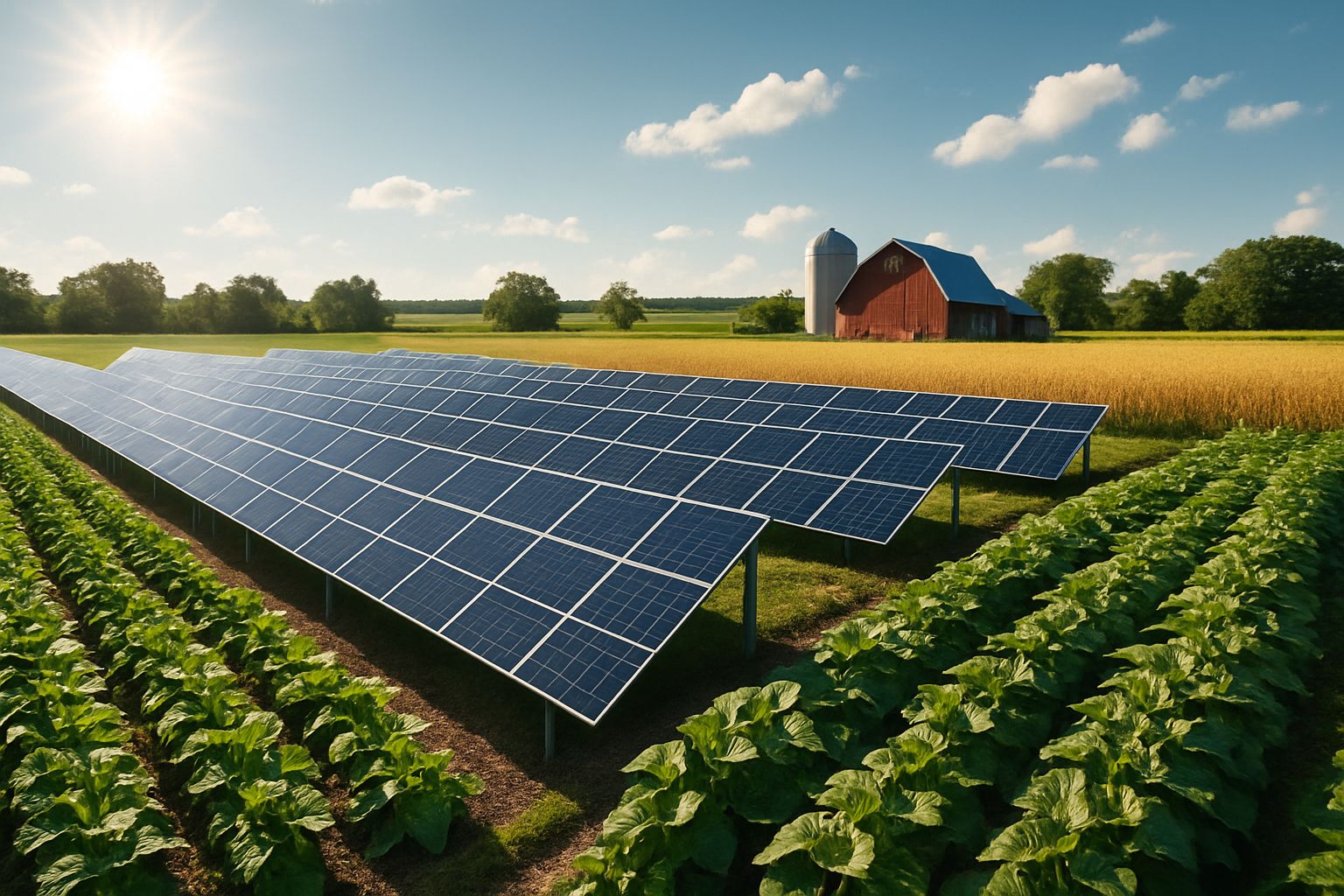
Article At A Glance
- Solar power can reduce a farm’s carbon footprint by up to 30%, making it one of the most impactful sustainability moves an agricultural operation can make.
- Farms that switch to solar typically see a 60–90% reduction in electricity costs, protecting their bottom line from volatile energy markets.
- Agrivoltaics — growing crops underneath solar panels — is quietly revolutionizing how farmers use their land, and the results are surprising.
- Solar energy eliminates reliance on water-intensive power sources, directly protecting irrigation supplies, livestock water, and surrounding ecosystems.
- Growing Solar Mist provides solar power solutions specifically designed for farming operations, helping agricultural producers maximize both environmental and economic gains.
Solar power isn’t just an energy upgrade for farms — it’s a complete environmental reset that’s changing the future of agriculture from the ground up.
For decades, farm operations have quietly been among the largest energy consumers in rural communities. Powering irrigation systems, grain dryers, cold storage, and livestock ventilation adds up fast. Most of that power has traditionally come from the grid — which means fossil fuels, emissions, and rising costs that farmers have little control over. That’s exactly why solar is gaining serious traction across the agricultural sector, and not just for the savings. The environmental case is just as compelling.
Resources like Growing Solar Mist have been at the forefront of helping farming operations understand and access solar solutions tailored to their specific land use and energy demands. The environmental benefits reach far beyond simply reducing an electricity bill.
Solar Power Is Changing How Farms Impact the Planet
Agriculture already faces enormous pressure from climate change — unpredictable rainfall, rising temperatures, and more frequent extreme weather events. What’s often overlooked is that farms also contribute to the very climate pressures they’re trying to survive. Traditional energy use on farms adds greenhouse gases to the atmosphere, draws from water-intensive power infrastructure, and can degrade the surrounding ecosystems that healthy farming depends on.
Solar power breaks that cycle. By generating electricity directly from sunlight, farms remove themselves from fossil fuel dependency and begin producing clean energy on their own land. The impact compounds over time — a well-sized solar system can operate for 25 to 30 years, delivering environmental benefits across every single one of those years without adding emissions into the atmosphere.
The shift isn’t just good for the planet. It positions farms as climate-resilient operations that are better prepared for regulatory changes, consumer preferences for sustainably sourced food, and the long-term viability of the land itself.
By the numbers: Farm operations that install appropriately sized solar systems typically see a 60–90% reduction in electricity costs, while simultaneously cutting their carbon footprint by up to 30% compared to grid-powered operations. These two outcomes — economic and environmental — reinforce each other in ways that make solar one of the smartest long-term investments in modern agriculture.
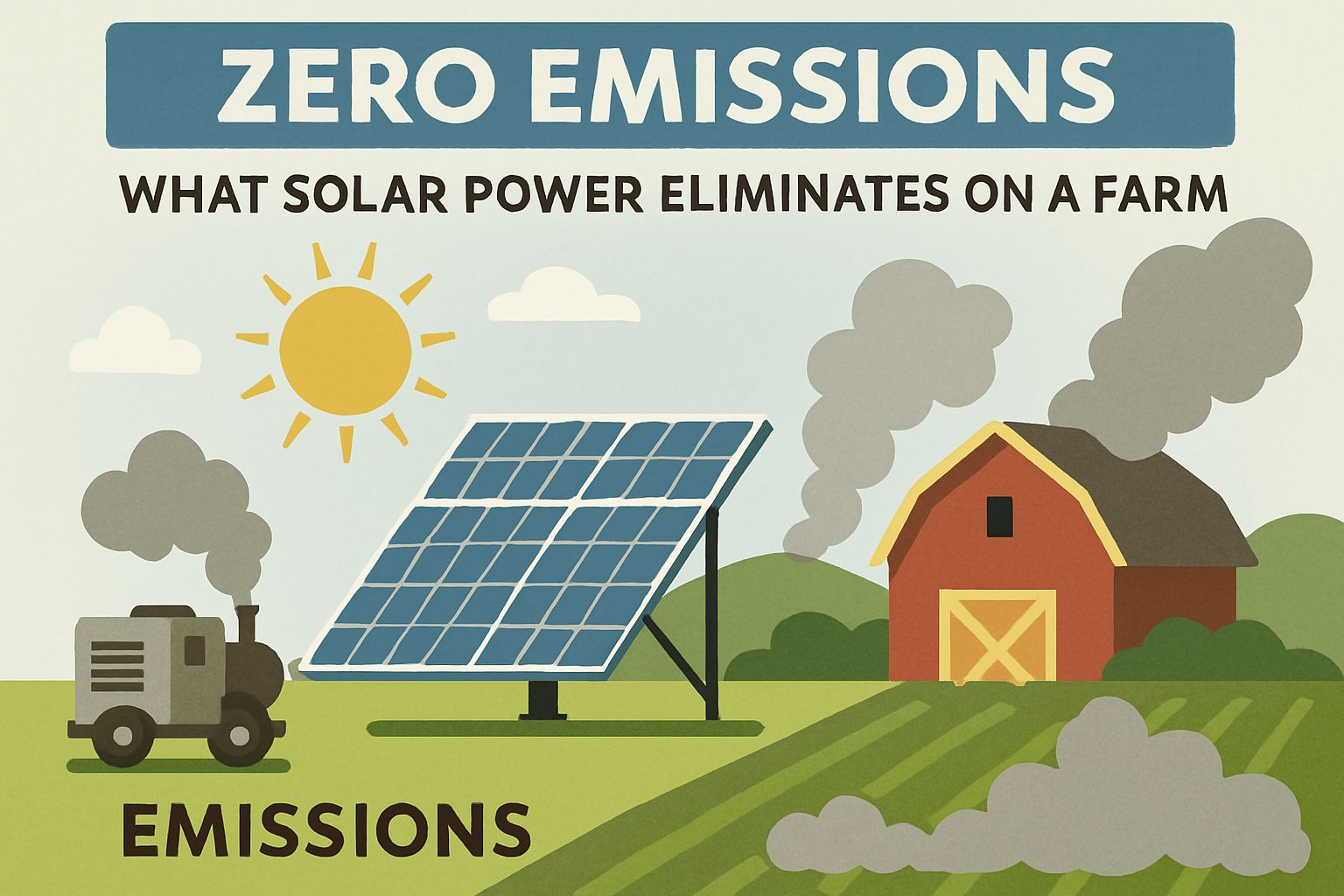
Zero Emissions: What Solar Power Eliminates on a Farm
Solar panels generate electricity through photovoltaic cells — no combustion, no exhaust, no byproducts released into the air. For farm operations that previously relied on diesel generators or grid electricity sourced from coal and natural gas, making the switch to solar eliminates a substantial stream of greenhouse gas emissions at the source.
How Fossil Fuels Damage the Air Around Farmland
Burning fossil fuels to power farm operations releases carbon dioxide, nitrogen oxides, and particulate matter into the surrounding air. In rural agricultural areas, this pollution doesn’t just contribute to global climate change — it directly affects the local environment farmers depend on every day. For those looking to mitigate these effects, exploring alternatives like solar panels for farming can be a sustainable solution.
Nitrogen oxides from diesel-powered equipment and fossil-fuel-sourced electricity interact with sunlight to form ground-level ozone. That ozone damages plant tissue, reduces photosynthesis efficiency, and can measurably lower crop yields over time. Meanwhile, particulate matter settles on soil and water sources, degrading the very resources that make farming possible.
- Carbon dioxide from fossil fuels accelerates climate instability, making seasonal farming patterns less predictable
- Nitrogen oxides contribute to ground-level ozone formation that directly stunts crop growth
- Particulate pollution settles into topsoil and waterways, disrupting soil biology and water quality
- Methane leakage from natural gas infrastructure adds potent greenhouse gases to rural air
The damage isn’t abstract or distant — it shows up in reduced yields, degraded soil health, and contaminated water supplies that farmers rely on season after season.
What Zero-Emission Energy Actually Means in Practice
When a farm runs on solar, the electricity powering irrigation pumps, grain dryers, and cold storage units produces zero direct emissions during operation. The panels convert sunlight into electricity silently, with no exhaust and no ongoing resource consumption beyond sunlight itself. Even accounting for the energy used to manufacture solar panels — which is recovered within 1 to 4 years of operation depending on the system — solar delivers dramatically cleaner energy across its full lifespan compared to any fossil fuel alternative.
For a working farm, this means every kilowatt-hour produced by solar panels is a kilowatt-hour that didn’t require burning coal, natural gas, or diesel. Across a 25-year panel lifespan, that’s an enormous cumulative reduction in the farm’s overall environmental impact.
How Air Quality Improvements Directly Affect Crop Yields
Cleaner air around farmland isn’t just an environmental win in principle — it translates directly into healthier crops. Reduced ground-level ozone means less oxidative stress on plant tissue, which supports stronger photosynthesis and more consistent yields. Farms operating in areas with improved air quality — partly driven by broader solar adoption — see measurable improvements in the growing conditions that determine harvest outcomes season after season.
Solar Power Protects Farm Water Sources
Water is the single most critical resource on any farm, and traditional energy production puts it at serious risk. Moving to solar doesn’t just reduce emissions — it actively protects the water sources that agriculture depends on, from irrigation reservoirs to the groundwater feeding livestock troughs and rural wells.
How Traditional Energy Production Contaminates Water
Coal and natural gas power plants are among the largest industrial consumers of freshwater in existence, using water for cooling towers and steam generation at massive scale. Beyond consumption, fossil fuel extraction and combustion introduces pollutants into waterways through runoff, leachate, and atmospheric deposition. Farms downstream from fossil fuel infrastructure — or relying on shared aquifers — face real contamination risks that solar energy eliminates by removing fossil fuel dependency from the equation entirely.
Why Water Conservation Matters More Than Ever for Farmers
Freshwater availability is increasingly strained across major agricultural regions. Aquifer depletion, drought cycles intensified by climate change, and competing demands from urban development all put pressure on the water supplies farmers depend on. By switching to solar — an energy source that requires no water to operate — farms reduce their indirect water consumption dramatically. Every solar-powered kilowatt-hour is one that didn’t require water to generate, preserving that resource for irrigation, livestock, and ecosystem health where it matters most.
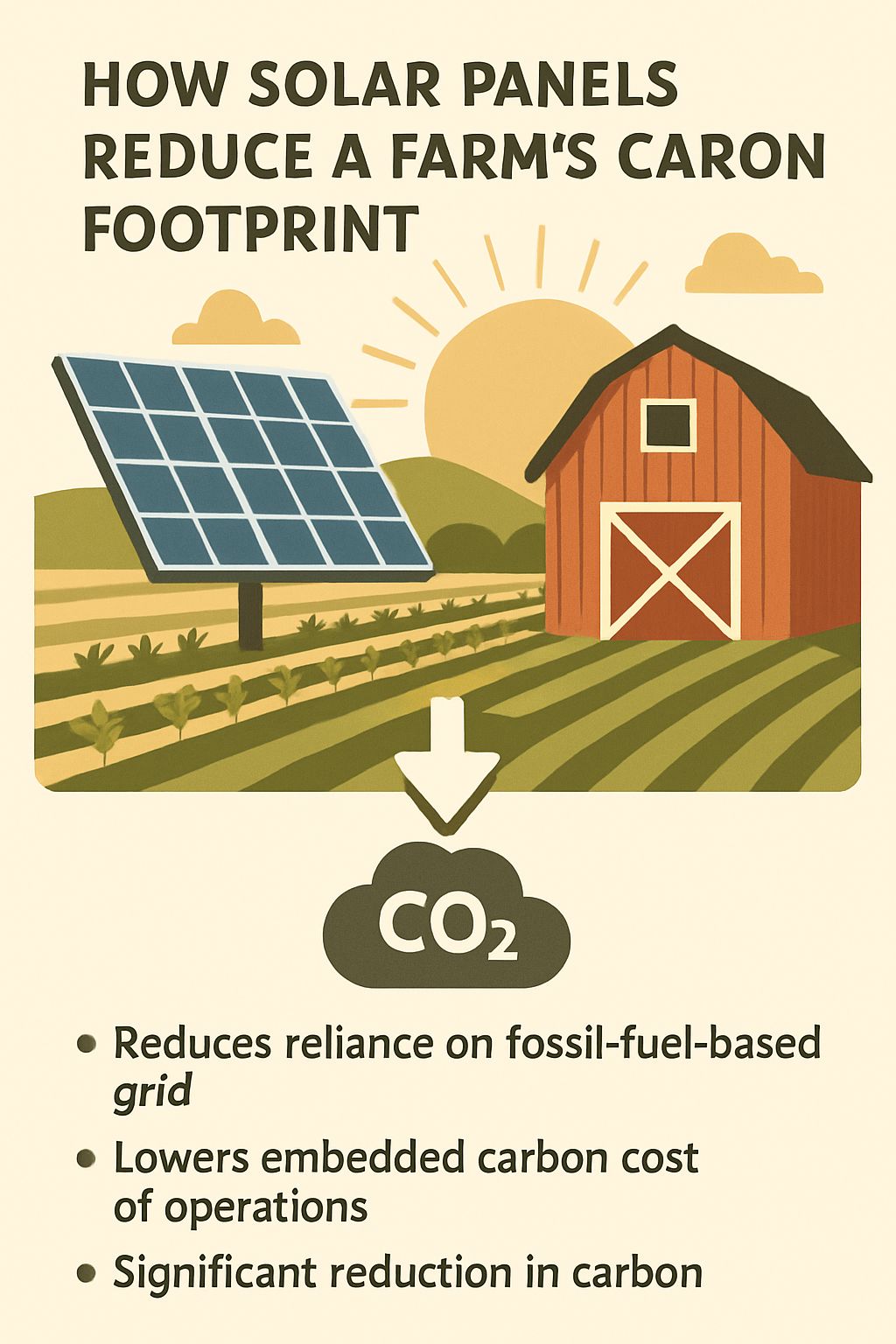
How Solar Panels Reduce a Farm’s Carbon Footprint
The carbon footprint of a farm isn’t just about what’s grown — it’s about how the operation is powered. Every kilowatt-hour drawn from a fossil-fuel-based grid carries an embedded carbon cost that accumulates invisibly across every irrigation cycle, every night of cold storage, every hour of machinery running in the barn. Solar power cuts directly into that hidden footprint, and the reduction is significant enough to matter both environmentally and competitively. Discover how growing under solar panels can also enhance crop yield while reducing environmental impact.
What a 30% Carbon Reduction Looks Like on a Working Farm
A 30% reduction in farm carbon emissions isn’t a theoretical projection — it’s a documented outcome for operations that size and install solar systems appropriately for their energy demands. For a mid-sized grain farm running energy-intensive drying equipment through harvest season, that reduction can translate to tens of thousands of pounds of CO₂ kept out of the atmosphere annually. A dairy operation running continuous refrigeration and ventilation systems sees similar gains, with solar panels offsetting the constant baseline draw that would otherwise be supplied by fossil-fuel-sourced grid electricity.
What makes this number compound over time is the lifespan of the technology. Solar panels carry manufacturer performance warranties of 25 to 30 years, meaning that 30% carbon reduction isn’t a one-season win. It’s a structural change to how the farm operates, delivering emissions benefits every single year across the full life of the installation. Learn more about the environmental benefits of solar energy for farmers.
How Reduced Emissions Benefit Surrounding Ecosystems
When a farm reduces its carbon output, the benefits don’t stop at the property line. Lower local emissions mean reduced acid deposition into surrounding soils and waterways, less nitrogen loading into nearby streams, and a measurable improvement in the air quality that affects both wild and cultivated plant life in the region. Farms exist within ecosystems — the hedgerows, wetlands, woodlots, and waterways that border agricultural land all benefit when the operation at the center becomes cleaner. Solar-powered farms become better neighbors to the natural systems that ultimately support agricultural productivity itself.
Agrivoltaics: Grow Crops and Generate Clean Energy at the Same Time
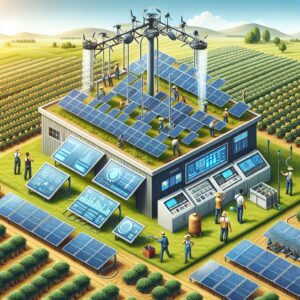
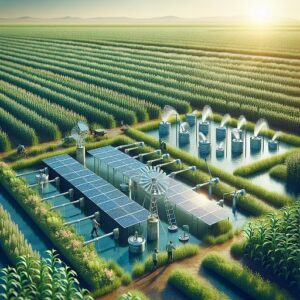
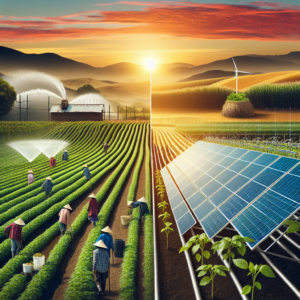
One of the most exciting developments in sustainable agriculture right now sits at the intersection of solar technology and crop science. Agrivoltaics — the practice of growing crops beneath or alongside solar panel arrays — is turning the traditional land-use tradeoff between energy production and food production on its head. Instead of choosing between a solar field and a crop field, forward-thinking farmers are discovering they can have both.
What Agrivoltaics Actually Is
Agrivoltaics involves installing elevated solar panel arrays at heights that allow farming activity to continue underneath them. The panels generate clean electricity while simultaneously providing partial shade to the crops below. This shared land-use model was first systematically studied in the 1980s but has gained serious traction in the last decade as panel costs have dropped and agricultural water stress has intensified.
The setup varies by operation. Some systems use fixed elevated panels spaced to allow tractor access between rows. Others use dynamic tracking panels that adjust their angle throughout the day to manage both energy production and light distribution to crops below. The design is matched to the specific crops being grown and the energy needs of the operation — making agrivoltaics a genuinely flexible system rather than a one-size-fits-all retrofit.
Which Crops Perform Best Under Solar Panels
Not every crop thrives in partial shade, but a substantial range of high-value agricultural products do. Research has consistently shown strong performance outcomes for crops that naturally prefer some relief from intense midday sun — and in drought-stressed regions, the microclimate created beneath solar panels can meaningfully reduce water demand while maintaining or even improving yields.
- Leafy greens (lettuce, spinach, kale) — thrive in partial shade and show reduced bolting under panel coverage
- Herbs (basil, cilantro, parsley) — benefit from temperature moderation provided by overhead panels
- Tomatoes and peppers — show resilience under agrivoltaic systems, particularly in high-heat climates
- Strawberries — produce well under partial shade with documented reductions in water use
- Pasture grasses — maintain productivity under spaced panel arrays while supporting livestock grazing
Crops that demand full, unfiltered sun exposure — like corn grown for maximum yield — are generally better suited to conventional open-field setups. The key is matching the agrivoltaic configuration to the right crops for the specific farm’s climate and goals.
How Dual Land Use Reduces Environmental Pressure
The land use math matters: Traditional utility-scale solar farms remove land from agricultural production entirely. Agrivoltaic systems eliminate that tradeoff — the same acre produces both food and electricity simultaneously, reducing the pressure to convert additional natural land or wildlife habitat for either energy or food production.
As global demand for both food and clean energy grows, the pressure to convert natural land — forests, wetlands, grasslands — into either farms or solar installations intensifies. Agrivoltaics directly reduces that pressure by making existing agricultural land serve both purposes at once. An acre running an agrivoltaic system contributes to energy generation without pulling that land out of food production, which means less incentive to clear adjacent natural habitat to compensate.
There’s also a soil health dimension that’s easy to overlook. Solar panels installed over cropland reduce direct rainfall impact on bare soil, decrease evaporation rates, and moderate soil temperature extremes — all factors that contribute to healthier, more biologically active topsoil over time. The environmental benefit runs deeper than just the electricity generated.
For farmers evaluating whether agrivoltaics makes sense for their operation, the combination of reduced energy costs, maintained or improved crop productivity, and measurable environmental benefits creates a compelling case — particularly as water scarcity and energy costs continue to rise together.
Solar Power Safeguards Local Ecosystems Around Farms
Farms don’t exist in isolation. They’re embedded in landscapes that include streams, woodlands, wetland edges, pollinator corridors, and wildlife habitat — all of which are directly influenced by how the farm operates. Solar power eliminates noise pollution, air emissions, and the chemical risks associated with fossil fuel storage and combustion, creating a quieter, cleaner agricultural footprint that supports rather than degrades the surrounding natural environment. Solar installations also provide incidental habitat benefits — panel edges and understory areas can support pollinator populations, ground-nesting birds, and native vegetation when managed thoughtfully, turning the solar array itself into a functioning part of the local ecosystem rather than a dead zone.
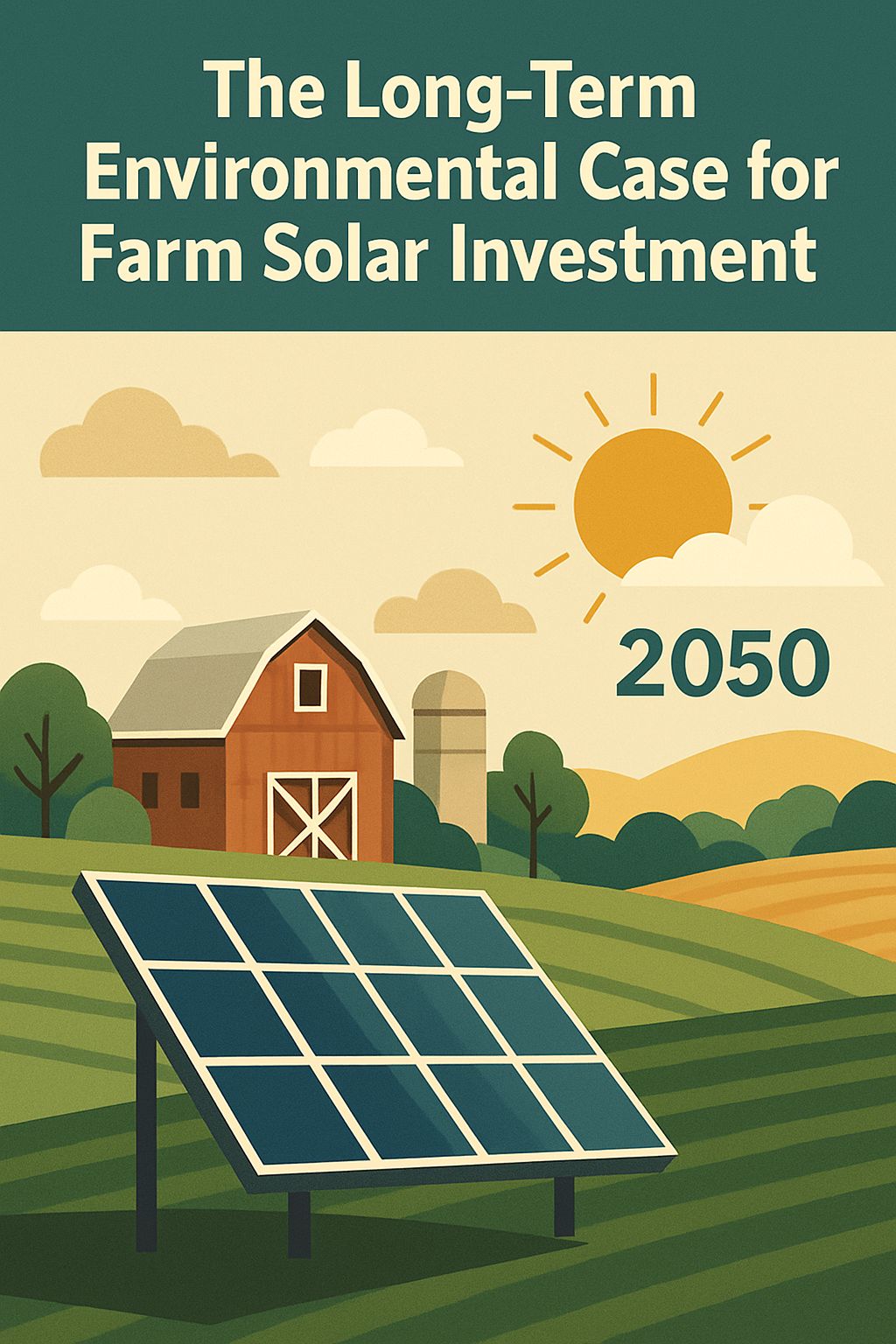
The Long-Term Environmental Case for Farm Solar Investment
The environmental argument for farm solar isn’t a short-term calculation — it’s a decades-long commitment that compounds in value over time. A solar system installed today will still be generating clean electricity and eliminating emissions in 2050, across a period when climate pressures on agriculture are projected to intensify significantly. The farms that invest in solar now are building environmental resilience that will matter more, not less, as the decades progress.
Emerging panel technologies are accelerating those long-term gains. Bifacial solar panels — which capture reflected light from the ground surface on their rear face in addition to direct sunlight on the front — are increasing energy output from the same physical footprint. Higher efficiency means more clean electricity generated per acre, compressing the timeline to full carbon payback and expanding the environmental benefit per installation. Combined with improved battery storage systems that allow farms to bank solar energy for nighttime and cloudy-day use, the technology trajectory strongly favors farms that move toward solar adoption now rather than waiting.
How Solar Panel Longevity Compounds Environmental Benefits
A solar panel installed on a farm barn roof today doesn’t stop being useful after a season or a decade. Most commercial solar panels carry performance warranties guaranteeing at least 80% output efficiency after 25 years of operation, and many systems continue producing well beyond that threshold. That means the carbon savings, the reduced grid dependency, and the eliminated emissions don’t just happen once — they stack up year after year across the full lifespan of the system. The environmental math is cumulative in the most productive way possible.
Compare that to any fossil-fuel-based energy system, which requires continuous fuel consumption, continuous emissions, and continuous environmental cost to maintain operation. Solar flips that model entirely. Once installed, the panels generate clean electricity with no ongoing resource extraction, no combustion, and no emissions — just consistent environmental benefit compounding quietly for decades across the farm’s full operation.
Bifacial Panels and Emerging Technology Improving Sustainability Gains
Bifacial solar panels represent one of the most meaningful recent advances for farm solar applications. Unlike traditional single-face panels, bifacial panels capture light on both their front and rear surfaces — absorbing direct sunlight from above and reflected light from the ground, rooftop, or surrounding surfaces below. In agricultural settings with light-colored soil, gravel paths, or reflective roofing, bifacial panels can produce meaningfully more electricity from the same physical footprint, increasing the environmental return on every acre committed to solar production.
Beyond bifacial technology, improvements in panel efficiency ratings, integrated battery storage systems, and smart inverter technology are all making farm solar installations more capable and environmentally effective than they were even five years ago. Higher-efficiency panels mean less surface area needed to meet a farm’s full energy demand, which reduces land use pressure and preserves more agricultural acreage for food production. Battery systems paired with solar arrays allow farms to store excess daytime generation and draw on it overnight or during cloudy periods — eliminating the remaining grid dependency that previously limited solar’s full environmental impact on farm operations. Learn how you can increase fresh herb growth yield under solar panels to further optimize your farm’s productivity.
Frequently Asked Questions
Farmers researching solar often come in with the same core questions — and the answers are worth getting right. The environmental benefits of farm solar are well-documented, but the specific details matter when making a decision at this scale.
Below are the questions that come up most consistently, answered directly with the specifics that actually help agricultural producers evaluate whether solar is the right move for their operation.
Does solar power actually reduce a farm’s carbon footprint significantly?
Yes — farm operations that install appropriately sized solar systems can reduce their carbon footprint by up to 30% compared to equivalent grid-powered operations. That’s not a marginal improvement. For a mid-sized operation running continuous energy loads across irrigation, cold storage, and ventilation, that reduction represents tens of thousands of pounds of CO₂ kept out of the atmosphere annually.
The reduction compounds across the full lifespan of the panels — typically 25 to 30 years — meaning the cumulative environmental impact of a single solar installation is far larger than any single-year number suggests. The carbon payback period for solar panels (the time it takes for a panel to offset the emissions from its own manufacturing) is typically 1 to 4 years, leaving 20+ years of net-positive environmental performance for every installation.
Can solar panels help improve crop health on a farm?
Solar adoption reduces the fossil fuel combustion and grid dependency that contributes to ground-level ozone formation around farmland. Lower ozone concentrations mean less oxidative stress on plant tissue, more efficient photosynthesis, and measurably healthier growing conditions. In agrivoltaic configurations specifically, the microclimate created beneath panel arrays can reduce heat stress on crops, lower evaporation rates, and moderate temperature swings that damage sensitive plants during extreme weather.
|
Crop Type |
Agrivoltaic Benefit |
Key Outcome |
|---|---|---|
|
Leafy Greens (lettuce, spinach) |
Reduced bolting from heat stress |
Extended harvest window |
|
Strawberries |
Partial shade reduces water demand |
Maintained yield with less irrigation |
|
Tomatoes & Peppers |
Temperature moderation in high-heat climates |
Improved fruit set consistency |
|
Pasture Grasses |
Retained moisture under panel shade |
Sustained grazing productivity |
|
Herbs (basil, cilantro) |
Reduced thermal stress |
More consistent growth rates |
The crop health benefits of solar are most pronounced in regions already experiencing heat stress, water scarcity, or air quality challenges — which increasingly describes a majority of productive agricultural land across the country. For farms in those conditions, the indirect crop health benefits of solar adoption add real agronomic value on top of the energy savings.
How does solar energy help protect water sources on farmland?
Traditional grid electricity is generated largely by power plants that consume enormous volumes of freshwater for cooling and steam generation. When a farm draws from that grid, it’s indirectly consuming water far from its own property — depleting shared regional water resources that agricultural communities depend on. Switching to solar removes that hidden water footprint entirely, since photovoltaic panels generate electricity from sunlight with zero water consumption during operation.
There’s also a local water quality dimension. Fossil fuel combustion releases sulfur dioxide and nitrogen oxides that return to the earth as acid rain and acid deposition, acidifying nearby streams, ponds, and groundwater that farms rely on for irrigation and livestock water. Solar power eliminates that emission stream at the source, protecting local water quality in a way that extends well beyond the farm’s own property boundaries.
In agrivoltaic settings, the panels themselves contribute to water conservation by reducing soil evaporation rates beneath the array. Research has shown that crops grown under solar panels require measurably less irrigation water than equivalent crops in open fields — a benefit that becomes increasingly critical as drought frequency and severity intensifies across major agricultural regions.
What is agrivoltaics and how does it benefit farmers environmentally?
Agrivoltaics is the practice of installing solar panel arrays above or alongside active cropland, allowing the same acre of agricultural land to simultaneously produce food and generate clean electricity. The panels are typically elevated on mounting systems high enough to allow farming equipment access and continued crop growth beneath them. The concept resolves one of the traditional objections to large-scale solar deployment — that it competes with agricultural land for space — by eliminating the competition entirely. For example, farmers can grow mushrooms under solar panels to increase growth and yield.
The environmental benefits of agrivoltaics are layered. The most immediate is the clean energy generation itself — every kilowatt-hour produced by the panels is one that didn’t require fossil fuel combustion. But the benefits extend into the soil, the local microclimate, and the broader land use picture in ways that make agrivoltaics one of the most compelling sustainability tools available to modern farmers.
- Reduces the need to convert natural land — forests, wetlands, grasslands — for either energy or food production
- Creates beneficial microclimates beneath panels that reduce crop water demand and heat stress
- Decreases soil evaporation rates, preserving soil moisture during dry periods
- Supports pollinator habitat in understory areas when managed with native vegetation
- Moderates soil temperature extremes, supporting healthier biological activity in topsoil
- Generates zero-emission electricity simultaneously with active food production
For farmers operating in regions where land, water, and energy costs are all rising simultaneously, agrivoltaics offers a single structural response to all three pressures at once — which is exactly why adoption is accelerating rapidly across diverse agricultural sectors worldwide.
Are the environmental benefits of farm solar power long-lasting?
The environmental benefits of solar on farms are not a short-term effect — they’re structural and cumulative. A solar system installed today with a 25-year performance warranty will still be eliminating emissions, protecting water sources, and reducing the farm’s fossil fuel dependency well into the 2050s. Every year the system operates is another year of compounding environmental benefit with no additional resource input beyond sunlight.
Panel degradation rates are slower than most farmers expect. Industry-standard degradation is approximately 0.5% per year in output efficiency, meaning a panel at year 25 is still operating at around 87.5% of its original capacity. The environmental performance track closely parallels the energy output — the emissions eliminated per year decline only slightly across the system’s lifespan, making solar one of the most durable environmental investments available to agricultural operations.
Emerging technologies are extending both the productive lifespan and the environmental effectiveness of farm solar systems. Improved panel coatings, more robust racking systems designed for agricultural environments, and integrated monitoring software that identifies underperforming panels early all contribute to longer-lasting, higher-performing installations. Bifacial panels and advanced battery storage are further improving the environmental return on each installation by maximizing clean energy capture and minimizing remaining grid dependency. For example, farmers can boost tomato yield by growing them under solar panels for increased production.
Solar power offers numerous environmental benefits for farmers, including reducing carbon emissions and lowering energy costs. By harnessing the sun’s energy, farmers can operate more sustainably and decrease their reliance on fossil fuels. This transition not only helps in combating climate change but also promotes energy independence. For more insights on this topic, check out the environmental benefits of solar energy for farmers.


Leave a Reply