

Key Takeaways: Drones vs. Manual Solar Inspections for Farmers
- Drones can scan thousands of solar panels in hours, cutting inspection time from weeks to days and reducing thermographic inspection costs by 30 to 40 percent compared to manual methods.
- Thermal imaging cameras on drones catch problems invisible to the naked eye, including hot spots, micro-cracks, and electrical faults that silently drain energy output on farm solar installations.
- AI-powered drone software automatically generates fault reports from aerial scans, giving farmers actionable repair priorities without needing to interpret raw thermal data themselves.
- Large-scale solar farms that once took a month to inspect manually can now be surveyed in a single week — a game-changer for farmers managing agrivoltaic setups or utility-scale installations.
- There is a specific inspection frequency that solar experts recommend for farm installations — and most farmers are not hitting it, which is quietly costing them energy output every season.
Key Takeaways: How Drones Are Changing Solar Inspections for Farmers
Solar panels and farming go together better than most people realize — but only if those panels are actually working.
For farmers who have invested in solar installations, whether rooftop arrays on barns or large agrivoltaic setups across fields, keeping those panels performing at full capacity directly affects the return on that investment. A single undetected fault on one string of panels can silently bleed energy output for months. Traditional manual inspections — workers walking rows, climbing rooftops, and eyeballing panels — were never built to catch the subtle, invisible problems that cause the most damage. Drone solar inspection technology has changed that equation entirely. Companies like those specializing in agricultural drone services are helping farm operators run faster, safer, and far more accurate solar panel assessments than any ground-level crew could manage.
Manual Solar Checks Are Costing Farmers Time and Money
Walking a large solar farm manually is not just slow — it is genuinely unreliable. A human inspector covering rows of panels under direct sunlight can realistically assess surface-level damage like shattered glass or obvious soiling, but that is about where the usefulness ends. Hot spots caused by internal cell degradation, micro-cracks invisible to the naked eye, and bypass diode failures produce no visible surface signs. They only show up as heat signatures detectable by thermal imaging equipment.
For a utility-scale solar farm spread over dozens of acres, a full manual thermographic inspection using handheld infrared cameras could take close to a month. That is a month where damaged panels continue operating at reduced output, where farmers are paying labor costs for a slow process, and where the safety risks of workers walking uneven terrain in summer heat are very real. The math simply does not work in favor of traditional inspection methods at any meaningful scale.
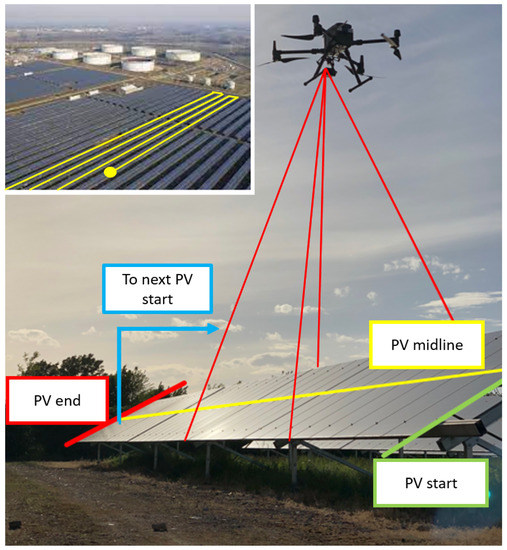
“Autonomous UAV Inspection” from www.mdpi.com and used with no modifications.
How Drone Solar Panel Inspection Actually Works
Drone solar inspection is not just flying a camera over your panels and hoping something shows up. It is a structured, multi-phase process that combines precision flight planning, specialized sensor technology, and AI-driven data analysis to produce inspection reports that are far more detailed and accurate than anything a ground crew can generate.
The process moves through three clear stages: aerial data collection using thermal and visual cameras, automated image analysis to flag anomalies, and report generation that prioritizes faults by severity. Each stage builds on the last, and the result is a complete picture of your solar array’s health in a fraction of the time manual methods require.
Flight Planning Over Your Solar Farm
Before a single drone leaves the ground, operators map out the full flight path based on the exact layout of the solar installation. This is not guesswork — flight planning software takes GPS coordinates of the array, calculates optimal altitude and overlap between image captures, and programs automated flight routes that ensure no panel is missed. For large farm installations, multiple drones can be deployed simultaneously across different zones to compress the total inspection window even further.
Altitude matters more than most farmers expect. Flying too high reduces thermal image resolution and makes it harder to detect small hot spots. Flying too low risks collision with panel mounting hardware and reduces coverage per flight. Most professional solar drone inspections run at altitudes between 20 and 50 meters above the panel surface, balancing image quality with coverage efficiency.
Inspection Method
Time for 1MW Solar Farm
Faults Detectable
Relative Cost
Manual Handheld Thermal
3 to 5 days
Surface + some thermal
High labor cost
Drone with Thermal Camera
2 to 4 hours
Thermal + visual + string-level
30–40% lower than manual
Drone with AI Analysis
2 to 4 hours + automated report
Full fault classification
Lowest total cost
The efficiency gap between manual and drone-based inspection is not marginal — it is transformational, especially for farmers managing hundreds or thousands of individual panels across uneven agricultural terrain.
Thermal Cameras vs. Visual Cameras: What Each One Catches
Most professional solar inspection drones carry two camera types simultaneously. Visual RGB cameras capture high-resolution images of physical surface damage — cracked glass, soiling, bird droppings, and misaligned mounting hardware. Thermal infrared cameras detect heat signatures, identifying cells and strings generating excess heat due to electrical faults, degradation, or partial shading. Neither camera alone gives you the full picture. Together, they provide a complete diagnostic layer that no human inspector with handheld equipment can efficiently replicate across a large array.
How AI Turns Aerial Images Into Actionable Fault Reports
After the drone completes its flight, the real intelligence kicks in. AI-powered inspection software processes the thermal and visual image data, cross-references geospatial metadata to pinpoint the exact location of every anomaly, and classifies each fault by type and severity. Farmers receive reports that clearly show which panels need immediate replacement, which need cleaning, and which are showing early warning signs worth monitoring. This removes the need for specialized thermography expertise on the farmer’s end — the software does the interpretation, and the farmer gets clear repair priorities.
What Problems Drones Detect That Human Eyes Miss
The real value of drone solar inspection is not just speed. It is detection depth. Drones equipped with thermal cameras catch a category of faults that are completely invisible during any standard visual walkthrough, and these are precisely the faults that cause the greatest long-term energy loss on farm solar installations.
Understanding what drones actually find — and why those findings matter financially — is key to appreciating why this technology has become standard practice for serious solar farm operators.
Hot Spots and Electrical Faults
A hot spot is a localized area of a solar panel where one or more cells generate significantly more heat than surrounding cells. This happens when a cell is damaged, shaded, or has developed high resistance due to degradation. Hot spots do not just reduce output from that individual cell — they create reverse current conditions that can damage the entire panel and, in serious cases, create fire risks. For more insights on solar panel maintenance, you can explore how drone inspection is changing solar panel maintenance.
Thermal drone cameras detect hot spots as bright heat signatures against the cooler background of functioning panels. The temperature differential can be as small as a few degrees Celsius in early-stage faults, or as large as 40 degrees Celsius or more in severe cases. Without thermal imaging, both would look completely normal from the ground.
Bypass diode failures are a related electrical fault that thermal drones catch reliably. A failed bypass diode causes an entire substring — typically one-third of a panel — to operate in reverse bias, generating heat rather than power. This is one of the most common electrical faults in aging solar installations and one of the hardest to detect without aerial thermal scanning.
- Hot spots: Localized cell overheating caused by damage, shading, or high resistance — detectable as thermal anomalies even in early stages
- Bypass diode failure: Causes entire panel substrings to generate heat instead of power, often invisible without thermal imaging
- PID (Potential Induced Degradation): Voltage-related cell degradation that shows as a diffuse thermal pattern across multiple panels in a string
- Interconnect failures: Broken solder connections between cells that create resistance hot spots at cell boundaries
Micro-Cracks and Cell-Level Damage
Micro-cracks in solar cells are caused by mechanical stress — hail, heavy snow loads, rough panel handling during installation, or simply thermal expansion and contraction cycles over years of operation. They are invisible to the naked eye and do not always appear on standard visual camera images. But as micro-cracks grow and the cracked cell area becomes electrically isolated, the affected region stops generating current. Thermal imaging shows these zones as cooler areas within an otherwise warm, active panel — a signature pattern that AI inspection software is specifically trained to flag.
On farm installations where panels are regularly exposed to hailstorms, heavy agricultural equipment vibration, and temperature extremes, micro-crack rates are typically higher than in more protected commercial rooftop installations. Early detection through regular drone inspection prevents micro-cracked panels from degrading further into complete cell failures that require full panel replacement rather than targeted maintenance.
Soiling, Bird Droppings, and Shading Issues
Dirt, dust, bird droppings, and agricultural debris accumulation on panel surfaces are among the most common causes of reduced solar output on farm installations — and they are also among the easiest to fix once identified. The challenge is knowing exactly which panels are affected and how severely. Drone visual cameras map soiling patterns across an entire array in a single flight, identifying panels where surface contamination has reached a threshold that justifies cleaning. This prevents farmers from either over-cleaning panels unnecessarily or missing heavily soiled sections that are quietly dragging down whole string performance.
Shading issues are more complex. Partial shading from a nearby tree branch, a new farm structure, or even seasonal changes in sun angle can disproportionately impact output because of how solar strings are wired. One shaded panel in a series string pulls down the performance of every other panel connected to it. Drone thermal imaging identifies shading-related output loss patterns that ground-level observation would never connect back to a specific structural cause, giving farmers the information they need to make targeted fixes — trimming vegetation, repositioning equipment, or adjusting panel tilt angles.
String-Level and Alignment Problems
String-level faults occur when an entire series of panels connected in one electrical string underperforms or fails completely due to a wiring fault, corroded connector, or failed string inverter input. Thermal drones identify these as entire rows of panels showing abnormal heat patterns compared to adjacent functioning strings. Alignment problems — panels that have shifted on their mounting hardware due to wind loading, ground movement, or improper installation — also affect output and are clearly visible in high-resolution drone imagery. Catching these issues early prevents what would otherwise become cascading failures across interconnected strings.

Drones Cut Solar Inspection Costs by 30 to 40 Percent
The cost reduction that drone solar inspection delivers is not a marketing claim — it is a documented operational reality for utility-scale and mid-size solar farm operators. Thermographic inspection of large solar installations using traditional handheld methods requires large crews, extended site access, and significant labor hours to cover even a moderate-sized array. Drone inspection collapses that labor requirement dramatically, and the cost savings follow directly.
Industry data shows drones cut the cost of thermographic inspection for utility-scale solar farms by between 30 and 40 percent compared to manual methods. For a farmer running a multi-acre agrivoltaic installation, that difference can represent thousands of dollars per inspection cycle — savings that compound across the annual maintenance budget when inspections are scheduled at the recommended frequency.
Inspection Time Drops From a Month to a Week
A large-scale solar farm that would require close to a month of manual inspection can be fully surveyed by a drone team in approximately one week. For installations in the range of 1 megawatt and above, a single drone equipped with a thermal camera can cover the full array in a matter of hours. When multiple drones are deployed simultaneously across different sections of the farm, that timeline compresses further.
The practical implication for farmers goes beyond just saving inspection time. The faster the inspection is completed, the sooner faults are identified and repaired. Every day a faulty panel or string operates at reduced output is lost energy revenue. Compressing the inspection window from weeks to days means the gap between fault occurrence and fault correction shrinks dramatically — which directly protects the farm’s energy yield numbers. Learn more about using drones for solar farm inspections.
Less Labor, Fewer Risks, Lower Bills
Ground-based solar inspection is physically demanding and genuinely hazardous work. Inspectors walking agricultural terrain in summer heat, climbing onto barn rooftops to check panel arrays, or navigating uneven ground between panel rows face real injury risks. Workers’ compensation exposure and liability considerations are factors farm operators cannot ignore when scheduling manual inspections.
Drone inspection removes almost all of that human exposure. A two-person drone team — one pilot, one data analyst — can cover what would otherwise require a crew of five or more ground inspectors working for days. The labor bill shrinks, the safety risk drops to near zero, and the inspection quality improves simultaneously. For farm operators running lean operations, that combination is practically impossible to argue against.
Why Farmers Specifically Benefit From Drone Inspections
Farmers face a distinct set of challenges with solar maintenance that commercial rooftop installation operators simply do not encounter. The combination of large land areas, agricultural activity happening continuously around the solar installation, and exposure to weather conditions and biological debris unique to farming environments makes drone inspection not just convenient but genuinely the most logical tool for the job.
Large Land Coverage Without Disrupting Crops or Livestock
An agrivoltaic setup — where solar panels are installed above or between active crop rows — creates an inspection environment where ground-based crews would cause real disruption. Inspectors walking between panel rows risk damaging crops, disturbing irrigation lines, or stressing livestock in adjacent areas. A drone flying 30 meters overhead covers the same ground with zero surface contact, zero crop disturbance, and no operational interruption to the farming activities happening below. For farmers running continuous growing operations beneath their solar arrays, this distinction matters enormously.
No Workers Exposed to Heat or Dangerous Rooftop Conditions
Many farm buildings — barns, equipment storage facilities, processing sheds — carry rooftop solar installations that require periodic inspection. Getting a human inspector safely onto those rooftops involves ladders, fall protection equipment, heat exposure, and liability considerations that add cost and complexity to every inspection visit.
A drone equipped with a thermal and RGB camera can conduct a complete inspection of a barn rooftop array from ground level in under 20 minutes, with the pilot standing safely in the farmyard. The image resolution available from modern inspection drones at low altitude is sufficient to detect cell-level faults, surface soiling, and mounting hardware issues without any inspector ever leaving the ground.
The safety argument alone is compelling for farm operators. But when you layer the speed advantage, the cost reduction, and the superior fault detection capability on top, the case for drone solar inspection over manual methods becomes overwhelming regardless of the size of the installation.
- Zero crop disruption: Drones fly above active growing areas without surface contact or operational interference
- No rooftop access required: Complete barn and shed rooftop array inspections conducted from ground level
- Livestock-safe operation: Properly operated inspection drones cause minimal stress to animals compared to ground crews moving through paddocks
- All-terrain coverage: Drones cover hilly, uneven, or waterlogged farm terrain that would slow or stop a ground inspection crew entirely
- Year-round scheduling flexibility: Drone inspections can be scheduled around planting, harvest, and critical livestock management periods without site access conflicts

How Often Should Farmers Schedule Drone Solar Inspections
Most solar manufacturers recommend at least one full thermographic inspection per year as a baseline. For farm installations, that minimum is rarely enough. Agricultural environments introduce soiling, biological debris, hail exposure, and physical vibration from nearby equipment at rates that far exceed what a standard commercial rooftop installation experiences. Two inspections per year — one in spring before peak production season and one in autumn after summer heat stress — gives farm operators the detection frequency needed to catch and correct faults before they compound into serious output losses.
Larger utility-scale farm installations, particularly those operating under power purchase agreements where output shortfalls carry financial penalties, benefit from quarterly drone surveys. The cost of four drone inspections per year is substantially lower than the revenue impact of a string failure running undetected for six months. For farmers who installed solar as a primary or supplementary income stream, treating inspection frequency as a revenue protection strategy rather than a maintenance checkbox is the right frame.
Drone Solar Inspection Is the Smartest Maintenance Move Farmers Can Make
The combination of lower inspection costs, faster fault detection, zero disruption to farm operations, and dramatically improved detection accuracy makes drone solar inspection the clear choice for any farm operator serious about protecting their solar investment. Whether you are running a 10-kilowatt rooftop array on a single barn or a multi-megawatt agrivoltaic installation across hundreds of acres, the fundamentals are the same — panels that are not inspected regularly lose output silently, and that lost output represents real money leaving the farming operation every single day.
Frequently Asked Questions
Here are the most common questions farmers ask when considering drone solar inspection for the first time, answered directly based on how these systems actually work in agricultural environments.
Question
Quick Answer
Can drones inspect small rooftop systems?
Yes, even single-barn arrays can be fully inspected from ground level
Do farmers need a drone pilot license?
Hiring a certified operator is standard practice for professional inspections
How long does an inspection take?
Hours for large farms, under 20 minutes for a single rooftop array
What camera type is best?
Dual thermal and RGB camera payload for complete fault detection
What does a drone inspection cost?
Varies by array size, but consistently 30–40% less than manual methods
Every farm solar setup is different in scale and complexity, so the details behind each of these answers matter. Below is the full breakdown for each question.
Can drones inspect small rooftop solar systems on farm buildings?
Yes — and this is one of the most underutilized applications of drone solar inspection in agricultural settings. A small rooftop array on a barn or equipment shed can be fully inspected using a drone in under 20 minutes, with the operator standing safely on the ground below. The drone flies at low altitude directly above the rooftop, capturing both thermal and visual imagery of every panel in the array. The result is the same quality of fault detection data that a large solar farm receives, scaled down to match the size of the installation.
For farmers with multiple outbuildings each carrying their own solar array, a single drone inspection visit can cover all of them in sequence on the same day. This makes professional drone inspection practical and cost-effective even for operations with relatively small total installed solar capacity.
Do farmers need a drone pilot license to use inspection drones?
In most countries, flying a drone commercially — including for solar inspection purposes — requires a certified remote pilot license. In the United States, this means an FAA Part 107 Remote Pilot Certificate. Rather than obtaining certification themselves, most farm operators hire professional drone inspection service providers who are already certified, carry appropriate liability insurance, and operate inspection-grade equipment with calibrated thermal cameras. This is the fastest and most reliable path to getting a professional inspection completed without the time investment of pilot training and certification.
How long does a drone solar inspection take for a large farm?
A 1-megawatt solar farm — which typically covers between 5 and 10 acres depending on panel configuration — can be fully surveyed by a single inspection drone in approximately 2 to 4 hours of flight time. Post-flight AI analysis and report generation typically adds a few hours of processing time, meaning a complete inspection report with fault classifications and GPS-tagged anomaly locations is usually available within 24 hours of the drone flight. For farms operating significantly larger installations, multiple drones deployed simultaneously can compress the total timeline further, bringing even a 10-megawatt array within a one-day inspection window.
What type of drone camera is best for detecting solar panel faults?
The most effective solar inspection drones carry a dual-payload camera system — a radiometric thermal infrared camera and a high-resolution RGB visual camera operating simultaneously. The thermal camera detects heat-based anomalies including hot spots, bypass diode failures, and string-level electrical faults. The RGB camera captures surface-level damage, soiling patterns, and mounting hardware issues. Together, they produce a complete diagnostic dataset that neither camera could generate alone. For farm inspections specifically, look for thermal cameras with a sensitivity of 50 millikelvin (mK) or better, which ensures reliable detection of early-stage hot spots before they develop into serious panel damage.
How much does a drone solar panel inspection cost for a farm?
Drone solar inspection pricing varies based on array size, location, and the level of reporting detail required. As a general benchmark, professional drone inspection services for agricultural solar installations consistently come in at 30 to 40 percent less than equivalent manual thermographic inspection methods when total labor and time costs are factored in. For a rooftop array on a single farm building, a professional inspection visit typically falls in the range of a few hundred dollars. For a utility-scale multi-acre installation, costs scale with array size but the per-panel cost decreases significantly at larger volumes. For more information on choosing the right solar panels for your farm, consider exploring the best solar panels comparison.
When evaluating inspection cost, the more useful calculation is cost relative to protected energy output. A single undetected string fault on a mid-size farm installation can represent hundreds of dollars of lost energy generation per month. An inspection that identifies and enables repair of that fault within days of occurrence pays for itself multiple times over in recovered output alone.

Leave a Reply