

Key Takeaways
- Monocrystalline panels convert 17-22% of sunlight into usable electricity, outperforming every other commercially available panel type for farm applications.
- Farm operations can slash energy costs by 40-60% with monocrystalline systems, often paying back the initial investment in as little as 1.5 to 7 years depending on incentives.
- These panels last 25+ years with minimal degradation, meaning the system you install today will still power your operation well into your grandchildren’s farming years.
- Space-efficient design means monocrystalline panels need 20-30% less roof or ground area than alternatives, a critical factor for farms balancing crop production with energy generation.
Running a farm means juggling dozens of energy-hungry systems at once, from irrigation pumps to grain dryers to milk coolers, and every one of them chips away at your bottom line. Monocrystalline solar panels have become the go-to solution for farmers looking to take control of those costs without sacrificing the reliability their operations depend on. This guide breaks down exactly why these panels outperform other options and how to put them to work on your land.
Why Monocrystalline Panels Are a Smart Bet for Your Farm
Monocrystalline panels are built from single-crystal silicon, which gives electrons more room to move and translates directly into higher power output per square foot. That single design choice is why these panels consistently outperform polycrystalline and thin-film alternatives across nearly every farm application, from powering a chicken coop’s ventilation fans to running a full dairy parlor.
Agricultural solar specialists have helped hundreds of farms transition to monocrystalline systems specifically because the technology handles the unique demands of farm life better than cheaper alternatives. Farms deal with dust, temperature swings, seasonal peak loads, and remote locations where grid reliability isn’t guaranteed. Monocrystalline panels are engineered to hold up under exactly those conditions.
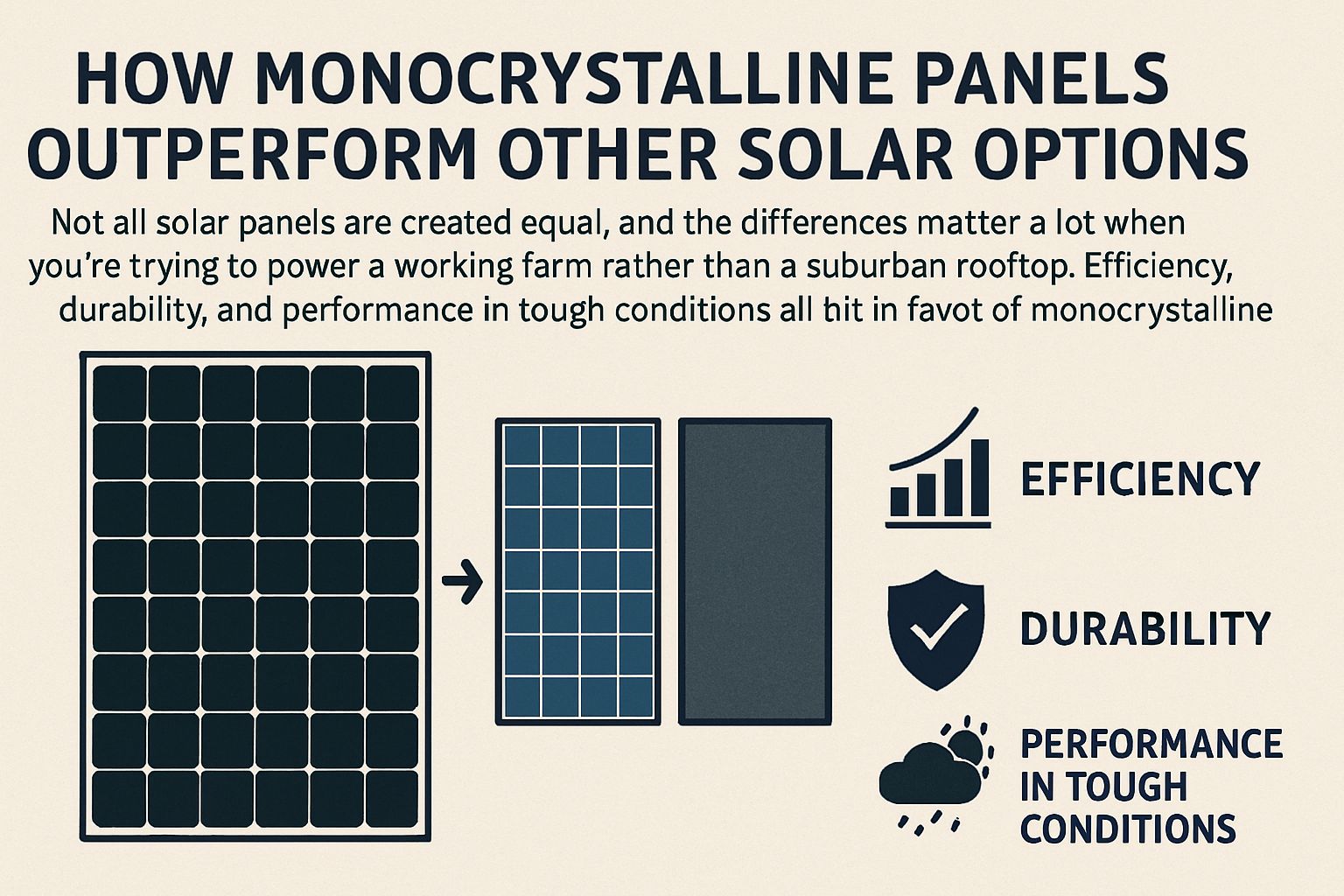
How Monocrystalline Panels Outperform Other Solar Options
Not all solar panels are created equal, and the differences matter a lot when you’re trying to power a working farm rather than a suburban rooftop. Efficiency, durability, and performance in tough conditions all tilt in favor of monocrystalline technology.
The gap becomes obvious once you compare the numbers side by side. Here’s how the three main panel types stack up:
|
Panel Type |
Efficiency Rate |
Lifespan |
Annual Degradation |
|---|---|---|---|
|
Monocrystalline |
17-23% |
25-30 years |
0.3-0.5% |
|
Polycrystalline |
13-17% |
20-25 years |
0.5-0.8% |
|
Thin-Film |
10-12% |
10-20 years |
Higher wear in harsh weather |
Efficiency Rates: 17-22% Explained
Premium monocrystalline panels from manufacturers like SunPower and REC hit efficiency ratings as high as 22.8%, compared to the 15-17% range typical of polycrystalline panels. That efficiency gap means roughly 20% more power generation from the exact same amount of roof or ground space. For a farm with limited real estate, that difference can determine whether you’re able to fully offset your energy bills or fall short.
Monocrystalline vs Polycrystalline vs Thin-Film
Polycrystalline panels remain popular in agriculture mainly because of their lower upfront cost, and they work fine for farms with ample open space and less demanding energy needs. Thin-film panels bring flexibility and light weight to the table, making them a decent fit for curved surfaces like greenhouse roofs, but their 10-12% efficiency rate makes them a poor match for farms with heavy energy demands. Monocrystalline panels split the difference by delivering the highest output per square foot, which matters most when space is tight or energy needs are substantial.
How Single-Crystal Silicon Boosts Power Output
Monocrystalline panels are manufactured by slicing single-crystal silicon ingots into wafers, creating the purest silicon configuration available for commercial solar use. This uniform crystal structure allows electrons to move more freely through the material, which directly increases how much sunlight gets converted into usable electricity. It’s also why these panels have that distinctive uniform black appearance with rounded edges, a visual cue that’s become shorthand for premium solar technology.
What Monocrystalline Panels Cost & How Fast They Pay Off
Cost is usually the first question farmers ask, and it’s a fair one. Monocrystalline panels do carry a 10-15% higher upfront price tag compared to polycrystalline alternatives, but that gap closes fast once you factor in the incentives and savings available specifically for agricultural operations.
Upfront Price vs Long-Term Savings
All commercial solar projects qualify for a 30% federal tax credit, and farms have access to additional support through USDA REAP grants, which can cover up to 50% of total project costs. Stack those together and farmers can save up to 80% on installation costs. Commercial projects may also qualify for accelerated depreciation through MACRS, which further sweetens the financial picture in the early years of ownership.
Real Payback Periods for Farm Installations
Farms implementing monocrystalline solar systems typically see payback periods of 5-7 years, though some agricultural installations break even in as little as 1.5 to 3 years when grants and tax credits are fully leveraged. After that payback window closes, farmers are left with decades of dramatically reduced energy costs, since these panels keep producing reliably for 25 years or more.
Case Study: Johnson Family Dairy’s 75kW System
Johnson Family Dairy in Wisconsin installed a 75kW monocrystalline system that now generates 92,000 kWh annually. Their previous annual electric costs sat at $11,800, and after going solar, they saw first-year savings of $9,200. Projected out over 25 years, that single installation is expected to save the farm $348,000 in energy costs, a number that reframes solar not as an expense but as one of the highest-return investments available to a working farm.
How Long Monocrystalline Panels Last on Your Farm
A solar investment only makes sense if it sticks around long enough to earn its keep, and this is where monocrystalline panels really separate themselves from cheaper alternatives. Farmers aren’t looking for a five-year fix; they need equipment that survives decades of sun, wind, hail, and temperature swings without losing its punch.
25+ Year Lifespan and Warranty Coverage
Monocrystalline panels are built to last 25 years or longer, and most premium models carry power production warranties covering 25 to 30 years of use. Even after a quarter-century of service, these panels typically still perform at 80% or more of their original output capacity. That kind of longevity means a farmer installing panels today is setting up a power source that will likely outlast several tractors, a couple of roof replacements, and possibly a generational handoff of the farm itself.
Degradation Rates Compared to Other Panel Types
Every solar panel loses a small amount of efficiency each year, but the rate at which that happens varies quite a bit by panel type. Monocrystalline panels degrade at just 0.3-0.5% annually, compared to 0.5-0.8% for polycrystalline panels and even steeper losses for thin-film technology in harsh outdoor conditions. Over a 25-year lifespan, that difference adds up to meaningfully more electricity produced, which is exactly why monocrystalline remains the preferred choice for farms that need consistent output year after year.
Performance Through Heat, Cold, and Cloudy Days
Farms don’t get to pick their weather, and neither do the solar panels installed on them. A panel that only performs well on bright, mild days isn’t much use to a working operation that needs power through blazing summer heat, overcast stretches, and everything in between. Monocrystalline panels were engineered with exactly this kind of variability in mind.
Low Temperature Coefficient Keeps Output Stable
Solar panels actually lose some efficiency as they heat up, but monocrystalline technology handles this better than any other panel type on the market. With a temperature coefficient of around -0.35% per degree Celsius, these panels hold onto their output even during scorching summer afternoons when farm equipment tends to run hardest. That stability matters most for operations like cold storage and milk cooling, which draw peak power exactly when the sun is at its hottest.
This lower temperature coefficient isn’t just a technical spec buried in a datasheet; it translates into real dollars saved during the months when energy demand and heat both peak simultaneously. Farms in hot climates, particularly across the South and Southwest, see the biggest practical benefit from this characteristic.
Why Shade and Cloud Cover Matter Less
Advanced N-type monocrystalline panels resist light-induced degradation, which means they maintain higher output over decades even when farm dust or partial shading from nearby structures reduces direct sunlight exposure. During spring and fall, when the sun sits lower in the sky, or during stretches of partial cloud cover, monocrystalline panels continue producing electricity at higher rates than polycrystalline or thin-film alternatives.
Bifacial monocrystalline panels take this a step further by capturing reflected light on both the front and back of the panel. In appropriate farm installations, particularly ground-mounted arrays over light-colored soil or gravel, this design can increase total energy harvest by 5-30%.
For farmers weighing panel options, this cloudy-day and shaded-condition performance often gets overlooked in favor of headline efficiency numbers. But for operations in regions with unpredictable weather, this resilience can matter just as much as peak sunny-day output.

Why Space Efficiency Matters for Compact Farmland
Every acre on a working farm has a job to do, whether that’s growing crops, grazing livestock, or housing equipment. Dedicating land to solar panels means that space efficiency isn’t a nice-to-have; it’s often the deciding factor in whether solar makes sense at all.
Less Roof or Ground Space for the Same Power
Monocrystalline panels generate more electricity per square foot than any other commercially available solar technology, which means fewer panels are needed to hit the same energy targets. A dairy operation requiring 200,000 kWh annually would need approximately 15-20% less roof or ground space using monocrystalline panels compared to polycrystalline alternatives. Polycrystalline and thin-film options typically require 20-30% more surface area to generate equivalent power, a difference that adds up fast on farms where every square foot of usable land already has competing demands.
Best Farm Applications for Monocrystalline Panels
Modern farms run on electricity in ways that weren’t true even a decade ago, and that shift has made solar power far more practical for offsetting real operational costs. Monocrystalline panels are particularly well suited to high-load, high-value systems where reliability and efficiency both matter.
From irrigation to climate control to refrigeration, these panels can be sized and positioned to tackle some of the biggest line items on a farm’s utility bill. Discover the financial benefits for farmers when using solar panels effectively.
Irrigation Systems and Water Pumps
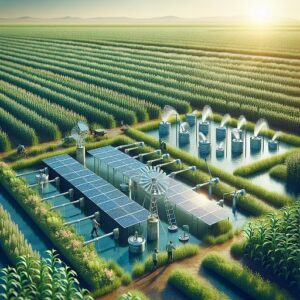
Irrigation represents one of the largest energy expenses on many farms, with pumping systems often running extensively during peak daylight hours, which happens to line up perfectly with peak solar production. Monocrystalline panels paired with properly sized irrigation pumps can offset a substantial share of this cost, turning what used to be a predictable seasonal expense into a much smaller line item.
Livestock Ventilation, Heating, and Cooling
Modern livestock facilities require consistent ventilation, heating, and cooling to keep animals healthy and productive, and that demand doesn’t let up regardless of the season. Monocrystalline systems paired with battery storage ensure continuous operation even during grid outages or overnight hours, which matters a great deal when animal welfare is on the line.
Properly sized systems can achieve some impressive offset numbers for climate control specifically:
Livestock operations can achieve 50-90% offset of energy requirements for climate control systems with properly sized monocrystalline solar arrays, according to agricultural solar data.
That range depends heavily on facility size, insulation quality, and how the system is designed, but it gives farmers a realistic benchmark for what’s achievable when planning a livestock-focused solar installation.
Dairy Milk Cooling Systems
Dairy operations face some of the steepest energy demands in agriculture, largely driven by milk cooling systems, which consume 25-40% of a dairy farm’s total electricity usage. Because these systems run around the clock, they represent one of the best opportunities for solar to make a dent in overall costs.
Pairing monocrystalline panels with modern equipment amplifies these savings even further, particularly when the cooling system itself gets an upgrade alongside the solar installation.
Grain Drying Operations
Grain drying represents one of the most energy-intensive seasonal activities on many farms, often creating a short but intense spike in electricity demand during harvest season. Monocrystalline panels sized to handle this seasonal peak can meaningfully reduce the cost of getting grain to market-ready moisture levels.
Cold Storage for Fruit and Vegetable Farms
Fruit and vegetable operations rely heavily on refrigeration to maintain product quality from harvest through sale, and that refrigeration runs continuously regardless of weather or season. Monocrystalline panels paired with modern variable speed compressors and smart controllers can reduce refrigeration energy costs by 60-80%, a combination that turns one of the biggest ongoing expenses on produce farms into a manageable, predictable cost.
Across all these applications, a few consistent advantages keep showing up:
- Peak solar production tends to align naturally with peak farm energy demand, particularly for irrigation and cooling systems.
- Battery storage paired with monocrystalline panels extends reliability into nighttime hours and grid outages.
- Higher efficiency means smaller systems can still meet substantial energy loads, preserving usable farmland.
- Reduced degradation over time means the savings calculated in year one remain largely intact well into year twenty.
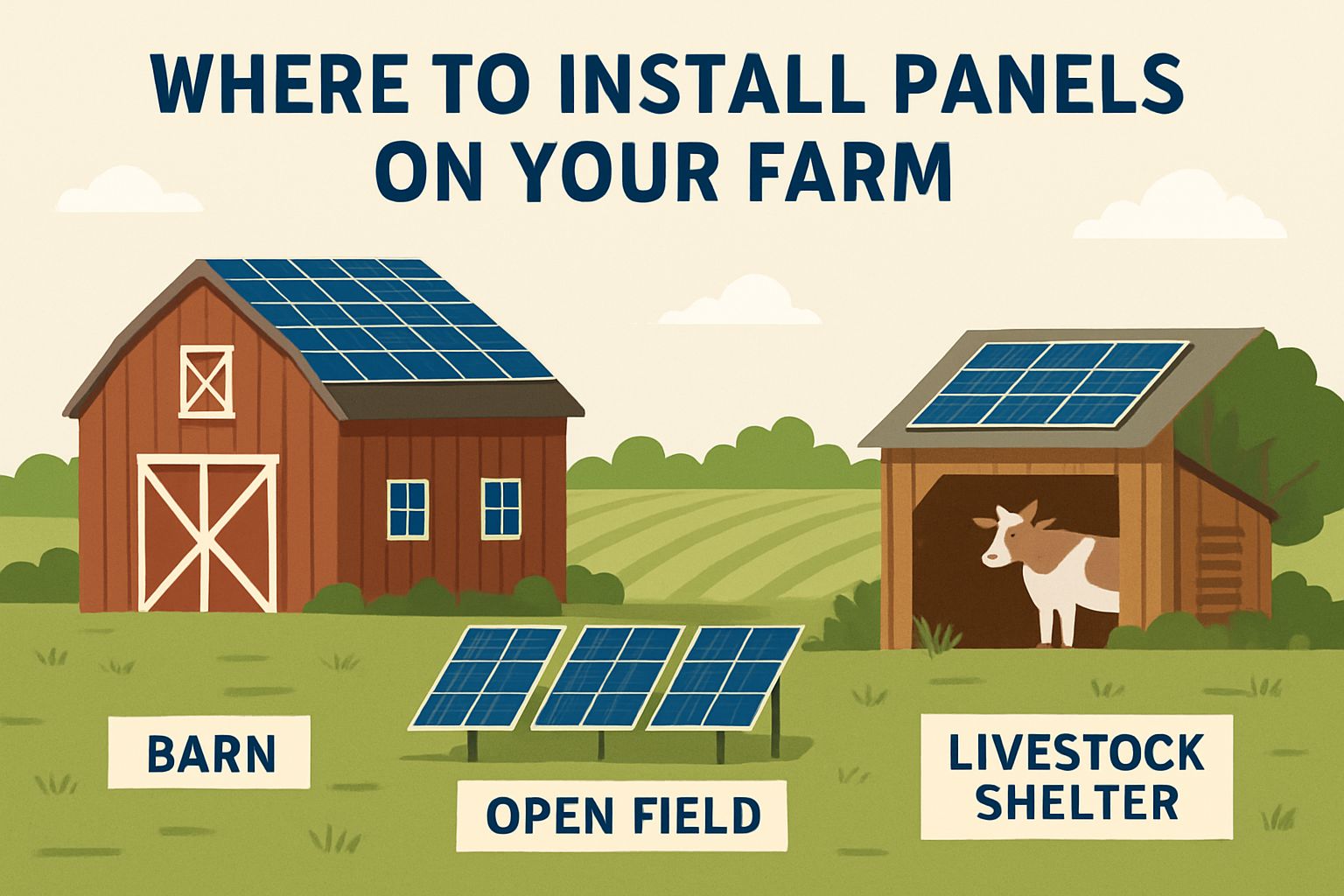
Where to Install Panels on Your Farm
Deciding where to put solar panels is just as important as deciding which panels to buy. Farms have more flexibility here than most residential or commercial properties, since barns, open fields, and even livestock shelters can all serve as viable mounting locations.
The right choice depends on available structures, land use priorities, and how much sun exposure each potential site receives throughout the year.
Strategic installation on barn roofs, ground mounts, or dual-use agrivoltaic systems maximizes both energy production and land utilization simultaneously. Many farms end up using a combination of these approaches rather than committing to just one.
Here’s a quick comparison of the most common installation options farmers consider:
|
Installation Type |
Best For |
Key Consideration |
|---|---|---|
|
Barn Roof Mount |
Farms with existing structures and limited spare land |
Roof orientation and structural load capacity |
|
Ground-Mounted Array |
Farms with open, unused acreage |
Can incorporate sun-tracking for higher output |
|
Agrivoltaic System |
Farms wanting dual-use of land for crops and energy |
Best suited to shade-tolerant crops like leafy greens |
|
Livestock Shelter Mount |
Operations needing shade structures for animals |
Combines animal welfare benefits with energy production |
Barn Roof Mounts
Modern agricultural buildings constructed with engineered trusses can usually support solar arrays without significant structural modifications, since solar installations typically add just 2-4 pounds per square foot. South-facing roof sections receive the most direct sunlight in the northern hemisphere, making them the ideal placement whenever barn orientation allows for it.
Roof mounting also has the practical advantage of not taking up any usable farmland, since it makes use of space that’s otherwise going unused above existing structures. For farms with large barn complexes, this can be enough surface area to power a significant share of overall operations without touching a single acre of productive land.
Before committing to a roof mount, it’s worth having the structure evaluated by someone familiar with agricultural buildings specifically, since older barns or those with non-standard truss designs may need reinforcement before installation. This is typically a quick assessment, but skipping it can lead to costly surprises later.
Ground-Mounted Arrays with Sun Tracking
Ground-mounted arrays can incorporate single or dual-axis tracking systems that follow the sun’s path throughout the day, increasing energy production by 25-40% compared to fixed installations. For farms with open acreage not currently in production, or land that’s marginal for crops due to soil quality or drainage issues, ground mounts offer a way to generate meaningful income from otherwise underutilized space. Tracking systems do add complexity and cost upfront, but the production boost often justifies the investment for larger installations.
Agrivoltaics: Growing Crops Under Solar Panels
Agrivoltaics, the practice of integrating solar panels with active agricultural production on the same land, represents one of the more exciting developments in farm energy planning. Rather than choosing between growing crops and generating power, farmers can do both on the same acreage by elevating panels high enough to allow equipment access and sunlight penetration underneath.
Research from the University of Massachusetts shows that certain crops, particularly leafy greens and some berry varieties, actually benefit from the partial shade that agrivoltaic systems provide. The reduced sun exposure can lower heat stress on plants and cut down on water evaporation, meaning some farmers are seeing better crop yields under panels than they would in full, unshaded sun. This dual-use approach is still gaining traction, but it’s proving especially valuable for farms where every acre needs to justify its use.
Livestock Shelter Systems With Built-In Solar
Livestock shelter systems combine shade structures with power generation, giving animals relief from direct sun exposure while simultaneously producing electricity for the farm. These structures work particularly well for pasture-based operations where traditional barn space is limited, since they serve double duty without requiring a separate building investment. Cattle, sheep, and other livestock benefit from reduced heat stress under these structures, which can translate into better weight gain and overall herd health alongside the energy savings.
Energy Independence for Rural Farm Operations
Rural farms often sit at the far end of utility infrastructure, which means power outages hit harder and last longer than they would in more populated areas. Building energy independence into farm operations isn’t just about saving money; it’s about protecting the business from disruptions that are largely outside anyone’s control. For more information on maximizing savings and profit, check out the financial benefits of solar panels for farmers.
Reducing Grid Reliance in Remote Areas
Solar panels reduce a farm’s reliance on the main electric grid, which matters most in rural areas prone to outages from storms, equipment failures, or simple distance from repair crews. Farms that generate a substantial share of their own power aren’t left scrambling when the grid goes down, since their operations can continue running off solar production or stored battery capacity. This independence becomes especially valuable during planting and harvest windows, when even a short power interruption can affect an entire season’s output.
Battery Storage for Power During Outages
Pairing monocrystalline panels with battery storage systems means farms can keep critical operations running even when the sun isn’t shining or the grid goes down entirely. Livestock ventilation, refrigeration units, and security systems can all stay powered through overnight hours or extended outages, which removes a significant source of stress for farmers managing operations that can’t simply pause for a few days.
This kind of resilience planning has become increasingly common as battery costs have dropped and storage capacity has improved. Farms investing in solar today are frequently building storage into the initial system design rather than treating it as a future add-on, since the combined system tends to be more cost-effective than retrofitting batteries later.

Environmental Benefits Beyond the Energy Bill
Cutting energy costs is usually the main driver behind a farm’s decision to go solar, but the environmental upside deserves its own mention. Using solar energy for farming operations reduces carbon emissions and other pollutants associated with burning fossil fuels, which matters both for the immediate farm environment and for the broader agricultural industry’s sustainability goals.
Monocrystalline panels specifically carry the lowest carbon footprint and maximum renewable energy utilization compared to other panel types, largely due to their higher efficiency and longer operational lifespan. Fewer panels are needed to generate the same power output, which means less material, less manufacturing impact, and less waste over the full lifecycle of the system. For farms marketing themselves as sustainable operations, whether to consumers, cooperatives, or supply chain partners, this kind of solar investment can become a meaningful part of that story.
Frequently Asked Questions
Farmers considering monocrystalline solar tend to have a handful of recurring questions, and getting clear answers upfront makes the planning process a lot smoother.
How many monocrystalline panels does a farm need?
The right number depends entirely on your farm’s energy consumption, available installation space, and local sunlight conditions. A small operation running basic irrigation might need a system in the 10-20kW range, while a larger dairy or grain operation could require 75kW or more, similar to the Johnson Family Dairy installation. Working with an agricultural solar specialist to calculate actual load requirements is the most reliable way to land on the right system size.
Can monocrystalline panels power an entire dairy operation?
Yes, with proper sizing, monocrystalline systems can offset a significant share, and in some cases nearly all, of a dairy operation’s electricity needs. Milk cooling alone accounts for 25-40% of a dairy farm’s total electricity usage, and pairing solar with efficient cooling equipment can dramatically shrink that cost. Full offset typically requires a system sized specifically to the farm’s peak and average loads, along with battery storage to cover nighttime cooling demands.
Do monocrystalline panels work well in cold climates?
Monocrystalline panels actually perform quite well in cold weather, since their low temperature coefficient means they don’t lose the efficiency gains that colder temperatures provide the way some other panel types do. Snow can temporarily reduce output if it accumulates on panel surfaces, but the smooth, uniform design of monocrystalline panels tends to shed snow faster than textured polycrystalline alternatives. Farms in northern climates still see strong year-round performance, particularly during clear, cold winter days when panel efficiency actually peaks.
What maintenance do monocrystalline panels require on a farm?
Maintenance requirements are minimal compared to most farm equipment, which is part of what makes these systems so appealing for busy operations. Occasional cleaning to remove dust, bird droppings, or debris helps maintain peak performance, and periodic inspections of wiring and mounting hardware catch any issues before they become bigger problems.
Beyond that, monocrystalline panels are largely a set-it-and-forget-it investment, especially compared to the ongoing upkeep required by generators, pumps, or other farm machinery.
Are monocrystalline panels worth the higher upfront cost?
For most farms, yes, the higher upfront cost pays for itself through superior efficiency, longer lifespan, and lower degradation rates over time. The 10-15% price premium compared to polycrystalline panels typically gets recovered within the first several years of operation, especially once federal tax credits and USDA REAP grants are factored into the equation.
After that initial payback period, farms are left with two decades or more of significantly reduced energy costs, all from a system that requires very little ongoing attention.
The math tends to favor monocrystalline especially strongly for farms with limited installation space or particularly high energy demands, since getting more power from fewer panels directly addresses both of those constraints.


Leave a Reply