
Key Takeaways
- Sealed AGM lead acid batteries cost 40-60% less upfront than lithium alternatives, making them the most accessible entry point for farm solar backup systems.
- Unlike flooded lead acid batteries, sealed AGM units are spill-proof and produce minimal gas emissions, meaning they can be safely installed inside barns, equipment sheds, and other enclosed farm structures.
- A single grid outage during peak irrigation season can cause crop losses worth thousands of dollars per acre — the right battery backup eliminates that risk entirely.
- Sizing your battery bank incorrectly is the #1 reason farm solar backup systems fail — there’s a specific 5-step process covered in this article that prevents that mistake.
- GrowingSolarmist.com provides agricultural solar energy guidance specifically designed for farm operations navigating the transition to reliable renewable energy systems.
If your farm’s solar system goes dark during a grid outage, everything from irrigation to cold storage is at risk — and that’s a problem sealed lead acid batteries solve better than most farmers realize.
Solar energy has transformed how modern farms manage power costs, but generation alone isn’t enough. The sun doesn’t shine at night, clouds roll in without warning, and grid failures happen at the worst possible moments. Without reliable energy storage, all that renewable investment becomes fragile. GrowingSolarmist.com covers exactly these real-world agricultural solar challenges, helping farm operators make storage decisions that actually hold up when the pressure is on.
Sealed Lead Acid Batteries Are the Smartest Backup Choice for Solar Farms Right Now
Sealed lead acid batteries — specifically AGM (Absorbent Glass Mat) technology — have quietly become the go-to backup solution for farm solar systems across the country. They’re not flashy, and they don’t carry the marketing weight of lithium-ion, but they deliver something farmers care about far more: dependable power at a price that makes financial sense. For operations running irrigation pumps, cold storage units, and essential lighting, that reliability is everything.
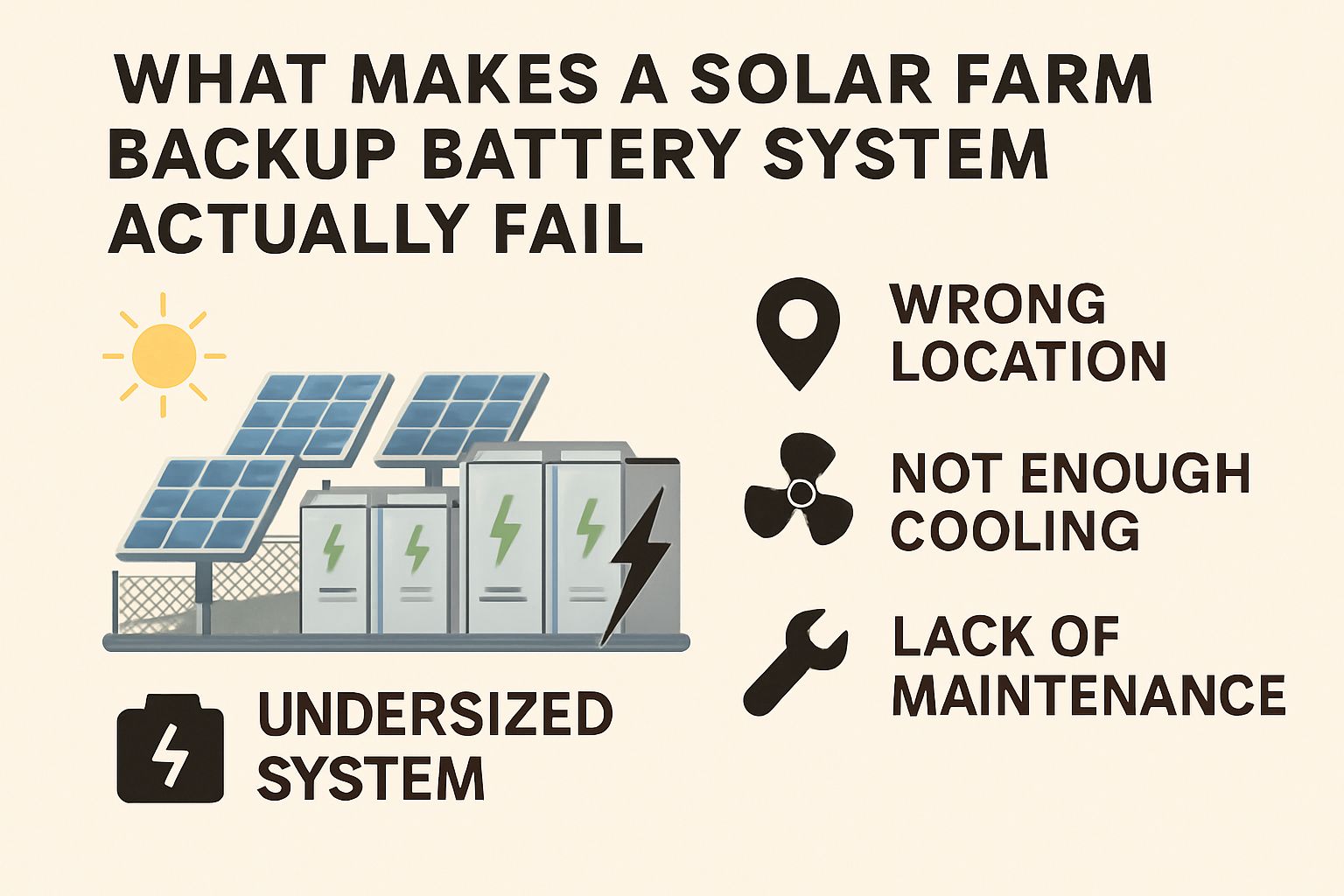
What Makes a Solar Farm Backup Battery System Actually Fail
Most farm battery backup failures don’t come from bad luck. They come from predictable, avoidable mistakes made at the planning stage. Understanding where these systems break down is the first step toward building one that doesn’t.
Why Grid Outages Hit Farms Harder Than Any Other Operation
A residential power outage is an inconvenience. A farm power outage is a financial crisis. Irrigation systems shut down mid-cycle, refrigeration units for stored produce lose temperature control, and livestock watering systems go offline — all within hours of a grid failure. Unlike a home, a farm operates on tight biological and mechanical schedules that don’t pause for infrastructure problems. To mitigate these challenges, many farmers are turning to HJT solar panels for reliable energy solutions.
The financial exposure is significant. Crop damage or loss can occur within hours as irrigation systems fail during heat stress periods. Cold storage failures can destroy thousands of dollars in perishable inventory overnight. Poultry and livestock operations face even faster consequences when ventilation and watering systems lose power. These aren’t edge-case scenarios — they’re the exact conditions that make energy storage a core operational investment, not an optional upgrade.
What makes the farm situation uniquely vulnerable is the combination of high power demand, remote locations, and extended outage exposure. Rural grid infrastructure is often the last to be restored after storms or equipment failures. Farms that sit at the end of long distribution lines can remain without grid power for 12 to 72 hours while urban areas recover in 2 to 4 hours. That gap is where a properly sized sealed AGM battery bank earns its cost back in a single event.
- Irrigation failure — crop stress and loss begin within hours during peak growing season
- Cold storage failure — perishable produce and dairy products at risk within 4 hours
- Livestock systems — automated watering and ventilation shutdowns create immediate animal welfare risks
- Security and monitoring — cameras, alarms, and remote sensors go offline without backup
- Extended rural outages — farms on rural distribution lines often wait 2-3x longer for grid restoration than suburban areas
The Real Cost of Running Diesel Generators as a Primary Backup
Diesel generators have been the default farm backup for decades, but the actual operating cost picture is far less favorable than most operators assume. Diesel fuel costs fluctuate significantly, generator maintenance is ongoing, and the labor involved in monitoring, refueling, and starting equipment during emergencies adds up fast. A system that requires someone to manually intervene at 2am during a storm is not a reliable system — it’s a managed liability.
How Undersized Battery Banks Leave Critical Systems Exposed
The most common and costly battery backup mistake on farm solar systems is undersizing the battery bank relative to actual load requirements. Operators frequently size their storage based on average daily consumption rather than peak demand and worst-case outage duration. The result is a battery bank that looks adequate on paper but drains within four to six hours when real loads kick in.
Depth of discharge is the critical variable most farm operators underestimate. Sealed AGM batteries should not be discharged below 50% of their rated capacity on a regular basis — doing so dramatically shortens cycle life. This means a battery bank rated at 1,000 amp-hours only reliably delivers 500 usable amp-hours before you’re cutting into battery lifespan. Any sizing calculation that doesn’t account for this 50% depth-of-discharge limit will produce a system that underperforms and degrades prematurely. For more insights on optimizing solar panel systems, explore solar technologies comparison for farmers.
Temperature further compounds the undersizing problem. AGM battery capacity drops measurably in cold conditions — at 32°F (0°C), a sealed lead acid battery delivers approximately 70-80% of its rated capacity compared to performance at 77°F (25°C). Farms in northern climates sizing battery banks for summer loads without a cold-weather capacity buffer are routinely disappointed by winter backup performance.
Real-World Sizing Trap: A farm calculates it needs 800Ah of storage, purchases an 800Ah AGM bank, and assumes the job is done. In practice, they have roughly 400Ah of usable capacity (50% DoD limit), reduced to approximately 300Ah in cold weather — less than 40% of what they calculated. This is the single most common reason farm solar backup systems fail their operators at the critical moment.
How Sealed Lead Acid Batteries Work in Solar Farm Systems
Sealed lead acid batteries store energy through a reversible electrochemical reaction between lead plates and a sulfuric acid electrolyte. When your solar panels generate more electricity than your farm is currently consuming, that excess energy flows into the battery bank, converting electrical energy into chemical energy stored in the lead plates. When demand exceeds solar production — at night, during cloud cover, or during a grid outage — the process reverses, releasing stored energy back as usable electricity.
What separates sealed AGM batteries from conventional flooded lead acid units is how they manage the electrolyte. Rather than free liquid acid that can spill, stratify, or require topping off with distilled water, AGM batteries suspend the electrolyte in a fiberglass mat compressed between the lead plates. This design fundamentally changes how the battery can be used, stored, and installed on a working farm.
The Role of AGM Technology in Maintenance-Free Operation
AGM stands for Absorbent Glass Mat — and that mat is what makes the technology a practical choice for farm operations where battery maintenance rarely makes it to the top of the priority list. The glass mat saturates with electrolyte and holds it in place, eliminating the need for periodic water addition that flooded batteries demand. A properly installed AGM bank can operate for its full service life without any electrolyte maintenance whatsoever.
This maintenance-free characteristic is more operationally significant than it first appears. Flooded lead acid batteries require regular inspection, water top-offs every one to three months depending on usage, and careful monitoring for sulfation and stratification. On a farm managing dozens of competing priorities across planting, harvesting, and livestock cycles, battery maintenance is exactly the kind of task that gets deferred — and deferred maintenance on flooded batteries directly shortens their service life. AGM technology removes that failure point entirely.
How Absorbed Electrolyte Design Prevents Spills and Gas Emissions
The sealed, valve-regulated design of AGM batteries addresses two safety concerns that make conventional flooded batteries problematic in farm settings. First, there’s no free liquid to spill if a battery is tipped, vibrated, or physically disturbed — a real consideration in environments with heavy equipment movement. Second, AGM batteries produce significantly lower gas emissions during charging compared to flooded units, which release hydrogen gas that requires ventilation management in enclosed spaces.
AGM batteries do produce trace amounts of gas during charging, which is why they incorporate pressure relief valves — but emissions are dramatically reduced compared to flooded alternatives. This means AGM banks can be safely installed in equipment rooms, utility closets, and barn structures without the dedicated ventilation systems that flooded battery installations require. That installation flexibility translates directly into lower setup costs and more practical placement options on real farm properties. For more information on the benefits of using AGM batteries in solar panel systems, check out this guide on AGM batteries.
Charge and Discharge Cycles Explained for Farm Energy Loads
A charge cycle occurs every time a battery goes from discharged back to fully charged. Sealed AGM batteries are rated for a specific number of cycles before their capacity degrades to 80% of original — typically 300 to 500 cycles at 50% depth of discharge for quality agricultural-grade AGM units. For a farm solar system cycling once daily, that translates to roughly one to two years of heavy cycling before noticeable capacity reduction begins, and three to five years of service life under normal mixed-use conditions.
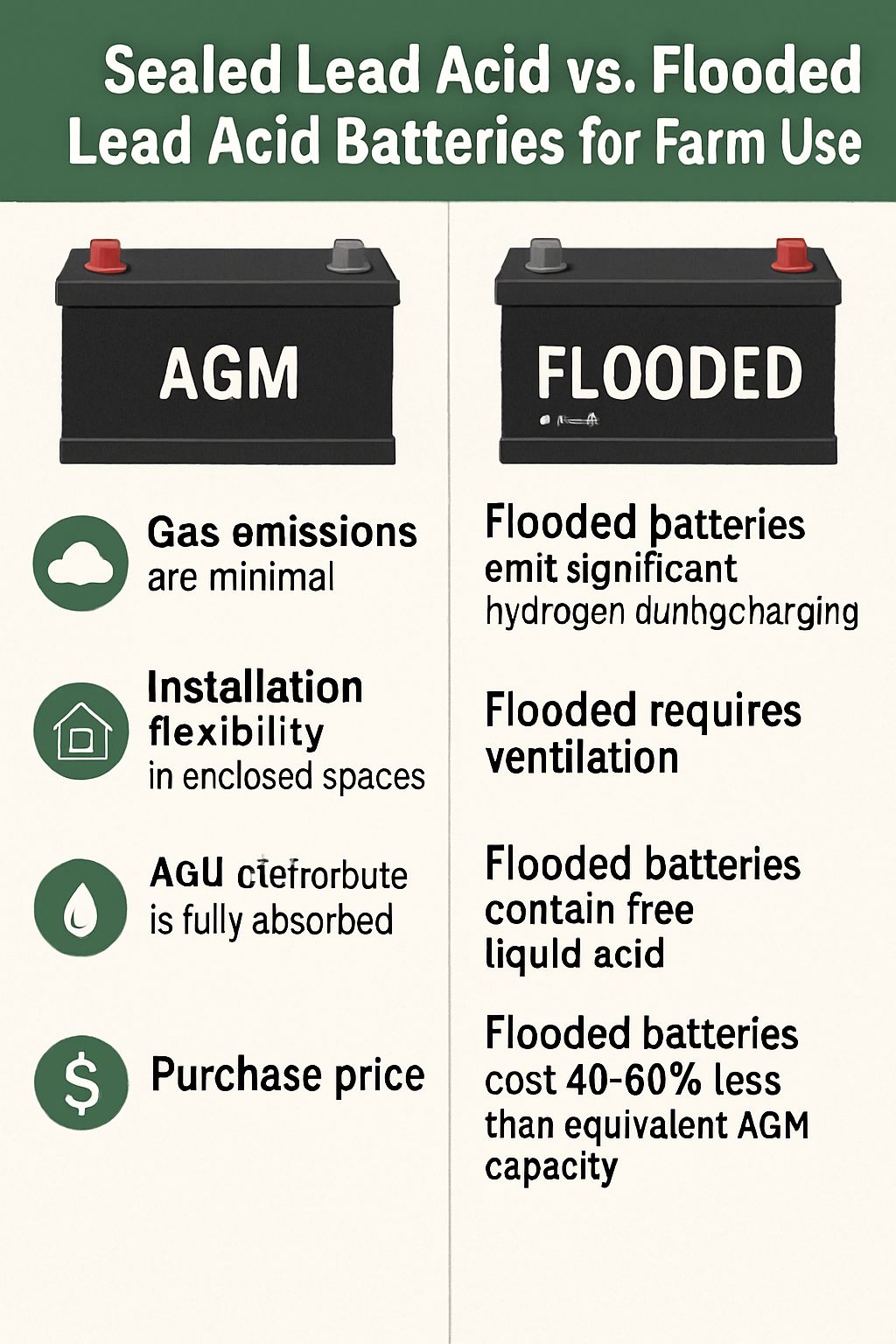
Sealed Lead Acid vs. Flooded Lead Acid Batteries for Farm Use
Both sealed AGM and flooded lead acid batteries use the same fundamental electrochemistry — lead plates in sulfuric acid electrolyte. The difference is in construction, maintenance requirements, and practical usability in agricultural environments. Choosing between them isn’t just a technical decision; it’s an operational one based on how your farm actually runs.
Flooded lead acid batteries have a legitimate place in farm solar systems. When properly maintained, deep-cycle flooded batteries can deliver 10 to 15 year service lifespans — significantly longer than most AGM batteries under comparable cycling conditions. Their lower purchase price makes them attractive for large-capacity installations where budget constraints are the dominant factor. For farms with a dedicated maintenance program and the technical capacity to manage them consistently, flooded batteries remain a viable option.
However, the maintenance commitment is real and non-negotiable. Flooded batteries require monthly inspections, regular distilled water additions, periodic equalization charges, and careful temperature monitoring. They must be installed in ventilated spaces due to hydrogen gas emissions during charging. Any lapse in this maintenance schedule accelerates sulfation — a chemical process where lead sulfate crystals form on the plates, permanently reducing battery capacity. Most farm operations find that the maintenance burden offsets the cost savings within the first two to three years. For more details on battery options, you can explore types of batteries for solar irrigation systems.
- Electrolyte management: Flooded batteries require regular water top-offs; AGM requires none
- Gas emissions: Flooded batteries emit significant hydrogen during charging; AGM emissions are minimal
- Installation flexibility: AGM can be installed in enclosed spaces; flooded requires ventilation
- Spill risk: Flooded batteries contain free liquid acid; AGM electrolyte is fully absorbed
- Purchase price: Flooded batteries cost 40-60% less than equivalent AGM capacity
- Service life with maintenance: Flooded can reach 10-15 years; AGM typically 3-7 years under regular cycling
Installation Safety in Enclosed Farm Structures
The safety advantage of AGM batteries in farm buildings is substantial. Flooded lead acid batteries installed in enclosed structures — barns, equipment sheds, server rooms for farm management systems — require purpose-built ventilation to safely disperse hydrogen gas produced during the charging process. Hydrogen concentrations above 4% in air become explosive, which means ventilation isn’t optional; it’s a code requirement and a genuine safety concern.
AGM batteries eliminate this constraint. Their sealed valve-regulated design contains gas internally and only releases trace amounts through pressure relief valves under normal operating conditions. This means an AGM battery bank can be installed in an existing utility room, attached to a barn wall, or placed in a repurposed equipment enclosure without structural ventilation modifications. For farms retrofitting solar backup into existing buildings, that flexibility often makes AGM the only practical choice regardless of the price differential. Learn more about solar panel farm operations.
Maintenance Demands Side by Side
The maintenance gap between flooded and sealed AGM batteries becomes most visible during the busiest farm seasons — exactly when no one has time to check electrolyte levels or perform equalization charges. Flooded batteries on a farm solar system realistically need attention every four to six weeks: checking specific gravity with a hydrometer, topping cells with distilled water, and inspecting terminals for corrosion. Miss two or three of those service windows during planting or harvest season and you’re accelerating plate sulfation that permanently reduces capacity. AGM batteries require terminal inspection and a basic voltage check a few times per year — that’s the entire maintenance program.
Cost Comparison Over a Full Service Lifespan
Upfront, flooded lead acid batteries cost roughly 40 to 60% less per amp-hour of capacity than sealed AGM equivalents. A 400Ah flooded bank might run $300 to $400, while a comparable AGM bank costs $500 to $650. Over a 10-year window, however, the math shifts considerably. Flooded batteries that achieve their 10 to 15-year lifespan with diligent maintenance represent excellent value — but the real-world replacement cycle on farms with inconsistent maintenance is typically four to six years, not ten. A single premature replacement cycle on a large flooded bank eliminates the upfront savings entirely. AGM batteries, while more expensive initially, deliver predictable service life without the maintenance variable that makes flooded battery economics so difficult to forecast accurately.
Sealed Lead Acid vs. Lithium Iron Phosphate: Which Wins for Farms
|
Factor |
Sealed AGM Lead Acid |
Lithium Iron Phosphate (LiFePO4) |
|---|---|---|
|
Upfront Cost (per kWh) |
$150 – $250 |
$400 – $700 |
|
Usable Capacity (DoD) |
50% recommended |
80 – 90% usable |
|
Cycle Life at Rated DoD |
300 – 500 cycles |
2,000 – 5,000 cycles |
|
Operating Temperature Range |
-4°F to 122°F (-20°C to 50°C) |
14°F to 131°F (-10°C to 55°C) |
|
Weight (relative) |
Heavy |
60% lighter than AGM |
|
Maintenance Required |
Minimal (terminal checks) |
None |
|
Cold Weather Performance |
Reduced at freezing temps |
Cannot charge below 32°F without heating |
|
Recycling Infrastructure |
Widely available (98% recycle rate) |
Limited, developing infrastructure |
|
Typical Farm Payback Period |
2 – 4 years |
5 – 8 years |
The lithium vs. sealed lead acid debate for farm solar systems comes down to one core question: how long are you planning to stay in the same system configuration? Lithium iron phosphate batteries offer genuinely superior cycle life, higher usable capacity per rated amp-hour, and dramatically lighter weight. For a farm committing to a fixed solar infrastructure for 10 or more years, the long-term economics of lithium can justify the upfront investment premium.
But agriculture doesn’t always operate on 10-year fixed plans. Farms expand, consolidate, change crops, and adapt infrastructure constantly. A sealed AGM battery bank that’s paid for itself in three years and needs replacement in year five represents a manageable capital cycle — not a failure. The ability to scale a lead acid system incrementally, adding battery strings as the operation grows, gives farm operators financial flexibility that a large upfront lithium investment doesn’t.
There’s also a cold-weather charging limitation with lithium that’s frequently glossed over in marketing materials. Lithium iron phosphate batteries cannot be safely charged at temperatures below 32°F (0°C) without an integrated battery heating system. Charging a lithium battery in freezing conditions causes lithium plating on the anode — permanent, irreversible damage that degrades capacity and creates safety risks. Sealed AGM batteries charge in cold conditions with reduced efficiency but without damage, making them the more forgiving choice in northern farm climates without additional thermal management investment.
Upfront Cost Difference and Budget Reality for Farmers
The price gap between sealed AGM and lithium iron phosphate batteries is not closing as fast as early projections suggested. Quality agricultural-grade AGM batteries from manufacturers like Trojan, Rolls, and Universal Power Group continue to hold a 40 to 60% cost advantage per usable kilowatt-hour when depth-of-discharge limits are factored into the real capacity comparison. For a mid-sized farm needing 10 to 20 kWh of usable backup storage, the upfront cost difference between an AGM bank and an equivalent lithium system frequently ranges from $3,000 to $8,000 — a capital gap that matters significantly to operations managing tight seasonal cash flows.
Cycle Life and Long-Term Reliability in Agricultural Conditions
|
Cycling Pattern |
AGM Expected Cycle Life |
LiFePO4 Expected Cycle Life |
|---|---|---|
|
Daily cycling at 50% DoD |
300 – 500 cycles (~1–1.5 years) |
2,000 – 3,000 cycles (~5–8 years) |
|
Occasional backup use (weekly) |
500 – 700 cycles (~10 years) |
3,000+ cycles (~15+ years) |
|
Seasonal use (3–4 months/year) |
Up to 7 years service life |
Up to 15+ years service life |
|
Partial cycling at 20–30% DoD |
Significantly extended life |
Maximized cycle count |
For farms using battery backup primarily for occasional grid outage protection rather than daily deep cycling, the cycle life advantage of lithium narrows considerably in practical terms. A sealed AGM bank cycled only during actual outages — perhaps 20 to 40 times per year in a typical rural grid environment — can deliver seven to ten years of reliable service. That changes the long-term cost comparison substantially compared to a system cycling daily. Learn more about how solar panels power agricultural operations.
Agricultural conditions add variables that laboratory cycle ratings don’t capture. Dust, vibration from nearby equipment, wide ambient temperature swings, and inconsistent charging from variable solar production all affect real-world battery longevity. Sealed AGM batteries have a decades-long track record in exactly these conditions — in farm vehicles, off-grid rural installations, and telecommunications backup systems in remote locations. That proven durability record matters when you’re making a capital investment decision without a controlled operating environment.
Temperature management is the single biggest factor separating good AGM battery installations from poor ones on working farms. Batteries installed in direct sun exposure in uninsulated metal sheds routinely experience summer temperatures exceeding 100°F (38°C) — conditions that accelerate electrolyte loss and plate corrosion even in sealed AGM units. Every 15°F (8°C) above 77°F (25°C) effectively halves battery service life. A battery bank expected to last five years at 77°F will deliver roughly two and a half years in a consistently hot enclosure. Insulated battery enclosures or climate-controlled utility rooms are a practical investment that pays back in extended service life.
The bottom line for most farm operators is this: if capital is constrained and the solar backup system will see moderate to occasional cycling, sealed AGM batteries deliver reliable performance, manageable maintenance, and a realistic payback timeline. If long-term cycling intensity is high and capital is available, lithium iron phosphate deserves serious evaluation — but not as the default assumption that some installers promote it to be.
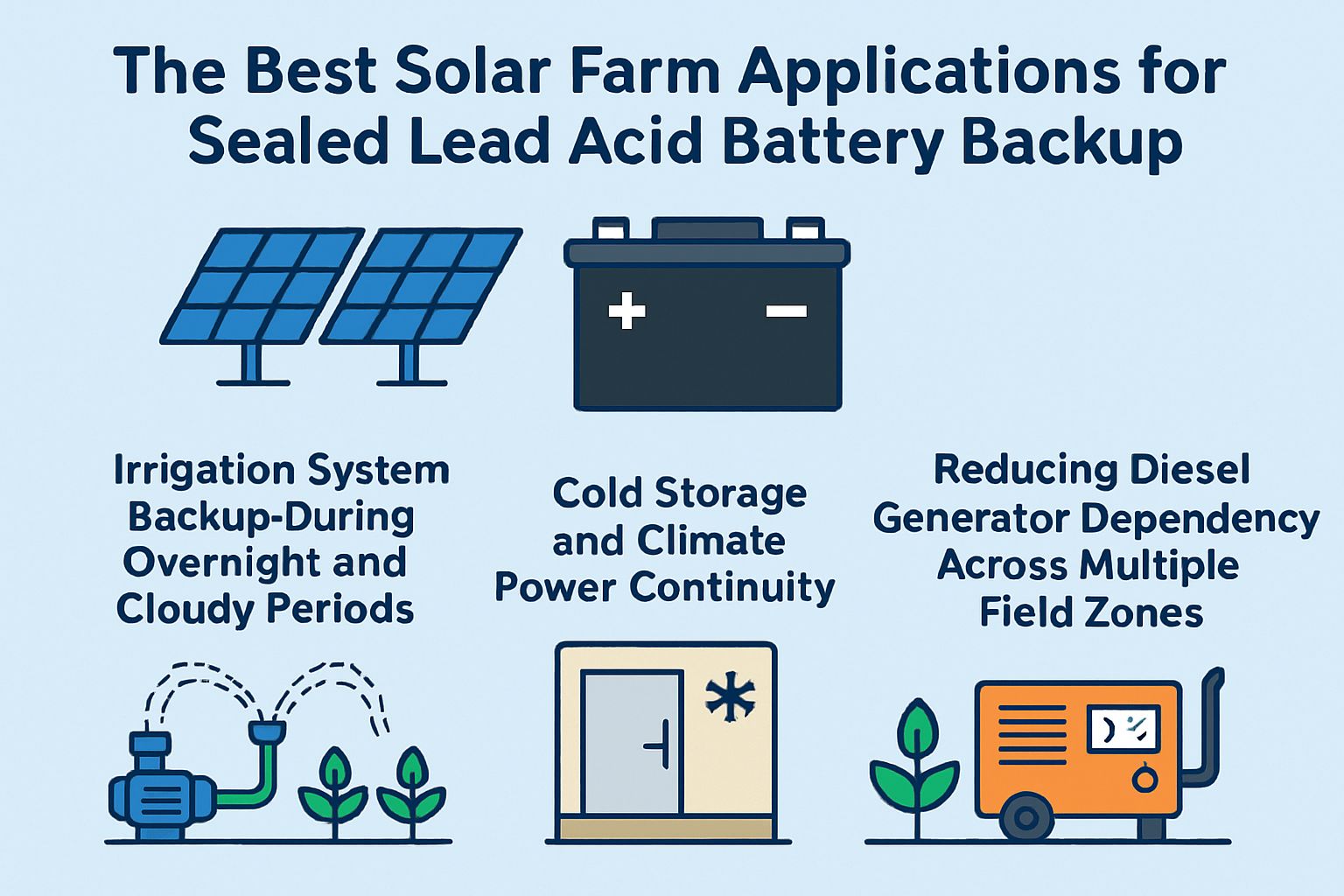
The Best Solar Farm Applications for Sealed Lead Acid Battery Backup
Not every farm system needs the same backup depth or the same discharge rate. Matching your sealed AGM battery bank to the specific loads it needs to support — rather than trying to back up everything at once — is how farm operators get the most reliable, cost-effective performance from their storage investment.
Irrigation System Backup During Overnight and Cloudy Periods
Irrigation is the highest-stakes application for farm solar battery backup, and it’s where AGM battery banks prove their value most directly. Modern drip irrigation and center pivot systems run on precise schedules timed to minimize evaporation and stress on crops — interrupting those schedules, even for a few hours, creates yield impacts that compound through the growing season. A sealed AGM battery bank sized to run irrigation pumps through a full overnight period or a multi-day cloudy stretch provides the continuity that protects those yield outcomes.
The load calculation for irrigation backup is straightforward but unforgiving. A 1-horsepower irrigation pump draws approximately 750 watts continuously. Running four pumps across a medium-sized operation represents a 3,000-watt continuous load — meaning a 12-hour overnight backup requirement demands roughly 36 kWh of total stored energy, or approximately 18 kWh of usable AGM capacity at 50% depth of discharge. That translates to a substantial battery bank, which is why proper sizing from the beginning matters so much for irrigation-focused installations.
Cold Storage and Climate Control Power Continuity
Cold storage failures are financially devastating and often invisible until it’s too late. Produce held at 34°F (1°C) begins degrading within hours if storage temperatures rise above 45°F (7°C) — a threshold that can be crossed in a matter of hours during a summer grid outage without backup power maintaining refrigeration compressors. For farms storing their own harvested produce, dairy products, or temperature-sensitive inputs like seeds and chemicals, cold storage backup isn’t optional — it’s the difference between a profitable harvest and a total loss. Sealed AGM battery banks coupled with solar generation provide the low-maintenance, always-ready backup that refrigeration systems require.
Reducing Diesel Generator Dependency Across Multiple Field Zones
Diesel generators are still common across agricultural operations, but the true cost of generator dependency — fuel, maintenance, operator labor, and reliability exposure — makes a compelling case for transitioning to sealed AGM battery backup wherever practical. The transition doesn’t have to be all-or-nothing; many farm operators use AGM battery banks as the primary backup layer, with diesel generators retained as an emergency tertiary backup for extended outages exceeding battery capacity. For those interested in innovative solutions, HJT solar panels are proving to be an efficient alternative for powering farming operations.
- Fuel cost elimination — battery backup powered by solar generation costs nothing per kilowatt-hour to operate once installed
- Zero-start reliability — AGM batteries respond to load instantly without manual starting, fuel checks, or warm-up periods
- Multi-zone coverage — distributed battery banks can protect separate field zones independently without running generator cable across the property
- Noise and emissions reduction — critical in residential-adjacent farm operations with neighbor or regulatory noise concerns
- Reduced maintenance burden — eliminating generator run-hours reduces oil changes, air filter replacements, and fuel system maintenance significantly
The distributed deployment advantage of AGM battery banks is particularly valuable on larger properties. Instead of one central generator requiring long cable runs to reach outlying field equipment, smaller battery banks positioned near each critical load zone provide localized backup with lower installation costs and better response characteristics. A 200Ah AGM bank mounted near a remote pump station costs a fraction of the trenching and conduit work required to extend generator power to the same location.
Hybrid approaches — where AGM battery banks handle the first 8 to 12 hours of any outage automatically, with a generator available for extended events — give farm operators the best of both technologies. The generator runs far fewer hours annually, reducing maintenance cycles and extending its operational lifespan while the battery system handles the majority of real-world outage events silently and automatically.
How to Size a Sealed Lead Acid Battery Bank for Your Solar Farm
Battery bank sizing is the most technically critical step in any farm solar backup project, and it’s where most systems are either over-engineered at unnecessary cost or under-built at the expense of reliability. The five-step process below gives you a systematic framework for arriving at a battery bank specification that actually matches your farm’s real operational requirements. For additional insights on optimizing your solar setup, consider exploring the comparison of solar technologies.
1. Calculate Your Farm’s Daily Energy Consumption in Kilowatt-Hours
Start by auditing every electrical load that needs backup power — not every load on the property, just the critical systems your operation cannot function without during a grid outage. List each load’s wattage and daily operating hours, then multiply to get watt-hours per day. Convert to kilowatt-hours by dividing by 1,000. For a farm running a 750W irrigation pump for 8 hours, a 400W cold storage compressor for 24 hours (compressor duty cycle typically 50%, so 12 hours effective), and 200W of essential lighting for 6 hours, the daily critical load is (6,000 + 4,800 + 1,200) = 12,000Wh, or 12 kWh per day.
2. Determine the Number of Backup Hours Your Operation Requires
Once you have your daily critical load in kilowatt-hours, decide how many hours of backup autonomy your operation genuinely requires. This isn’t a guess — it’s based on your local grid reliability history and the consequences of specific system failures. A farm in a region that experiences frequent 4 to 8 hour outages during summer storms needs a different battery bank than one in an area where outages routinely stretch 24 to 48 hours. Contact your utility provider for historical outage duration data for your service area, or review your own records if you’ve been tracking power interruptions.
For most farm solar backup applications, a 12 to 24 hour autonomy target covers the vast majority of real-world grid outage scenarios. Sizing beyond 24 hours of autonomy with sealed AGM batteries can produce a battery bank so large that the capital cost rivals or exceeds lithium alternatives — at which point the technology selection conversation needs to happen again. If your risk assessment genuinely demands 48 to 72 hours of backup autonomy, a hybrid AGM-plus-generator approach almost always delivers better economics than attempting to store that capacity entirely in lead acid batteries.
3. Factor in Depth of Discharge Limits to Protect Battery Lifespan
This is the step most farm operators skip, and it’s the one that matters most. Sealed AGM batteries should not be regularly discharged below 50% of their rated capacity. Doing so doesn’t just reduce available energy in the moment — it permanently accelerates plate sulfation and reduces the total number of cycles the battery will deliver over its lifetime. A battery bank regularly discharged to 80% depth of discharge will deliver roughly half the cycle life of the same bank kept within the 50% limit.
The practical implication is straightforward but financially significant: your battery bank needs to be rated at twice the usable capacity you calculated in steps one and two. If your critical loads require 12 kWh of backup energy over your target autonomy period, your battery bank must be rated at a minimum of 24 kWh total capacity to deliver 12 kWh without exceeding the 50% depth-of-discharge limit. Add a 20% buffer for aging capacity degradation and system inefficiencies, and your target installed capacity becomes approximately 29 kWh — a specification that often surprises farm operators who started by thinking they needed a 12 kWh bank.
4. Account for Temperature Conditions at Your Farm Location
Battery capacity ratings are published at 77°F (25°C) — a temperature that many farm battery installations never actually see. In northern climates where batteries may be exposed to temperatures near or below freezing during winter months, derate your expected capacity by 20 to 30% to reflect real-world cold-weather performance. In hot climates where battery enclosures may exceed 95°F (35°C) during summer, plan for both reduced capacity and accelerated aging. Building a temperature derating factor into your sizing calculation from the start is far less expensive than discovering the gap when your system underperforms during its first seasonal extreme. For more insights, consider exploring solar technologies comparison for farmers.
5. Match Battery Bank Capacity to Your Solar Panel Array Output
Your battery bank needs to be rechargeable by your solar array within a reasonable daily window. The general guideline for sealed AGM batteries is that the charging current should not exceed the C/10 rate — meaning a 500Ah battery bank should receive no more than 50 amps of charging current to maximize battery longevity. Fast charging above this rate causes heat buildup in the cells that accelerates plate corrosion and reduces service life.
On the other side of this equation, your solar array needs to be large enough to fully recharge your battery bank during a normal sunny day after an overnight discharge. A solar array that generates 5 kWh per day cannot realistically recharge a 20 kWh battery bank to full capacity before the next overnight cycle — leaving you with progressively less stored energy each successive day of use. The standard design target is a solar array capable of generating 1.2 to 1.5 times your daily battery bank capacity in average peak sun hours for your location.
Use your location’s peak sun hours (available from the National Renewable Energy Laboratory’s PVWatts tool) to calculate how many kilowatts of solar panels are needed to generate your target daily recharge energy. A location with 5 peak sun hours per day requires a 4 kW solar array to generate approximately 20 kWh daily — enough to recharge a 20 kWh AGM bank under good conditions. Building 20 to 25% extra solar capacity into your array accounts for panel degradation, soiling losses, and less-than-ideal weather days that would otherwise leave your battery bank chronically undercharged.
- Step 1 output: Total daily critical load in kWh
- Step 2 output: Required autonomy hours × daily load = total backup energy needed (kWh)
- Step 3 output: Multiply backup energy by 2 (50% DoD limit), then by 1.2 (aging buffer) = minimum rated bank capacity
- Step 4 output: Apply temperature derating factor (0.75–0.80 for cold climates, 0.85–0.90 for moderate) to confirm real-world capacity
- Step 5 output: Divide rated bank capacity by peak sun hours × 1.25 = minimum solar array size in kW
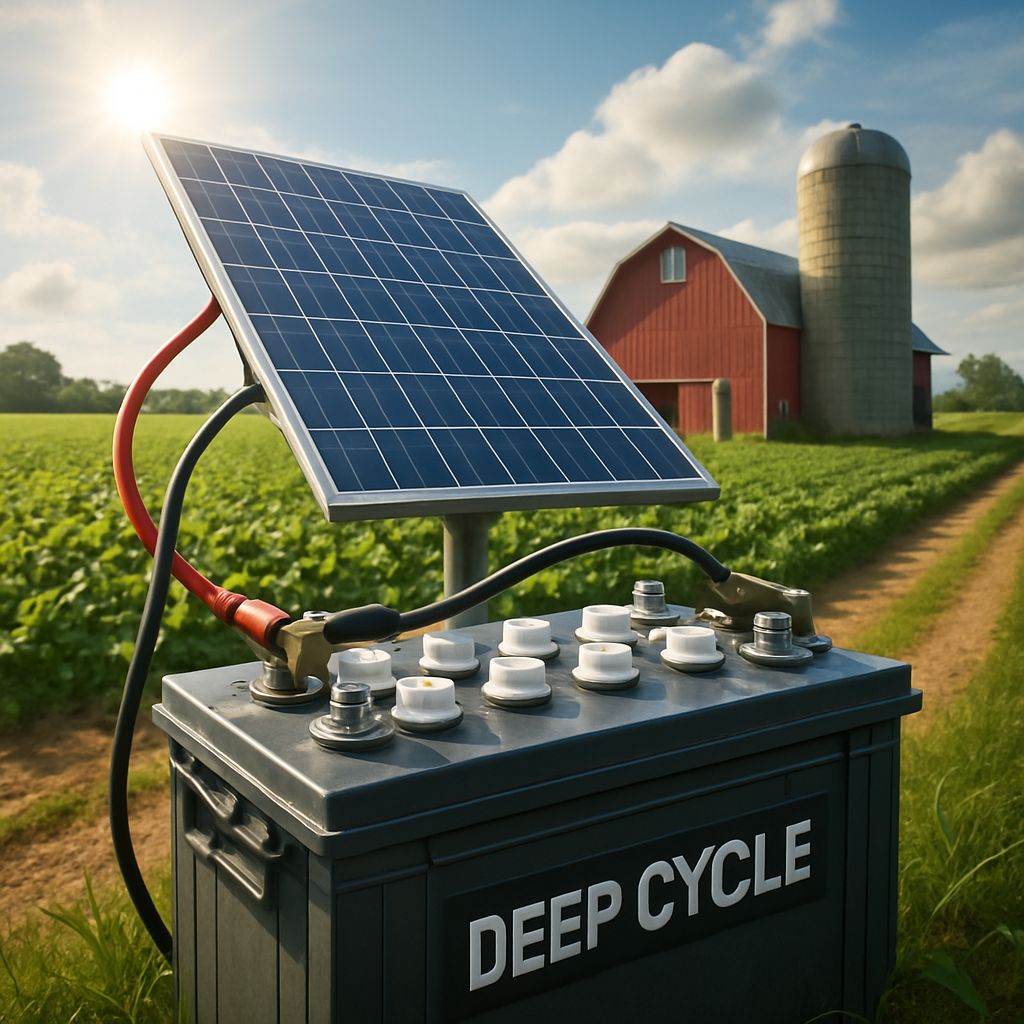
“Deep‑Cycle Flooded Lead‑Acid Battery …” from growingsolarmist.com and used with no modifications.
For farm operators navigating the real-world economics of solar backup — where capital is finite, operating priorities are constant, and energy storage needs to work the first time every time — sealed AGM lead acid batteries remain the most practical, field-proven choice available today. They cost less to get started, they tolerate the imperfect conditions of agricultural environments, they’re safe to install where you actually need them, and they deliver dependable backup performance without demanding technical expertise to maintain. Lithium technology is advancing and has its place in high-cycling applications, but for the farm operator sizing their first solar backup system or expanding an existing one, sealed AGM batteries offer a combination of accessibility, reliability, and proven track record that no other technology currently matches at the same price point. Additionally, solar technologies comparison can provide insights for farmers looking to optimize their energy solutions.
Frequently Asked Questions
The questions below represent the most common points of uncertainty farm operators encounter when evaluating sealed AGM batteries for solar backup systems. Each answer is based on real-world agricultural installation data and established electrochemical performance characteristics.
If your specific situation involves unusual load profiles, extreme climate conditions, or hybrid system configurations, working through a detailed load audit before purchasing any equipment will save you significantly more than any battery price comparison. The sizing math is straightforward once you have accurate load data — the mistake most operators make is estimating rather than measuring.
How Long Do Sealed Lead Acid Batteries Last in a Solar Farm Setup?
Sealed AGM batteries in farm solar applications typically deliver three to seven years of service life, depending heavily on cycling frequency, depth of discharge, and operating temperature. Systems used primarily for occasional outage backup — cycling 20 to 50 times per year — commonly achieve five to seven years. Systems cycling daily for solar self-consumption will typically see three to four years before capacity drops below 80% of original rated capacity. For more on how solar technology is transforming farming, read about drones transforming solar power management in farming.
The most reliable way to extend AGM battery service life on a farm is to keep operating temperatures below 80°F (27°C), avoid regular discharge below 50% capacity, and ensure the charging system uses a proper multi-stage charge profile (bulk, absorption, float) matched to the battery manufacturer’s specifications. Quality charge controllers from manufacturers like Victron Energy or Morningstar with temperature-compensated charging deliver measurably longer battery service life compared to simple PWM controllers without temperature sensing.
Can Sealed AGM Batteries Be Installed Inside Farm Buildings Safely?
Yes — sealed AGM batteries are specifically designed for safe installation in enclosed spaces, which is one of their primary advantages over flooded lead acid alternatives in farm settings. The absorbed electrolyte design eliminates spill risk, and the valve-regulated sealed construction limits gas emissions to trace amounts under normal operating conditions. Unlike flooded batteries, AGM units do not require dedicated hydrogen ventilation systems when installed in barns, equipment rooms, or utility buildings.
Basic installation best practices still apply: batteries should be mounted on stable, non-conductive surfaces, terminals should be protected from accidental contact with metal tools or hardware, and battery enclosures should be kept clear of flammable materials. Maintaining ambient temperatures below 85°F (29°C) in the installation space extends service life significantly. A simple louvered ventilation panel in the enclosure is sufficient for most AGM installations — full mechanical ventilation is not required under normal operating conditions. For those interested in advanced solar technologies, check out the comparison of solar technologies for farmers.
What Happens to Sealed Lead Acid Batteries in Freezing Temperatures?
Sealed AGM batteries experience measurable capacity reduction in cold temperatures, but they continue to function and can be safely charged in freezing conditions — which is a meaningful advantage over lithium iron phosphate alternatives that cannot be charged below 32°F (0°C) without a heating system. At 32°F (0°C), expect approximately 70 to 80% of rated capacity. At 14°F (-10°C), capacity drops to roughly 50 to 60% of the room-temperature rating. For more insights on powering agricultural operations, explore HJT solar panels for farms.
A fully charged sealed AGM battery is highly resistant to freezing — the sulfuric acid electrolyte in a charged state has a freezing point well below -40°F (-40°C). The freezing risk increases significantly as a battery becomes deeply discharged, when the electrolyte approaches water in composition and can freeze at 32°F (0°C). This is another strong operational reason to avoid deep discharging sealed AGM batteries in cold climates: a deeply discharged battery left in freezing conditions can suffer permanent plate damage from ice formation in the cells.
For farms in cold climates, insulating the battery enclosure to maintain temperatures above 32°F (0°C) during winter months is a practical investment. Simple foam board insulation around a battery box, combined with the minor heat generated by the batteries themselves during charging, is often sufficient to maintain acceptable operating temperatures in moderately cold environments. In regions with sustained temperatures below 0°F (-18°C), a small thermostatically controlled heating element inside the battery enclosure provides the temperature floor needed to protect capacity and prevent freeze damage.
Cold Weather Capacity Reference:
77°F (25°C) — 100% rated capacity (baseline)
50°F (10°C) — approximately 85–90% rated capacity
32°F (0°C) — approximately 70–80% rated capacity
14°F (-10°C) — approximately 50–60% rated capacity
0°F (-18°C) — approximately 40–50% rated capacity
Size your cold-climate battery bank using the derated capacity figure, not the room-temperature rating.
How Many AGM Batteries Do I Need to Run a Farm Irrigation System Overnight?
The answer depends on your pump wattage and how many hours of overnight operation you need to cover. A single 1-horsepower irrigation pump draws approximately 750 watts continuously. Running that pump for 10 hours overnight requires 7,500 watt-hours (7.5 kWh) of energy. At 50% depth of discharge, your AGM battery bank needs a rated capacity of 15 kWh minimum. At a nominal 12V system voltage, 15 kWh requires approximately 1,250 amp-hours of battery capacity — typically achieved with multiple batteries wired in series-parallel configurations.
In practical terms, a common approach for a single 1HP pump running 10 hours overnight on a 48V battery system uses a bank of twelve 100Ah 12V AGM batteries (four strings of three batteries in series), delivering 1,200Ah at 12V equivalent — approximately 14.4 kWh rated, or about 7.2 kWh usable at 50% DoD. For multiple pumps or longer overnight run requirements, scale the bank proportionally. Always verify your specific pump’s actual amp draw with a clamp meter rather than relying on nameplate ratings, which frequently understate real running current by 10 to 20%.
Are Sealed Lead Acid Batteries Recyclable at End of Life?
Sealed lead acid batteries are among the most successfully recycled products in the world. The lead acid battery industry maintains a recycling rate of approximately 98 to 99% in the United States — a figure that no other battery chemistry approaches. Every component of a sealed AGM battery is recoverable: the lead plates are smelted and recast into new batteries, the polypropylene case is granulated and reprocessed into new plastic products, and the sulfuric acid electrolyte is neutralized and treated or converted to sodium sulfate for use in other industries.
The recycling infrastructure for lead acid batteries is mature, widespread, and accessible from virtually every location in the country. Auto parts retailers, battery distributors, scrap metal dealers, and dedicated battery recyclers all accept end-of-life sealed AGM batteries. Many retailers offer core charge credits — a deposit refunded when you return your old batteries — which effectively subsidizes your next battery purchase while ensuring proper recycling.
Contrast this with lithium iron phosphate batteries, where the recycling infrastructure is still developing and end-of-life disposal options are significantly more limited. For farm operators with environmental stewardship commitments — or operations subject to environmental compliance requirements — the closed-loop recycling infrastructure of sealed lead acid batteries represents a genuine sustainability advantage that deserves consideration alongside the performance and cost comparison.
When your AGM batteries reach end of life, do not dispose of them in standard waste streams. Contact your battery supplier for return options, locate your nearest certified lead acid battery recycler through the Battery Council International’s dealer locator, or coordinate with a local scrap metal dealer who handles lead acid batteries. Proper recycling keeps toxic lead out of landfills and directly reduces the mining demand for virgin lead — a circular economy loop that has functioned at scale in the battery industry for decades.
Sealed lead acid batteries are a popular choice for solar panel farms due to their reliability and cost-effectiveness. These batteries are capable of providing backup power during periods of low sunlight, ensuring that the farm’s operations continue smoothly. In addition to their durability, they require minimal maintenance, making them an ideal option for large-scale solar projects. For those interested in exploring more about solar technologies, the comparison of solar technologies can provide valuable insights into different options available for farmers.






Leave a Reply