

Article-At-A-Glance
- Drone-based solar monitoring can reduce inspection time from days to just a few hours, directly cutting labor costs for farmers with large solar installations.
- Thermal imaging cameras mounted on drones detect hot spots, faulty connections, and panel defects that are completely invisible to the naked eye.
- Early fault detection through routine drone inspections prevents compounding energy losses that quietly drain farm revenue over time.
- Drones eliminate the safety risks associated with manual solar panel inspections, including falls from rooftops and injuries navigating rough terrain.
- Keep reading to find out how drone solar monitoring protects long-term ROI and which drone types deliver the best results for farm-scale solar setups.
If your solar panels aren’t performing at full capacity, you’re losing money every single day without knowing it.
For farmers, solar energy is more than just an environmental choice — it’s a financial strategy. Whether you’re running a small rooftop system on a barn or managing a large ground-mounted solar farm, those panels need to work efficiently to justify the investment. The problem is that traditional inspection methods simply can’t keep up. Manual checks are slow, physically dangerous, and often miss the subtle faults that cause the biggest energy losses over time. Equinox Drones is one of the companies at the forefront of applying drone technology specifically to solar energy inspection, helping operations like yours stay ahead of costly failures.
Drone-based solar monitoring changes the equation entirely. With aerial thermal imaging, real-time data capture, and rapid site mapping, drones give farmers an inspection tool that is faster, safer, and far more detailed than anything a ground-based team can deliver.
Drones Are Changing How Farmers Manage Solar Energy
Solar adoption on farms has accelerated significantly over the past decade. Agrivoltaic systems — where solar panels and crops share the same land — are becoming increasingly common, and large-scale solar farms are now a genuine revenue stream for agricultural landowners. But as the number of panels grows, so does the complexity of keeping them all running at peak output.
The old approach of walking the rows, visually scanning panels, and occasionally hiring inspection crews just doesn’t scale. It’s also reactive — you only find out something is wrong after performance has already dropped. Drone monitoring flips this into a proactive strategy, catching issues before they compound into serious losses.
Why Traditional Solar Inspection Methods Fall Short on Farms
Manual solar inspections on farms come with a long list of problems. Ground-level visual checks miss internal panel faults entirely, thermal issues are invisible without specialized equipment, and inspecting a large solar installation on foot can take days of labor. On farms where every hour counts, that’s a real operational cost. There’s also the physical risk — technicians climbing mounting structures or working on sloped rooftop arrays face genuine fall hazards, especially on uneven agricultural terrain.
What Drone-Based Solar Monitoring Actually Does
A drone-based solar inspection involves flying a UAV — typically equipped with both a high-resolution visual camera and a thermal infrared camera — over your solar installation in a systematic grid pattern. The drone captures detailed imagery of every panel, identifying temperature anomalies, physical damage, dirt accumulation, and electrical faults. That data is then processed into actionable reports that tell you exactly which panels need attention and why.
This isn’t just a visual flyover. The thermal layer is where the real value lives. Infrared imaging reveals hot spots caused by failing cells, poor wiring connections, or shading problems that would never show up in a standard photograph. Combined with high-resolution visual data, you get a complete picture of your solar installation’s health in a single flight.
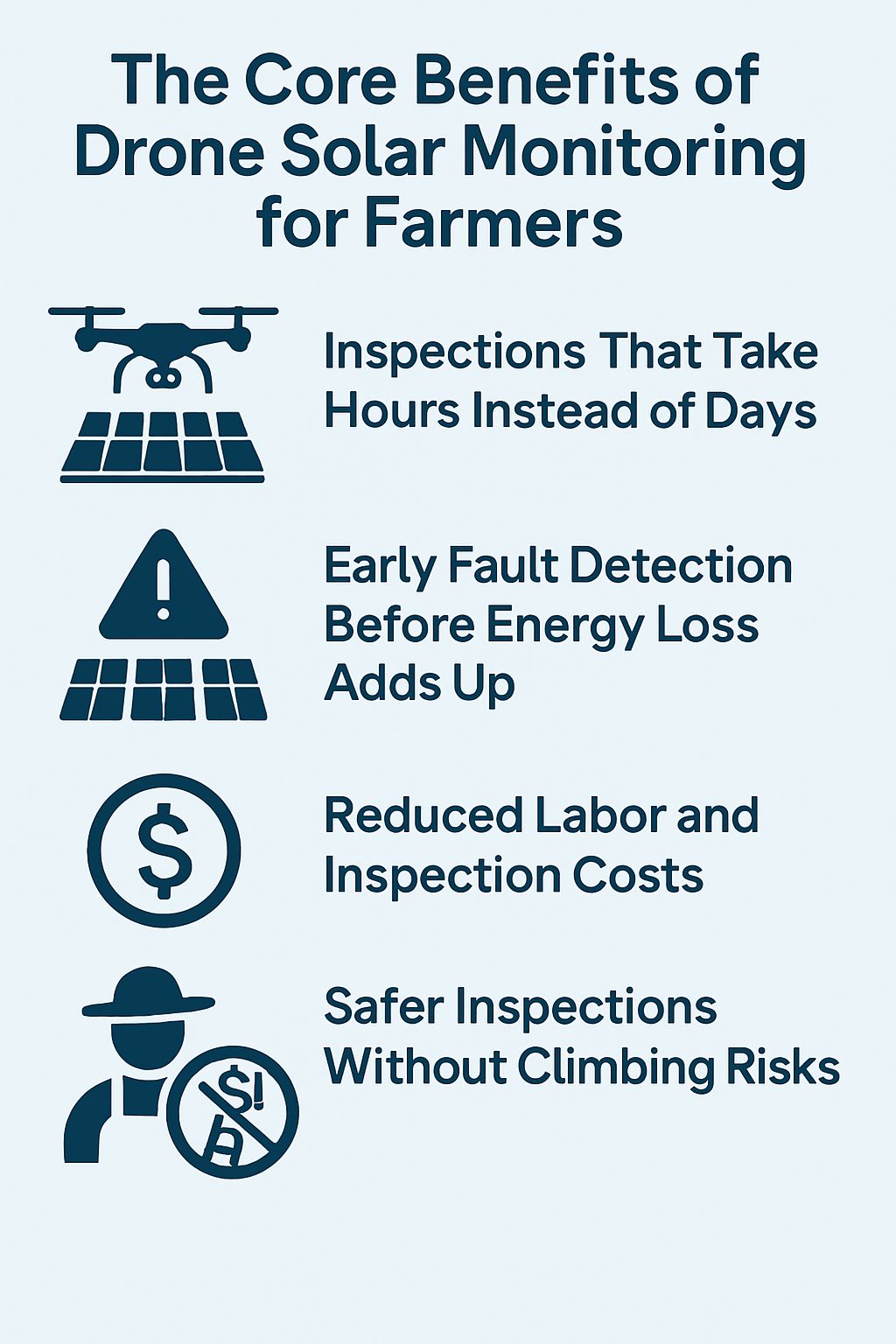
The Core Benefits of Drone Solar Monitoring for Farmers
The practical advantages of switching to drone-based inspections stack up quickly, especially at farm scale. Here’s where the impact is most significant:
Inspections That Take Hours Instead of Days
One of the most immediate benefits is speed. A drone can cover the same ground in a few hours that would take a manual inspection team several days to complete. For a farmer managing a multi-acre solar installation, this is not a minor convenience — it’s a fundamental shift in operational efficiency. More frequent inspections become practical, which means faults get caught earlier and energy output stays consistent.
Early Fault Detection Before Energy Loss Adds Up
A single underperforming panel in a series string can drag down the output of every panel connected to it. Without regular thermal imaging, that fault could go undetected for months. Drone inspections identify these issues at the earliest stage, allowing for targeted repairs before the energy loss compounds into a significant financial hit.
Reduced Labor and Inspection Costs
Hiring inspection crews, managing their access to your site, and covering the time involved in manual surveys adds up fast. Drone inspections require fewer personnel and complete the job in a fraction of the time. Over a full year of routine monitoring, the cost savings compared to traditional inspection methods are substantial — particularly for farms with extensive solar infrastructure.
Safer Inspections Without Climbing Risks
Agricultural solar installations often sit on structures that present real safety challenges — barn rooftops, elevated mounting frames, or ground arrays on uneven land. Drones remove the need for anyone to physically access these structures during inspection. The entire survey is conducted remotely, eliminating fall risks and reducing liability for farm operators entirely.
Thermal Imaging: The Technology Behind the Results
Thermal imaging is the core technology that makes drone solar monitoring genuinely useful rather than just visually interesting. Standard cameras show you what a panel looks like. A thermal camera shows you how it’s performing. Learn more about the applications and benefits of drones in solar inspections.
How Thermal Cameras Spot Failing Solar Panels
Thermal cameras detect infrared radiation — essentially heat — emitted by objects. In a healthy solar panel, heat distribution across the surface is relatively uniform. When a cell starts to fail, a connection corrodes, or debris blocks part of the panel, that area generates excess heat that shows up as a bright spot on the thermal image. These hot spots are the earliest warning sign of panel degradation, and they’re completely undetectable without thermal equipment. For more on solar panel types, explore the comparison of monocrystalline vs polycrystalline panels.
Visual vs. Thermal Data: What Each One Reveals
Visual imaging from a drone’s standard camera captures physical damage — cracked glass, dirt buildup, bird droppings, and structural issues with mounting hardware. This data is genuinely useful, but it only tells part of the story. A panel can look perfectly intact from the outside and still be operating at a fraction of its rated output due to internal cell failures.
Thermal data fills that gap. Infrared imaging reveals temperature anomalies across every panel in your installation, flagging issues like bypass diode failures, cell micro-cracks, and poor electrical connections — none of which are visible to any camera working in the standard light spectrum. When you combine both data streams from a single drone flight, you get a complete diagnostic picture with no blind spots. For more insights on solar panel types, explore the comparison of monocrystalline vs thin-film solar panels.
|
Detection Type |
Visual Camera |
Thermal Camera |
|---|---|---|
|
Physical damage / cracks |
✓ |
Partial |
|
Dirt & debris buildup |
✓ |
✓ |
|
Hot spots & cell failures |
✗ |
✓ |
|
Bypass diode faults |
✗ |
✓ |
|
Shading-related losses |
Partial |
✓ |
|
Wiring connection issues |
✗ |
✓ |
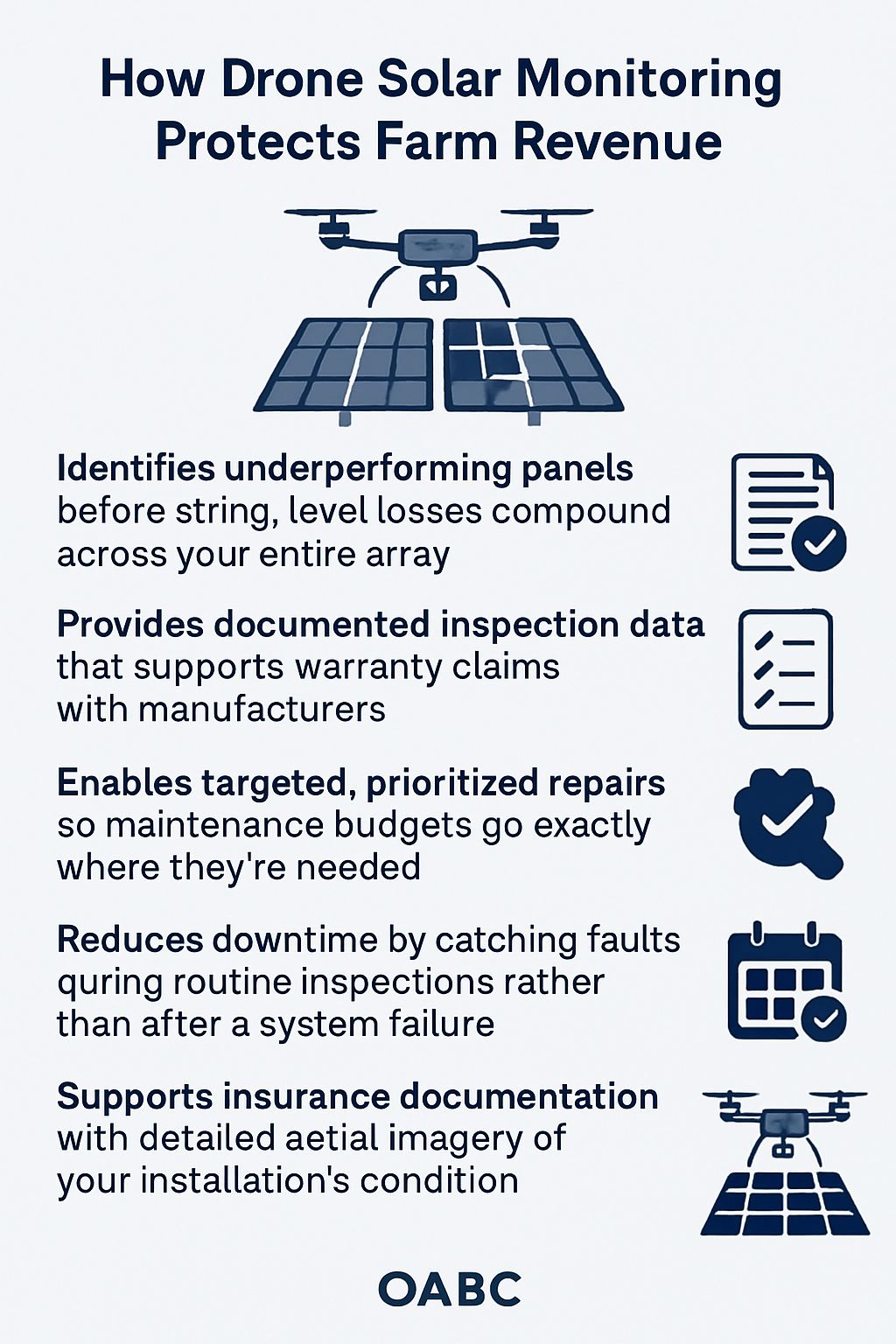
How Drone Solar Monitoring Protects Farm Revenue
- Identifies underperforming panels before string-level losses compound across your entire array
- Provides documented inspection data that supports warranty claims with manufacturers
- Enables targeted, prioritized repairs so maintenance budgets go exactly where they’re needed
- Reduces downtime by catching faults during routine inspections rather than after a system failure
- Supports insurance documentation with detailed aerial imagery of your installation’s condition
For farmers, solar panels represent a long-term capital investment. Whether your system is grid-tied and generating income through energy credits, or off-grid and powering your operations directly, every percentage point of lost efficiency has a real dollar value attached to it. Drone monitoring is what keeps that investment performing as intended year after year.
The financial protection goes beyond just finding broken panels. Routine drone inspections create a documented performance history for your solar installation. That history is valuable when negotiating with insurers, filing warranty claims, or demonstrating system health to potential buyers if you ever sell the property.
The Real Cost of Underperforming Solar Panels on a Farm
A single faulty panel in a series-wired string doesn’t just lose its own output — it acts as a bottleneck that limits every other panel in that string. On a large farm installation, one undetected fault can silently suppress the output of dozens of panels for months. Multiply that across multiple strings and an inspection schedule that only runs once or twice a year, and the cumulative energy loss becomes a serious financial drain that never appears as a single obvious event. For farmers considering different types of solar panels, it’s important to understand the comparison between monocrystalline and thin-film panels to ensure optimal performance.
How Faster Repairs Translate to Consistent Energy Output
The faster a fault is identified, the faster it gets fixed — and every day a panel runs at full capacity instead of reduced output is direct revenue recovered. Drone inspections compress the detection-to-repair timeline dramatically. Instead of waiting for a noticeable dip in your inverter output data to trigger an investigation, you’re identifying the exact location and nature of the fault during a scheduled drone survey, handing your maintenance team a precise action list rather than a mystery to solve. For farmers interested in maximizing their solar investment, understanding the benefits of different solar panels can also play a crucial role.
Long-Term ROI of Routine Drone Inspections
The return on investment for routine drone monitoring compounds over time. An inspection program that runs quarterly catches faults at their earliest stage, when repairs are simplest and cheapest. Annual or biannual inspections might miss the same faults for months, allowing small issues to escalate into panel replacements or inverter damage — costs that dwarf the price of a drone survey.
Farms that integrate drone monitoring into their standard maintenance calendar consistently keep their solar installations operating closer to rated capacity than those relying on reactive, ground-based inspections. Over a 10 to 25-year panel lifespan, that difference in sustained output efficiency represents a substantial cumulative return on the original solar investment.
Site Surveying and Solar Farm Mapping With Drones
Drone utility in solar management doesn’t start at the inspection stage — it starts before a single panel is installed. Pre-installation drone surveys are one of the most underused tools available to farmers planning a new solar project, and getting this stage right has a direct impact on how well the system performs for its entire operational life.
Pre-Installation Surveys That Improve Panel Placement
Before installing a solar array, understanding the exact characteristics of your land is critical. Slope angles, shading from trees or structures at different times of day, drainage patterns, and soil stability all influence where panels should be placed and how they should be oriented. A drone survey captures all of this data quickly and with a level of precision that ground-based assessments simply can’t match.
Using high-resolution aerial imagery and topographic mapping, farmers and solar installers can model different layout configurations before any groundwork begins. This means fewer design revisions during installation, better panel orientation for maximum sun exposure, and smarter string configurations that minimize the impact of any localized shading.
Topographic Mapping for Maximum Solar Efficiency
Drones equipped with LiDAR sensors or photogrammetry software can generate highly accurate 3D topographic maps of your farm site. These maps reveal elevation changes, drainage channels, and terrain features that affect both panel placement and long-term structural stability of mounting systems. For more on solar panel types, explore bifacial vs. thin-film solar panels and their benefits for farmers.
On flat agricultural land, even subtle grade changes matter. Water pooling beneath panel arrays accelerates corrosion of mounting hardware and creates mud accumulation that affects panel cleaning requirements. A detailed topographic map identifies these risk zones before installation so the system design accounts for them from day one.
For larger agrivoltaic setups — where crop production and solar generation share the same land — drone mapping also helps optimize the spacing and height of panel rows to minimize shading on crops while maximizing energy capture. Getting this balance right requires precise spatial data that only aerial mapping can provide efficiently at farm scale. For those interested in understanding the best solar panels for farmers, this spatial optimization is crucial.
- Elevation mapping: Identifies slope variations that affect panel tilt angles and structural load requirements
- Shading analysis: Models shadow patterns from trees, buildings, and terrain at different times of day and across seasons
- Drainage planning: Flags low-lying areas prone to water pooling that could affect mounting hardware longevity
- Access route planning: Maps practical maintenance pathways through the installation for future inspection and repair crews
- Crop-solar spacing: Optimizes row spacing in agrivoltaic systems to balance light availability for both panels and crops
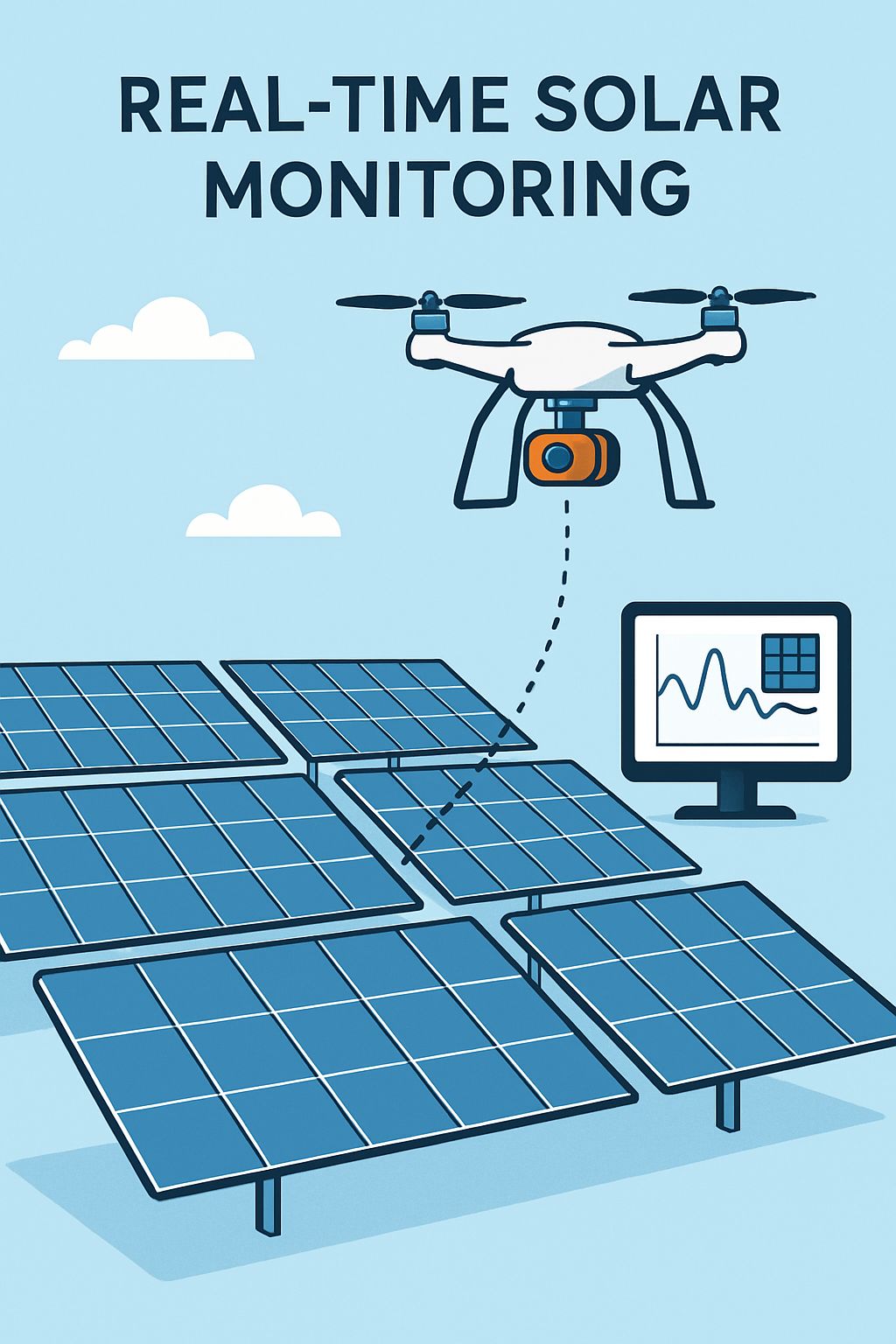
Real-Time Solar Monitoring Capabilities
Beyond scheduled inspection flights, advanced drone systems are moving toward continuous and semi-continuous monitoring configurations. Fixed drone charging stations — sometimes called drone-in-a-box systems — allow UAVs to launch automatically on a set schedule, conduct their survey, return to base, recharge, and repeat without any manual intervention. For large solar farms, this means near-continuous performance data without ongoing labor costs.
Even on a standard scheduled-flight basis, the real-time data capture during a drone inspection is significantly more current than data from ground-based monitoring systems that rely on inverter output readings alone. Inverter data tells you that output has dropped — drone thermal imaging tells you exactly which panel caused it, where on the panel the fault is located, and how severe the temperature differential is. That specificity turns a vague performance alert into a precise maintenance instruction, dramatically reducing the time between fault detection and resolution.
Environmental Advantages Farmers Should Know
Drone solar monitoring isn’t just a financial tool — it directly supports the environmental goals that motivate most farmers to invest in solar energy in the first place. When panels underperform due to undetected faults, the gap between your expected clean energy output and actual output is quietly filled by grid power or backup generation. Keeping every panel operating at full capacity means your solar installation is doing the maximum environmental work it was designed to do.
How Efficient Solar Monitoring Reduces Carbon Waste
Every kilowatt-hour your solar installation fails to produce due to an undetected fault is a kilowatt-hour sourced from somewhere else — typically the grid, which still carries a significant carbon load in most regions. Regular drone inspections minimize this invisible carbon leakage by ensuring your panels consistently deliver their rated output. It’s a simple chain: better monitoring leads to faster repairs, faster repairs lead to higher solar output, and higher solar output means less dependence on carbon-heavy grid electricity.
There’s also the issue of panel lifespan. Faults that go unaddressed don’t stay static — they degrade the panel further, accelerating wear and shortening the panel’s usable life. Replacing panels ahead of their expected lifespan carries its own environmental cost in materials and manufacturing. Routine drone monitoring that catches faults early and extends panel longevity is, in effect, a waste-reduction strategy as much as it is a maintenance strategy.
Drones themselves have a minimal operational footprint compared to the inspection methods they replace. A drone survey produces no vehicle emissions from driving inspection crews across large farm sites, requires no scaffold structures, and consumes far less energy per inspection than ground-based alternatives. As drone battery technology continues to improve and solar-powered UAV designs become more common, that operational footprint gets even smaller.
- Reduced grid dependence: Maximizing solar output through timely fault detection directly reduces reliance on carbon-intensive grid power
- Extended panel lifespan: Early fault intervention slows panel degradation, reducing the environmental cost of premature replacements
- Lower inspection emissions: Drones eliminate the vehicle traffic and crew mobilization associated with traditional ground inspections
- Optimized energy yield: Pre-installation drone mapping ensures panels are positioned for maximum generation efficiency from day one
Supporting Sustainable Farming Through Better Energy Management
For farmers committed to sustainable operations, solar energy is only as valuable as its actual output. A poorly maintained solar installation that runs at 70% of rated capacity is delivering 70% of the environmental benefit you invested in. Drone monitoring closes that gap, keeping your clean energy strategy performing at the level your operation and your values demand. When combined with precision agriculture practices across the rest of the farm, it forms part of a coherent, data-driven approach to genuinely sustainable land management.
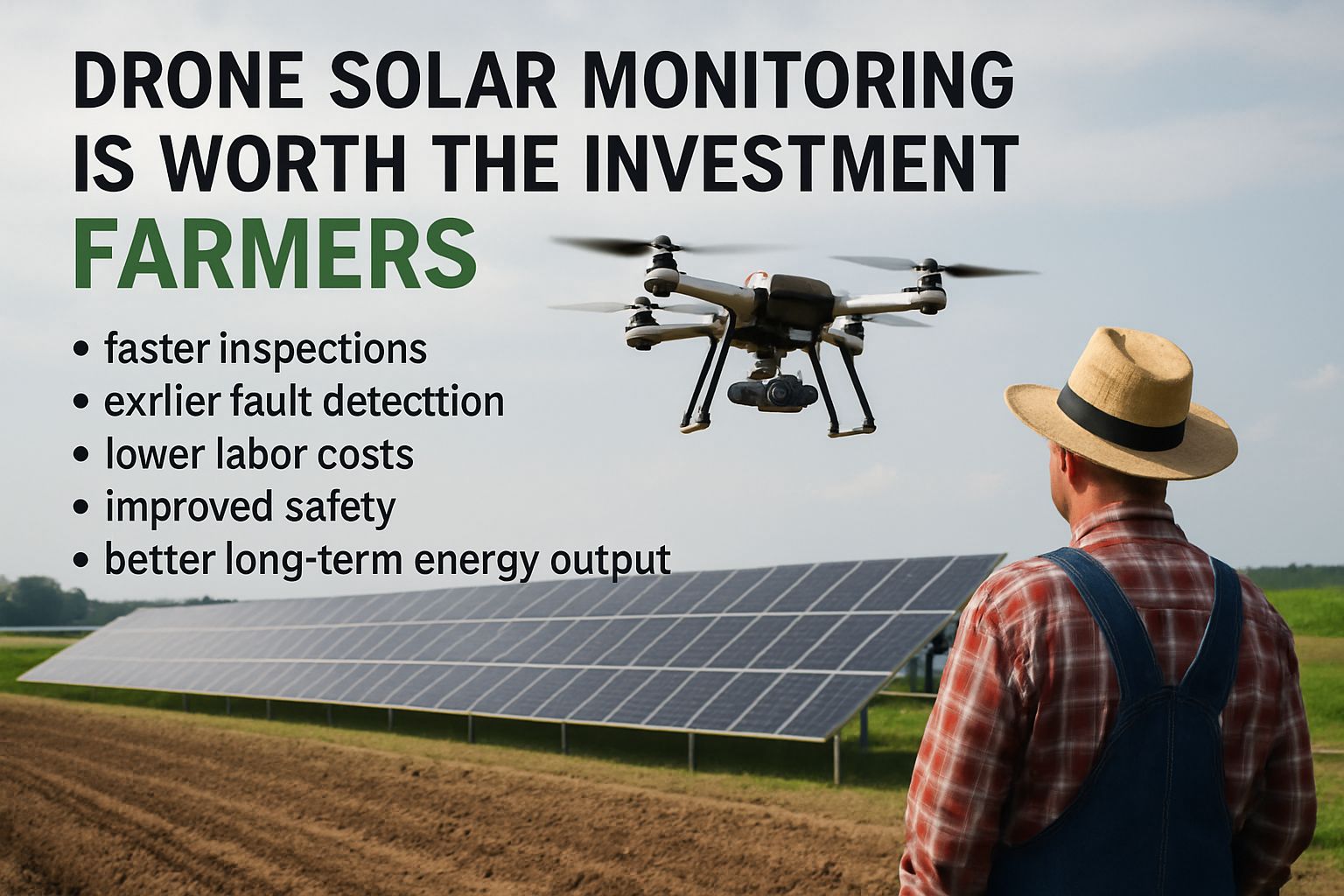
Drone Solar Monitoring Is Worth the Investment for Farmers
The evidence is straightforward. Drone-based solar monitoring delivers faster inspections, earlier fault detection, lower labor costs, improved safety, and better long-term energy output — all of which protect the financial return on your solar investment. For farmers managing significant solar infrastructure, the cost of routine drone inspections is consistently outweighed by the energy losses, repair escalations, and safety incidents they prevent. Whether you’re running a rooftop system on a single barn or managing a multi-acre agrivoltaic installation, integrating drone monitoring into your maintenance calendar is one of the most practical steps you can take to protect and maximize the value of your solar assets. Equinox Drones specializes in exactly this kind of agricultural solar inspection work, combining thermal imaging expertise with deep experience in farm-scale drone operations.
Frequently Asked Questions
Farmers new to drone solar monitoring often have similar questions about how it works in practice, what regulations apply, and whether it makes sense for their specific setup. Here are the most common ones answered directly.
How often should farmers use drones to inspect solar panels?
For most farm-scale solar installations, a quarterly drone inspection schedule strikes the best balance between early fault detection and cost efficiency. Quarterly inspections mean the maximum gap between an undetected fault developing and being caught is around three months — short enough to prevent serious energy loss accumulation while keeping inspection costs manageable.
Larger installations, or those in environments with heavy dust, bird activity, or extreme seasonal weather, may benefit from monthly inspections. At minimum, a biannual inspection — once before and once after the peak generation season — should be considered the baseline for any farmer who wants to protect their solar investment from compounding fault-related losses.
Do farmers need a license to operate drones for solar monitoring?
In the United States, operating a drone commercially — including for solar inspections on your own farm if any commercial benefit is involved — requires a FAA Part 107 Remote Pilot Certificate. This involves passing a knowledge test covering airspace regulations, weather, and drone operating procedures. Many farmers choose to hire certified drone inspection service providers rather than obtaining their own certification, which is often the more practical approach for farm operations where drone inspections are periodic rather than daily tasks.
What types of drones are best suited for solar panel inspections on farms?
The most effective drones for solar panel inspections combine a high-resolution RGB camera with a thermal infrared sensor in a single platform. Fixed-wing drones offer excellent coverage range for very large solar farms, but multirotor drones — like the DJI Matrice 300 RTK paired with a Zenmuse H20T sensor — are generally preferred for farm-scale work because of their ability to hover, adjust altitude precisely, and navigate around obstacles. The key specifications to look for are a thermal resolution of at least 640 x 512 pixels, a flight time exceeding 30 minutes, and compatibility with photogrammetry software for converting flight data into actionable inspection reports.
Can drone solar monitoring work on small-scale farm solar setups?
Absolutely. Drone inspection services are not limited to utility-scale solar farms. A rooftop array on a barn, a small ground-mounted system powering irrigation equipment, or a modest agrivoltaic setup all benefit from thermal drone inspection — particularly because small systems have fewer redundant panels to absorb the impact of a single fault. On a small array, one underperforming panel represents a much larger share of total output than it would on a large installation.
For small setups, the inspection itself takes very little time, which typically makes the service cost lower than larger farm engagements. The value proposition is actually very strong at small scale — the cost of a single drone inspection is usually recovered quickly through the energy output improvements that result from identifying even one or two faults that were previously undetected.
How much can farmers save by switching to drone-based solar inspections?
The savings come from multiple directions simultaneously, which is why the total financial benefit is often larger than farmers initially expect. Direct labor cost reductions from replacing multi-day manual inspection crews with a drone survey that completes in hours is typically the most immediately visible saving. For a mid-sized solar installation, this alone can represent thousands of dollars per inspection cycle.
The deeper savings come from the energy losses that drone inspections prevent. A fault that suppresses output across a string of panels for several months — the typical outcome of infrequent manual inspections — can represent a significant portion of the system’s annual energy yield. On a farm-sized installation generating meaningful grid credits or offsetting substantial electricity costs, that recovered output has direct cash value.

Leave a Reply